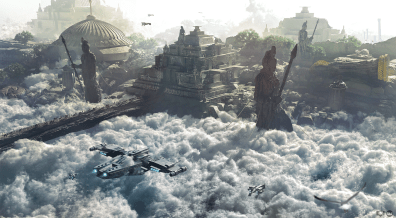
Star Wars VII, What’s it Going to Be?

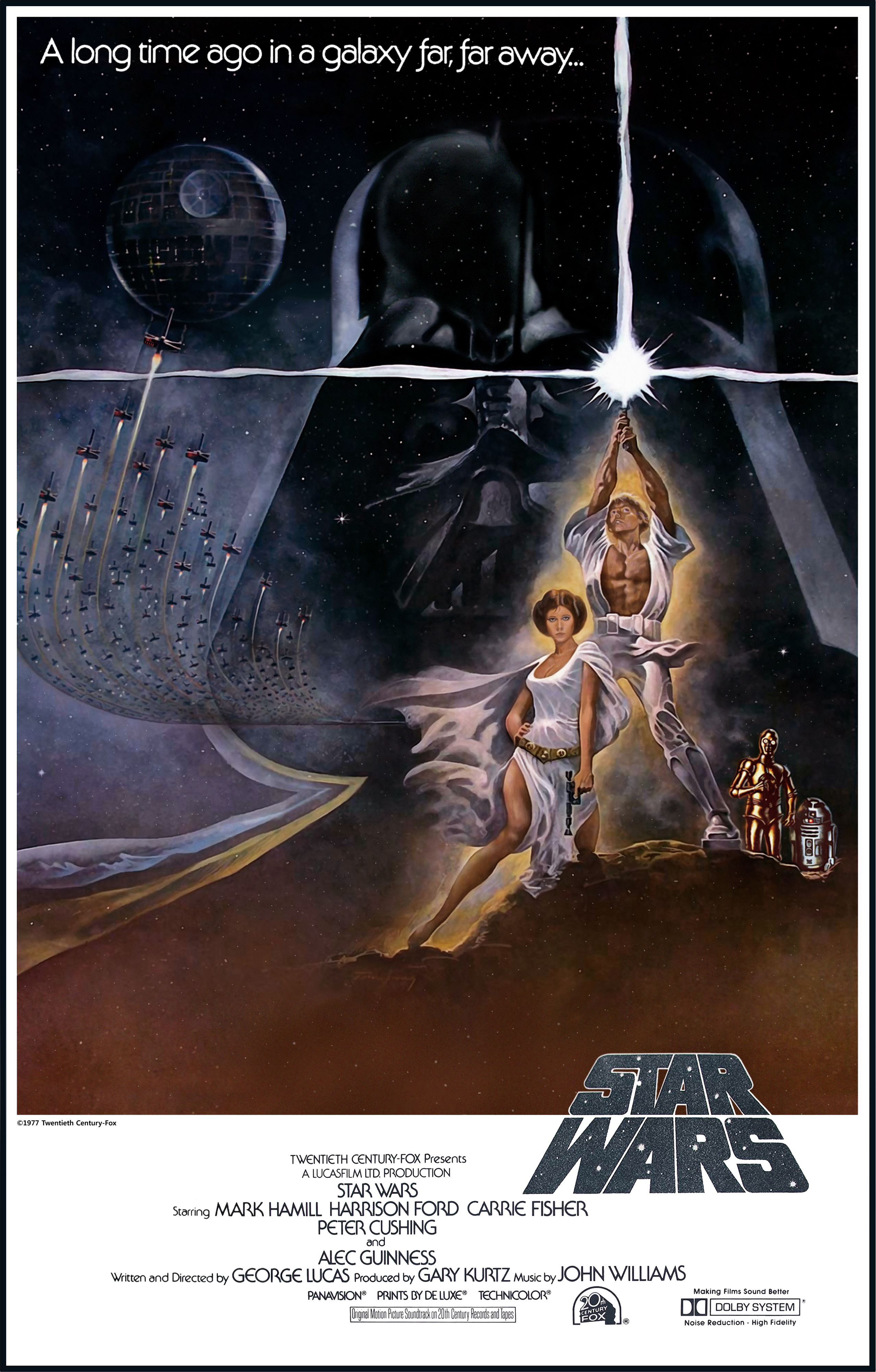
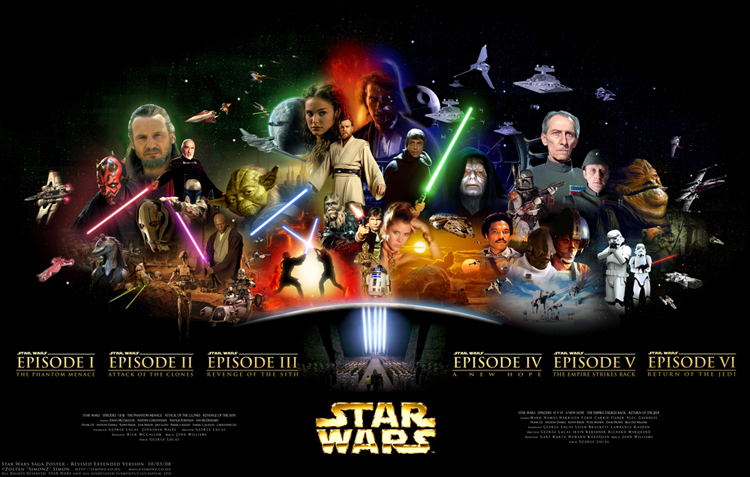
The news that Disney has purchased LucasArts for a cool 4 billion has certainly been making the rounds of late! Even more interesting is the release that they will be releasing the sequel trilogy sometime in 2015. This news has once again fueled a great deal of speculation as to what direction the new movies will take. Regardless of who is at the helm, it is generally agreed that there are only so many story arcs that the new movies could take…

The following list comes from AMOG‘s (Alpha Male Of the Group) online magazine, courtesy of Keith Veronese. The list is pretty comprehensive, and covers all the likely candidates for potential sequel and spinoff story lines. And lets face it, with the course of the prequels took, we all would like something new to rehabilitate the series! And with Lucas no longer at the helm, we all might just get what we want!

Immediate Pick-Up:
The first possible story arc for the new trilogy would be to pick up where the last movie left off. As it stood, the Empire was dealt a significant blow, but was far from finished. Granted, the Death Star was destroyed and both the Emperor and Darth Vader were dead, but the majority of the Imperial Fleet was still intact, as was its infrastructure and network of allied planets. As evil and rotten as it was, the Empire still commanded a great deal of loyalty and support within the Core Worlds, and the Rebel Alliance was likely to have its hands full dealing with all of them.

The benefits of this story are pretty clear. It’s a blank canvass in terms of plot, into which a new generation of writers can hurl all kinds of ideas. In addition, it’s a chance to bring back the old gang for another run, albeit with new actors and actresses.

The Thrawn Trilogy:
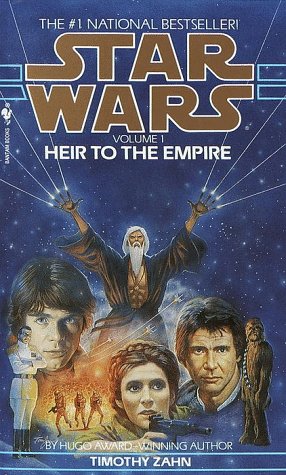
Written by noted sci-fi author Timothy Zhan, the Thrawn Trilogy are perhaps the most famous novelization in the franchise. Set five years after events in Return of the Jedi, the trilogy centers on the enigmatic character of Grand Admiral Thrawn, the last of the Empire’s senior officers who has assumed control of the Imperial fleet. Intrinsic to these plans are a lost fleet that disappeared prior to the Clone Wars, a secret cache of cloning vats the Emperor established during his reign, and an insane Jedi Master living on a remote world.

Meanwhile, Senator Leia Organa Solo (that’s right, they tied the knot!) is pregnant and expecting twins. While she has become a member of the New Republic government, Han has continued in his role as a fleet General and is using his old contacts in the smuggling world to try and drum up shipping for the new government. His efforts bring him into contact with a group of privateers who will one day go from being self-interested sorts to the same kind of heroes Han had become.

And finally, there are the adventures of Luke, who is drawn to Jedi Master C’boath and seeks to learn from him. However, they quickly become enemies as Luke realizes he is insane and seeks to capture Leia’s twins for his own purposes. He also comes into contact with Mara Jade, a Force-sensitive woman who once served the Emperor. She plans to kill Luke, but circumstances have thrown them to work together and cooperate.

Needless to say, this would be a good story arc for the series, and would be convenient since it’s already been written in full. All the old characters are reprized and fleshed out, and some new, decidedly Star Wars-esque characters are also introduced. And given that much time has passed since the originals, it would be a good opportunity for some new actors to tackle the roles of all our favorites. I’m sure Disney would be willing to spring for some cameos from the original cast as well!

Darth Vader Spinoff:
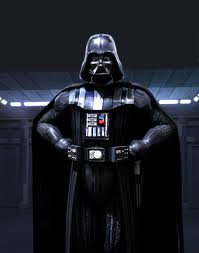
True, we got more than enough of his origin story with the prequel trilogy, but there’s still plenty of room for Darth Vader to grow! In fact, there is a twenty year gap between the prequels and the original movies, during which time Vader essentially did his best work. This included hunting down the remaining Jedi, rooting out dissent and resistance to the Emperor’s rule, and just generally cementing his reputation as an evil cybernetic menace!

The benefits here are pretty obvious, at least as far as a single movie are concerned. Plenty of lightsaber fights, stalking from planet to planet looking for Jedi, and lots of that creepy respirator and James Earl Jones-esque dialogue. However, it might be difficult to maintain a three-movie story arc from this. But that might not be a problem, given the next option:

Boba Fett Spinoff:
Boba Fett is arguably the most popular member of the supporting cast, and there are plenty who believe that he deserves his own moment in the spotlight. And after the prequels gave him a passing intro, there might be some merit to giving him a more complete origin story. Imagine Boba Fett as a young man, going about the known universe and establishing himself as the most notorious bounty hunter.

Aside from being action-packed and full of plenty of the seedier stuff of Star Wars, this film could be paired with a Vader movie as a potential second installment. And perhaps a third could be opened involving Obi-Wan, focusing on his adventures as he travelled from place to place on Tatooine, hoping to stay off the Empire’s radar while keeping an eye on Luke.

The Sith Wars:
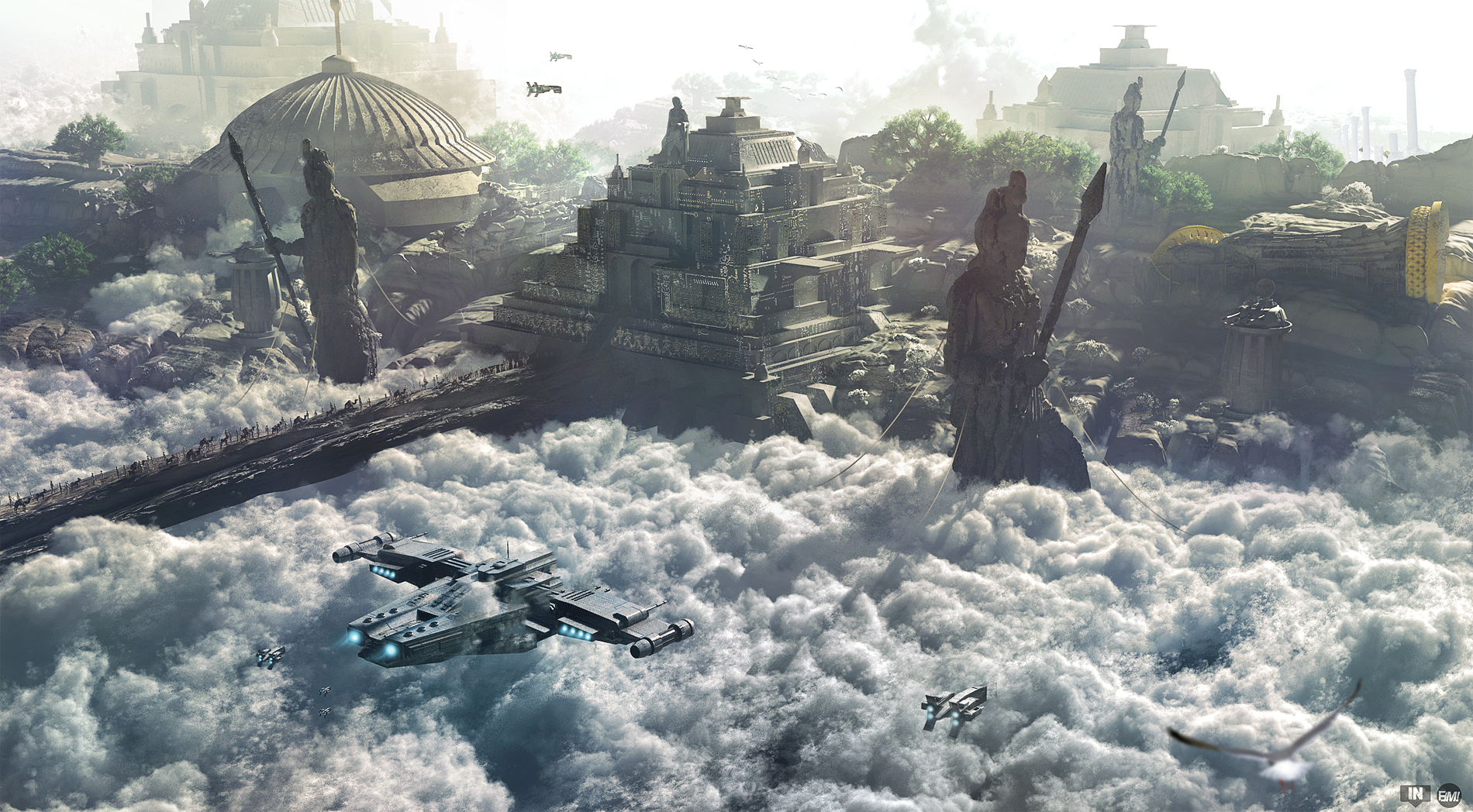
Finally, there is an area of the franchise which has become rather popular of late, and that is the rather fertile period in the Star Wars timeline known as the Sith Wars. What began with the Knights Of The Old Republic series has now evolved into a MMOG with Star Wars: The Old Republic. And even though the reception was not as extreme as LucasArts might have hoped, the stage has certainly been set for a possible second prequel series.

Taking place thousands of years before the events in the first Star Wars trilogy, the Sith Wars chronicles the titanic war which took place between the Old Republic and the Sith Empire. And although there have been several installments in the franchise that carry the name “Sith War”, the expanded universe now claims that the greatest confrontation took place 3681 years before the fall of the Old Republic and lasted until 3653. This war was in turn the result of over 1300 years of preparations and buildup by the Sith, who never forgot the crushing defeat they had suffered at the hands of the Republic during the Great Hyperspace War.

The benefits of this story are also quite obvious. In addition to being a very established story arc, there are plenty of interesting characters, developments and battles in this period which, if properly developed, would result in cinematic gold! What’s more, people do enjoy origins stories which are well told, and after the mixed reviews of the last prequels, a deep-origins story could be just the thing to rehabilitate the franchise. And it’s got all the right elements; Jedi, Sith, lightsaber fights, and a titanic war between good and evil, similar in tone to the war between the Rebel Alliance and the Empire.

What’s more, this story will have no sense of duty to suffer from. Unlike episodes I, II, and III which were burdened by having to explain where all the original characters came from, how Anakin fell to the Dark Side and how the Empire came to be, a Sith War trilogy would be able to tell a story where the details are not entirely pre-written. What’s more, the massive war does not suffer from the ambiguity or the Clone Wars, which seemed like little more than background for the prequels main focus – which was the fall of Anakin Skywalker. This time around, we’d be able to see lots of fighting and not be distracting by a whining Hayden Kristensen complaining about how much his life sucks!

____

So what’s it going to be? Personally, my money is on options two and five. Having read the Thrawn Trilogy and thoroughly enjoyed it, I would certainly pay money to see it adapted to the big screen. At the same time, I’m itching to see some of that Sith War swashbuckling and fleet battles! Man, tough choice, and the studio hasn’t even announced what they might be planning yet…

Religion in Sci-Fi

Since its inception as a literary genre, religion has played an important role in science fiction. Whether it took the form of informing the author’s own beliefs, or was delivered as part of their particular brand of social commentary, no work of sci-fi has ever been bereft of spirituality.Even self-professed atheists and materialists had something to say about religion, the soul and the concept of the divine, even if it was merely to deny its existence.

And so, I thought it might make for an interesting conceptual post to see exactly what some of history’s greats believed and how they worked it into their body of literature. As always, I can’t include everybody, but I sure as hell can include anyone who’s books I’ve read and beliefs I’ve come to know. And where ignorance presides, I shall attempt to illuminate myself on the subject. Okay, here goes!

Alastair Reynolds:
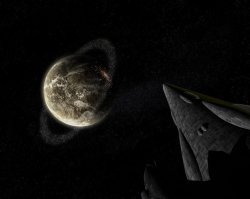
Despite being a relative newby to the field of sci-fi authors, Reynolds has established a reputation for hard science and grand ideas with his novels. And while not much information exists on his overall beliefs, be they religious or secular, many indications found their way into his books that would suggest he carries a rather ambiguous view of spirituality.

Within the Revelation Space universe, where most of his writing takes place, there are many mentions of a biotechnological weapon known as the “Indoctrination Virus”. This is an invasive program which essentially converts an individual to any number of sectarian ideologies by permeating their consciousness with visions of God, the Cross, or other religious iconography.

In Chasm City, these viruses are shown to be quite common on the world of Sky’s Edge, where religious sects use them to convert people to the official faith of the planet that claims Sky Haussmann was a prophet who was unfairly crucified for his actions. In Absolution Gap, they also form the basis of a society that populates an alien world known as Hela. Here, a theocratic state was built around a man named Quaiche, who while near death watched the moon’s gas giant disappear for a fraction of a second.

Unsure if this was the result of a strain he carries, he created a mobile community that travels the surface of the planet and watches the gas giant at all times using mirrors and reclining beds, so that they are looking heavenward at all times. Over the years, this community grew and expanded and became a mobile city, with each “believer” taking on transfusions of his blood so they could contract the the strain that converted him and allowed him to witness all that he did.

While this would indicate that Reynolds holds a somewhat dim view of religion, he leaves plenty of room for the opposite take. All throughout his works, the idea of preserving one’s humanity in a universe permeated by post-mortal, post-human, cybernetic beings remains a constant. In addition, as things get increasingly dark and the destruction of our race seems imminent, individual gestures of humanity are seem as capable of redeeming and even saving humanity as a species.

In fact, the names of the original trilogy allude to this: Revelation Space, Redemption Ark, Absolution Gap. Like with everything else in his books, Reynold’s seems to prefer to take a sort of middling approach, showing humanity as an ambiguous species rather than an inherently noble one or foul one. Religion, since it is a decidedly human practice, can only be seen as ambiguous as well.

Arthur C. Clarke:
At once a great futurist and technologist, Clarke was nevertheless a man who claimed to be endlessly fascinated with the concept of God and transcendence. When interviews on the subjects of his beliefs, he claimed that he was “fascinated by the concept of God.” During another interview, he claimed that he believed that “Any path to knowledge is a path to God—or Reality, whichever word one prefers to use.”

However, these views came to change over time, leading many to wonder what the beliefs of this famed author really were. At once disenchanted with organized religion, he often found himself subscribing to various alternative beliefs systems. At other times, he insisting he was an atheist, and nearing the end of his life, even went so far as to say that he did not want religious ceremonies of any kind at his funeral.

Nowhere were these paradoxical views made more clear than in his work. For example, in 2001: A Space Odyssey, the theme of transcendence, of growing to the point of becoming god-like, is central. Early hominid’s evolution into humanity is seen as the direct result of tampering by higher forces, aliens which are so ancient and evolved that they are virtually indistinguishable from gods. Throughout the series, human beings get a taste of this as they merge with the alien intelligence, becoming masters of their own universe and godlike themselves.

In the last book of the series – 3001: Final Odyssey, which Clarke wrote shortly before his death – Clarke describes a future where the Church goes the way of Soviet Communism. Theorizing that in the 21st century a reformist Pope would emerge who would choose to follow a similar policy as Gorbachev (“Glasnost”) and open the Vatican archives, Clarke felt that Christianity would die a natural death and have to be replaced by something else altogether. Thereafter, a sort of universal faith built around an open concept of God (called Deus) was created. By 3001, when the story is taking place, people look back at Christianity as a primitive necessity, but one which became useless by the modern age.

So, in a way, Clarke was like many Futurists and thoroughgoing empiricists, in that he deplored religion for its excesses and abuses, but seemed open to the idea of a cosmic creator at times in his life. And, when pressed, he would say that his personal pursuit for truth and ultimate reality was identical to the search for a search God, even if it went by a different name.

Frank Herbert:
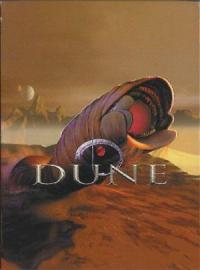
Frank Herbert is known for being the man who taught people how to take science fiction seriously all over again. One of the reasons he was so successful in this regard was because of the way he worked the central role played by religion on human culture and consciousness into every book he ever wrote. Whether it was the Lazarus Effect, the Jesus Incident, or the seminal Dune, which addresses the danger of prophecies and messiahs, Frank clearly believed that the divine was something humanity was not destined to outgrow.

And nowhere was this made more clear than in the Dune saga. In the very first novel, it is established that humanity lives in a galaxy-spanning empire, and that the codes governing technological progress are the result of a “jihad” which took place thousands of years ago. This war was waged against thinking machines and all other forms of machinery that threatened to usurp humanity’s sense of identity and creativity, resulting in the religious proscription “Thou shalt not make a machine in the likeness of a human mind.”

Several millennium later, the Bene Gesserit Sisterhood, a quasi-religious matriarchal society, are conspiring to create a messianic figure in the form of the Kwisatz Haderach. The name itself derives from the Hebrew term “Kefitzat Haderech” (literally: “The Way’s Jump”), a Kabbalic term related to teleportation. However, in this case, the name refers to the individual’s absolute prescience, the ability to jump through time in their mind’s eye. In preparation for the arrival of this being, they have been using their missionaries to spread messiah legends all over the known universe, hoping that people will respond to the arrival of their superbeing as if he were a messianic figure.

When the main character, Paul Atreides – the product of Bene Gesserit’s breeding program – arrives on the planet Arrakis, where his family is betrayed and killed, he and his mother become refugees amongst the native Fremen. They are one such people who have been prepped for his arrival, and wonder if he is in fact the one who will set them free. In order to survive, Paul takes on this role and begins to lead the Fremen as a religious leader. All along, he contends with the fear that in so doing, he will be unleashing forces he cannot control, a price which seems too high just to ensure that he and his mother survive and avenge themselves on their betrayers.

However, in the end, he comes to see that this is necessary. His prescience and inner awareness reveal to him that his concepts of morality are short-sighted, failing to take into account the need for renewal through conflict and war. And in the end, this is exactly what happens.By assuming the role of the Kwisatz Haderach, and the Fremen’s Mahdi, he defeats the Emperor and the Harkonnens and becomes the Emperor of the known universe. A series of crusades followers as his followers go out into the universe to subdue all rebellion to his rule and spread their new faith. Arrakis not only becomes the seat of power, but the spiritual capital of the universe, with people coming far and wide to see their new ruler and prophet.

As the series continues, Paul chooses to sacrifice himself in order to put an end to the cult of worship that has come of his actions. He wanders off into the desert, leaving his sister Alia to rule as Regent. As his children come of age, his son, Leto II, realizes the follies of his father and must make a similar choice as he did. Granted, assuming the role of a God is fraught with peril, but in order to truly awaken humanity from its sleep and prepare it for the future, he must go all the way and become a living God. Thus, he merges with the Sandworm, achieving a sort of quasi-immortality and invincibility.

After 3500 of absolute rule, he conspires in a plot to destroy himself and dies, leaving a huge, terrible, but ultimately noble legacy that people spend the next 1500 years combing through. When they come to the point of realizing what Leto II was preparing them for, they come to see the wisdom in his three and half millennia of tyranny. By becoming a living God, by manipulating the universe through his absolute prescience, he was preparing humanity for the day when they would be able to live without Gods. Like the Bene Gesserit, who became his chosen after the fact, he was conspiring to create “mature humanity”, a race of people who could work out their fates moment by moment and not be slaved to prophecies or messiahs.

As you can see, the commentary ran very deep. At once, Herbert seemed to be saying that humanity would never outlive the need for religion, but at the same time, that our survival might someday require us to break our dependency on it. Much like his critique on rational thought, democracy and all other forms of ideology, he seemed to be suggesting that the path to true wisdom and independence lay in cultivating a holistic awareness, one which viewed the universe not through a single lens, but as a multifaceted whole, and which was really nothing more than a projection of ourselves.

For those seeking clarity, that’s about as clear as it gets. As Herbert made very clear through the collection of his works, religion was something that he was very fascinated with, especially the more esoteric and mystical sects – such as Kaballah, Sufism, Zen Buddhism and the like. This was appropriate since he was never a man who gave answers easily, preferring to reflect on the mystery rather than trying to contain it with imperfect thoughts. Leto II said something very similar to this towards the end of God Emperor of Dune; as he lay dying he cautions Duncan and Siona against attempts to dispel the mystery, since all he ever tried to do was increase it. I interpreted this to be a testament of Frank’s own beliefs, which still inspire me to this day!

Gene Roddenberry:
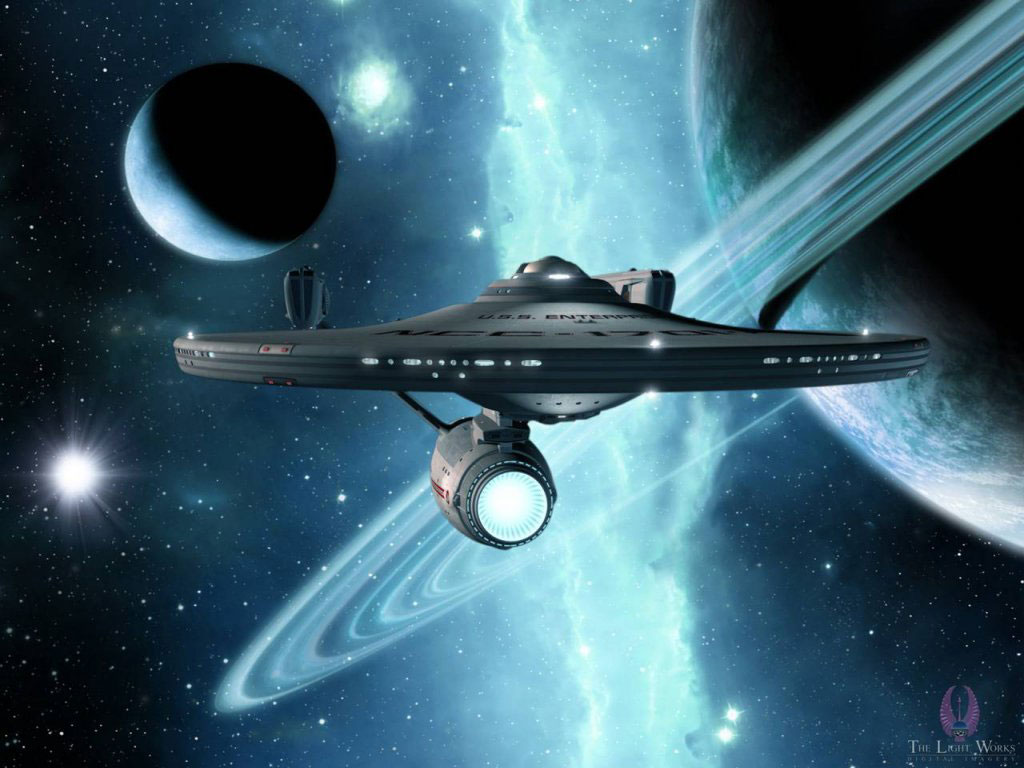
For years, I often found myself wondering what Roddenberry’s take on organized religion, spirituality, and the divine were. Like most things pertaining to Star Trek, he seemed to prefer taking the open and inclusive approach, ruling nothing out, but not endorsing anything too strongly either. Whenever religion entered into the storyline, it seemed to take the form of an alien race who’s social structure was meant to resemble something out of Earth’s past. As always, their was a point to be made, namely how bad things used to be!

Behind the scenes, however, Roddenberry was a little more open about his stance. According to various pieces of biographical info, he considered himself a humanist and agnostic, and wanted to create a show where none of his characters had any religious beliefs. If anything, the people of the future were pure rationalists who viewed religion as something more primitive, even if they didn’t openly say so.

However, this did not prevent the subject of religion from coming up throughout the series. In the original, the crew discovers planets where religious practices are done that resemble something out of Earth’s past. In the episode “Bread and Circuses”, they arrive on a planet that resembles ancient Rome, complete with gladiatorial fights, Pro-Consuls, and a growing religion which worships the “Son”, aka. a Jesus-like figure. This last element is apparently on the rise, and is advocating peace and an end to the cultures violent ways. In “Who Mourns Adonais”, the crew are taken captive by a powerful alien that claims to be Apollo, and who was in fact the true inspiration for the Greek god. After neutralizing him and escaping from the planet, Apollo laments that the universe has outgrown the need for gods.

In the newer series, several similar stories are told. In the season one episode entitled “Justice”, they come Edenic world where the people live a seemingly free and happy existence. However, it is soon revealed that their penal code involves death for the most minor of infractions, one which was handed down by “God”. This being is essentially an alien presence that lives in orbit and watches over the people. When the Enterprise tries to rescue Wesley, who is condemned to die, the being interferes. Picard gains its acquiescence by stating “there can be no justice in absolutes”, and they leave. In a third season episode entitled “Who Watches the Watchers”, Picard becomes a deity to the people of a primitive world when the crew saves one of their inhabitants from death. In an effort to avoid tampering with their culture, he lands and convinces him of his mortality, and explains that progress, not divine power, is the basis of their advanced nature.

These are but a few examples, but they do indicate a general trend. Whereas Roddenberry assiduously avoided proselytizing his own beliefs in the series, he was sure to indicate the ill effects religion can have on culture. In just about every instance, it is seen as the source of intolerance, injustice, irrationality, and crimes against humanity and nature. But of course, the various crews of the Enterprise and Starfleet do not interfere where they can help it, for this is seen as something that all species must pass through on the road to realizing their true potential.

George Lucas:
Whereas many singers of space opera and science fiction provided various commentaries on religion in their works, Lucas was somewhat unique in that he worked his directly into the plot. Much like everything else in his stories, no direct lines are established with the world of today, or its institutions. Instead, he chose to create a universe that was entirely fictional and fantastic, with its own beliefs, conflicts, institutions and political entities. But of course, the commentary on today was still evident, after a fashion.

In the Star Wars universe,religion (if it could be called that) revolves around “The Force”. As Obi-Wan described it in the original movie “It is an energy field created by all living things. It surrounds us and penetrates us. It binds the galaxy together.” In Empire, Yoda goes a step farther when he says “Life creates it, makes it grow. Its energy surrounds us and binds us. Luminous beings are we, not this crude matter.”Sounds rather pantheistic, doesn’t it? The idea that all life emits an essence, and that the fate of all living things is bound together in a sort of interdependency.

What’s more, the way the Force was governed by a Light Side and a Dark Side; here Lucas appeared to be relying on some decidely Judea-Christian elements. Luke’s father, for example, is a picture perfect representation of The Fall, a Faustian man who sold his soul for power and avarice. The way he and the Emperor continually try to turn Luke by dangling its benefits under his nose is further evidence of this. And in the end, the way Darth Vader is redeemed, and how he is willing to sacrifice himself to save his son, calls to mind the crucifixion.

In the prequels, things got even more blatant. Whereas Anakin was seen as a sort of Lucifer in the originals, here he became the prodigal son. Conceived by the “Will of the Force”, i.e. an immaculate conception, he was seen by Qui Gonn as “The Chosen One” who’s arrival was foretold in prophecy. The Jedi Council feared him, which is not dissimilar to how the Pharisees and Sanhedrin reacted to the presence of Jesus (according to Scripture). And of course, the way Anakin’s potential and powers became a source of temptation for him, this too was a call-back to the Lucifer angle from the first films.

All of this was in keeping with Lucas’ fascination with cultural mythos and legends. Many times over, Lucas was rather deliberate in the way he worked cultural references – either visually or allegorically – into his stories. The lightsaber fights and Jedi ethos were derived from medieval Europe and Japan, the architecture and many of the costumes called to mind ancient Greece, Rome and Byzantium, the setting and gun fights were regularly taken from Old Westerns, and the Imperial getup and rise to power of the Emperor were made to resemble Nazi Germany.

However, Lucas also dispelled much of the mystery and pseudo-religious and spiritual quality of his work by introducing the concept of the “midi-chlorians”. This is something I cannot skip, since it produced a hell of a lot of angst from the fan community and confounded much of what he said in the original films. Whereas the Force was seen as a mystic and ethereal thing in the originals, in the prequels, Lucas sought to explain the nature of it by ascribing it to microscopic bacteria which are present in all living things.

Perhaps he thought it would be cool to explain just how this semi-spiritual power worked, in empirical terms. In that, he failed miserably! Not only did this deprive his franchise of something truly mysterious and mystical, it also did not advance the “science” of the Force one inch. Within this explanation, the Force is still a power which resides in all living things, its just these microscopic bacteria which seem to allow people to interact with it. Like most fans, I see this as something superfluous which we were all better off without!

H.G. Wells:
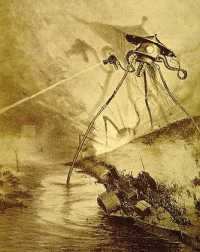
Prior to men like Herbert and the “Big Three” (Asimov, Clarke, and Robert A. Heinlein), Wells was the master of science fiction. Since his time, during which he published a staggering amount of novels, short-stories and essays, his influence and commentaries have had immense influence. And when it came to matters of faith and the divine, Well’s was similarly influential, being one of the first sci-fi writers to espouse a sort of “elemental Christian” belief, or a sort of non-denominational acceptance for religion.

These beliefs he outlined in his non-fiction work entitled God the Invisible King, where he professed a belief in a personal and intimate God that did not draw on any particular belief system. He defined this in more specific terms later in the work,  aligning himself with a “renascent or modern religion … neither atheist nor Buddhist nor Mohammedan nor Christian … [that] he has found growing up in himself”.

When it came to traditional religions, however, Wells was clearly of the belief that they had served their purpose, but were not meant to endure. In The Shape of Things to Come, he envisioned the creation of a global state (similar to Zamyatin’s “One State” and Huxley’s “World State”), where scientific progress was emphasized and all religions suppressed. This he saw as intrinsic to mankind’s progress towards a modern utopia, based on reason and enlightenment and the end of war.

In War of the Worlds, a similar interpretation is made. In this apocalyptic novel, one of the main characters is a clergyman who interprets the invasion of the Martians as divine retribution. However, this only seems to illustrate his mentally instability, and his rantings about “the end of the world” are ultimately what lead to his death at the hands of the aliens. Seen in this light, the clergyman could be interpreted as a symbol of mankind’s primitive past, something which is necessarily culled in the wake of the invasion my a far more advanced force. And, as some are quick to point out, the Martians are ultimately defeated by biology (i.e. microscopic germs) rather than any form of intervention from on high.

Isaac Asimov:
Much like his “Big Three” colleague Clarke, Asimov was a committed rationalist, atheist and humanist. Though he was born to Jewish parents who observed the faith, he did not practice Judaism and did not espouse a particular belief in God. Nevertheless, he continued to identify himself as a Jew throughout his life. In addition, as he would demonstrate throughout his writings, he was not averse to religious convictions in others, and was even willing to write on the subject of religion for the sake of philosophical and historical education.

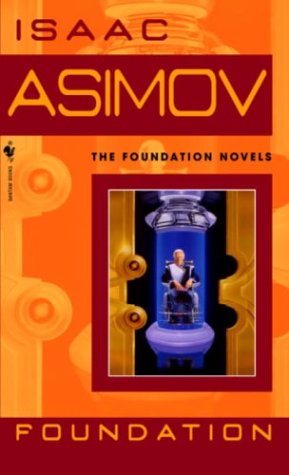
His writings were indicative of this, particularly in the Foundation and I, Robot series. In the former, Asimov shows how the Foundation scientists use religion in order to achieve a degree of influential amongst the less-advanced kingdoms that border their world, in effect becoming a sort of technological priesthood. This works to their advantage when the regent of Anacreon attempts to invade Terminus and ends up with a full-scale coup on his hands.

In the Robot series, Asimov includes a very interesting chapter entitled “Reason”, in which a robot comes to invent its own religion. Named QT1 (aka. “Cutie”) this robot possesses high-reasoning capabilities and runs a space station that provides power to Earth. It concludes that the stars, space, and the planets don’t really exist, and that the power source of the ship is in fact God and the source of its creation.

Naturally, the humans who arrive on the station attempt to reason with Cutie, but to no avail. It has managed to convert the other robots, and maintains the place in good order as a sort of temple. However, the human engineers conclude that since its beliefs do not conflict with the smooth running of the facility, that they should not attempt to counterman it’s belief system.

What’s more, in a later story entitled “Escape!” Asimov presents readers with a view of the afterlife. After developing a spaceship that incorporates an FTL engine (known as the hyperspatial drive), a crew of humans take it into space and perform a successful jump. For a few seconds, they experience odd and disturbing visions before returning safely home. They realize that the jump causes people to cease exist, effectively dying, which is a violation of the Three Laws, hence why previous AI’s were incapable of completing the drive.

Taken together, these sources would seem to illustrate that Asimov was a man who saw the uses of religion, and was even fascinated by it at times, but did not have much of a use for it. But as long as it was not abused or impinged upon the rights or beliefs of others, he was willing to let sleeping dogs lie.

Philip K. Dick:
Naturally, every crowd of great artists has its oddball, and that’s where PKD comes in! In addition to being a heavy user of drugs and a fan of altered mental states, he also had some rather weird ideas when it came to religion. These were in part the result of a series of religious experiences he underwent which began for him in 1974 while recovering from dental surgery. They were also an expresion of his gnostic beliefs, which held that God is a higher intelligence which the human mind can make contact with, given the right circumstances.

Of Dick’s hallucinations, the first incident apparently occurred when a beautiful Christian woman made a delivery to his door and he was mesmerized by the light reflecting off of her fish pendant, which he claimed imparted wisdom and clairvoyance. Thereafter, Dick began to experience numerous hallucinations, and began to rule out medication as a cause. Initially, they took the form of geometric patterns, but began to include visions of Jesus and ancient Rome as well. Dick documented and discussed these experiences and how they shaped his views on faith in a private journal, which was later published as The Exegesis of Philip K. Dick.

As he stated in his journal, he began to feel that his hallucinations were the result of a greater mind making contact with his own, which he referred to as the “transcendentally rational mind”, “Zebra”, “God” and “VALIS” (vast active living intelligence system). Much of these experiences would provide the inspiration for his VALIS Trilogy, a series that deals with the concept of visions, our notions of God and transcendent beings.

In addition, many of Dick’s hallucinations took on a decidedly Judea-Christian character. For instance, at one point he became convinced that he was living two parallel lives; one as himself, and another as “Thomas” – a Christian persecuted by Romans in the 1st century AD. At another point, Dick felt that he had been taken over by the spirit of the prophet Elijah. These experiences would lead him to adapt certain Biblical elements into his work, a prime example being a chapter in Flow My Tears, the Policeman Said, which bore a striking resemblance to the a story from the Biblical Book of Acts, which Dick claimed to never have read.

All of this is a testament to the rather profound (and possibly nuts!) mind of PKD and his fascination with all things divine and spiritual. Though not a man of faith in the traditional sense, he was very much a part of the counter-culture in his day and experimented with drugs and alternative religious beliefs quite freely. And while most of his ideas were dismissed as outlandish and the result of drug abuse, there were many (Robert A Heinlein included) who saw past that to the creative and rather gifted artistic soul within. It is therefore considered a tragedy that PKD died in relative obscurity, having never witnessed how much of an impact and influence he would have on science fiction and modern literature.

Ray Bradbury:
Next up, we have the late great Ray Bradbury, a science fiction writer for whom all literature was of immense import. This included the Bible, the Tanakh, the Koran, and just about any other religious text ever written by man. What’s more, many of his works contain passages which would seem to indicate that Bradbury held religion in high esteem, and even believed it to be compatible (or at least not mutually exclusive) with science.

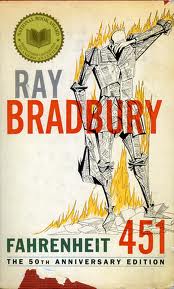
For example, in his seminal novel Fahrenheit 451, one of the most precious volumes being protected by the character of Faber, a former English professor, is the Bible itself. When Montag confronts him and begins ripping the pages out of it, Faber tells him that it is one of the last remaining copies in the world that actually contains God’s words, instead of the newer versions which contain product placements.

As the story progresses and World War III finally comes, Montag joins Faber and a community of exiles, all of whom are responsible for “becoming a book” by memorizing it. In this way, they hope to preserve whatever literature they can until such a time as civilization and the art of writing re-emerges. Montag is charged with memorizing the Book of Ecclesiastes, and joins the exiles on their journey.

In the Martian Chronicles, Bradbury is even more clear on his stance vis a vis religion. In the short story “-And the Moon Be Still as Bright”, the Fourth Expedition arrives on Mars to find that the majority of the Martians have died from chickenpox. A disillusioned character named Jeff Spender then spends much time in the alien ruins and comes to praise the Martians for how their culture combined religion and science.

Humanity’s big mistake, according to Spender, was in praising science at the expense of religion, which he seemed to suggest was responsible for modern man’s sense of displacement. Or has Spender put it: “That’s the mistake we made when Darwin showed up. We embraced him and Huxley and Freud, all smiles. And then we discovered that Darwin and our religions didn’t mix. Or at least we didn’t think they did. We were fools. We tried to budge Darwin and Huxley and Freud. They wouldn’t move very well. So, like idiots, we tried knocking down religion.”

In short, Bradbury saw humanity as lost, largely because of it deification of reason at the expense of faith. However, he did not appear to be advocating any particular religion, or even religion over science. When it came right down to it, he seemed to be of the opinion that faith was important to life, an outlet for creativity and inspiration, and needed to be preserved, along with everything else.

Robert A. Heinlein:
As yet another member of the “Big Three”, Heinlein’s own religious view bear a striking resemblance to those of his contemporaries. Much like Clarke and Asimov, he was a committed rationalist and humanist, and varied from outright atheism to merely rejecting the current state of human religion. According to various sources, this began when he first encountered Darwin’s Origin of the Species at the age of 13, which convinced him to eschew his Baptist roots.

These can be summed up in a statement made by Maureen, one of his characters in To Sail Beyond the Sunset, when she said that the purpose of metaphysics was to ask the question why, but not to answer. When one passed beyond the realm of questions and got into answer, they were firmly in religious territory. Naturally, the character of Maureen preferred the former, as the latter led to intolerance, chauvinism, and persecution.

In Stranger In A Strange Land, one of the most famous science fiction novels of all time, plenty of time is dedicated to the main character’s (the Martian Smith) experiences with religion. After becoming disillusioned with humanity’s existing institutions, he decides to create a new faith known as the “Church of All Worlds”. This new faith was based on universal acceptance and blended elements of paganism, revivalism, and psychic training. In short, it was an attempt to predate major religions by reintroducing ancient rites, nature worship, and the recognition of the divine in all things.

What’s more, Stranger’s challenge to just about every contemporary more, which included monogamy, fear of death, money, and conventional morality could only be seen by religious authorities as an indictment of traditional values. In that respect, they were right. Heinlein plotted out the entire novel in the early fifties, but did begin writing it for a full decade. He would later of say of this, “I had been in no hurry to finish it, as that story could not be published commercially until the public mores changed. I could see them changing and it turned out that I had timed it right.”

But just in case his work did not suffice, Heinlein expressed his opinions quite clearly in the book entitled Notebooks of Lazarus Long (named after one of his recurring characters): “History does not record anywhere at any time a religion that has any rational basis. Religion is a crutch for people not strong enough to stand up to the unknown without help. But, like dandruff, most people do have a religion and spend time and money on it and seem to derive considerable pleasure from fiddling with it.” These and other quotes illustrated his issues with religion, which included their irreconcilable nature with reason, their inherent contradictions, and the ludicrous things done in their names.

Summary:
And that’s what the masters had to say on the subject, at least those that I chose to include. As you can plainly see, their opinions ran the gambit from outright condemnation of religion (but not necessarily of faith) to believing that religion had it’s place alongside science as an equally worthy form of expression. And of course, there were those who fell somewhere in the middle, either seeing religion as an ambiguous thing or something that humanity would not outgrow – at least not for the foreseeable future. Strangely, none of them seemed to think that religion trumped science… I wonder why 😉

Seth Green’s New Star Wars Show!

George Lucas would surely fume over this, were it not for the fact that he’s probably getting massive royalties! And as they say, imitation is the sincerest form of flattery. So I suppose he is taking the news that Seth Green, creator of Robot Chicken and the voice of Chris in Family Guy, will soon be releasing another Star Wars parody.

That’s the premise behind Star Wars: Detours, a new animated show that takes the Star Wars universe and does pretty much what Robot Chicken did. Mock it, celebrate it, and just have a lot of fun playing with the characters and storyline. And much like its predecessor, anyone who grey up in the 80’s and loves having their retro/nostalgia sense played to will love it!

However, unlike its predecessor, this one isn’t likely to get all raunchy and gross. Whereas RC appeared on Adult Swim, this is one will be premiering on the Cartoon Network, meaning mainstream audiences will be watching it. Meh, I guess it pays to hedge your bets! No indication on when it will be premiering, but that news is sure to follow! In the meantime, check out the trailer for this new show.

Source: g4tv

The Walking Dead Viewing Guide

Found this over at Cracked.com, where some smart-ass nerd who obviously knows the comic backwards and forwards thought he’d mock the show. Having never read the comic, I can’t comment on the rightness of this little guide, but let’s just say I intend to now. Being a fan of the show,  much like most people I’ve talked to here on the subject, saying that they are vastly inferior to the comics makes me think that I’m missing something.

But of course its called comedy for a reason. And as I’m sure we are all aware, every franchise geek since the beginning of time has had the same thing to say vis a vis adaptations. In fact, if you were to make a top 10 list of things franchise geeks never say, number one would be “The movie was just as good as the book”… right after, “the prequel was just as  good as the original” and “George Lucas didn’t rape my childhood” 😉

The Star Wars That I Used To Know

You know that song that’s been getting stuck in your head over and over for the last year or so, thanks to viral videos and constant radio exposure? Well, if you’re not thinking of “Somebody That I Used to Know” – the Gotye original that was recently covered and re-popularized by Walk of the Earth – then we are on two completely different wavelengths!

But I’m not here to talk about our psychic disparities. The point is that a group named Teddiefilms has breathed new life into this song and Lucas-bashing by producing a satire of this song. Entitled “The Star Wars That I Used To Know”, this song does an amazing job of capturing fan angst and the spirit of the song. Ably written, performed, and directed in a way that calls to the mind the original video, this parody has it all!

Check it out…

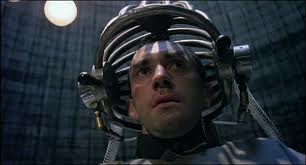
New Total Recall Trailer

Yep, as the title line says, a new trailer has come out for the upcoming remake of Total Recall. Ordinarily, this wouldn’t be that big a deal, except that this one shows how they are including a key part from the old movie: the three-breasted hooker! It seems that she will be featured in this movie as well, which geeks everywhere were sure to be asking. It goes without saying that anyone who saw the original remembers that woman. But for true sci-fi geeks and pubescent boys, she was right up there with Princess Leia in the bikini, inspiring more than her share of nerdgasms!

And since the movie is getting nearer, I am wondering if I am going to bother to see it. Sure, I’m curious and kind of intrigued by the reboot of a movie I appreciated as an adolescent, but is it worth it? Given the price of tickets these days (punitive!), I had to make a list of reasons for and against. First up…

Reasons to see this movie:

  • It looks pretty cool. If nothing else, it would be interesting to see what the updated special effects amount to. The old movie contained many instances of animatronics that didn’t look too realistic. Personally, I’d like to see if the CGI looks better.
  • Clearly, the technology has been updated, and includes flying cars, robot policemen and cooler weapons.
  • The trailers seem to indicate an apparent loyalty to the old storyline, even if it’s not a scene for scene remake. This is good seeing as how the plot was the original movie’s biggest strength, in my opinion.

Okay, not bad, not bad. But if I comb through these points, I notice that curiosity and the allure of eye candy – special effects, not Jessica Biel or Beckinsale! – are pretty much the only reason. I would like to see what they do with the storyline, but it’s not like there are going to be any surprises.
Reasons to wait for the DVD:

  • If the movie IS loyal to the original, then couldn’t it just as easily be argued that it’s not worth the theater price?
  • The original was based on a PKD short story named “We Can Remember It for You Wholesale”, which the screen writers altered and expanded upon greatly. So the updated version isn’t really a re-imagining of a classic sci-fi story, but of a popular movie.
  • I get the feeling the only reason they made this movie is because Hollywood producers have gotten incredibly lazy and would rather pull a Lucas (aka. redoing an old movie with updated special effects) than make anything new.

Huh… perfectly good counter-points. If I did see this movie, it wouldn’t out of loyalty to Philip K. Dick, but rather than some dudes who worked for the Hollywood machine. And what the hell have they done for me? Okay, they did give me Blade Runner, 2001, the Star Wars trilogy, the Back to the Future trilogy, Alien, Aliens, Terminator 1 and 2, Serenity, and the Matrix… but what have they done for me LATELY?

Well, that’s my appraisal of it, at any rate. Luckily, I’ve been doing some reading today that says there are a whole slew of movies coming out in 2012 that are not remakes, reboots, or re-imaginings. And some of these are well overdue, as far as fans of classic science fiction are concerned. Of that, more later. In the meantime, check out the updated trailer. Note the absence of actual boobs…

Attack of the Clones. Here we go again…

Hello again! Here we are picking things up again with the Star Wars saga. Today, it’s the second installment in the prequel series, the ridiculously named Attack of the Clones. As I’m sure we all remember, Clones was the stuff of mixed reviews, some critics hailing its special effects and visual style, while others emphasized its flat dialogue and wooden romance.

But even more interesting was the fact that critics were torn over whether it was better or worse than the Phantom Menace. Not a good sign, and the butt of a LOT of jokes and debate. Hard to imagine that fanboys who were united in bashing the PM would find themselves fighting each other over which they thought sucked more!

But to be fair, there were some good points in this movie. So without further preamble, let’s get into it:

Plot Synopsis:
The movie opens with the crawl once again saying that there is a crisis. This time around, it’s the threat of Separatists – led by former Jedi Count Dooku – that’s making things problematic. And once again there is deadlock in the Senate over it. In any case, now-Senator Amidala comes to Coruscant to speak her peace on behalf of those who oppose taking strong measures, and an assassination plot gets underway.

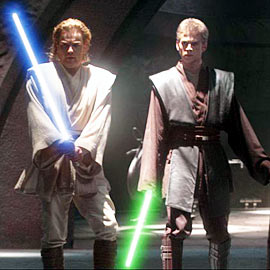
This prompts the Jedi order to send two old friends, Obi-Wan and Anakin, to provide her with added protection. Their introduction is rather painful to behold, as the hormonally raging Anakin begins relating how he hasn’t stopped dreaming of her and tries to make awkward conversation with her. He also picks a fight with his mentor, Obi-Wan, over what their mandate truly is. In the midst of all this, Jar Jar breaks the fourth wall by looking into the camera and smiling at the audience – a sort of, “I’m still here, bitches” for all the fanboys to see!

In another bit of “things to come”, we also learn that Anakin has been having dreams of another woman – his mother. He dreams that something terrible is going to happen, but in the meantime, they must focus on Padme, who’s assassin is still out there. For some reason, they decide to “use her as bait”, which consists of letting her sleep in a window-filled room with nothing but R2 as protection. Didn’t Obi-Wan say they weren’t supposed to be investigating, just protecting? Oh well…

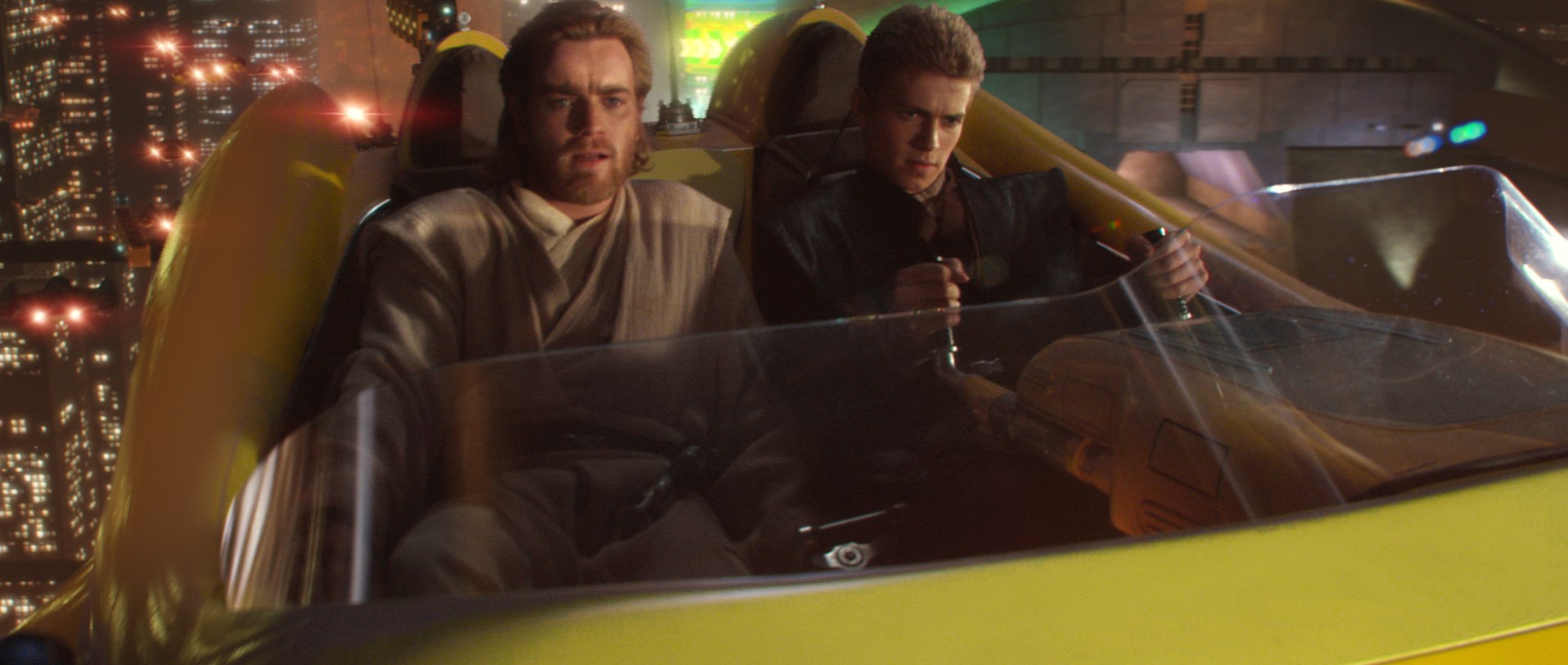
In any case, her would-be assassin sends a probe with some poisonous slugs to attack her. Obi-Wan and Anakin kill said slugs, and Obi-Wan jumps through the window to grab the probe and ride it. Wait, didn’t he say they weren’t supposed to be investigating? Why’s he so determined to follow this probe then? Anakin grabs a speeder, they fly like mad, and chase the attacker through the city. Anakin reveals that this woman is a shape-shifter, a fact which seems superfluous, but whatever. They also performs some stunts that defy the laws of physics, but that’s also unimportant.

After reaching a bar, Obi-Wan and Anakin chase her inside and begin combing the crowd. After a quick re-enactment of the scene from A New Hope (where Obi-Wan sliced off another thugs hand), they drag the shape-shifter outside and learn she’s subcontracting. But of course, her contractor kills her before she can say her name. Obi-Wan, who for some reason was willing to chase the shapeshifter across the planet, just lets him go…

The Jedi Council decides its time to send Padme home, and that Anakin is to go with her. Meanwhile, Obi-Wan is to track down the assassin by himself, a quest which takes him to the world of Kamino. This decision to split them, far from making logical sense, seems more like an excuse to get Anakin and Padme alone. Why send a Padawan off on his own, especially when his master has such misgivings about his attitude and powers?

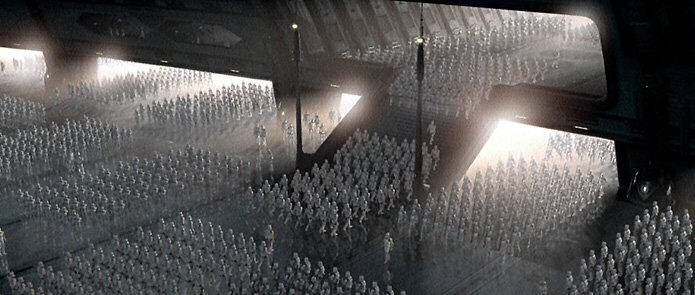
But anyhoo, things get kind of cool when Obi-Wan arrives on Kamino and learns that former Master Sifo Dyas ordered the creation of a clone army. This, combined with the fact that the location of the planet was removed from the Republic archives memory would seem to indicate that there is a conspiracy afoot. Obi-Wan then meets with the clone template, a bounty hunter named Jango Fett, and is convinced he’s found Padme’s would-be assassin. They fight, Jango escapes, and Obi-Wan pursues him to Geonosis.

Meanwhile, we get a string of scenes that are meant to elicit a romantic response. After following Padme around, complaining bitterly about Obi-Wan and professing his love in a series of ever creepier and wooden dialogue, Padme tells Anakin there’s no way. Why? She’s a Senator… Uh, what? Are Senators not allowed to date? Of course, Anakin can’t because he’s a Jedi, but the very fact that they’re talking about this would seem to indicate the feeling is now mutual. Seems sudden, but neither here nor there…

Arriving at Geonosis, where there’s a massive a droid-building colony, Obi-Wan gets into it with Jango and the Slave I. After thinking he’s killed him (Obi-Wan eludes death by copying Han’s hiding move from Empire), Jango proceeds to planet and Obi-Wan follows shortly behind. After wintessing a meeting between Dooku and the Separatists in which they plan their attack (using their droid and clone armies), Obi-Wan broadcasts his position and is then captured. He meets Dooku, who proceeds to tell him the truth, after a fashion…

He tells Obi-Wan there is a Sith in charge of the Senate, and that his plans are motivated to bring him down. He asks for Obi-Wan’s help, who in a move taken from Empire and Jedi, tells him he “will never join you”. Back on Naboo, Anakin continues to have bad dreams about his mom and decides he must go to Tatooine. He retraces her path, only to discover that she was taken in by some people from the movie – the Lars family, which includes the future Uncle Owen and Aunt Beru.

He learns she was taken by Sandpeople, and catches up with them just in time to watch his mother die, at which point, he and loses it! And I mean REALLY LOSES IT! In a scene we don’t get to see, Anakin takes out his lightsaber and kills the entire community of Sandpeople who kidnapped and tortured his mom, including the women and children. He returns to the Lars family dwelling and tells Padme of his mass murder, to which she replies that it’s no big deal.

I’m sorry, NO BIG DEAL?! Are you freaking kidding me? Seriously, this man just confessed to murdering women and children and all Padme can say is that “to be angry is to be human”? What kind of sociopathic, enabling bullshit is that? Is she so into bad boys that she’s willing to overlook this first-time offense? Or are they in such a hurry to get to the next scene that she’s just got to forgive and move on? And why the hell didn’t the Jedi Order even mention this on his return? We all saw Yoda sensing it? C’mon people!

Alright, moving on… Back on Coruscant, the news of a Separatist army explodes like a bombshell, with Palpatine once again exploiting it for personal gain. Thinking he’s doing the smart and noble thing, Jar Jar moves that Palpatine get emergency powers – a la Octavian – and his first act is to create an army for the Republic. Why they don’t have one already is beyond me, but who cares? Point is, Palpatine has got his way, and Yoda and Mace Windu decide its time to get involved.

Anakin and Padme also get the distress signal from Obi-Wan and decide they will go save him. They arrive on Geonosis too and after a needless scene where they are almost killed in a robot factory, they too are captured. A scene ripped off from Gladiator follows, as they are reunited in a massive Colosseum-type arena to die in a public display. They escape and begin to wreak havoc, and are rescued just in time by the arrival of Mace and the Jedi Order. They fight to a standstill and are surrounded, when Yoda arrives with the Clone army and begins kicking some ass.

A big fight scene ensues on the open plains of Geonosis between droids and Clones, while Obi-Wan and Anakin chase Dooku down. He beats them both in a rather implausible scenario, first managing to cripple Obi-Wan without actually killing him or severing any of his limbs, and then cutting off Anakin’s arm (an obvious preview of the scene from Jedi). Yoda once again shows up to save the day, and in another scene from Jedi, Dooku does his lightning trick.

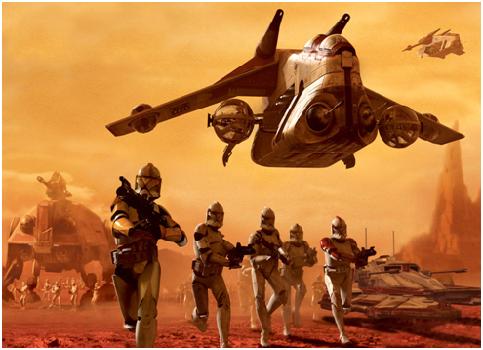
The fight ends with a stalemate, Dooku runs with Padme shooting at his ship. Once more, a scene from the originals is at work here, this time from Empire when Leia was shooting at the Slave I. But Dooku escapes, makes it back to Coruscant and tells Sideous (Palpatine) that the war is happening, as anticipated. He meanwhile sends the first batch of clones on their new Star Destroyer look-alikes, and Yoda laments that the Dark Side has fallen and “The Clones Wars” have begun.

The movie ends with Padme and Anakin back on Naboo, where they’ve decided to get married after all. But since it’s a secret wedding, the droids are the only parties in attendance. THE END!

What didn’t work:
Well, where to begin? I shan’t dwell on the wooden dialogue or the horrid lack of romantic tension, since those are the popular whipping posts of most critics when it comes to this movie. Instead, I’d like to stick to some of the more obvious weaknesses, those that become more clear with hindsight.

  1. The Set-Up: Things get rolling when we learn that an assassin is trying to kill Padme, presumably because she’s the voice of moderation between the Republic and the Separatists. However, things get really implausible, really fast. For one, why the hell did Jango Fett subcontract anyway. Why not simply kill her himself? And why did this lady use poisonous bugs when a simple bomb would have killed Padme instantly? We saw how easily that probe flew to her window, so why the slow, stupid and easily thwarted approach? Then came how Jango’s involvement led Obi-Wan on his wild goose chase. The only reason he knew to find him on Kamino was because he used a dart which was manufactured there. The only reason he know to fly to Geonosis was because Jango mentioned it to him. And why was Jango pulling double duty with the whole assassination thing anyway? If the Kaminos are such good cloners, anybody’s DNA would do and they could just enhance it. Having him do that and eliminate Padme was just a way to tie the two plots together really and make sure Obi-Wan could find out all that was going on.
  2. Love-Story Contrivances: I know, I said I wouldn’t mock the terrible dialogue, which I won’t. To me, the real weakness here was just how contrived and unnatural the whole love story seemed. Aside from a brief, age-inappropriate meeting ten years before, Anakin and Padme are practically strangers. Having Anakin say that he’s loved her ever since they met was completely forced. On top of that, the way they are sent to Naboo together and all the scenes of them doing lovers things: boating, playing in open fields, eating and retiring to the hearth – are all obvious attempts to try and force a sense of romance. That’s the key word here: force (no pun intended). Between Anakin constantly announcing his feeling for her and all the idyllic scenery they take in, it’s like Lucas was behind us constantly saying “Look, they’re in love!” In the original movie, Lucas took his time to build up the romance between Han and Leia. In the beginning, they couldn’t stand each other, but this concealed some genuine tension. In time, this flourished as they got to know each other and began to start acknowledging each others strengths. In the end, it was clear that their different backgrounds and personalities is what led to their attraction. Throw in some genuine crisis, and they realized they were in love. See? That’s a love story, not this!
  3. Unsubtle Dialogue: Again, said I would avoid talking about the wooden dialogue. Which I am, sort of! My gripe here is just how unsubtle and (again) forced it all was, which is something the critics really didn’t get into. Examples: in the beginning, Anakin announces that he loves Padme when talking with Obi-Wan and Jar Jar. When talking to Padme, Anakin announces that Obi-Wan is an unfair master who’s too hard on him. When sitting around the fire, Anakin announces how much he loves her. Finally, she announces her feelings back. And in this, they are hardly alone. All throughout the movie, actors announce what’s going on as a means to convey what’s happening and to make the audience feel the requisite emotions. Never is time taken to convey feelings, mood, or establish tension the old fashioned way. And this just makes for a bad movie! As Robot Satan said in Futurama: “You can’t have characters just announce their feelings! That makes me SO ANGRY!”
  4. Way Too Much: In the documentary of the making of Phantom Menace, there is a lovely scene where Lucas and his people are watching the screening and there’s this moment of “uh-oh” at the end. They then discuss how Lucas did too much and how that brought down the ending. You’d think between movie one and two, he would have learned from this, but no! In this movie, he tried to do way more. On top of showing how romance developed between Padme and Anakin, he’s also shoved in a big ol’ preview of Anakin’s descent to the Dark Side, how the Clones Wars started, and Palpatine’s evil rise to power. A lot of critics jumped on this, saying that the movie was too long and suffered from a sense of duty. And in that, they were profoundly right! Duty is another key word when describing this movie. Having spent movie one showing where Anakin came from, they now had to preview his fall, where the twins came from, and how the Clone Wars started all at once. And it made for a sloppy feel, with too much happening and things bouncing around from one thing to the next without any of it getting enough development.
  5. Recycling: But alas, all of these faults could have been mediated had it not been for the fact that there really didn’t seem anything new about these movies. All throughout, there is material which seems to serve no purpose than to satisfy origin stories or recapture elements of the first three movies. In Clones, Boba Fett, Luke’s surrogate parents, the Death Star and Vader’s robotic arm are all previewed, and that’s on top of the Clone Wars and the romance plot. Once more it’s like Lucas is behind us saying “Look! That’s how it happened!” But like everything else, it just feels forced. Why not let new characters have their time in the spotlight? Why is it necessary to use every character from the first three movies? And another thing, this movie, more than in the first, uses scenes from the originals like never before. I mean, its one thing to rip off other movies, like the arena scene from Gladiator, but Lucas was even ripping off himself! The scene in the bar where Obi-Wan cuts off the hunters arm, the scene where Obi-Wan hides his ship on the back of an asteroid, the scene where he tells Dooku he won’t turn, the scene with the lighting bolts, the scene at the end where Padma is shooting at Dooku’s ship. All of these are clearly meant to recapture the feeling of the original Star Wars, but they fell short for the simple reason that audiences wasn’t nearly as emotionally involved. There’s paying homage to an original, and then there’s recycling, and this was the latter!
  6. Lazy Shooting: Something else which became apparent by this movie was the lazy way in which it was shot. After Phantom, It was already obvious that Lucas loved to cram as much CGI into every frame as possible. Hell, that much was obvious with the Star Wars Gold Editions! But if you watch the movies again, pay close attention to how EVERY SINGLE scene is shot. In these, you have the actors either walking slowly across the stage or sitting down. Always. Two cameras capture all of their dialogue and exchanges, Camera one, camera two. Always. If they are walking and talking, they will always stop, turn, and go back and forth between camera one and two. Meanwhile, all visual effects and background are provided by a green screen and all CGI characters are represented by colored lights. There are virtually no props, no stand ins, and a minimum of real actors. This, I have learned, reflects Lucas’ preferred way of directing. He sits in his chair at the edge of the green screen and drinks his coffee while the actors interact with each other or lights which tell them where to look. They walk through, stop, turn, or stay seated, do their lines, and his two cameras capture everything. Action shots are handled in much the same way, with only the occasional close-up or distance shot. Unless of course the entire sequence is animated by CGI, which they usually are!
  7. Strengths? Not so much: The strong points about this movie, the ones that critics hailed, mainly had to do with vision and special effects. But here’s the thing: Lucas’ vision in this movie consisted of CGI environments that all seemed to be taken from other movies or real locations. That doesn’t seem very bold or original. And what’s more, even the special effects weren’t so innovative. Clones was launched during the summer of 2002, right about the time that Spider Man, Minority Report and Men in Black 2 were released, all of which made impressive use of CGI. So really, what was so stunning and unique about this movie’s visual effects? And if action was something else about this movie that people liked, consider that it came out at the same time as The Bourne Identity and XXX as well.  So really, this movie was not a stand-out, smash-hit, summer blockbuster. If anything, it was one hit in a summer full of them.

Well, that about covers the weaknesses of this movie. I did my best to avoid the cliched, beaten-to-death talking points, and yet I still feel I hit on them quite a bit. And I really went long there too didn’t I? And yet, I haven’t even mentioned what bothered me personally about this movie. But to do so means ditching all the civilized critique stuff and going all the way back to summer of 2000.

In was back then, between the first two movies movies, that Lucas seemed to be pulling an about face. A year after the Phantom Menace debuted, reassuring rumors began to circulate that Lucas claimed its sequel would be more dark, more realistic and more gritty, kind of like the way Empire was to the first movie. However, these hopes were shot when Lucas announced that the second movie would be a romance story at that Jar Jar would remain in the picture.

When asked about the fans hopes for something more adult and dark, he casually dismissed these and other criticisms by saying that Star Wars had always been a “Saturday morning serial for kids”. This above all else seemed to annoy me, and countless other fans, since it now seemed apparent that Lucas really didn’t care what his age old fans and was going to continue to do the things that was making the new movies incompatible with the old.

However, after movie two he seemed to sit up and take notice of just how annoyed the fans and critics were getting. With one movie left in the franchise, he seemed determined to give these objections some due before the sun set on the prequel trilogy. Of that, more next time. Stay tuned!


The Star Wars Prequels, Duty Strikes!

Hello, welcome to my last installment on the Star Wars franchise in honor of May the 4th. Only took six days, and I still got the final three movies to cover. Not my best work. But as they say, we all have lives. Well, some of us do. For those who have nothing better to do than read what I write I can only say… you poor things!

In any case, I promised when reviewing the originals that I would dedicate at least one post to the Star Wars the prequel trilogy. But one can scarcely do that without getting into the whole Star Wars legacy and addressing questions about Lucas himself and the directions he’s taken. Love them or hate them, the prequels remain a bone of contention for original fanboys and the new generation of acolytes.

To start, I’d like to give a very quick recap of the three movies before saying what was good and bad about them.

The Phantom Menace:
This movie was without a doubt one of the most anticipated releases in the history of cinema. After years of waiting and hearing that Lucas intended to revisit his universe with some prequel pictures, fans finally got their big break in the summer of 1999. If you’ve seen some of the footage of opening night, where people were lining up around the block, in costume, kissing the floor upon entry, and waving around multicolored lightsabers inside the theater when the movie came on, then you’ve got idea of just how raw and powerful the atmosphere was.

And yet, the Phantom Menace would also go down in history as one of the biggest disappointments of all time. One could easily say that all the build-up made that inevitable. But there were clearly some other factors as well, and people would spend years speculating on them. Of that, more later. First, let’s recap the plot.

The movie opens with the declaration that there is a taxation dispute going on and that the “greedy Trade Federation” has decided to blockade a remote world named Naboo in protest. Sounds a little dry and implausible but okay. We see two Jedis, Obi-Wan and Qui Gonn, being sent to reach a settlement with said Federation.

But once they get aboard, things get hairy. The Feds destroy their ship, on the orders of some “Phantom” dude who’s clearly manipulating things back home. He orders them to begin an invasion of the planet while he covers their asses in the Galactic Senate. Meanwhile, they try to kill them using poisonous gas and some rather inept robots.

Obi-Wan and Qui Gonn manage to escape, relaying on some sweet combat moves and Jedi springing, stow away on one of the troop transports, and are taken down to the surface. Somehow, they are landed on the other side of planet and must find a way to reach the capitol to “warn the Naboo”. Uh, what good does it do to warn people in the midst of an invasion? And why are they on the other side of the planet if the robots are invading the capitol anyway? Bad navigation console?

They come across a glaring stereotype named Jar Jar, a bumbling Gungan idiot who tells them his people can help. They swim underwater to the Gungan city where the Boss Nass, through a little force persuation, gives them a pod and lets them take Jar Jar with them, mainly because he owes his life to Qui Gonn (echoes of the Wookie life-debt there). They make it to the capitol and manage to the save the princess, a monotone teenage Geisha named Amidala. Turns out, royalty is elected on this world, and she agrees to go with them to Coruscant to plead their case before the Senate.

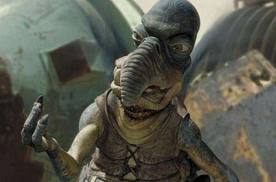
After a daring escape, which is facilitated by R2, they make it to space. However, there hyperdrive is damaged and they must land on nearby Tatooine. Qui Gonn goes off to find a parts dealer and meets another stereotype, an alien named Watto (who might as well be called Shylock given his caricatured appearance and character). He won’t take their credits, and since they don’t have anything to barter with, Qui Gonn concocts a needlessly convoluted scheme.

Yes, instead of simply going to another dealer or hiring a ship (a la Star Wars I), he decides to back Watto’s slave (a boy named Anakin) in a pod race using his ship as collateral. If the boy wins, Watto keeps the money and Qui Gonn gets his parts. But after determining that the boy is force sensitive – via a midichlorian count, one of the biggest let downs ever! – and (according to his mother) the result of immaculate conception, he decides to up the ante. If the boy wins, he gets to take him and the parts with him. For some reason, he seems completely remorseless about seperating the boy from his mother, but whatever.

Oh, and did I mention he built 3P0 – a factory model protocol droid – from spare parts to help his mom around the house? Weird, I thought these things were designed for, you know, protocol, as opposed to doing dishes! But whatever… He meets R2 and the they have immediate chemistry 😉

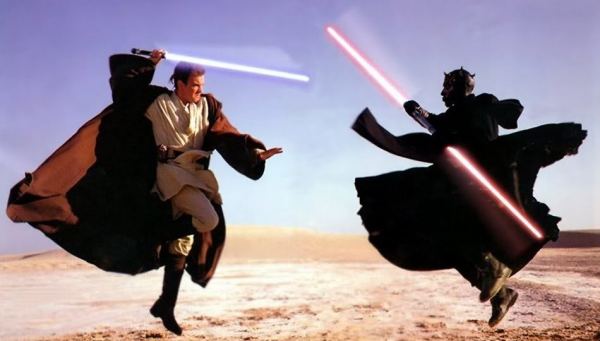
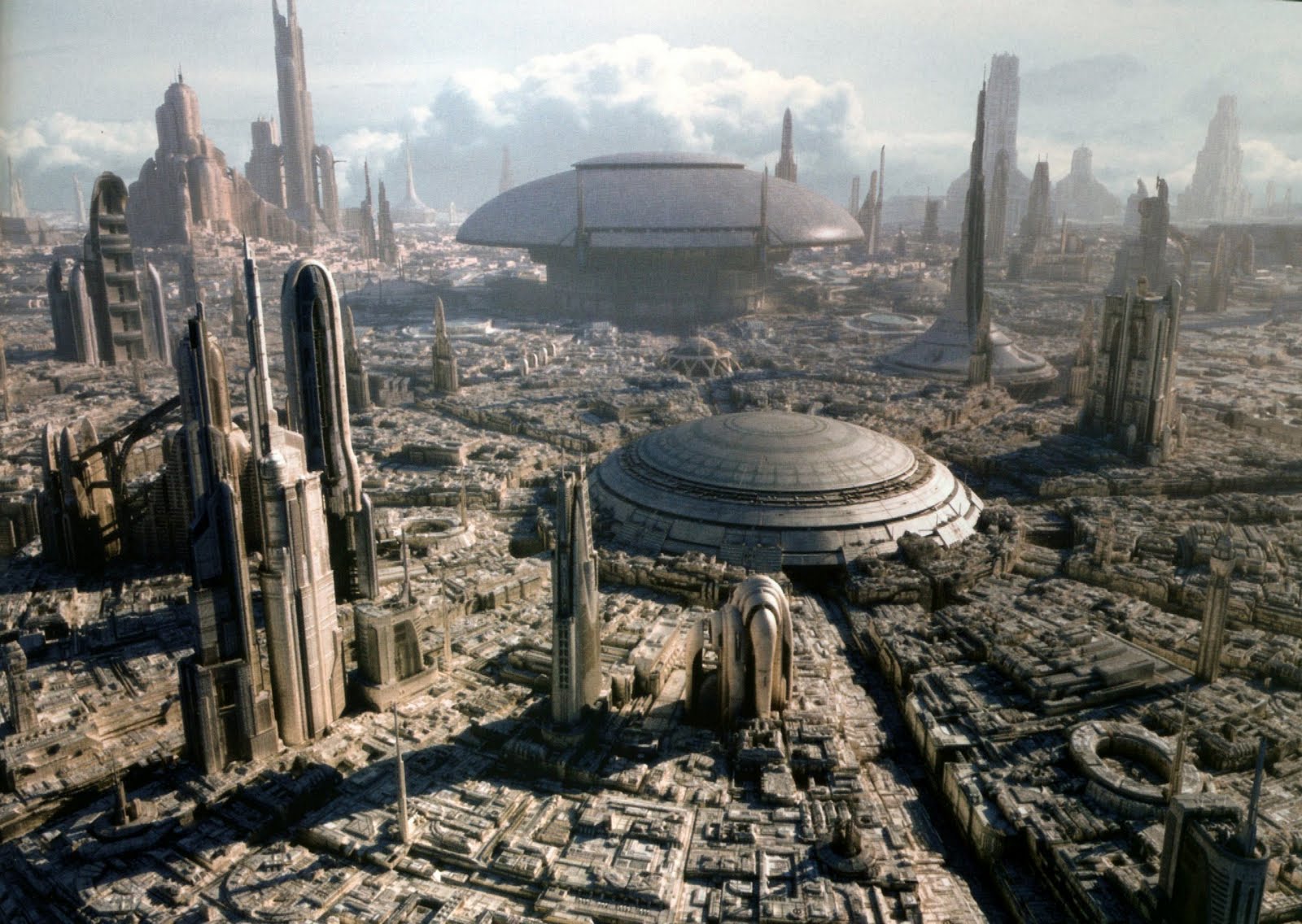
After the big ass pod race, clearly inspired by Ben Hur, Anakin wins using his Force abilities and Qui Gonn has his bounty. Their departure is momentarily interrupted when a Sith named Darth Maul shows up, seeking the princess, and Qui Gonn must fight him. They make it out and head to Coruscant, which is introduced for the first time in the franchise, and begin to attend to all the dry political crap that is waiting for them.

There, Senator Palpatine, representative of Naboo (and the man posing as the “Phantom”) tells them they’re in the thick of it. The Chancellor could force the issue but can’t since he’s been marred by accusations of corruption. Palpatine recommends calling a vote of non-confidence to unseat him so that someone less weak-kneed will take over. After finding nothing but gridlock in the Senate, Amidala concedes and makes the motion. Palpatine is happy, since he (surprise, surprise!) gets nominated!

Meanwhile, the Jedi Council has a look at Anakin, and is worried. It seems his fear of losing his mother is a bad thing, at least according to Yoda. Fear, through commodius viccus, leads to the Dark Side. Seems harsh, but this combined with his age, leads to their decision not to train him. Qui Gonn goes to bat for the little kid, but they are stubborn.

However, things change when Amidala decides she must go back home and the two Jedi are ordered to go with her. For some reason, they take Anakin and his two droids too, and Jar Jar is coming too to provide more slapstick. When they arrive, they begin plotting how their going to overthrow Federation occaption. The Gungans are recruited to help, and agree to lure the droid army into a battle as a feint to leave the capitol open. They decide to make Jar Jar, the idiot they exiled for being clumsy, a General and charge him with leading their attack. …Really?

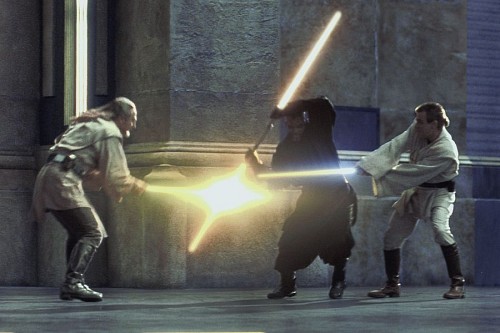
Meanwhile, Amidala, the Jedi and a handful of her security people infiltrate the capitol. After Amidala and her people take the throne room though a little decoy and switch, Qui Gonn and Obi-Wan come face to face with Maul. A brilliant duel ensues, Qui Gonn dies, and Obi-Wan defeats him by pulling a flip and slice routine that frankly, Maul should have been able to prevent. Hell, its the same thing Anakin tries in the third movie and Obi-Wan lopped both legs and one of his arms off! And Maul’s way more badass!

But the really objectionable part comes when Anakin, through sheer dumb luck, ends up commandeering a fighter and flies into orbit with the Naboo fighters to engage the Fed command ship. Those watching couldn’t help but notice that the other ships have all left for some reason, but again, WHATEVER! Anakin, despite the Feds claim that nothing can get through their shields, manages to do just that when he accidentally flies his fighter into their bay and fires some torpedoes into their main reactor. The ship blows up just as Anakin flies out.

Down below, the Gungans are having a hard time tackling the droid army, and Jar Jar’s constant slapstick and bumbling aren’t helping things much. But somehow, he manages to stay alive, and eventually the destruction of the command ship renders all the droids inoperative. The day is won and the capitol celebrates. The Jedi have a memorial and speculate on how Maul must have had an accomplice, since Sith always work in twos. The camera then pans to Palpatine to let us know, as if we hadn’t figured it out already, that he’s baaaad!

And that’s how the movie ends. With lots of fanfare that calls to mind the medal ceremony of the first movie, we see Gungans, the Princess, Obi-Wan and Anakin all standing on ceremony as people cheer and blow horns. The credits rolled, and audiences everywhere were left speechless…

The Reception:
After the movie finished on opening night, it was like the fans everywhere were going “uh, what just happened?” Seriously, if you watch the documentary footage, you can’t help but notice how underwhelming the mood was once the movie was over, nothing close to the electricity that there was going in. It was as if they’d come to witness the second coming and were forced to watch cheep parlor tricks instead. The critics weren’t too kind either, most giving it mixed reviews based on its weak scripting, the inclusion of Jar Jar, the dry political content, and the saccharine character of Anakin.

However, there were good things about this movie too which did not go unnoticed. Just about everyone acknowledged that the pod race and lightsaber duel were worth the price of admission. But overall, this movie fell far short of expectations. And with the benefit of hindsight, the weaknesses became all the more apparent.

  1. The plot stunk of duty: This is something that would become more apparent as the trilogy went on. For all three movies, the entire plot seemed like a set-up for a bunch of explanations. This is a weak basis for a story and makes the audience feel like the movie is plodding along out of a sense of duty rather than a desire to tell a story. In the Phantom Menace, the focus was overwhelmingly on explaining how Palpatine got into power, even if that was only a small part of the story. Aside from that and the introduction of Anakin, there was nothing of importance happening elsewhere. I mean seriously, a taxation dispute? A blockade of a remote world? THESE things put the Galactic Republic in turmoil? I know this was all meant to show how inefficient and corrupt the Republic had become in its dying days, but c’mon! Give us something of consequence!
  2. The plot just plain stunk!: Throughout the first half of the movie, so much happens for which there is no decent explanation. Mainly, audiences just followed it along, waiting to see where it went and only realizing with hindsight that it didn’t make any sense. For starters, why did the Trade Federation agree to this risky scheme when they didn’t even know who they were dealing with? Were they that desperate to getting out of paying their taxes? Second, why was it necessary to fly to the surface to warn the Naboo if they were already being invaded? Third, why did Qui Gonn go through all that trouble just to get some parts? Why not go to another dealer, find a smuggler, agree to pay them ten times what they wanted once they got to Coruscant? Why sponsor a pod race, plot to free a boy, use his force power to manipulate the situation, and ultimately leave the boy’s mother behind in the end? It all seemed so reckless and silly, not what you’d expect from a Jedi Master. What’s more, everybody and their brother was warning him against taking on Anakin, saying they foresaw danger in his training. So why then was he so obsessed with training him, because of that vague prophecy? If this is such an important factor, why weren’t audiences made aware of what that prophecy was? Maybe then we might understand why he was so intent on seeing Anakin become a Jedi and the Council was not. But this was never done, not in this movie or its sequels. And Qui Gonn’s death-bed request that the boy be trained was a pretty weak excuse for the Jedi Council accepting him after all.
  3. One-dimensional characters: There’s this hilarious clip over at Red Letter Media where a guy asks a bunch of people to describe characters from the Star Wars universe. The rules are, say stuff about them without mentioning what they look like or what their job is. In the case of the originals, the people selected could say volumes about Han, Luke, Leia, et al. But with the prequels, they couldn’t say jack! There’s a reason for this. Beyond their basic roles, every character in this movie had no real substance or character. Hell, it wasn’t even clear who the main character was. So many people are the focus of the film and doing things to advance the plot that it doesn’t feel like their is a protagonist at all. Ah, which brings me to point 3!
  4. Who’s the focus here? All good stories have a protagonist. A person’s who’s journey is the focal point of the story and helps the audience to identify with them and become emotionally involved. In the originals, that person was Luke Skywalker. By no means was he the only character, but he was clearly the focus of the story. His own journey of self-discovery was the main driving force of the plot, and his battle with his own demons and his past provided the resolution. In the Phantom Menace, all we get is snap shots of different people doing things to advance the plot towards a resolution, which feels too tidy in the end.
  5. Too much reliance on CGI: It’s an easy thing to criticize a director for relying on CGI, but when you consider the fact that Lucas managed to capture lightning in a bottle using nothing but stop-motion, animatronics and puppets, you have to wonder why he was so obsessed with using the latest technology. Granted, it allowed him to do things he couldn’t before, but it also limited his shoots and made the movie feel incredibly sterile. In just about every shot in this movie, you don’t have real sets and actors on location. You have actors walking in front of a green screen and looking at hanging lights instead of physically real stand-ins. And no matter how advanced the technology, people will always know what they are seeing isn’t real. And when all the backgrounds look so perfectly glossy, clean and packed to the hilt with digital effects, it all just feel fake.

Some Possible Explanations:
As all fans of the Star Wars franchise are aware of by now, Lucas was never that good at scripting or directing. In fact, it was well known that in the first movie, help needed to be brought in to complete the film. In the second movie, that help was on hand from the beginning and it showed. But by the third, Lucas was clearly back at the helm and making the big decisions. With this in mind, it’s little surprise why the Phantom Menace was the way it was. With the success of the original franchise, Lucas had grown richer and more powerful than anyone thought possible, and with companies like Lucas Arts and Industrial Light and Magic behind him, who the hell is going to question him? He’s George freaking Lucas!

Surely, the man must have thought himself immortal by the late nineties when he began writing the script. All those people who used to tell him what to do or challenge him were now gone, replaced by sycophants and suck ups who grew up idolizing him. And can you blame them? It’s George freaking Lucas! How could the creator of Star Wars be wrong?

Sure, there were plenty of cool action scenes and the new technology was pretty damn effective at letting Lucas do all the things he couldn’t do before. But this was Star Wars, dammit! Where were the classic characters, the epic storytelling, the stuff that went beyond special effects and eye-popping visuals? Part of what made the originals so damn good was the depth that went far beyond the ships, guns, and lightsaber duels.

When you look at the originals, at all the things Lucas wanted to do but got called on, you begin to understand. According to rumor, Luke Skywalker was supposed to be a half-cyborg, Han was supposed to be a green alien, and the dialogue was supposed to be a lot more wooden and cheesy than it turned out to be. But thanks to dedicated professionals who knew how to rely on Lucas’ strengths and help him with his weaknesses, something truly awesome and classic was made.

But, as with most things, this success proved to be the downfall. Like Lucas, we all seemed to think he was solely responsible for the creation of Star Wars. Granted he was, in his own words, “the creator as well as the decider” (a cheesy reference to that awful Bushism), but he was never the sole voice of the project. Literally everybody, from the co-directors, co-writers, and even the actors themselves had a role in helping him to make his movies. Without them, we are left with Lucas as he is, warts and all. And after years of success and a growing obsession with the latest special effects, that’s not a very pretty sight!

Well, that’s what I thought of Phantom Menace. Stay tuned for Attack of the Clones… This aint gonna be pretty! But in the meantime, here’s some funny news. It turns out Topher Grace, who played Eric on That 70’s Show, has made an 85 minute editors cut of the three movies. Follow this link to read more on this interesting and funny story:

http://www.bestweekever.tv/2012-03-07/topher-grace-edits-star-wars-prequels

Prometheus and an interview with Ridley Scott

Recently, I came across the lovely article entitled “Don’t f—- around with gods” from the Sydney Morning Herald. The subject was director Ridley Scott’s new movie, Prometheus, which is currently in post-production and set to be released in June of this year. As I’m sure everyone is aware by now, this movie is a return to the universe of Alien, a franchise which Scott began in earnest 30 years ago. Originally thought to be a prequel, Scott has since revealed that this movie is in fact a sort of standalone movie which explores the concept of Exogenesis – the idea that life came to Earth or other planets from an extra-solar source.

Although linked to the original Alien movie in that it deals with the same derelict that the crew of Nostromo encountered, the story is far more concerned with the alien race known as the Space Jockeys than the xenomorphs themselves. Or at least, that appears to be the focus. I’m sure the xenos make an appearance, and probably end up screwing everybody over, as is there tendency! But mainly, Scott emphasized that the plot, as suggested by the title, has to do with the discovery of powerful, dangerous things. When one encounters alien technology, the specter of the bound god who gave fire to humanity can’t help but be resurrected. It’s just timeless like that!

In the course of the interview, Scott also spoke extensively about his reasons for getting into science fiction in the first place. I have to say that I loved his answer: “Science fiction is a wonderful – sorry about the pun – universe for – again, another much overused word – creativity. It’s an arena where anything goes… The opportunity presents itself to fundamentally do anything you want, providing that you draw up a rule book in the first place. You’ve got to draw up the rules of your drama and within that universe you’ve got to actually stick to your own rule book. I think that’s what’s happening – we’re not drawing enough rules up when we do materials. It feels like writing a book…”

Wow. It’s wonderful when you see words that you yourself have said put into the mouths of true veterans! If I was to make a list of directors whom I admire for their creativity and vision over the years, Scott would be tied with Stanley Kubrick for first place! With movies like Alien, Blade Runner, Black Hawk Down and Gladiator to his credit, I got to say that I’m pleased as punch that he and agree on two fundamental precepts. One, science fiction is a great realm for creativity and inventiveness due to the fact that the only limitations are those of the author’s imagination. And two, that it’s best to have a detailed game plan worked out in advance. This is what sunk Lucas’ prequels people! Always know where you’re going in advance and try to stick to the plan. Otherwise you wind up with contrived plot twists and forced situations. Trust me, I know!

Another great thing to read was Scott’s indictation that Prometheus wouldn’t be a massive CGI fest. Something which set Cameron’s Aliens apart from the dubious Avatar was the use of real live actors in suits or animatronics instead of digital creations. Granted, this was done in an age when CGI wasn’t available, but those who followed in Scott and Cameron’s footsteps understood the value of shooting things this way. If there was one thing AVP did right, it was the use of costumed actors and real sets rather than blue screens and generated images.

Having set the precedent, I think it’s only right that Scott remain true to this heritage. After all, his environments, especially that of the Space Jockey Ship, were known for their dark, gritty, grimy look, something which was very… Lovecraftian! Try doing that with digital effects, it just doesn’t work! CGI might be great for creating visuals, but the textures are always too clean and sterile. Or in the case of Avatar, too cartoony! And actors are far more convincing when they’re interacting with a real person, or even a robotic alien, than a standing stick or a tennis ball on the end of a string!

In any case, here’s the link to the article. It’s a good read, and definitely for fans of Scott, the Aliens franchise, and just sci-fi in general!

Dystopia in Popular Culture

Picking up where I left off last time, I thought I’d get into some examples of how dystopian fiction has influenced popular culture. And given all the feedback I got on my previous post, I also wanted to incorporate some suggested titles as well. But, just to be clear, I still haven’t read Hunger Games, so please don’t ask about it!

Alright, so last time, I mentioned just about every examples of dystopian literature I could find. From the earliest examples of Candide and Gulliver’s Travellers, onto the more modern interpretations of The Time Machine and We, and culminating with classics like BNW and 1984, I essentially ended before I could get into how these novels have had an influence on film and other media. In addition to inspiring the written words, these classics have inspired an entire culture of iconography, symbolism and motifs.

Not surprising, really. Every work of dystopian fiction and satire has sought to create images in the reader’s mind, using highly specific descriptions in order to paint a scene and inspire the right mood. Whenever these novels have been adapted to film, or directors were simply trying to convey similar themes, the task of properly conveying it all visually has always been a hefty one. The same is true for graphic novels and any other visual medium. So today, just for fun, and perhaps to complete my romp through the realm of this inspired genre, here are some examples of dystopia in modern media:

Blade Runner:
Granted, Blade Runner was based on Philip K Dick’s Do Android Dream of Electric Sheep?, a dystopian story in some respects, but not in the same way that the movie was. Whereas the novel took place in a post-apocalyptic Los Angeles (circa 2019) which is sparsely populated and where a living animal is seen as a status symbol. In the movie, the year and location are the same, but the setting is starkly different. Here, it is a stuffy, polluted, mega-city made up of massive skyscrapers and giant animated billboards, where the streets are dirty and packed with people who spoke a strange dialect known as Cityspeak (check out my post on Cityspeak for on that).

And what made it all so awesome, aside from the plot, was the attention to detail. Director Ridley Scott, the same man who brought us Aliens, brought his usual artistic touch and a team of first-grade set designers to the table. Overall, they produced some pretty awesome concepts, ones which are still being praised to this day. Here are just a few:

The Tyrell Corp. building, which was kind of the focal point of the movie. Early on, we get a birds-eye view of it as Detective Deckard Cain (Harrison Ford) is being flown there in a Spinner (flying car). Later on, the leader of the Replicant party, Roy Batty, travels there as well seeking answers to some of life’s most basic questions.

For starters, the building is clearly based on a the design of a Ziggurat, the breed of ancient Babylon temple that inspired such legends as the “Tower of Babel”, and which serves as a clear representation for the almost godlike power Tyrell wields. The interior design, with its large columns, soft lighting, candles, an owl (a possible reference to Athena’s owl) and the way Tyrell can block out the sun at will all serve to further illustrate this point. That scene near the end where is dressed in lavish white robes also seemed pretty symbolic, I’d say!

And for those who read 1984, there is a possible encoded reference to the four ministries as well- Truth, Peace, Love, and Plenty – all of which were pyramid-like in design. Coincidence? Who knows? All that matter is when it comes to massive structures that harken back to ancient Egypt and Mesapotamia, the symbolic value is clear. Much like the civilizations that built them, these things stood for power and dominion, both over lesser subjects and the afterlife itself. They were the ruler’s way of achieving immortality by creating something that embodied their power and would stand the test of time. As Shelley said in his poem “Ozymandias”: “Look on my works, ye mighty, and despair!”

And when it comes right down to it, this old-world kind of mentality, updated for the modern age, is indispensable to any dystopian story: Absolute power, wielded by the few over the many and represented in conspicuous and obvious ways! In many cases, it comes in the form of totalitarian governments (a la The Party) who runs things with an iron fist and build massive government buildings to remind everyone of who’s in charge. But in other cases, it takes the form or corporate dominance, where the wealthy rule society like feudal barons while the rest live like serfs. And much like their bureaucratic peers, they choose to lord this by building lavish buildings to themselves and covering themselves with ornate symbols!

Another trademark bit of dystopian set design were the massive skyscrapers, complete with giant video-billboards. No doubt, these too were designed to give the impression of the control corporations had over the people of LA in the future. As if regular sized billboards ads weren’t enough, (or televised, print, bench, flier, blimp, and radio ads) now it seemed that corporate monopolies were splastering their logo’s on screens the size of buildings!

And just to make it realistic, Ridley Scott and his designers were also sure to use logos that were already big in the early 80′s and seemed destined to get bigger – Atari, Coca Cola, Pan Am Air, Cuisinart, Bell System. But interestingly enough, all of these companies suffered heavy losses after the movie’s release. The phenomena came to be known as the “Blade Runner Curse”. Strange, one would think audiences began associating them with dark imagery or something ;)

But personally, I think one of the most effective aspects of the movie’s look and feel came through in the construction of the streets. Here, Scott’s design team made sure that every shot was crammed full of people who whore plastic jumpers, dark glasses, cool headgear, and carried what looked like umbrellas with neon handles. Then came the street vendors who peddled food or exotic pets in the same neighborhoods, facades that were ashen grey in color, and all kinds of neon signs written in various languages. It painted quite the scene, one which can only be described by the words “Future Noire”.

Brazil: 
Directed by Terry Gilliam, an old-time member of the comedy troupe Monty Python and director of such movies as The Adventures of Baron Munchausen, The Fisher King and 12 Monkeys, Brazil was a rather humorous take on the classic 1984. In it, we are presented with a dystopian society that is ruled by a totalitarian regime, but which is buffoonish and incompetent rather than exacting and brutal.

In addition, the people in this world are also overly-dependent on machinery which is rather unreliable and poorly maintained. And last of all, there is the main character of Sam Lowry, a low-level government employee who works in a mind-numbing government job, lives in a small apartment, and is having prescient dreams about a woman and a man in mask who is torturing him.

The movie shared many plot and thematic elements with 1984, but much of its genius comes through in the set design and direction. Given that the aim of the movie was to present a world in which the machinery is as undependable as the bureaucracy, Gilliam decided to go with a look that would call to mind the kind of over-the-top aesthetics of past sci-fi films. While everything was admittedly grey, dark, and shot in wide and tilted angles, there was also a sort of comic, retro feel to the whole thing. This helped to establish the central premise of the movie, in which incompetence and mind-drudging inefficiency were what was destroying humanity, not a specific agenda.

In addition, Gillian had much to say about artifice and vanity in this film. Lowry’s mother, who plays an important role in the plot, is obsessed with plastic surgery which she hopes will make her look younger. Towards the end of the movie, Lowry dreams that his mother is attending the funeral of a friend who died as a result of too many invasive procedures. And in what can only be described as an moment of oedipal confusion, his mother even looks like Jill, the much younger woman he has fallen in love with!

An interesting take on 1984 isn’t it? Rather than following a philosophy like the one espoused by O’Brien, where the Party wields absolute control over reality and people’s minds, want to eliminate all emotion except hatred, and has destroyed any activities that do not serve their interests, the totalitarian regime in Brazil is instead motivated by laziness and a desire to cover its own ass. Not being wrong literally means more to them than the lives of their citizens. What better commentary is there on a bureaucratized society?

Judge Dredd:
Yes, the movie didn’t so well, and the script and plot were so simplistic that Stallone himself called it a “no-brainer”. But that doesn’t change the fact that the source material is actually one of the better graphic novels in existence, especially when it comes to depth and irony. Set in a post-apocalyptic world of the not-too-distant future, the comics take place for the most part inside “Mega City One”, one of several megalopolis’s that have sprung up in the US after a nuclear war which left it and Soviet Union utterly devastated.

Within this city, just about everything is automated and unemployment is almost universal. Every city block contains over fifty-thousand people, amounting to a population of about 400 million people per city. Due to overcrowding, massive unemployment and uncontrollable violence, the leaders of this future society created a quasi-fascist justice system whereby individual “Street Judges” (policemen) were charged with dispensing judgement and punishment on site. This had a stabilizing effect on society, but the problems remain…

Automatically, one can see a few things at work here. For starters, there’s the Hobbesian idea of man in the state of nature; how because of nuclear war, life became “nasty, brutish and short” and a tyrannical system was needed to put things back in order. In addition, there’s the whole “who polices the police?” side of things, where audiences naturally fear that the judges will abuse their power or fight to the death to hang onto it.

And last, there is the very real sociological concept of the “megalopolis”, the Northeastern mega city running from Virginia to Maine which was originally coined by French geographer Jean Gottmann. In the course of the comic’s history, it is made clear that Mega City One was not actually designed, but grew out of natural urban sprawl that predated the nuclear war. It was only after the war that it became a self-contained place where automation, unemployment and chaos become so rampant.

Now one might also get the impression that this was all meant to illustrate some preachy, “we made a mistake” kind of message (which is in fact what happened in the movie). But in truth, these issues are presented with a fair degree of subtly and irony in the graphic novel.

Knowing full well how his audience would react to fascist symbols and ideology, John Wager (creator) presented readers with a story that is loaded with both. For starters, the Judge’s symbol is an eagle, which bears a striking resemblance to the Nazi black eagle. The Judge’s uniform is also highly ornate and calls to mind the classical imperial motifs of Centurions and Gladiators. And the fact that Dredd’s face is never seen can only be seen as highly indicative. He’s a faceless law-giver, much like Stormtroopers or the SS.

What’s more, the people who sport these symbols and preach these values are presented as heroes. Judge Dredd, for all intents and purposes, is a social fascist who is bereft of  sentimentality, doubt or remorse over what he does. Unlike the other Judges, there’s no crime he won’t ignore, and he never stops for more than ten minutes at a time to rest in a sleep chamber, then he’s back on the job. He also has little sympathy for people who believe in enlightened reform or who criticize the Street Judges for their abuses of power.

The purpose of this always seemed to be for the sake of ironic social commentary. Rather than condemning the Judges and the system they represent (or endorsing them) we are meant to see how – under the right circumstances – something like this could very well happen!

THX 1138:
You know, its movies like this that remind us all that there was a time that George Lucas had talent, when he cared about thing like plots and inspired story-telling, and not special effects and merchandizing. But I’ll leave my riffs about the Star Wars prequels for another day. Right now, I will admit that there is plenty about this directorial debut worth praising, and not the least of which was the faithful dystopian tone it struck.

Set in a dystopian future where the human race is required by law to take drugs that suppress emotion and sexual desires, are controlled by android police, and all inhabitants worship a godlike being known as OMM 0910, the story is clearly a commentary on how rationalization and automation threatened to destroy humanity. In addition, there are clear and obvious parallels to novels like We, Brave New World and 1984.

For example, the people in this future are all given designations instead of names, the state sanctioned religion is reminiscent of Big Brother, and the mandatory use of mind altering drugs calls to mind Soma. And of course, the stark, clinical portrayal of society in the future is very similar to descriptions of the One State and Oceania in We and 1984. And let’s not forget the scene were android police torture and abuse the main character? Tell me that didn’t come directly out of the scenes where Winston was languishing in the Ministry of Love!

And of course the overall moral of the story, that love is precious and will fight the odds against the forces of cold rationality, this too was practically lifted from Orwell’s and Zamyatin ‘s classics! This is not a criticism, mind you. If anything, Lucas demonstrated a keen ability to adopt freely from novels and franchises in a way that really worked. Much as he would do with Star Wars just a few years later, he seemed to know where to borrow from and how to put it all together!

The Watchmen:
Now this was one of my favorite graphic novels of all time. Lucky for me, it also falls into the realm of dystopian fiction, hence I can talk about it here! In addition to taking place in an alternate universe, the setting is one which is quite dark and gritty. Set in the 1980′s, which is the same period in which it was written, the story is of an alternate reality where the existence of superheroes has caused history to diverge quite a bit from our own. Technically, superheroes have been in existence for many decades, which helps to give the story a real sense of historicity.

However, it was with the service of superheroes in actual wars and government programs that caused history to shift. Beginning with Doctor Manhattan’s intervention in Vietnam and culminating in the development of cheap, renewable energy by Ozymandias (with Manhattan’s help), the Cold War took an unexpected turn. Russia was systematically beaten back to the point where it was becoming desperate and nuclear war seemed inevitable. Meanwhile, society began to decay as war began to occupy more and more of society’s attention and the inner cities were neglected and left to rot.

Told for the point of view of Rorschach, a borderline social fascist with deep-seated issues, the darkness and impending sense of doom really come through! As he investigates the death of the Comedian, a fellow superhero who’s death incites the whole plot, we learn how both he, the Watchmen, and society came to be the way it is. His own tragic story, and that of the Comedians, serves to illustrate how the American Dream failed and cynicism and fear took over.

But of course, the point with dystopian stories is not just to speculate, but to make a point about the time in which it was written. Looked at from this angle, the Watchmen was really telling us about the real world of the 1980′s, a world which had come very far since the post-war era in terms of technological, social and cultural development. And like many other cultural commentaries, a sense of failure and betrayal is at work. What happened to the post-war dream? What happened to the American Dream? How did poverty, crime, licentiousness and cynicism become so rampant? From Rorschach point of view, the Cold War is largely to blame, but so is human nature. And given that he is such a dark and messed up character, I don’t think his opinions were meant to be taken too seriously!

V for Vendetta:
Yet another awesome graphic novel, and one which also inspired a hit movie adaptation. A piece of speculative fiction, this series was produced in the 1980′s and was set in a near-future dystopian England. Over the years, this series’ thematic elements and symbolism have been compared to 1984. However, in truth, the story has much more in common with The Iron Heel and It Can’t Happen Here, by Sinclair Lewis (which should have made my list of dystopian literature, dammit!) In these two novels, especially the latter, a fascist regime takes power by appealing to the people’s sense of moral purity and a desire for order, and in the end the people got more than they bargained for!

But alas, the story in the comic book version involves nuclear war and the transformation of the UK into “lifeboat Britain”. Given that the movie was made in the early 2000′s, the story had to be updated somewhat. There, the focus shifted to terrorism and the exploitation of fear – echoes of The Handmaids Tale and “Loose Change” there, but I digress. After being passed over by the nuclear holocaust, Britain found itself being flooded with refugees and victims of the war. Bit by bit, authoritarian measures were put into place to deal with the crisis, until eventually, the fascist government of Norsefire took over, and that’s when the real changes happened!

They’re motto: “Strength Through Purity, Purity through Faith” pretty much sums it up! In addition to pushing a religious agenda, they were also very much concerned with purging British society or minorities and “undesirables”. A police state was put into place where a series of departments – the Eyes, Ears, Mouth, and Hands – were tasked with controlling and monitoring all aspects of society. The Eyes handled surveillance, the Ears listened to people’s by tapping their phones and bugging their homes, the Mouth disseminated propaganda, and the Hands investigated criminal activity. And of course all minorities, be they racial minorities, homosexuals, or just political dissidents, were sent to concentration camps where they were exterminated and experimented on.

Into all this enters the character of V, an anarchist revolutionary who is the product of one camp’s twisted experiments. As a result of their invasive procedures, he became an enigmatic genius/amnesiac with a serious chip on his shoulder who is now on a quest to pay the government back for its crimes. His famous disguise, the Guy Fawkes mask and robes of black and red, are as intrinsic to establishing his character as his monologues and affinity for blowing up government buildings!

Judging by the color scheme alone, one immediately can tell that this man is an anarchist by his use of the color black (or anarcho-syndicalist seeing as how he combines it with red). The mask is a further indication of this, given that Guy Fawkes was a radical who tried to blow up parliament because he believes any vestige of government to be anathema to freedom. So in the end, we can see that this a man who wants to bring down the system and is reaching into Britain’s forgotten past to resurrect the idea of civil liberty.

In contrast, Norsefire’s logo was pretty straightforward too. In the comic, Norsefire represented itself on its “motivational posters” with a set of white wings with a space in the middle that was in the shape of a cross, and behind it lay flames. This is obviously meant to conjure up images of religious propriety, or holy war, and of action, all of which are clear allusions to fascist and religious-right iconography. It was also meant, in my opinion, to call to mind Britain’s Action Party, a fascist political group that played a small but influential role in British political life during the 1970′s.

In any case, one can see several staples of dystopia at work in this series, hence why it earned a loyal following and garnered so much critical acclaim. In addition to the idea of a nuclear war breeding totalitarian regime in Britain (right out of 1984), of “Lifeboat Britain” giving rise to a fascist regime (which may have helped to inspire the novel Children of Men) and countless allusions to Nazism and how it really could take root in Britain – which calls to mind Orwell’s essay “England Your England” where he basically asserted that it couldn’t.

Final Thoughts:
Wow, this sort of stuff makes me feel head-heavy and tired! It seems that when you get into a subject as rich as dystopian literature and its various offshoots, there’s no shortage of material! But I think I’ve learned something from all of this and it’s important that I get it right. So bear with me…

As I said in my last post, utopian literature predates dystopian by a couple centuries at least. And I also focused on the differences between the two, how utopian lit shows our failures by using a prefect society as a comparison while dystopian societies show the logical outcome of our most worrisome flaws. However, I’ve now come to think that the issue is far more complicated than all that. For starters, one can find elements of the former in the latter and vice-versa. What’s more, utopian novels and treatises were often loaded with irony, at times truncated themselves to make the point that perfect societies were not so perfect, or perhaps unattainable.

On the other hand, all dystopian novels take as their starting point the idea of a failed utopia. Whether it was a willful lie (as O’Brien revealed in 1984) or an attempt at perfection gone wrong, all dystopians arose out of attempt to create a “perfect society”. In the case of the classics written after the 18th century, the inspiration for this is clear. Beginning with the French Revolution, then the Russian, and countless other revolutions who’s aim was to radically transform society, it seemed that every attempt to create “real equality” and an “earthly paradise” was doomed to result in tyranny and abuse. Sometimes horribly so!

But the earlier utopian writers didn’t have these failed social experiments to point to. In their case, saying that utopias were unattainable would have had to have been purely philosophical. And examples abound! The very word Utopia, for example, is Greek for “no-place”. And the narrator of this book, the man who is an apparent specialist on this fabled society, is named Raphael Hythloday. This last name has a Greek root which loosely translates to “expert in nonsense”. Samuel Butler, another utopian writer, named his fictional society Erewhon, which is simply “Nowhere” written backwards. In addition, in his “perfect” society, people are punished for being sick and treated for criminal behavior, an inversion of the usual procedure!

I guess its like the dividing line between heaven and hell, or revelation and madness. Somehow, the line is fine, and one misstep can take you from one to the other in the blink of an eye! And, as with everything else, we carry these things with us  and project them wherever we go. Well… that was deep! Stay tuned, I’m sure to have something more cheerful for next time!