The Future of Space Exploration

spacex-icarus-670Back in January, National Geographic Magazine celebrated its 125th anniversary. In honor of this occasion, they released a special issue which commemorated the past 125 years of human exploration and looked ahead at what the future might hold. As I sat in the doctor’s office, waiting on a prescription for antibiotics to combat my awful cold, I found myself terribly inspired by the article.

So naturally, once I got home, I looked up the article and its source material and got to work. The issue of exploration, especially the future thereof, is not something I can ever pass up! So for the next few minutes (or hours, depending on how much you like to nurse a read), I present you with some possible scenarios about the coming age of deep space exploration.

MarsOneSuffice it to say, National Geographic’s appraisal of the future of space travel was informative and hit on all the right subjects for me. When one considers the sheer distances involved, not to mention the amount of time, energy, and resources it would take to allow people to get there, the question of reaching into the next great frontier poses a great deal of questions and challenges.

Already, NASA, Earth’s various space agencies and even private companies have several ideas in the works or returning to the Moon, going to Mars, and to the Asteroid Belt. These include the SLS (Space Launch System), the re-purposed and upgraded version of the Saturn V rocket which took the Apollo astronauts to the Moon. Years from now, it may even be taking crews to Mars, which is slated for 2030.

ESA_moonbaseAnd when it comes to settling the Moon, Mars, and turning the Asteroid Belt into our primary source of mineral extraction and manufacturing, these same agencies, and a number of private corporations are all invested in getting it done. SpaceX is busy testing its reusable-launch rocket, known as the Grasshopper, in the hopes of making space flight more affordable. And NASA and the ESA are perfecting a process known as “sintering” to turn Moon regolith into bases and asteroids into manufactured goods.

Meanwhile, Virgin Galactic, Reaction Engines and Golden Spike are planning to make commercial trips into space and to the Moon possible within a few years time. And with companies like Deep Space Industries and Google-backed Planetary Resources prospeting asteroids and planning expeditions, it’s only a matter of time before everything from Earth to the Jovian is being explored and claimed for our human use.
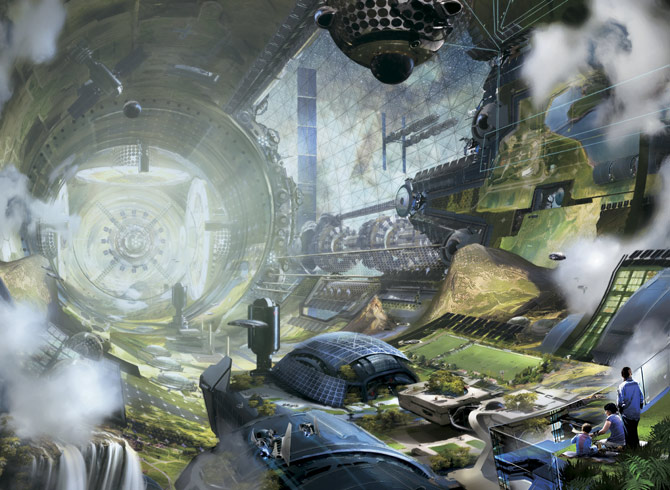
Space Colony by Stephan Martiniere

But when it comes to deep-space exploration, the stuff that would take us to the outer reaches of the Solar System and beyond, that’s where things get tricky and pretty speculative. Ideas have been on the table for some time, since the last great Space Race forced scientists to consider the long-term and come up with proposed ways of closing the gap between Earth and the stars. But to this day, they remain a scholarly footnote, conceptual and not yet realizable.

But as we embark of a renewed era of space exploration, where the stuff of science fiction is quickly becoming the stuff of science fact, these old ideas are being dusted off, paired up with newer concepts, and seriously considered. While they might not be feasible at the moment, who know what tomorrow holds? From the issues of propulsion, to housing, to cost and time expenditures, the human race is once again taking a serious look at extra-Solar exploration.

And here are some of the top contenders for the “Final Frontier”:

Nuclear Propulsion:
Project-Orion-Spacecraft
The concept of using nuclear bombs (no joke) to propel a spacecraft was first proposed in 1946 by Stanislaw Ulam, a Polish-American mathematician who participated in the Manhattan Project. Preliminary calculations were then made by F. Reines and Ulam in 1947, and the actual project – known as Project Orion was initiated in 1958 and led by Ted Taylor at General Atomics and physicist Freeman Dyson from the Institute for Advanced Study in Princeton.

In short, the Orion design involves a large spacecraft with a high supply of thermonuclear warheads achieving propulsion by releasing a bomb behind it and then riding the detonation wave with the help of a rear-mounted pad called a “pusher”. After each blast, the explosive force is absorbed by this pusher pad, which then translates the thrust into forward momentum.

Though hardly elegant by modern standards, the proposed design offered a way of delivering the explosive (literally!) force necessary to propel a rocket over extreme distances, and solved the issue of how to utilize that force without containing it within the rocket itself. However, the drawbacks of this design are numerous and noticeable.
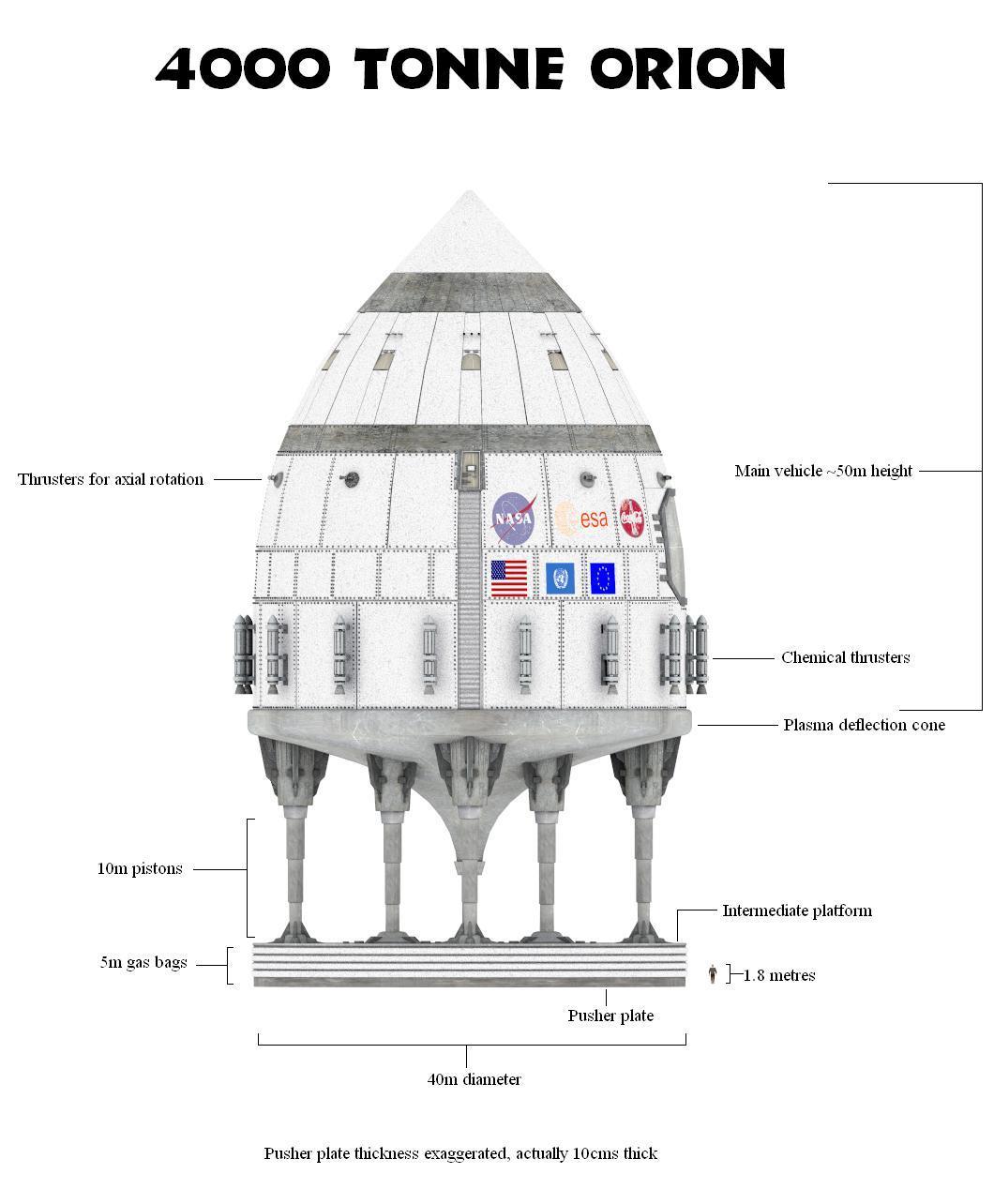
Orion SchematicF0r starters, the ship itself is rather staggering in size, weighing in anywhere from 2000 to 8,000,000 tonnes, and the propulsion design releases a dangerous amount of radiation, and not just for the crew! If we are to rely on ships that utilize nuclear bombs to achieve thrust, we better find a course that will take them away from any inhabited or habitable areas. What’s more, the cost of producing a behemoth of this size (even the modest 2000 tonne version) is also staggering.

Antimatter Engine:
NASA_antimatterMost science fiction authors who write about deep space exploration (at least those who want to be taken seriously) rely on anti-matter to power ships in their stories. This is no accident, since antimatter is the most potent fuel known to humanity right now. While tons of chemical fuel would be needed to propel a human mission to Mars, just tens of milligrams of antimatter, if properly harnessed, would be able to supply the requisite energy.

Fission and fusion reactions convert just a fraction of 1 percent of their mass into energy. But by combine matter with antimatter, its mirror twin, a reaction of 100 percent efficiency is achieved. For years, physicists at the CERN Laboratory in Geneva have been creating tiny quantities of antimatter by smashing subatomic particles together at near-light speeds. Given time and considerable investment, it is entirely possible this could be turned into a form of advanced propulsion.

In an antimatter rocket, a dose of antihydrogen would be mixed with an equal amount of hydrogen in a combustion chamber. The mutual annihilation of a half pound of each, for instance, would unleash more energy than a 10-megaton hydrogen bomb, along with a shower of subatomic particles called pions and muons. These particles, confined within a magnetic nozzle similar to the type necessary for a fission rocket, would fly out the back at one-third the speed of light.

antimatter_shipHowever, there are natural drawback to this design as well. While a top speed of 33% the speed of light per rocket is very impressive, there’s the question of how much fuel will be needed. For example, while it would be nice to be able to reach Alpha Centauri – a mere 4.5 light years away – in 13.5 years instead of the 130 it would take using a nuclear rocket, the amount of antimatter needed would be immense.

No means exist to produce antimatter in such quantities right now, and the cost of building the kind of rocket required would be equally immense. Considerable refinements would therefore be needed and a sharp drop in the cost associated with building such a vessel before any of its kind could be deployed.

Laser Sail:
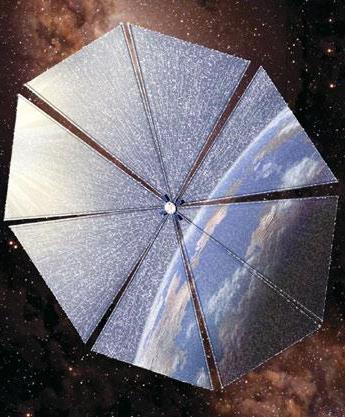
solar_sail1Thinking beyond rockets and engines, there are some concepts which would allow a spaceship to go into deep space without the need for fuel at all. In 1948, Robert Forward put forward a twist on the ancient technique of sailing, capturing wind in a fabric sail, to propose a new form of space travel. Much like how our world is permeated by wind currents, space is filled with cosmic radiation – largely in the form of photons and energy associated with stars – that push a cosmic sail in the same way.

This was followed up again in the 1970’s, when Forward again proposed his beam-powered propulsion schemes using either lasers or masers (micro-wave lasers) to push giant sails to a significant fraction of the speed of light. When photons in the laser beam strike the sail, they would transfer their momentum and push the sail onward. The spaceship would then steadily builds up speed while the laser that propels it stays put in our solar system.

Much the same process would be used to slow the sail down as it neared its destination. This would be done by having the outer portion of the sail detach, which would then refocus and reflect the lasers back onto a smaller, inner sail. This would provide braking thrust to slow the ship down as it reached the target star system, eventually bringing it to a slow enough speed that it could achieve orbit around one of its planets.
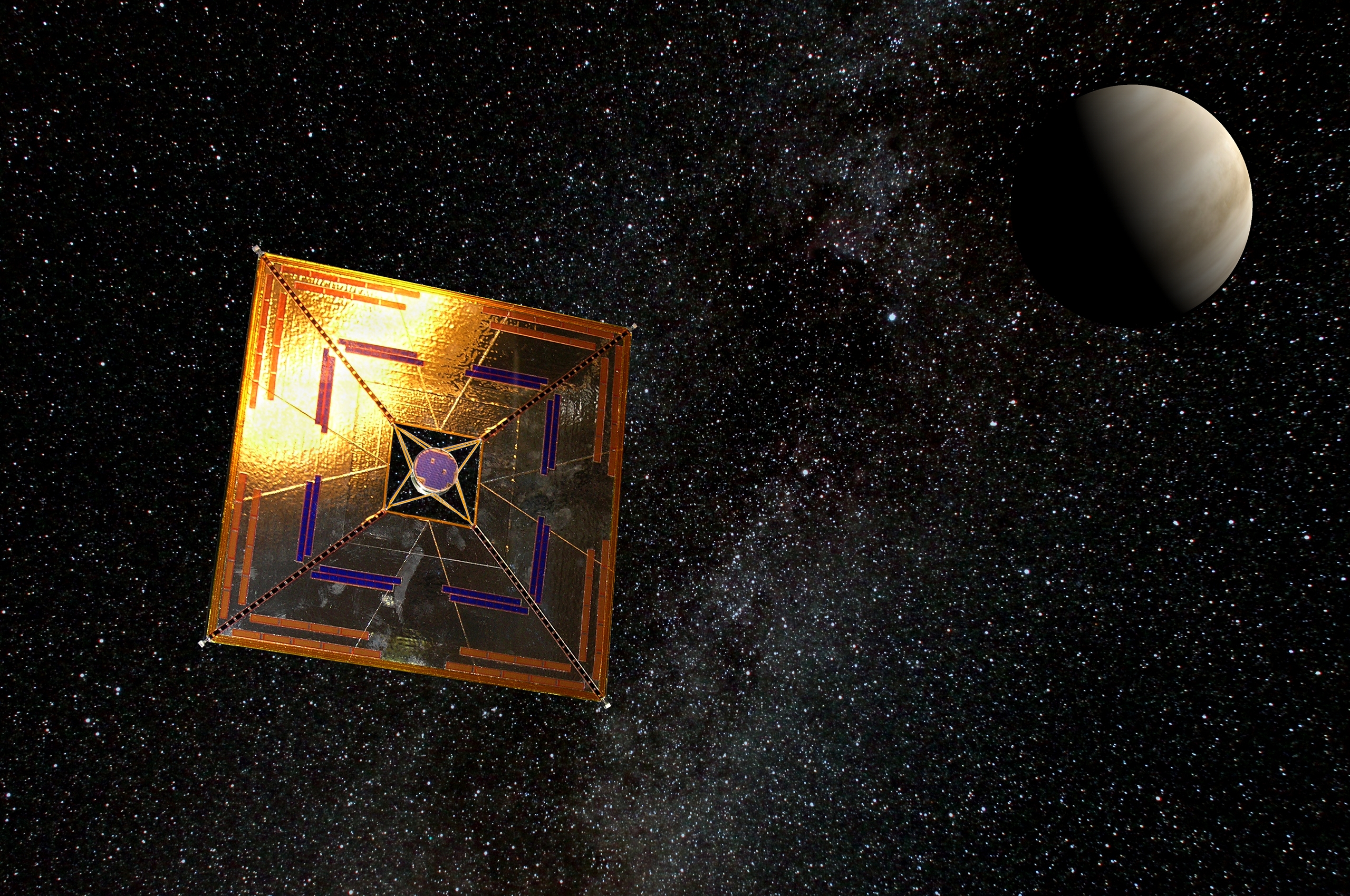
solar_sailOnce more, there are challenges, foremost of which is cost. While the solar sail itself, which could be built around a central, crew-carrying vessel, would be fuel free, there’s the little matter of the lasers needed to propel it. Not only would these need to operate for years continuously at gigawatt strength, the cost of building such a monster would be astronomical, no pun intended!

A solution proposed by Forward was to use a series of enormous solar panel arrays on or near the planet Mercury. However, this just replaced one financial burden with another, as the mirror or fresnel lens would have to be planet-sized in scope in order for the Sun to keep the lasers focused on the sail. What’s more, this would require that a giant braking sail would have to be mounted on the ship as well, and it would have to very precisely focus the deceleration beam.

So while solar sails do present a highly feasible means of sending people to Mars or the Inner Solar System, it is not the best concept for interstellar space travel. While it accomplishes certain cost-saving measures with its ability to reach high speeds without fuel, these are more than recouped thanks to the power demands and apparatus needed to be it moving.

Generation/Cryo-Ship:
ringworld2Here we have a concept which has been explored extensively in fiction. Known as an Interstellar Ark, an O’Neill Cylinder, a Bernal Sphere, or a Stanford Torus, the basic philosophy is to create a ship that would be self-contained world, which would travel the cosmos at a slow pace and keep the crew housed, fed, or sustained until they finally reached their destination. And one of the main reasons that this concept appears so much in science fiction literature is that many of the writers who made use of it were themselves scientists.

The first known written examples include Robert H. Goddard “The Last Migration” in 1918, where he describes an “interstellar ark” containing cryogenic ally frozen people that set out for another star system after the sun died. Konstantin E. Tsiolkovsky later wrote of “Noah’s Ark” in his essay “The Future of Earth and Mankind” in 1928. Here, the crews were kept in wakeful conditions until they reached their destination thousands of years later.
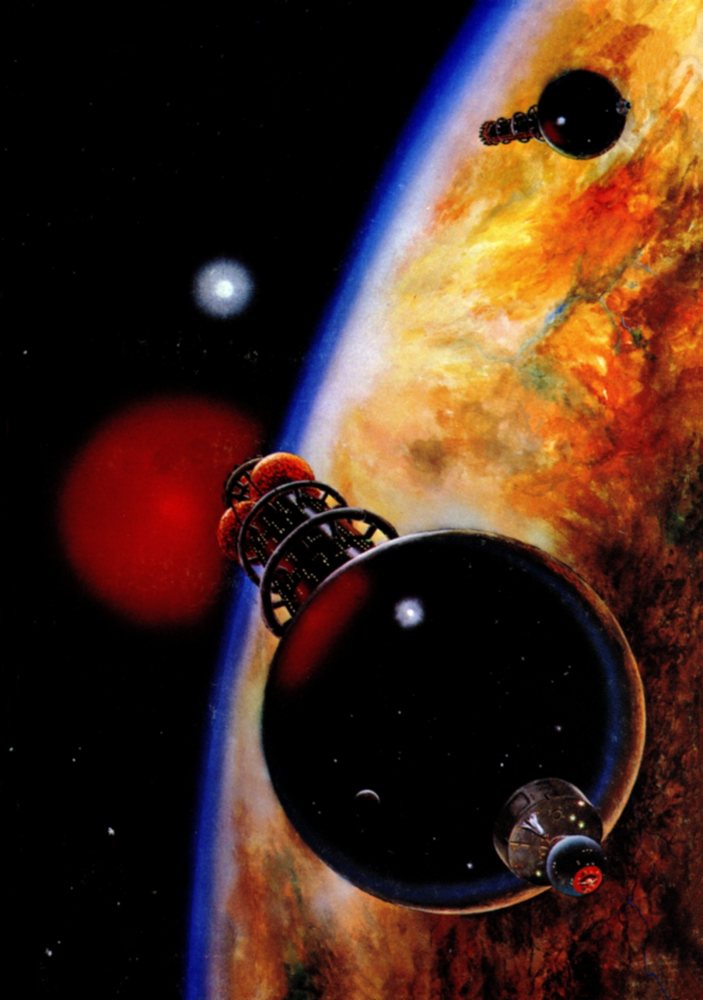
enzmann_starshipBy the latter half of the 20th century, with authors like Robert A. Heinlein’s Orphans of the Sky, Arthur C. Clarke’s Rendezvous with Rama and Ursula K. Le Guin’s Paradises Lost, the concept began to be explored as a distant possibility for interstellar space travel. And in 1964, Dr. Robert Enzmann proposed a concept for an interstellar spacecraft known as the Enzmann Starship that included detailed notes on how it would be constructed.

Enzmann’s concept would be powered by deuterium engines similar to what was called for with the Orion Spacecraft, the ship would measure some 600 meters (2000 feet) long and would support an initial crew of 200 people with room for expansion. An entirely serious proposal, with a detailed assessment of how it would be constructed, the Enzmann concept began appearing in a number of science fiction and fact magazines by the 1970’s.
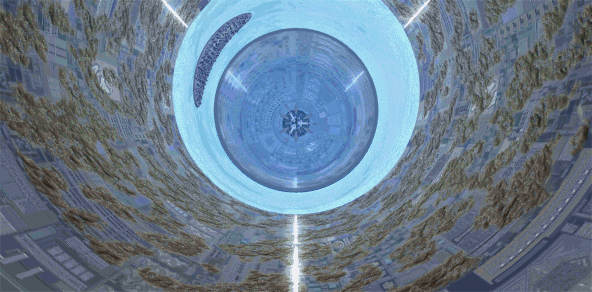
RAMA2Despite the fact that this sort of ship frees its makers from the burden of coming up with a sufficiently fast or fuel-efficient engine design, it comes with its own share of problems. First and foremost, there’s the cost of building such a behemoth. Slow-boat or no, the financial and resource burden of building a mobile space ship is beyond most countries annual GDP. Only through sheer desperation and global cooperation could anyone conceive of building such a thing.

Second, there’s the issue of the crew’s needs, which would require self-sustaining systems to ensure food, water, energy, and sanitation over a very long haul. This would almost certainly require that the crew remain aware of all its technical needs and continue to maintain it, generation after generation. And given that the people aboard the ship would be stuck in a comparatively confined space for so long, there’s the extreme likelihood of breakdown and degenerating conditions aboard.

Third, there’s the fact that the radiation environment of deep space is very different from that on the Earth’s surface or in low earth orbit. The presence of high-energy cosmic rays would pose all kinds of health risks to a crew traveling through deep space, so the effects and preventative measures would be difficult to anticipate. And last, there’s the possibility that while the slow boat is taking centuries to get through space, another, better means of space travel will be invented.

Faster-Than-Light (FTL) Travel:
???????????????????????Last, we have the most popular concept to come out of science fiction, but which has received very little support from scientific community. Whether it was the warp drive, the hyperdrive, the jump drive, or the subspace drive, science fiction has sought to exploit the holes in our knowledge of the universe and its physical laws in order to speculate that one day, it might be possible to bridge the vast distances between star systems.

However, there are numerous science based challenges to this notion that make an FTL enthusiast want to give up before they even get started. For one, there’s Einstein’s Theory of General Relativity, which establishes the speed of light (c) as the uppermost speed at which anything can travel. For subatomic particles like photons, which have no mass and do not experience time, the speed of light is a given. But for stable matter, which has mass and is effected by time, the speed of light is a physical impossibility.

Galactica_newFor one, the amount of energy needed to accelerate an object to such speeds is unfathomable, and the effects of time dilation – time slowing down as the speed of light approaches – would be unforeseeable. What’s more, achieving the speed of light would most likely result in our stable matter (i.e. our ships and bodies) to fly apart and become pure energy. In essence, we’d die!

Naturally, there have been those who have tried to use the basis of Special Relativity, which allows for the existence of wormholes, to postulate that it would be possible to instantaneously move from one point in the universe to another. These theories for “folding space”, or “jumping” through space time, suffer from the same problem. Not only are they purely speculative, but they raise all kinds of questions about temporal mechanics and causality. If these wormholes are portals, why just portals in space and not time?

The supermassive black hole at the center of the Milky Way galaxy.And then there’s the concept of a quantum singularity, which is often featured in talk of FTL. The belief here is that an artificial singularity could be generated, thus opening a corridor in space-time which could then be traversed. The main problem here is that such an idea is likely suicide. A quantum singularity, aka. a black hole, is a point in space where the laws of nature break down and become indistinguishable from each other – hence the term singularity.

Also, they are created by a gravitational force so strong that it tears a hole in space time, and that resulting hole absorbs all things, including light itself, into its maw. It is therefore impossible to know what resides on the other side of one, and astronomers routinely observe black holes (most notably Sagittarius A at the center of our galaxy) swallow entire planets and belch out X-rays, evidence of their destruction. How anyone could think these were a means of safe space travel is beyond me! But then again, they are a plot device, not a serious idea…

alcubierre-warp-drive-overviewBut before you go thinking that I’m dismissing FTL in it’s entirety, there is one possibility which has the scientific community buzzing and even looking into it. It’s known as the Alcubierre Drive, a concept which was proposed by physicist Miguel Alcubierre in his 1994 paper: “The Warp Drive: Hyper-Fast Travel Within General Relativity.”

The equations and theory behind his concept postulate that since space-time can be contracted and expanded, empty space behind a starship could be made to expand rapidly, pushing the craft in a forward direction. Passengers would perceive it as movement despite the complete lack of acceleration, and vast distances (i.e. light years) could be passed in a matter of days and weeks instead of decades. What’s more, this “warp drive” would allow for FTL while at the same time remaining consistent with Einstein’s theory of Relativity.

In October 2011, physicist Harold White attempted to rework the equations while in Florida where he was helping to kick off NASA and DARPA’s joint 100 Year Starship project. While putting together his presentation on warp, he began toying with Alcubierre’s field equations and came to the conclusion that something truly workable was there. In October of 2012, he announced that he and his NASA team would be working towards its realization.

But while White himself claims its feasible, and has the support of NASA behind him, the mechanics behind it all are still theoretical, and White himself admits that the energy required to pull off this kind of “warping” of space time is beyond our means at the current time. Clearly, more time and development are needed before anything of this nature can be realized. Fingers crossed, the field equations hold, because that will mean it is at least theoretically possible!

warp_drive

Summary:
In case it hasn’t been made manifestly obvious by now, there’s no simple solution. In fact, just about all possibilities currently under scrutiny suffer from the exact same problem: the means just don’t exist yet to make them happen. But even if we can’t reach for the stars, that shouldn’t deter us from reaching for objects that are significantly closer to our reach. In the many decades it will take us to reach the Moon, Mars, the Asteroid Belt, and Jupiter’s Moons, we are likely to revisit this problem many times over.

And I’m sure that in course of creating off-world colonies, reducing the burden on planet Earth, developing solar power and other alternative fuels, and basically working towards this thing known as the Technological Singularity, we’re likely to find that we are capable of far more than we ever thought before. After all, what is money, resources, or energy requirements when you can harness quantum energy, mine asteroids, and turn AIs and augmented minds onto the problems of solving field equations?

Yeah, take it from me, the odds are pretty much even that we will be making it to the stars in the not-too-distant future, one way or another. As far as probabilities go, there’s virtually no chance that we will be confined to this rock forever. Either we will branch out to colonize new planets and new star systems, or go extinct before we ever get the chance. I for one find that encouraging… and deeply disturbing!

Source: ngm.nationalgeographic.comnasa.gov, discoverymagazine.com, eng.wikipedia.org, 100yss.org

Manned Mars Mission Update!

Mars_landerMillionaire and space enthusiast Dennis Tito surprised the world with his announcement that he plans to fund a couple’s expedition to Mars. Apparently, the trip is planned to take place in 2018 during a conjunction of our planet with Mars, will take 501 days, and will involve sending a married couple in a capsule roughly the size of a Winnebago. But as time goes on, more news is trickling out of the “Inspiration Mars” program, and some of it is raising eyebrows.

For example, there’s the news that the Mars capsule will involve a rather interesting form of radiation shielding… made of feces. You read that right, the capsule will contain shielding composed of human feces (among other things) that will shield the couple inside from harmful cosmic radiation. But before people begin visualizing some ugly, creepy concoction, let me assure them that this concept is not as unusual as it sounds.

tito-mars-mission-conceptWhen it comes right down to it, this is the greatest health threat the people who go will face, followed shortly thereafter by muscle atrophy, boredom and cramped conditions. And rather than line the capsule with expensive and heavy metals, such as lead, the engineers designing the Inspiration Mars capsule thought they might kill two birds with one stone.

According to Taber MacCallum, co-founder and CEO of the Paragon Space Development Corporation and member of the Inspiration Mars team, explained that the idea had to do with waste recycling and storage. Since the couple will be eating, drinking and defecating within the capsule for a full 501 days, the waste has to go somewhere.

Mars_orbitThe proposed solution? Put it in the walls, along with food and liquid waste, and then desiccate it all to recycle the water. Or, as MacCallum put it:

It’s a little queasy sounding, but there’s no place for that material to go, and it makes great radiation shielding… Dehydrate them as much as possible, because we need to get the water back. Those solid waste products get put into a bag, put right back against the wall.

But to be fair, this proposal is not exactly new. In fact, the idea was mentioned back in 2011 by Michael Flynn, a life support engineer at NASA Ames Research Center, who proposed using urine and feces to shield space stations. Packing for Mars author Mary Roach The Geek’s Guide to the Galaxyalso mentioned it in a 2011 edition of The Geek’s Guide to the Galaxy. NASA’s Innovative Advanced Concepts program is also working out the nuts and bolts of this concept under the name of “Water Walls Architecture”.

Source_croppedWater, MacCallum explained, is the key ingredient here, since it serves as a better radiation shield than metal. It’s the nuclei of atoms that block the radiation you see, and water contains more atoms (and therefore more nuclei) per volume than metal does. Food and waste also provide good radiation shielding, and because the food blocks rather than absorbs the radiation, it will remain safe to eat.

Naturally, McCallum was sure to note that they are still working out some of the logistical problems. For one, they still need to figure out how best to keep the Mars-bound couple from experiencing too many nasty sights and smells on their journey.

Gotta admit, this isn’t something you think about when you hear the word “space travel” do you? But then again, you have to account for things like this. Until people can survive without consuming food and water, and expelling waste, long-term space missions will have to figure out what to do about all the dirty, ugly business people get into!

Sources: newscientist.com, IO9

Space Junk: The of Bane of the Space Age

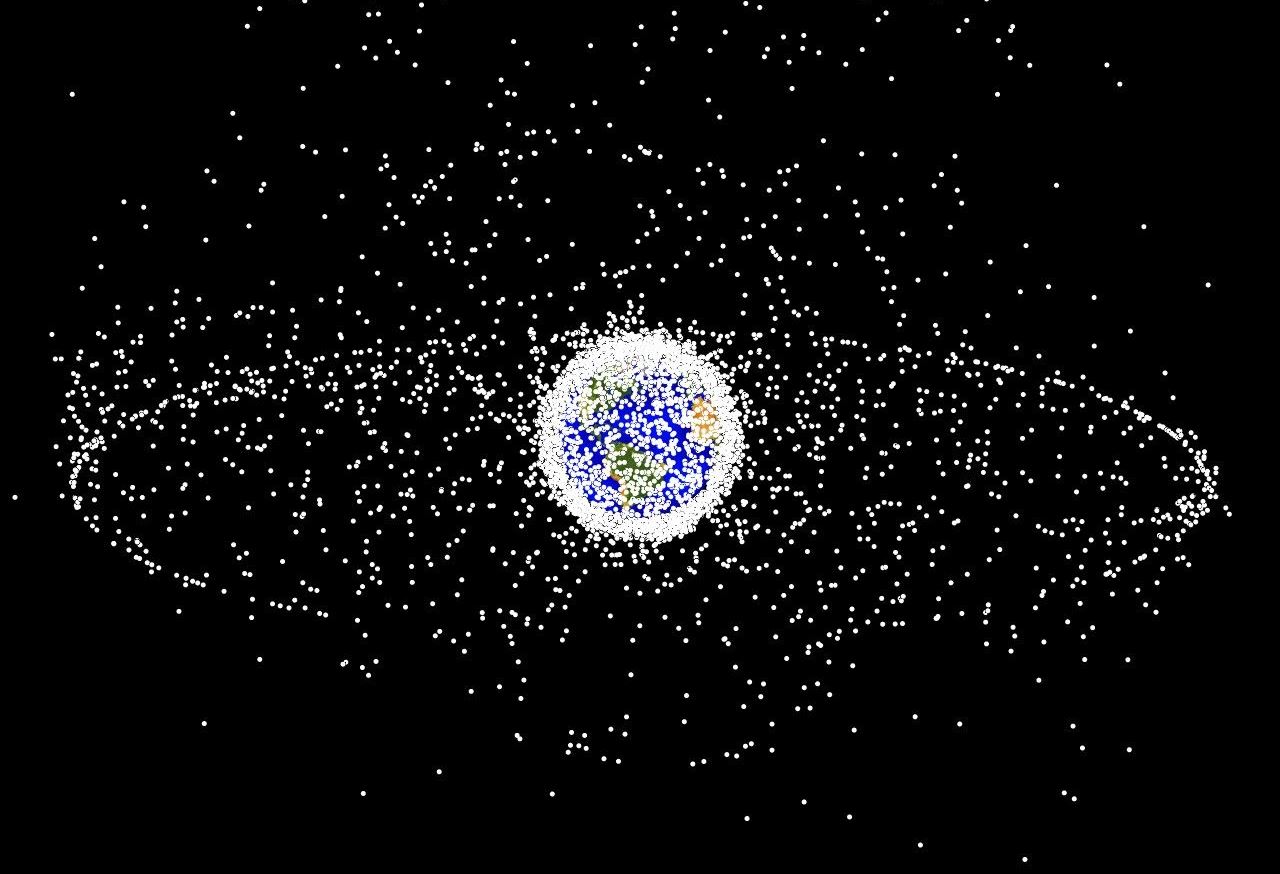
janitorOneSpace, or at least the portion which sits in low orbit around our planet, is quite literally a junkyard. Currently, it is estimated that there over 500,000 bits of debris floating above our world, which takes the form of satellite and rocket components, as well as broken down satellites that ceased functioning long ago. Naturally, these objects pose hazards for space flight, and collisions between objects have been known to occur.

In fact, just three years ago, a U.S. and Russian satellite collided over Siberia, generating an estimated 1,000 pieces of new debris at least 4 inches across. In addition, the International Space Station has to periodically adjust its orbit just to get out of the way of traffic. And since exploration and commercial travel to and from the Moon is expected within the near future, something needs to be done to take the garbage out.

cubesatAnd that’s where CleanSpace One comes into play, a janitor satellite that the Swiss Space Center in the Swiss Federal Institute for Technology (EPFL) began developing last year. Specifically designed to target derelict satellites that threaten our communications and information networks. The satellite has a price tag of 11 million dollars, and is expected to be deployed in three to five years.

Naturally, the task before it is a tricky one. In order to do a “launch and seize” operation, the satellite would have to get onto the same orbital plane as its target, latch onto it at high speed, and then de-orbit it. To do this, EPFL is working on an “ultra-compact motor” to get the janitor onto the right track, as well as a grasping mechanism to grab hold of the space junk once its aligned and within distance of it.


And then there’s the efficiency factor. As it stands, a vessel like the CleanSpace One is a one-shot deal design. Once it’s latched onto space junk, it essentially re-enters the atmosphere with it and drops it below, meaning it is unable to gather up multiple pieces of debris and dispose of them discreetly. As such, it would take even a large fleet of janitor satellites quite a long time before they made a dent in all the space junk.

Luckily, there’s another option that has been on the table even longer than the janitor satellite. The reasoning behind this concept is, if you don’t the means to de-orbit all that space junk, just hit it with some photons! When you consider all the debris in orbit and the havoc it plays with the space lanes, not to mention how its only getting worse, a “targeted” approach may just be what the doctor ordered.

space_laserBack in 2011, James Mason, a NASA contractor at the Universities Space Research Association in Moffett Field, Calif., and his colleagues presented a paper claiming that an anti-collision laser system which would target space debris was feasible. Although they acknowledged that more study was required before it could be implemented, they also claimed that lab simulations suggested that the idea would work in practice.

The idea would center around the deployment of a medium-powered laser of 5 to 10 kilowatts to essentially nudge debris off a potential collision course. Rather than eradicate the junk that clutters up the space lanes, this system would be responsible for anticipated crashes and preventing them by ensuring space junk didn’t cross paths with the ISS, satellites, or orbiting shuttles.

space_debrisAnd even that doesn’t represent the entirety of proposed solutions. In addition to janitor satellites and laser, the Russian Space Agency has also been batting around an idea for an orbital pod that would sweep away satellite debris. Details remain sketchy and little information has been released to the public, but the RSA has claimed that they hope to have such a craft ready to go no later than 2023.

Yes, it seems we as a species are entering into phase two of the Space Age. And in this segment of things, orbital pods, offworld habitations, and exploration into the outer Solar System may very well be the shape of things to come. As such, we’re going to need clearer skies above our heads if anything hopes to make it off of Earth without a series fender bender!

space_debris_wide

Sources: news.cnet, cbsnews.com

Wanted: Married Couple to go to Mars

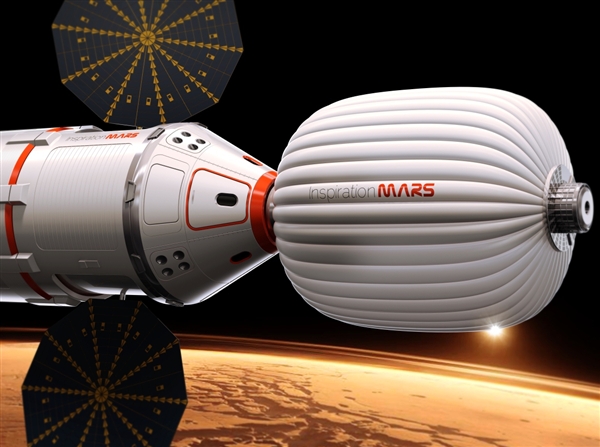
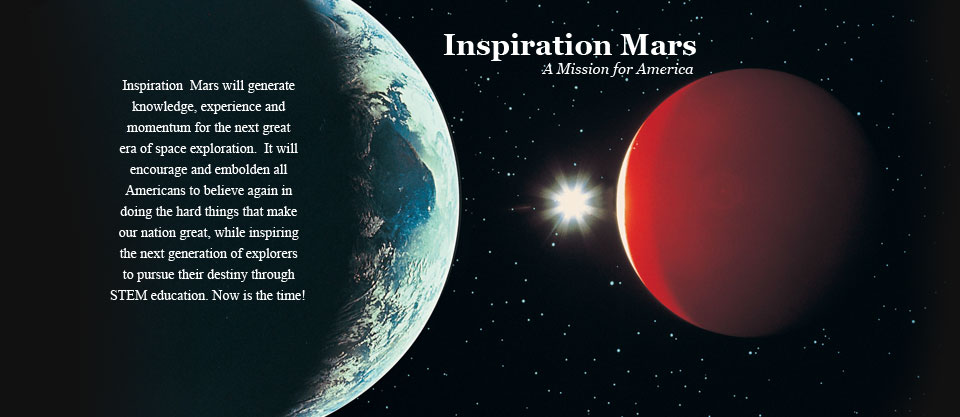
tito-mars-mission-conceptSounds like the setup for a sci-fi romantic comedy doesn’t it? But in fact, it’s the basis for a planned Mars mission which is being hosted by space adventurist Dennis Tito. As the head of the non-profit organization known as Inspiration Mars, Tito has long believed that humanity must seize on the opportunity being provided by a new generation of space exploration, with the intention of becoming a truly “multi-planet species”.

The mission will consist of sending two professional crew members –  who will likely be a married couple – on a “fast, free-return” mission, passing within 160 kilometers of Mars before swinging back and safely returning to Earth. The spacecraft will likely be tinier than a small Winnebago recreational vehicle, and will be launched on Jan. 5, 2018 when planet Earth and Mars will be in alignment.

inspiration_marsTo make it happen, Inspiration Mars has signed a Space Act Agreement with NASA – specifically the Ames Research Center (Ames) – to conduct thermal protection system and technology testing and evaluation, as well as tapping into NASA’s knowledge, experience and technologies. Tito emphasized during their initial meeting that his organization was not looking for money, but a partner to help them develop the required technologies.

The mission system will consist of a modified capsule launched out of Earth orbit using a single propulsive maneuver to achieve the Mars trajectory. An inflatable habitat module will be deployed after launch and detached prior to re-entry. Closed-loop life support and operational components will be located inside the vehicle, designed for simplicity and “hands-on” maintenance and repair.

Mars_A1_Latest_2014As already stated, the mission is a non-profit venture that is designed to inspire. As Tito himself put it:

“[the mission will engage] the best minds in industry, government and academia to develop and integrate the space flight systems and to design innovative research, education and outreach programs for the mission. This low-cost, collaborative, philanthropic approach to tackling this dynamic challenge will showcase U.S. innovation at its best and benefit all Americans in a variety of ways.”

What’s more, Tito believes that the time is right for this mission, and not only because of the orbital window of opportunity. “Investments in human space exploration technologies and operations by NASA and the space industry are converging at the right time to make this mission achievable,” he said.

The mission will last 501 days, and Tito has emphasized that it will be an American adventure, not an international one. Tito himself plans to fund the next two years of the mission, beyond that it will be funded primarily through private, charitable donations, as well as government partners that can provide expertise, access to infrastructure and other technical assistance. He also believes media rights will be a major part of things, since the mission will be an historic first and ought to be caught on tape!

mars_lifeAnd the reason they wanted a married couple to do the deed is quite simple. Jane Poyter, a member of Inspiration Mars explains:

“Imagine, it’s a really long road trip and you’re jammed into an RV and you can’t get out,” Poynter said. “There’s no microgravity … all you have to eat for over 500 days are 3,000 lbs of dehydrated food that they rehydrate with the same water over and over that will be recycled,” adding that the two crew will need the proven ability to be with each other for the long term.

Makes sense. After all, who but a couple already intimately familiar with each others foibles and used to spending an inordinate amount of time together could make it 501 days without killing each other? And as we all know, taking a trip together is the true test of a relationship’s mettle, especially when its a capsule smaller than an RV with no chance of escape!

And for Tito’s sake, I hope things work out. One thing is for sure, his dream of a public-private relationship to make space travel happen is already taking shape.

In the meantime, be sure to check out the promotional animation, showing the mission and the mechanics of the free return trajectory:

Source: www.universetoday.com, inspirationmars.com

Asteriod Prospecting by 2015

asteroid_beltDeep Space Industries, a private aerospace company, has been making a big splash in the news lately. Alongside SpaceX, they have been pioneering a new age in space exploration, where costs are reduced and private companies are picking up the slack. And in their latest bid to claim a share of space, the company announced plans late in January to begin asteroid prospecting operations by 2015.

For some time, the concept of sending spaceships to mine asteroids and haul ore has been explored as a serious option. Within the asteroid belt that lies between Mars and Jupiter, countless tons of precious metals, carbon, silicates, and basaltic minerals. If humanity could tap a fraction of a fraction of that mineral wealth, it would be able to supply Earth’s manufacturing needs indefinitely, without all the harmful pollutants or run off caused by mining.

asteroid_miningSo to tap this potential goldmine (literally!) known as the Asteroid Belt, DSI plans to launch a fleet of mini spacecraft into solar orbit to identify potential targets near to Earth that would be suitable to mine. Lacking the resources of some of the bigger players in the space rush, DSI’s probes will ride-share on the launch of larger communications satellites and get a discounted delivery to space.

Initially, a group of 25kg (55 pounds) cubesats with the awesome designation “Firefly” will be launched on a journey lasting from two to six months in 2015. Then, in 2016, the 32 kilograms (70 pound) DragonFly spacecraft will begin their two-to-four-year expeditions and return with up to 68 kilograms (150 pounds) of bounty each. Beyond this, DSI has some truly ambitious plans to establish a foundry amongst the asteroids.

asteroid_foundryThat’s another thing about the Belt. Not only is it an incredibly rich source of minerals, its asteroids would make an ideal place for relocating much of Earth’s heavy industry. Automated facilities, anchored to the surface and processing metals and other materials on site would also reduce the burden on Earth’s environment. Not only would there be no air to befoul with emissions, but the processes used would generate no harmful pollutants.

In DSI’s plan, the foundry would use a patent-pending nickel gas process developed by one of DSI’s co-founders, Stephen Covey, known as “sintering”. This is the same process that is being considered by NASA to build a Moon Base in the Shackleton Crater near the Moon’s south pole. Relying on this same technology, automated foundries could turn ore into finished products with little more than microwave radiation and a 3D printer, which could then be shipped back to Earth.

deepspaceindustries-640x353Naturally, DSI will have plenty of competition down the road. The biggest comes from Google-backed Planetary Resources which staked it claim to an asteroid last April. Much like DSI, they hope to be able to mine everything from water to fuel as well as minerals and rare earths. And of course, SpaceX, which has the most impressive track record thus far, is likely to be looking to the Asteroid Belt before long.

And Golden Spike, the company that is promising commercial flight to the Moon by 2020 is sure to not be left behind. And as for Virgin Galactic, well… Richard Branson didn’t get crazy, stinking rich by letting opportunities pass him by. And given the size and scope of the Belt itself, there’s likely to be no shortage of companies trying to stake a claim, and more than enough for everyone.

So get on board ye capitalist prospectors! A new frontier awaits beyond the rim of Mars…

Source: Extremetech.com

Life-Giving Elements Found on Mars!

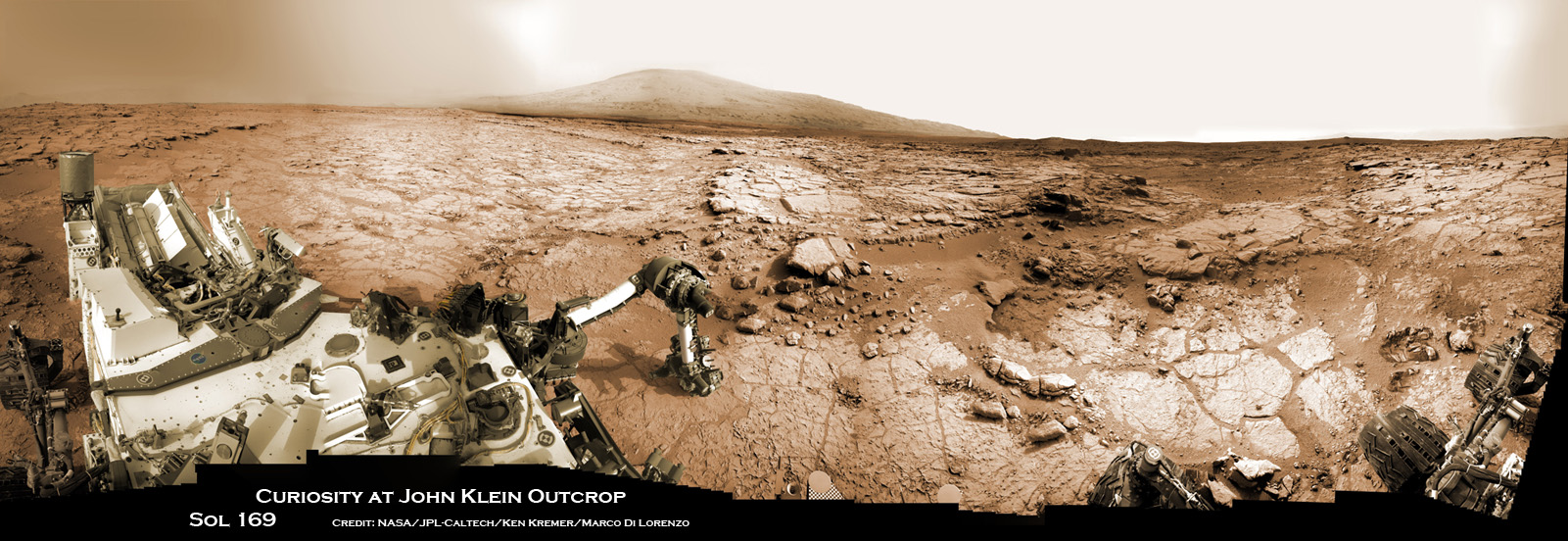
Curiosity_drillingsCuriosity has just finished analyzing the samples collected from its first drilling operation at the John Klein rock formation in Yellowknife Bay. And what it found confirms what scientists have suspected about the Red Planet for some time. Contained within grey the dust collected from the rock’s interior, the rover discovered some of the key chemical ingredients necessary for life to have thrived on early Mars billions of years ago.

After running the two aspirin-sized samples through its two analytical chemistry labs (SAM and CheMin), the Mars Science Laboratory was able to identify the presence of carbon, hydrogen, oxygen, nitrogen, sulfur and phosphorus in the sample – all of which are essential constituents for life as we know it based on organic molecules.

Curiosity_chemWhat’s more, according to David Blake – the principal investigator for the CheMin instrument – a large portion of the sample was made up of clay minerals, which in itself is telling. The combined presence of these basic elements and abundant phyllosilicate clay minerals indicate that the area was once home to a fresh water environment, one where Martian microbes could once have thrived in the distant past.

By confirming this, the Curiosity Rover has officially met one of its most important research goals – proving that all the elements necessary for life to flourish were once present on Mars. And when you consider that the Curiosity team was not expecting to find evidence of phyllosilicate minerals in the Gale Crater, the find was an especial delight. Based on spectral observations conducted from orbit, phyllosilicates were only expected to be found in the lower reaches of Mount Sharp, which is Curiosity’s ultimate destination.

Curiosity-Sol-169_5C1b_Ken-KremerSo what’s next for Curiosity? According to John Grotzinger, the Principal Investigator for the Mars Science Laboratory, Curiosity will remain in the Yellowknife Bay area for several additional weeks or months to fully characterize the area. The rover will also conduct at least one more drilling campaign to try and replicate the results, check for organic molecules and search for new discoveries.

Source: universetoday.com

NASA’s 3D Printed Moon Base

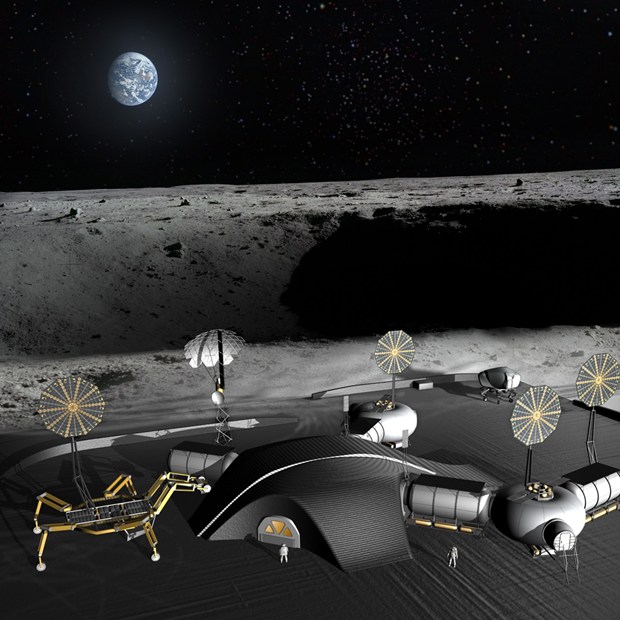
ESA_moonbaseSounds like the title of a funky children’s story, doesn’t it? But in fact, it’s actually part of NASA’s plan for building a Lunar base that could one day support inhabitants and make humanity a truly interplanetary species. My thanks to Raven Lunatick for once again beating me to the punch! While I don’t consider myself the jealous type, knowing that my friends and colleagues are in the know before I am on stuff like this always gets me!

In any case, people may recall that back in January of 2013, the European Space Agency announced that it could be possible to build a Lunar Base using 3D printing technology and moon dust. Teaming up with the architecture firm Foster + Partners, they were able to demonstrate that one could fashion entire structures cheaply and quite easily using only regolith, inflatable frames, and 3D printing technology.

sinterhab2_1And now, it seems that NASA is on board with the idea and is coming up with its own plans for a Lunar base. Much like the ESA’s planned habitat, NASA’s would be located in the Shackleton Crater near the Moon’s south pole, where sunlight (and thus solar energy) is nearly constant due to the Moon’s inclination on the crater’s rim. What’s more, NASA”s plan would also rely on the combination of lunar dust and 3D printing for the sake of construction.

However, the two plans differ in some key respects. For one, NASA’s plan – which goes by the name of SisterHab – is far more ambitious. As a joint research project between space architects Tomas Rousek, Katarina Eriksson and Ondrej Doule and scientists from Nasa’s Jet Propulsion Laboratory (JPL), SinterHab is so-named because it involves sintering lunar dust: heating it up with microwaves to the point where the dust fuses to become a solid, ceramic-like block.

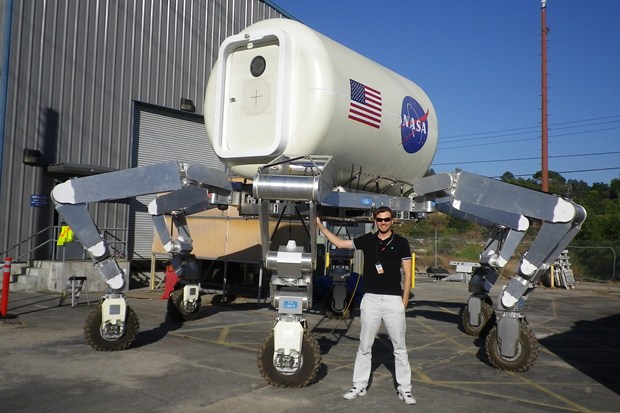
This would mean that bonding agents would not have to be flown to the Moon, which is called for in the ESA’s plan. What’s more, the NASA base would be constructed by a series of giant spider robots designed by JPL Robotics. The prototype version of this mechanical spider is known as the Athlete rover, which despite being a half-size variant of the real thing has already been successfully tested on Earth.

athlete_robotEach one of these robots is human-controlled, has six 8.2m legs with wheels at the end, and comes with a detachable habitable capsule mounted at the top. Each limb has a different function, depending on what the controller is looking to do. For example, it has tools for digging and scooping up soil samples, manipulators for poking around in the soil, and will have a microwave 3D printer mounted on one of the legs for the sake of building the base. It also has 48 3D cameras that stream video to its operator or a remote controlling station.

The immediate advantages to NASA’s plan are pretty clear. Sintering is quite cheap, in terms of power as well as materials, and current estimates claim that an Athlete rover should be able to construct a habitation “bubble” in only two weeks. Another benefit of the process is that astronauts could use it on the surface of the Moon surrounding their base, binding dust and stopping it from clogging their equipment. Moon dust is extremely abrasive, made up of tiny, jagged morcels rather than finely eroded spheres.

sinterhab3Since it was first proposed in 2010 at the International Aeronautical Congress, the concept of SinterHab has been continually refined and updated. In the end, a base built on its specifications will look like a rocky mass of bubbles connected together, with cladding added later. The equilibrium and symmetry afforded in this design not only ensures that grouping will be easy, but will also guarantee the structural integrity and longevity of the structures.

As engineers have known for quite some time, there’s just something about domes and bubble-like structures that were made to last. Ever been to St. Peter’s Basilica in Rome, or the Blue Mosque in Istanbul? Ever looked at a centuries old building with Onion Dome and felt awed by their natural beauty? Well, there’s a  reason they’re still standing! Knowing that we can expect similar beauty and engineering brilliance down the road gives me comfort.

In the meantime, have a gander at the gallery for the proposed SinterHab base, and be sure to check out this video of the Athlete rover in action:

Source: Wired.co.uk, robotics.jpl.nasa.gov

Powered by the Sun: The Future of Solar Energy

Magnificent CME Erupts on the Sun - August 31Researchers continue to work steadily to make the dream of abundant solar energy a reality. And in recent years, a number of ideas and projects have begun to bear fruit. Earlier this year, their was the announcement of a new kind of “peel and stick” solar panel which was quite impressive. Little did I know, this was just the tip of the iceberg.

Since that time, I have come across four very interesting stories that talk about the future of solar power, and I feel the need to share them all! But, not wanting to fill your page with a massive post, I’ve decided to break them down and do a week long segment dedicated to emerging solar technology and its wicked-cool applications. So welcome to the first installment of Powered By The Sun!

spaceX_solararrayThe first story comes to us by way of SpaceX, Deep Space Industries, and other commercial space agencies that are looking to make space-based solar power (SBSP) a reality. For those not familiar with the concept, this involves placing a solar farm in orbit that would then harvest energy from the sun and then beam the resulting electricity back to Earth using microwave- or laser-based wireless power transmission.

Originally described by Isaac Asimov in his short story “Reason”, the concept of an actual space-based solar array was first adopted by NASA in 1974. Since that time, they have been investigating the concept alongside the US Department of Energy as a solution to the problem of meeting Earth’s energy demands, and the cost of establishing a reliable network of arrays here on Earth.

Constructing large arrays on the surface is a prohibitively expensive and inefficient way of gathering power, due largely to weather patterns, seasons, and the day-night cycle which would interfere with reliable solar collection. What’s more, the sunniest parts of the world are quite far from the major centers of demand – i.e. Western Europe, North America, India and East Asia – and at the present time, transmitting energy over that long a distance is virtually impossible.

NASA "Suntower" concept
NASA “Suntower” concept

Compared to that, an orbiting installation like the SBSP would have numerous advantages. Orbiting outside of the Earth’s atmosphere, it would be able to receive about 30% more power from the Sun, would be operational for almost 24 hours per day, and if placed directly above the equator, it wouldn’t be affected by the seasons either. But the biggest benefit of all would be the ability to beam the power directly to whoever needed it.

But of course, cost remains an issue, which is the only reason why NASA hasn’t undertaken to do this already. Over the years, many concepts have been considered over at NASA and other space agencies. But due to the high cost of putting anything in orbit, moving up all the materials required to build a large scale installation was simply not cost effective.

spacex-dragon-capsule-grabbed-by-iss-canadarm-640x424However, that is all set to change. Companies like SpaceX, who have already taken part in commercial space flight (such as the first commercial resupply to the ISS in May of 2012, picture above) are working on finding ways to lower the cost of putting materials and supplies into orbit. Currently, it costs about $20,000 to place a kilogram (2.2lbs) into geostationary orbit (GSO), and about half that for low-Earth orbit (LEO). But SpaceX’s CEO, Elon Musk, has said that he wants to bring the price down to $500 per pound, at which point, things become much more feasible.

And when that happens, there will be no shortage of clients looking to put an SBSP array into orbit. In the wake of the Fukushima accident, the Japanese government announced plans to launch a two-kilometer-wide 1-gigawatt SBSP plant into space. The Russian Space Agency already has a a working 100-kilowatt SBSP prototype, but has not yet announced a launch date. And China, the Earth’s fastest-growing consumer of electricity, plans to put a 100kW SBSP into Low-Earth Orbit by 2025.

space-based-solarpowerMost notably, however, is John Mankins, the CTO of Deep Space Industries and a 25-year NASA vet, who has produced an updated report on the viability of SBSP. His conclusion, in short, is that it should be possible to build a small-scale, pilot solar farm dubbed SPS-ALPHA for $5 billion and a large-scale, multi-kilometer wide power plant for $20 billion. NASA’s funding for SPS-ALPHA dried up last year, but presumably Mankins’ work continues at Deep Space Industries.

Cost and the long-term hazards of having an array in space remain, but considering its long-term importance and the shot in the arm space exploration has received in recent years – i.e. the Curiosity Rover, the proposed L2 Moon outpost, manned missions to Mars by 2030 – we could be looking at the full-scale construction of orbital power plants sometime early in the next decade.

And it won’t be a moment too soon! Considering Earth’s growing population, its escalating impact on the surface, the limits of many proposed alternative fuels, and the fact that we are nowhere near to resolving the problem of Climate Change, space-based solar power may be just what the doctor ordered!

Thanks for reading and stay tuned for the next installment in the Powered By The Sun series!

Source: Extremetech.com

Global Warming Slowed by Volcanoes

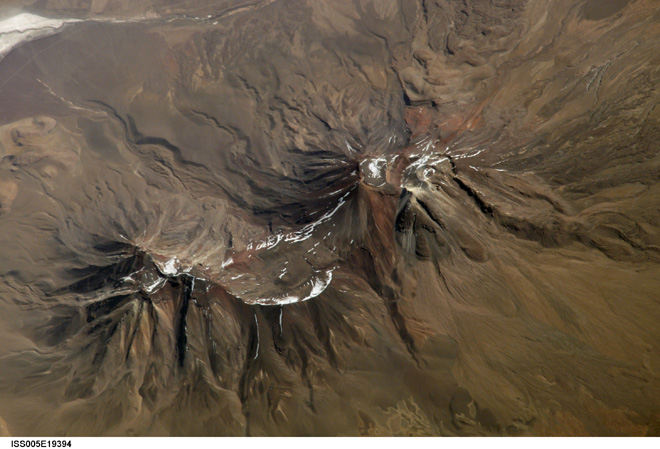
Klyuchevskaya Volcano. NASA Goddard Space Flight Center

Global mean temperatures have been rising in recent years, consistent with every projection provided by Climate Change specialists and planetary ecologists. However, it now seems as though the rate of increase is not as bad as it should have been, thanks to a series of small-to-moderate-sized volcanic eruptions that have spewed sunlight-blocking particles high into the atmosphere.

Between 2000 and 2010, the average atmospheric concentration of carbon dioxide rose more from about 370 parts per million to nearly 390. According to Ryan Neely III, an atmospheric scientist at the University of Colorado, Boulder, if that uptick were the only factor driving climate change, the average global temperature would have risen about 0.2°C. But a surge in the concentration of light-scattering particles in the stratosphere countered as much as 25% of that potential temperature increase.

Sanpedropable Volcano as seen from the ISS
San Pedro Volcano, as seen from the ISS

In addition, Neely and his colleagues ran a series of simulations that indicated that human the human contribution of aerosols to the stratosphere – which would have had a counteractive effect to the carbon – was minimal between 2000 and 2010. William Randel, an atmospheric scientist at the National Center for Atmospheric Research in Boulder claimed that the pattern of stratospheric particulate variations during the past decade “shows the fingerprint of volcanoes, with the right episodes showing up at the right time.”

For some time now, researchers and ecologists have known that sulfur dioxide, a major biproduct of volcanic eruptions, has a global cooling effect. Once introduced into the upper atmosphere, this particulate matter blocks out solar radiation and prevents it from being absorbed by the Earth’s soil, water, and plant life. In fact, it was a massive series of eruptions which took place during the Cretaceous–Paleogene Era that is believed to be linked to the extinction of the dinosaurs.

converted PNM fileFor many years, geoengineers have considered releasing sulfur dioxide into the upper atmosphere in order to slow down the process of Climate Change, a measure intended to give Earth’s scientists more time to develop alternative fuels and its people more time to get their act together. However, at this juncture it seems that the planet has obliged us and given us a bit of window, and completely unheeded.

It’s good to know that human agency alone does not determine the course this planet will take. At the same time however, one should not get too enthused and think this means we’re in for a big reprieve. Based on the most recent data, humanity still only has a few decades before the worst begins to happen and our world slowly becomes uninhabitable.

Source: sciencemag.org, Wired.com


NASA’s Cold Fusion Technology

cold_fusionIn 1989, two scientific researchers – Martin Fleischmann and Stanley Pons – announced the achievement of cold fusion. In a press release that garnered massive amounts of publicity, they stating that their experiment, involving a electrified palladium rod placed in a solution of heavy water, had succeeded in absorbing hydrogen and compressing it within the rod to the point that individual atoms began to fuse and helium was formed.

Naturally, other labs began to test their method and found that the same did not happen for them. With time, the experiment was revealed to be the result of a false positive as more and more labs claimed they unable to replicate the results. In the end, their announcement appeared premature and their claims unscientific. Still, the men never retracted their claim and moved their labs overseas.

NASA_coldfusionAnd interestingly enough, the declaration that they had achieved the dream of clean, abundant, cheap energy fueled the public’s imagination. Henceforth, the concept of cold fusion, as they had preached it, was featured in numerous movies and stories, even though it was now believed to be something of a pipe dream. And for some, the idea of the technology never died. Cold fusion remained a scientific dream similar to a Grand Unifying Theory or the elusive Higgs Boson.

One such organization is NASA, who continues work on this science through the development of their low-energy nuclear reaction (LENR) technology. It is their hope that one day the technology will be sophisticated enough to become commercially viable, making cold fusion reactors that could power everything  – from homes, to cars, to planes – a reality.

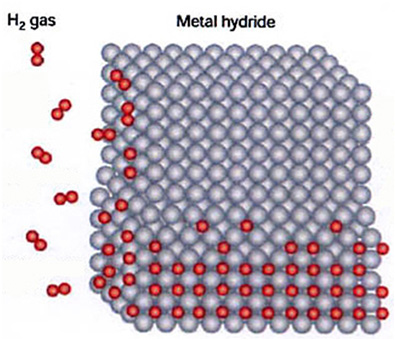
lner-nickel-hydrogen-latticeAnd unlike previous attempts that sought to harness basic fusion, the technology behind the LENR is really quite revolutionary. Rather than rely on strong nuclear forces to meld atoms and produce energy, LENR harnesses the power of weak nuclear force.

This is done by using an oscillating nickel lattice that takes in hydrogen atoms and then exchanges electrons with them. This has the effect of forming slow-moving neutrons which are absorbed, making the nickel unstable. To regain its stability, the nickel strips a neutron of its electron so that it becomes a proton — a reaction that turns the nickel into copper and creates a lot of energy in the process.

The big upside to this process is the fact that it produces zero ionizing radiation and zero radioactive waste, making it the safest and cleanest nuclear process to date. In addition, NASA claims that relying on reactors like these, it would only take 1% of the world’s nickle production to meet the world’s current energy needs, and at a quarter of the cost of dirtier fuels like coal. On top of that, they’ve also indicated that the same process can be done using a carbon lattice instead of nickel, making it even more versatile.

???????????????????????????????So the question remains, why isn’t every household running on a LENR reactor already? Well, two problems. For one, the amount of energy needed to get the ball rolling is quite high. Initially, the LENR requires a 5-30THz frequency burst of energy to make the nickel lattice begin oscillating, which is difficult to efficiently produce.

Second, other labs have experienced a few… uh, accidents… trying to reproduce the process, which included a few explosions and some melted windows. No deaths were reported, mind you, but it does demonstrate that the process can generate a LOT of power if not properly controlled.

Still, other means of generating electricity, such as nuclear fission, have experienced some bumps along the way (i.e. Chernobyl and Three Mile Island) and we still rely on them. And oil and coal are what we’ve come to think of as “dirty means” of generating power, meaning they cause tremendous amounts of pollution or can lead to environmental debacles, such as oil spills. And natural gas can only last so long. So realistically, there may be hope for LENR and cold fusion yet.

Fingers so very crossed! And be sure to check out NASA’s video explaining the process:


Source:
Extremetech.com