More Top Stories of 2012

large-hadron-collider-640x399

With 2012 now officially behind us, and more and more stories trickling into this humble bloggers account about what was accomplished therein, it seems that the time is ripe for another list of breakthroughs, first, and achievements that made the news during the previous year!

Last time, I listed what I saw as the top 12, only to find that there were several others, some of which I actually wrote about, that didn’t make the cut. How foolish of me! And so, to remedy this and possibly cover stories that I neglected to cover the first time around, I have produced another list of the top stories from 2012.

And much like last time, I have listed them according to alphabetical order, since I couldn’t possibly assign them numbers based on importance.

Abortion Study:

anti-abortion-pushAbortion has always been a contentious issue, with one side arguing for the rights of the unborn while the other argues in favor of women’s right to control her own body and reproduction. And as it happens, 2012 saw the publication of the first longitudinal study of what happens to women who are denied this right.

The UC San Francisco research team, Advancing New Standards in Reproductive Health (ANSIRH), studied nearly 1,000 women from diverse backgrounds across the U.S. over several years. All of these subjects were women had sought out abortions but been denied access for one reason or another. What they discovered was that these women were more likely to slip below the poverty line, be unemployed, remain in abusive relationships, and suffer from hyper stress. What this ongoing study demonstrates is that abortion is an economic issue for women, with dire consequences for those denied them.

Autism Reversed:
mice
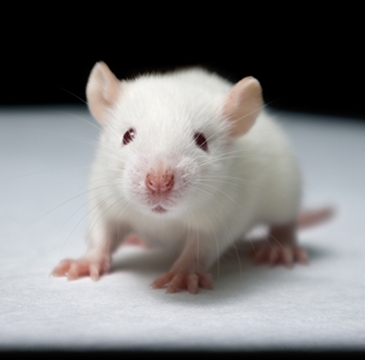
2012 was an especially significant year in medical advances thanks to a team at McGill University in Montreal announced that they’ve successfully reversed the symptoms of autism in mice. Using mice with autism-like symptoms caused by a genetic mutation, the researchers figured out how to administer a protein that reversed the symptoms.

Naturally, this development is a step in the long process of understanding a disorder which remains largely misunderstood. In addition, it may, in time, lead to the development of a gene therapy that will prevent autism from being triggered in children and even weed it out of parent’s genetic code, ensuring that their children will be immune.

Commercial Space Travel:
virgin_galacticIt has long been the dream of financiers, captains of industry and enthusiasts to create commercial space travel; a means for the average person to go into space, the moon, and even beyond. And all at a reasonable price! This dream is still the subject of speculation and fantasy, but 2012 was a year of firsts that made it seem that much closer.

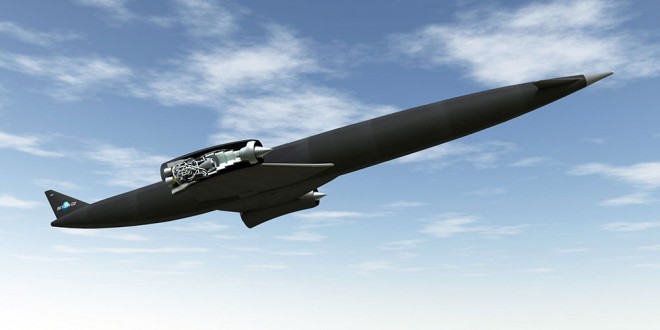
For starters, Virgin Galactic, the brain-child of Richard Branson, began flight tests on SpaceShipTwo, the rocket ship that will take people into orbit. Then came Reaction Engines Limited with the proposed design for the hypersonic aerospace engine. And finally, there was the creation of Golden Spike, a company made up largely of former astronauts, who want to make commercial flight to the moon a go by 2020.

Electricity-Creating Virus:

M13_virusA breakthrough virus named M13 made news in 2012 for being the first ever virus that could turn physical activity into electricity. The key is what is known as the “piezoelectric effect,” which happens when certain materials like crystals (or viruses) emit a small amount of power when squeezed. Created by a  team of scientists at the Berkeley Lab, this genetically engineered M13 viruses was able to emit enough electricity to power a small LED screen, but poses no threat to humans. One day, all devices could be powered through the simple act of typing or walking, and buildings could be powered by absorbing people’s activity.

Encyclopedia of DNA (ENCODE):
encodeThe publication of the human genome back in the late 90’s was a major breakthrough for genetics and medical science. And in 2012, another breakthrough was achieved by researchers at USC with the publication of ENCODE – The Encyclopedia of DNA Elements Project. Unlike the previous project, these researchers were able not only to catalog the human genome’s various parts, but what those components actually do.

Among the initiative’s many findings was that so-called “junk DNA” – outlier DNA sequences that do not encode for protein sequences – are not junk at all, and are in fact responsible for such things as gene regulation, disease onset, and even human height. These findings will go a long way towards developing gene therapy, biotechnology that seeks to create artificial DNA and self-assembling structures, and even cloning.

Face Transplant:
FaceTransplant_6062012 was also the year that the first full-face transplant was ever conducted. The recipient in question was a man named Richard Norris, a man who lost significant portions of his face from a gunshot accident back in 1997. And after years of attempted reconstructive surgeries, doctors working out of the University of Maryland Medical Center performed a procedure that gave Mr. Norris a has face, teeth, tongue, and a completely new set of jaws.

Not only that, but within days of the surgery, Norris was able to move his facial muscle and jaw. Combined with the nature of the surgery itself, this is not short of unprecedented, and could mean a new age in which severe accident victims and veterans are able to recover fully from physical traumas and live perfectly normal, happy lives.

The Higgs Boson Discovered:
higgs_boson
I can’t believe I didn’t include this story last time, as it is possibly the biggest story of 2012, and perhaps one of the biggest stories since the millennium! 2012 will forever go down in history as the year that the Higgs Boson was discovered. After some 40 years of ongoing research, and fears that it would never be discovered, the last missing piece of The Standard Model of particle physics was found.

Not only does the existence of the Higgs Boson confirm that the Standard Model is valid, it also helps explain how other elementary particles get their mass. This will herald a new step in the advance of particle and the quantum physics, and could lead to the development of quantum computing, quantum generators, and a greater understand of the universe itself.

High-Tech Condom:
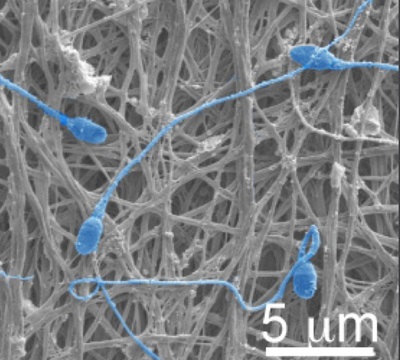
condom1Using a revolutionary nano-fabrication process known as electrospinning, researchers at the University of Washington have produced the world’s first female condom that not only prevents pregnancy and protects against HIV, but also evaporates after use. In addition, the manufacturing method used is a step in the direction of viable nanotechnology. Score one for safe sex, public health, and a waste free future permeated by tiny machines and smart materials! That’s a big score card…

Infinite Capacity Wireless:
vortex-radio-waves-348x1962012 was also the year that it was proven that it could be possible to boost the capacity of wireless communication infinitely. The discovery was first made by Bo Thide of the Swedish Institute of Space Physics and some Italian colleagues in Venice, and then confirmed by a team of American and Israeli researchers who used the technique to transmit data at a rate of 2.5 terabytes a second.

Conventional radio signals are transmitted on a flat plane, but Thide twisted the transmitting and receiving antennae into the shape of corkscrew. By adding another dimension to the mix, the technique added a lot of extra bandwidth. As a result, the problem of bandwidth crunches might be a thing of the past, not to mention problems of slow download/upload.

Google Neural Net:
googleneuralnetwork1
Another first and definitely one of the biggest headlines of 2012, far as I was concerned. So why I forgot to include it last time is beyond me! For generations scientists have contemplating the idea of AI and wondered how and where the first leap might be made from basic computing towards true machine intelligence. And as it turns out, Google X Labs, the same place where Project Glass was conceived, seems to have accomplished just that.

The accomplishment came when the labs created a neural network based on sixteen core processors and a connectome with a billion connections. The network accomplished its first task by studying millions of images on Youtube and then demonstrating the ability to differentiate between the faces of cats and humans. This act of independent reasoning that went beyond mere image recognition, and is a major step towards the achievement of a fully-functional artificial intelligence.

Stem cell mammal:
stem_cellsFor the first time in history, researchers at Kyoto University created a mouse by using eggs derived from stem cells alone. The achievement once again shows the remarkable possibilities presented by regenerative technologies like stem cells, while raising pressing ethical questions about the potential for human births in which parents might not be required.

Water in the Solar System:
titan_lakes2012 was also the year that an unprecedented amount of discoveries were made in our solar system. In addition to all the interesting revelations made by the Curiosity Rover, a number of probes discovered water on Europa, Mercury, Titan, and other Saturnalian moons. Usually, this comes in the form of water saturated with hydrocarbons, as was evident on Titan, but the discoveries remain monumental.

In addition to Titan’s methane lakes and Nile-like river, ice and organic molecules were discovered near the poles of Mercury. Evidence of water was found on Mars, indicating the existence of rivers and oceans at one time, and the Cassini space probe confirmed that Enceladus has its own oceans. All of this bodes well for the future of space exploration and colonization, where domestic sources of water may be used for hydrogen cells, hydroponics and even drinking water.

World’s First Tractor Beam:
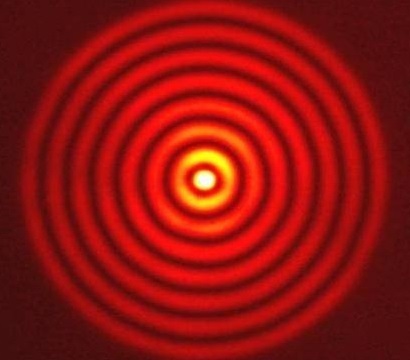
tractor_beamIn another interesting first, NASA scientists demonstrated in 2012 that another staple technology from Star Trek may be realizable. Yes, in addition to the warp drive, scientists scientists David Ruffner and David Grier demonstrated that a tractor beam may also be realizable in the not-too-distant future. And given the 100 Year Starship Project and other desires to commit to space exploration, such a device could come in mighty handy!

Using a prototype optical beam to pull a small sphere of silica (30 micrometers) suspended in water, Grier and Ruffner pioneered the use of a Bessel beam, a long-established concept, to pull an object of discernible size and mass around. Naturally, NASA hopes to create a more high-powered version of the technology for use on space craft down the road.

*                    *                    *

Thank you once more for attending this symposium on technological breakthroughs during the year of 2012! It was a good year, wouldn’t you say? And barring the advent of killer robots sometime in the near future that unleash a nuclear holocaust on us and force us all to work as slaves, I think people will look back on these developments in a positive light.

Yes, assuming humanity can keep its wits about itself and ensure the ethical application of all we’ve accomplished, 2012 may be seen as a turning point, where incurable diseases became preventable, AI’s became realizable, and limitless communications, super-fast computations, paper-thin flexible devices, green technology, commercial spaceflight, and Solar planet colonization all became truly viable.

Source: extremetech.com, IO9.com

The Moon: The Next Hot Vacation Destination?

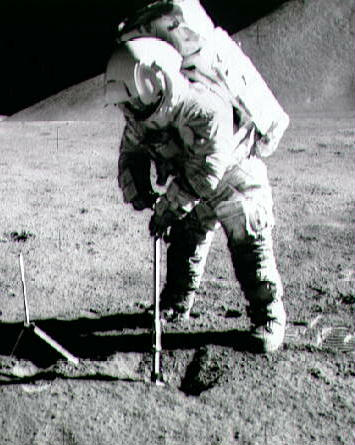
apollo17Back in 2006, a series of millionaires shelled out a hefty 20 million dollars for a round trip to the International Space Station. At the time, this was considered quite the privilege, seeing as how civilian personnel almost never get to go into space or spend time on the ISS. But as it turns out, this story may be on its way to becoming small potatoes, thanks in part to a new company that has announced plans to mount commercial voyages to the moon by 2020.

Apollo_11_bootprintThe company is called Golden Spike, a company made up largely of former astronauts and personnel who want to use existing and future technology to make private Lunar trips possible. Its current chairman is Gerry Griffin, Apollo flight director and former director of NASA’s Johnson Space Center. The president and CEO is planetary scientist Alan Stern, former head of all NASA science missions.

Given the cost, Golden Spike is mainly focused on offering its services to governments at the moment, much like how Russia has offering its services to governments looking to get to the ISS in the past few years. In that case and this one, these would be nations that would like to participate in space and planetary exploration but can’t afford a program of their own. But of course, should there be private citizens who want to book a ride and can afford it, they are not likely to be turned away!

Alpha Moon Base at http://www.smallartworks.ca

Granted, at one time, science fiction writers were predicting that humanity would have bases on the moon by the early 21st century. But those predictions were largely abandoned thanks to the scrapping of the Apollo program and the fact that the ISS was Earth’s only orbiting space station by the turn of the century. And of course, the only way to get there cost private citizens 20 million bucks!

But this announcement, which comes on the heels of several encouraging developments, may have reignited these hopes. First, there was Reaction Engines Ltd’s announcement of the concept for the Skylon hypersonic engine , followed shortly thereafter by Virgin Galactic’s successful deployment of SpaceShipTwo. Given the pace at which aerospace is evolving and progressing, commercial flight to the moon may be coming, though a little later than previously expected.

However, making it affordable remains a daunting task. As it stands, Golden Spike’s own estimates place the cost of a single trip to the Moon at roughly 1.5 billion dollars. Naturally, the company has also indicated that they intend to make the process more affordable so all people can make the trip. No telling how this will be achieved, but if history is any indication, time has a way of making technology cheaper and more commercially viable.

apollo14So… vacation on the moon anyone? Hell, I can envision an entire line of spas, time shares and getaways on the Lunar surface in the not-too-distant future. Sure, it may not be the Mediterranean or the Mayan Riviera, but I can think of plenty of fun activities for people to do, and the novelty factor alone ought to sell tickets. Rover tours, visits to the Apollo landing sites, low-g sports and anti-aging therapies. Oh, and if Alan Shepard and the Apollo 14 mission are any indication, you can even play golf there!

Check out this video of Golden Spike’s proposed tours to the Moon, or learn more about the company by visiting their website.

Source: news.cnet.com

Volcanoes on Venus?

venus_terraformIn spite of the challenges posed in studying the planet Venus – see dense clouds of sulfuric acid and surface temperatures in excess of 480 degrees C – scientists have learned quite a bit in recent years from orbiting spacecraft about the planets atmosphere and surface.

For example, the European Space Agency’s Venus Express made an interesting discovery that made the news recently. In short, since its arrivals in 2006, it detected has a sharp decline in atmospheric sulfur dioxide (SO2) concentrations, which followed in the wake of a spike in SO2 concentrations.

The most plausible explanation for this, according to Emmanuel Marcq, is a volcanic eruption, caught in the act. Marcq is the lead author on the report detailing this occurrence, which appeared in a recent issue of Nature Geoscience. A volcano is not the only possibly, he admits. “We know that on Earth there are long-term atmospheric cycles,” he says. “So it could happen on Venus as well. We can’t dismiss this possibility at the moment.”

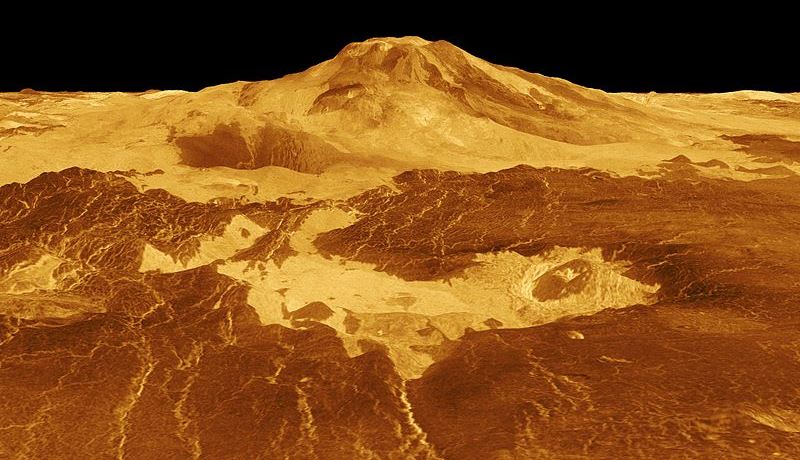
Venus_Maat_MonsBut of course, volcanoes are much more likely. Not only are they the a known source of SO2 (at least on Earth), the surface of Venus is also peppered with volcanoes and its surface is marked by extensive volcanic activity. Most of these are extinct, but evidence obtained over the past few decades have indicated that there may be some that are still active.

For example, back in the early 1980’s Pioneer Venus documented SO2 levels nearly 50 times higher than anyone expected, followed by a steady dramatic decline. Then in the early 1990’s, the Magellan spacecraft detected what appeared to be fresh lava. “It’s very similar to the one we’re observing now,” said Marcq.

Naturally, this sort of activity is one of the things that makes Venus such a rosy place to live! In addition to the runaway Greenhouse Effect that has turned its atmosphere into the carbon choked, acidic stuff of death, its surface is prone to recurring lava flows and hot magma. Naturally, it will be quite the feat to land a satellite on the surface to conduct research in the same way that we currently do Mars. And as for terraforming, which has also been proposed, that too will be quite the challenge!

A Look at “Living Mars”

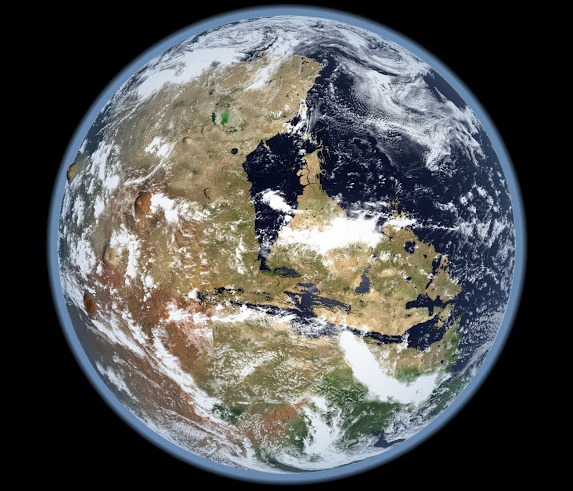
Living-Mars With the confirmation that Mars with once home to oceans and rivers, and with speculation that a terraformed Mars will once again, there are many who wonder what a “Blue Mars” would look like. As it happens, a software engineer named Kevin Gill took it upon himself to create a series of images showing what a “living Mars” might look like.

Relying on his own imagination and a series of combined source material, the Red Planet gets a makeover, with aesthetically pleasing results! In an interview via email, Gill said the following of his process:

“This was something that I did both out of curiosity of what it would look like and to improve the software I was rendering this in. I am a software engineer by trade and certainly no planetary scientist, so with the exception of any parts derived from actual data, most of it is assumptions I made based on simply comparing the Mars terrain to similar features here on Earth (e.g. elevation, proximity to bodies of water, physical features, geographical position, etc) and then using the corresponding textures from the Blue Marble images to paint the flat image layer in a graphics program.”

Living-Mars.2For example, the view above is of the western hemisphere of Mars, with Olympus Mons on the horizon beyond the Tharsis Montes volcanoes and the Valles Marineris canyons near the center. The placement of clouds and the atmosphere was mainly to achieve a sense of scale and grandeur, but the rest is in keeping with information obtained by NASA over the years.

And these are just some of the images Gill has made over the years. His Flickr is awash in visualizations, many of which are of Mars, the Moon, and of course Earth, all of which are rendered from orbit. He also makes 3D models of geographic features, which comes in handy when its time to construct large-scale models.

Moon Probes End Mission With A Crash/Bang

moonAs part of NASA’s ongoing Lunar studies, and perhaps to assist in the eventual creation of a lunar outpost, NASA’s latest Lunar satellites – known as Ebb and Flow – ended their mission with a crash and a bang on Dec. 16th, at precisely 5:28 p.m. EST, which was confirmed by the sudden loss of radio contact.

After launching back in September with the intention of mapping the gravitational field of the Moon, the satellites ended their mission by intentionally crashing down rather than waiting for the inevitable orbital decay. The purpose of this mission, which cost taxpayers a hefty $500 million, was to gain insight into the moon’s internal structure.

In what is known as a “targeted impact”, the flight controllers at the Jet Propulsion Laboratory guided the satellites into the side of a mountain-like section of a partially buried crater rim near the moon’s north pole. After conducting their mission close to the Lunar surface, it was known that the satellites orbits would decay and they would eventually crash on their own.

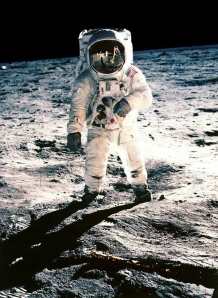
Neil_armstrong_moonWith their fuel nearly exhausted and the mission’s scientific observations complete, mission managers opted to burn the last of their propellant and crash the satellites, rather than risk that they might one day fall to the surface at or near a so-called “lunar heritage site,” including six where manned Apollo missions landed and more than a dozen where unmanned U.S. and Russian probes touched down.

In addition to their compliment of scientific instrumentation, each spacecraft also carried cameras used by middle school students to photograph the lunar surface. This was all part of a project sponsored by Sally Ride Science, a science education company founded by the late shuttle astronaut.

The spacecraft hit the moon in darkness and even though they were moving at some 6116 km/h (3,800 mph), mission managers did not expect any observers on Earth to see a flash or any other telltale signs of the impact. But NASA’s Lunar Reconnaissance Orbiter will be on the lookout for any signs of fresh craters during subsequent passes over the region.

Source: news.cnet.com

A Curiosity Christmas!

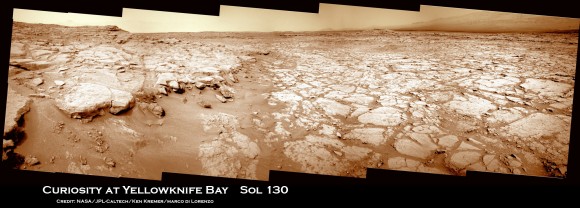
marsHey all! It’s a new year, a new day, but hopefully, there’s still some holiday cheer to go around! And in that spirit, I thought I’d share some news which came in over the holidays concerning Curiosity’s mission to Mars. For the rover, Christmas was celebrated at a location dubbed “Grandmas House”. Well, technically it spent it at Sol 130, a designated point in an area known as “Yellowknife Bay”. This area is a small depression located in the geographic region known as Glenelg, some 400 meters from “Bradbury Landing” where it first put down.

Curiosity-at-Yellowknife-Bay-Sol-130_3a_Ken-Kremer-580x208It is in Yellowknife Bay that Curiosity has been engaged in searching for its first target site to drill for a rock sample. The purpose of this to test out the rover’s high powered hammering drill, a test which has been put off because the Mars Science Team feared that the rock samples at other locations were not optimal. But the Glenelg area – which lies at the junction of three different types of geologic terrain – features a different type of geologic terrain compared to what Curiosity has driven on previously.

Curiosity-Yellowknife-Bay-Sol-125_2c_Ken-Kremer-580x151While there, Curiosity snapped a series of panoramic pictures of the area, which NASA compiled into the photos seen here and at the top. The rover also used its the APXS X-ray mineral spectrometer, ChemCam laser and MAHLI hand lens imager to gather initial science characterization data on the region and its rocky outcroppings. As you can plainly see, Yellowknife Bay was aptly named, being quite similar in appearance to its namesake here on Earth.

Hard to say what Curiosity will find once its begins drilling, but NASA is sure to be raving about it, either way. Everyone knows those Mars Science Laboratory people can’t keep anything a secret, even when they’re not sure they’ve got anything. Yes, MSL, that was a veiled reference to that “Earthshaking news” story you got us all excited about. And to answer you’re next question, no, I haven’t gotten over it yet. Can’t you tell?

Stay tuned for more news from the Red Planet! And while you’re at it, check out the video below where MSL team member Colette Lohr, the Tactical Uplink Lead, provides the latest video update on the Curiosity rover.

Source: Universetoday.com, (2)

NASA Takes on “Gangnam Style”

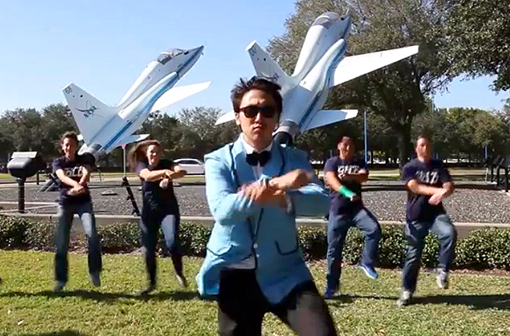
nasa-johnson-style_510x336NASA recently took a challenge to produce a music video parodying Psy’s “Gangnam Style”. Entitled “NASA Johnson Style!” the song takes its name from NASA’s Lyndon B. Johnson Space Center, a facility which houses educational programs for interns and students aspiring to progress further into the field of space science. It was there that this video was made, by several such young people who were very inspired (or perhaps had too much time on their hands).

According to the video’s description, the eclectic group of youths claimed that the parody was intended to “inform the public about the amazing work going on at NASA and the Johnson Space Center.” And in addition to its cheeky lyrics, the video also features some rather famous characters, such as veteran astronauts Tracy Caldwell Dyson, Mike Massimino and Clay Anderson.

Check it out!

Source: Cnet.com

Top Stories of 2012

biotech_alienAs Dec. 31st fast approaches, I find myself thinking about New Years resolutions. And part of that is taking stock on what’s been accomplished in the past year. For me, one of those resolutions was to stay current and share all the new and exciting news from the field of science and tech all my followers people; to the best of my abilities, that is.

In keeping with this, I wanted to create a list of the most important developments of the last year. Many sites have produced a top 10, top 12, even a top 7, list of what they thought the most significant accomplishments were. Well, I wanted to do one of my own! Opinion varies as to what the biggest leaps and bounds were over the course of the last year, and I’ll be damned if I don’t get my say in. Lord knows I’ve spent enough time reading about them, so here’s my comprehensive list of the greatest inventions, developments and advances made during 2012.

I think you’ll all agree, the list packed with stories that are intriguing, awe-inspiring, and even a little scary! Here are the top 12, as selected by me, in alphabetical order:

3D Printing:
cartilage1As far as tech trends go, this one has been in the works for some time. However, 2012 will be remembered as the year that 3D printing truly became a reality. From tree-dimensional models to consumer products to even guns, 3D printers have been featured in the news many times over for their potential and frightening abilities.

However, one of the greatest potential uses will be in the field of artificial cartilage, organs, and even food. As the technology is refined and expands to the field of organic molecules, just about anything can and will be synthesized, leading to an era where scarcity is… well, scarce!

Bionic Implants:
mindcontrolledprostheticPerhaps the years biggest achievement came in the form of bionic prosthetics, artificial limbs which are calibrated to respond to the nerve impulses of the user. As a result, amputees, veterans and accident victims are able to receive artificial limbs that act like the real thing.

The most notable case was Zak Vawter who scaled the 103 flights of Chicago’s Willis Tower using an artificial leg. In addition, two men in Britain had their sight restored after undergoing the first ever case of retinal surgery where bionic implants were placed in their eyes.

Brain Implants:
digital-mind1In September of 2012, scientists grafted an implant onto the brain of Chimpanzee, enhancing its brain power by ten percent. This consisted of an electrode array that was attached to the cerebral cortex of several monkey subjects, researchers were able to restore and even improve their decision-making abilities.

The implications for possible therapies is far-reaching, such as with brain injuries and cognitive disorders. But additionally, it also heralds the beginning of an era where human beings will be able to enhance their intelligence, recall, and memory retention.

Commercial Space Flight:
skylonThough not yet fully realized, 2012 was a big year in terms of commercial space flight. For example, Richard Branson and Virgin Galactic announced the first successful fully-loaded “glide test” of SpaceShipTwo, the rocket craft that will be taking passengers into low orbit as soon as all the kinks are worked out of the design.

In addition, Reaction Engines announced a breakthrough with the design of their hypersonic engine, which they claim will be fitted to their proposed spaceship – the Skylon. Capable of achieving speeds of up to Mach 5, this new craft is expected to be able to take off from conventional airfields, propel itself into low orbit, and deliver supplies to the ISS and make commercial trips around the world. No telling when either company will be conducting its first real suborbital flights, but the clock is ticking down!

Curiosity Rover:
Curiosity_selfportrait
One of the years biggest announcement was the deployment of the Curiosity Rover on the Martian surface. Since it landed, the rover has provided a constant stream of scientific updates and news on the Red Planet. Though the Mars Science Team did not find the “earthshaking” proof organic molecules, it did make a number of important discoveries.

Amongst them was solid evidence that Mars was once home to large rivers and bodies of water. Furthermore, the x-ray lab on board the rover conducted studies on several rock and soil samples, determining what the chemical and mineral composition of Mars surface is.

Faster-Than-Light Travel:
alcubierre-warp-drive-overviewIn the course of speaking at the 100 Year Starship, scientists at NASA began working on the first FTL travel system ever. Long considered to be the stuff of science fiction, physicist Harold White announced that not only is the math sound, but that his team at NASA had actually started working on it.

Relying on the concept of the Alcubierre Drive, the system involves expanding and contracting space time around the ship, allowing it to move faster than the speed of light without violating the Law of Relativity.

Geo-engineering:
converted PNM file
In October, the world’s first – and illegal – act of geo-engineering took place off Canada’s West Coast. The product of a “rogue geohacker” named Russ George, who was backed by a private company, the project involved the dumping of around 100 tonnes of oron sulphate into the Pacific Ocean. This technique, known as ocean fertilization, was meant to stimulate the growth of algae which metabolize carbon and produce oxygen.

The experiment, which is in violation of two United Nations moratoria, outraged many environmental, legal, and civic groups, many of whom hail from Haida Gwaii, the traditional territory of the Haida nation, who had enlisted by George as part of a proposed “salmon enhancement project”. Though illegal and abortive, the act was the first in what may very well become a series of geoengineering efforts which will be performed the world over in order to stay the progress of Climate Change.

Google’s Project Glass:
google_glasses2012 was also the year that augmented reality became… well, a reality (oh dear, another bad pun). Back in April, Google unveiled its latest concept device for wireless and portable computing, known as Project Glass. Combining an active display matrix, a wireless internet connection and a pair of shades, Google managed to create a device that looks like something straight out of cyberpunk novel.

HIV and Flu Vaccines:
HIV-budding-ColorWhen it comes to diseases, HIV and the Flu have two things in common. Until 2012, both were considered incurable, but sometime in the near future, both could be entirely preventable. In what could be the greatest medical breakthroughs in history, 2012 saw scientists and researchers experiment with antibodies that have been known to fight off HIV and the flu, and to good effect.

In the former case, this involved using a new process known as Vectored ImmunoProphylaxis (VIP), an inversion of the traditional vaccination method, where antibodies were introduced to mice. After allowing the antibodies to reproduce, researchers at Caltec found that the mice were able to fight off large quantities of the virus. In the latter, researchers at the Friedrich-Loeffler Institute in Riems Island, Germany used a new RNA-based vaccine that appeared to be able to fight off multiple strains of flu, not just the latest mutation.

Taken together, these vaccines could bring an end to a common, but potentially deadly ailment, and signal the end of the plague of the 20th century. In addition, this could be the first in a long series of developments which effectively brings all known diseases under our control.

Medical Implants:
enhancement2012 also saw the culmination of several breakthroughs in terms of biomedical research. In addition to the world’s first medimachine, there were also breakthroughs in terms of dissolving electronics, subdermal implants that dispense drugs, and health monitoring patches.

Little wonder then that Cambridge University announced the creation of the Center for the Study of Existential Risk to evaluate future technologies, or that Human Rights Watch and Harvard University teamed up to release a report calling for the ban of “killer robots”. With all the potential for enhancement, it could be just a matter of time before non-medical enhancements are a reality.

Mind-controlled prostheses:
woman-robotic-arm_650x366Researchers at BrainGate created a brain-machine interface that allows users to control an external device with their minds. The first person to use this revolutionary new system was Cathy Hutchinson, a stroke victim who has been paralyzed from the neck down for 15 years, who used the robotic arm to drink a cup of coffee.

This news, combined with other advances in terms of bionic prostheses, could signal the end of disability as we know it. Henceforth, people with severe injuries, amputations and strokes could find themselves able to make full recoveries, albeit through the use of robotic limbs.

Self-driving cars:
googlecar2012 marked an important year as three states (California, Nevada, and Florida) made autonomous vehicles legal. Self-driving cars, once perfected and produced en masse, will help with traffic congestion and significantly reduce the chance of auto accidents through the use of GPS, radar, and other technologies.

*               *               *

All in all, it’s been an exciting year. And with all that’s been accomplished, the future is certainly looking a lot more interesting and even frightening. What is clear is that predictions made for some time now are becoming realizable, including replication, a cure for all known diseases, advanced robotics, implants, cybernetics, and even post-humanism. Regardless of where one sits on these developments, be you pro, con, or neutral, I think we can all agree that it is an exciting time to be alive!

Happy New Year to all, and here’s hoping 2013 proves just as interesting, and hopefully a lot more peaceful and sound. And may we ALL find ourselves able to keep our New Years resolutions and build upon all we’ve accomplished so far. And of course, with all the potential for medical and technological enhancements that are coming, I sincerely hope we can find ways to improve ourselves on a personal level too!

NASA: The World Will Not End on Dec. 21st, 2012

Worlds CollidingIt seems NASA spends untold resources trying to debunk conspiracy theories and doomsday predictions. Sad, when you consider all the wonderful uses this time and energy could be dedicated towards, like putting people on Mars! In any case, and in anticipation for this coming Friday (and Saturday, if all goes well!), I thought I’d share this video NASA released to put people’s minds at ease. The world will NOT end on Dec. 21st, 2012, it claims, and presents the scientific findings that say so.

Set on Dec. 22nd, 2012, the video approaches the apocalypse as if it is something that has already come and gone and proceeds to explain how the myth of the 2012 End of the World scenario began in the first place. In examining the actual Mayan Calendar, the reasons for why the calendar ends when it does, and taking a look at all the stellar and terrestrial phenomena which are believed to coincide with the date (but which won’t), NASA shows why we have nothing to worry about.

In fact, if anything, the date in question will be a time of rejoicing. Not only is it the holiday season for people worldwide, it is also the natural turning point in the Mayan Calendar, the date at which the ancient astronomers reckoning of time would “reset” in accordance with their ancient theology. This was a regular pattern as far as the Yucatan-based civilization was concerned, and is a testament to their long and expansive concepts of time and cosmology.

Nothing destructive was ever mentioned or implied in the Mayan belief system, merely a rolling over of the odometer and an entrance into a new age. If anything, it was western apocalyptics and cultists, with their preconceived notions of the End of Days and astrology, that attached this significance to the date. Astrological phenomena, such a meteor striking Earth, an inversion of our gravitational field, a massive solar flare, or another planet colliding with us, were all added as a means of explaining how. But, as the experts as NASA show, none of this stuff is happening or in danger of happening in the next few days.

In short, we can all look forward to another holiday season with plenty of food, family, in-laws and swag. As my grandpa used to say “the sun will still rise in the east and set in the west”, the world will keep on spinning, and people will keep on waiting for the end of the days to come. Fear not the End of Days, fear waking up tomorrow and realizing that you still have to get up, go to your job, and tolerate all the little annoyances we all deal with on a daily basis. And while your at it, be thankful you’re alive and STOP WISHING FOR IT ALL TO END!

And if that is still not enough to convince the doomsayers that life will go on, perhaps a quick look at their track record will be enough to convince the rest of us of how often they are wrong. Consider…

30-36 – 2012 C.E: After the death of Jesus and the spread of early Christianity, believers begin to prepare for the “coming of the Lord”. After several centuries, it is clear that the End of Days isn’t just around the corner, so believers begin to settle in and create Monasteries in the hopes of living how the Savior would have wanted. Two-thousand years later, we’re all still waiting!

410 C.E.: Rome is sacked, leading many Christians to fear that the Barbarian hordes are the harbingers of the Apocalypse. However, St. Augustine of Hippo allays much of these fears with his book City of God, where he states that though the corporeal capital of Christianity may have been sacked, the city of God abides. People promptly calm down…

900 C.E.: The fall of the Western Roman Empire leads to renewed fears that the world is ending. However, despite the decline in education, wealth, central leadership, life expectancy, and an upsurge in violence, life goes on…

1000 C.E.: Europe becomes consumed by apocalyptic predictions with the coming of the Millennium. On Dec. 31st, 999, nothing happens! The sun rises on the following day and people go back about their business…

1206-1294 C.E.: The Mongol Hordes, a vast and terrible army, reach Europe from Asia and begin a campaign of conquest and slaughter. People everywhere believe they are the Four Horsemen of the Apocalypse foretold in the Book of Revelation. However, Mongol expansion soon ceases, the Empire is subdivided amongst Ghengis Khan’s sons and vassals, and life continues. Just another Horde from the East that failed to deliver on the Apocalypse I guess!

1348-1350 C.E.: The Black Death strikes Europe. People everywhere believe this is God’s judgement and the Rapture is sure to follow. Flagellants punish themselves for the good of humanity, witches are burned, Jews are murdered, cats hung, and any and all traces of “wicked behavior” and people are scapegoated and purged. However, within two years, the plague passes, one-third of Europe has died, but life goes on and a period of rapid recovery soon follows.

1914 C.E.: The outbreak of the Great War leads many to believe that Armaggedon, the last great battle that will signal the end of time, is upon them! After four years of brutal, protracted warfare, all sides agree to a ceasefire and previously held romantic notions of warfare are shattered. Henceforth, Remembrance Day, Veteran’s Day, Memorial Day, and a series of other national and international holidays mark the occasion and remind us how foolish and horrible war really is. However, the world does not end…

1918 C.E.: “Red October” shakes the world, with many predicting that the victory by the “Godless Communists” is a sign of the Apocalypse. However, despite the terrible crimes that follow in the Marxist-Leninists wake, especially where Joseph Stalin, Mao Zedong and Pol Pot are concerned, the world keeps on spinning, even after the conflict becomes nuclear in scope (see next).

1945  – 1991 C.E.: The advent of nuclear weapons and the beginning of the Cold War lead to a resurgence in Apocalyptic predictions, with many claiming that “The End is Near” on a regular basis. However, numerous close shaves pass without incident, the Cold War ends by 1991, and all predictions as to how “Nuclear Holocaust” will take place fail to be realized. In the end, many people realize that the human race isn’t suicidal or quite as stupid as previously thought. Others continue to ponder how WWIII will happen, but produce no realistic scenarios.

1948 C.E. – : The Arab-Israeli Conflict begins and escalates with such events as the Suez Crisis (1956), the Six Day War (1967), and Yom Kipper (1973). Religious scholars and believers begin to claim that these events were foretold in Scripture, and foretell of the coming battle of Armageddon – which will take place at Tel Meggido in modern day Israel. However, land for peace and a detente have prevented any full-scale wars since 1973, and the Oslo Accords of 1992 seem to suggest that a permanent peace between Israel and the Palestinians is just a matter of time.

1980’s C.E.: The growing awareness of the AIDS virus prompts many religious nuts and homophobes to claim that “Gods Judgement is Here” and is taking the form of a virus that strikes down sinners. However, public education and about thirty years with no Rapture lead most to conclude that this is a terrible disease which merits no religious condemnation. Public decrying of victims remains, but few people take them seriously.

1994/5 C.E.: Renewed outbreaks of the Ebola virus leads to new fears of a global pandemic. Movies like The Stand, Outbreak and just about any scenario involving biological warfare do great at the box office, but the apocalyptic nightmare never comes true. And when people realize that casualties are largely reserved to African nations, they generally stop caring!

1990 – 2000 C.E.: Y2K histeria sets in as people get wind of a possible bug that could shut down the world’s computers. People begin hoarding and stocking their shelves in preparation for the pandemonium and chaos that is expected. When the clock strikes midnight of Dec. 31st 1999, nothing happens! The world keeps spinning, the computers keep working, and the nuts go looking for another reason to panic. There are still plenty to choose from…

And let’s not forget 9/11, Hurricane Katrina, the Bath Salts Zombies and every other major disaster that has befallen the world in recent years. Seems every day weirdos and nutjobs are finding reasons to think we’re all going to die. One would think they wanted it to happen or something…

In the meantime, enjoy the video and all its sane and sensible points!

Source: Nasa.org, gaurdian.co.uk

Nile-Like River Spotted on Titan

titan_nileOut in the far reaches of the Solar System, the Cassini Space Probe continues to send us mind-bogging images of Saturn and it’s moons. This latest was released by NASA just two days ago, a photograph which shows a massive river on Titan, Saturn’s appropriately-named largest moon. Already, Cassini confirmed the existence of a large, methane lake in Titan’s “tropical” region. But this latest find would seem to indicate the Titan is even more Earth-like than previously thought.

For example, the river is not only comparable in relative size and shape to the Nile here on Earth, it is also filled with a cold, hydrocarbon liquid (most likely ethane or methane). This is a historic find, since it is the first time images have revealed a river system this vast and in such high resolution anywhere beyond Earth. But of course, it’s what the river implies that has many scientists especially excited. For example, Jani Radebaugh, a Cassini radar team associate at Brigham Young University, USA, claims that the river may be an indication of plate tectonics:

“Though there are some short, local meanders, the relative straightness of the river valley suggests it follows the trace of at least one fault, similar to other large rivers running into the southern margin of this same Titan sea. Such faults – fractures in Titan’s bedrock – may not imply plate tectonics, like on Earth, but still lead to the opening of basins and perhaps to the formation of the giant seas themselves.”

In short, the river is another indication that Titan may be an early version of Earth. At one time, it is believed Earth’s own surface was covered with lakes that were much different in chemical composition than the one’s we know today. The process of change is what may have given rise to certain colonies of cell bacteria, which in turn created more complex organisms and eventually vertebrates. Intrinsic to all of this were shifts in the planet’s plates, which corresponded to several life-creating epochs in Earth’s history – the most notable being the “Cambrian Explosion”.

Naturally, there are plenty of difference between this “alien” river and it’s Earth-bound cousin too. For one, the Nile extends for a whopping 6,650 kilometers (4,132 miles), whereas Titan’s big river is roughly 400 km long. What’s more, Titan cycles hydrocarbons instead of water, as our life-friendly planet does. On top of all that, Titan is able to maintain these hydrocarbons in a liquid state because of its cold temperatures, much colder than what we enjoy here on the comparatively balmy Earth.

nileStill, I think you’ll agree, the resemblance is quite startling 😉 Stay tuned for more news from our Solar System. It becomes more exciting every day!

Source: Universe Today.com