Powered by the Sun: Nanotech Solar Cells

???????????????????????????????????????????????????????????????????????????????????????????????????????????????????????????????????????????????????????????????????????????????????????????????????????????????????????????????????????????????????????????????????????????????????????????????????????????????????????????????????????????????????????????????????????????????????????????????????????????????????????????????????????????With every passing year, interest in solar power has been growing by leaps and bounds. Given the impacts of Climate Change, widespread droughts, tropical storms, wildfires and increasing global temperatures, this should not come as a surprise. But an equally important factor in the adoption of clean energy alternatives has to do with improvements that are being made which will make it more efficient, accessible, and appealing to power companies and consumers.

Three such recent developments come to us from Standford, MIT, and the Neils Bohr Institute, respectively; where researchers have announced new ways using nanoprocesses to boost the yield of individual solar cells. In addition to cutting costs associated with production, installation, and storage, increasing the overall electrical yield of solar cells is a major step towards their full-scale implementation.

solar_nanoFirst, there’s MIT’s new concept for a solar cell, which uses nanowires to massively boost the efficiency of quantum dot photovoltaic cells. Quantum dots – which are basically nano-sized crystals of a semiconducting material – are already being considered as an alternative to conventional silicon cells, since they are cheaper and easier to produce.

However, until recently they have been a letdown in the efficiency department, lagging significantly behind their silicon counterparts. By merging zinc oxide nanowires into the design of their quantum dot photovoltaic cells, the MIT researchers were able to boost the current produced by 50%, and overall efficiency by 5%.  Ultimately, their goal is to get that up to 10%, since that is considered to be the threshold for commercial adoption.
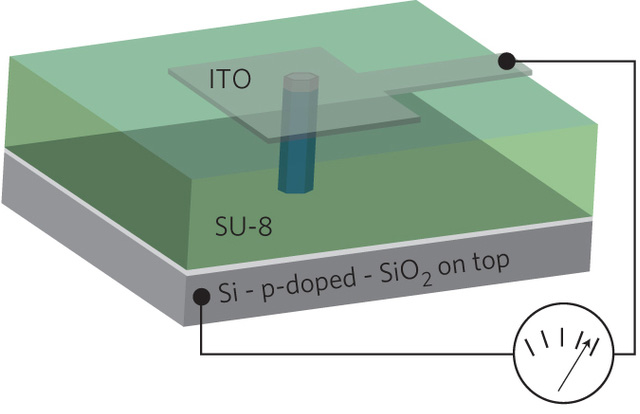
gallium-arsenide-nanowire-solar-cellMeanwhile, researchers at the Niels Bohr Institute in Denmark and EPFL in Switzerland announced that they have built solar cells out of single nanowires. In this case, the process involved growing gallium-arsenide (GaAs) wires on a silicon substrate, and then completing the circuit with a transparent indium tin oxide electrode, which are currently employed in the creation of photovoltaic cells and LEDs on the market today.

Prior to these development, nanowires were being researched mainly in conjunction with computer chips as a possible replacement for silicon. But thanks to the combined work of these researchers, we may very well be looking at solar cells which are not only hair-thin (as with the kind being developed by Penn State University) but microscopically thin. And much like the research at the University of Oslo involving the use of microbeads, this too will mean the creation of ultra-thin solar cells that have a massive energy density – 180 mA/cm2, versus ~40 mA/cm2 for crystalline silicon PVs.

solar_boosterAnd last, but not least, there was the announcement from Stanford University of a revolutionary new type of solar cell that has doubled the efficiency of traditional photovoltaic cells. This new device uses a process called photon-enhanced thermionic emission (PETE) that allows for the absorption of not only light, but heat. This combination makes this new type of cell the equivalent of a turbocharged solar panel!

pete-photovoltaic-thermionic-diagram-stanfordIn conventional cells, photons strike a semiconductor (usually silicon), creating electricity by knocking electrons loose from their parent atoms. The PETE process, on the other hand, uses the gallium arsenide wafer on top gather as much sunlight as possible, creating a lot of excited electrons using the photovoltaic effect. The underside, which is composed of nanoantennae, emits these photoexcited electrons across a vacuum to the anode with gathers them and turns them into an electrical current.

Beneath the anode is a of heat pipe that collects any leftover heat which could be used elsewhere. One of the easiest applications of PETE would be in concentrating solar power plants, where thousands of mirrors concentrate light on a central vat of boiling water, which drives a steam turbine. By concentrating the light on PETE devices instead, Stanford estimates that their power output could increase by 50%, bringing the cost of solar power generation down into the range of fossil fuels.

Though there are still kinks in their design – the cell has a very low 2% rate of energy efficient thus far – the researchers at Stanford are making improvements which are increasing its efficiency exponentially. And although their planned upgrades should lead to a solar cell capable of operating in extremely hot environments, they stress that the goal here is to build one that is capable of gathering power in non-desert environments, such as Spaced-Based solar arrays.

Combined with improved production methods, storage capacities, and plans to mount solar arrays in a variety of new places (such as on artificial islands), we could be looking at the wholesale adoption of solar power within a few years time. Every day, it seems, new methods are being unveiled that will allow Solar to supplant fossil fuels as the best, cheapest and most efficient means of energy production. If all goes as planned, all this could be coming just in time to save the planet, fingers crossed!

Sources: Extremetech.com, (2)

Towards a Cleaner Future: Fuel Cell Breakthrough!

hydrogen-fuel-cellOne of the greatest challenges facing renewable energy is making it affordable and cost effective, to the point where it will naturally offset such sources as fossil fuels and coal. And when it comes to hydrogen fuel cells, a recent development may have accomplished just that. Quite surprising when you consider that it came from Alberta, home of the Athabasca Oil Sands and an output of roughly 4 million barrels of crude a day.

It all happened late last month, when researchers at the University of Calgary published a paper in the Journal of Science that they had come up with a much cheaper and easier way to build an electrolyzer. This is the device that uses electricity to break up water into hydrogen and oxygen, which are then used to power hydrogen fuel cells.

Picture shows the refuelling hydrogen syFor some time now, these fuel cells have been considered the most promising means of powering automobiles with a clean, renewable energy source. By recombining the two basic elements of hydrogen and oxygen, energy is generated and the only waste product is water. The only difficulty is the means of production, as electrolyzers often depend on expensive and sometimes toxic metals.

The most common of current methods involves the use of expensive rare earth metals in precise crystalline arrangements to catalyze, or speed up, the reaction. But with the new process developed by Chris Berlinguette and Simon Trudel comes into play, which involves catalyzers built out of common metals without the need for the crystal structure, the process will not only be vastly simplified but extremely cheaper.

solar_arrayBased on the estimates presented in their paper, Trudel and Berlinguette estimate that their new eletrolyzer will deliver results comparable to current techniques but at a cost of about one-one-thousandth the norm. The implications for clean, renewable energy,  such as wind or solar generators, could be enormous. Not only would it be far cheaper and more efficient, there would be far less toxic waste materials produced.

Not only that, but another major stumbling block for clean energy could be overcome. As is the case with just about any type of renewable power source – wind, solar, tidal – is that it is dependent on conditions which limit when power can be generated. But stored hydrogen energy can be used at anytime and could easily replace gas and coal, just as long as the production process is cost-effective.

hydrogencarAs Berlinguette himself pointed out, making and electrolyzer cost-effective means being able to produce power on demand and to scale:

If you think of a wind turbine producing electricity at two o’clock in the morning, there’s no one around to actually use that electricity, so it just gets dumped. If you could set that up with an electrolyzer, you could convert that electricity into hydrogen, then the next day, when there is demand, you can sell that electricity at a premium during periods of high demand.

In anticipation of the inevitable investment this will attract, Berlinguette and Trudel have already formed a company called FireWater Fuel Corp. to market their work and expect to have a commercially available electrolyzer by next year. So for those of you with money to invest and a socially-responsible, environmental outlook, get out your check books out and be prepared to invest!

Source: huffingtonpost.ca


Powered By the Sun: The Solar Island

solar4As Climate Change becomes an ever increasing problem, nations are turning to alternative technologies and geological engineering to offset the effects. This means significant investments being made in technologies such as solar cells and other clean energies. However, the question of where to put all the resulting arrays is one which cannot be overlooked. Since we are trying to save the environment, it doesn’t exactly make sense to clear more tracts of land to make room for them.

Already, there is a land rush to build more solar power plants all around the world. In the U.S., the Department of Interior is currently processing leases for roughly 1.8 million acres in the West alone. Globally, solar photovoltaic (PV) capacity has been doubling annually, with another 16 gigawatts of power added just in 2010. At this rate, and considering how much space is needed to set up the average array, we could run out of room real fast!

solar_islandAnd yet, the one thing that accounts for the majority of the planet’s surface area has been sadly neglected up until this point. I am of course referring to the oceans, lakes, reservoirs, retention ponds, and all other natural or unnatural bodies of water. As they account for over three-quarters of the planet’s real estate, they are quickly being targeted as the new frontier for floating solar power plants, with companies and locations being considered from India to Europe, to Napa Valley.

One of the more ambitious plans comes to us from Switzerland, will a proposed array will be built on Lake Neuchâtel later this year. As a collaborative effort between the solar developer Nolaris and the Swiss energy company Viteos, the proposed floating array will be the first of three set upon the lake. Each island will measure some 25 meters in diameter, be built from plastic and steel, and support 100 photovoltaic cells that will rotate with the sun.

solar_island1What’s more, this is just one of several ideas under consideration. Other companies pursuing this concept are favoring floating pontoons with individual photovoltaic assemblies on the water’s surface. In this case, concentrating lenses will focus the sunlight on a solar cell while a simple motor, light sensors, and software rotate the cells to maximize power generation. In tropical climes, where many pilot projects are being considered and storms are quite common, the entire array will be able to submerge as the winds rise.

In other places, where land is particularly expensive, floating solar may even come to rival its land-based counterpart. In Australia, for example, a company named Sunengy is pushing the concept of “Liquid Solar Array” technology, which they claim will be able to match the power output of a typical hydroelectric dam and cover less than 10% of the reservoir’s surface. They are currently teaming up with the Indian giant Tata Power to build India’s first floating solar power plant, and estimate that if India used just 1% of its 11,500 square kilometers of captured water it could generate the equivalent of 15 large coal-fired power stations.

As the saying goes, necessity is the mother of invention. And as it stands, planet Earth needs energy, and needs to generate it in such a way that won’t mess up the environment any further or usher in the scourge of Climate Change. When the survival of our planet and our species is at stake, you can expect people to get very inventive. Very, very inventive!

Source: factcoexist.com

Powered by the Sun: The Ion Cannon Solar Panel

solar5Hello and welcome back to my ongoing series of PBTS, dedicated to all the advancements being made in solar power. Today’s entry is an interesting one, and not just because it involves an ion cannon… well sort of! It comes to us courtesy of Twin Creeks, a solar power startup that has come up with a revolutionary way to generate photovoltaic cells that are half the price of those currently found on the market.

For many decades, solar power has been held back due to the fact that the cost has been prohibitive compared to fossil fuels and coal. By offering yet another way of cutting the cost of their production, Twin Creeks is bringing this clean alternative one step closer to realization. Ah, but here’s the real kicker: turns out that this revolutionary process involves a hydrogen ion particle accelerator!

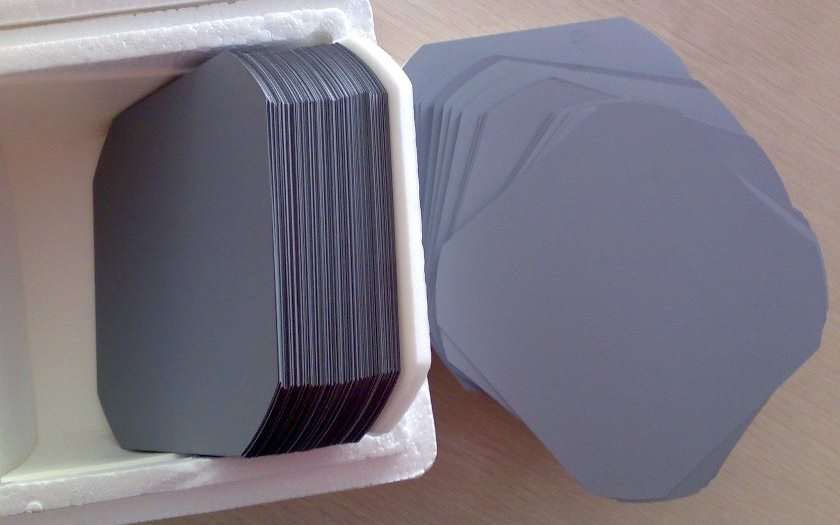
hyperion-particle-accelerator1-640x353As has been mentioned in this series before, conventional solar cells are made from slicing 200-micrometer-thick (0.2mm) sections of silicon wafer from a large block. Then electrodes are added, a sheet of protective glass is placed on top, and they are placed in the sun to generate electricity. But of course, this approach has two serious drawbacks. One, a great deal of silicon is wasted in the production process. Two, the panels would if they were thinner than 200 micrometers, but silicon is brittle and prone to cracking if it’s too thin.

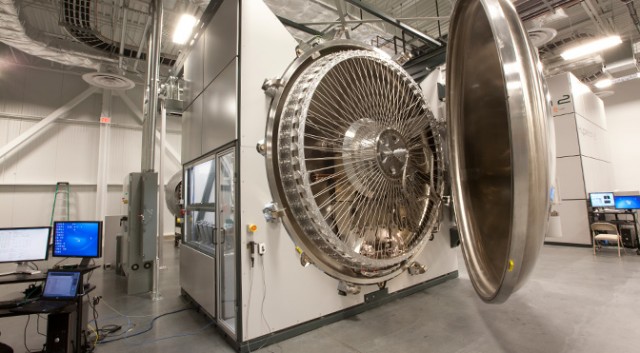
And this is where Twin Creeks ion cannon, aka. Hyperion, comes into play. It’s starts with a series of 3-millimeter-thick silicon wafers being placed around the outside edge of the big, spoked wheel (see above). The particle accelerator then bombards these wafers with hydrogen ions and, with exacting control of the voltage of the accelerator, the hydrogen ions accumulate precisely 20 micrometers from the surface of each wafer.

twin-creeks-hyperion-wafer-ii-flexibleA robotic arm then transports the wafers to a furnace where the ions expand into hydrogen gas, which cause the 20-micrometer-thick layer to shear off. A metal backing is applied to make it less fragile as well as highly flexible (as seen on the right). The remaining silicon wafer is taken back to the particle accelerator for another dose of ions. At a tenth of the thickness and with considerably less wastage, it’s easy to see how Twin Creeks can halve the cost of solar cells.

This process has been considered before, but the cost of a particle accelerator has always been too high. However, Twin Creeks got around this by building their own, one which is apparently “10 times more powerful” (100mA at 1 MeV) than anything on the market today. Because of this, they are able to guarantee a product that is half the cost of solar cells currently coming out of China. At that price, solar power truly begins to encroach on standard, fossil-fuel power.

But, of course, there still needs to be some development made on producing solar cells that can store energy overnight. Weather strictures, such as the ability to generate electricity only when its sunny out, remains another stumbling block that must be overcome. Luckily, it seems that there are some irons in that fire as well, such as research into lithium-ion and nanofabricated batteries. But that’s another story and another post altogether 😉

Stay tuned for more sun-powered hope for the future!

Source: Extremetech.com

Powered by the Sun: Microbead Solar Cells

solar3Despite how far solar cells have come in recent years, issues like production and installation costs have remained an ongoing obstacle to their full scale adoption. But as they say, obstacles are meant to be overcome, and can often produce very interesting solutions. For example, peel and stick solar panels that can be manufactured by a 3D printer are one option. Another is the recent creation of a solar cell as thin as a strand of hair. And as it happens, a third has just been unveiled.

This latest one comes to us from the University of Oslo, where researchers have come up with a way to produce silicon solar cells that are twenty times thinner than commercial solar cells. Typically, solar cells are fashioned out of 200-micrometer-thick (0.2mm) wafers of silicon, which given their average rate of power generation works out to about five grams of silicon per watt of solar power. Combined with all the silicon wasted in the production process, this makes for a very inefficient process.

Solar-Wafer-Solar-CellsOne way around this is to reduce the thickness of solar wafers, but this presents its own problems. As the wafer gets thinner, more light passes straight through the silicon, dramatically reducing the amount of electricity produced by the photovoltaic effect. Blue light, which has a short wavelength, can be absorbed by a very thin solar cell; but red light, which has longer wavelengths, can only be captured by thicker wafers.

Enter into this the breakthrough created by the Oslo researchers. Using a revolutionary technique involving microbeads – tiny plastic spheres that create an almost perfect periodic pattern on the silicon. Apparently, these beads force the sunlight to “move sideways,” ensuring a more uniform and powerful rate of absorption. Another trick is to dot the backs of each cell with asymmetric microindentations,which can trap even more solar energy.

solar_beadsUsing these techniques, silicon wafers can be created that measure a mere 10 micrometers in thickness but can do the job of a 200 micrometer cell. By using 95% less silicon, the cost of production drops considerably, which will reduce the cost of solar power installations and – more importantly – increase profits. With current production methods and costs, the profit margin associated with solar power is pretty negligible.

This latter aspect is especially important as far as commercial production comes into play. If we are to expect industries to adopt solar power for their energy needs, it has to be worth their while. At the moment, the Oslo researchers are in talks with industrial partners to investigate whether these methods can be scaled up to industrial production. But given the nature of their work, they seem quite confident that their technology could come to the market within five to seven years.

Stay tuned for more installments in the PBTS series!

Source: Extreme.tech

Powered by the Sun: Solar-Powered Reactors

solar2Welcome back to another installment in PBTS! Today’s news item is a rather interesting one, and it comes to us from the University of Delaware where researcher Erik Koepf has come up with an interest twist on solar power. In most cases, scientists think to use cells that can absorb photons and use them to generate a flow of electrons. But in Koepf’s case, sunlight is used in a different way; namely, as a means of creating alternative fuels.

Basically, the concept for Koepft’s new solar-powered reactor revolves around the idea of getting directly to the hydrogen that is found in conventional fuels, i.e. coal and fossil fuels. While they are decent enough energy sources, they do not burn clean, due to the extensive impurities they carry and by-products they create. If it were possible to remove the essential hydrogen from them, we would have a clean burning and efficient energy supply without the hassle of pollution.

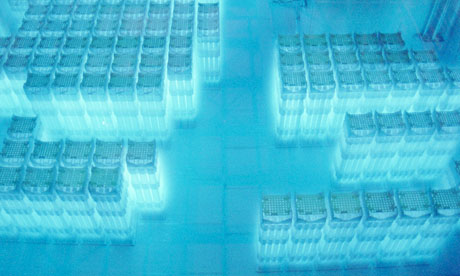
Nuclear MOX plant : recycling nuclear waste : Submerged Spent Fuel Elements with Blue GlowAnd that’s where the solar reactor comes in. As the name suggests, the reactor relies on the Sun’s energy, which it then uses to split water molecules to get at their hydrogen atoms. This is done by exposing a zinc oxide powder on a ceramic surface to massive amounts of focused sunlight. From there, a thermochemical reaction happens that splits water apart into oxygen and hydrogen.

Though it may sound complicated, the sheer beauty of this concept lies in that fact that it uses the Sun’s infinite energy to do the heavy lifting and accomplish atom smashing. No particle accelerators, no nuclear fusion or fission; and best of all, no pollution! Since the process creates no emissions or Greenhouse gases, this is perhaps one of the most environmentally friendly energy concepts to date.

But of course, the project has some additional requirement which fall under the heading, “additional parts sold separately”. For one, the reactor needs to get seriously hot – between 1750° to 1950° Celsius (3182° to 3542° Fahrenheit) – before it can get to the work of splitting water molecules. For this, a focusing mirror that is roughly 13 square meters, flawlessly flat and 98% reflective is needed.

solarpowergeNo much mirror existed when Koepf and Michael Giuliano (his research associate) got started, so they had to develop their own. In addition, that mirror needs to focus the solar energy it collects onto a tiny six centimeter circle that has to be precisely aimed. If the light is just a millimeter or two off to one side, the entire reactor could be damaged. In essence, the system is simple and ingenious, but also temperamental and very fragile.

What’s more, just how efficient it is remains to be seen. While the first tests were successful in creating small amounts of hydrogen, the  the real test will take place next month when the duo present their reactor in Zurich, Switzerland, where it will be running at full power for the very first time. Naturally, expectations are high, but it is too soon to tell if this represents the future or a failed attempt at viable alternative power.

Source: Extremetech.com

Powered by the Sun: Solar Powered Clothing

solar1Imagine threads that would turn the wearer into a walking power source. That’s the concept behind a new type of fiber-optic solar cell developed by John Badding of Penn State University. Announced back in December of 2012, this development could very well lead to the creation of full-body solar cells that you wear, providing you with an ample amount of renewable electricity that you could could carry with you everywhere you go.

Similar in appearance to most fiber-optic cables made from flexible glass fibers, these new solar cells are thinner than the average human hair and could conceivably be woven into clothing. Whereas you conventional solar cell exists only in two-dimensions and can only absorb energy when facing the sun, this 3D cross-section of silicon infused fiber are capable of absorbing light from any direction.

flexible-solar-cell-625x418Already, John Badding and his research team have received interest from the United States military about creating clothing that can act as a wearable power source for soldiers while they’re in the field. In addition, like peel and stick solar panels, we can expect commercial applications for satchels, like the kind used to house laptops. Forget the power cable, now you can charge your battery pack just by setting it in the sun.

And given the upsurge in wearable tattoos and implantable medical devices, these fibers could also prove useful in clothing to ensure a steady supply of power that they could draw from. Hell, I can picture “solar shirts” that have a special recharging pocket where you can place your MP3 player, smartphone, tablet, or any other electronic device once the battery runs down.

Solar-Panels-625x418Naturally, all of this is still in the research and development stage of things. John Badding and his team have yet to aggregate the single strands into a piece of woven material, meaning it is still speculative as to whether or not they will be able to withstand the stress faced by regular clothing without breaking down. Nevertheless, the material is still a significant advancement for solar energy, with the new cells presenting many possibilities for remote energy use and accessibility.

And I for one am still excited about the emergence of fabric that generates electricity. Not only is it a surefire and sophisticated way of reducing our carbon footprint, it’s science fiction gold!

Source: psfk.com

Powered by the Sun: The Future of Solar Energy

Magnificent CME Erupts on the Sun - August 31Researchers continue to work steadily to make the dream of abundant solar energy a reality. And in recent years, a number of ideas and projects have begun to bear fruit. Earlier this year, their was the announcement of a new kind of “peel and stick” solar panel which was quite impressive. Little did I know, this was just the tip of the iceberg.

Since that time, I have come across four very interesting stories that talk about the future of solar power, and I feel the need to share them all! But, not wanting to fill your page with a massive post, I’ve decided to break them down and do a week long segment dedicated to emerging solar technology and its wicked-cool applications. So welcome to the first installment of Powered By The Sun!

spaceX_solararrayThe first story comes to us by way of SpaceX, Deep Space Industries, and other commercial space agencies that are looking to make space-based solar power (SBSP) a reality. For those not familiar with the concept, this involves placing a solar farm in orbit that would then harvest energy from the sun and then beam the resulting electricity back to Earth using microwave- or laser-based wireless power transmission.

Originally described by Isaac Asimov in his short story “Reason”, the concept of an actual space-based solar array was first adopted by NASA in 1974. Since that time, they have been investigating the concept alongside the US Department of Energy as a solution to the problem of meeting Earth’s energy demands, and the cost of establishing a reliable network of arrays here on Earth.

Constructing large arrays on the surface is a prohibitively expensive and inefficient way of gathering power, due largely to weather patterns, seasons, and the day-night cycle which would interfere with reliable solar collection. What’s more, the sunniest parts of the world are quite far from the major centers of demand – i.e. Western Europe, North America, India and East Asia – and at the present time, transmitting energy over that long a distance is virtually impossible.

NASA "Suntower" concept
NASA “Suntower” concept

Compared to that, an orbiting installation like the SBSP would have numerous advantages. Orbiting outside of the Earth’s atmosphere, it would be able to receive about 30% more power from the Sun, would be operational for almost 24 hours per day, and if placed directly above the equator, it wouldn’t be affected by the seasons either. But the biggest benefit of all would be the ability to beam the power directly to whoever needed it.

But of course, cost remains an issue, which is the only reason why NASA hasn’t undertaken to do this already. Over the years, many concepts have been considered over at NASA and other space agencies. But due to the high cost of putting anything in orbit, moving up all the materials required to build a large scale installation was simply not cost effective.

spacex-dragon-capsule-grabbed-by-iss-canadarm-640x424However, that is all set to change. Companies like SpaceX, who have already taken part in commercial space flight (such as the first commercial resupply to the ISS in May of 2012, picture above) are working on finding ways to lower the cost of putting materials and supplies into orbit. Currently, it costs about $20,000 to place a kilogram (2.2lbs) into geostationary orbit (GSO), and about half that for low-Earth orbit (LEO). But SpaceX’s CEO, Elon Musk, has said that he wants to bring the price down to $500 per pound, at which point, things become much more feasible.

And when that happens, there will be no shortage of clients looking to put an SBSP array into orbit. In the wake of the Fukushima accident, the Japanese government announced plans to launch a two-kilometer-wide 1-gigawatt SBSP plant into space. The Russian Space Agency already has a a working 100-kilowatt SBSP prototype, but has not yet announced a launch date. And China, the Earth’s fastest-growing consumer of electricity, plans to put a 100kW SBSP into Low-Earth Orbit by 2025.

space-based-solarpowerMost notably, however, is John Mankins, the CTO of Deep Space Industries and a 25-year NASA vet, who has produced an updated report on the viability of SBSP. His conclusion, in short, is that it should be possible to build a small-scale, pilot solar farm dubbed SPS-ALPHA for $5 billion and a large-scale, multi-kilometer wide power plant for $20 billion. NASA’s funding for SPS-ALPHA dried up last year, but presumably Mankins’ work continues at Deep Space Industries.

Cost and the long-term hazards of having an array in space remain, but considering its long-term importance and the shot in the arm space exploration has received in recent years – i.e. the Curiosity Rover, the proposed L2 Moon outpost, manned missions to Mars by 2030 – we could be looking at the full-scale construction of orbital power plants sometime early in the next decade.

And it won’t be a moment too soon! Considering Earth’s growing population, its escalating impact on the surface, the limits of many proposed alternative fuels, and the fact that we are nowhere near to resolving the problem of Climate Change, space-based solar power may be just what the doctor ordered!

Thanks for reading and stay tuned for the next installment in the Powered By The Sun series!

Source: Extremetech.com

The Future is Here: Peel and Stick Solar Panels!

solar_arrayEver since Albert Einstein first proposed the concept in 1921, photovoltaic cells – solar cells – have been at the forefront of alternative fuel and energy research. And while progress has been made, two key factors have remained as stumbling blocks to their widespread adoption: One, the cost of making solar cells; and two, the cost of installing them.

In order for this to change, analysts have predicted for some time that solar panels would need to be printed on cheap, durable materials that could be installed anywhere. Until such time, they would continue to lose out against the gas and coal equivalents, which would continue to generate as much energy as a single solar cell while remaining comparatively cheaper.

solar_powerAnd as it turns out, the wait may be coming to an end. According to Silvija Gradecak, a materials science and engineering professor at MIT, new research from around the world is driving us ever closer to that goal. And it is her lab, among others, that is making a major contribution, through the release of a new breed of bendy, peel-and-stick solar panels.

The focus of Gradecak’s team has been on the production of a organic, thin-film cells that are made from abundant materials which could be manufactured on the cheap. And in December of last year, they made a breakthrough with the production of a transparent photovoltaic cell by using flexible graphene and a nanowire coating. This thin, flexible and transparent photo cell, they claimed, could be mounted anywhere and is comparatively cheaper than current silicon based varieties.

solar_cellNaturally, Gradecak was sure to point out that this development did not take place in a vacuum. Nor was it the only one of its kind:

“”There was a significant effort to develop these type of devices and the slope of this improvement is very high… I personally believe this is not just theoretical. In a couple of years you will see these types of devices commercially.”

And in that respect, she is right. At Stanford, researchers presented their own concept for a next generation solar cell this past December: a flexible, peel-off panel that can stick to almost any surface. Composed of nickel, silicon and silicon dioxide and a protective polymer layer, the cell consists of multiple layers that can be peeled away and applied as needed.

Exciting times, these are, especially when long-awaited environmental solutions are finally becoming feasible. It also inspires hope that we might be able to tackle a little problem known as emissions before it is too late. Of course, that would require making this technology available worldwide, especially in developing economies where coal and gas power are especially lucrative. But anything is doable, especially if the price is right!

Source: Co.Exist.com

Nokia Morph Concept Phone

nokia_morphThis story is a bit of an expansion on a preview post, and one which I’ve put off since I spent so much time talking about phones a few weeks ago. And the concept is a little dated at this point, but since it’s still in the works and just as revolutionary. And trust me, its quite cool and to read about!

It seems that there is no shortage of new and radical ideas when it comes to the field of personal communications these days! And when it comes to personal phones, it seems the sky’s the limit. In keeping with the trend to build smaller, ergonomic, flexible and thinner smartphones and PDA’s, Nokia has another concept which is making waves.

It’s known as the Morph, a new concept that showcases some revolutionary leaps being made in numerous fields. Thanks to ongoing collaboration between the Nokia Research Center (NRC) and the Cambridge Nanoscience Centre in the UK, this device incorporates numerous advances being made in terms of thin displays, flexible housings and nanotechnological processes. Once feasible, this phone will literary be assembled at the microscopic levels, leading to a phone made of “smart matter”.

In addition to the revolutionary nanoscale manufacturing process, the phone will present a number of radical new possibilities for users and device manufacturers everywhere. They include:

  • Newly-enabled flexible and transparent materials that blend more seamlessly with the way we live
  • Devices that are self-cleaning and self-preserving
  • Transparent electronics that offer an entirely new aesthetic dimension
  • Built-in solar absorption that charge a device and batteries that are smaller, longer lasting and faster to charge
  • Integrated sensors that allow people to learn more about the environment, empowering them to make better choices

In addition to the advances above, the integrated electronics shown in the Morph concept could cost less and include more functionality in a much smaller space, even as interfaces are simplified and usability is enhanced. What’s more, the development and combination of these technologies will have far-reaching benefits for the fields of communication and personal computing, revolutionizing how people do these in their daily lives.

And of course, Nokia was sure to create an animated video displaying the Morph concept in action. Take a gander:

Source: press.nokia.com, youtube.com