I told you it’s been a busy time for the Yuva anthology, and not just for my venerable colleagues. In my case as well, I’ve made some headway on the short story Arrivals and thought it was time to share! For the last few samples, the story was focused on the goings-on of the Planetary Council once they had learned that a new convoy of ships was approaching the planet. As always, there were hard questions, fears and agendas at play.
For this part, I have chosen to shift the focus back to the person who noticed the new convoy of colonists (aka. the Second Wave) coming in the first place – Marcellin Strauss, a simple technician who toiled in anonymity prior to the detection of the approaching convoy that set everything on the planet in motion. Now, he finds himself being sought out by the Planetary Council, and told to report to strange location for reasons that are not shared. Hope you like the sampling, and stay tuned for more!
_____
Asteria Research Facility
Zarmina, Vogt
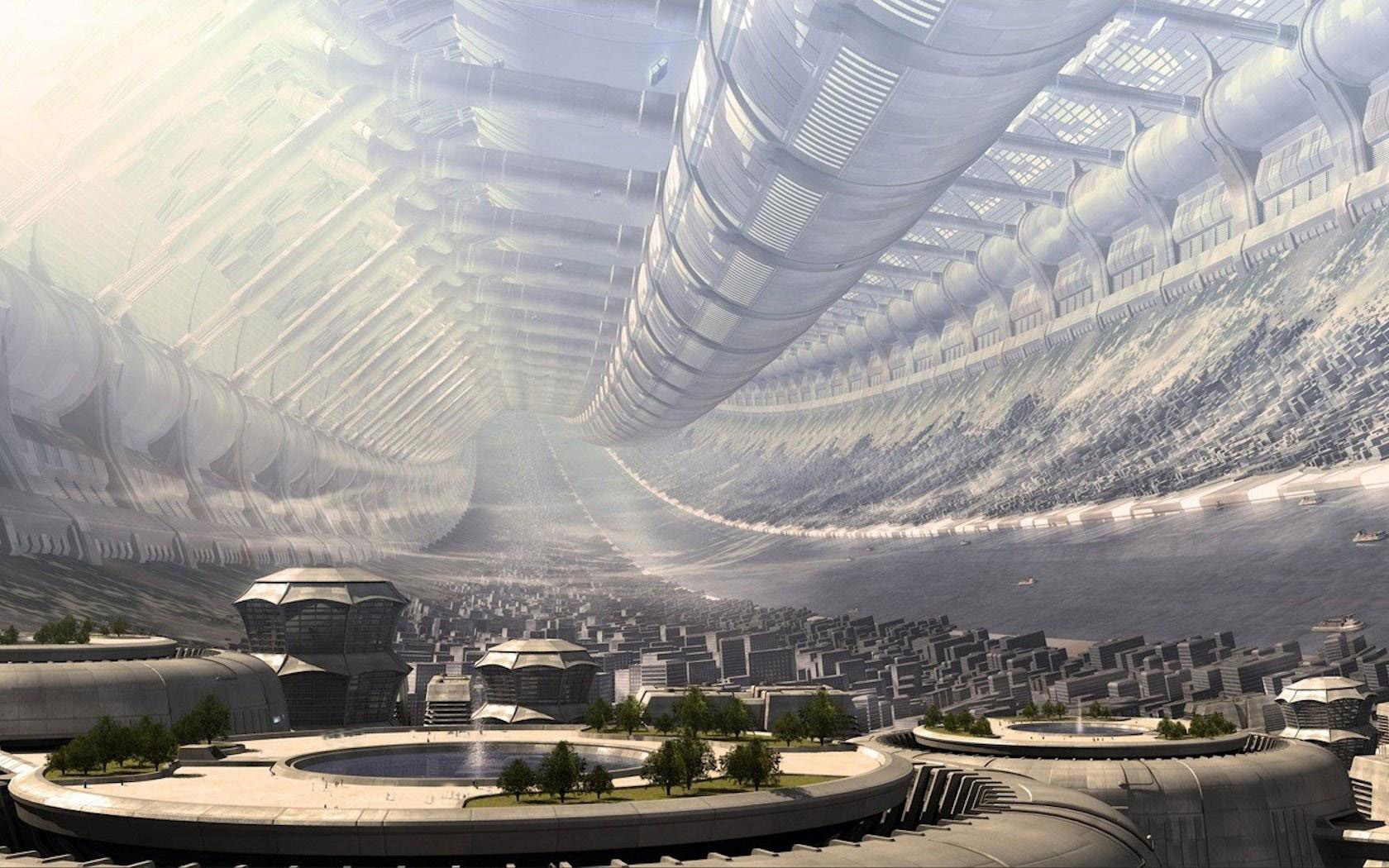
It was like looking at a still frame in some futuristic SenSim. The building had the appearance of a mushroom, an off-white, ground-hugging thing with just the slightest overhanging edges. And yet, its dimensions seemed unnaturally large for the setting, far bigger than anything he’d seen in an auxiliary dome, which this place certainly appeared to be.
As he disembarked from the transit car, Strauss consulted his Tab to make sure he was in the right place. The Council’s message had been somewhat short on explanations, but the directions had been quite precise. The private line he had taken to get here had deposited him at a stop just over a hundred meters away, and every building and laneway that sat between him and the mushroom cap seemed awfully quiet. As he looked around the expanse of the small dome, he got the strange feeling that he was very much alone… and being watched.
“Welcome resident! How may I assist you?”
Strauss almost jumped. He turned quickly to the right and noticed the transit chest sitting there. As always, this consisted of a squat red box with a tall display stand at the side. On the display screen, the words it had just uttered were displayed prominently; the happy, iconic face of Magid Mukhtari smiling as it repeated them.
“Welcome resident! How may I assist you?”
“I, uh…” he replied dumbfoundedly, and looked back in the direction of the far building.
“Will you be requiring personal transit on this trip?” the voice asked, suggesting the most obvious option. He considered the distance between him and his destination and judged that it was not an unreasonable suggestion.
“I guess so,” he said, and placed his Tab on his chest.
“Very good, sir. Please return the vehicle to one of several designated transit boxes on your journey when you are finished with it.”
The door on the box opened and a ground car presented itself to him. Stepping onto the foot rest, he placed his hands on the control ring and felt the car power up. The terminal in the middle came online and the face of Muhktari was there as well, giving him a quick tutorial.
“Just place your feet on the acceleration pads located at the front of the footrest to-”
Strauss didn’t bother to wait for it to finish. He had had enough experience driving himself around to know how the capitol cars worked. The face of the screen laughed as he took off, putting distance between himself and the stop.
“Whoa! I see you’ve done this before! Please exercise caution when driving amongst pedestrians and other vehicles. And remember to return the car to a designated transit chest when you are finished with it. Have a nice day!”
What pedestrians? he wondered, as he drove towards his destination. Several minutes passed as he closed the distance between the transit line and the far building. And at no point did he see anyone, nor any indication of people working inside the other structures. The feeling of isolation intermixed with the sense that he was being watched yet again, and it did not make for a happy state of mind.
He was just glad he wasn’t hungover as well, though a shot of liquid courage would certainly have been welcome! He did his best to focus on where he was headed and tried not to think of the eerie, empty buildings that were passing him by, or the distinct impression that they weren’t so much empty as containing spies who watched him from every window.
But on that front, things weren’t much better. At his current distance, the building seemed to loom much higher than before, forcing him to look up towards the dome’s roof to take it all in. This meant that the ceiling, with all it’s rigid struts and panels were now it’s backdrop. The strange, webbed pattern only served to make it all look somehow more… spooky.
As he got closer, he came to realize something else about the building. All along the façade, there were lines of various colors, but none of them seemed to correspond to a segment in the structure. As far as one could tell, the building was a single piece, no joints or seams to speak of. Such seemed unlikely, but the illusion was not dispelled with any decrease of distance.
That’s when every single device on his body began to signal to him. The sound was unmistakable, indicating that they were going into offline mode since there was no longer any bandwidth in this area. He came to a stop and pulled his Tab from his chest to confirm this. Sure enough, the Tab presented a topographical representation of the area that showed a large, circular dead zone emanating out from the mushroom-shaped building. Rather than having ventured beyond the range of the QIN’s wireless network, he was now entering an area where it was actively being denied.
He took a deep breath and let it out slowly. Between his observations of the structure and this latest revelation, it seemed clear that whoever was inside was taking great pains to keep what they were doing in there a secret.
What am I stepping into here? he wondered. He scanned the outer edge of the building again, trying to see if he could spot any telltale signs of cameras or spy drones. There were none that he could see, but he sensed they were there… somehow, somewhere.
And yet, he found himself pressing the accelerator pedal again and driving closer. Whatever this summons was, whatever was going on inside that odd-looking building, he wanted to know. Besides, at this point, he was just about there. Might as well go all the way and see what all the hubbub was about.
“You have reached your destination,” the happy face of Mukhtari said once he came to stop. “I am not picking up any transit chests at this location. If you would like to park this vehicle for later use, please say so now. If not, please tell this car to –”
“Return,” he ordered, stepping free of the footrest. The voice stopped in midsentence, having recieved the requisite order to head back to it’s last storage location. It did manage to issue a kind farewell as it zipped away along the street, moving in a perfect rectilinear fashion.
“We hope that you enjoyed your ride!”
Strauss chuckled to himself and looked towards the mushroom, which now had the appearance of being a big, white giant. He was tempted to walk up and touch it, thinking at this point that it had to be composed of some kind of ceramic or composite material.
However, in one spot there was an irregularity – a sort of circular hole that was two meters high and less than a single meter deep. Inside, the same seamless ceramic material sat, solid and impenetrable. But this was the only thing that even resembled a door. Taking another deep breath, Strauss took a few steps towards it and steeled himself for a surprise, one way or another.
That’s when he heard a loud hiss and a high pitched squeal. Strauss’ gate came to an immediate halt and his heart began to beat overtime. He stood motionless for several seconds, worried that he had set something off, afraid to move lest he make it worse.
But the noticed, the circular opening was opening further. Inside, several small lines appeared on the circular surface, bisecting the door at cross-angles, and then began pulling it open. When they finally opened all the way, he saw a woman standing there, wearing a grey jumpsuit with the same strange color patterns he noticed on the building’s façade.
“You Marcellin Strauss?” she asked, sticking her head through the open doorway. He found himself scanning her suit still, wondering just what the hell section it represented. She wasn’t with Planetary, or Defense, for that matter. Neither the color nor the insignia patches matched. He then realized she had asked him a question and simply nodded, unable to form words at the moment.
“Good,” she said. “Get inside, we have a lot to cover and we’re running late.”
She turned back inside and clearly meant for him to follow. Strauss managed to find his voice and clumsily uttered the obvious question. “I- I’m sorry. Who are you?”
She turned back to him and raised an eyebrow, a reaction that let him know exactly how little she thought of the question. “Madeleine Hartberg, Yuva Cosmonautic Corps.”
“Cosmonau-” he stuttered. “I- I wasn’t aware there was one.”
She smiled sideways. “There is now. And there are people inside who would very much like to talk to you. Are you going to come see them, or stand there like an idiot all day?”
Strauss once again fell mute and couldn’t move. And whoever this woman was, she was clearly getting annoyed because of it.
“Look, Strauss, I don’t have time to explain everything right now. Bottom line is, you’ve been asked to participate in something bigger than anyone on this planet has known since we made ‘Fall. Now are you coming, or are you going to miss out on that opportunity?”
Marcellin’s voice didn’t respond, but his feet seemed to be in working order. He knew this, because he began to follow her inside.
“Good!” she said, ushering him in. “Now please move it. Thirty seconds of this and I’m already sick of you!”

 Good news, everyone! My services as a freelance writer were recently enlisted by the good folks who run HeroX and Universe Today. Thanks to my old friend and mentor, Fraser Cain (who consequently got me started in the indie publishing bizz), I’m going to be bringing the experience I’ve garnered writing my own blog to a more professional format – writing about space exploration, innovation and technological development.
 For those unfamiliar, HeroX is a spinoff of the XPRIZE Foundation, the non-profit organization that runs public competitions intended to encourage technological development and innovation. It’s directors includes such luminaries as Google’s Elon Musk and Larry Page, director James Cameron, author and columnist Arianna Huffington, and businessman/ philanthropist Ratan Tata, and more. In short, they are kind of a big deal!
 Universe Today, on the other hand, is kind of an old stomping ground for me. Years back, I did articles for them that dealt with a range of topics, including geology, natural science, physics, environmentalism, and astronomy. In both cases, I’ll be doing write ups on news items that involve technological development and innovation, and doing interviews with some of the people in the business.






 Lately, I’ve been getting back to work on the space anthology known as Yuva – and for good reason. Not only has our group been blessed with the arrival of some new blood in recent months, but for many of us (me especially), the inspiration bug has bitten after a long hiatus.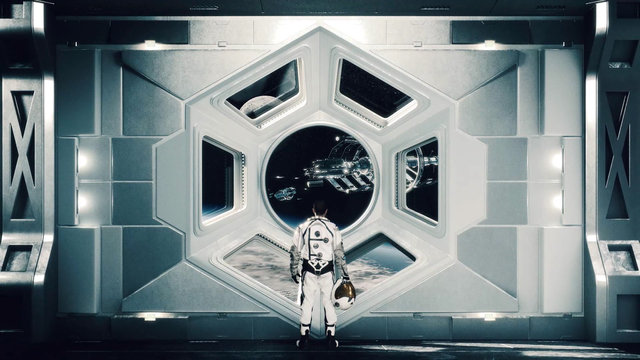




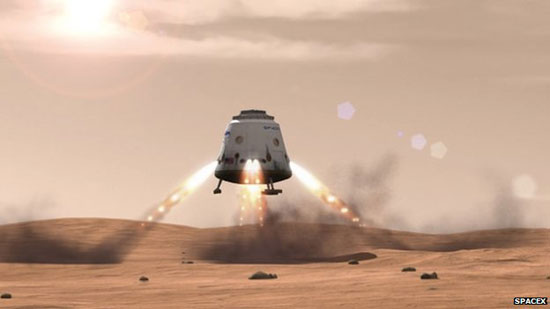 Other notable features include the propellent, which is a pair of non-cryogenic liquids – monomethyl hydrazine for the fuel and nitrogen tetroxide for the oxidizer. These are hypergolic, meaning that they ignite on contact with one another, which helps the SuperDraco to restart multiple times. It’s also built to be deep throttled, and can go from ignition to full throttle in 100 ms. But what really sets the SuperDraco apart is that is has 200 times the power of the Draco engine, which works out to 7,440 kg (16,400 lbs) of thrust.
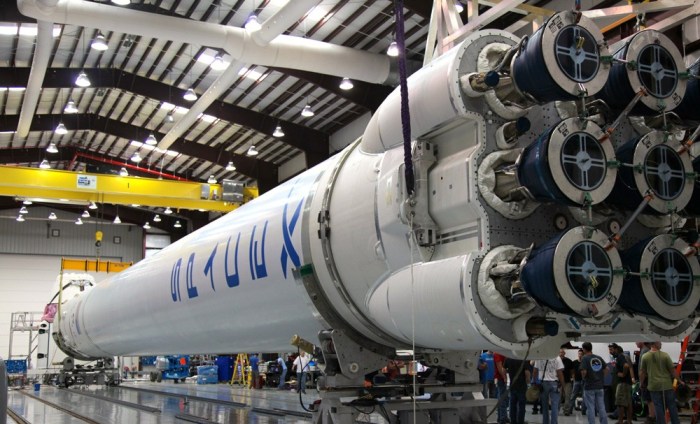 Eight engines firing for five seconds are enough to carry the capsule safely away from the booster with 120,000 lb of axial thrust. In addition, the eight engines also provide a high degree of redundancy should one or more engines fail. But what’s really ambitious about the SuperDraco is that, like the Falcon 9 booster, the Dragon is designed to ultimately return to its spaceport under its own power and land with the precision of a helicopter, and it’s the power and control of the SuperDraco that makes this possible.
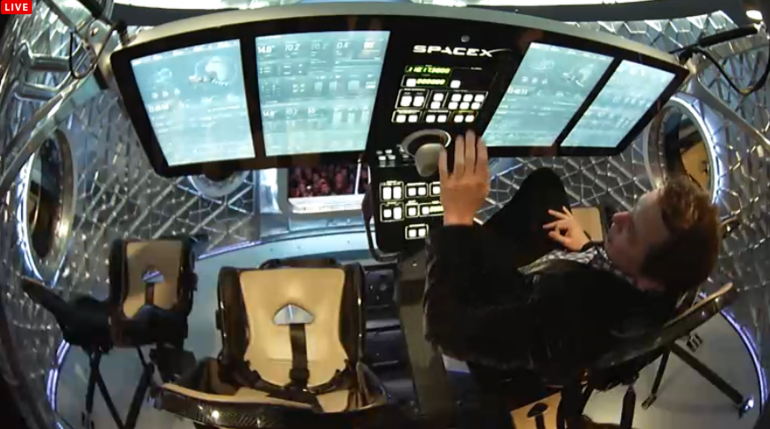
 But equally impressive was the unveiling of the Dragon V2 manned space capsule, which took place at a brief media event at SpaceX’s Hawthorne, California headquarters at the end of May. This larger, more powerful version of the reusable Dragon capsule will one day carry astronauts to the International Space Station (ISS) and return to Earth to land under its own power. This latest development brings the company one step closer towards its ultimate goal of a fully reusable manned capsule capable of making a powered landing.