New Anthology Sample: Arrivals!

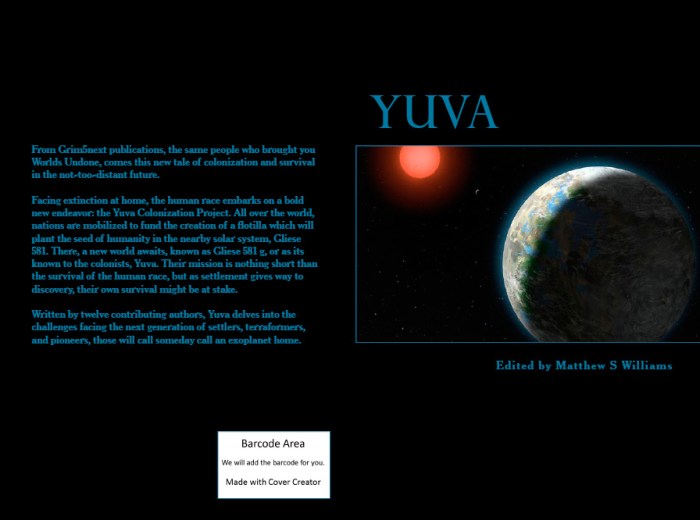
Yuva_coverIt’s been awhile since I posted anything from my group’s upcoming Yuva anthology. But of course, there’s a reason for that. With time constraints and other commitments competing for our attention, my group and I have had little time for this ongoing project. But now that I’ve finished editing the preliminary draft of Papa Zulu, I’ve had some time on my hands and decided to rededicate it where its needed.

Below is the latest sample from my story Arrivals, the opening story for Part III of our anthology. As you may know, this story involves the colonists of Yuva, over a century after they first arrived, getting news that a Second Wave is on its way. In the last sample, the Planetary Council was discussing what to do, and a joint mission was proposed between the Ministry of Defense and Planetary Research to fly out and meet the ships while they were still in transit.

In this sample, another revelation is made, and it’s not very pleasant one! Read on to learn more…

*                     *                    *

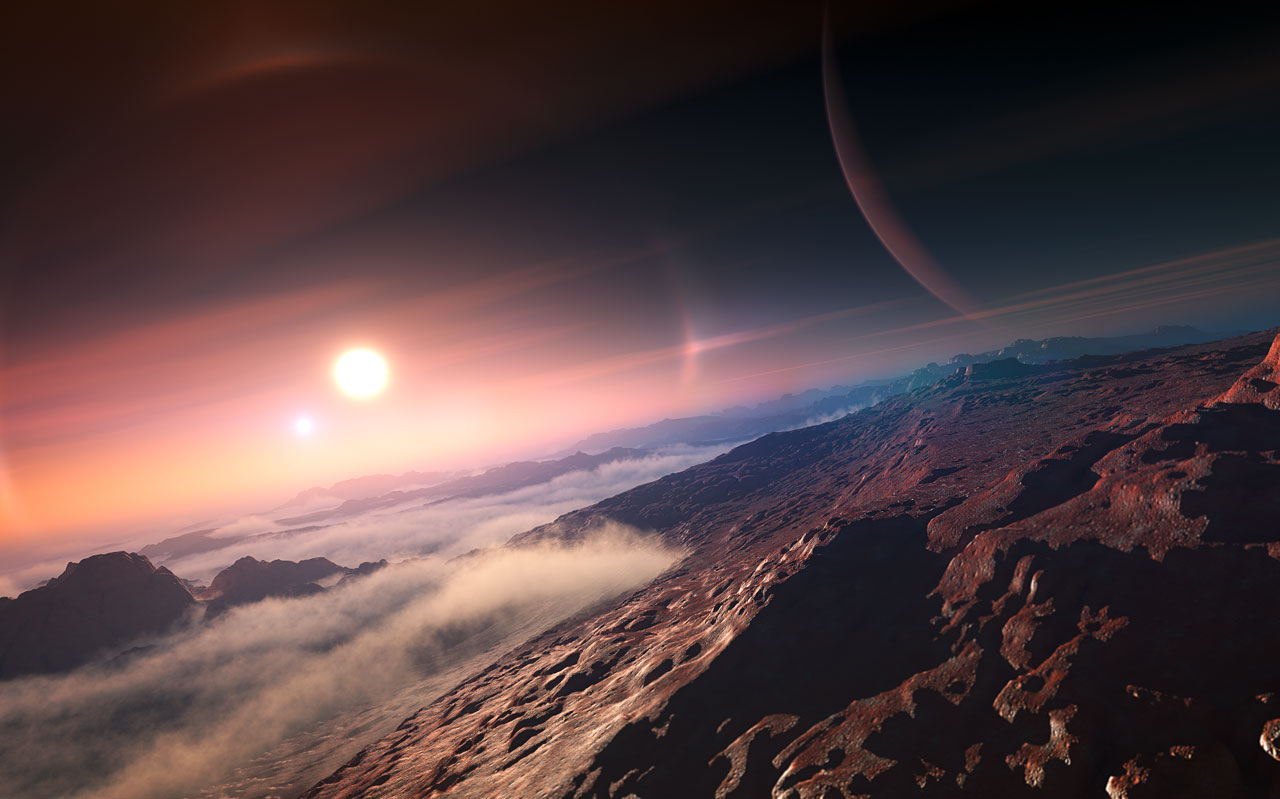
Padda examined the design specs before her, the latest in a series of proposals from the joint task force charged with creating their diplomatic transports. It was now late afternoon and the sun was filtering in through the dome at a slight angle, lending a lovely glow to the arboretum’s generous supply of native specimens.

And in the cumulative radiance of the room, sunlight intermixed with neon-green and purples, the organic light of her Tab’s display glowed and showed her the Ministry’s latest design specs. As expected, the engineers had taken all possibilities to heart, and were producing endless iterations to ensure that the fleet that met the Flotilla would be prepared for any eventuality.

Well, almost any eventuality…

As Padda scanned through image after 3-D image of shuttles with double-hulls, upgraded thrusters, and upgraded acceleration cushions for its crew, she wondered if any amount of planning could prepare them for what they would be encountering soon. In her mind’s eye, she had run several scenarios, some practical and others fantastic. But all of them retained the same mix of awe and terror.

And in that, she knew she wasn’t alone. All over the planet, the spec and interact films were running sims that were based on the impending mission to meet the Second Wave. Word on the QIN had it that most of the simulations were nightmarish, finding an entire crew of dead colonists inside, the work of a hostile organism or a terrible disease. Others had it that the ships were a Trojan horse preceding an invasion, containing some kind of biological or nanotechnological scourge. People always loved to fantasize, and somehow, disaster scenarios remained a powerful draw.

And yet, the paranoid fantasies were not entirely unfounded. Three ships, coming from an Earth that had progressed a full century since Padda’s own ancestors had departed. And every indication they had told them that they were of greater sophistication than the ones that taken part in the First Wave. They had yet to meet them, and already one of their greatest concerns had been confirmed. Those that were on the way would be more advanced than those they were coming to meet.

Yes, despite their virtually identical genetic makeup, there was little doubt that the people they would be encountering on the other side of that airlock would seem very… alien to them. It was a thought that had crept up countless times in the past few months. And each time, she could not help but experience a slight shiver.

Finishing with her perusal of the latest draft plans, she gestured across the surface of her Tab to minimize these and call up the list of her latest messages. At the top of her Inbox, amidst countless requests, referrals, and questions regarding the latest in a million bureaucratic matters, was a message from Motlke. She called it up and looked directly head, preparing for her contacts to broadcast the video directly into her visual field.

She was surprised to see only a small text message appear as soon as it cued up.

My office, 1300 hours. Come alone.

Delete this message upon reading.

The directness and unmistakably clandestine nature of the message surprised her. Waving her hand across the screen, she quickly close and deleted the message, as instructed. Discreetly, she reattached her Tab to her suit, allowing the cells to draw power from her clothes, and left the arboretum.

___

“What are you talking about?” Padda asked, her face suddenly turning cold.

“I assure you, the information is legitimate,” Moltke replied. “My source in Defense says he’s seen all the schematics, even had the chance to peruse some documents on the stated purpose of the design. His exact words were ‘contingency situation’. That leaves very little doubt in my mind as to what it’s for.”

Padda placed her hands in front of her face in prayer fashion and took a deep breath. Though she knew Moltke well enough to give him the benefit of the doubt, her mind simply couldn’t accept what it was being told. She knew the people at Defense were in the habit of expecting and preparing for the worst. But this?

The sheer audacity and clandestine nature of it all, not to mention the severity…

“And he specifically said it was a weapon? There was no confusion on that point?”

“He was very clear,” Moltke said with a nod. Gently, he glided around to the other side of his desk, moving to the dispenser at the wall and requesting some refreshment. “Not only did the plans call for an unmanned craft, my source emphasized that a specific section was designated as ‘payload’. In the parlance of military planners, that means much the same as warhead.”

Padda took another deep breath and placed her hands on her lap. The dispenser began to buzz quietly and pour steaming tea into an awaiting pot, while another began to carefully print out biscuits onto a sheet. The noise suddenly made her realize that she had not eaten in hours and she was in fact quite hungry.

“And did he specify what nature the weapon would take?”

Moltke shrugged and then removed the teapot and biscuits from the dispenser, placing them all a small tray and bringing them over to his desk. He got to the next part as he poured the tea into two cups and handed her one.

“He could not be specific on that point. But, I did some additional checking, on a hunch, and I think I might have found out what Defense might be up to.”

Padda hummed receptively and smelled the tea. He had anticipated her desire correctly by ordering the Darjeeling. After blowing on it a few times, she took a tentative sip.

“And what did you find?”

Moltke took a sip himself and then exhaled hotly.

“Well, as you know, our high-energy labs have been working hard to produce all the antimatter we put in for. And that’s quite understandable, given the quantities that we stressed we would need. However, I placed a call to the labs to see if they had received any additional requests for fuel. As it turns out, the quantity they are now working towards is forty percent higher than what our initial projections called for. Obviously, this was no accident. I had to call in a few favors in order to get the details, but it seems a certain Councilor contacted them and put in for a greater requisition.”

“Let me guess…” Padda placed the cup down and folded her hands on her lap again. “Astrakhan?”

Moltke took another sip, chuckling to himself. “The order was not signed, but it was official and came directly from the Ministry. So between this requisition order, and the blueprints my source witnessed, I’d say it’s pretty obvious what they have planned.”

Padda shook her head. Yes, it was indeed obvious what they were up to. From all outward indications, they were prepping an antimatter warhead, something that could take out the entire Second Wave before it reached Yuva. Eliminate the potential threat before it had a chance to become a real one. But then again, Moltke’s source had used the words “contingency situation”. Was it possible Astrakhan and his colleagues would be giving them a chance to fail first? That seemed like the far more likely situation, and far less audacious. Her mind quickly began to embrace this more appealing of the two options…

“Is there any chance Defense could be planning to use this weapon as a ‘first strike’ option?”

“Possible,” Moltke conceded. “But if that is the case, he and his associates would have much to answer for once the dust settled on the whole affair. Mass murder is not something our people would look kindly upon, no matter how much he and his associates could stress that they did it to protect us.”

Padda accepted that. Granted, Astrakhan would not be the first man in history that was willing to sacrifice his career, even his life, in the name of protecting his people. But somehow, the Councilor just didn’t seem like the type to martyr himself, not when the danger was still so potential and nebulous.

No, she admitted to herself. There’s still time to do things our way.

“Assuming you’re right,” she said at last. “How do we proceed?”

Moltke shrugged again, draining the last of his tea. “I’m really not sure. Knowing doesn’t exactly change the nature of our situation right now, does it?”

Padda shook her head. “No, I guess it doesn’t. If we confront Astrakhan now, he’ll just deny it. I mean, we have nothing solid to charge with him. And if we tip our hand now, he and his people will no doubt just find a more clandestine way to prepare a ‘contingency’ weapon.”

Moltke raised his finger to her in pedagogical fashion. “Not to mention that it will let him know that I have sources within his Ministry. No, in the end, I’m afraid all we can do is… proceed with the plan we have and hope everything works out.”

“And by that you mean that we proceed with the rendezvous, and pray that our exploration teams don’t find something aboard those ships that will convince Defense that they need to blow them all to hell.”

Moltke chuckled. “Yes, that’s about right.” He looked to the biscuits sitting between them, noting that she hadn’t touched a one. “Now eat something, Anuja. You look absolutely famished.”

News From Space: Birth of Black Hole Witnessed

big bang_blackholeWhen it comes to observational astronomy, scientists and cosmologists have been facing a sort of crisis of late. With so many instruments aimed at the heavens, recording what little information makes it all the way to Earth, simply observing distant stars has been providing diminishing returns. In order to keep moving forward, we must observe the most unusual and, in many cases, violent cosmic events so we can see some truly novel data.

This presents a bit of a challenge, since the the space industry can’t possibly set up enough telescopes to look at every part of the night sky all at once. With so much depth through which to zoom, it would seem a lost cause to try to capture unexpected, short-lived events. And yet, one such event, one that is truly cosmic in nature (no pun!), was captured just recently.

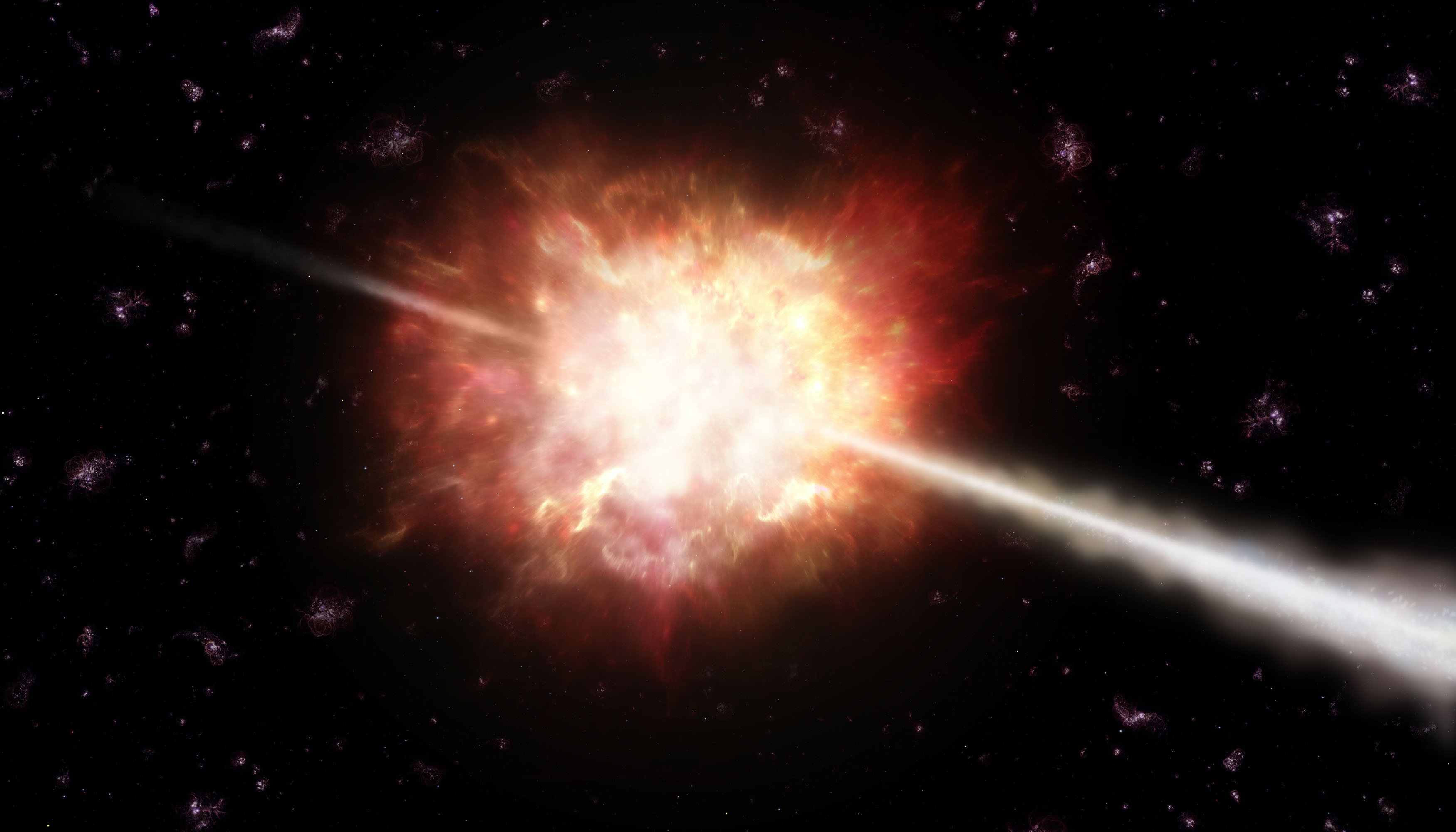
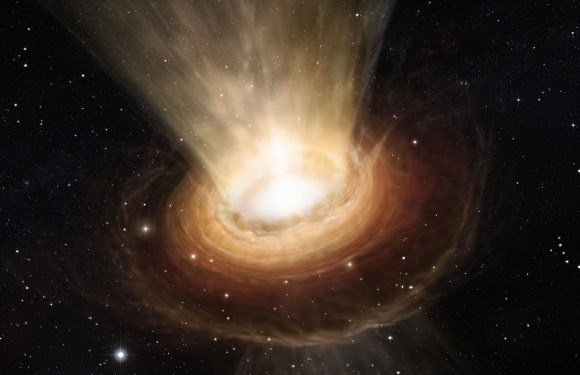
NASA's_Fermi,_Swift_See_'Shockingly_Bright'_Burst_(before_and_after_labels)It took place back in late November, when an “armada of instruments” from all over the world saw a massive gamma-ray burst originating from a point in space known as GRB 130427A. This burst was more powerful than what many researchers believed was theoretically possible, and is now thought to be the collapse of a giant star and the birth of a black hole.

The event has been described as a “Rosetta stone moment” by astronomers for a number of reasons. In addition to being a truly rare and awesome sight, this burst has also sent out information that astronomers will be studying for many years to come. And while it’s too soon to draw any real conclusions, there is already widespread excitement about the sheer newness of it.

blackhole_birthAnd yet, GRB 130427A only lasted about 80 seconds at observable intensities, so the fact that it was observed, letalone documented so thoroughly was truly surprising! This was all thanks to the Los Alamos National Laboratories in New Mexico, where six robotic cameras – collectively referred to as RAPTOR, or RAPid Telescopes for Optical Response – were able to respond in time to catch the event unfold.

The RAPTOR telescopes are networked together and all obey a central computer “brain”. Between their dedicated computing hardware and robotic swivel-mounts, they can turn to view any point in the sky in less than three seconds. As the world’s fastest “optical response” devices, RAPTOR’s telescopes are designed to make sure we don’t miss astronomical events when they happens, because in astronomy there are no second chances.

gamma-ray-burst The RAPTOR telescopes to ensure things aren’t missed by performing extremely diffuse, wide-angle sweeps of the sky to pick up hints at about where and when a major event is taking place. When one of the telescopes sees a hint of something good, it and the others quickly reorient and zoom to capture it in full detail. And with all six telescopes capturing the same event, the wealth of information gleamed is quite impressive.

The telescopes have different specializations as well. For example, the RAPTOR-T views all events through four aligned lenses with four different color filters. By looking at the differences in color distribution in the sample, RAPTOR-T can provide info about the distance to an event (by measuring Red Shift and Blue Shift) or about some elements of its environment.

grb130427aThis gamma ray burst is thought to be the brightest in decades, perhaps in a century. And if astronomers had missed it, it’s likely that nobody would have gotten the chance to capture one again. Luckily, the event was also seen by a number of other gamma ray detectors and x-ray telescopes. These included NASA’s Fermi, NuSTAR, and Swift satellites, all of which managed to see some portion of the event as it unfolded.

However, most telescopes joined in to view the event’s so-called afterglow, an incredibly violent occurrence where the newly-born black hole threw out debris and damage over a wide radius. For several hours, this radius glowed and astronomers watched as it faded. The intensity of high-energy gamma rays in that afterglow faded in tandem with its conventional light emissions.

This is one of the first useful bits of information provided by this event – the link between gamma rays and optical phenomena. But this is just one way that it could be astronomy’s latest Rosetta Stone observation. In the next few months, we can all look forward to a slew of exciting updates as astronomers sort through the implications of having witnessed the birth of an unprecedented singularity.

And in the meantime, check out this video of the gamma-ray burst, as observed by the RAPTOR All-Sky Monitor:


Source:
extremetech.com

Birth of an Idea: Seedlings

alien-worldHey all! Hope this holidays season finds you warm, cozy, and surrounded by loved ones. And I thought I might take this opportunity to talk about an idea I’ve been working on. While I’m still searching for a proper title, the one I’ve got right now is Seedlings. This represents an idea which has been germinated in my mind for some time, ever since I saw a comprehensive map of the Solar System and learned just how many potentially habitable worlds there are out there.

Whenever we talk of colonization, planting the seed (you see where the title comes from now, yes?) of humanity on distant worlds, we tend to think of exoplanets. In other words, we generally predict that humanity will live on worlds beyond our Solar System, if and when such things ever become reality. Sure, allowances are made for Mars, and maybe Ganymede, in these scenarios, but we don’t seem to think of all the other moons we have in our Solar System.

solar_systemFor instance, did you know that in addition to our system’s 11 planets and planetoids, there are 166 moons in our Solar System, the majority of which (66) orbit Jupiter? And granted, while many are tiny little balls of rock that few people would ever want to live on, by my count, that still leaves 12 candidates for living. Especially when you consider that most have their own sources of water, even if it is in solid form.

And that’s where I began with the premise for Seedlings. The way I see it, in the distant future, humanity would expand to fill every corner of the Solar System before moving on to other stars. And in true human fashion, we would become divided along various geographic and ideological lines. In my story, its people’s attitudes towards technology that are central to this divide, with people falling into either the Seedling or Chartrist category.

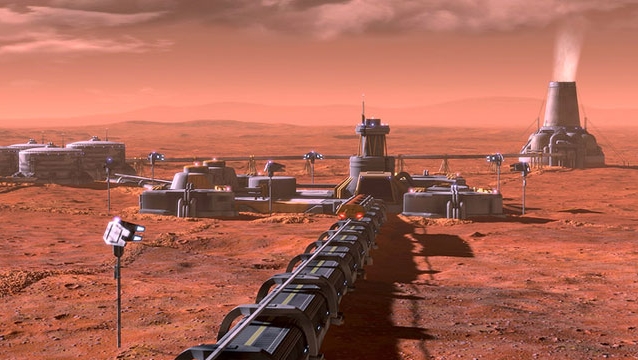
nanomachineryThe Seedlings inhabit the Inner Solar System and are dedicated to embracing the accelerating nature of technology. As experts in nanotech and biotech, they establish new colonies by planting Seeds, tiny cultures of microscopic, programmed bacteria that convert the landscape into whatever they wish. Having converted Venus, Mars, and the Jovian satellites into livable worlds, they now enjoy an extremely advanced and high standard of living.

The Chartrists, on the other hand, are people committed to limiting the invasive and prescriptive nature technology has over our lives. They were formed at some point in the 21st century, when the Technological Singularity loomed, and signed a Charter whereby they swore not to embrace augmentation and nanotechnology beyond a certain point. While still technically advanced, they are limited compared to their Seedling cousins.

terraforming-mars2With life on Earth, Mars and Venus (colonized at this time) becoming increasingly complicated, the Chartrists began colonizing in the outer Solar System. Though they colonized around Jupiter, the Jovians eventualy became Seedling territory, leaving just the Saturnalian and Uranian moons for the Chartrists to colonize, with a small string of neutral planets lying in between.

While no open conflicts have ever taken place between the two sides, a sort of detente has settled in after many generations. The Solar System is now glutted by humans, and new frontiers are needed for expansion. Whereas the Seedlings have been sending missions to all suns within 20 light-years from Sol, many are looking to the Outer Solar System as a possible venue for expansion.

exoplanets1At the same time, the Chartrists see the Seedling expansion as a terrible threat to their ongoing way of life, and some are planning for an eventual conflict. How will this all play out? Well, I can tell you it will involve a lot of action and some serious social commentary! Anyway, here is the breakdown of the Solar Colonies, who owns them, and what they are dedicated to:

Inner Solar Colonies:
The home of the Seedlings, the most advanced and heavily populated worlds in the Solar System. Life here is characterized by rapid progress and augmentation through nanotechnology and biotechnology. Socially, they are ruled by a system of distributed power, or democratic anarchy, where all citizens are merged into the decision making process through neural networking.

Mercury: source of energy for the entire inner solar system
Venus: major agricultural center, leader in biomaterial construction
Earth: birthplace of humanity, administrative center
Mars: major population center, transit hub between inner colonies and Middle worlds

Middle Worlds:
A loose organization of worlds beyond Mars, including the Jovian and Saturnalian satellites. Those closest to the Sun are affiliated with the Seedlings, the outer ones the Chartrists, and with some undeclared in the middle. Life on these worlds is mixed, with the Jovian satellites boasting advanced technology, augmentation, and major industries supplying the Inner Colonies. The Saturnalian worlds are divided, with the neutral planets boasting a high level of technical advancement and servicing people on all sides. The two Chartrist moons are characterized by more traditional settlements, with thriving industry and a commitment to simpler living.

Ceres: commercial nexus of the Asteroid Belt, source of materials for solar system (S)
Europa: oceanic planet, major resort and luxury living locale (S)
Ganymede: terraforming operation, agricultural world (S)
Io: major source of energy for the Middle World (N)
Calisto: mining operations, ice, water, minerals (N)
Titan: major population center, transit point to inner colonies (N)
Tethys: oceanic world, shallow seas, major tourist destination (N)
Dione: major mining colony to outer colonies (C)
Rhea: agricultural center for outer colonies (C)

Outer Solar Colonies:
The Neptunian moons of the outer Solar System are exclusively populated by Chartrist populations, people committed to a simpler way of life and dedicated to ensuring that augmentation and rapid progress are limited. Settlements on these worlds boast a fair degree of technical advancement, but are significantly outmatched by the Seedlings. They also boast a fair degree of industry and remain tied to the Inner and Middle Worlds through the export of raw materials and the import of technical devices.

Miranda: small ice planet, source of water (C)
Ariel: agricultural world, small biomaterial industry and carbon manufacturing (C)
Umbriel: agricultural world, small biomaterial industry and carbon manufacturing (C)
Titania: agricultural world, small biomaterial industry and carbon manufacturing (C)
Oberon: agricultural world, small biomaterial industry and carbon manufacturing (C)
Triton: source of elemental nitrogen, water, chaotic landscape (C)

News From Space: Big Bang Vs. Black Hole

big bang_blackholeFor decades, the Big Bang Theory has remained the accepted theory of how the universe came to be, beating out challengers like the Steady State Theory. However, many unresolved issues remain with this theory, the most notable of which is the question of what could have existed prior to the big bang. Because of this, scientists have been looking for way to refine the theory.

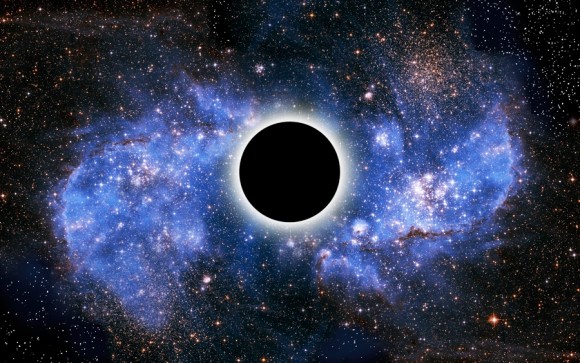
Luckily, a group of theoretical physicists from the Perimeter Institute (PI) for Theoretical Physics in Waterloo, Ontario have announced a new interpretation on how the universe came to be. Essentially, they postulate that the birth of the universe could have happened after a four-dimensional star collapsed into a black hole and began ejecting debris.

big_bangThis represents a big revision of the current theory, which is that universe grew from an infinitely dense point or singularity. But as to what was there before that remain unknown, and is one of a few limitations of the Big Bang. In addition, it’s hard to predict why it would have produced a universe that has an almost uniform temperature, because the age of our universe (about 13.8 billion years) does not give enough time to reach a temperature equilibrium.

Most cosmologists say the universe must have been expanding faster than the speed of light for this to happen. But according to Niayesh Afshordi, an astrophysicist with PI who co-authored the study, even that theory has problems:

For all physicists know, dragons could have come flying out of the singularity. The Big Bang was so chaotic, it’s not clear there would have been even a small homogenous patch for inflation to start working on.

black_holeThe model Afshordi and her colleagues are proposing is basically a three-dimensional universe floating as a membrane (or brane) in a “bulk universe” that has four dimensions. If this “bulk universe” has four-dimensional stars, these stars could go through the same life cycles as the three-dimensional ones we are familiar with. The most massive ones would explode as supernovae, shed their skin and have the innermost parts collapse as a black hole.

The 4-D black hole would then have an “event horizon”, the boundary between the inside and the outside of a black hole. In a 3-D universe, an event horizon appears as a two-dimensional surface; but in a 4-D universe, the event horizon would be a 3-D object called a hypersphere. And when this 4-D star blows apart, the leftover material would create a 3-D brane surrounding a 3-D event horizon, and then expand.

planck-attnotated-580x372To simplify it a little, they are postulating that the expansion of the universe was triggered by the motion of the universe through a higher-dimensional reality. While it may sound complicated, the theory does explain how the universe continues to expand and is indeed accelerating. Whereas previous theories have credited a mysterious invisible force known as “dark energy” with this, this new theory claims it is the result of the 3-D brane’s growth.

However, there is one limitation to this theory which has to do with the nearly uniform temperature of the universe. While the model does explain how this could be, the ESA’s Planck telesceop recently mapped out the universe and discovered small temperature variations in the cosmic microwave background (CBM). These patches were believed to be leftovers of the universe’s beginnings, which were a further indication that the Big Bang model holds true.

big_bang1The PI team’s own CBM readings differ from this highly accurate survey by about four percent, so now they too are going back to the table and looking to refine their theory. How ironic! However, the IP team still feel the model has worth. While the Planck observations show that inflation is happening, they do not show why the inflation is happening.

Needless to say, we are nowhere near to resolving how the universe came to be, at least not in a way that resolves all the theoretical issues. But that’s the things about the Big Bang – it’s the scientific equivalent of a Hydra. No matter how many times people attempt to discredit it, it always comes back to reassert its dominance!

Source: universetoday.com, perimeterinstitute.ca

Repitching an Old Idea: The Council of Muraqaba

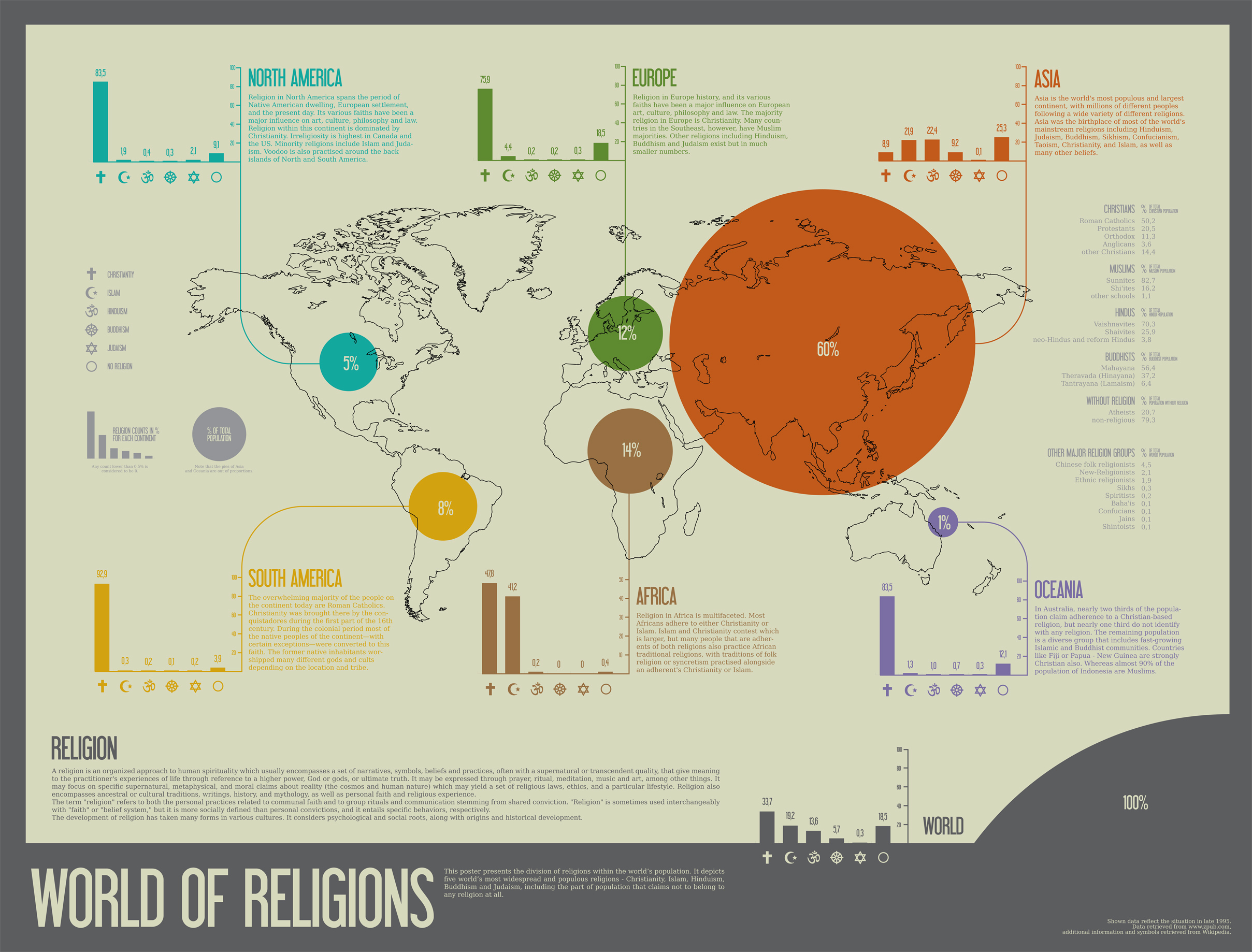
world_religionsHey folks! A lot of things have got me thinking about another old idea that I think needs to be updated and brought forward. This one comes from many years back, roughly 2007, when I was working on the series of short stories that make up my Legacies series. As one of several ideas I was working with back then, it kind of fell by the wayside as I busied myself with writing the others – Flight of the Icarus, Eyes in the Dark, Turncoats, Vega Rising.

Eventually, as with many ideas us indie writers come up with, it lost my interest after lingering so long in my Inbox. But after a few conversations with respected colleagues, I found myself thinking about it again and looking to update it, add a new spin, and just generally give it another try. The story, in its updated version, is called The Council of Muraqaba, and it concerns humanity’s efforts to create a universal religion in the future.

world_religions_distWhen I first came up with the idea for a universal faith as part of my Legacies universe, I was still in my Frank Herbert phase and borrowed many crumbs off his table. His own notes in Dune about the Orange Catholic Bible and the Commission of Ecumenical Translators that created it really inspired me, and it put me in mind of the World Religions class I took in high school, which just happened to be one of my favorite subjects.

In 2007, the short story that was to feature the attempts to create this religion was more of an original idea, at to me. I envisioned a world where the council behind the religion’s creation established a permanent seat where matters of interfaith exchanges could take place, and where research into what made them all tick could be done and universal principles uncovered.

world_religions_popThis seemed like a timely idea to me given just how controversial, central, and daunting the issue of faith continues to be in our world today. Between people who demand that others conform to their religion to those who condemn religion of any kind, and from those who use it justify violence and persecution to those who blame it for the problems of entire regions of the world (i.e. Africa, the Middle East and Islamophobia), it’s almost inescapable.

Because of this, and because of the way humanity has a hard time outgrowing old habits, I figured a story that dealt with humanity’s continued difficulties with religion and sectarian differences should be included in my Legacies bundle. But as I said, I’ve been updating the idea a bit thanks to some conversations with friends which raised some poignant issues about the future, and thanks to some research about what the future is likely to hold…

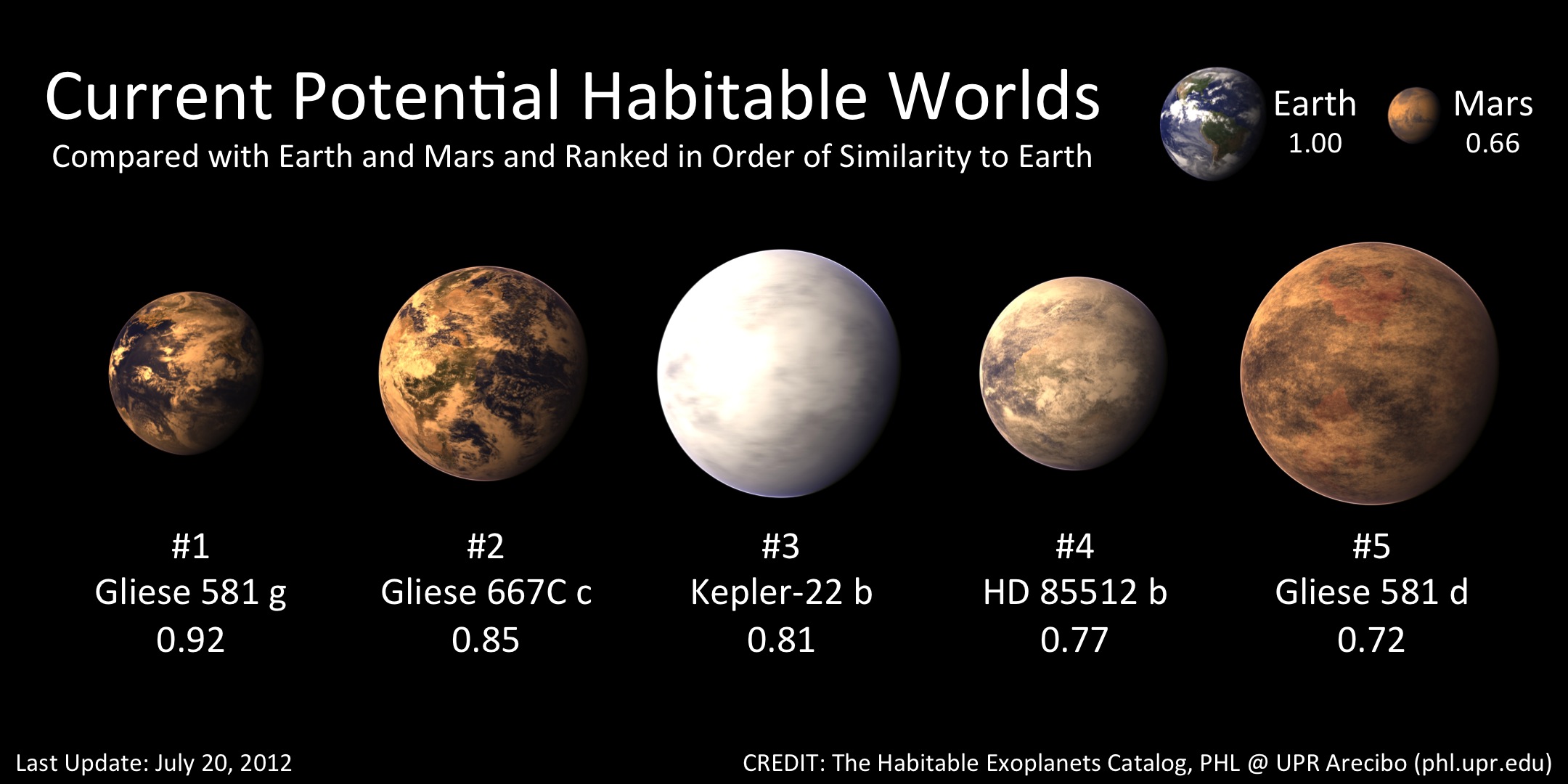
gliese-581.jpgWhat I am envisioning now is a world where a group of mystic settlers originally established a colony on Gliese 581 d – aka. Muraqaba – in the hopes of creating a community where traditional faiths could still be practiced, free from the fear of ongoing progress and how it was leading many to conclude that religion was obsolete. Named after the Sufi practice of meditation, they sought to live in peace and practice freely, and were on guard against what they saw as “needless augmentation”.

In time, this community expanded and became dedicated to finding a way to bring all faiths together and finding common ground not just between religions but between faith and science itself, something which still eluded people in this age. Eventually, this led to the creation of the Council of Muraqaba, a permanent institution where scholars and religious authorities could meet, discuss, and network with people in the universe at large to iron out matters of spirituality.

matrix_cyberspaceIronically, the Council became a hub for some of the most advanced interstellar learning and education since people who were light years away from each other could communicate using a quantum array that allowed FTL communications to take place. The experience of this is central to the story, as it provides a sort of mystic mental sharing that is akin to a spiritual connection, emotions and thoughts shared instantaneously between people.

And of course, there will be a twist as a regular day at the Council turns into something sinister. Just because the local inhabitants have succeeded in creating a dialogue with the universe at large doesn’t mean that everyone is interesting in what they have to say. And some people are concerned that all this “common ground” stuff is eroding the things that make their faith special and want it to end.

And some… some are interested in what the Council has to say for reasons that go far beyond matters of faith! Be sure to check it out, as I think this story just might be one of my more inspired pieces of writing. And my thanks once again for Khaalidah for turning on the light in my head. There’s a reason I call you “Lady Inspiration” you know 😉

BIG News From Space: Alien Matter Found?

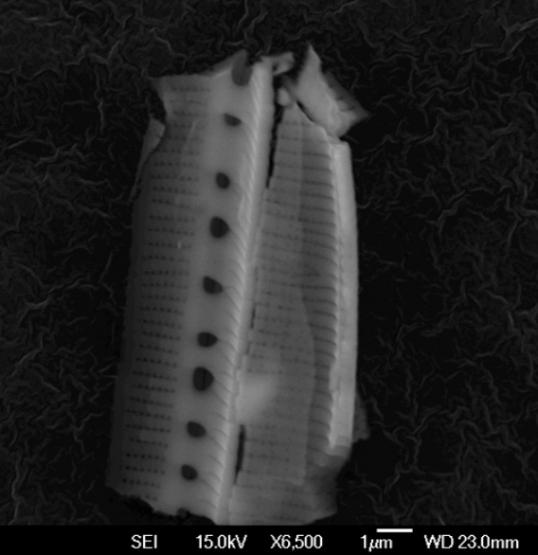
Alien OrganismsIts been an exciting 48 hours for the scientific community. It began when a team of British scientists floated a balloon up into the stratosphere, more than 25 km (16 miles) up, and when it came down they found it was carrying tiny organisms. The scientists claimed that there is no way that such organisms could have come from Earth and found their way into the stratosphere, so they must have come from space.

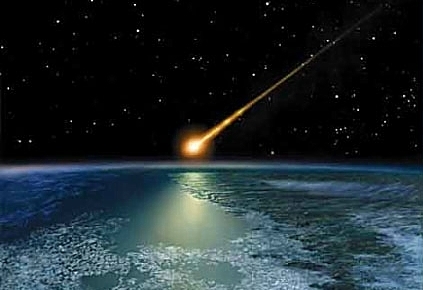
Specifically, they must have come from a comet, given their particular characteristics, and they could even be evidence that all life on Earth really did originate in the stars. This theory is known as Exogenesis (or Panspermia), and contends that this is how organisms are spread throughout the universe – spawning in certain environments, but flourishing on worlds where they are deposited and conditions are just right.

Alien Organisms1According to Professor Milton Wainwright of the Department of Molecular Biology and Biotechnology at the University of Sheffield, they are “about 95 percent convinced” of that fact, though he admits that it’s hard to be absolutely certainty. But apart from the height of the organisms, which would make it hard to imagine them being from Earth, Wainwright and his team also noted that they bear no physical signs of ever being earthbound.

As Wainwright said in the course of announcing the team’s findings:

There is no known mechanism by which these life forms can achieve that height. As far as we can tell from known physics, they must be incoming. The particles are very clean. They don’t have any dust attached to them, which again suggests they’re not coming to earth. Similarly, cosmic dust isn’t stuck to them, so we think they came from an aquatic environment, and the most obvious aquatic environment in space is a comet.

In addition, the science team ruled out the possibility that the particles were originally from Earth and were blasted into the stratosphere by a volcano, noting that it’s been too long since the last volcanic eruption on Earth for the particles to have maintained such a height. So the tentative conclusion remains, that the organisms were placed in orbit by a passing comet.

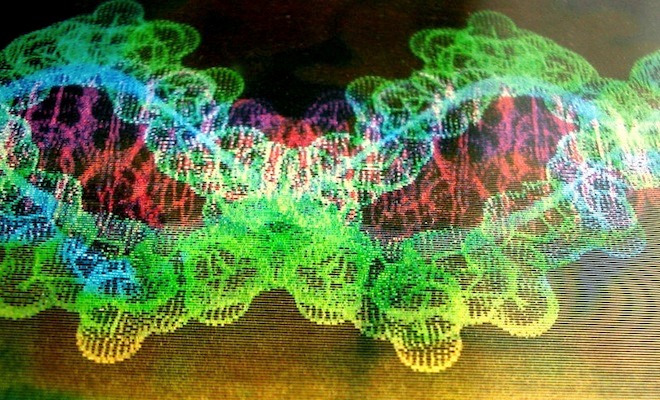
DNA-1What’s even more exciting is the prospect that the organisms, though they are all likely dead at this point, are likely to contain alien DNA. If this proves to be true, it could further the idea that life on Earth may have had its beginnings in cosmos. Next month, the team plans to try the balloon test again to see if they can both confirm their results and find new organisms in upcoming meteor shower tied to Halley’s Comet.

Exciting prospects indeed. But almost immediately after the announcement been made, dissenting voices began to come forward to poke holes in the team’s theory. One such person is Phil Plait, an astronomer who upon reading the findings in the Journal of Cosmology, raised a number of concerns and criticisms about the team’s research.

First, Plait notes, one member of the research team, Chandra Wickramasinghe, has claimed numerous times that he’s discovered diatoms – a type of phytoplankton found in meteorites – and this particular paper also includes similar diatom findings. Wickramsinghe also, according to Plait, has a long history of making dubious claims about extraterrestrial life, using less-than-thorough research.

PanspermiaPlait also noted that the Journal of Cosmology, where the paper was published, has a less-than-spotless reputation. In the past, the quality of peer review at the journal has been questioned, and they have also been accused of promoting fringe and speculative viewpoints on astrobiology, astrophysics, and quantum physics. Of particular concern is the journal’s apparent bias that the theory of Panspermia is established fact, which remains a theory.

But as to the scientific findings themselves, there’s the question of whether the diatom really came from space or became attached to the balloon as it transited from the surface into orbit. While the team claims that precautions were taken and the sample was too clean, extended testing may prove this conclusion to be wrong, and possibly premature.

Second, Plait disputes the conclusion that the diatom could not have been put up in the atmosphere by a volcanic eruption. Specifically, he noted that the researchers didn’t seem to take into account things like turbulence in the stratosphere that could have kept objects previously hurled up there by volcanoes floating around for quite some time.

panspermia1Then there’s the claim that evidence points that the organisms came from a comet. The fact that it was “remarkably clean and free of soil or other solid material,” works against this conclusion, according to Plait. If indeed it came embedded in rock, there would surely be samples of soil, dust, ice or minerals attached to it, as these are things commonly found in a comet.

And finally, there’s the theory the researchers developed that these organisms are evidence that life actually began somewhere in space, then came to Earth. While Panspermia is a good theory, Plait claims that the scientists are going about arguing it in a way that is not strictly scientific:

Panspermia is worth investigating, but it’s worth investigating correctly. Outrageous claims on thin evidence with huge conclusion-jumping don’t comprise the best way to do it. Stories like this one are sexy and sure bait for an unskeptical media, of course. But at the very least they don’t help the public understand science and the scientific process, and I know some scientists take an even dimmer view of it.

But of course, the announcement was just made and there’s still plenty of checking to do. In the meantime, we can all certainly speculate, and I would like to hear from the people out there. What do you think? Does this discovery constitute a scientific breakthrough, or is it an elaborate hoax or a case of eager scientists jumping to conclusions?

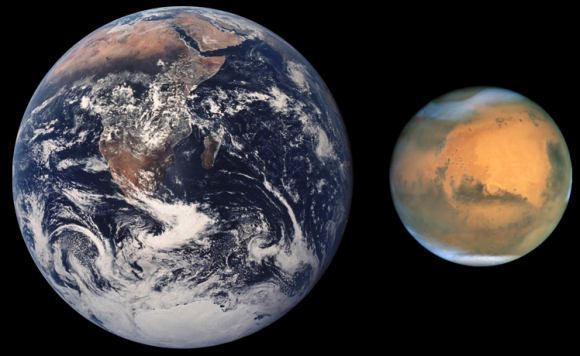
Mars_Earth_Comparison-580x356And let’s not forget, this announcement comes not long after Professor Steven Benner’s similar announcement that new evidence connects the origin of life on Earth to life on Mars. No reason why Exogenesis and the Martian hypothesis can’t coexist now is there?

Sources: blastr.com, (2)

News From Space… ShipTwo!

spaceshiptwo-2nd-flightVirgin Galactic’s founder Sir Richard Branson has been working tirelessly for over a decade now in the hopes of realizing the dream of privatized space travel. And earlier this month, his company once again made history with the second rocket-powered supersonic test flight of its SpaceShipTwo craft. And in the process, it broke its previous records for speed and altitude, bringing it that much closer to its first commercial flight.

The flight test took place last Thursday at 8:00 am PDT, when the SS2 took off slung beneath the WhiteKnightTwo (WK2) carrier aircraft from Virgin Galactic’s Mojave Air and Space Port in California. The SS2 was then released from the carrier at 14,000 meters (46,000 ft) and the rocket motor burned for 20 seconds, pushing the spacecraft to an altitude of 21,000 meters (69,000 ft) and a maximum speed of Mach 1.43 (1,752 km/h, 1,088 mph).

spaceshiptwo-2nd-flight-6According to the company, the tourism spacecraft went through its full technical mission profile in a single flight for the first time, including the deployment of its “feathering” re-entry mechanism at high altitude. This took place after engine shutdown and involved rotating the tail section to vertical, which slows the ship down and allows the shuttle to glide back home. The craft then landed in a controlled, unpowered glide at Mojave at 9:25 AM.

This flight builds on the success of the first rocket-powered supersonic flight that took place on April 29. Designed out of carbon composite, the space craft is powered by a hybrid rocket motor that uses solid rocket fuel and nitrous oxide as an oxidizer. Once test flights are complete, it will begin carrying six passengers on suborbital flights and will also have the option of deploying research equipment such as micro-satellites into Low-Earth Orbit (LEO).

spaceshiptwo-2nd-flight-1Naturally, the CEO and founder, Sir Richard Branson, chose to mark the occasion with some choice words:

We couldn’t be more delighted to have another major supersonic milestone under our belts as we move toward a 2014 start of commercial service. It was particularly thrilling to see for the first time today the whole elegant system in action during a single flight, including the remarkable feathering re-entry system. It was this safety feature more than anything else that originally persuaded us that the overall design of the system was uniquely fit for purpose. Everything we have seen today just confirms that view.

Next year, if all goes well, Virgin Galactic will be conducting its first commercial flights, ferrying passengers into low orbit where they will experience several minutes of weightlessness before gliding back to Earth. In this, they are joined by such groups as KLM, Golden Spike and SpaceX in attempting to create the first set of commercial space flights which will one day bring people to and from orbit, and possible even the Moon.

spaceshiptwo-2nd-flight-2And of course, Virgin Galactic was sure to capture the test flight on tape using a tail camera. It captures the engine burn, and then the near-vertical acceleration, as the craft puts planet Earth in its rear view and heads for atmo! Quite cool! Check it out:


Source: gizmag.com

News from Mars: Another (Planned) Mission!

mars-mission1When it comes to generational milestones, those of born since the late 70’s often feel like we’re lagging behind previous generations. Unlike the “Greatest Generation” or the “Baby Boomers”, we weren’t around to witness Two World Wars, the Great Depression, the Cuban Missile Crisis, the death of JFK, Neil Armstrong, or the FLQ Crisis. For us, the highlights were things like the development of the PC, the birth of the internet, Kurt Cobain, and of course, 9/11.

But looking ahead, those us of belonging to Generation X, Y, and Millennials might just be around to witness the greatest event in human history to date – a manned mission to Mars! And while NASA is busy planning a mission for 2030, a number of private sources are looking to make a mission happen sooner. One such group is a team of UK scientists working from Imperial College London that are working to mount a a three person mission to Mars.

mission-to-marsThe planned mission consists of two spacecraft, the first of which is a Martian lander equipped with a heat shield that will send the crew off into Earth’s orbit. The second craft would be a habitat vehicle, which is the craft that the crew would live in during the voyage. The habitat vehicle would consist of three floors, and measure in at around 30 feet (10m) tall and 13 feet (4m) in diameter.

The astronauts would be situated in the lander during takeoff, and would move to the habitat when the dual-craft reaches Earth orbit. Once the astronauts are safely within the habitat, a rocket would shoot the dual-craft off on its journey to Mars, which would take nine months to arrive, less than the approximately 300 days that most projections say it will take.

Mars_landerOnce In space, the dual-craft would then split apart but remain connected by a 60 meter (200 foot) tether. Thrusters from both vehicles would then spin them around a central point, creating artificial gravity similar to Earth’s in the habitat. Not only would this help the astronauts feel at home for the better part of a lonely year, but it would also reduce the bone and muscle atrophy that are associated with weightlessness.

The craft would be well-stocked with medicine to ensure that the crew remained in fine health for the nine month transit. Superconducting magnets, as well as water flowing through the shell of the craft, would be employed to help reduce both cosmic and solar radiation. And once the dual-craft reaches Mars, it would tether back together, the crew would move back into the lander, and then detach from the habitat descend to the Martian surface.

Mars-mission-2This mission would also involve sending a habitat and return vehicle to Mars before the astronauts arrived, so the crew would have shelter upon landing as well as a way to get home. The crew would spend anywhere from two months to two years on Mars, depending on the goals of the mission and the distance between Mars and Earth. On the way back home, the mission would dock with the ISS, then take a craft back to Earth from there.

What’s especially interesting about this proposed mission is that each stage of it has been proven to work in an individual capacity. What’s more, the concept of using water as a form radiation shielding is far more attractive than Inspiration Mars’, which calls for using the astronauts own fecal matter!

Unfortunately, no real timetable or price tags have been proposed for this mission yet. However, considering that every individual step of the mission has been proven to work on its own, the proposed overall journey could work. In the meantime, all us post-Baby Boomers can do is wait and hope we live to see it! I for one am going sick of hearing Boomers talk about where they were when Apollo 11 happened and having nothing comparable to say!

And be sure to enjoy this video of the University College London team discussing the possibilities of a Mars mission in our lifetime:


Sources:
bbc.co.uk, extremetech.com

New Movie Trailer: Europa Report

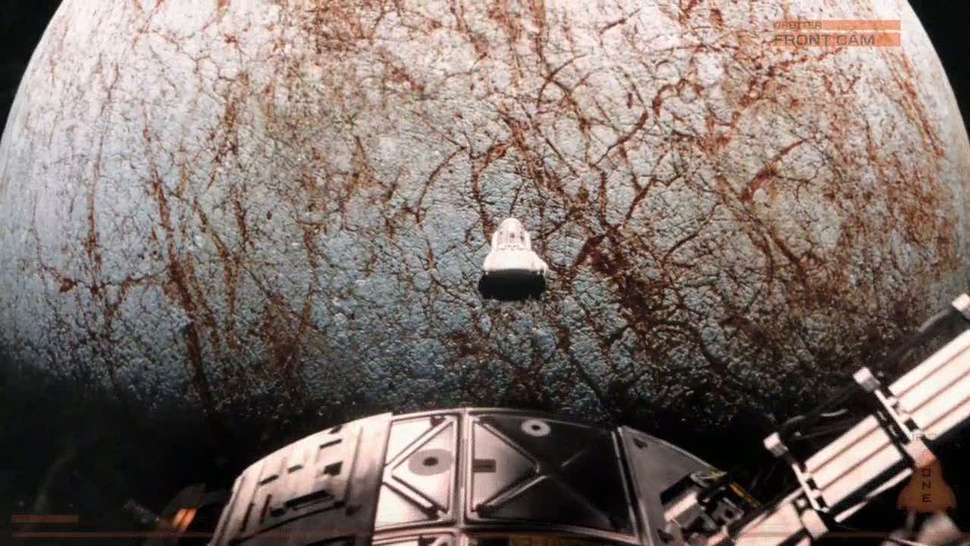
europa_reportOrdinarily, I like to show movie previews before the movie has been released. This time around, I’m a little behind the curve. But my thanks to Rami for bringing this movie to my attention, since it seems like just the thing for us sci-fi geeks and buffs. It’s called the Europa Report, a near-future speculative science fiction film that follows in the vein of the 2001: A Space Odyssey and the Blair Witch Project.

Taking place in 2061, the story follows a group of astronauts who are sent on a private venture to Jupiter’s moon of Europa to investigate it for signs of life. Naturally, things go wrong, lives are lost, and the footage of their mission becomes the basis of a “report” that people back at Earth pour over, hoping to find some answers to the mystery of what happened.

The film was officially released just under two weeks ago, on August 2nd, and has received some pretty kick-ass reviews. Over at space.com, they claimed the movie was “One of the most thrilling and realistic depictions of space exploration since Moon or 2001: A Space Odyssey”, while IO9’s Annalee Newitz wrote of the film:

The representations of Jupiter and Europa in this film come directly from real satellite imagery gathered by NASA, and the journey to Europa itself is both realistic and gorgeous. There’s a lesson here about how dramatic tension and brilliant concept design, even on an indie budget, can create a sense of wonder rivaling that of a VFX blockbuster. And the payoff at the end is electrifying.

Hot damn, that’s a good endorsement! As for me, and I imagine Rami, I plan to see it and offer a review of my own! A movie like this couldn’t be more timely. Already, long-term plans are being made to send a lander or a space penetrator to Europa to have a gander at what lies beneath its icy veil. And I look forward to the day when the reality of that planet and all the speculative fiction can get together and compare notes!

Source: IO9.com

News from SpaceX: More Tests and the Coming Launch

spaceX_elonmuskElon Musk just can’t get enough of the spotlight lately! But that’s the price you pay for being a billionaire, innovator, genius-type person! And barely a week after announcing his idea for the Hyperloop high-speed train, it now seems that SpaceX is once again making the news, thanks to its latest test of the Grasshopper reusable rocket system as well as their planned launch of the Falcon Heavy rocket.

For those unfamiliar with the Grasshopper, this is a proposed reusable rocket system that Musk and SpaceX created with the hopes of bringing the costs associated with space launches down considerably. Since September 2012, the rocket has been put through successive tests, reaching higher and higher altitudes and safely making it back to the ground.

grasshopper_lateraldivertIn this latest test, the rocket successfully performed a “lateral divert test”. In all previous tests, the rocket lifted off vertically from a launch pad and then used its Merlin-1D engine to ease itself back down to the pad. However, in actual launch situations, the rocket wont simply be traveling up and down. When it comes time to land, a considerable amount of lateral steering will be necessary to line it back up with the launch site.

This is what the test, which took place on Tuesday, August 13th, amounted to. It began with the Grasshopper reaching its previously-achieved altitude of 250 meters, but then continued with the rocket moving an additional 100 m (328 ft) to one side. It was subsequently still able to land safely back at the center of the launch pad, compensating for its lateral diversion.

According to SpaceX: “The test demonstrated the vehicle’s ability to perform more aggressive steering maneuvers than have been attempted in previous flights.” What’s more, it places the company that much closer to the realization of a truly reusable rocket system, something which will drastically cut costs for future space missions.

And of course, they were sure to catch the entire test on video:


But equally important for this rising company that seeks to privatize space travel was the announcement that they have are moving ahead with plans to launch their Falcon Heavy rocket system by late 2013 or early 2014. At present, the Falcon is the most power rocket system in the world, overshadowed only by the now retired – but soon to be reserviced – Saturn V booster that put the Apollo astronauts into space and on the Moon.

spaceX-falcon9As Musk himself said of the rocket:

Falcon Heavy will carry more payload to orbit or escape velocity than any vehicle in history, apart from the Saturn V moon rocket, which was decommissioned after the Apollo program. This opens a new world of capability for both government and commercial space missions.

Fully loaded, the Falcon Heavy will be able to carry payloads of 53 metric tons (117,000 pounds or 53,070 kg) into orbit, and is made up of two engine stages. The first stage consists of a Falcon 9 rocket, with a nine-engine cores, followed by two additional nine-engine cores attached to either side. In addition, the Merlin engines have been upgraded to handle the additional weight, and are being tested at SpaceX’s facility in McGregor, Texas.

flacon-heavy-3At liftoff the 69.2m (227 ft) long Falcon Heavy will generate 3.8 million pounds of thrust, which is equivalent to the thrust of fifteen Boeing 747’s taking off at the same time. SpaceX claims that this gives the Falcon Heavy more than twice the performance of the next most powerful vehicle – the Delta IV Heavy operated by the Boeing-Lockheed Martin joint venture United Launch Alliance.

SpaceX also says that with more than twice the payload of the Delta IV but at one third the cost, the Falcon Heavy sets a new world record in terms of economy at approximately US$1,000 per pound to orbit. This is in keeping with Musk’s promise to bring the associated costs of space travel and exploration down, hopefully one day to his goal of $500 per pound.


spaceX_solararrayWith the ability to carry satellites or interplanetary spacecraft to orbit, SpaceX is offering the Falcon Heavy on the commercial market for US$80–$125 million, which compares to the $435 million per launch the U.S. Air Force has budgeted for four launches in 2012. So in effect, Musk’s company is offering a money-saving alternative to both the public and private sector.

For those fascinated by the long-term potential of space travel, this is certainly exciting news. By cutting the costs of placing satellites, supplies and people in orbit, many things are being made feasible that were previously impossible. This includes conducting more research in orbit, the ability to create space-based solar arrays (a very cool solution to our current power problems and the limitations of Earth-based solar power) and perhaps even begin work on a Moon settlement.

solar_system1Beyond that, there are the growing possibilities of commercial space travel, space tourism, and even setting our sights father afield with manned missions to the Moon, prospecting missions to the asteroid belt, and surveying probes to Jupiter’s Moons and to the very edge of the Solar System. Possibly even beyond…

Exciting times we live in, when the impossible is slowly becoming possible!

Sources: gizmag.com, (2), spacex.com