Favorite Cult Classics (Part the Second)

Welcome back! As promised, the second half of my nostalgic, cult classic favorites for you to peruse! Let me know what you think, and feel to add some contenders of your own. Cult hits are nothing if not personal, and what constitutes a classic is open to interpretation. Okay, six to ten, here goes:

2001: A Space Odyssey:
Yes, this movie deserves top billing for being a classic! And yet, the movie really doesn’t seem to garner much appreciation from audiences, not unless they are self-professed film buffs or hard sci-fi fans. Not sure I qualify for either, but I loved this movie for the simple reason that it was packed full of mind-blowing themes. Much like Akira, it was chock-full of things that got my young mind thinking and completely shaped my outlook on science fiction.

Sure, there are those who complain that this movie is boring and esoteric, but I found all that a fitting price for the kick-ass subject matter, not to mention the mind-blowing climax. You got a mystery, speculations about human evolution, ancient aliens, space exploration, and existential singularities! All the while, the weight of the philosophical implications are weighing at your mind…

And let’s not forget how inspiration this movie proved to be. Today, the concept of ancient astronauts, aliens who came to Earth millions of years ago and tampered with human evolution, has become all the rage. From Star Trek to Stargate, Battlestar Galactica to Prometheus, the concept of ancient astronauts has played out. And frankly, 2001 has them all beat! Between Kubrick and Clarke, their concept of the aliens and how they altered the course of evolution on Earth was the most realistic I have ever seen.

But I think what I liked best about was the fact that the movie was the subtle nature of the whole thing. At once speculative, philosophical, and visually stunning, this movie was characteristic of Kubrick, who preferred to convey things visually rather than coming out and telling people what was going on. You never really quite knew what happened during that eye-popping final scene, but those who love sci-fi and imaginative filmaking were sure to have ideas!

Alien:
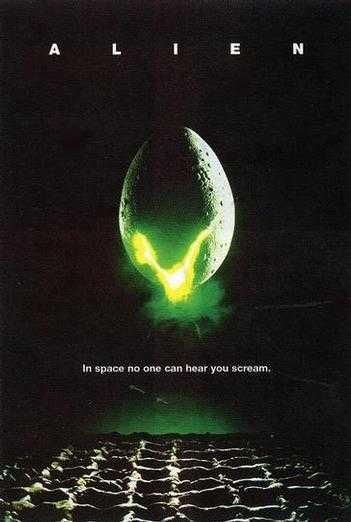
Granted, this movie wasn’t exactly under-appreciated, but compared to the lavish attention the rest of the franchise has garnered- even though it was all downhill after Aliens – this first installment truly was the diamond in the rough. Not only did it have a cool concept, awesome set designs and a kick-ass back story, the direction and cinematography captures the story’s sense of dread and claustrophobia perfectly.

Little wonder then why this movie spawned an entire franchise, because it really did have everything. You had your blue-collar peeps working for the major interstellar company (Weyland-Yutani), a frightening discovery made on an uncharted planet, a mysterious derelict belonging to an unknown race, and a terrifying creature awakened from its slumber. And not just any kind of creature, but a complex symbiote that was designed for and possessed of a single purpose.

Or as Ash put it: “Perfect organism. Its structural perfection is matched only by its hostility.” He had a point didn’t he? In fact, all structures in this movie were pure genius, whether it was the Nostromo, the Derelict, or the Facehugger and Chestbuster combo. As with everything Scott does, attention to detail and the careful construction of a universe was paramount. Every set was richly detailed, well shot, and clearly made to elicit the right feel and impressions on the audience.

Much of the credit for this goes to H.R. Giger as well, the surrealist artist who brought Lovecraftian horror to the alien concept and set of the alien ship. Years later, I still find myself tuning in just to get a glimpse of that Gothic reconstruction, or to see the Space Jockey sitting in its chair, the tell-tale hole punching through its chest. Few movies have managed to capture that same sense of awe and wonder for me, with the possible exceptions of 2001 and Akira

Johnny Mnemonic:
Some people might think I’m crazy for listing this movie as a personal classic, but it can’t be helped! And my reasons are pretty simple. On the one hand, this movie kind of has that “so bad, it’s good” thing going on, but at the same time, I also felt it possessed some real signs of quality. Sure, the acting was pretty wooden, the fight choreography total crap, and the low-budget nature apparent throughout. But it was still a pretty faithful adaptation of Gibson’s work and introduced to that world at a still-young age. Hence why I come back to it every few years just to see it again.

Filmed in the mid-90’s, this movie is an adaptation of the short story by William Gibson and previewed a lot of what he wrote in Neuromancer. For example, you’ve got the big bad corporations, the cyberspace jockeys, freelance assassins, Yakuza, and the character Molly Millions. Things are also set in “The Sprawl”, the megapolis that stretches from Boston to Atlanta and is contained in geodesic domes, and the look and feel is definitely of the cyberpunk variety.

Into all this, Gibson introduced the revolutionary concept of mnemonic couriers, people who have “wetwire” implants in their brains that allow them to carry vast quantities of data from point A to point B. Basically, these couriers are the answer of what to do in a world where information is the most precious commodity, and all databases are vulnerable to hacking and protected by “Black ICE” – hostile Intrusion Countermeasure Electronics (aka. viruses)

And, in keeping with Gibson’s style, the story involves a titanic corporation that is fighting to maintain its monopolistic grip, while freelancers, smugglers and assorted little people are fighting to undermine them and distribute the information freely. Naturally, the main character of Johnny is an unlikely hero who is forced to take a break from looking out for number one and help others for a change. Might sound cheesy, and a little cliche, but it works and delivers on Gibson’s style. At the very least, it’s a guilty pleasure flick for me.

Screamers:

Now here’s a movie that’s high on the pleasure, low on the guilt. While a low-budget sci-fi flick that was (like Johnny Mnemonic) produced and filmed entirely in Canada, it had many signs of quality that immediately made it a cult hit. There’s the post-apocalyptic setting, the frightening tone, and the Cold War feel of the thing, updated for the 90’s. All the while, there is the knowledge that this is an adaptation of Philip K. Dick’s Second Variety, which sort of makes it a must-see of PKD fans.

Much like in the original story, the plot of the film involves a race of self-producing, self-upgrading machines that are designed to infiltrate enemy territory and eliminate all combatants. But of course, things begin to go awry when the people who produced them realize that they have upgraded to the point where they can impersonate human beings. And whereas the original story was set on Earth and took place between the US and Russia, the updated story takes place on Sirius 6b, a pining planet that became the front line between a the political-economic entity known as the NEB  and those who chose to resist its rule.

Personally, I felt the updated version works. Not only does the conflict seem more relevant, being between a mega-corporate entity and a coalition of workers and dissenters, but the off-world setting also feels more realistic. Perhaps it was the fact that in the post-Cold War world, nuclear war between two superpowers didn’t seem a likelihood anymore. Or it could just be that the whole NEB angle was reminiscent of Weyland-Yutani and Alien. All I know is, I liked it!

What’s more, a good deal of attention went into creating the setting and modelling the Screamers – aka. the automated machines that kill people. Designed to be the perfect terror weapons, they emit a high-pitched “scream” before making their attack, and can toy with their targets for some time before moving. This concept, combined with some good shooting, really created a sense of tension which is felt throughout. And of course, the paranoia which is engendered by the appearance of human-like machines was a very nice touch! A good movie, and a fitting adaptation which managed to capture PKD’s cautionary tale about the dangers of runaway progress.

Time Bandits:
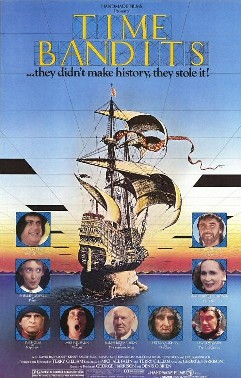
And last, here is the classic time traveling tale that I first saw in my childhood. Recently, my wife was told by a coworker that she should ought to see it, and my memory was jogged! Yes, this is indeed a cult classic, and one which is deserving of plenty of kudos and praise. Well cast, well written, witty and poignant, it’s one of those quintessential 70’s movies which has been rediscovered by several generations of film buffs and sci-fi fans.

The story opens with an imaginative and historically-minded child who lives in an overly-bourgeois neighborhood with his materially-possessed family. But upon realizing that there is a time-portal in his wall and that people from the past and future can come through it, his world is turned upside down. Quickly, he become the unwitting companion in a group of dwarves who are traveling through time, stealing precious artifacts, and being pursued by both the “Supreme Being” and an evil sorcerer.

Immediately, one can see the layered and inspired plot taking shape here. On the one hand, you have some decidedly Judea-Christian elements, plus a tale of childhood imagination and escapism. The dichotomy of the Supreme Being who possesses the power of time travel and the sorcerer who wants it for himself are representative of God and Lucifer, after a fashion. The dwarves who stole this power for themselves are a sort of Icaran allegory, or possibly Adam and Eve once they ate from the tree of knowledge. And ultimately, the way they are saved in the end from evil represents their redemption.

All the while we are left wondering if the boy is merely dreaming, or if what he is experiencing is real, which is an element that is intrinsic to all tales of childhood fantasies. On the one hand, the protagonists flights of fancy are seen as a weakness and immaturity to those around them, whereas we tend to see as it a rare gift to see past the surface. Should it all be a fantasy, then the story is left without a formal sense of resolution; but if it is real, then the hero has been vindicated and proven right. Appropriately, the movie plays with the two possibilities, going back and forth, but then giving strong hints at the end that it was in fact real. So really, you have a story that is inspired, imaginative, and also suspenseful!

___

Well, that’s my top ten list for the best cult classic movies of all time. What’s yours? I know I have a few in common with some people ’round these parts, and I also know that a few were previously unheard of. Hence why I want to here from others. I have a feeling there are some which I need to see and would very much enjoy. Already, I’m poised to watch Sunshine, A Boy and His Dog, and a few others which I’ve heard good things about. And I hope that in the course of swapping lists, I might be able to find a few more I’d like to see. Take care, and enjoy the rest of the long-weekend, those of who are reading this in Canada. As for the Yanks in the audience, and the rest of the world for that matter, enjoy the work week 😉

Terraforming in Pop Culture

Welcome back to the wonderful world (pun!) of Terraforming. In my last post on the subject, I came to see that it emerged in fiction in the early 20th century as part of our growing awareness of the universe and humanity’s place within it. As western civilization grew and came to encompass the entire world through exploration, conquest and colonization, human scientists simultaneously discovered that our universe was much larger than previously thought, and began to postulate that life could exist on other planets.

In short, while our world grew smaller, the universe grew much, much larger. With no more nooks  or corners left to explore and conquer, we began to set our sights to the heavens for the next frontier. It’s such a fertile topic, but I shan’t get into it here. If I start waxing philosophical on all the thought that goes into exploring new worlds, we’ll be here forever.

Onto to the subject for today, which is terraforming in popular culture! As you can guess, there are quite a few instances of this taking place, and for good reason. Wherever science fiction and exoplanets have shown up in pop-culture, the concept terraforming was sure to follow. In some cases, this constituted a mere mention, but in others, detailed descriptions were given. Here is a list of just a few examples that I could find:

Aliens:
Central to the plot of Aliens was the fact that LV-426, the planet where the Nostromo and its crew encountered the Xenomorph in the first movie, had become a settler colony. As the executive at Weyland Yutani told Ripley, it was what they referred to as a “Shake and Bake Colony”, where terraformers were sent on ahead to run the atmospheric processors and make the planet suitable for human use. This was all in keeping with WY’s motto of “Building Better Worlds”. Pshaw!

Shortly after they arrive on LV-426, Ripley and the compliment of Colonial Marines determined that the colonists had been moved into the atmospheric processor, specifically to its lower levels where the air was hot and humid. Apparently, these conditions were favorable to the Xenomorph hatchlings, which began to use the colonists as hosts to breed”Chestbusters”.

After their disastrous confrontation in the hive, the atmospheric processor suffered a rupture to its coolant systems, which meant that the entire thing would go thermonuclear in just a few hours. After being all but eradicated in their first encounter with the Xenomorph and losing their only transport back to the ship, this served to add further urgency to the plot. And in the end, it was the destruction of the atmospheric processor which ensured that the Xenomorph colony was destroyed and all traces of them (with the exception of the Queen) wiped out.

Cowboy Bebop:
Set in the not-too-distant future, this anime from from the late nineties was set in a universe where humanity lived throughout the Solar System. This was made possible due to the discovery of hyperspace gates; however, due to the explosion of one near the Moon, Earth found itself being bombarded by meteorites which devastated large sections of the planet. As a result, much of the human race had to relocate to the Inner Planets, the Asteroid Belt, and the moons of Jupiter.

Many episodes of the show take place on the planets of Venus, Mars, Ganymede, Io, Callisto, and Titan, where terraforming has rendered them partially of fully habitable. Though the concept is treated as a sort of given, some degree of explanation is given as to how it took place and the varying degrees of success that resulted. In the case of Mars and Venus, the terraforming was so successful that Mars became the new hub of human civilization and Venus a major population center.

With this background firmly in place, the series plot arc – which involves a motley group of bounty hunters patrolling the system Space Western style – is then able to unfold. Though the show last only 26 episodes, it did achieve a cult following and a level of influence, similar to Joss Wedon’s Firefly (another Space Western that died prematurely).

Firefly:
Speak of the devil, or in this case, a show that made good use of the concept of terraforming. Intrinsic to the plot of this show, so much so that they opened every episode by referring to it, is the fact that in this future, the human race was forced to relocate to a new star system after Earth had been “used up”. Arriving at the “White Star”, they found dozens of planets and hundreds of moons around the system’s central sun and its many dwarf suns. These planets were then terraformed, a process which took generations, and began populated them soon after.

Another fact which is central to the story is the fact that while the central worlds were terraformed successfully and boasted large, advanced populations, the outer planets were poorly terraformed, leading to dry, desolate worlds that became havens for crime and backwards populations. Though life was show to be difficult in these colonies, they were also the only places where people can still enjoy a life free of the repressive Alliance regime.

But more importantly, this back story gave Joss Whedon an excuse for the look and feel of his acclaimed Space Western! It also played perfectly into the show’s historical narrative, where the expanding Alliance represented the closing of the American frontier and the death of a way of life. For not only were the First Nations and their culture being sacrificed in the name of “Manifest Destiny”, a great deal of the American Dream of an open frontier was as well.

Red Planet:
Set in 2056 AD, the plot of this film centers around ongoing terraforming efforts on Mars. Faced with the dual problems of overpopulation and pollution, NASA and other space agencies begin sending automated probes to Mars that contain atmosphere-producing algae. These probes have been seeding Mars for twenty years as the first stage in a terraforming effort that will make the planet suitable for human settlement. When the oxygen production is inexplicably reduced, a crew is sent to investigate so that the  terraforming efforts can be put back on track.

When the mission arrives, and endures numerous disasters,they eventually discover that the introduction of Earth algae has stirred up the native Martian life. This consists of nematodes that have come to the surface to feed on the algae, emitting oxygen in return. This, they realize, has changed the parameters of the original project, but leaving it otherwise intact.

Star Trek II and III:
What is generally hailed by fans as the best movie of the franchise (Wrath of Khan) opens up with a rather unusual take on terraforming. In fact, the plot of both the second and third movie revolve around a project known as Genesis, a means of instantaneously transforming a planet from a lifeless husk into a habitable M-class planet.

In Wrath of Khan, things begin when the starship Reliant, while searching for a lifeless planet in the Ceti Alpha system, is taken over by Khan Noonien Soong and his band of genetically-modified people. Having learned of their mission, Khan becomes obsessed with finding the Genesis device so that he can restore the desolate landscape of Ceti Alpha V, presumably with the intention of resurrecting his dead wife.

In the end, Kirk and the Enterprise disable his ship inside a nebula, prompting Khan to set the Genesis device to self-destruct in the hopes of taking Kirk with him. With their warp drive non-functional, the Enterprise could not escape, prompting Spock to sacrifice himself in order to bring the engines back online. Though he dies from radiation poisoning, the ENterprise escapes as the Genesis device detonates, which has the effect of turning the nebula itself into an M-Class planet.

At the very end of the movie, Spock’s body is placed inside a torpedo casing and fired into orbit around Genesis. After landing on the surface, the “Genesis wave” heals Spock’s body and he is reborn. This, as all fans of the franchise know, was the basis for the third movie where Kirk and the Enterprise come back to Genesis to retrieve him. In the course of doing so, the Genesis plant is examined in more detail and the effects of the project. Ultimately, though the device was capable of creating life out of lifeless, it proved unstable and resulted in the total collapse of the planet created.

Total Recall:
The film adaptation of Philip K Dick’s “We can Remember it for You Wholesale” differed from the source material in many key ways. For example, in addition to the central theme of memory and the dividing line between real and artificial, there was also an extensive backstory involving Mars. Ultimately, the character of Quad (played by Arnold Schwarzenegger) learns that he is drawn to Mars because that is where he is from, and his false identity implanted because of something he witnessed there.

In the end, it is revealed that this secret has to do with an ancient alien device that lies at the heart of the planet, a device which has the power to terraform Mars into a habitable world. Apparently, this involved some super-heated coils that, when activated, would plunge into the planet’s watery core, evaporating them and filling Mars’ atmosphere with water vapor. When Quad activated the device, it had the effect of creating breathable atmosphere within a matter of minutes.

Not the most realistic depiction of terraforming, but it did have it’s upsides. For one, it took advantage of contemporary scientific theories that stated that Mars might have underground sources of water and ice. Second, it incorporated speculation of how these could be used to eventually create oxygen-creating plants on the surface and hence, an atmosphere. Last, it worked into the plot in that the villain, Coohagen, knew that if Mars had a natural atmosphere, it would destroy the basis of his power (controlling the air supply).

Cool Ships (volume IX)

Borg Sphere:
BThis first example shows us that thought they were obsessed with simple geometric shapes, the Borg were capable of thinking outside of the cube. If anything, the sphere is a more perfect shape and aesthetically way more pleasing, so its a wonder why they didn’t do it sooner.

Making its first appearance in Star Trek: First Contact, the sphere appeared to be an auxiliary craft which was housed inside a Borg Cube. But in truth, these vessels were actually much more versatile, acting as scout ships and tactical vessels, doing deep-space reconnaissance or performing light assault missions.

In the spinoff series Voyager, Borg Spheres make several appearances. The most notable of which was the series finale (episode 168: “Endgame”), where Voyager was pursued and overtaken by one and had to destroy it from the inside to escape. This, in addition to scenes from other episodes, indicated that every sphere has an internal compartment capable of housing a sizable starship.

Measuring 600 meters in diameter, a standard Borg Sphere carries a crew of 11,000 drones, is protected by regenerative shields, ablative armor, and has the usual array of Borg weapons (which include tractor beams and disruptors). It is capable of warp speed, transwarp speed, and in some cases, can even generate a temporal vortex to achieve time travel (as was demonstrated in First Contact).

Jem’Hadar Battleship:
dominion_dread2You know, I was never was much of a Trekkie. Compared to other franchises, I never really did get into the shows that much. That is, until DS9 introduced the whole Dominion plot line, then I got into it with both feet! Space battles, explosions, ships blowing each other up… what’s not to like? And to make these battles happen, the show’s conceptual artist had to come up with some new designs.

One such design was the Jem’Hadar Battleship, which made its debut in season 6 (episode 144, “Valiant”). Introduced midway through the war, this new breed of warship was designed for the sole purpose of breaking the stalemate between the Dominion and the Allies. That and inspiring fear!

At twice the size of a Galaxy-class vessel (USS Enterprise D) and boasting over 40 torpedo launchers, this ship was clearly meant to be so large and so powerful that no Federation or allied ship would have a hope of stopping it. However, its size and speed also made it a relatively easy target for multiple enemy ships, which would have no trouble hitting it and could outmaneuver it in battle.

After it’s initial deployment, where it destroyed the USS Valiant, several battleships were rolled off the line and took part in the war, especially during the latter engagements of the war like the Battle of Cardassia. Many ships were needed to break the lines which they reinforced, and it was only by the timely defection of Cardassian forces that the Dominion was overwhelmed in these battles.

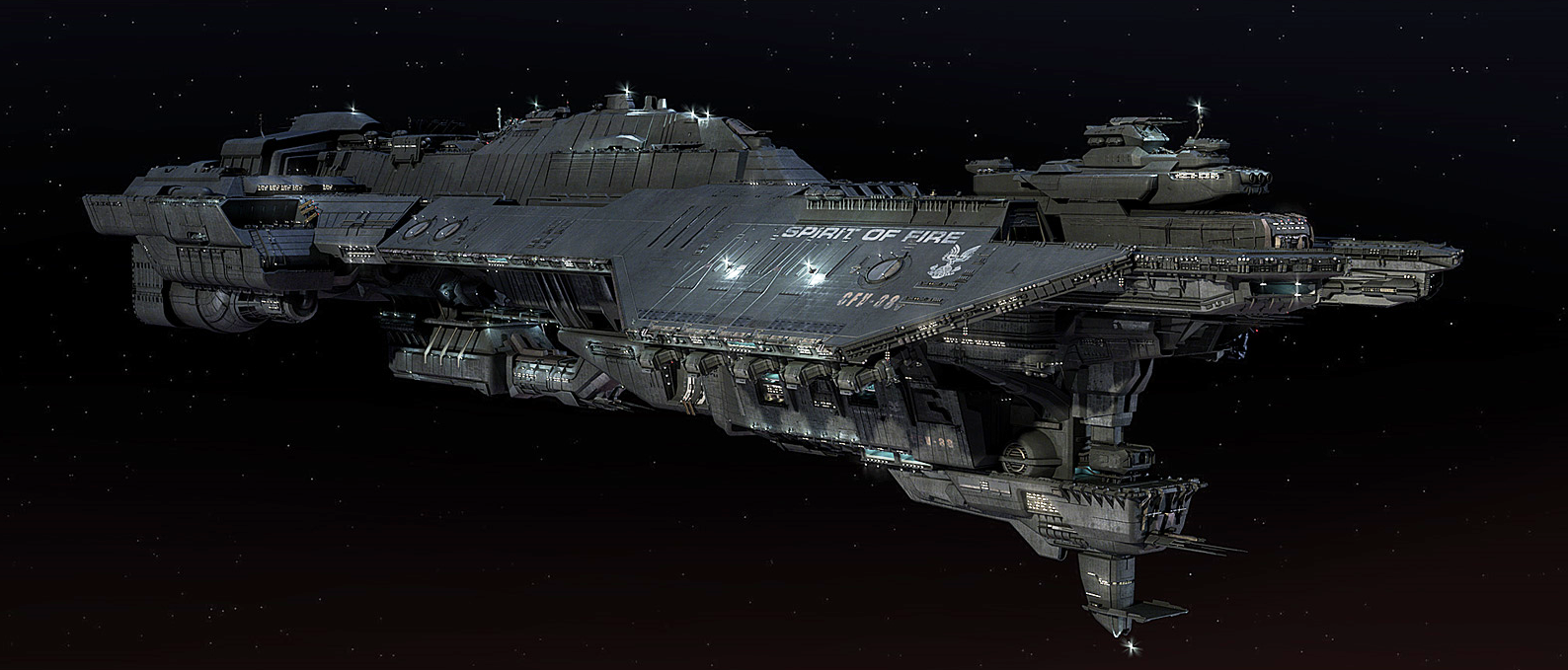
USNC Spirit of Fire:
To the Halo universe once more, this time for a look at a modified colony ship known as the Spirit of Fire! Making its appearance in Halo Wars, this ship was the largest in the UNSC navy and served with distinction during the Covenant War.

As already noted, the Spirit of Fire was originally a Pheonix-class colony ship, a vessel that was designed to carry colonists and supplies to new worlds as part of the UNSC’s prewar expansion efforts. However, this changed with the appearance of the Covenant and their apparent need to knock over human settlements.

Recommissioned for military service by the UNSC, the Fire was outfitted with a magnetic accelerator cannon, point defense guns and missile turrets, hull armor, and a major engine overhaul. Its internal bays were also converted to carry Scorpion tanks, Warthogs, Pelicans, fighters, bombers, and anything else it would need to put a small army onto a planet. As a former colony ship, the Fire retained the ability to enter atmosphere and land planetside, making it all the more effective at troop deployment.

During the course of the war, the ship was declared missing and all hands were presumed dead after it failed to return from a mission. However, the ship was actually traveling back at sublight speed from an engagement after it lost its fusion core. The crew had used this to destroy a Forerunner “Shield Planet” which happened to be housing a large Covenant attack fleet. In sacrificing its engine core, it prevented a major strike by Covenant forces on human territories, and therefore saved countless lives. Not bad for a civilian ship, eh?

SDF-1 Macross:
SDF-1 MacrossWhen you hear the words, Super Dimension Fortress, what comes to mind? Definitely not a piddly little spaceship! Which is probably why the Macross’ full name contains them! Apparently, this ship was rebuilt from the remains of an alien craft that crash-landed on Earth, and was intended for use should said aliens ever come knocking again.

Although intended to travel to distant solar systems and promote peace with alien species, the Macross became the first line of defense once war with the Zentradi species began. Much like all the “mechas” from this franchise, this ship is capable of changing from its ship designation into a towering mech (known as “Storm Attacker” mode), a process which takes about 15 minutes.

The massive ship also carries the two carriers – the CVS-101 Prometheus and SLV-111 Daedalus – within it’s fuselage. When in cruiser mode, these are housed along the sides, but while in “Storm Attacker” mode, they constitute the robots “arms”. In terms of weapons, this baby comes equipped with 8 guided converging beam cannons, four 178cm rail cannons, automatic missile launchers, and a main super-dimension-energy cannon. Aliens beware!

Strident-class Star Defender:
StridentIt’s funny how the Rebels only seemed to get into mega-ships after the Empire was thoroughly licked. And yet, here we have another Star Defender ship which comes from the expanded Star Wars universe and only showed up for duty after the Empire lost all its big behemoths.

Produced by the Corellian Engineering Corporation (natch!), the Strident-class was the first breed of Super Star Destroyer to serve on the side of the Alliance (which now called itself the New Republic). But of course the Alliance didn’t like the term “destroyer” when applied to their mega ships, hence the name change. But the particulars are pretty much the same.

Much like the Viscount-class produced by the Mon Calamari, the Strident comes equipped with thousands of turbolasters, laser cannons, and ion guns, and its massive hold houses dozens of squadrons of starfighters as well as hundreds of shuttles and support ships. It took awhile but I’m guessing the Rebels finally decided to go big or go home!

The Spacejockey ship:
I can’t wait to learn more about THIS one! As the focal point for the first Act of Alien, the “Spacejockey” ship is also central to the plot of its soon-to-be-released prequel, Prometheus. Known also as “The Derelict”, very little is known about this ship other than the fact that it was of unknown origin and appeared to be transporting xenomorphs.

The Derelict was first discovered by the crew of the Nostromo when their ship was rerouted to LV-426 to investigate a distress beacon. When they approached the ship, its alien configuration was immediately clear. Shaped in the configuration of a horseshoe, the ship apparently had two prongs, one longer than the other, and an engine array located at the rear.

SpaceJockeyWhen investigating the inside of the ship, its alien nature became even more apparent. Whoever the Space Jockeys were, they clearly shared H.P. Lovecraft’s sense of aesthetics! Literally everything aboard looked organic and gothic, right down to the funky patterns on the walls! When discovering what appeared to be a control chair, the crew stumbled onto the remains of a long “Space Jockey” as well. Having an anthropomorphic shape and a trunked face, they are assumed to look like a cross between a human and an elephant.

Closer examination of the remains revealed that it died from a “chestbuster” breaking through its ribcage. With the discovery of the ship’s compliment of eggs, and the observable symbiosis between the “facehuggers” and “chestbusters”, it was unclear why the Spacejockeys were transporting them. Perhaps they came aboard by accident, perhaps they were intended for another use somewhere. These are all questions I look forward to being answered… say June-ish!

Vor’cha-class Cruiser:
Vor'chaSeems the Klingons are getting a lot of attention from me as of late. But I’ve come to acknowledge just how many cool ships they really do have. Clearly, these blood-drinking, Valhalla worshipping guys excel when it comes to bringing beauty to their instruments of death. But then again, one would have to assume that it’s one of the few artistic outlets they get to have!

Taken from the TNG universe, the Vor’cha was the mainstay of the Klingon armada and the replacement for the aging K’t’inga-class. The first of its design served as the flagship for the Empire, but became fully integrated into the armada once it was mass-produced and replaced by the larger Negh’var-class.

Making its first appearance in season 4 of Star Trek: TNG (episode 80: “Reunion”) where it served as the Chancellor’s flagship, this vessel would go on to make several subsequent appearances in the expanded franchise. It’s most notable appearances were during the Klingon-Cardassian War where several participated in the assault on DS9 itself. Later, during the Dominion War, many more would serve on the front lines against the Jem’Hadar and their allies.

Naturally, this Klingon ship boasted multiple disruptor arrays, the main one located at the front end of the ship with two more mounted on the wings beside the nacelles. These were capable of firing in either the solid mode (like a phaser) or intermittently. Maneuverable for a ship of its size, it also came equipped with a cloaking device which was available in all flight modes.

Vorchan-class warship:
centauri_2This ship gets seen a lot around the B5 universe. And since I can’t stop hitting them up for cool ships, it only makes sense to mention this baby here. The Vorchan-class cruiser, a medium warship, was the mainstay of the Centauri fleet and weapon of choice when it came to raids, reconnaissance and even large-scale offensive operations.

Though designed predominantly to escort heavier cruisers, such as the Primus-class warship, Vorchans were still highly effective in small squadrons and were often called upon to mount attack missions by themselves. During the Narn-Centauri War, Vorchan warships carried out many assaults on Narn colonies and installations and even participated in skirmishes with the heavier Narn warships.

Its armaments consist of two plasma accelerators, missile banks and guided mines. These armaments, paired with its size, speed and relative maneuverability allow it to stand toe-to-toe with just about anything the Narns, Earth or League of Non-Aligned Worlds could throw at it. And unlike the heavier Primus ships, it is capable of maneuvering inside atmospheres. And it’s cool, raptor-winged like design makes it pretty easy on the eyes too. Were it not for the fact that Roddenberry beat them to it, you can bet the B5 designers would have named this ship a Bird of Prey!

Nine down, who the hell knows how many more to go!

Cool Ships (volume V)

Back again! More ships, more designs, more franchises too. Like I said last time, there’s just no limit when you get right down to it. And in the course of doing my homework on cool sci-fi concepts, I’ve found that there are hundreds of franchises out there that I’ve never even heard of before. Of those I have heard of, I always seem to miss a few obvious candidates. That’s the beauty of ongoing segments though. Here are the latest, with some suggestions thrown in too 😉

Colonial Raptor:
Another late entry from the Battlestar Galactica universe, the updated version. Designed for reconnaissance, transport, atmospheric and space flight, and capable of making short range FTL jumps, the Raptor is the workhorse of the Colonial fleet and one of its most versatile vessels. Ordinarily, the Raptor is operated by a crew of two, one pilot and one Electronic Countermeasures Officer. Given it’s size and shape, it cannot launch from a launch tube and must take off and land from a Battlestar’s forward launch bay.

Having served with the Colonial fleet for over 40 years, making its debut in the first Cylon War, the versatility and reliability of this craft have prevented it from being phased out by newer generations of Colonial ships. During the second Cylon War, Raptors were used regularly in order to dust off survivors from Caprica and other colonies. Relying on a fly-by-wire system, rather than the new defense network systems, it also proved invulnerable to the virus the Cylon’s used to cripple the fleet.

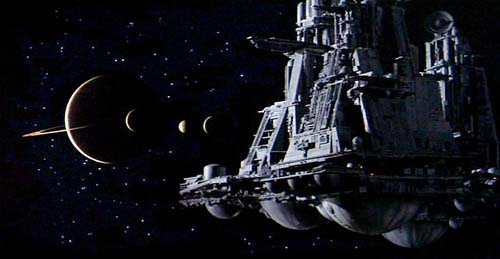
Cygnus:
Now here’s one that people probably won’t remember. In fact, I didn’t recall it either until I did some reading and realized I had seen the movie which featured it – The Black Hole – as a child and quite enjoyed it. Though a little Buck Rogers-y by modern standards, the concept and the movie and this ship still stand the test of time.

Released in 1979 by Walt Disney Pictures, The Black Hole was one of many movies that sought to take advantage of the sci-fi craze that Star Wars had unleashed. The plot centers on a derelict ship, known as the Cygnus, which is run by an android crew and a brilliant (albeit mad) scientist named Doctor Hans Reinhardt.

In addition to looking pretty cool, with its glowing transparent sections and old-school design, the Cygnus is apparently able to withstand the gravitational pull of black hole due to its ability to generate its own gravity well. In addition, its commander, Dr. Reinhardt, theorized that he would be able to fly it through a black hole and see once and for all what lay on the other side… It didn’t take, but still a cool idea!

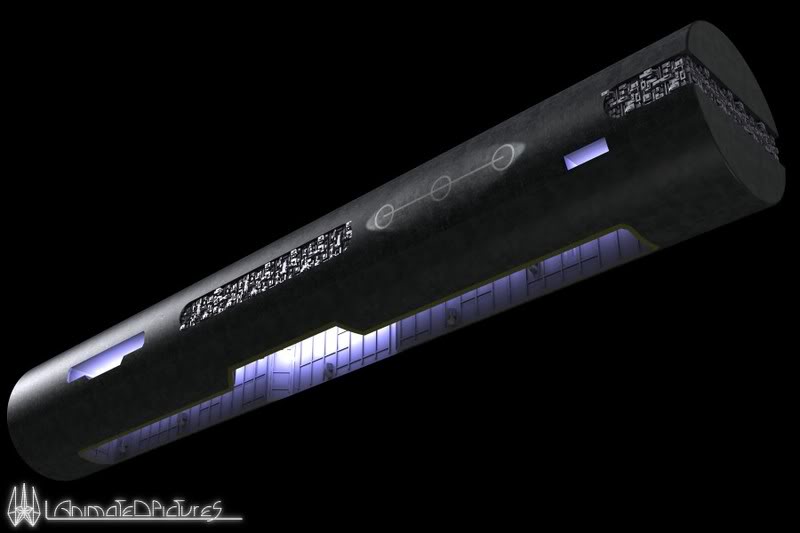
Guild Heighliner:

Artist’s concept for a Guild Heighliner

Here’s one I couldn’t believe I had forgotten. In fact, I will accept any and all chastisements for my failure to include Dune craft in this series thus far. This can include physical beatings, just stay away from the nads… not quite done with those yet!

Anyhoo, when it comes to Dune ships, the Heighliner definitely takes the cake! Massive as all hell, this ship was the backbone of all commerce, diplomacy, travel and tourism in the Dune universe. Like all shipping, it was the exclusive property of the Spacing Guild and subject to their many controls, laws and whims.

Boasting Holtzman engines – a FTL drive system that was capable of “folding space” – the ship still required the services of a Guild Navigator. This person, a semi-prescient mutant due to years of living in a spice tank, would see a path through time and space and thus navigate the ship safely to its destination.

According to the original Dune, a single Heighliner was capable of lifting an entire planet’s worth of personnel, goods and supplies from one point in space to the next. As Duke Leto tells Paul in Part I of the story: “A Heighliner is truly big. Its hold will tuck all our frigates and transports into a little corner — we’ll be just a small part of the ship’s manifest.” Later in that same installment, House Harkonnen used a single Heighliner in order to lift an entire army to Arrakis for a surprise assault on the Atreides, and the cost was nothing short of punitive!

Given that the Heighliners are the sole means of commerce in a Empire as massive as that of the Dune universe, its little wonder why Heighliners are so freakishly big. Chartering one aint cheap, and if you do stowe aboard, you are expected to mind your business and wait until you arrive at your destination. Due to their high level of secrecy and sensitivity, no one is even allowed to venture beyond their own boarding craft when on a Heighlinger, and virtually no one outside of the Guild has ever seen a Guild navigator. Considered to be neutral territory by Imperial law, any and all acts of violence aboard Guild Heighliners carry stiff penalties.

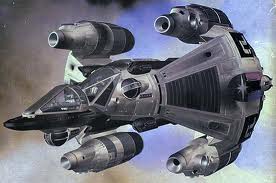
Gunstar:
Ah, another childhood classic! Taken from the film The Last Starfighter, the Gunstar was the first line of defense of the Star League against the evil Xur and the Ko-Dan Armada. Sounds pretty cheesy, huh? Well, it was the eighties! And this was yet another Disney franchise that seemed to be riding in the Star Wars wake. Still, this movie was one the first to make extensive use of CGI (Tron being the only other) and had a none-too-bad storyline too boot!

Boasting multiple guns, missiles and a “Death Blossom” trick that is nothing short of devastating, the gun star is a rather unique and innovative design. Apparently, it was meant to be a class of ship that would never go out of style, merging functionality with lethality and being able to take on any class of enemy ship.

Every Gunstar is a two seater, with the starfighter (gunner) in front, and the navigator in the rear. While the navigator flies the ship, the gunner directs fire from a swivel chair, which gives them control over the ships moveable weapons batteries. Although it has no shielding to speak of, the hull is protected by armor plating which can withstand multiple direct hits. When cornered, it is also capable of unleashing the “Death Blossom” where it will begin to rotate at a furious speed and unleash gun and missile fire in all directions. This however, is considered a weapon of last resort, since it will drain the ship’s power supply completely.

Heart of Gold:
Now here’s an interesting, and highly improbably, entry! Coming to us straight out of The Hitchhikers Guide To The Galaxy, the SS Heart of Gold is rather unique in that it merged scientific theory with Douglas Adam’s notoriously quirky sense of humor.

Being a prototype vessel, it was the first ship ever in the universe to boast the “Infinite Probability Drive”. This drive system is essentially a Faster-Than-Light engine which is actually based in quantum theory. Essentially, the theory states that a subatomic particle is most likely to be in a particular place at a particular time, but that there is also a small probability of it being found very far from its point of origin. Thus, a body could travel from place to place without passing through the intervening space as long as it had sufficient control of probability.

Pretty cool huh? In the original radio series, the shape of the vessel was not specified. In the novelization of the series, it was described as a “sleek white running shoe”. For the sake of the movie, artists went with a tea-cup design, and added some brake lights for good measure. Originally built as part of a secret government project on the planet of Damogran, the ship was stolen by President Zaphod Beeblebrox during its launching ceremony and became the means through which the main characters began exploring the universe.

Minbari Cruiser:
Back once more to the B5 universe for another fine example of kick-ass shippery! Known officially as the Sharlin-class Warcruiser, this Minbari vessel is the mainstay of the Minbari fleet in the original series. Big, bold, stealthy, and packing a sh*tload of firepower, this vessel is veritable nightmare for all but the most powerful of races. Even Shadow vessels mind their business when some of these are in the field.

Making its appearance in season one of the show (episode 17: “Legacies”) and went on to become a regular feature. When Sheridan assumed command of the station in season two, the renegade cruiser Trigati was destroyed in the course of a standoff. After B5 broke away from Earth in season 3, a force of Sharlin cruisers arrived just in time to prevent the station from being captured by forces loyal to Clarke. Many went on to serve alongside Sherian and Delenn in the Shadow War and even went on to help liberate Earth from Clarke’s forces.

According to Delenn, Minbari ships do not rely on conventional engines like other ships. Instead, a system of gravitational and electromagnetic fields for propulsion, which have the added benefit of supplying artificial gravity. This frees up their ships from the needs of rotating sections and makes for a more effective combat platform. Sharlin cruisers also boast a significant amount of weaponry, which consists mainly of heavy beam cannons, but also includes missile launchers, neutron guns, and electro-pulse cannons.

During the Earth-Mimbari War, Earth Forces were completely outmatched by this class of Cruiser. In addition to being highly resistant to Earth force weapons, the Sharlin cruiser also boasted a stealth field which prevented Earth ships from being able to lock onto it. In the course of the war, only one human Captain ever survived combat with one, Captain John Sheridan. Relying on a phony distress signal and several well placed tactical nukes, Sheridan was able to lure the Black Star, the Minbari flagship, into a trap and destroy it. Though the Minbari considered it a cheap victory, Sheridan’s fame and renown quickly spread throughout the fleet.

During the battle of Sector 83, the Sharlin-class Cruiser proved an effective weapon against the Shadows. Although somewhat slow and providing a large target for Shadows, their powerful beam weapons were capable of destroying a Shadow ship unassisted. When protected by smaller, faster craft like the White Star, it proves to be a very effective combat platform.

Nebula-B Escort Frigate:
More Star Wars! God, I think I’m OD’ing on this franchise. But the sign says “Cool Ships” and this one is no exception. Known as the Nebula-class frigate, this ship is probably best remembered as the “Medical Frigate” which appeared in Empire and Jedi. 

Measuring some 300 meters long and designed to defend Imperial convoys from Rebel attacks, this ship was more famously used by the Rebellion as a hospital ship. During heavy fighting, Nebula-B’s would be on hand to pick up pilots that had ejected and provide them with life-saving assistance, ensuring that Rebel pilots could live to fight another day.

The most famous appearance of a Medical Frigate was during the Battle of Endor, when several medical frigates were on hand to service Rebel pilots who had been shot down by superior Imperial forces. It was also on board the Medical Frigate Redemption that Luke Skywalker received his prosthetic hand after losing it in a lightsaber duel to Vader.

In addition to providing escort and as a hospital ship, the Nebula-B was proved useful as a deep space scout and reconnaissance ship, due to its sophisticated sensors. During raiding missions or less intense combat operations, many also served as command ships given their speed and defensive capabilities. One weakness of the Nebula-B however was its thin fusilage. Though this made the ship an inexpensive vessel by most standards, it also made it a poor choice for heavy combat. Hence why it was relegated to support, scouting and medical roles.

The Nostromo:
You know, I really thought I covered this one already. I already mentioned how the Alliance Cruisers from Firefly appeared to be inspired by this baby. And it just makes sense that if you’re going to cover ships from the sequel, (the USS Sulaco and the Cheyenne Dropship) that you cover the original first. But alas, the Nostromo was somehow passed over by me, another act of wanton insensitivity! Beating shall continue until my attitude improves!

Okay, now that we got my punishment out of the way, allow me to pay this ship it’s due homage. The main set for the movie Alien, the USCSS Nostromo was a deep space commercial vessel which belonged to the Weyland-Yutani corp (much like everything else in this universe!).

Overall, the Nostromo was a curious design which made perfect sense from a space-faring point of view. Doing away with such things as streamlining and aerodynamic sleekness, the ship was well suited to deep-space travel and hailing. In addition, it was also taller than it was long, another common aspect to spaceships which are confined to the whole sea ship/airplane paradigm.

It’s massive refinery, which it towed behind, would process its manifest of mined ore while it made its way back to Earth from wherever it had been deployed. Thus, in addition to providing transport and amenities for a crew of miners and spacers, it was also a mobile refining platform that could deliver processed materials to factories rather than just unrefined ore.

While on return from the distant planet of Thedus, the Nostromo was rerouted to LV-426 where it picked up the alien organism known as a xenomorph. After all but one of the crew were killed the by creature, Ellen Ripley, the ship’s Warrant Officer, set the ship’s to self-destruct and escaped aboard the ship’s life craft with the crew cat, Jones. According to Weyland-Yutani execs, who were some pissed when she returned without her ship, the destruction of this vessel cost them 24 million in adjusted dollars. Damn penny-pinchers!

The Sathanas:
What do you call the most fearsome, intimidating and powerful ship in the universe, without being too obvious, that is? The Sathanas, that’s what! Being the Latin name for Satan, this title is very apt when applied to a massive juggernaut built by a race known as the the Shivans (i.e. Shiva, Hindu god of destruction).

This last entry, much like The Colossus and Deimos from my last list, comes to us from the game Freespace 2. Making its appearance midway through the game, this terrifying vessel was the most powerful space-faring ship ever encountered by the human race or its allies.

Boasting four massive beam cannons which are situated at the end of its claw like appendages, this ship best exemplifies the offensive fighting spirit. Jumping into a field of battle, it is capable of dealing devastating blows on a target head on, keeping its flanks and rear hidden from the enemy.

Above all, it is clear that the Shivan built the Sathanas to act as a terror weapon in addition to a capital ship. One look at its design confirms this, given its clawing appendages and thorny skin. Defeating this ship outright is quite difficult given its reinforced plating and terrible array of weapons. Disabling this ship, through EMP missiles and guns, is not much easier given the incredibly density of its hull and many redundant systems. In the end, the only way to beat it seems to be for lighter craft to take out its “claws” while heavier vessels strike at it from a distance. However, this still proves to be a suicidal mission given the Sathanas’ many missile and defensive batteries.

Ultimately, taking down this ship in the game is much like the real-life campaign to sink the Bismark. This dreadnought, which was the pride and joy of the German navy in WWII, also boasted massive weapons, a heavily armored hull and superior systems. In the end, the Royal Navy brought it down through a combination of luck, persistence, and careful engagements, taking their time to disable it and then closing in to pound it relentlessly! Hmmm. I guess good history makes for good gaming 🙂

Final Thoughts:/strong>
The suggestion box, as always, is still open. Thanks to Goran Zidar for suggesting the Gunstar, I knew I’d have to include it sooner or later and I’m glad someone asked. Anything else? I got another installment on the way, and probably a few more after that. No? Sigh, alright, bring on the beatings! No nads!