News from Space: Latest Tests and New Players

Apollo11_earthIn the new age of space travel and exploration, commercial space companies are not only boasting immense growth and innovation, but are reaching out to fill niche markets as well. In addition to launchers that can send orbiters and payloads into space, there are also new breeds of commercial satellites, new engines, and a slew of other concepts that promise to make the industry more promising and cost effective.

A case in point is the small satellite launch company Firefly Space Systems, which recently unveiled its planned Alpha launcher. Aimed at the small satellite launch market, it’s designed to launch satellites into low-Earth orbit (LEO) and Sun-synchronous orbits for broadband communication using an unconventional aerospike engine, it is also the first orbital launcher to use methane as fuel.

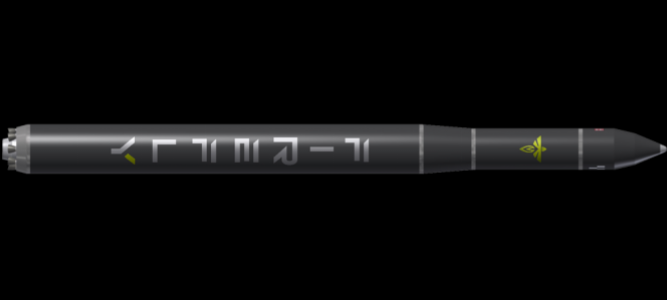
firefly-alphaThe Firefly Alpha is a specialized design to launch light satellites at low cost into low Earth Designed to carry payloads of up to 400 kg (880 lb), the Alpha features carbon composite construction and uses the same basic design for both of its two stages to keep down costs and simplify assembly. Methane was chosen because it’s cheap, plentiful, clean-burning and (unlike more conventional fuels) self-pressurizing, so it doesn’t require a second pressurization system.

But the really interesting thing about the two-stage rocket assembly is that the base of the engine is ringed with rocket burners rather than the usual cluster of rocket engines. That’s because, while the second stage uses conventional rocket engines, the first stage uses a more exotic plug-cluster aerospike engine that puts out some 400.3 kN (or 40,800 kg/90,000 lb)  of thrust.

firefly-alpha-4Aerospike engines have been under development since the 1960s, but until now they’ve never gotten past the design phase. The idea behind them is that rockets with conventional bell-shaped nozzles are extremely efficient, but only at a particular altitude. Since rockets are generally used to make things go up, this means that an engine that works best at sea level will become less and less efficient as it rises.

The plug aerospike is basically a bell-shaped rocket nozzle that’s been cut in half, then stretched to form a ring with the half-nozzle forming the profile of a plug. This means that the open side of the rocket engine is replaced with the air around it. As the rocket fires, the air pressure keeps the hot gases confined on that side, and as the craft rises, the change in air pressure alters the shape of the “nozzle;” keeping the engine working efficiently.
firefly-alpha-2The result of this arrangement is a lighter rocket engine that works well across a range of altitudes. Because the second stage operates in a near vacuum, it uses conventional rocket nozzles. As Firefly CEO Thomas Markusic put it:

What used to cost hundreds of millions of dollars is rapidly becoming available in the single digit millions. We are offering small satellite customers the launch they need for a fraction of that, around US$8 or 9 million – the lowest cost in the world. It’s far cheaper than the alternatives, without the headaches of a multi manifest launch.

Meanwhile, SpaceX has been making headlines with its latest rounds of launches and tests. About a week ago, the company successfully launched six ORBCOMM advanced telecommunications satellites into orbit to upgrade the speed and capacity of their existing data relay network. The launch from Cape Canaveral Air Force Station in Florida had been delayed or scrubbed several times since the original launch date in May due to varying problems.

spacex_rocketHowever, the launch went off without a hitch on Monday, July 14th, and ORBCOMM reports that all six satellites have been successfully deployed in orbit. SpaceX also used this launch opportunity to try and test the reusability of the Falcon 9′s first stage and its landing system while splashing down in the ocean. However, the booster did not survive the splashdown.

SpaceX CEO Elon Musk tweeted about the event, saying that the:

Rocket booster reentry, landing burn & leg deploy were good, but lost hull integrity right after splashdown (aka kaboom)… Detailed review of rocket telemetry needed to tell if due to initial splashdown or subsequent tip over and body slam.

SpaceX wanted to test the “flyback” ability to the rocket, slowing down the descent of the rocket with thrusters and deploying the landing legs for future launches so the first stage can be re-used. These tests have the booster “landing” in the ocean. The previous test of the landing system was successful, but the choppy seas destroyed the stage and prevented recovery. Today’s “kaboom” makes recovery of even pieces of this booster unlikely.
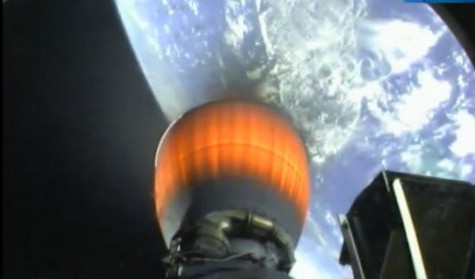
sceenshot-falcon9-580x281This is certainly not good news for a company who’s proposal for a reusable rocket system promises to cut costs exponentially and make a whole range of things possible. However, the company is extremely close to making this a full-fledged reality. The take-off, descent, and landing have all been done successfully; but at present, recovery still remains elusive.

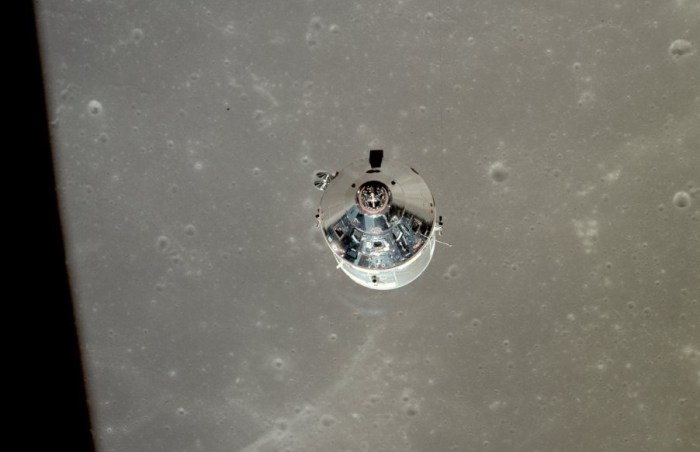
But such is the nature of space flight. What begins with conceptions, planning, research and development inevitably ends with trial and error. And much like with the Mercury and Apollo program, those involved have to keep on trying until they get it right. Speaking of which, today marks the 45th anniversary of Apollo 11 reaching the Moon. You can keep track of the updates that recreate the mission in “real-time” over @ReliveApollo11.

As of the writing of this article, the Lunar module is beginning it’s descent to the Moon’s surface. Stay tuned for the historic spacewalk!
apollo11_descent

Sources: universetoday.com, gizmag.com

Forty-Fifth Anniversary of Apollo 11

Apollo11_launch1Today, July 20th, marks the 45th anniversary of the first step being taken on the Moon. And even though the coming decades may involve astronauts setting foot on Mars or a nearby asteroid, the Moon landing will forever remain one of humanity’s greatest accomplishments. And the many speeches, footage and images associated with the mission remain firmly rooted in public consciousness.

Born during the closing months of the Eisenhower administration as a follow-up to Project Mercury – which successfully put astronauts into orbit – Project Apollo was conceived when spaceflight was still very much in its infancy. However, it was under President Kennedy that the goal of “landing a man on the Moon and returning him safely to the Earth” by the end of the decade truly began.

kennedy_moonspeechAnd though some within NASA were already doing some preliminary planning for a manned mission to the Moon in the late 1950s, there was no hardware that could see the mission fly, no rockets large enough to launch a manned spacecraft all the way to the Moon, and no provisions for managing a program of that magnitude. The men and women who brought the lunar landing to fruition were forced to invent almost everything as they went along.

And in the nine years between President Kennedy promising America the Moon and Neil Armstrong’s small step, NASA developed an unprecedented amount of technology and know-how that continues to shape the way NASA and other space agencies plan and implement missions today. These include the Saturn V multistage rockets, which are currently being refurbished for a manned mission to Mars by 2030.

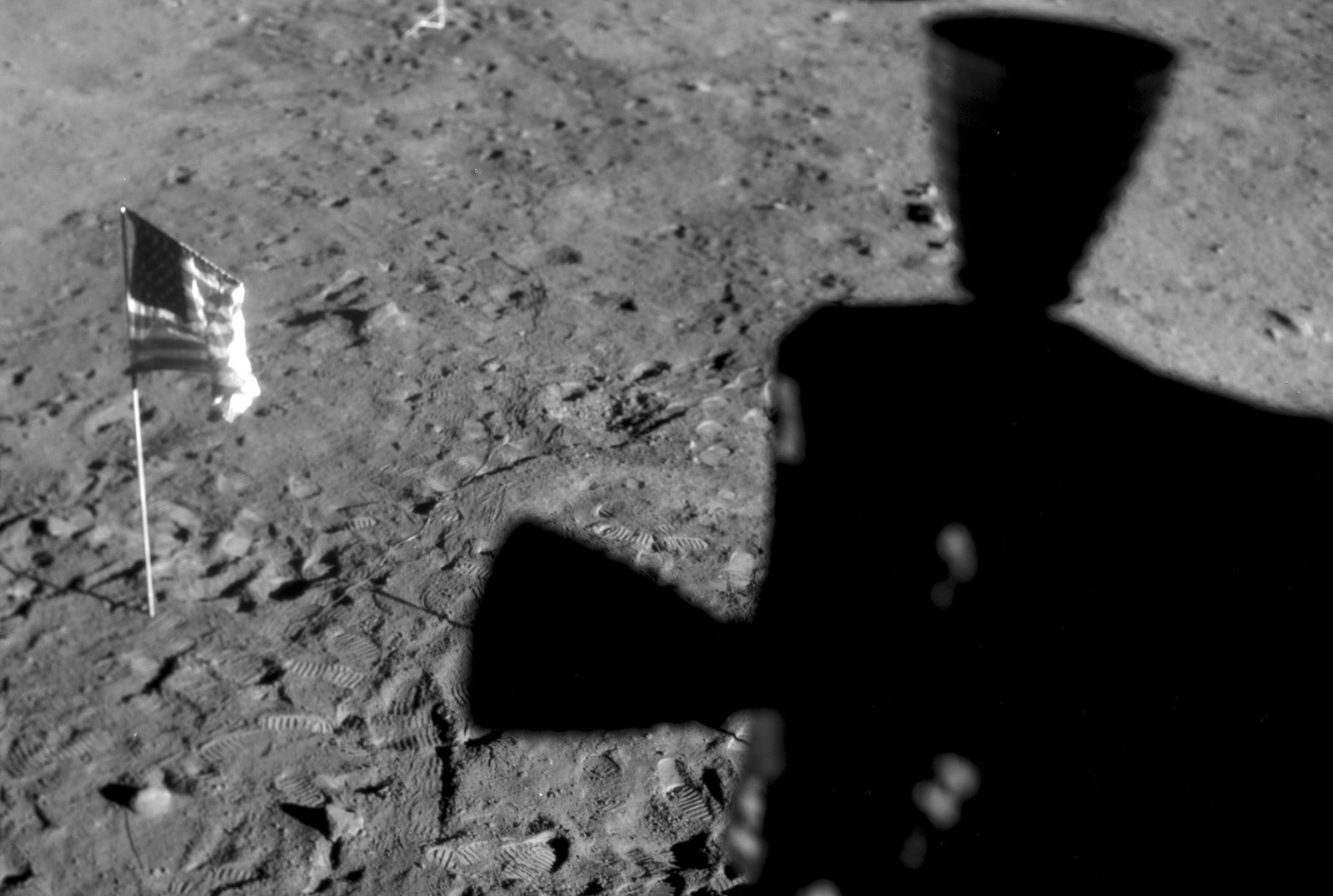
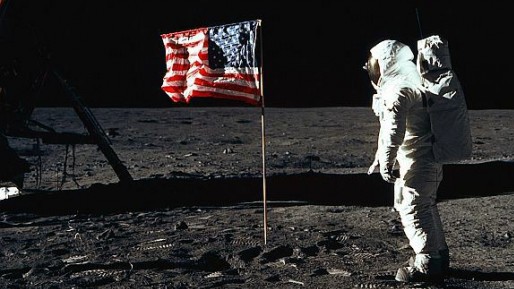
Apollo_11Launching on from Cape Kennedy on the morning of July 16th, 1969, the mission sent Commander Neil Armstrong, Command Module Pilot Michael Collins and Lunar Module Pilot Edwin “Buzz” Aldrin into an initial Earth-orbit. Then, just two hours and 44 minutes after launch, another engines burn put Apollo 11 into a translunar orbit. Four days later, the Lunar Module touched down and the three men – with Armstrong in the lead – stepped onto the Lunar surface.

And for those looking to participate in the anniversary, there are several ways you can participate. On Twitter, @ReliveApollo11 from the Smithsonian National Air and Space Museum is reliving the highlights from Apollo 11 mission to the Moon in “real time”. Also, @NASAHistory is tweeting images and events from the mission, and journalist Amy Shira Teitel (@astVintageSpace) is tweeting pictures, facts and quotes from the mission, again in “real time”.

apollo11_flag2At 7:39 p.m. PDT (10:39 p.m. EDT), when Armstrong opened began the first spacewalk on the Moon, NASA TV will replay the restored footage of Armstrong and Aldrin’s historic steps on the lunar surface. On Monday, July 21 at 7 a.m. PDT (10 a.m. EDT) NASA TV will be broadcasting live from Kennedy Space Center in Florida, where they will be renaming the center’s Operations and Checkout Building in honor of Armstrong, who passed away in 2012.

The renaming ceremony will include NASA Administrator Charles Bolden, Kennedy Center Director Robert Cabana, Apollo 11′s Collins, Aldrin and astronaut Jim Lovell, who was the mission’s back-up commander. International Space Station NASA astronauts Wiseman and Steve Swanson, who is the current station commander, also will take part in the ceremony from their orbiting laboratory 260 miles above Earth.

Apollo_11_bootprintOn Thursday, July 24 at 3 p.m. PDT (6 p.m. EDT), which is the 45th anniversary of Apollo 11′s return to Earth, the agency will host a panel discussion – called NASA’s Next Giant Leap – from Comic-Con International in San Diego. Moderated by actor Seth Green, the panel includes Aldrin, NASA Planetary Science Division Director Jim Green, JPL systems engineer Bobak Ferdowsi, and NASA astronaut Mike Fincke.

In addition to Aldrin recounting his experiences, Fincke and the other NASA staff are slated to talk about the new Orion space capsule and the Space Launch System rocket – both of which will carry humans on America’s next great adventure in space – and what the future holds for space exploration. These will no doubt include talk of the planned missions to an asteroid, Mars, and quite possibly the construction of a settlement on the Moon.

apollo11_flag1The NASA.gov website will host features, videos, and historic images and audio clips that highlight the Apollo 11 anniversary, as well as the future of human spaceflight. You can find it all by clicking here. And if you don’t have NASA TV on your cable or satellite feeds, you can catch it all online here. Plenty has been happening already, marking the anniversary of the launch and recapturing the mission in “real-time”.

Forty five years later, and Apollo 11 still holds a special place in our collective hears, minds, and culture. One can only hope that the next generation of astronauts prove as equal to the task as those who made the Moon Landing were. And I’m sure that when they do make history, Neil Armstrong (may he rest in peace) will be watching approvingly.

And be sure to check out this video from Spacecraft Films, showing the entire Apollo 11 mission in 100 seconds:


Sources: universetoday.com, motherboard.vice.com, nasa.gov, spacecraftfilms.com

The Future is Here: The Walking Bio-Robot

walking-bio-robot-spinal-muscleGiven that the field of robotics and electronics are making inroads into the field of biology – in the form of biorobotics and bionics – it was only a matter of time before applications began moving in the other direction. For example, muscles have been considered in recent years as a potential replacement for electric actuators, in part because they can run in a nutrient-rich fluid without the need for any other power source.

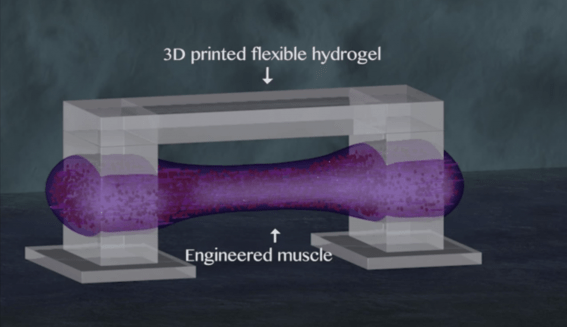
The latest example of this biological-technological crossover comes from Illinios, where bio-robotics experts have demonstrated a bio-bot built from 3-D printed hydrogel and spinal muscle tissue that can “walk” in response to an electrical signal. Less than a centimeter in length, the “bio-bot” responds to electrical impulses that cause the muscle to contract.

According to study leader, Professor Rashid Bashir, biological tissue has several advantages over other robotic actuators:

[Muscle] is biodegradable, it can run in fluid with just some nutrients and hence doesn’t need external batteries and power sources – and it could eventually be controlled by neurons in our future work.

walking-bio-robot-spinal-muscle-3Previous versions, using heart muscle tissue, were also able to “walk” but were not controllable, as heart tissue contracts constantly of its own accord. Spinal muscle, by contrast, responds to external electrical stimuli and provide a range of a range of potential uses. These include bio-robots being able to operate inside the body in medical applications, or being used outdoors in environmental services.
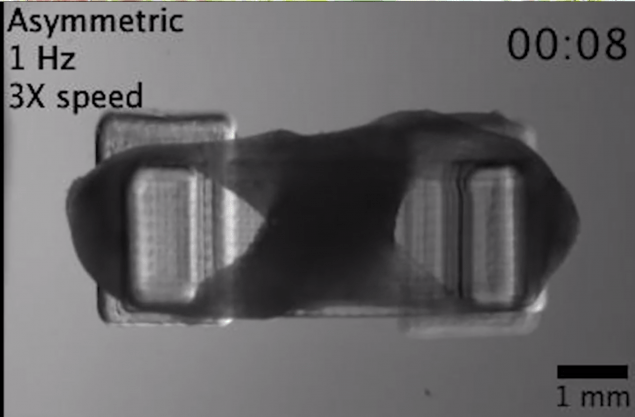
And though this design is very simple, it serves as a proof of concept that demonstrates that the technology works. Bashir and his team are now looking to start extending toward more complex machines – incorporating neurons that can get the bot walking in different directions when faced with different stimuli. Initially, they’ll look at designing a more complex hydrogel backbone that gives the robot the ability to move in more than one direction.

walking-bio-robot-spinal-muscle-6They’re also looking at integrating neurons to steer the tiny bots around, either using light or chemical gradients as a trigger. This would be a key step toward being able to design bots for a specific purpose. As Bashir said:

The idea of doing forward engineering with these cell-based structures is very exciting. Our goal is for these devices to be used as autonomous sensors. We want it to sense a specific chemical and move towards it, then release agents to neutralize the toxin, for example. Being in control of the actuation is a big step forward toward that goal.

This development is significant for a number of reasons. Not only is it a step on the road towards bionics and biorobotics, it also demonstrates that the merging of technology and biology works both ways. Not only are machines being designed to improve our biology, our biology is also inspiring machinery, and even being used for its unique and superior properties to make machines run better as well.

And be sure to watch this video of the muscle-powered bio-robot being explained:


Source:
gizmag.com
, news.illinois.edu

Biomedical Breakthroughs: Vascular Network Bioprinting

bioprintingThe ability to generate biological tissues using 3-D printing methods – aka. “bioprinting” – may one day help medical researchers and hospitals to create artificial, on-demand custom body parts and organs for patients. And numerous recent advancements – such as the creation of miniature kidneys, livers, and stem cell structures – are bringing that possibility closer to reality.

And now, according to a new study produced by researchers from the University of Sydney, it is now possible to bioprint artificial vascular networks that mimic the body’s circulatory system. Being able to bio-print an artificial vascular network would give us the ability to keep tissue and organs alive where previously it would not have been possible. The body’s vascular network enables it to transport blood and, therefore, oxygen and nutrients, to tissues and organs.

vascularIt also provides a means of transporting waste materials away from tissues and organs. Dr. Luiz Bertassoni. the lead author of the study explained:

Cells die without an adequate blood supply because blood supplies oxygen that’s necessary for cells to grow and perform a range of functions in the body. To illustrate the scale and complexity of the bio-engineering challenge we face, consider that every cell in the body is just a hair’s width from a supply of oxygenated blood. Replicating the complexity of these networks has been a stumbling block preventing tissue engineering from becoming a real world clinical application.

In order to solve this problem, the researchers used a bioprinter to create a framework of tiny interconnected fibers to serve as a mold. The structure was then covered with a “cell-rich protein-based material” and solidified using light. The fibers were removed to leave a network of tiny channels that formed into stable human blood-capillaries within just a week’s time.

stem_cells3According to the University of Sydney study, the technique demonstrated better cell survival, differentiation and proliferation compared to cells that received no nutrient supply. In addition, it provides the ability to create large, life-supporting three-dimensional, micro-vascular channels quickly and with the precision required for application to different individuals.

This is a major step forward for the bioprinting industry, according to Bertassoni:

While recreating little parts of tissues in the lab is something that we have already been able to do, the possibility of printing three-dimensional tissues with functional blood capillaries in the blink of an eye is a game changer.

bioprinter1In addition, Bertassoni claims that the ultimate aim of the research is for patients to be able to walk into a hospital and have a full organ printed with all the cells, proteins and blood vessels in the right place:
We are still far away from that, but our research is addressing exactly that. Our finding is an important new step towards achieving these goals. At the moment, we are pretty much printing ‘prototypes’ that, as we improve, will eventually be used to change the way we treat patients worldwide.

Bioprinting that uses a patient’s own DNA to generate custom-made organs and tissues offers a world of medical possibilities in which organ donors are no longer necessary, and the risk of rejection and incompatibility is negligible. Not only that, it will usher in a world where no injury is permanent and prosthetics are a thins of the past.

Sources: gizmag.com, sydney.edu.au

Towards a Clearner Future: World’s Largest Renewables Projects

jaguar-solar-arrayThanks to increasing efficiency in solar panels, as well as dropping costs for manufacture and installation, generating renewable electricity at home or in commercial  buildings is becoming increasingly viable. And this fast-growing trend has been manifesting itself in an impressive list of “world’s largest” projects, with government and industry pairing to make renewable energy a major power source.

For example, back in January, the world’s largest solar bridge was completed in London on the Blackfriars Bridge. As part of Blackfriars Station in London, the bridge was fitted with 4,400 photovoltaic panels between 2009 and 2014 – which are expected to reduce the station’s CO2 emissions by an estimated 511 tonnes (563 tons) per year. Considering London’s issues with air quality and mass transit, this is a major step towards sustainability.

ivanpah-1Then in February, the Ivanpah Solar Electric Generating System (ISEGS) – the world’s largest solar-thermal plant – became fully operational in the Mojave Desert in southeastern California. The 392 MW plant, which was developed with funding from NRG Energy, Google, and BrightSource Energy, is expected to generate enough electricity to power 140,000 homes, each year.

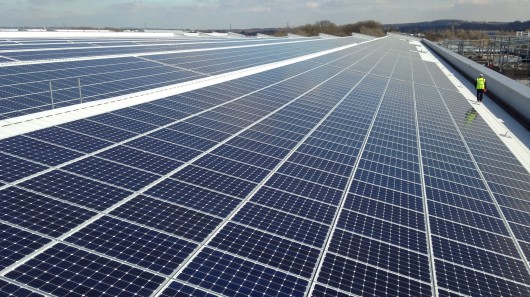
And in April, Jaguar joined Audi, Ferrari and Renault by installing fields of solar panels on top of its new Engine Manufacturing Center in South Staffordshire. This solar field is now the largest rooftop array in the UK, comprising over 21,000 photovoltaic panels and a capacity of 5.8 MW. Jaguar estimates the installation will meet more than 30 percent of the centers energy needs and reduce the plant’s CO2 footprint by over 2,400 tonnes (2,645.5 tons) per year.

windstream-wind-solar-hybrid-jamaicaAnd now, Windstream Technologies – a commercial wind and sun generating firm aimed at bringing renewable energy to municipalities, commercial buildings and homes -has installed what it says is the world’s largest wind-solar hybrid array on the roof of the Myers, Fletcher, & Gordon (MFG) lawfirm in Kingston, Jamaica. The array is expected to generate over 106,000 kWh annually and demonstrates the ability to maximize energy production with limited roof space.

MFG’s installation is a part of an effort by Jamaica’s sole energy provider, Jamaica Public Service, to make the capability for producing renewable energy for its approximately one-million citizens more widely available. The array is expected to generate 25kW of wind power and 55kW of solar power, and the electricity generated can either be used, stored off-grid or fed back into the grid.

windstream-wind-solar-hybrid-jamaica-3The installation incorporates 50 of WindStream’s SolarMill devices, with each different model comprising one or more solar panel and three or more turbines. This is to ensure that the daily and seasonal trends of wind and solar resources are all mitigated by capturing both at any time of the day or year. Windstream says it will return its investment within four years and will produce savings of around US$2 million over the course of its estimated 25-year lifespan.

Merging solar, wind and other renewable technologies into communities, commercial spaces and housing is not only a means of cutting emissions and utility bills, it is also a way to tackle two of renewable energy’s greatest stumbling blocks. These are the problems of storage and intermittency – generating energy when it’s needed and getting it to where it’s needed.

And be sure to check out this video of the rooftop array from Windstream Technologies:


Sources:
gizmag.com, (2), nrg.com, networkrailmediacentre.co.uk

The Future is Here: Memory Prosthetics

Restoring Active Memory (Shutterstock)Developing implants that can restore damaged neural tissue – either by restoring the connections between damaged memory synapses or restoring cognitive function – is seen as the next great leap in prosthetic medicine. In recent years, steps have been taken in both areas, offering patients and willing subjects the option of restoring or hacking their neurology.

For example, last year, researchers working at the University of California and the University of Pennsylvania successfully managed to design and implement a brain implant that acted as a bypass for damaged brain tissue. This neural prosthesis successfully restored brain function in rats, demonstrating that the closed-loop brain-machine-brain interface could one day perform the same function in brain-damaged humans.

brain-darpa-617x416And as with many such projects, the Defense Advanced Research Projects Agency (DARPA) soon became involved, taking up the reins to fund the research and development of the technology. As part of the DARPA Restoring Active Memory (RAM) program, the device is currently being developed with the hope of restoring memory function in veterans who have suffered a traumatic brain injury.

Currently, over 270,000 military service members since 2000 and an estimated 1.7 million civilians in the US are affected by TBI, which often manifests as an inability to retrieve memories formed before being injured and an impaired ability to form new memories. Currently, there are also no effective treatments available, and beyond veterans, there are countless people around the world who suffer from the same condition as a result of accidents.

brainscansThe teams will first develop computer models that describe how neurons code memories, as well as analyzing neural signals in order to understand how targeted stimulation might help restore the brain’s ability to form memories. The UCLA team will use data collected from epilepsy patients that already have electrodes implanted in their brains to develop a model of the hippocampal-entorhinal system – known to be involved in learning and memory.

Meanwhile, the University of Pennsylvania team will study neurosurgical patients with implanted brain electrodes, recording data as they play computer-based memory games in order to gain an understanding of how successful memory function works. All patients will be volunteers, and the teams then plan to integrate these models into implantable closed-loop systems.

brain_chip2Like the research on rats, the implant will pick up neural signals from an undamaged section of the brain and route it around the damaged portion, effectively forming a new neural link that functions as well as the undamaged brain. And this is not the only research that aims to help assist in memory function when it comes to veterans and those suffering from TBI.

At Lawrence Livermore National Labs (LLNL), for example, efforts are being made to create a new type of “memory bridge”. This research builds upon similar efforts from USC, where researcher Ted Berger developed the first implantable memory device (coincidentally, also as part of DARPA’s RAM program) where limited electrodes were applied to the hippocampal regions of the brain to assist in recall and memory formation.

brain-implant-hippocampus-usc-640x424However, until now, no research lab has had any real clue as to what kinds of “codes” are involved when applying electrical stimulus to the brain. The LLNL group, which previously contributed to the groundbreaking Argus II retinal prosthesis is now taking a more integrated approach. With the recent announcement of ample federal BRAIN Initiative funding, they aim to build multifunction electro-optical-chemical neural sensor-effectors.

On the electrical end, LLNL’s new wafer technology will use fairly high electrode counts (perhaps 500-1000 spots). Compared to the usual higher density 11,000-electrode chips that have been used in the past, these chips will have more sparsely distributed electrode locations. Integrated light guides will provide conduits for optogenetic manipulations, and as an added bonus bi-directional fluid channels for any number of chemical exchanges are also etched in. 

llnl-brain-implantAnd like their California/Penn colleagues, the LLNL has teamed up with DARPA to get the funding they need to make this project a reality. So far, DARPA funders have brought in the implant heavyweight Medtronic, which made news last year with the development of its own closed-loop stimulators, to lend its expertise. In their case, the stimulators merged Brain-Computer Interface (BCI) with Deep Brain Stimulation (DBS) to treat Parkinson’s.

Unfortunately, while immense progress in being made at the hardware end of things, there is still the matter of cracking the brains code first. In other words, where the device needs to be placed and which neurons need to be precisely controlled remain a mystery. Not all neurons are the same, and control hierarchies and preferred activation paths will inevitably emerge.

DeepBrain-New1Ultimately, what is needed in order to make precisely-targeted deep brain stimulation (DBS) possible is a real 3D model of the regions of the brain involved. Multiple efforts are underway, not the least of which are the work of Michele Tagliati’s group from the Movement Disorders Program in the department of neurology at Cedars-Sinai, or the Human Brain Project in Luasanne, Switzerland.

In these and other cases, the use of MRIs and brain scans to create a working map of the human brain – so that attempts to create biomimetic prosthetics that can enhance or assist in it’s functions – is the ultimate goal. And once researchers have a better idea of what the brain’s layout is, and what kinds of control hierarchies and paths are involved, we can expect to see brain implants becoming a regular feature of medicine.

And as always, devices that can restore function also open the way for the possibility of enhancement. So we can also expect that bionics prosthetics that restore memory and cognitive function will give way to ones that boost these as well. The dream of Homo Superior, the post-human, or transhumanism – whatever you choose to call it – is looking to be increasingly within our grasp.

And be sure to check out this video from LLNL showcasing how their new neural implant works:


Sources:
 cnet.com, extremetech.com, darpa.mil

The Future of Medicine: The HIV Prevention Pill

https://i0.wp.com/cdn3.vox-cdn.com/uploads/chorus_image/image/35164636/Andrew_Cuomo_2013__2_.0_standard_640.0.jpgEarlier this month, New York State governor Andrew Cuomo did something very meaningful and unexpected. In an effort to drastically cut the rate of new infections in the state, he announced that he was backing the development of Truvada – the controversial HIV prevention pill. The pill was officially endorsed by the CDC in May, but this is the first time that a high-level elected official has recommended its use.

Currently, about 3,000 new HIV infections are reported in New York state each year. Cuomo wants to reduce that to 750 by 2020, and to do so, he has introduced a three-pronged strategy. Parts one and two focus on more HIV tests and getting more people with HIV to see physicians. But the third part, which includes making Truvada readily available, has the potential to cause a stir since some believe that an HIV-prevention pill promotes lower rates of condom use.

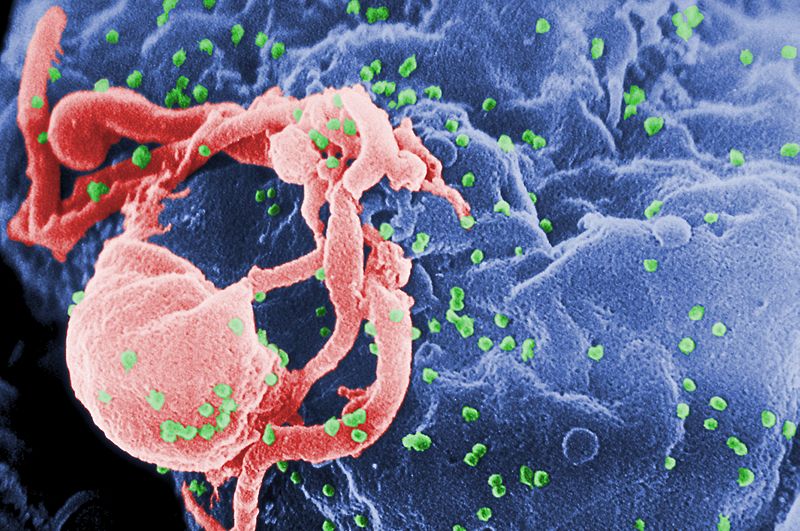
truvada_0Luckily, a recent scientific study conducted by the University of California at San Fransisco found no link between use of the drug and condom use. More importantly, the drug has a proven track record when it comes to preventing HIV. Recent reports state that it cuts infection rates by more than 90 percent, and people who take the drug every day are 99 percent protected from the onset of infection.

Furthermore, despite its $13,000-a-year price tag, the drug is covered by most insurers. So, its continued obscurity appears to have more to do with marketing than anything else. In truth, many people who are at risk for HIV still aren’t aware of the drug’s existence. And despite the CDC’s recent backing, its manufacturer, Gilead, has yet to market the drug for HIV prevention, even though it is currently used as part of treatment regimens.

http://cbsnewyork.files.wordpress.com/2014/03/479278263_10.jpg?w=620&h=349&crop=1This is why Cuomo’s announcement, which took place during Pride Weekend, was so important. By backing the drug formally, and encouraging physicians to get the word out, he is helping to promote awareness and curb HIV infection rates. Naturally, there are those who think Cuomo’s announcement is part of a ploy to get votes from members of the LGBTQ community.
Given the recent decline in condom use among teens of all sexual orientations, this is certainly good news. While a drug like this does nothing to prevent the acquisition of other STIs – such as gonorrhea or chlamydia – it is important to remember that these diseases are treatable and non-fatal. Ultimately, having an HIV prevention drug available will ensure that there is a preventive measure in place that people are more likely to use.

HIV-budding-ColorBeside the Truvada endorsement, the state is also set to start enforcing a 2010 law that requires doctors to regularly offer HIV testing to patients between the ages of 13 and 65. And the state recently repealed a law that asked doctors and nurses to obtain written consent from patients before performing HIV tests, because the requirement acted as a barrier to testing.

As a recent article in The New York Times points out, the most notable aspect of the state’s rejuvenated approach to combating HIV is the combined economics of the strategies involved. None of these methods should lead to increased spending because they don’t include new medical breakthroughs. Instead, the state will probably end up saving money since every prevented HIV case saves about $400,000 in medical costs.

https://i0.wp.com/media.sacbee.com/static/weblogs/photos/images/2011/jun11/gay_pride_ny_sm/gay_pride_ny_09.jpgAnd this is just one of many HIV preventions that has been proven safe, effective, and ready to market. Between bee-venom nanoparticle treatments, vaccines, and even topical creams that have been proven to eliminate the virus, the coming decades are likely to see a severe drop in the number of deaths associated with the disease. And by mid century, who knows? The disease that became the plague of the 20th century may finally be history!
Source: theverge.com, nytimes.com

The Future of Disaster Relief: The Ecos PowerCube

EcosPowerCube-640x353One of the greatest challenges to humanitarian aid and disaster relief is the task of getting services to where they needed the most. Whether it’s hurricanes, earthquakes, mudslides, or wildfires; getting electricity, water, and other utilities up and running again is a tough task. And with every moment that these services are not available, people are likely to die and humanitarian crises ensue.

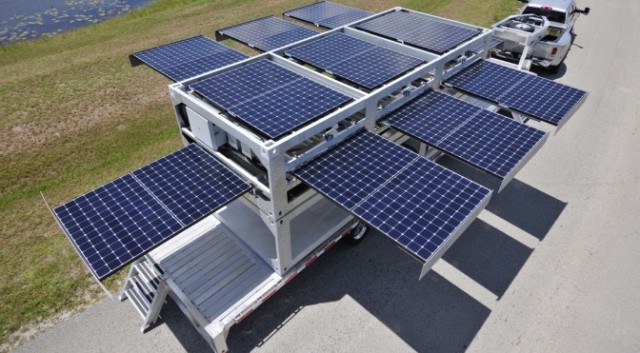
However, Ecosphere Technologies – a diversified water engineering and environmental services company – believes it’s designed a solution in the form of their new PowerCube. This self-contained, mobile apparatus is designed to deliver solar power to off-grid areas along with water purification facilities and WiFi base stations — all in a single package that is the size of a shipping container.

https://i0.wp.com/www.extremetech.com/wp-content/uploads/2014/06/disaster-lg-1.jpgThe Ecos PowerCube will be available in three sizes that are designed to fit into 10-foot, 20-foot, and 40-foot shipping containers. The largest models will be capable of generating up to 15kW of power, which will be parceled between providing electrical hook-ups, water treatment and internet access. And they will also serve as temporary shelters, providing temporary sleeping quarters or medical stations.

What is especially innovative about the design is the use of fold-out solar panels, which allow for significant power generation without compromising on the handy space-saving form. Deployed, the Cube is able to maximize its solar-absorbing surface area; but packed up, its small enough to fit into a shipping container and be deployed around the world. However, the design also comes with its share of drawbacks.

powercube-howFirst, there’s the apparent lack of batteries, which means the Cubes will only be able to provide power while the sun is shining. This is crucial since time is often of the essence in disaster areas, with windows for treating wounds and rescuing the buried and trapped lasting typically less than three days. Second, the 15kW generator is rather meager compared to what a diesel generator can produce – between 600kW and 1.7MW.

This means, in essence, that some twenty or so PowerCubes would have to be shipping to a disaster area to equal the electrical capacity of a single large diesel generator. And the intermittency problem is certainly an issue for the time being, unless they are prepared to equip them with high-capacity batteries that can quickly absorb and hold a charge (some graphene or integrated Li-ion batteries should do it).

https://i0.wp.com/www.extremetech.com/wp-content/uploads/2014/06/military-lg-2.jpgIn the meantime, it is still a crafty idea, and one which has serious potential. Not only do disaster areas need on-site water distribution – shipping it in can be difficult and time consuming – but internet access is also very useful to rescue crews that need up-to-date information, updates, and the ability to coordinate their rescue efforts. And military installations could certainly use the inventions, as they would cut down on fuel consumption.
Still, refinements will need to be made before this is a one-fit solution problem of what to do about disaster relief and fostering development in densely populated areas of the world where things like water-treatment, electricity, and internet access is not readily available.

Source: extremetech.com, ecospheretech.com

Cyberwars: Latest Snowden Leaks

FRANCE-US-EU-SURVEILLANCE-SNOWDENThe case against the NSA’s program of cyberwarfare and espionage has become somewhat like an onion. With every new revelation, the matter becomes more stinking and fetid. Certainly, the first release of classified NSA documents – which dealt with the US’s ongoing cyberwarfare against China and other nations – was damaging to the agency’s image. But it has been the subsequent publication of documents that deal with domestic surveillance that have been the most damning.

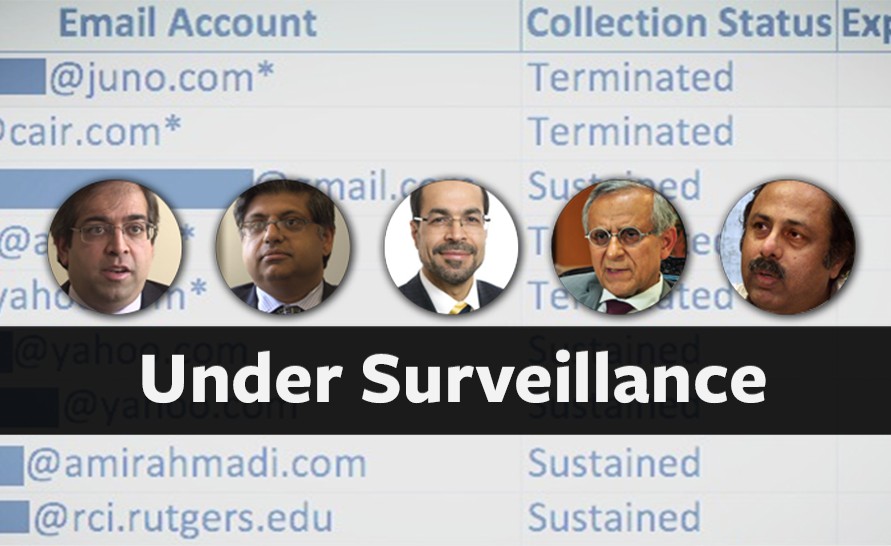
According to Snowden, he was motivated to leak this information because of the troubling case of hypocrisy inherent in the NSA programs. And in the lastest leak, Snowden has now confirmed that at least five Muslim-Americans – including prominent lawyers, a civil rights leader and academics – were the subject of years’ worth of surveillance by both the FBI and the National Security Agency.

under_surveillance_full_v2Among the targets were Nihad Awad, the executive director of the Council on American-Islamic Relations – the top Muslim-American civil rights organization in the United States – and Faisal Galil, a longtime Republican operative and former Bush Administration official who worked for the Department of Homeland Security and held a top-secret security clearance during the time he was under surveillance.

Also among the American targets was Asim Ghafoor, an attorney for the al-Haramain Islamic Foundation who who has represented clients in terrorism-related cases . He is also the man who famously discovered in 2004 that he and his clients were under surveillance after the Treasury Department mistakenly released to him a document listing calls he’d made to his clients.

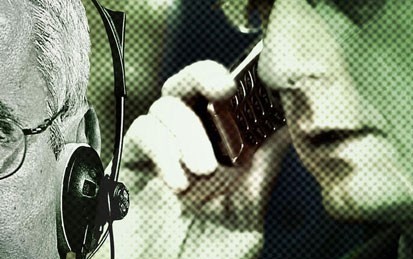
wire_tappingOther targets include Hooshang Amirahmadi, an Iranian-American professor of international relations at Rutgers University and Agha Saeed, a former political science professor at California State University who champions Muslim civil liberties and Palestinian rights. All of the targets appear to have been singled out because of their Muslim backgrounds and their activities either defending Muslim clients or on behalf of various causes.

The individuals appear on an NSA spreadsheet in the Snowden archives called “FISA recap”—short for the Foreign Intelligence Surveillance Act. Under that law, the Justice Department must convince a judge with the top-secret Foreign Intelligence Surveillance Court that there is probable cause to suspect of an American of being engaged in or abetting terrorism, espionage, or sabotage against the US.

FILE PHOTO  NSA Compiles Massive Database Of Private Phone CallsThe authorizations must be regularly renewed by the court for the surveillance to remain in effect, usually every 90 days for U.S. citizens. In none of these cases were the individuals singled out for surveillance because they were suspected of committing or planning a crime. And six years after the period the document covers, none of them has been charged with any crime related to the surveillance.

Greenwald says the revelations offer a more detailed look at who the government is targeting. Although there are some Americans on the list who have been accused of terrorism, the five highlighted in The Intercept piece have all led what appear to be law-abiding lives. As Greenwald explained:

This is the first time that there’s a human face on who the targets are of their most intrusive type of surveillance. [H]ere you really get to see who these people are who are the people worthy of their most invasive scrutiny. I think it’s important for people to judge—are these really terrorists or are these people who seem to be targeted for their political dissidence and their political activism?


faisal_gillAll of these five individuals identified in the article has gone on record to vehemently deny any involvement in terrorism or espionage. Outside of their ancestry, there appears to be no justification whatsoever for the surveillance. Faisal Gill, whose AOL and Yahoo! email accounts were monitored while he was a Republican candidate for the Virginia House of Delegates, had this to say when interview by The Intercept:

I just don’t know why. I’ve done everything in my life to be patriotic. I served in the Navy, served in the government, was active in my community—I’ve done everything that a good citizen, in my opinion, should do.

Ghafoor was also of the opinion that profiling had everything to do with him being targeted for electronic surveillance. When told that no non-Muslim attorneys who defended terror suspects had been identified on the list, he replied:

I believe that they tapped me because my name is Asim Abdur Rahman Ghafoor, my parents are from India. I travelled to Saudi Arabia as a young man, and I do the pilgrimage. Yes, absolutely I believe that had something to do with it.

https://i0.wp.com/media.nj.com/ledgerupdates_impact/photo/2012/06/muslim-lawsuitjpg-88e364e9b8e195f4.jpgCivil liberties groups have expressed anger that the five appear to have been targeted largely for having Muslim backgrounds. One such group is the Muslim Advocates, which released the following statement shortly after the story was published:
This report confirms the worst fears of American Muslims: the federal government has targeted Americans, even those who have served their country in the military and government, simply because of their faith or religious heritage. Muslim Advocates calls on the President and Congress to take steps immediately to reform the NSA surveillance program to uphold basic privacy rights and civil liberties that the Constitution guarantees to every American, regardless of faith.

The new revelations confirm for the first time that the government targeted U.S. attorneys, sometimes without warrants. Crucially, the revelations also give targets of the domestic surveillance legal standing to sue. Snowden indicated to Greenwald last year that he included the target list in the cache of leaked documents because he wanted people who had been under such surveillance to have evidence to challenge the spying in court.

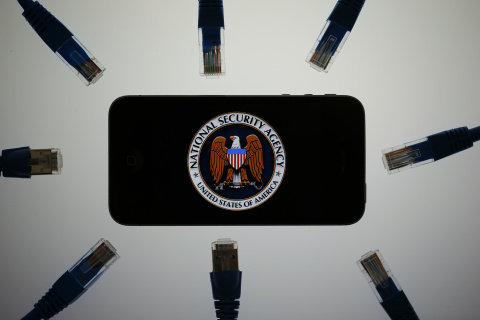
An illustration picture shows the logo of the U.S. National Security Agency on the display of an iPhone in BerlinIn the past, journalists and attorneys have tried to challenge the constitutionality of the government’s surveillance activities in court. But since the defendants did not have proof that they in particular had been targeted, the courts were forced to rule that they did not have standing. The spreadsheet, however, provides evidence of targeted surveillance for those who have now been identified.

In short, this latest revelation has provided Americans, and not just those of Muslim descent, with the means to hold the NSA and the FBI accountable for the first time. Since the historic episode known as the “war on terror” began, revelations have led to challenges and promises for reform. But in all cases, the crucial issue of whether or not these programs would be allowed to continue has been carefully sidestepped.

cyber_security2Whether it was the failure of FISA reform to reign in domestic wiretapping and data mining, or the Obama administrations endorsement of “transparent” surveillance, it seems obvious clear that an administrative solution was not in the works. But opening the way for successive lawsuits for wrongful surveillance might just prove to be more effective.

What is certain, though, is that the battle between civil liberties and surveillance in the “Digital Age” is nowhere close to being resolved. As the daily volume of data sent around the world continues to grow – from terabytes to petabytes to exabytes – there will continually be a need for monitors to watch for sinister things. And as long as they are willing to push the boundaries in the name of security, there will continue to be challenges.

Sources: wired.com, firstlook.org

Preparing for the Zombie Apocalypse!

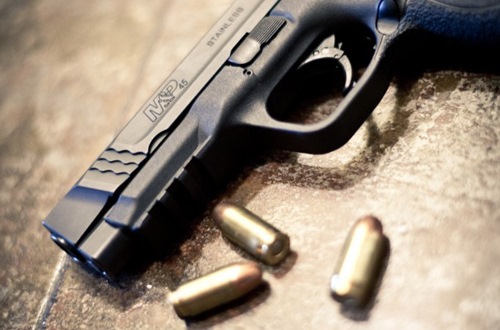
zombies-city-and-the-crowdCurrent events not related to science, tech, and/or pop culture are not exactly my forte. But I came across this article in the new lately and could not resist passing it on. To break it down, police in West Brighton NY conducted a raid on a man’s apartment over the weekend. In the course of searching his place, they found tw0 loaded pistols – a Springfield Armory XD40 .40 cal and an American Firearms Mfg. Co. .25 cal – along with 43 loose .25 caliber rounds.

But the twist came when they asked Nelson Quinones, one of the two residents, why he was in possession of these guns, which he kept stashed in his dresser drawer and under his bed. Apparently, the man told police that he was gearing up for “doomsday” or the “zombie apocalypse”. Quinones also had a gravity knife on his person when police searched him in his apartment building’s rear parking lot, court papers allege.

https://i0.wp.com/www.transportationissuesdaily.com/wp-content/uploads/2012/06/Zombies-ahead.jpgAccording to court papers and the District Attorney, both he and Ms. Meritza Hay (who lives with him) face serious criminal charges as a result of these weapons. Both face third- and fourth-degree criminal possession of a weapon, as well as criminal possession of a firearm and possession of ammunition. But Mr. Quinone’s wife also faces more serious charges due to the fact that she was convicted of misdemeanor drug possession in 2000.

But let’s face it: the real issue here is the zombie apocalypse, isn’t it? This man was in the early stages of stockpiling weapons because he knew what was coming! And while his intentions were good, his methods were terribly flawed! So let me address those now in an open letter to Mr. Quinone. Hopefully, it will give him something to think about while he’s languishing in jail…

gun_violenceMr. Quinone, while I applaud your efforts to be prepared for the inevitable rise/return of the living/walking dead, there’s a few things you need to understand. First of all, if you’re going to go the gun route for the zombie apocalypse, a 9mm is really the only way to go. More capacity for your weapon, big enough to take out a zombie’s brain, and far more common. This is important when it comes time to scavenge.

Second, everybody knows that firearms draw the attention of zombies (aka. Walkers, aka. Biters, aka. Zack, aka. Whiskeys!). If you’re planning on having to defend yourself from them, you should be hoarding melee weapons, such as the trusty katana sword, a machete, a truncheon, or just some good old fashioned baseball bats. You really want to fortify that for a zombie fight, wrap some barbed wire around it or stud it with some nails.

See?
See? Way more effective than a gun!

Some riot armor would help too, or just some improvised protection like some leather patches stitched into a suite of armor. Zombies spread their infectious disease through bites and scratches, so something that will prevent them from your from getting grazed would be a boon. And let’s not even get into how little thought you put into the state of your transportation.

Everybody knows that in the midst of a zombie apocalypse, you’re going to need to get the hell out of dodge, so something that can address the special needs of survival on a budget is a must. Naturally, you might be tempted to get yourself a horse since these and other more traditional modes of transportation are fuel-efficient (which is a big plus in any apocalyptic scenario).

zombie_carBut horses or mules are likely to panic at the site of flesh-eating zombies and buck you. What’s more, the presence of unfetid, uncorrupted flesh tends to draw the zombies in your direction. Far better to soup up your existing vehicle into a zombie-smasher with the addition of some floodlights and a front-end plough. I believe the picture above of Robert Kirkman’s zombie car will help to illustrate.

Last, but certainly not least, is the issue of supplies. When police raided your home, did they find a huge collection of fresh water containers, dehydrated foods, C-rations, vitamin supplements, batteries, solar cookers, camping stoves, propane tanks, or signal flares? No, they didn’t! These should be your FIRST priority, not some hand guns! What were you planning – to waiting for the crisis to hit before running down to the mall and hoarding with the rest of us?

Now that's what a storeroom looks like!
Now that’s what a storeroom looks like!

He who plans for the apocalypse ahead of time is always better prepared and more suited to life once its underway. Just ask all those nuts who live in their hilltop communities – the ones who’ve been stockpiling guns, ammo, food, water, diesel fuel and generators for decades. These guys will tell you that now is the time to stockpile for the coming apocalypse. But don’t mention zombies, they might think you’re crazy and shoot you.

But above all is the rather timid effort you put into stockpiling weapons, sir. I mean really, two handguns? Real survivalists have been spending the past few years amassing as many assault weapons, shotguns, pistols, and submachine guns as they can afford and the law will allow. Such popular weapons include the AR-15, Tech-9, Mossberg 590A1, and the Glock 17. And if the law is a bit inflexible in your state, just zip next door or go to a gun show!

zombiegun3Yes, it pains me to say it, buy you really dropped the ball on this one, sir! Now some might say that this was just your lame-ass attempt to excuse owning two illegal guns. But I know you to be a conscientious individual who cares greatly for your and your significant other’s safety. I also know that as such an individual, you want to be prepared to meet this inevitable catastrophe head on.

So assuming it hasn’t come to pass while you’re still in jail (in which case, you’ll die like a rat in a cage), I urge you to reconsider your efforts! Cover the necessities first, then worry about the incidentals. Thank you, and in the meantime, be sure to watch yourself while standing in the chow line. Also, don’t drop the soap. And if you can, find the biggest, meanest, ugliest man you can, and glom onto him. You don’t want to be just anybody’s bitch!

And if my might be so bold, you could read my Whiskey Delta series that deals with the zombie apocalypse, which I am currently working on the third installment for. It’s chock full of survival tips. They do get Amazon delivery in jail, don’t they? NOOOO? Well then, you’re screwed!