Back from the Edge… Again!

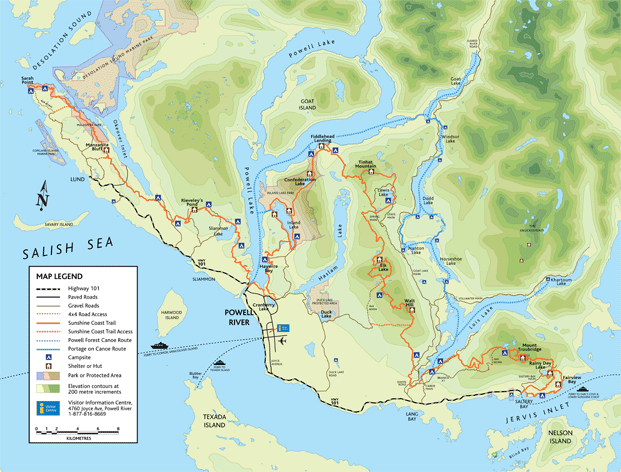
newmapHey folks. Once again, the wife and I have emerged from our walking tour of the Sunshine Coast Trail alive and unscathed and we are pretty pleased to be back in civilization. This is the second time we’ve hiked the trail, and after last year’s abortive but adventurous attempt, we were determined to make a go of it this year.

Sunshine_Coast_Trail-Powell_River-tnLast time around, we began our march into the wilderness from Sarah Point, the northernmost tip of the trail that sits at the edge of a peninsula. That required scaling a kelp-covered rock face since the tide was low, and that was quite the adventure in itself! Several followed, as we hiked across high, rocky hills and dealt with a shortage of water since it was a particularly hot summer!

This year, we did things a little differently, beginning our march from the town of Powell River and proceeding inland along the rocky bluffs that overlook Powell Lake. We also were sure to bring a tent, and not trust in the cabins that are spaced at intervals throughout the wilderness. We also chose our route based on the fact that there were several lakes, so we wouldn’t be subject to water shortages… again!
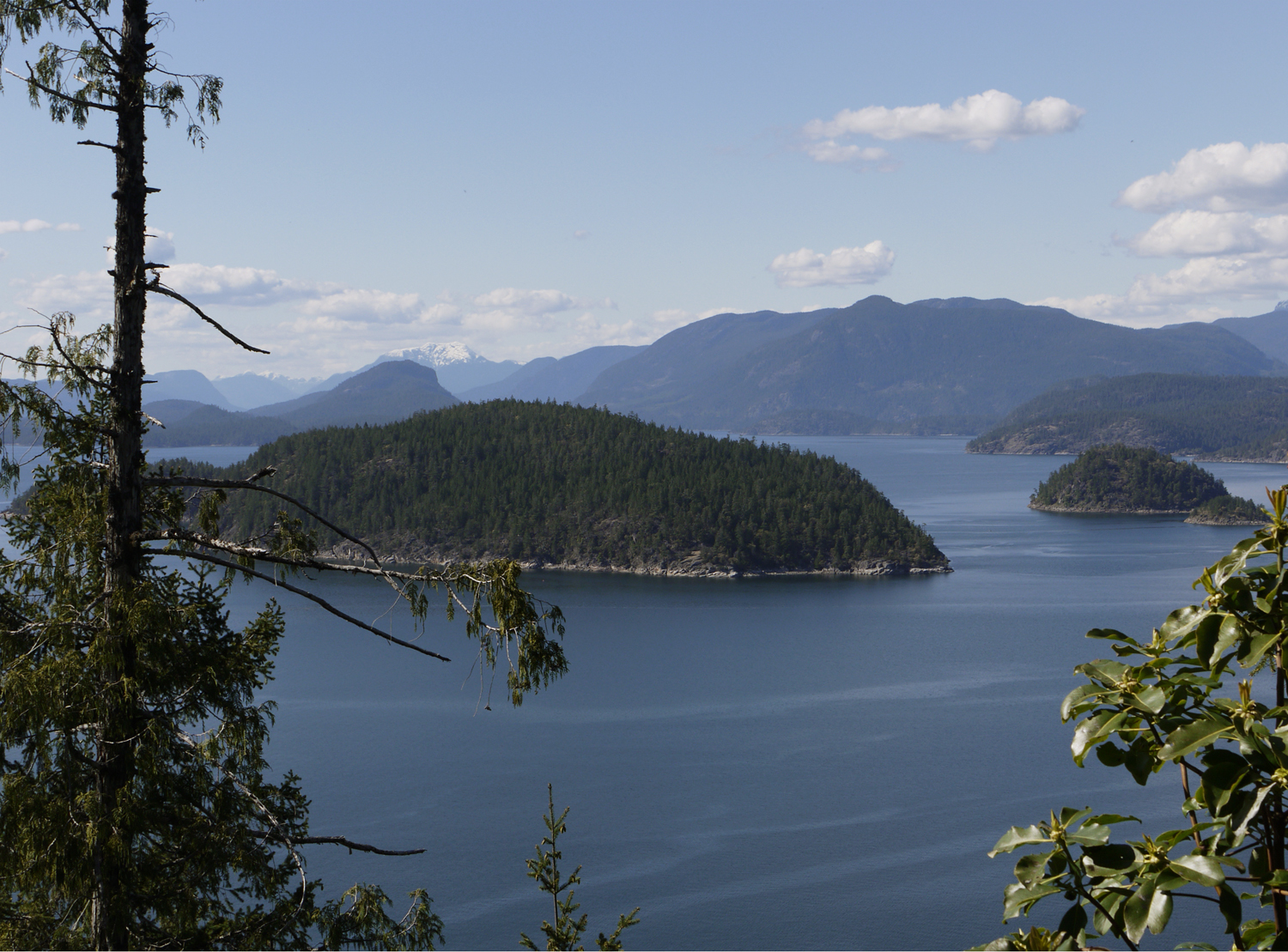
1000594And let me tell you, it was quite the adventure. After a weekend spent at a friend’s wedding and all the travel it takes to get from our home down south to Comox and then the mainland, we were already feeling a little over-sunned and quite restless. And despite the presence of bear poop and low rumbles behind us along the trail, we managed to get to our first destination unscathed.

Our destination on the first night was a lovely campsite tucked in at Haywire Bay which is part of Powell Lake. We swam, ate, and slept out under the stars in our new and ultra-light tent. We got some odd looks, since the majority of people in this park had driven in and were sleeping in their motorhomes and mobile campers. Somehow, hikers who carry all their gear are in the minority in these parks. Go figure!
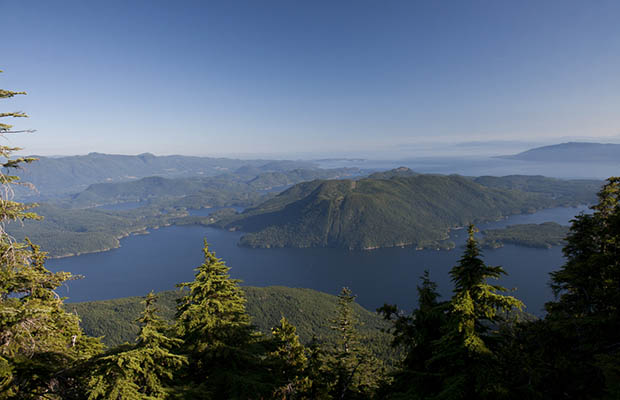
7186361The next day, we hiked farther into the interior and made our way through clearcut patches and more forests to Inland Lake. Here, we camped out on a small island on the lake called Anthony Island, which was another adventure of its own. Ravens ate our dinner sausage, which nearly made us vegetarians on the last two nights. And for a good hour before dusk, we lay in our tents and heard strange noises that sounded like wild animals.

Lucky for us, no animals were in our campground. And whatever the noise was, it seemed to dissipate around 10 pm and we were able to get some sleep. But of course, I kept my knife handy and we kept making loud noises every time we suspected something big and furry was in the vicinity.

The next day, we were outta there! We hiked back to the Inland Lake campground 4km away and set up our tent there. We wanted to walk farther into the interior still, to a place called Confederation Lake. However, we knew that Inland had a gravel road that ran all the way back to Powell River, close to the one we used to get into the wilderness in the first place. This was our exit strategy, so we decided instead to spend day three hiking around the lake and sticking close to this road.

townsite-brewingAnd then, just yesterday, we packed up all our gear, hiked the 10 km of logging roads and back streets to get back into Powell River. Once there, we visited the Townsite Brewery, drank some samples, and picked up some bottles to bring home. Half are intended for our neighbors who watched over our cat, Jasper, while we were gone.

We were then fortunate enough to get a ride back into the town proper, which was another five km away along sun parched roads. After hiking about 40 km through the wilderness and along logging roads, we weren’t too eager to walk along a sun-parched highway. We already did that to get out of town at the beginning, and that was no picnic!

PowellRiverThen came a restful lunch at a nice restaurant, cold beer, and a ferry ride back to Comox where we spent the night at my folks place. Hot showers and a soft bed are a luxury few can appreciate unless they go without for days on end. And sure, we’re burnt and sore, but we feel really good. This year’s trip felt like an accomplishment whereas last years felt like a failure.

The rest we plan to enjoy for the remainder of our vacay which will now be spent at home relaxing! So expect to hear more from me in the next few days. But not during the peak hours of say 10 to 4. I imagine the wife and I will be hiking at home since we’re full of piss and vinegar still and want to chase that feeling.

Hope this summer is finding all of you happy, healthy and full of piss and vinegar too!

Happy Canada Day!

happy_canada_dayWell, it’s Canada’s birthday, a day of celebration and national holiday. And I thought what better to celebrate that day on this site than with a video of Chris Hadfield playing for audience on Parliament Hill. Back when I used to live in the nation’s capitol, I’d turn out on the Hill with roughly 100,000 other people to take in the show and then stay for the fireworks.

And I can honestly say I wish I could have been there. Since his return to Earth on May 13th of this year, Hadfield has been showing absolutely no signs of slowing down. After months of educational, inspirational and musical broadcasts from the International Space Station, he’s now making guest appearances, giving talks, and as usual, showcasing his musical talents!

chris-hadfield-852-17888-8colOther than that, I hope my friends back in Ottawa are having fun today. I know that some of them are likely braving the crush of people downtown right now, suffering through the sweltering heat to take part in the festivities and patriotic fervor. Wish I was there with ya, buds!

And also, I would like to take this opportunity to wish one of my best friends, Chi hung-La, currently residing in Edmonton, Alberta, a happy birthday. Lucky for him, and all of us who care about him, the flooding didn’t effect his neck of the woods. And also to longtime family friend Shannon Hagerman. Happy birthday to you too!
And to any fellow Canucks out there, hope this day finds you happy, comfortable, and having a good time surrounded by family and friends. And since it is vacation season, I’ll be gone for about a week on the Sunshine Coast Trail again this year. But expect me back soon enough! Happy Canada Day, and a glorious summer to all!

Building the Future: 3D Printing and Silkworms

arcology_crystalWhen it comes to building the homes, apartment blocks and businesses headquarters of the future,  designers and urban planners are forced to contend with a few undeniable realities. No only are these buildings going to be need to be greener and more sustainable, they will need to be built in such a way that doesn’t unnecessarily burden the environment.

Currently, the methods for erecting a large city building are criminally inefficient. Between producing the building materials – concrete, steel, wood, granite – and putting it all together, a considerable amount of energy is expended in the form of emissions and electricity, and several tons of waste are produced.

anti-grav3d2Luckily, there are many concepts currently on the table that will alter this trend. Between using smarter materials, more energy-efficient design concepts, and environmentally-friendly processes, the future of construction and urban planning may someday become sustainable and clean.

At the moment, many such concepts involve advances made in 3-D printing, a technology that has been growing by leaps and bounds in recent years. Between anti-gravity printers and sintering, there seems to be incredible potential for building everything from settlements on the moon to bridges and even buildings here on Earth.

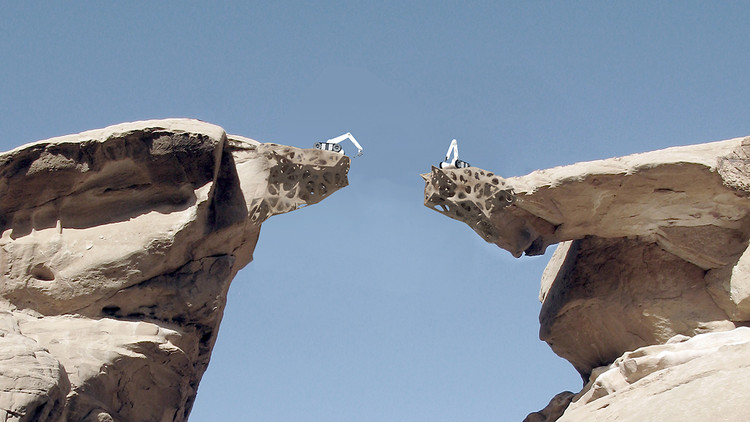
bridge_3One case in particular comes to us from Spain, where four students from the Institute for Advanced Architecture of Catalonia have created a revolutionary 3-D printing robot. It’s known as Stone Spray, a machine that can turn dirt and sand into finished objects such as chairs, walls, and even full-blown bridges.

The brainchild of Anna Kulik, Inder Prakash, Singh Shergill, and Petr Novikov, the robot takes sand or soil, adds a special binding agent, then spews out a fully formed architectural object of the designers’ choosing. As Novikov said in an interview with Co.Design:

The shape of the resulting object is created in 3-D CAD software and then transferred to the robot, defining its movements. So the designer has the full control of the shape.

robot-on-site_0So far, all the prototypes – which include miniature stools and sculptures – are just 20 inches long, about the size of a newborn. But the team is actively planning on increasing the sizes of the objects this robot can produce to architectural size. And they are currently working on their first full-scale engineering model: a bridge (pictured above).

If successful, the robot could represent a big leap forward in the field of sustainable design. Growing a structure from the earth at your feet circumvents one of the most resource-intensive aspects of architecture, which is the construction process.

And speaking of process, check out this video of the Stone Spray in action:


At the same time, however, there are plans to use biohacking to engineer tiny life forms and even bacteria that would be capable of assembling complex structures. In a field that closely resembles “swarm robotics” – where thousands of tiny drones are programmed to build thing – “swarm biologics” seeks to use thousands of little creatures for the same purpose.

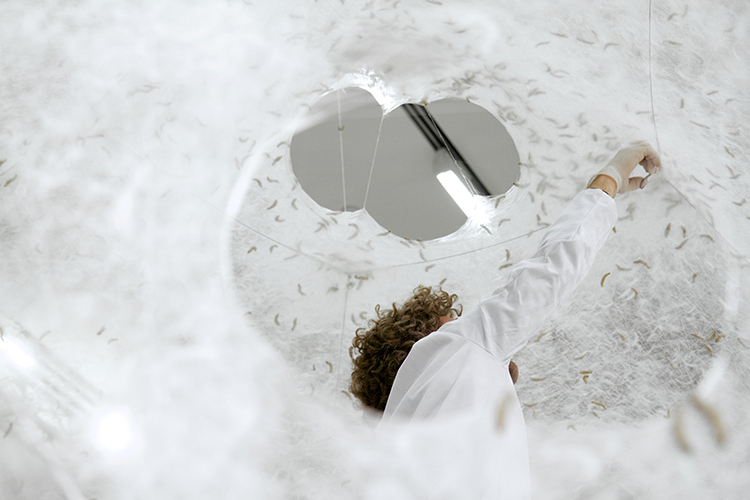
silkpavilionMIT has taken a bold step in this arena, thanks to their creation by the Mediated Matter Group that has rebooted the entire concept of “printed structures”. It’s called the Silk Pavilion, a beautiful structures whose hexagonal framework was laid by a robot, but whose walls were shell was created by a swarm of 6,500 live silkworms.

It’s what researchers call a “biological swarm approach to 3-D printing”, but could also be the most innovate example of biohacking to date. While silkworms have been used for millennia to give us silk, that process has always required a level of harvesting. MIT has discovered how to manipulate the worms to shape silk for us natively.

silkpavilion-2The most immediate implications may be in the potential for a “templated swarm” approach, which could involve a factory making clothes just by releasing silkworms across a series of worm-hacking mannequins. But the silkworms’ greater potential may be in sheer scale.

As Mediated Matter’s director Neri Oxman told Co.Design, the real bonus to their silkworm swarm its that it embodies everything an additive fabrication system currently lacks. 

It’s small in size and mobile in movement, it produces natural material of variable mechanical properties, and it spins a non-homogeneous, non-woven textile-like structure.

What’s more, the sheer scale is something that could come in very handy down the road. By bringing 3-D printing together with artificial intelligence to generate printing swarms operating in architectural scales, we could break beyond the bounds of any 3-D printing device or robot, and build structures in their actual environments.

silkpavilion-1In addition, consider the fact that the 6,500 silkworms were still viable after they built the pavilion. Eventually, the silkworms could all pupate into moths on the structure, and those moths can produce 1.5 million eggs. That’s enough to theoretically supply what the worms need to create another 250 pavilions.

So on top of everything else, this silkworm fabrication process is self-propagating, but unlike plans that would involve nanorobots, no new resources need to be consumed to make this happen. Once again, it seems that when it comes to the future of technology, the line between organic and synthetic is once more blurred!

And of course, MIT Media Lab was sure to produce a video of their silkworms creating the Silk Pavilion. Check it out:


Sources:
fastcodesign.com, (2)

Feeding the Future: 3D Printing to End World Hunger?

3DfoodThe Systems & Materials Research Corporation, a 3D printing development firm, received a lot of attention after it became revealed that NASA had hired him (to the tune of $125,000) to develop a printer that could create pizza. Looking ahead to the era of deep-space exploration, NASA wanted something that could provide its astronauts with food that was tasty, nutritious, and not subject to a shelf life.

But to Anjan Contractor, the head of SMRC, 3D printing also presents a solution to a much more terrestrial problem: world hunger. He sees a day when every kitchen has a 3D printer, and the earth’s 12 billion people feed themselves customized, nutritionally-appropriate meals synthesized one layer at a time, from cartridges of powder and oils they buy at the corner grocery store.

3dfood1Contractor’s vision would mean the end of food waste, because the powder his system will use is shelf-stable for up to 30 years. Each cartridge, whether it contains sugars, complex carbohydrates, protein or some other basic building block, would therefore be fully exhausted before ever needing to be returned to the store. So in addition to providing for our daily needs, this process would also eliminate a massive proportion of the waste we generate on a daily basis.

In addition, the proliferation of food synthesizers is also likely lead to new and diverse ways of producing the basic calories on which we rely. Since a powder is a powder, the inputs could be anything that contain the right organic molecules. And with open source software, where people can upload and download recipes all the time, people will have a chance to get creative and expand the repertoire.

OLYMPUS DIGITAL CAMERAAnd in addition to alleviating hunger, there is the added (and arguably bigger) bonus of relieving pressure on the natural environment. Already, environmentalists are gravelly concerned about the amount of land that is consumed every year by urban sprawl. But even more disconcerting is the amount of land, forests, wetlands, and natural habitats, that are consumed and destroyed by the need to farm food for these environments, and dispose of their waste.

And he is hardly alone when it comes to the concept of turning powdered ingredients and pastes into food. The Dutch holding company known as TNO Research, which owns several technology firms, has also been contemplating the possibilities of turning any food-like starting material into an edible meal. According to an outline provided by their researchers, 3D printed meals of the future could include any of the following “alternative ingredients”:

  • algae
  • duckweed
  • grass
  • lupine seeds
  • beet leafs
  • insects

As long as the biological properties of the base materials are appropriate – meaning they have the requisite carbohydrates, protein, fatty acids, etc – than it should be possible to synthesize just about anything.

3dfood2In addition, companies like Philips and institutions like MIT have been working on the concept of food printers for many years. In Philip’s case, this research led to the creation of the Diagnostic Kitchen program. This led to ideas for a Food Printer, which was inspired by the concept of ‘molecular gastronomists’, chefs who deconstruct meals and then reassemble it in completely different ways.

In much the same way, a Food Printer would take various edible ingredients and then combine and ‘print’ them in the desired shape and consistency. The nutritional value and relevance of what was being ‘printed’ would also be adjusted based on input from the diagnostic kitchen’s nutrition monitor. If, for example, you were trying to carbo-load for an athletic event, wanted to build muscle, or lower your cholesterol, you could tweek the levels of carbs, protein, or fatty acids to suit your needs.

MIT_3DprinterAnd there’s the Cornucopia,  a 3D printer that was unveiled by MIT’s gastronomy geeks back in 2010. Here, a series of refrigerated food canisters provide the food ingredients, which are then deposited into a built-in mixer which delivers concoctions that can be either heated or cooled thanks to a temperature controlled print head. A touch screen allows users to dial in what they want, and adjust ingredients to get the desired end.

Granted, there are those who won’t likely see this as an appetizing prospect. But as Contractor notes, that’s probably because they haven’t tried the high-end stuff yet. As the technology improves, attitudes about printed food products are likely to change. What’s more, he also believes overpopulation might add a little incentive to the mix:

I think, and many economists think, that current food systems can’t supply 12 billion people sufficiently. So we eventually have to change our perception of what we see as food.

Quite right. When the world is bursting at the seems and so many people are forced to live together in close quarters, hardly anyone is likely to raise a fuss about assembled food. Not when the alternative is an empty belly or a planet that will collapse from the weight of so much farming and waste. So if you’re the kind of person who likes their meat, veggies and fruits to be farmed locally and organically, you may want to consider moving to the country!

And be sure to check out this concept video produced by NTO that showcases the future of 3D printing, which of course includes food production:


Source:
qz.com, popucity.net, geek.com

World War Z: Novel vs. Movie

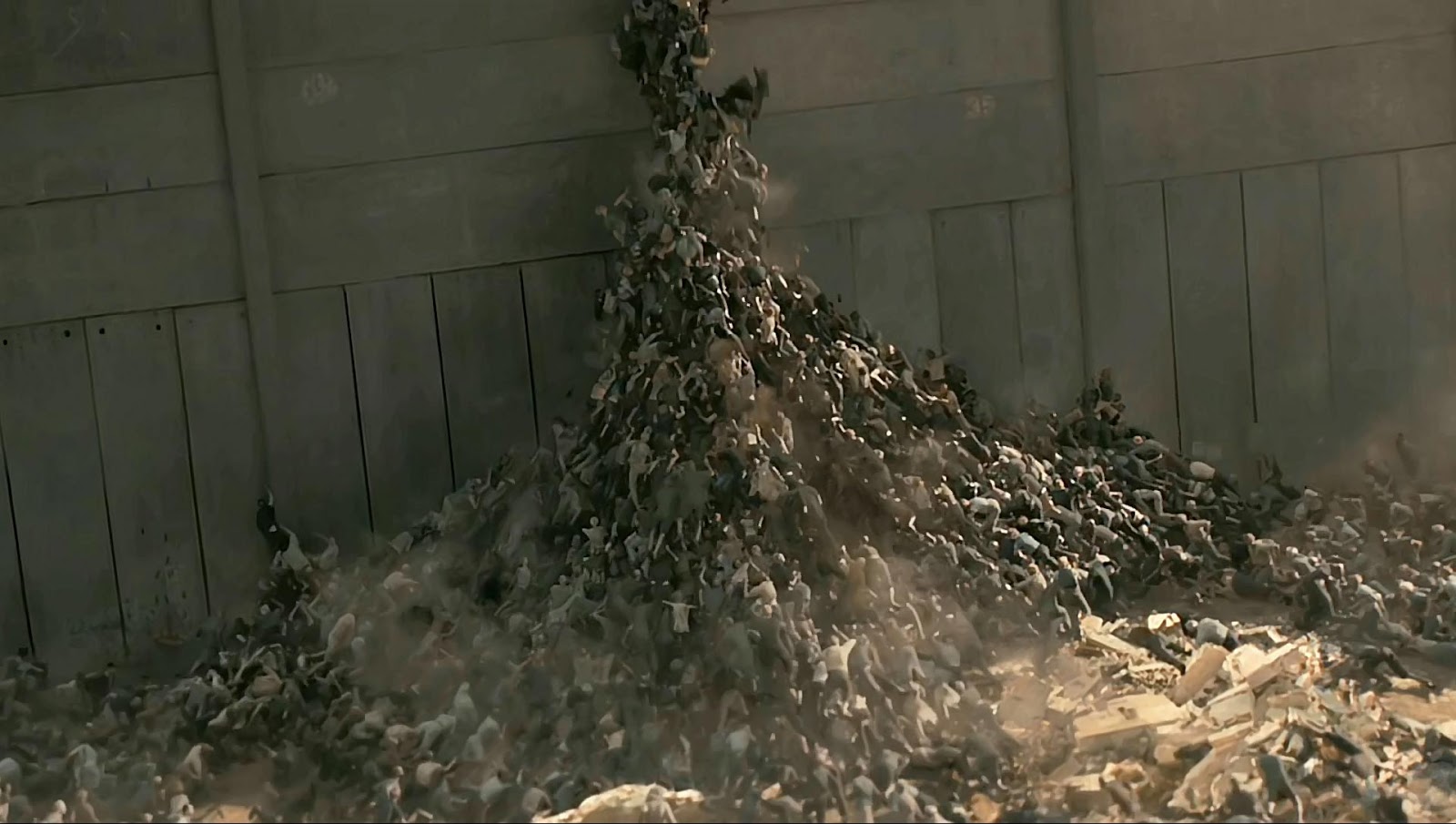
worldwar_zI’ll admit right off the bat that I haven’t seen the movie yet. But having bought the book recently and delved into it, I could tell right away when the previews hit that director Marc Forster and his crew of writers had no intention of following it at all. Sure, it looked like it good be exciting, and a good shoot em movie, but calling it an “adaptation” seemed like a stretch at best.

If anything, it appeared that Max Brook’s awesome and thoughtful story about a man who is going around the world and assembling post-facto oral accounts about the zombie apocalypse – how and where it began, what the signs were, how people survived – was little more than a guideline for a big budget disaster flick. If there was any doubt, the fact that Brad Pitt was cast as the lead silenced them all in a nanosecond.

Luckily, stuff like this allows other people to come up with good satire. Case in point, this infographic created by the folks over at The Oatmeal. In addition to providing all kinds of funny, happy ecards, infographics and jokes, they are also a place where one can pledge money for the new Arkyd program – the crowdfunded telescope you can have you picture placed on for $25.

world_warz_infoHere, they show the movie and book as two spheres, indicating that they overlap in one important way: they have the same name! Yep, that’s it. In every other capacity, except for the fact that it involves a zombie apocalypse and Brad Pitt’s character loosely resembles the narrator in the book, the movie and book could not be more different.

Personally, I think I’ll see it anyway. Maybe not in the theater, but it might be a good candidate for rental or Netflix. The wife thinks it looks like fun and I know that my curiosity won’t be satisfied until I witness this “adaptation” firsthand. Peace out, and go for the brain!

Source: theoatmeal.com

News from Mars: Oxygen-Rich Atmosphere

marsEver since the Opportunity and Curiosity Rovers began their research stint on the red planet, evidence has been pouring in that indicates that the planet once supported life. And now, by examining the compositions of Martian meteorites found on Earth and data provided by the Mars rovers, Scientists from the Department of Earth Sciences at the University of Oxford have determined that the planet once boasted an oxygen-rich atmosphere.

The key determinant was the fact that the Martian surface rocks were five times richer in nickel than the meteorites found on Earth, a find which cast doubt on whether the meteorites were typical volcanic products. Whilst it is possible that the geological composition of Mars varies immensely from region to region, the team believes that it is more likely that the differences arise through a process known as subduction – in which material is recycled into the interior.

mars_oxygenThe scientists suggest that the Martian surface was oxidized very early in the history of the planet and that, through subduction, this oxygen-rich material was drawn into the shallow interior and recycled back to the surface during eruptions 4 billion years ago. The meteorites, by contrast, are much younger volcanic rocks that emerged from deeper within the planet and so were less influenced by this process.

As Professor Bernard Wood, the senior author of a study that appeared in Nature magazine, put it:

What we have shown is that both meteorites and surface volcanic rocks are consistent with similar origins in the deep interior of Mars but that the surface rocks come from a more oxygen-rich environment, probably caused by recycling of oxygen-rich materials into the interior. This result is surprising because while the meteorites are geologically young, around 180 million to 1.4 billion years old, the Spirit rover was analyzing a very old part of Mars, more than 3.7 billion years old.

In addition to evidence that Mars once had a sizable amount of surface water, in the form of rivers and lakes, this latest study demonstrates that Mars was once very much like Earth. In all likelihood, it would have been home to countless forms of bacteria, single-celled organisms, and possibly larger creatures as well. But being at the edge of our Sun’s habitable zone, it was unable to maintain the conditions for life to thrive.

terraforming-hswmarsSad news, but encouraging when it comes to the prospect of making Mars able to sustain life again. And in the coming years and decades, that’s precisely what a number of space agencies, private companies and citizens want to do. And if these plans are to succeed long term, the planet will have to be converted into something that can independently support life.

In short, the colonization of Mars requires that the planet become something akin to its old self.

Source: sci-news.com

Climate Crisis: Population Growth in Coming Years

trafficWhen it comes to populations and environmental problems, cities are at the very heart of the issue. Not only are they where the majority of humanity lives, a reality which will only get worse as time goes on, they are also the source of most of our pollution, waste, and land use. People require space to live and work, as well as food, water and

Last year, the world’s population increased to 7 billion, which represents a seven-fold increase in the space of the last two centuries. What’s more, the proportion of people living in urban centers (as opposed to rural) shot up from 3% to almost half of the world’s people. This rate of population growth and redistribution is unprecedented, and is not likely to slow down anytime soon.

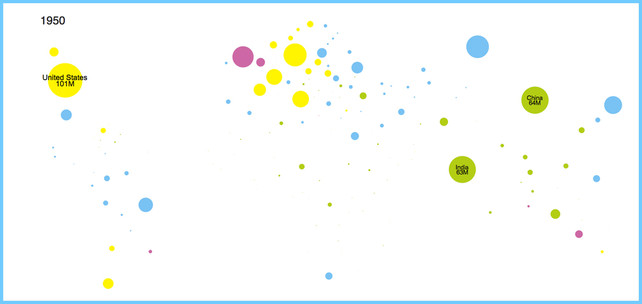
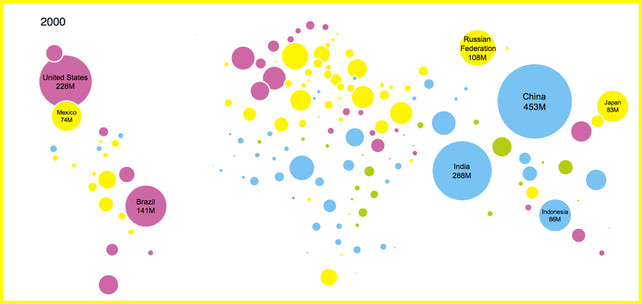
urbanworld_50Consider the following series of infographics which were released by Unicef with the help of the design studio Periscopic. Titled “An Urban World”, they illustrate the issues of population growth and distribution. This interactive, HTML5 visualization of the world covers the years of 1950-2050. But rather than showing our geographic boundaries, every country* is depicted only by their population living in urban environments.

As you can see, each country is represented by a circle that depicts the number of people living in urban environments. As these populations grow, the circles get bigger. And as urban populations get more dense, the circles shift from green to blue to yellow to fuchsia. Immediately, a glaring fact is made clear: the problem is getting worse and at an alarming rate.

urbanworld_2000In addition, there are several nuggets of info which are staggering and particularly worrisome. For example, by 2050, both China and India will have about a billion people living in cities alone. In addition, since the 1990s, more than 75% of the U.S. population has lived in cities. At one time, the US was an outlier in this regard, but found ourselves joined over the next two decades by France, Spain, the U.K., Mexico, Korea, Australia, and Brazil.

But of course, this growth need not be a bad thing. When all is said and done, humanity has a choice. One the one hand, these megacities can take the form of smartly scaled communities of loosely populated expanses and efficient agriculture. On the other, they could easily take the form of urban slums and underdeveloped countrysides that are stricken by poverty and filthy.

urbanworld_2050It’s a complex issue, no doubt about it, especially when you consider the flip side to the whole equation. As the saying goes, every new life means a new mouth to feed, but also a pair of working hands. What’s more, studies have shown that people living in cities tend to be far more energy efficient, and that energy surplus is usually directed toward more and more technological growth and innovation.

Seen in this light, the massive cities of the future could be hubs for the ongoing development of new energies and creative living solutions. And with more people living in large, connected, interdependent environments, the more business startups, ideas, and contributions were likely to get. Part of the reason we have seen so much progress in solar, piezoelectric motors, and bio-electricity is because of this trend. More growth will conversely mean more clean energy.

overpopulation Quite the paradox, really. Who knew people could be both the cause and solution to the world’s worst problem! In the meantime, feel free to head on over to the Unicef site and watch this interactive infographic. Just press play, and watch the cities of the world swell at the edges, competing for room on the page as they compete for room on this planet.

Also, be sure to take a gander at this infographic from BBC Future that demonstrates the current population of the world’s major cities per square meter, the projected population per square meter by 2050, and the livability rating of the city in question. They even provide some context at the bottom by showing the size of relative spaces – from prison cells to Olympic swimming pools, and comparing that to the average space an urban dweller enjoys.

city_spaces
Sources:
bbc.com, fastcodesign.com
, unicef.org

Drone Wars: New Revelations and Broken Promises

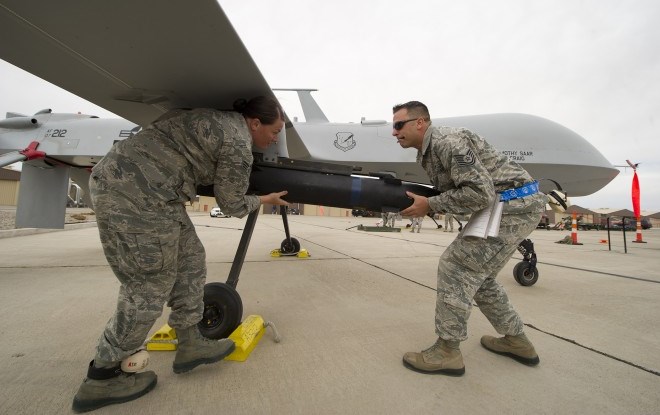
???????????????????????????????????????????????????????????????????????????????????????????????????????????????????????????????????????????????????????????????????????????????????????????????????????????????????????????????????????????????????????????????????????????????????????????????????????????????????????????????????People concerned about the use of drones might remember fondly how President Obama, in a speech held late last month, promised that the “drone surge” was effectively at an end. As it turns out, it took the President and his administration only eight days to break that promise. In a new strike, which killed four people it has been made clear that the clandestine war continues.

In Obama’s speech, he contended that “Beyond the Afghan theater, we only target al-Qaida and its associated forces, and even then, the use of drones is heavily constrained.” Among those constraints are the use of detainment instead of execution, and “respect for state sovereignty”. Perhaps most importantly, Obama underscored the drones will for now on only target “terrorists who pose a continuing and imminent threat to the American people.”

(U.S. Air Force photo/Staff Sgt. Brian Ferguson)(Released)To clarify this point, the White House even released a fact sheet clarifying whom it will and will not kill in the future. It stated that:

[T]he United States will use lethal force only against a target that poses a continuing, imminent threat to U.S. persons. It is simply not the case that all terrorists pose a continuing, imminent threat to U.S. persons; if a terrorist does not pose such a threat, the United States will not use lethal force.

However, this latest strike, which took out Wali ur-Rehman – the second in command of the Pakistani Taliban – and three other members shows that this is anything but the case. Rehman and his ilk are not members of Al-Qaeda, nor do they represent a terrorist group that is targeting the US and its citizens. Most importantly, they are not operating inside Afghanistan.

talibanFact is, Rehman and his compatriots pose a threat to only Pakistan, which is involved in an ongoing war with fundamentalist factions in its western provinces. They are the enemies of the Pakistani state, which is a nominal ally in the war on terror and with the war in Afghanistan. This makes his execution at the hands of the US a matter of protecting political and strategic interests, not anti-terrorism.

What’s more, there are indications that this strike may have been counterproductive for Pakistan. Pakistani military sources told Reuters in December that Rehman was “a more pragmatic” leader than incumbent Hakimullah Mehsud, with whom Rehman was said to be feuding. While Rehman was said to pursue reconciliation with the Pakistani government, the Pakistani military officers speculated that his rise “might lead to more attacks across the border in Afghanistan” on U.S.-led forces.

drone_warSo any way you slice it, this latest drone strike was a clandestine operation made by a government that claimed to be finished with such things. Lucky for us, there may be a way to gleam the truth about the secret history of the drone war and their ongoing use as tools of government policy.

As it turns out, there are ways to hack and record drone video feeds to see what they see right before they unleash death and destruction. And in an ironic twist, much of the credit for this revelation may go to a group of Iraqi insurgents. In 2008, U.S. troops in Iraq declared that Shi’ite insurgents had figured out how to tap and record video feeds from overhead American drones.

Hackers-With-An-AgendaBuilding on this, Josh Begley, a 28-year-old NYU grad student, is creating a software application that will allow anyone with basic coding skills to organize, analyze and visualize drone-strike data from Pakistan, Yemen and Somalia dating back to 2002. Based on information collected by the U.K. Bureau of Investigative Journalism, the Applicable Programing Interface (API) can be used to create interactive Websites that elaborate on the information and give it context.

The drone API, which is actually Begley’s master’s thesis, is not his first foray into capturing robot-attack data. His @dronestream Twitter feed documents all reported UAV attacks. Last year Begley created an iPhone app that tracks drone strikes, but Apple rejected it. Other developers have jumped on the bandwagon, too. London-based artist James Bridle runs a Tumblr blog that matches overhead satellite imagery to reports of drone attacks.

drone_target_1In an interview with Wired’s Danger Room, Begley explained that the purpose behind this software is the desire to bridge the “empathy gap” between Western audiences and drone-attack victims:

To Americans like me, what may have previously been blank spots on the map all of a sudden have complex stories, voices of their own. From 30,000 feet it might just be cars and buildings. But there are people in them. People who live under the drones we fly.

The public release of Begley’s API, which took five months to complete, is timed to coincide with the White House-promoted National Day of Civic Hacking on June 1. Hacking Day aims to “liberate government data for coders and entrepreneurs.” The ACLU, for one, is commemorating the event with an API linked to the group’s vast database of documents related to U.S.-sanctioned torture of terror suspects.

drone_map1After twelve years of drone strikes and promises that don’t appear to be being honored, the arrival of this app might just be what the public needs. And even though software giants like Apple may not be interested in developing it further, there are no shortages of talented individuals, professional hackers and hobby labs that will take up the cause.

It wouldn’t be too farfetched to think that a plethora of websites will begin to emerge that can track, monitor, and record all drone strikes, perhaps even as they happen. And combined with recent revelations about state-run data mining operations and software that is being designed to combat it, private citizens may be able to truly fight back against clandestine operations and government surveillance.

Sources: Wired.com, (2)

News From Space: Arkyd Telescope and Shenzhou 10

spacex-icarus-670It seems that every day, the frontiers of space exploration are being pushed. In recent months, two stories occurred close to home (relatively speaking) that have stuck out in my memory. The first had to do with Planetary Resources plan to commission the world’s first crowdfunded telescope. The second came from China, where the new Shenzou 10 space ship launched on its way to dock with the prototype Tiangong-1 space station.

These stories were both groundbreaking for a number of reasons. Arkyd’s plan for a publicly-owned and funded telescope is not only an historic first, its also a major step forward in the creation of a new era of space exploration, one which is far more open and democratic than before. The second story represents a major leap for China as a major power, and their plans to conduct research aboard the Tiangong-1 shows a commitment to opening their space program to the public.

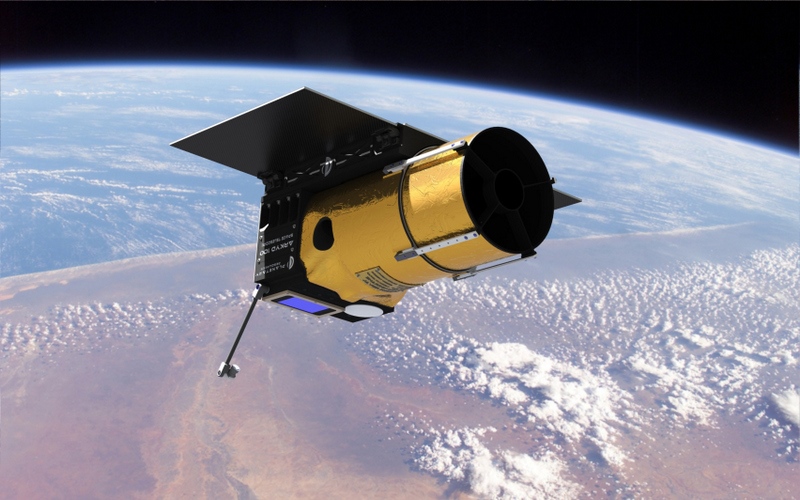
ARKYD-in-SpaceAnd as it happens, there have been recent developments on both fronts. On June 20th, less than a week ago, the Arkyd space telescope passed their goal of $1 million with its Kickstarter campaign. But perhaps to keep the money flowing, the company announced an ambitious aim to add extrasolar planet searching  to the list they can double that goal to $2 million.

And they’ve set some other fundraising milestones just to keep things interesting:

  • $1.3 million: A ground station at an undisclosed “educational partner” that would double the download speed of data from the orbiting observatory.
  • $1.5 million: This goal, just released yesterday, is aimed at the more than 20,000 people who signed up for “space selfies” incentive where uploaded pictures are photographed on the telescope while it is in orbit. For this goal, “beta selfies” will be taken while the telescope is in the integration phase of the build.
  • $1.7 million: The milestone will be announced if Arkyd reaches 15,000 backers. (It has more than 12,000 as of this

With five days remaining and a total of $1,189,359 now raised, they are not likely to break that ceiling. Still, the company’s plan to begin prospecting asteroids for the sake of future mining efforts now seems well within reach. Best of luck to them!

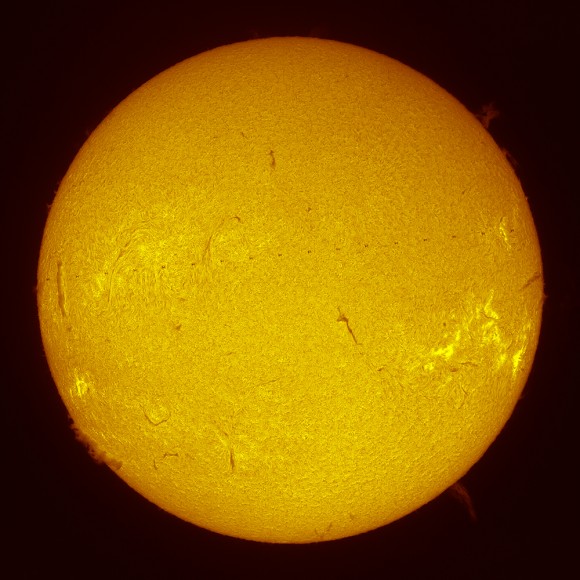
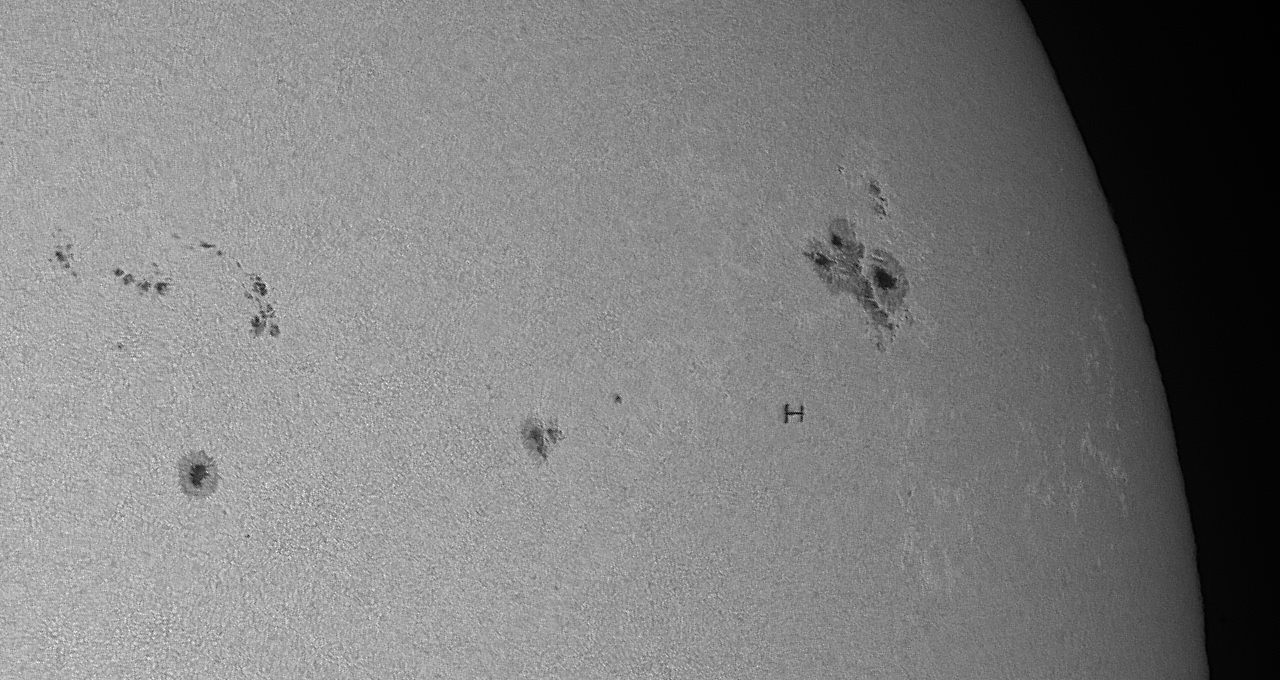
shenzhou10_tiangong1As for China’s Shenzhou 10, in an event that was captured on film, the space module is now docked with the Tiangong-1 space station and made a scenic transit in front of the sun. Astrophotographer Terry Legault had less than half a second to capture these incredible shots, but managed to get not one, but two shots in two consecutive days. Not an easy task to pull off, let alone twice!

If you look closely at the picture above, you can just make out Tiangong-1 station to the right of the sun, located below and to the left of a large cluster of sun spots. This top image is a crop of a full-face view of the Sun, taken with white light filters by Thierry from southern France on June 16, just after noon UTC. The transit duration was just 0.46 seconds, the distance of the spacecraft to observer was 365 km away, and the spacecraft was traveling at 7.4km/s (26,500 km/h or 16,500 mph).

shenzhou10_tiangong3This second imagine was taken the next day, again from the south of France, at 12:34:24 UTC on June 17, 2013. This one, in Hydrogen-alpha shows the Shenzhou-10/Tiangong-1 complex in multiple shots over the 0.46 second transit. Click on the photo to get the full resolution, then zoom in to see multiple shots of station as it made its transit across the face of the sun.

In a previous interview with Universe Today, Thierry explained how he prepares to take images like these:

For transits I have to calculate the place, and considering the width of the visibility path is usually between 5-10 kilometers, but I have to be close to the center of this path, because if I am at the edge, it is just like a solar eclipse where the transit is shorter and shorter. And the edge of visibility line of the transit lasts very short. So the precision of where I have to be is within one kilometer.”

Legault studies maps, and has a radio synchronized watch to know very accurately when the transit event will happen.

My camera has a continuous shuttering for 4 seconds, so I begin the sequence 2 seconds before the calculated time. I don’t look through the camera – I never see the space station when it appears, I am just looking at my watch!

Kudos to the man for once again capturing images of the heavens and sharing them with the world. And exciting times these are, when space exploration is once again booming and the frontiers of tomorrow are increasingly within our reach.

Sources: universetoday.com, (2), legault.perso.sfr.fr