
How did I miss this???

 The Science Fiction and Fantasy Writers of America have announced the nominees for the 2012 Nebula Awards, as well as the nominees for the Ray Bradbury Award for Outstanding Dramatic Presentation. Click here for the list.
How did I miss this???
The Science Fiction and Fantasy Writers of America have announced the nominees for the 2012 Nebula Awards, as well as the nominees for the Ray Bradbury Award for Outstanding Dramatic Presentation. Click here for the list.
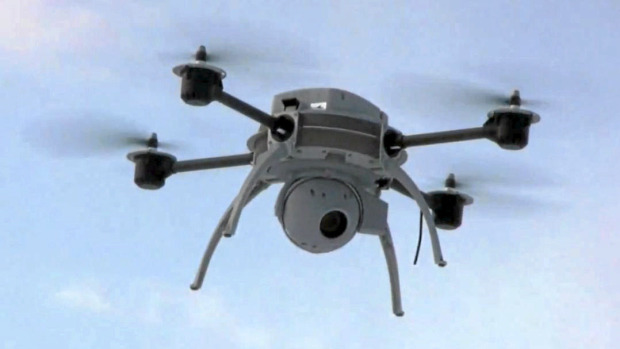
 In a decision which has been decried by countless community activists and civil rights leaders, the Alameda County Sheriff’s Department announced plans last month to deploy up to two small, lightweight drones to assist in police surveillance. Despite resistance from the community, the town seems poised to join many other cities in using UAV’s for domestic security, effectively steam-rolling over concerns over privacy and “Big Brother” government.
As it stands, several police agencies across the US are currently using drones, including the Miami-Dade Police Department and the Texas Department of Public Safety. Until recently, the Seattle Police Department also employed a two-drone fleet, but grounded them amidst growing concerns over privacy and a recent government report, which warned that drone use could become even more commonplace.
 Before anyone gets too worried, rest assured that the drones in question are a far cry from the UAV’s currently conducting armed missions overseas. Unlike the Predator and Reaper drones that carry multiple Hellfire missiles and can level entire villages, these drones are relatively benign, weighing only a few pounds and relying on a series of propellers to keep them aloft. But of course, the potential for harm resides in their ability to monitor, not to kill…
 Concerns over domestic drone surveillance reached a sort of climax last February after federal lawmakers signed the Modernization and Reform Act of 2012 into law. Among other things, the act required the Federal Aviation Administration (FAA) to accelerate drone flights in U.S. airspace. In response, the Government Accountability Office (GAO) warned that the act would allow drone use to become commonplace in the US.
In accordance with that law, drones, known in the report as “unmanned aerial systems,” are currently limited in the United States to law enforcement activities, search and rescue, forensic photography, monitoring or fighting forest fires, border security, weather research, scientific data collection and even hobbies. However, the law calls for expansion so drones can be used for commercial, utility and public uses.
 Naturally, the FAA feels that the new law doesn’t take into account several key problems – notably concerns surrounding privacy, security and even GPS jamming and spoofing. In short, they pointed out that despite drone’s on-board navigation and detection system that allow them to avoid crashes, said systems could cause complications if and when drones share airspace with private aircraft.
Among other things, the FAA recommended that drone GPS systems undergo encryption so they would be resistant to jamming and hacking, which is apparently a danger in non-military unencrypted drones. They also advised that the government set up secure operation centers for unmanned drones, and recommended that the government formulate privacy protections to head off potential “abuses”.
 Obviously, the FAA’s report and public concern struck a note. Just last month, federal lawmakers introduced legislation regulating state and federal government use of unmanned drones in the United States. This legislation prohibits drones from being armed, and would demand that agencies register drones and adopt privacy polices. What’s more, the proposal would allow drones to be used only in criminal matters, in which warrants would be required.
Once again, it appears that the Obama administration is willing to step in where public concerns over developing technology are concerned. Recall the instruction signed by Defense Secretary Ashton Carter back in December of last year designed to limit the development of autonomous aerial drones? Well here too, instructions have been given, but the general sense of worry is far from alleviated.
 It puts me in mind of a prediction Arthur C. Clarke made shortly before he died in 2008. He predicted that despite concerns over “Big Brother”-type monitoring, that digital surveillance would be adopted by every city within the civilized world, until such time that crime was virtually eliminated. Much like many predictions he made, this one proved a little optimistic and futurist for some of his fans (including this one!).
As it stands, the use of remote machines to monitor our world is an ongoing and growing concern, and the debate will hardly be decided so easily. In the end, we all just have to ask if we really want to live in a post-privacy state, what the costs of living in that kind of world will be, and whether or not it will truly mean the emergence of dystopian scenarios, as envisioned by George Orwell and others.
 Not exactly a wide range of choices is it? But that pretty much tells you what I think about this game doesn’t it? Freespace came along at a time when I was pretty much losing interest in flight simulators. Civilization II was growing stale, Unreal had yet to come out, and the Star Wars franchise was still busy producing Rebellion.
What’s more, Descent: Freespace and its sequel were two of the most awesomely conceived, inspired and original flight simulators I ever played. It presented some truly classic and hard science fiction, combined with just enough commercial appeal, and some genuinely fun fight and flight sequences to keep me entertained for months!
And it’s sequel was equally awesome, adding to the mix with more missions, more story, more ships, and more storyline. Like most gamers, my only disappointment came in the form of their not being a third and final chapter. Because of this, fans have taken it upon themselves of maintaining and enhancing the game engine until a third game does come out. But more on that later…
First up, Descent: Freespace, the game that started it all!
Descent: Freespace – The Great War:
 The game takes place in the distant future, where humanity has spread into the cosmos thanks to the discovery of subspace travel and formed the Galactic Terran Alliance (GTA). As the game opens, we learn that the GTA is at war with an alien species known as the Vasudans. The war is in its fourteenth year and you, a green pilot, have just joined the Galactic Terran Defense Forces (GTDF) and been assigned to the GTD (Galactic Terran Destroyer) Galatea.
The game also begins with an intro movie which prologues the story. In it, a Terran installation is destroyed by an unidentified alien force that jump into the Ross 128 system and obliterates everything in sight. Before your first mission, the subject of this “phantom attack” is addressed and dismissed, with Command claiming that the Vasudans were responsible.
 What follows is a series of missions against the Vasudan armada. However, this ends when a new type of ship arrives and begins attacking you and the Vasudans indiscriminately. After a series of such attacks, Command names this new threat the “Shivans” (after Shiva, the Hindu God of Destruction) and arranges a ceasefire with the Vasudan government. Henceforth, all efforts are dedicated to finding out what this new species is and where they come from.
The next few missions involve extensive intelligence gathering, as it is clear that the Shivans are immensely superior in terms of weaponry and technology. Not only are their ships shielded and virtually impervious to your weapons, their systems make them incredibly difficult to track. But after a series of recon and capture missions, Terran and Vasudan scientists begin to incorporate their technology into our own.
 Matters are also complicated somewhat when a new death cult emerges known as the Hammer of Light. Made up of Vasudans who believe that the Shivans are a race of holy destroyers foretold in prophecy, this group begins assisting the Shivans by attacking anyone who resists them. Henceforth, they too must be fended off while you and your Vasudan allies continue in your efforts to study the enemy. The next step in undertaking is the capture of the Shivan Destroyer Taranis.
After you and your squad disable it, the ship is towed back to Terran space, where a landing team goes in and gets first hand look at the Shivan species. They appear to be a race of large, quadruped creatures with a claw-like appendage that have weaponry embedded in their faces. However, no one can be sure if this is the actual species, some form of robotic avatar, or cybernetic war machines. In any case, the landing crew is killed very quickly.
 Shortly thereafter, a new ship appears, dubbed the Lucifer, which destroys the Taranis and the Terran station nearby. The ship begins to make appearances all along the front, destroying ships with its two giant beam emitters, and eventually destroys the Galatea. In time, the Lucifer makes its way to the Vasudan homeworld, lays waste to it, and appears to be headed for Earth next. All attempts to stop it fail, as the ship appears protected by impenetrable shields.
Throughout the game, monologues are told which begin to provide some deep back story to the game. After several cut scenes, it becomes clear that the narrator is a member of an extinct species known as the Ancients, which were wiped out by the Shivans millenia ago. This informs the player that the Shivans are very ancient themselves, foreshadows the destruction they will bring, and also hints at what the Shivans weakness is.
 The Vasudans stumble upon all this information when a group of refugees land on a world once inhabited by the Ancients. Within a vast alien archive, they discover the records which are shown in the cut scenes and discover that the Shivan’s shields do not work in subspace. After being reassigned to the GTD Bastion, a plan is mounted to track the Shivan vessel as it makes the jump for Earth and disable its jump engines while it is in transit.
A pitch battle takes place after you and your squad race to intercept the ship as it jumps, which is almost thwarted by the last-minute arrival of a Hammer of Light destroyer. You and yours barely make it into the node, pursue the Lucifer into subspace, and engage it and its fighter squads until you can take out its jump engines. The jump node then collapses and the Shivan vessel is destroyed.
The game then ends with a monologue by the main character, who explains that Earth is now cut off from the rest of space and safe for the time being. He also says that the Shivans, in being destroyers were actually preservers, in that they destroyed the Ancients who would otherwise have been too poweful to beat once humanity and the Vasudans encountered them. It is also said that the Shivans will be returning, though not within the narrators lifetime, a bit of knowledge which he describes as “bliss”.
Summary:
In case it wasn’t already obvious, I loved this game. In fact, I even consider it to be one of my biggest inspirations when it comes to writing science fiction. The gameplay was fun, realistic, and structured in such a way as to make it all engrossing and suspenseful. Add to that a sense of genuine realism, and you can see why this franchise became so popular. It was the kind of science fiction game that was made by hard sci-fi fans for hard sci-fi fans.
 Starting with the gameplay, the fighters and spacecraft are very much realistic, not looking at all like airplanes or ships. None of this aerodynamic crap or old-world paradigm stuff; all vessels looked like they were designed for space only. And the weapons and combat sequences are nothing short of cool! Not only do you shoot things up, you are required to take out ship’s subsystems using EMP’s, scan things using your close-range sensors, and even resupply and repair yourself with support ships. And the display is a very realistic looking HUD that is very well laid out and practical.
You also have a cool command interface with your ships, being able to order them in and out of the fight, to attack various targets, and/or cover you when you’re under fire. Ah, and those explosions… when you light up an enemy capitol ship, it not only blows up. It goes nova! Check it out below. Though it might seem a bit tried by modern standards, it was certainly groundbreaking for its time!

The aliens were also created with some genuine attention to detail, and avoided all the Star Trek-like mistakes which are so common to science fiction. For one, the aliens don’t speak English or have crazy names that are just strings of consonants. The language they speak is gibberish as far as we are concerned and requires a translation matrix. And with the exception of the name Vasudan, the aliens are given designations or equivalencies in English which approximate their meaning in alien languages.
For example, since the Vasudans live on a predominantly desert planet, they are all given names from ancient Egyptian culture. The Vasudans approve of this, as they are a culture that respects longevity, spiritualism, and ancient wisdom. The Shivans, consistently, are all named in accordance with mythological references to destroyers and hostile forces – i.e. Shivans, Lucifer, Sathanas, Cain, etc. They do not speak to us, since we have no basis for cultural exchange, or use their real names.
 And another realistic feature: even by game’s end, virtually nothing is known about the Shivans aside from that which is gleamed from their captured technology. And though hints are dropped as to their nature and history, no clear answers are even given. For example, its clear the Shivans have advanced subspace technologies and seem solely concerned with controlling nodes and destroying other sentients. At the same time, subspace is where they are most vulnerable. From this, we are led to believe that perhaps they are from another dimension, and are left wanting more…
 Oh yes, and another aspect of this game which I attracted me to it was the similarities it had with Babylon 5, my favorite show at the time and one of the best sci-fi series ever! One of the aspects of the back story to B5 was the war which takes place between humanity and the race known as the Mimbari. The war went very badly for humanity, due to the fact that the Mimbari were more advanced and Earth’s ships couldn’t lock on to them due to some kind of stealth technology.
All of these elements seemed to inform the concept of the Shivans. Not only are their weapons more powerful than yours – at least initially – their ships also possess shields are impossible to track until you gather the intel on how they work. So for the first few missions you see them, they appear as squiggling dots on your radar, are virtually immune to your gunfire, and cannot be tracked by missiles. Much like in the B5, you are told early on that a victory, any victory, is needed against the enemy to bolster morale.
Ultimately, people other than myself were left demanding more and got it almost right away. Not only was there an expansion that followed on the heels of this game, it was also followed by a much-anticipated and muchly awesome sequel (more on that later). On top of that, the game also featured a series of campaign missions that were user-designed and contributed, making Freespace one of the most fan-friendly simulators of all time.

That tradition has continued well into the franchise quasi-retirement, thanks to the creation of the Freespace 2 Source Code Project – a group of programmers currently maintaining and enhancing the game engine since 2002. This engine has been used for games based on Babylon 5 and the relaunched Battlestar Galactica franchise. So in addition to keeping this fan-favorite game alive, the F2SCP also helps other cult favorites come to life in space simulator form.
Stay tuned for more on the Descent: Freespace front, continuing with the aforementioned sequel!

Global mean temperatures have been rising in recent years, consistent with every projection provided by Climate Change specialists and planetary ecologists. However, it now seems as though the rate of increase is not as bad as it should have been, thanks to a series of small-to-moderate-sized volcanic eruptions that have spewed sunlight-blocking particles high into the atmosphere.
Between 2000 and 2010, the average atmospheric concentration of carbon dioxide rose more from about 370 parts per million to nearly 390. According to Ryan Neely III, an atmospheric scientist at the University of Colorado, Boulder, if that uptick were the only factor driving climate change, the average global temperature would have risen about 0.2°C. But a surge in the concentration of light-scattering particles in the stratosphere countered as much as 25% of that potential temperature increase.

In addition, Neely and his colleagues ran a series of simulations that indicated that human the human contribution of aerosols to the stratosphere – which would have had a counteractive effect to the carbon – was minimal between 2000 and 2010. William Randel, an atmospheric scientist at the National Center for Atmospheric Research in Boulder claimed that the pattern of stratospheric particulate variations during the past decade “shows the fingerprint of volcanoes, with the right episodes showing up at the right time.”
For some time now, researchers and ecologists have known that sulfur dioxide, a major biproduct of volcanic eruptions, has a global cooling effect. Once introduced into the upper atmosphere, this particulate matter blocks out solar radiation and prevents it from being absorbed by the Earth’s soil, water, and plant life. In fact, it was a massive series of eruptions which took place during the Cretaceous–Paleogene Era that is believed to be linked to the extinction of the dinosaurs.
 For many years, geoengineers have considered releasing sulfur dioxide into the upper atmosphere in order to slow down the process of Climate Change, a measure intended to give Earth’s scientists more time to develop alternative fuels and its people more time to get their act together. However, at this juncture it seems that the planet has obliged us and given us a bit of window, and completely unheeded.
It’s good to know that human agency alone does not determine the course this planet will take. At the same time however, one should not get too enthused and think this means we’re in for a big reprieve. Based on the most recent data, humanity still only has a few decades before the worst begins to happen and our world slowly becomes uninhabitable.
Source: sciencemag.org, Wired.com
 Good morning ladies and gentlemen, or evening depending on your time zone. As it stands, my cold endures, even after a whole week! I tell you, we need to learn how to weaponize little kids and use them in bio-warfare. No one will ever fire a bullet again because entire countries will be too busy nursing colds and flus to fight…
But I digress. One upside to this down time is that it has allowed me to catch up on some projects which have been sorely neglected of late. And one such project is my the anthology collection that my writing group and I are working on. After many months of recruiting and beating the bushes for more members, the authors and I decided to double up and take on some additional stories.
And I picked the story idea named “Arrivals”. Taking place in Part III of the anthology, Arrivals deals with the coming of the Second Wave of colonists, people who are at least a century more advanced than their First Wave brethren who left Earth some two hundred years beforehand. Naturally, there are some difficulties merging the new people in with the world, given that a great deal of time and space separates the two.
And what’s more, the new wave arrive telling stories of Earth, stories that aren’t exactly encouraging. It seems that amidst the Climate Change-fueled crises that was rocking the Solar System when the First Wave left, a new group of neo-fascists have taken power on Earth. A war was imminent between Earth and its Solar Colonies when they left, which is now believed to be underway.
Knowing that war is happening at home does not bode well for the colonists of Yuva, especially if the neo-fascists win and begin looking in Yuva’s direction. Anyhoo, here is the first sample of the story, an introduction for the story I intend to write. Enjoy!
* * *
Andrewartha Monitoring Station
New Darwin, Bonfils
He walked the length of the catwalk, his every step clanging loudly against the grating. Each one made the headache he was nursing that much worse, and every breath yielded the same taste of oxidized metals and machine lubricant. But it was better than the taste of grain alcohol that still lingered on his tongue.
All in all, it was a typical day for Strauss, tending to the machinery that kept an ear open on this half of the planet’s ecology after a night of hard drinking.
Rounding the corner and scraping his elbow against a pile of crates, he removed the Tab from his chest and checked the readout on it again. It took a second for the screen to power up, him having run down the cells last night listening to music and interfacing with his favorite virtual environments. After a few cups of hootch, he had been known to get a little too engaged in sensory simulations involving cowgirls and a little rolling in the hay.
And of course, he had been thoughtless, leaving it rather than sticking it in a window to draw some meager power from the sun, or attaching to the bulkhead to let it get a charge from an embedded circuit.
Luckily, the cells were in a forgiving mood and powered up. With the display now bright enough for him to read, he selected the message from PR central and gave it another read.
Anomalous readings reported on the following dates.
A series of numerics followed, indicating to the very second when the readings were recorded at Andrewartha based on Vogt Standard Time. The message continued thereafter:
Check comm array for possible malfunction. If specs green, consult relay nodule in 7-B for possible false readings.
Touching the screen with his finger, he drew a line through the first part of the message. The comm array was working just fine, according to his earlier diagnostic. Not that it mattered much, there was very little to report from this station at any given time. The most exciting readings they ever got where when the Bonfils Cluster emitted the high-pitched frequencies that seemed to accord to their mating cycle, right before they blew their stacks and sent embers every which way across the continent.
It was like clockwork too, given that the diurnal cycle had very little in the way of an effect this far south. In addition to being land-locked on this ball of rock, they were also tilt-locked, ensuring that the long nights and dim days barely ever got longer or brighter.
Which brought him to the second part of the message. Possible false readings… The implication being that the fault in the readings he’d sent was on his end. Assuming that the transmission hadn’t somehow garbled the data due to some solar interference or jamming, the techs back home could only assume that a glitch had to be the result of a defective scanner. Not until they ruled out all that would they be prepared to admit that maybe something was going on in the Bonfils plant community that they couldn’t account for. The arrogance of established minds!
Then again, he wasn’t too crazy about the idea of that being the case himself right now. Activity outside that was out of the ordinary could only mean something was up. Eerily, strangely, possibly dangerously up. There was so much they didn’t know about the Deveroza at this point, other than the fact that they could be most lethal when studied without the proper care. Any changes in their behavior could not be considered a good thing.
And until his year was complete at this outpost, he didn’t want anything to happen that would disrupt his schedule. Monotony by day, sound sleep at night, the occasional drunken release, and it would be over before he knew it. No, anything that altered his humdrum lifestyle and threatened to prolog his stay was surely less preferable than a mere technical glitch right now.
Strauss folded up his Tab up and placed it around the wrist of his uniform, knowing that he’d need at least one hand free for what he was about to do. And reaching the terminus of the hallway, he set his eyes on the pressure sealed door before him and took a deep breath. In order to keep the higher ups satisfied, he would once again need to conduct a little hazardous duty and do what he both hated and loved, which was to go outside.
Such was the nature of being confined inside a husk of metal like this one, forbidden to go outside for anything other than the most necessary of missions. He was sure someone back home ought to write a dissertation on it, how it conditioned a certain bipolar fixation among its attendants, making them both simultaneously claustrophobic and agoraphobic. Getting out was the only way to stave off insanity, but doing so required a level of daring and bravado that seemed borderline insane itself.
He would be sure to talk it over with some people in the Social Psych department when he returned home.
Detaching the mask from his belt and placing it on, he pulled the uniform’s hood segment over his head and waited for the seal to form. The goggles powered up next and indicated that he had a prefect pressure seal. Sighing happily, he spoke into his suit’s uplink.
“Andie, are you online?”
A moot question, as the station’s beta-level custodian was always online. Never farther away than a simple voice command.
“Of course, Marcellin. How may I assist you?”
“Need to go outside to reconnoiter,” he replied. “Can you open door 7-B for me?”
“Of course. One moment please.”
He heard a loud hiss coming from the door as inside, the pressure equalized with the station’s interior environment. On the status panel located next to the doorway, a light turned green, followed shortly thereafter by Andie’s chipper voice.
“You may step in when ready.” The door let out a loud thud, the seals opening only with serious force. “Be advised, the pressure change will be noticeable and is considered unfit for human exposure. Advise you have you suit done up in advance.”
“Already done,” he said with mild annoyance, and stepped inside. The door slid shut behind him, the hissing noise returning as the room changed its pressure once again. He got the strange feeling of wind blowing around him, the feeling of sudden cold as outside air filled the room and prepared him for what was to come. When it stopped abruptly, Strauss took another deep breath.
“Pressure equalized with external atmosphere. Have a nice day.”
The outer door opened. He set his boot onto the outer surface and stepped out…
It was like walking into some kind of surreal or psychedelic work of art. At this altitude, the sky was in a perennial state of twilight, never quite day or night, just different shades of dawn or dusk. And the embers against that sky, they made it look as though the entire horizon had been set ablaze. Strauss would get the oddest feeling sometimes, looking out at this sky. It was as if it were speaking to something deep inside him, a memory buried deep within his cellular memory.
His boots became magnetized the moment he began moving across the external surface, a precaution against getting blown away by the high winds that were so prevalent at this altitude. Each step was labored and slow as the magnets kept pace with his movements, anchoring his each step but releasing when he commanded his leg to move. All the while, he could feel the outside wind tugging on his getup and the tiny sparks flying by.
His goggles beeped at him, feeding climatological data directly into his sensory cortex. He could tell without needing to check any instruments that the ambient temperature was well below human comfort levels, that the air pressure was slightly lower than what the average human body was accustomed to, and that the concentrations of ember pollen were normal given recent activity. Everything seemed in the green, an appraisal which didn’t change when he finally reached the array.
He brushed at the main panel when he arrived, removing half an inch of dust and caked embers from the surface. Accessing it from the Tab now wrapped around his wrist, he punched in the command to open it. The panel made a loud clunk as the door slid free, revealing a large compartment filled with various electronics. Peering inside, he found the port he wanted and detached a small strand from his Tab, waiting for it to form into a coupling cable that could be patched in.
Activating his comm, he called on Andie again to assist.
“Andie, pal, you still with me?”
With the exception of a few clicks, his voice came through his sensory link, loud and clear:
“I am here, Marcellin. How may I assist you?”
“Prepare transmission for Planetary Research, care of Doctor Gordian.”
He connected the Tab’s cable into the port inside and waited for it to finish interfacing. It was also a second more before Andie was finished moving the transmission dish into position and connecting to the PR band at Zarmina. He chimed back when all was set.
“Transmission link established.”
“Good, now link up to my Tab. All data provided here is to be attached with the diagnostic performed on the main dish earlier. Merge both into an attachment and include it in the transmission. Ready?”
“Ready, Marcellin. Recording now and preparing all data. Do you wish to add a personal message?”
Turning to his cuff, he took a gander at the diagnostic readings coming through. He tapped at it a few times to enter in some parameters, selecting the readings that fell within the dates specified. Even unrefined, the diagnostic search seemed to be reporting nothing out of the ordinary. Day after day, week after week, month after month since he’d been here, the array reported a solid line of green functionality.
It was more than a little depressing to see the time which he had spent here summed up so succinctly. Had it really been that long?
“Gladly, Andie. Begin recording, audio only, please.” He cleared his throat and began speaking slowly and deliberately. “Doctor Gordian, this is Marcellin Strauss. Further to your transmission regarding anomalous readings, I have performed the requisite diagnostic checks and am pleased to announce that there are no technical glitches on this end. Both the signal dish and the scanning arrays are functioning well within established parameters. Whatever you noticed, it must be at your end, or due to something else entirely.”
He waited for a second for Andie to sense his intent and stop recording.
“Are you finished, Marcellin?” he asked.
“Yes, Andie. Send it now.”
“Right away.”
Detaching the cable from the inside, Strauss retracted it into his cuff and closed the panel shut. Within seconds, a new layer of sparkling dust was forming and he was already well on his way inside.
On his way back, his headache let up long enough for him to have a single lucid thought. What if the signals they were reading weren’t coming from the fields and field of Deverosa located inland? What if it were coming from somewhere else entirely, a transmitter or a beacon somewhere outside Bonfils? That would certainly explain the duration and intensity of the signals the scanners had picked up. Short and focused, like nothing the flora ever put out.
He paused at the airlock and considered it a second longer. As much as he hated the prospect of making any additional work for himself, he couldn’t deny that the thought was proving quite intriguing. Already it was burning through his hangover and threatening to bring something akin to clarity to his mind.
“Andie, are you there?”
“I am,” the computerized voice said. “Are you wanting to come back in?”
“Uh, yes, Andie. Please open the door. But while you’re doing that, can you access those readings specified in the original message from Gordian? I want to run some tests on those.”
“Certainly. What would you like me to look for?”
He thought that one over for a second as the door opened to admit him and he stepped inside. As Andie cycled the air and conducted decontamination procedures, he did his best to remember all the elementary lessons he had received back in primary. At some point in his youth, he had heard how the Flotilla had used a free-space optical communication system when they first made to the trip from Sol. Such methods were not used since planetfall, but if it someone were out there trying to make contact…
It was a long shot. But if correct, it would certainly payoff, maybe even get him a transfer sooner than expected.
“Structure,” he said finally. “Isolate the readings and assume they represent an optical transmission. I think someone out there might be trying to talk to us down here.”
 Fans of The Big Bang Theory, or anyone who has lived in Canada for the last 20 years, ought to be instantly familiar with the Barenaked Ladies. However, what is not common knowledge is that Chris Hadfield, an astronaut aboard the International Space Station, is himself Canadian and apparently, quite the musician! Not only can he sing, he can play the guitar in zero-gravity and even execute some sweet moves. Quite the ensemble!
And in this rare treat, which took place back in February, Hadfield, the Barenaked Ladies, and the Wexford Gleeks children’s choir all collaborated to create the world’s first space-to-earth musical collaboration. The song they sang was an original creation, entitled “I.S.S. (Is Somebody Singing)”, which was commissioned by CBCMusic.ca and The Coalition for Music Education with the Canadian Space Agency to celebrate music education in schools across Canada.
So if you have a few minutes, I recommend you cue up this video, turn the volume up, and enjoy a truly heartwarming and breathtaking song that celebrates Canada, music, planet Earth, and the wonder of looking down at it all from space. It’ll give you goose bumps, I swear!

It’s come to this, my fellow Revengers! We know where the answers to the Tyrene Code lies, even though we appear to be missing a key piece. After assembling the other paintings that make up the Tyrene collection and speaking to my source, we have come up with some theories regarding what’s this might all be about. Although things remains highly speculative at this point, we believe Tyrene came into contact with some kind of advanced or even alien tech in the past.
But regardless of what it is, it seems clear at this point that the international man of mystery known as Michael Tyrene drew great power from it. Given that, it’s little wonder then why this person known as “The Alchemist” wants to get their hands on it. No doubt they are assuming that if it gave one man extraordinary powers, it could another. And I’m thinking he’s not the only one.
Which means we need to do something about it. Since we have a location of where it is being kept, I’d say the only thing we can do now is move in and take it out. As we all know, super human abilities are not something to be treated lightly. And though there are those who might call us hypocrites for denying them to others, I think we can all agree, they are some things mankind wasn’t meant to possess!
Join me now in planning our assault on the Storehouse. Be advised, this won’t be an easy mission. As a CIA facility, it will be guarded, and I’ve already received some intel from our colleague Dark Angel that our meeting with my NSA source was being monitored. I think we can expect multiple challenges as we move to hit this place. So stealth and tact will be needed, until it’s not!
So… who’s in?
 It’s known as Mind-Machine-Interface, the ability to interface and control machines using only your mind. And thanks to a number of dedicated researchers in various fields, it’s no longer the stuff of science fiction. With mind-controlled prosthetics, bionic limbs, and the growing field of machine-enabled telepathy, the day may soon come when people can interface, access and control machinery with just a few thoughts.
But of course, that raises all kinds of concerns about invasive procedures, whether surgery will be needed in order to implant devices into the human brain that can translate brainwaves into commands. Alternately, where non-invasive means are involved, it can take some time to calibrate the machinery to respond to the user’s nerve impulses. As those awful infomercials say, “there has be a better way!”
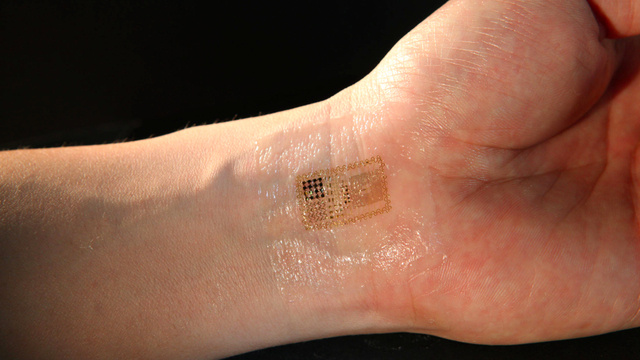
 As it turns out, electrical engineer Todd Coleman and his team at the University of California at San Diego has been working on a way to use wireless flexible electronics that one can apply on the forehead just like temporary tattoos. Building on the emerging field of biomedical electronics, these tattoos will be able to read brainwaves and allow a person to control electronic devices without the need for surgery or permanent implants.
The devices are less than 100 microns thick, the average diameter of a human hair, and consist of circuitry embedded in a layer or rubbery polyester that allow them to stretch, bend and wrinkle. The devices can detect electrical signals linked with brain waves and incorporate solar cells for power and antennas that allow them to communicate wirelessly or receive energy.
 Of course, other elements can be added as well, like thermal sensors to monitor skin temperature and light detectors to analyze blood oxygen levels, making it both a health monitoring patch and a fully-integrated control device. Combined with health patches that are being developed for use internally, an entire health network can be created that allows for every aspect of a patients health to monitored in real-time, anticipating and predicting health problems before they flare up.
Currently, Coleman and his colleagues are pursuing the application of using these patches to monitor premature babies to detect the onset of seizures that can lead to epilepsy or brain development problems. The devices are also being commercialized for use as consumer, digital health, and medical device. But the potential for their use is staggering, even alarming.
 For example, these devices can also be put on other parts of the body, such as the throat. When people think about talking, their throat muscles move even if they do not speak, a phenomenon known as subvocalization. Electronic tattoos placed on the throat could therefore behave as subvocal microphones through which people could communicate silently and wirelessly to each other.
However, a more alarming application is in the industrial and defense field, which is being pursued by the startup MC10 in Cambridge, Mass. In the course of their research, Coleman and his colleagues found that individuals who were hooked up to a computer through large caps studded with electrodes were able to remotely control airplanes and a UAV over cornfields in Illinois. Such is not possible with these tattoos at present, but Coleman admits that he and his colleagues are “working on it”.
 But even more alarming than this is the long term implications of what this could mean for us as a species, which is that electronics could one-day enable wireless peer-to-peer brain communication – aka. machine-enabled telepathy. With devices that can read and transmit brainwaves and vocal information, it would no longer be necessary for people to use radios, phones, email, or any other means of communication to talk to one another.
Simply tune in, subvocalize or think what you want to convey – and boom! instant messaging and perfected! Lord knows the art of diplomacy might suffer, and we can forget about sarcasm, tact, or shades of meaning. Society may very well breakdown or people will just have to grow thicker skin as everyone is forced to communicate what they really think to each other!
Source: txchnologist.com
 In 1989, two scientific researchers – Martin Fleischmann and Stanley Pons – announced the achievement of cold fusion. In a press release that garnered massive amounts of publicity, they stating that their experiment, involving a electrified palladium rod placed in a solution of heavy water, had succeeded in absorbing hydrogen and compressing it within the rod to the point that individual atoms began to fuse and helium was formed.
Naturally, other labs began to test their method and found that the same did not happen for them. With time, the experiment was revealed to be the result of a false positive as more and more labs claimed they unable to replicate the results. In the end, their announcement appeared premature and their claims unscientific. Still, the men never retracted their claim and moved their labs overseas.
 And interestingly enough, the declaration that they had achieved the dream of clean, abundant, cheap energy fueled the public’s imagination. Henceforth, the concept of cold fusion, as they had preached it, was featured in numerous movies and stories, even though it was now believed to be something of a pipe dream. And for some, the idea of the technology never died. Cold fusion remained a scientific dream similar to a Grand Unifying Theory or the elusive Higgs Boson.
One such organization is NASA, who continues work on this science through the development of their low-energy nuclear reaction (LENR) technology. It is their hope that one day the technology will be sophisticated enough to become commercially viable, making cold fusion reactors that could power everything – from homes, to cars, to planes – a reality.
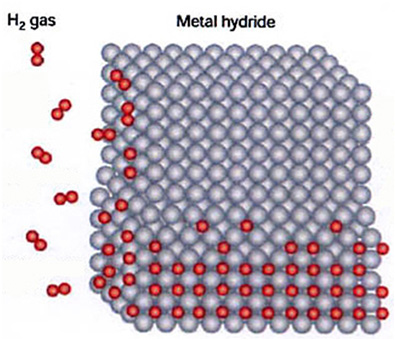 And unlike previous attempts that sought to harness basic fusion, the technology behind the LENR is really quite revolutionary. Rather than rely on strong nuclear forces to meld atoms and produce energy, LENR harnesses the power of weak nuclear force.
This is done by using an oscillating nickel lattice that takes in hydrogen atoms and then exchanges electrons with them. This has the effect of forming slow-moving neutrons which are absorbed, making the nickel unstable. To regain its stability, the nickel strips a neutron of its electron so that it becomes a proton — a reaction that turns the nickel into copper and creates a lot of energy in the process.
The big upside to this process is the fact that it produces zero ionizing radiation and zero radioactive waste, making it the safest and cleanest nuclear process to date. In addition, NASA claims that relying on reactors like these, it would only take 1% of the world’s nickle production to meet the world’s current energy needs, and at a quarter of the cost of dirtier fuels like coal. On top of that, they’ve also indicated that the same process can be done using a carbon lattice instead of nickel, making it even more versatile.
 So the question remains, why isn’t every household running on a LENR reactor already? Well, two problems. For one, the amount of energy needed to get the ball rolling is quite high. Initially, the LENR requires a 5-30THz frequency burst of energy to make the nickel lattice begin oscillating, which is difficult to efficiently produce.
Second, other labs have experienced a few… uh, accidents… trying to reproduce the process, which included a few explosions and some melted windows. No deaths were reported, mind you, but it does demonstrate that the process can generate a LOT of power if not properly controlled.
Still, other means of generating electricity, such as nuclear fission, have experienced some bumps along the way (i.e. Chernobyl and Three Mile Island) and we still rely on them. And oil and coal are what we’ve come to think of as “dirty means” of generating power, meaning they cause tremendous amounts of pollution or can lead to environmental debacles, such as oil spills. And natural gas can only last so long. So realistically, there may be hope for LENR and cold fusion yet.
Fingers so very crossed! And be sure to check out NASA’s video explaining the process:
Source: Extremetech.com
 Okay, that title might be a bit of a mislead, but after years of developing the technology, it seems that we might have something which is essentially the next best thing. Until recently, 3D printers were designed for use exclusively by trained technicians. And despite the ease with which modern 3D printers can be used, it is still difficult to design and prep the requisite models, which still requires expertise in modelling software.
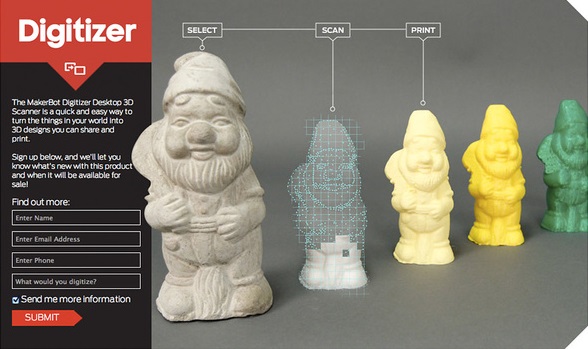
But that too could be changing, thanks to the new MakerBot’s Digitizer Desktop 3D Scanner. Designed to supplement their printer (the Replicator 2) this device is capable of scanning any object, creating a three-dimensional model, and then uploading it to your printer where it will then be molded into solid form, bit by bit. In effect, people can now create objects as easily as they could print off an inkjet document.
 The Digitizer was revealed for the first time at the South by South West (SXSW) Conference in Austin, Texas earlier today, where emerging technologies are being showcased alongside the latest in entertainment and music. And while the device was merely a prototype, one which is still undergoing testing and refining, MakerBot announced that they plan to begin commercial production very soon.
Which makes it official. Human beings now have access to Replicator technology and is one step closer to living in a Star Trek universe! Granted, were not quite to the point where we can generate anything, including food and precious metals, but this latest development has revealed to us a future where DIY can encompass just about anything. If a an appliance breaks in your home, just scan the faulty component and download it into your printer. No need to contact the manufacturer and activate that troublesome warranty!

Naturally, there are concerns about the controversy this will create as well. While the Digitizer Desktop 3D Scanner will certainly be another big step towards making 3D printing more accessible, it’s also sure to add fuel the debate over the legality and copyright issues of duplicating real world objects. What’s more, the cost of each unit (most likely a few thousand dollars each) is pretty prohibitive for most households, raising the question of real access.
Nevertheless, this is still pretty exciting news. Since the beginning of recorded history, our collective economic models have been based on the idea of resource scarcity. But with further refinements and the ability to generate objects out of more materials (including the organic), all our economic models are likely to change and we could very well be embarking on a future where scarcity has effectively become obsolete.
Yes, with a little more time, research and cool gadgets, we could be witnessing the collapse of financial history. Where all units of value will be made useless and as a species, we’ll be one step closer to economic equilibrium! And I have to admit, this is one area of change that I find exciting, as opposed to scary!
Source: Gizmodo.com
 Stories by Williams