
 A friend and mentor once told me that you shouldn’t be too worried about people stealing your ideas. To paraphrase what he said, you’ll have thousands of ideas, and no one can steal your work unless you’re careless. Those words rung true to me, mainly because I have far too many ideas, and not nearly enough of them are developed. Case in point, I’ve got four projects in the works, and none of them are near to completion.
And yet, I find myself once again adding an idea to the mix. It came to me over the course of the last few months while working for Universe Today and trying to refine my ideas on science fiction. Basically, I have been thinking for some time that any piece written by me should focus on the paradoxical issues of Climate Change and technological change, and how these will play out to shape our near, not-too-distant, and distant future.
And then an idea started forming. I would have filed it in the “not now, maybe later” column, but I think it might be something that could really work. And given the way I’ve been bugging people constantly over the past few months with it, asking their opinions, soliciting thoughts on the first few chapters, I clearly have become emotionally invested in it. So I thought perhaps it was time to commit to it, as I always do, by sharing the idea, and thus ensuring that there’s a record of it somewhere so no one can steal it! 😉
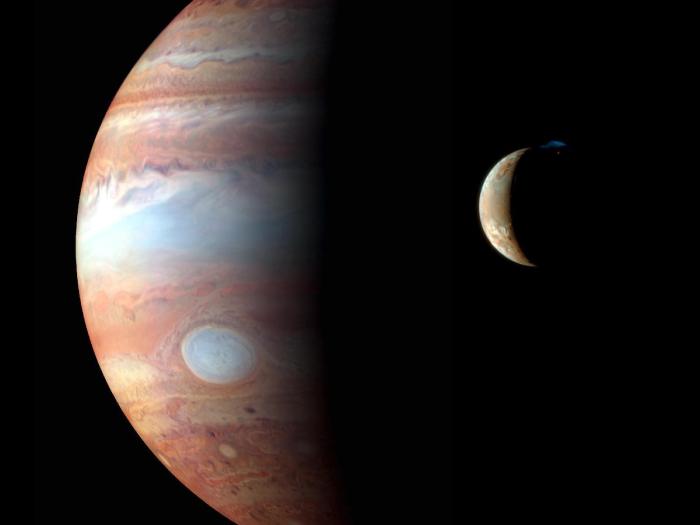
The Cronian Incident:
It is the late 22nd century, and humanity has grown to colonize almost every corner of the Solar System. Earth is now recovering from the worst aspects of “The Anthropocene”. Temperatures are dropping, species extinctions have stopped and are being reversed, and the population is stable, with over 13 billion people living in its cities, arcologies, and orbital habs. Over 1 million people live on the Moon, in cities built in lava tubes beneath the surface.
Mars and Venus are also home to humanity. On Mars, the Martian people live in domes that crisscross the surface, a Space Elevator brings people to and from the planet, and a constant flow of shipping to and from the Asteroid Belt and Solar System keeps the place busy. On Venus, the Cythereans live in cities that float atop the planet’s extremely dense atmosphere, harnessing carbon from the clouds to create graphene and diamond-based materials.
On all these worlds, humanity exists as a series of factions that know no national boundaries, and are collectively referred to as “Extros” – short for Extoprian. Thanks to over a century of runaway technological progress, diseases and disabilities have been eliminated, implants and embedded machinery allow for constant connectivity to the Nexus (future version of the Internet), and all vestiges of life are assisted by sentient programs and algorithms of various complexity.
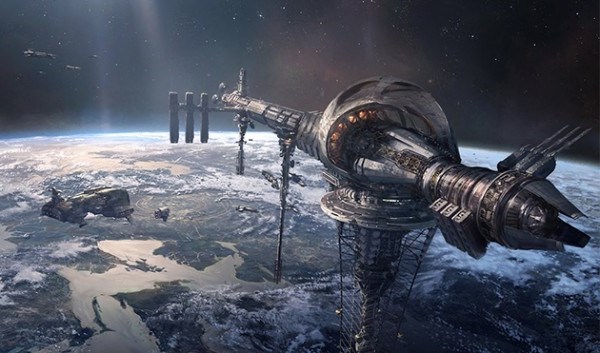
Meanwhile, the Outer Solar System hosts an entirely different mix of people. On the moons of Jupiter (the Jovians), Saturn (the Cronians), and Uranus (the Uranians), people enjoy a simpler existence. While they have access to plenty of advanced technology, many types of nanotech, biotech, and embeddadles are eschewed in favor of organic living, portable machines, and non-sentient computing.
Despite the fact that the Jovians, Cronians and Uranians are made up of countless peoples and factions, collectively, they are often referred to as “Retros” – a pejorative used to refer to their regressive lifestyle. But whether it is for religious reasons, personal reasons, or because they fear that Earth and the Inner Colonies have become consumed by runaway change and progress, the people who call these moons home prefer to maintain a balance.
Whereas these colonies were established in the latter half of the 21st century to ensure that humanity would have backup locations in case Earth died one day, by the 22nd century, they became dedicated to the preservation of something else. In this day in age, it is no longer about ensuring humanity’s physical survival, but rather preserving its spirit or a certain way of life.
 The Plot:
Enter into this universe Jeremiah Ward, a disgraced former-detective who developed a drug problem as a result of his stressful work and the pace of life in the Inner Colonies. After an incident where two witnesses were murdered – which was attributed to negligence on his part – he is given a hefty prison sentence, which he decided to serve out in a penal colony on Mercury.
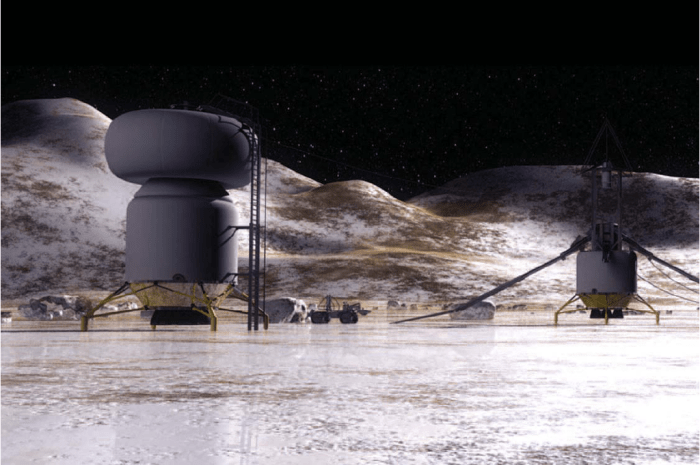
On this planet, where the day-side is hellish and unlivable, and the night-side is freezing and unlivable, mining crews live in the northern crater known as Prokofiev. Given the planet’s slow rotation (which takes 58 days to rotate once on its axis), mining crews go out to the night-side, spend days harvesting ore, and then transport it back to Prokofiev, where it then processed and fired off into space.
After a few years of this miserable existence, Ward is approached by a faction from Mars. Known as the Formists, this well-connected and powerful faction has a very strong standing on Mars. And they have a problem. One of their prospectors, who was traveling to the Outer Colonies to investigate their resource extraction operations, has gone missing. Worse yet, this prospector apparently had “sensitive materials” on his person that the Formists don’t want falling into the wrong hands.

These materials, they claim, detail a plan to convert Mars into a livable environment over the next few generations. Consistent with the Formists long term plan to terraform Mars into a new Earth, they are hoping to expand their contracts with the Outer Colonies for the vast amounts of resources they will need to do so. If these plans are made public, they worry that one of the rival factions – the Dysonists, the Habitationists, Settlers or Seedlings – will try to take advantage.
In exchange for finding their colleague and obtaining this information, Ward will have his sentence reduced to time served. He is told that his experience as an investigator makes him well-suited to the task, as well as the contacts he made in the Outer Colonies during his many years of service. But of course, he knows the real reason why he was selected: as a convict, he will be well-motivated to get the job done, and will be less likely to ask questions.
His journey takes him from Mars, to Jupiter’s moons of Ganymede and Callisto, and eventually to Titan – Saturn’s largest moon and the last stop of the prospector before he disappeared. When he finally comes to the end of his investigation, what he finds is far more than he bargained for. Rather than simply being a case of kidnapping or a hate-crime perpetrated by angry Retros, the prospector’s disappearance is part of a conspiracy that goes right to the heart of the Formist’s agenda.
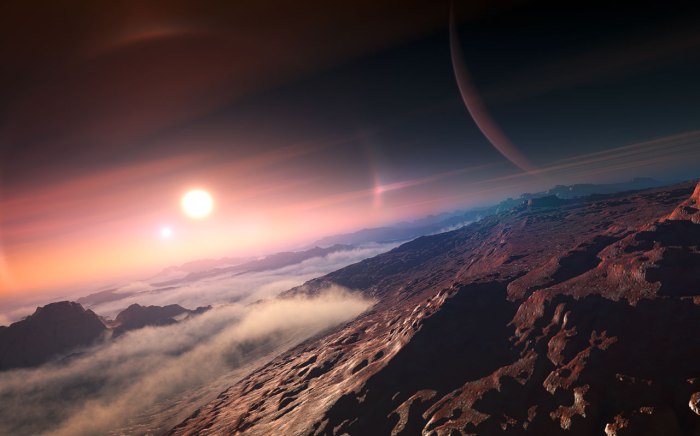
More than that, it goes right to the heart of an ongoing struggle, one which humanity has been preoccupied with for over a century. For in the end, the issue of humanity’s long-term survival has not been settled. And the solution to this problem just might mean sacrificing the few to save the many. In the end, Ward will be faced with a terrible decision: expose the agenda and spend the rest of his life on the run, or complete his mission and let things fall where they may?
***Of course, I can’t say what the big “conspiracy” is, for that would be spoilers galore! But suffice it to say, I have that worked out and its where the story gets particularly detailed, and brings up a lot of the intricacies of terraforming and space colonization.***
So that’s the idea. How does it sound? I’m five chapters in and quite hopeful that it will turn out to be something “magnum opus-y”.
 Desertification is one of the biggest threats associated with Climate Change. In places like North Africa and the Middle East, where countries already import up to 90% of their food, the spread of the desert due to increasing temperatures and diminished rainfall is made worse by the fact that cities in the region continue to grow. It’s a situation that is getting more expensive and energy-intensive at a time when things need to be getting more cost-effective and sustainable.
 Conceived by Forward Thinking Architecture, a Barcelona-based firm, the concept seeks to combine flexibility with a minimal carbon footprint. Towards this end, they chose to forgo usual transportation and create a unique conveyor system that would deliver produce without the use of any fossil fuels. The conveyor belt would be underground so it could keep running in a straight line even if buildings were in the way.
 Ideally, desert populations would be small enough that the region’s sparse rainfall could support local crops. But that’s not the reality. In addition, a small part of the recycled water would also be used to create an outdoor garden for education. As architect Javier Ponce, principal and founder of Forward Thinking Architecture, explained:
 These regions in particular have felt the pressure brought on by the escalating price of importing food. This pressure is exacerbated due to the disappearance of peak oil, which accounted for the vast majority of this region’s wealth. However, the project has farther-reaching implications, as Climate Change threatens to turn much of the world’s arable land into dry, drought-ridden plains.
 One of the greatest challenges facing future urban planning is the very real prospect of running out of land. In addition to urban sprawl encroaching on neighboring farmlands, the concentration of people at the core eventually creates a situation where open spaces become incredibly scarce. Luckily, the city of London – one of the largest and most densely populated cities in the world – is coming up with some innovative solutions.
 Experts from the Netherlands are helping to plan the new “floating village,” which will include 50 floating homes around a neighborhood square that comes complete with floating restaurants, offices, and shops, and possibly a floating swimming pool (more on that below). A floating walkway will lead back to land, where the city plans a much larger development with tens of thousands of new homes.
 As Richard Blakeway, the city’s deputy mayor for housing, land and property
 The Thames Baths Project is similar, aiming to create a freshwater lagoon amid the meandering old waterway. The consortium responsible consists of Studio Octopi, Civic Engineers and Jonathan Cook Landscape Architects, all of whom won the competition last year to come up with new river uses. Initially, they hoped to create a pool using water from the Thames that would be filtered and treated.










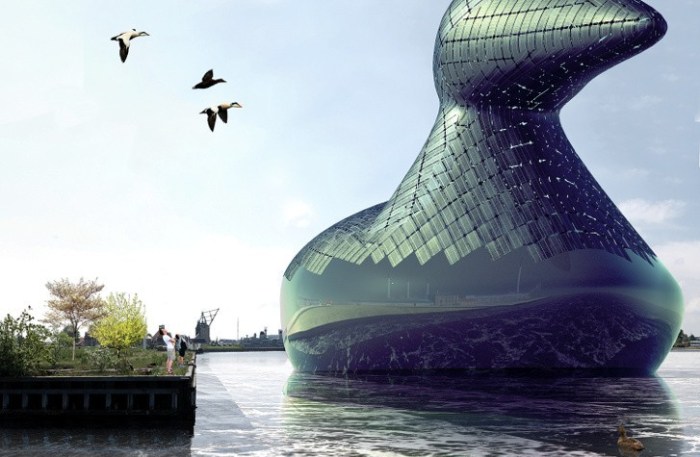 Inspired by the arctic eider duck, Energy Duck not only hopes to offer a unique renewable energy source, but also highlight the impact that climate change has had on the local population and breeding habitats of the eider duck in recent years. As its creators – Hareth Pochee, Adam Khan, Louis Leger and Patrick Fryer – explained:
 All of this helps the Energy Duck overcome the all-important issue of intermittency. By being able to generate energy around the clock, the Duck is not dependent on the sun shining in order to continue operating and providing power. As the team explained: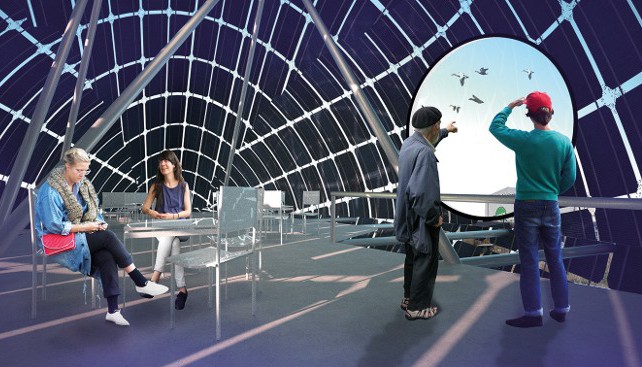


 Stories by Williams