Timeline of the Future…

hyperspace4I love to study this thing we call “the future”, and began to do so as a hobby the day I made the decision to become a sci-fi writer. And if there’s anything I’ve learned, its that the future is an intangible thing, a slippery beast we try to catch by the tail at any given moment that is constantly receding before us. And when predict it, we are saying more about the time in which we are living than anything that has yet to occur.

As William Gibson famously said: “…science fiction was always about the period in which it was written.” At every juncture in our history, what we perceive as being the future changes based on what’s going on at the time. And always, people love to bring up what has been predicted in the past and either fault or reward the authors for either “getting it right” or missing the mark.

BrightFutureThis would probably leave many people wondering what the point of it all is. Why not just wait and let the future tend to itself? Because it’s fun, that’s why! And as a science fiction writer, its an indispensable exercise. Hell, I’d argue its absolutely essential to society as a whole. As a friend of one once said, “science fiction is more of a vehicle than a genre.” The point is to make observations about society, life, history, and the rest.

And sometimes, just sometimes, predictive writers get it right. And lately, I’ve been inspired by sources like Future Timeline to take a look at the kinds of predictions I began making when I started writing and revising them. Not only have times changed and forced me to revise my own predictions, but my research into what makes humanity tick and what we’re up to has come a long way.

So here’s my own prediction tree, looking at the next few centuries and whats likely to happen…

21st Century:

2013-2050:

  • Ongoing recession in world economy, the United States ceases to be the greatest economic power
  • China, India, Russia and Brazil boast highest rates of growth despite continued rates of poverty
  • Oil prices spike due to disappearance of peak oil and costs of extracting tar sands
  • Solar power, wind, tidal power growing in use, slowly replacing fossil fuel and coal
  • First arcologies finished in China, Japan, Russia, India and the United States

arcology_lillypad

  • Humanity begins colonizing the Moon and mounts manned mission to Mars
  • Settlements constructed using native soil and 3D printing/sintering technology
  • NASA tows asteroid to near Earth and begins studies, leading to plans for asteroid mining
  • Population grows to 9 billion, with over 6 living in major cities across the all five continents
  • Climate Change leading to extensive drought and famine, as well as coastal storms, flooding and fires
  • Cybernetics, nanotech and biotech leading to the elimination of disabilities
  • 3D Construction and Computer-Assisted Design create inexpensive housing in developing world
europa_report

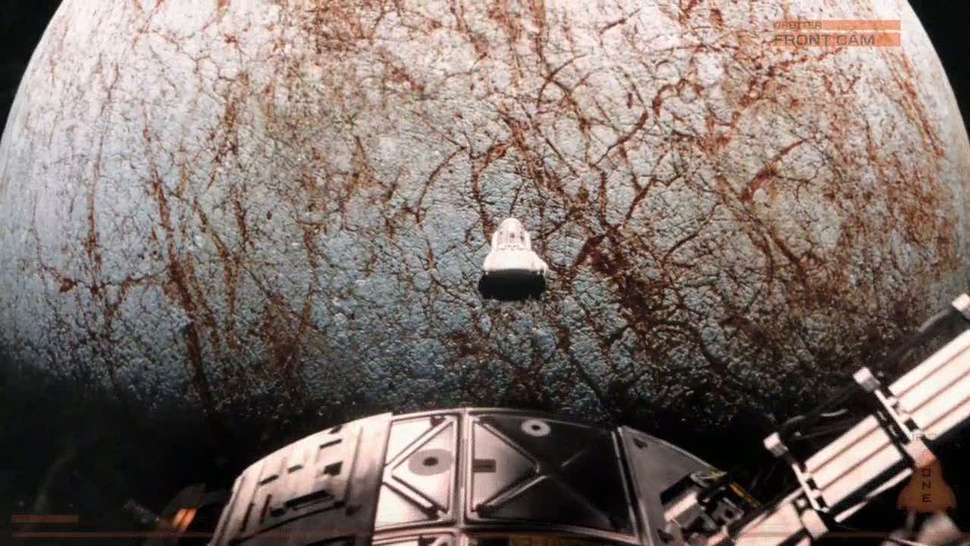
  • First exploratory mission to Europa mounted, discovers proof of basic life forms under the surface ice
  • Rome ordains first openly homosexual priests, an extremely controversial move that splits the church
  • First semi-sentient, Turing compatible AI’s are produced and put into service
  • Thin, transparent, flexible medical patches leading to age of “digital medicine”
  • Religious orders formed opposed to “augmentation”, “transhumanism” and androids
  • First true quantum computers roll off the assembly line

quantum-teleportation-star-trails-canary-islands-1-640x353

  • Creation of the worldwide quantum internet underway
  • Quantum cryptography leads to increased security, spamming and hacking begins to drop
  • Flexible, transparent smartphones, PDAs and tablets become the norm
  • Fully immersive VR environments now available for recreational, commercial and educational use
  • Carbon dioxide in the upper atmosphere passes 600 ppm, efforts to curb emissions are redoubled
  • ISS is retired, replaced by multiple space stations servicing space shuttles and commercial firms
  • World’s first orbital colony created with a population of 400 people

2050-2100:

  • Global economy enters “Second Renaissance” as AI, nanomachinery, quantum computing, and clean energy lead to explosion in construction and development
  • Commercial space travel become a major growth industry with regular trips to the Moon
  • Implant technology removes the need for digital devices, technology now embeddable
  • Medical implants leading to elimination of neurological disorders and injuries
  • Synthetic food becoming the rage, 3D printers offering balanced nutrition with sustainability

3dfood2

  • Canada, Russia, Argentina, and Brazil become leading exporters of foodstuffs, fresh water and natural gas
  • Colonies on the Moon and Mars expand, new settlement missions plotted to Ganymede, Europa, Oberon and Titan
  • Quantum internet expanding into space with quantum satellites, allowing off-world connectivity to worldwide web
  • Self-sufficient buildings with water recycling, carbon capture and clean energy becomes the norm in all major cities
  • Second and third generation “Martians” and “Loonies” are born, giving rise to colonial identity

asteroid_foundry

  • Asteroid Belt becomes greatest source of minerals, robotic foundries use sintering to create manufactured products
  • Europe experiences record number of cold winters due to disruption of the Gulf Stream
  • Missions mounted to extra-Solar systems using telexploration probes and space penetrators
  • Average life expectancy now exceeds 100, healthy children expected to live to 120 years of age
  • NASA, ESA, CNSA, RFSA, and ISRO begin mounting missions to exoplanets using robot ships and antimatter engines
  • Private missions to exoplanets with cryogenically frozen volunteers and crowdfunded spaceships

daedalus_starship_630px

  • Severe refugee crises take place in South America, Southern Europe and South-East Asia
  • Militarized borders and sea lanes trigger multiple humanitarian crises
  • India and Pakistan go to war over Indus River as food shortages mount
  • China clamps down on separatists in western provinces of Xinjian and Tibet to protect source of the Yangtze and Yellow River
  • Biotechnology begins to grow, firms using bacteria to assemble structural materials

geminoid

  • Fully sentient AIs created and integrated into all aspects of life
  • Traditionalist communities form, people seeking to disconnect from modern world and eschew enhancement
  • Digital constructs become available, making neurological downloads available
  • Nanotech research leading to machinery and materials assembled at the atomic level
  • Traditional classrooms giving way to “virtual classrooms”, on-demand education by AI instructors
  • Medical science, augmentation, pharmaceuticals and uploads lead to the first generation of human “Immortals”
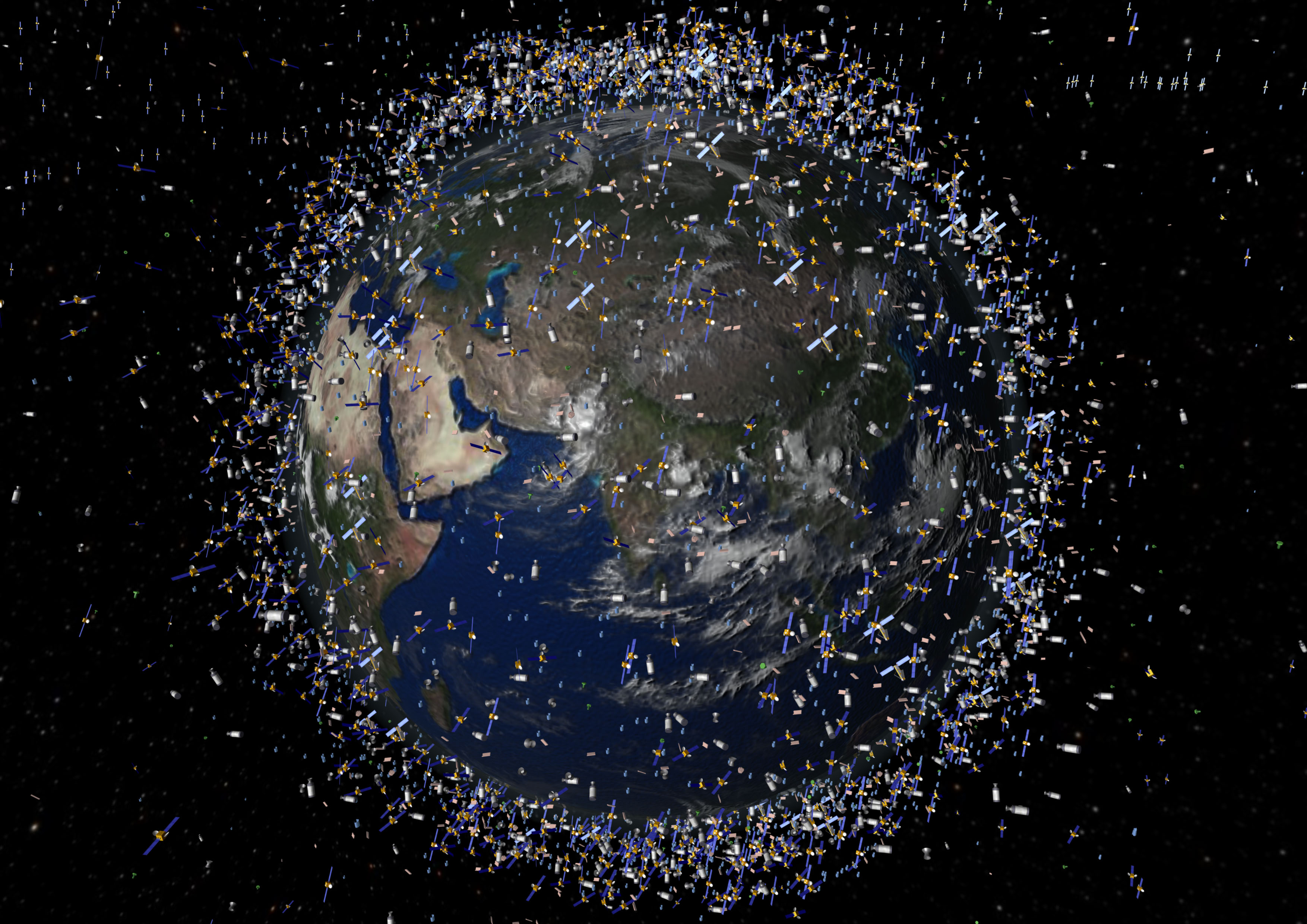
space_debris

  • Orbital colonies gives way to Orbital Nexus, with hundreds of habitats being established
  • Global population surpasses 12 billion despite widespread famine and displacement
  • Solar, wind, tidal, and fusion power replace oil and coal as the dominant power source worldwide
  • Census data shows half of world residents now have implants or augmentation of some kind
  • Research into the Alcubierre Drive begins to bear experimental results

alcubierre-warp-drive-overview22nd Century:

2100-2150:

  • Climate Change and global population begin to level off
  • First “Neural Collective” created, volunteers upload their thought patterns into matrix with others
  • Transhumanism becomes established religion, espousing the concept of transcendence
  • Widespread use of implants and augmentation leads to creation of new underclass called “organics”
  • Solar power industry in the Middle East and North Africa leading to growth in local economies
  • Biotech leads to growth of “glucose economy”, South American and Sub-Saharan economies leading in manufacture of biomaterials
  • Population in Solar Colonies and Orbital Nexus reaches 100,000 and continues to grow
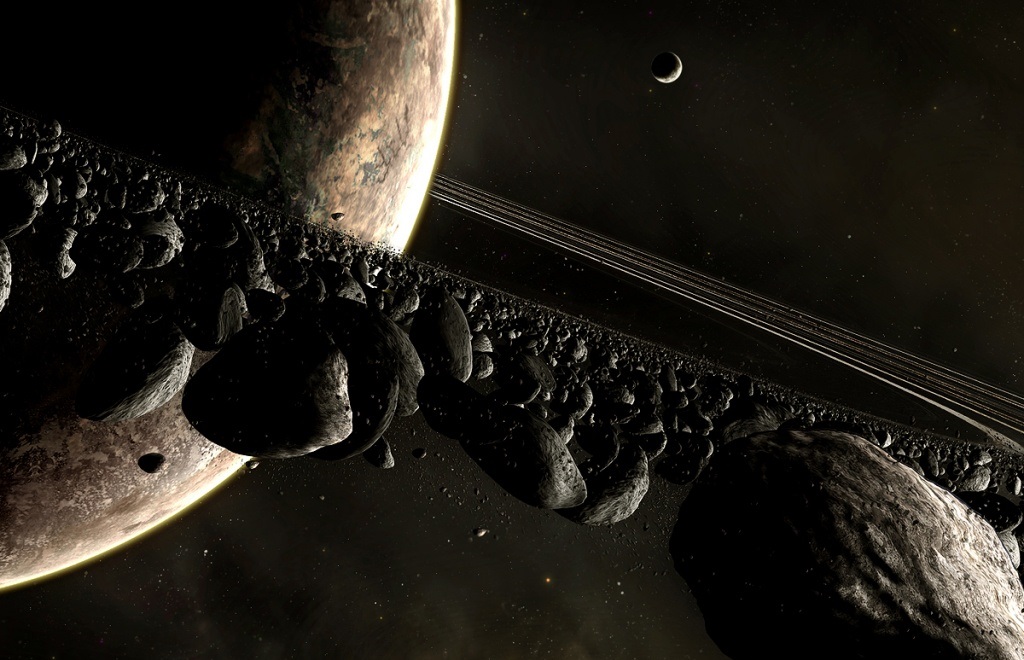
asteroid_belt1

  • Off-world industry continues to grow as Asteroid Belt and colonies provide the majority of Earth’s mineral needs
  • Famine now widespread on all five continents, internalized food production in urban spaces continues
  • UN gives way to UNE, United Nations of Earth, which has near-universal representation
  • First test of Alcubierre FTL Drive successful, missions to neighboring systems planned
  • Tensions begin to mount in Solar Colonies as pressure mounts to produce more agricultural goods
  • Extinction rate of wild animals begins to drop off, efforts at ecological restoration continue
  • First attempts to creating world religion are mounted, met with limited success

networked_minds

  • Governments in most developed countries transitioning to “democratic anarchy”
  • Political process and involvement becoming digitized as representation becomes obsolete
  • “Super-sentience” emerges as people merge their neural patterns with each other or AIs
  • Law reformed to recognize neural constructs and AIs as individuals, entitled to legal rights
  • Biotech research merges with AI and nanotech to create first organic buildings with integrated intelligence

2150-2200:

  • Majority of the world’s population live in arcologies and self-sufficient environments
  • Census reveals over three quarters of world lives with implants or augmentation of some kind
  • Population of Orbital Nexus, off-world settlements surpasses 1 million
  • First traditionalist mission goes into space, seeking world insulated from rapid change and development
  • Labor tensions and off-world riots lead to creation of Solar policing force with mandate to “keep the peace”

Vladivostok-class_Frigate

  • First mission to extra=Solar planets arrive, robots begin surveying surface of Gliese 581 g, Gliese 667C c, HD 85512 b, HD 40307 g, Gliese 163 c, Tau Ceti e, Tau Ceti f
  • Deep space missions planned and executed with Alcubierre Drive to distant worlds
  • 1st Wave using relativistic engines and 2nd Wave using Alcubierre Drives meet up and begin colonizing exoplanets
  • Neighboring star systems within 25 light years begin to be explored
  • Terraforming begins on Mars, Venus and Europa using programmed strains of bacteria, nanobots, robots and satellites
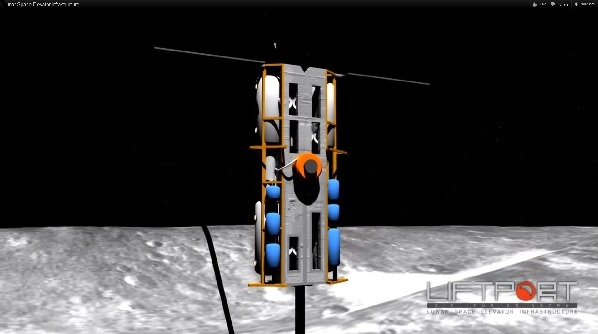
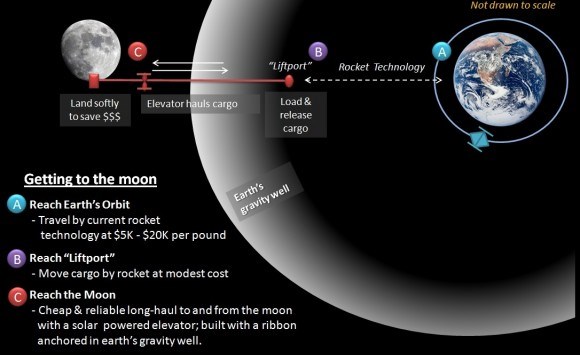
  • Space Elevator and Slingatron built on the Moon, used to transport people to space and send goods to the surface
space_elevator_lunar1

  • Earth’s ecology begins to recover
  • Natural species are reintroduced through cloning and habitat recovery
  • Last reported famine on record, food production begins to move beyond urban farms
  • Colonies within 50 light years are established on Gliese 163 c, Gliese 581 g, Gliese 667C c, HD 85512 b, HD 40307 g, Tau Ceti e, Tau Ceti f
  • Off-world population reaches 5 million and continues to grow
  • Tensions between Earth and Solar Colonies continue, lead to demands for interplanetary governing body
  • Living, breathing cities become the norm on all settled worlds, entire communities build of integrated organic materials run by AIs and maintained by programmed DNA and machinery

self-aware-colony

23rd Century and Beyond:

Who the hell knows?

*Note: Predictions and dates are subject to revision based on ongoing developments and the author’s imagination. Not to be taken literally, and definitely open to input and suggestions.
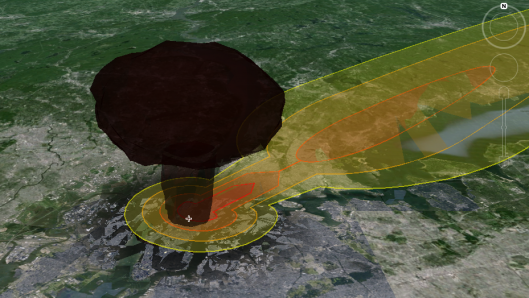
Nukemap 3D: Bringing Nuclear War to your Home!

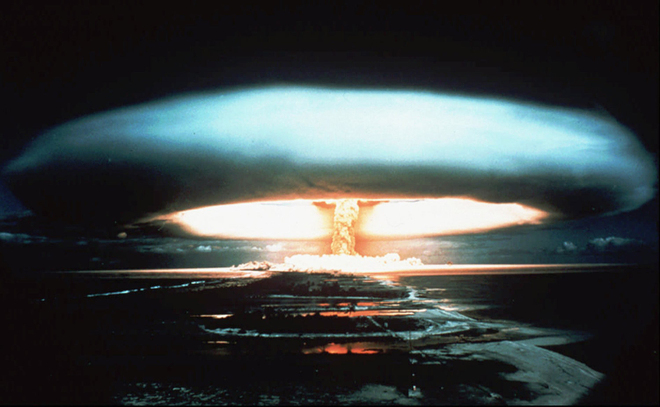
nukemap3Ever wonder what it would look like if a thermonuclear device hit your hometown? Yeah, me neither! But let’s pretend for a moment that this is something you’ve actually considered… sicko! There’s an online browser-based program for that! It’s called Nukemap3D, and uses a Google Earth plug in to produce a set of graphics that show the effects of a nuclear weapon on your city of choice.

All you have to do is pick your target, select your favorite thermonuclear device, and you can see an animated mushroom cloud rising over ground zero. The creator was Dr. Alex Wellerstein, an Associate Historian at the Center for History of Physics at the American Institute of Physics in College Park, Maryland, who specializes in the history of nuclear weapons and nuclear secrecy.

nukemap3-1Interestingly enough, Wellerstein’s inspiration for developing Nukemap 3D came from his experience of trying to teach about the history of nuclear weapons to undergraduates. As people who had completely missed the Cold War, these students naturally didn’t think about the prospect of nuclear war much, and had little to no cultural association with them.

Events like Hiroshima and the Cuban Missile Crisis were essentially ancient history to them. For him and his wife, who teaches high school, it was always a challenge to get students to relate to these issues from the past and seeing how they related to the present. Specifically, he wanted his students to address the larger issue of how one controls a dangerous technology that others find desirable.

nukemap3-2And given how inundated young people are today with technology, he believed an online browser that allowed children to visualize the effects of a nuclear attack seemed just like the thing. The concept originally grew out of his own research to determine the size of the Hiroshima bomb versus the first hydrogen bomb versus a modern nuclear weapon.

After producing a web page with the relevant info in 2012, he began receiving millions of hits and felt the need to expand on it. One of the things he felt was missing was info on additional effects of nuclear blasts, such as radioactive debris that comes down as fallout, contamination that can extend for hundreds of kilometers in all directions, and how this can spread with prevailing winds.

NuclearDetonationsIn addition to being a pedagogical tool which can help students appreciate what life was like during the Cold War, Wellerstein also hopes his site could help combat misinformation about modern nukes. All too often, people assume that small devices – like those being developed by North Korea – could only cause small-scale damage, unaware of the collateral damage and long-term effects.

Another use of the program is in helping to combat ideas of “instant apocalypse” and other misconceptions about nuclear war. As we move farther and farther away from an age in which nuclear holocaust was a distinct possibility, people find themselves turning to movies and pop culture for their information on what nuclear war looks like. In these scenarios, the end result is always apocalyptic, and by and large, this is not the case.

nuclear1In a war where nuclear confrontation is likely, civilization does not simply come to an end and mutants do not begin roaming the Earth. In reality, it will mean mass destruction within a certain area and tens of thousands of deaths. This would be followed by mass evacuations of the surrounding areas, the creation of field hospitals and refugee camps, and an ongoing state of emergency.

In short, a nuclear exchange would not means the instantaneous end of civilization as we know it. Instead, it would lead to an extended period of panic, emergency measures, the presence of NGOs, humanitarian aid workers, and lots and lots of people in uniform. And the effects would be felt long after the radiation cleared and the ruins were rebuilt, and the memory would be slow to fade.

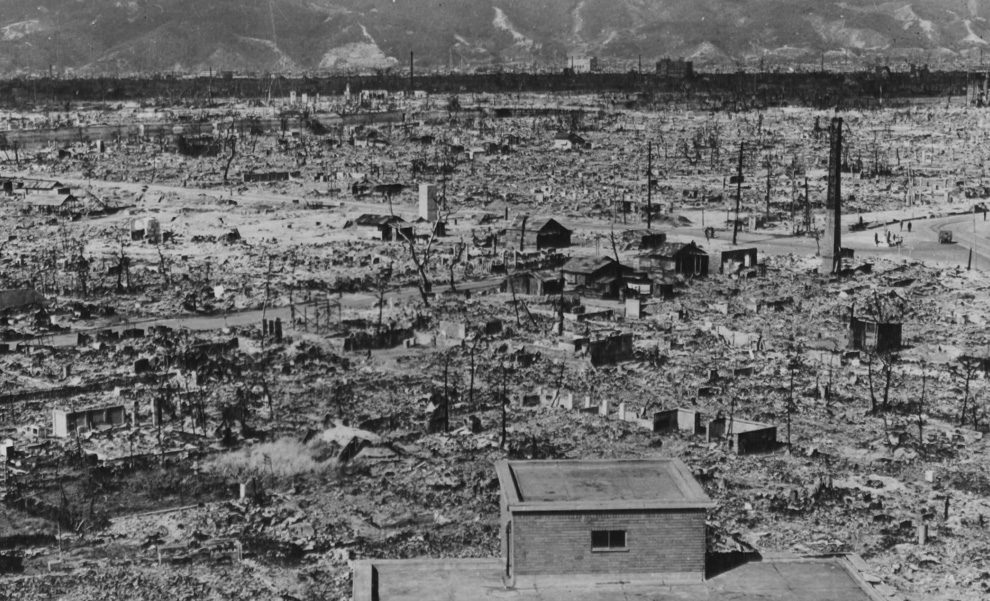
Hiroshima, after the blast

Basically, Wellerstein created Nukemap 3D in the hope of finding a middle ground between under exaggeration and over exaggeration, seeking to combat the effects of misinformation on both fronts. In a nuclear war, no one is left unaffected; but at the same time, civilization doesn’t just come to an abrupt end. As anyone who survived the horrors of Hiroshima and Nagasaki can attest, life does go on after a nuclear attack.


The effects are felt for a very long time, and the scars run very deep. And as those who actually witnessed what a nuclear blast looks like (or lived in fear of one) grow old and pass on, people need to be educated on what it entails. And a graphic representation, one that utilizes the world’s most popular form of media, is perhaps the most effective way of doing that.

In the meantime, be sure to check out Nukemap 3D and see exactly what your hometown would look like if it were hit by a nuclear device. It’s quite… eye-opening!

Source: gizmag.com


Space Elevators!

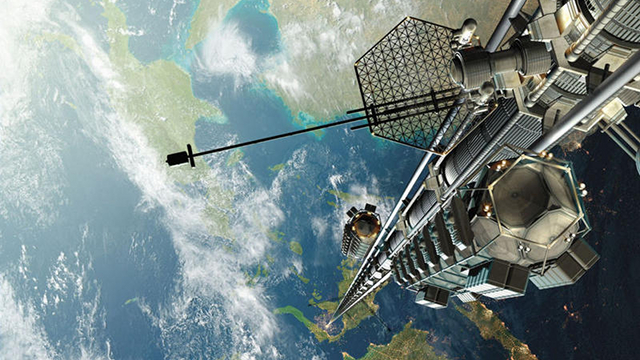
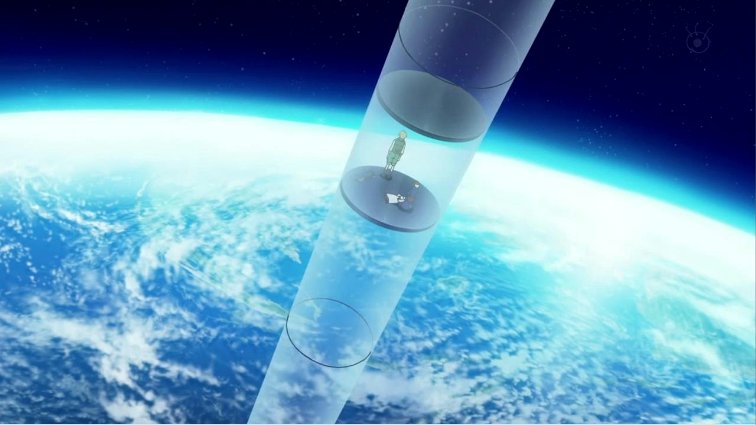
space_elevatorWhen it comes to classic and hard science fiction, there are few concepts more inspired, more audacious, and more cool than the Space Elevator. Consisting of a cable (or tether) attached the Earth near the equator and a station in geosynchronous orbit, a structure of this kind would allow us to put objects, supplies and even people into orbit without the need for rockets and space ships.

And perhaps I am a bit biased, seeing as how one of the writer’s featured in the Yuva anthology happens to have written a story that features one – Goran Zidar, whose story “Terraformers” includes an orbital colony that is tethered to the planet by a “Needle”. But I’ve found the concept fascinating for as long as I have known about it, and feel like its time for a conceptual post that deals with this most awesome of concepts!

Here goes…

History:
The first recorded example of the space elevator concept appeared in 1895 when Russian scientist Konstantin Tsiolkovsky was inspired by the Eiffel Tower in Paris. He considered a similar tower that extended from the ground into geostationary orbit (GSO) in space. Objects traveling into orbit would attain orbital velocity as they rode up the tower, and an object released at the tower’s top would also have the velocity necessary to remain in orbit.

space_elevator1However, his concept called for a compression structure, which was unfeasible given that no material existed that had enough compressive strength to support its own weight under such conditions. In 1959, another Russian scientist named Yuri N. Artsutanov suggested a more feasible proposal, a tensile structure which used a geostationary satellite as the base from which to deploy the structure downward.

By using a counterweight, a cable would be lowered from geostationary orbit to the surface of Earth, while the counterweight was extended from the satellite away from Earth, keeping the cable constantly over the same spot on the surface of the Earth. He also proposed tapering the cable thickness so that the stress in the cable was constant. This gives a thinner cable at ground level that becomes thicker up towards the GSO.

space_elevator_liftIn 1966, Isaacs, Vine, Bradner and Bachus, four American engineers, reinvented the concept under the name “Sky-Hook”. In 1975, the concept was reinvented again by Jerome Pearson, whose model extended the distance of the counterweight to 144,000 km (90,000 miles) out, roughly half the distance to the Moon. However, these studies were also marred by the fact that no known material possessed the tensile strength required.

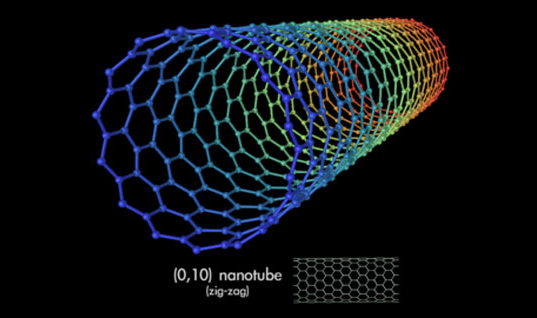
By the turn of the century, however, the concept was revitalized thanks to the development of carbon nanotubes. Believing that the high strength of these materials might make an orbital skyhook feasible, engineer David Smitherman of NASA put together a workshop at the Marshall Space Flight Center and invited many scientists and engineers to participate. Their findings were published in an article titled “Space Elevators: An Advanced Earth-Space Infrastructure for the New Millennium”.

carbon-nanotubeAnother American scientist, Bradley C. Edwards, also suggested using nanotubes to create a 100,000 km (62,000 mile) paper-thin cable that would be shaped like a ribbon instead of circular. This, he claimed, would make the tether more resistant to impacts from meteoroids.  The NASA Institute for Advanced Concepts began supporting Edwards’ work, allowing him to expand on it and plan how it would work in detail.

In Fiction:
arthurcclarke_fountains-of-paradiseIn 1979, the concept of the Space Elevator was introduced to the reading public thanks to the simultaneous publications of Arthur C. Clarke’s The Fountains of Paradise (1979) and Charles Sheffield’s The Web Between the Worlds. In the former, engineers construct a space elevator on top of a mountain peak in the fictional island country of Taprobane, which was loosely based on Clarke’s new home in Sri Lanka, albeit moved south to the Equator.

In an interesting and fact-based twist, the purpose for building the elevator on Earth is to demonstrate that it can be done on Mars. Ultimately, the protagonist of the story (Dr Vannevar Morgan) is motivated by his desire to help a Mars-based consortium to develop the elevator on Mars as part of a massive terraforming project, something which has been proposed in real life.

Sheffield- The Web Between the WorldsSimiliarly, in Sheffield’s Web, which was his first novel, we see a world famous engineer who has created extensive bridge networks all over the world using graphite cable. In hoping to achieve the unachievable dream, he begins work on a space elevator code named the “Beanstalk”. This brings him into an alliance with a corrupt tycoon who wants to make rockets obsolete, and intrigue ensues…

Three years later, Robert A. Heinlein’s novel Friday features a space elevator known as the “Nairobi Beanstalk”. In Heinlein’s vision, the world of the future is heavily Balkanized, and people exist in thousands of tiny nation states and orbital colonies which are connected to Earth via the Beanstalk, which as the name suggests, is located in equatorial Africa.

ksr_redmarsIn 1993, Kim Stanley Robinson released Red Mars, a sci-fi classic that remains a quintessential novel on the subject of Mars colonization. In the novel, the Martian colonists build a space elevator that allows them to bring additional colonists to the surface, as well as transport natural resources that were mined planetside into orbit where they can be ferried back to Earth.

In 1999, Sid Meier’s, creator of the famed Civilization gaming series, released the sci-fi based Sid Meier’s Alpha Centauri that deals with the colonization of the planet “Chiron” in the Alpha Centauri system. In the course of the turn-based strategy game, players are encouraged to construct special projects as a way of gaining bonuses and building up their faction’s power.

One such project is the Space Elevator, which requires that the faction building first research the technology “super tensile solids” so they have the means of building a super-tensile tether. Once built, it confers bonuses for space-based unit production, allows orbital drop units to be deployed over the entire planet, increases production rates for satellites, and removes the need for aerospace facilities. spaceelevator_alpha_centauriIn David Gerrold’s 2000 novel, Jumping Off The Planet, we are again confronted with an equatorial space elevator, this time in Ecuador where the device is once again known as the “beanstalk”. The story focuses on a family excursion which is eventually revealed to be a child-custody kidnapping. In addition to this futuristic take on domestic issues, Gerrold also examined some of the industrial applications of a mature elevator technology.

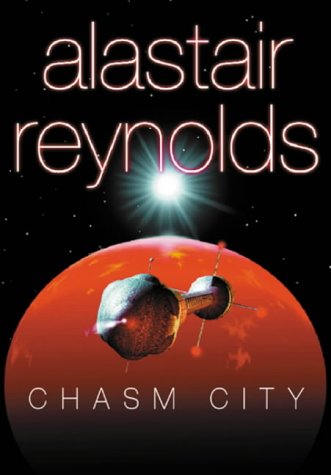
Chasm_City_coverIn 2001, Alastair Reynolds, a hard sci-fi author and creator of the Revelation Space series, released Chasm City, which acted as a sort of interquel between the first and second books in the main trilogy. At the opening of the novel, the story takes place on Sky’s Edge, a distant world where settlers travel to and from ships in orbit using a space elevator that connects to the planetary capitol on the surface.

And in 2011, author Joan Slonczewski presented a biological twist on the concept with her novel The Highest Frontier. Here, she depicts a college student who ascends a space elevator that uses a tether constructed from self-healing cables of anthrax bacilli. The engineered bacteria can regrow the cables when severed by space debris, thus turning the whole concept of tensile solids on its head.

Attempts to Build a Space Elevator:
Since the onset of the 21st century, several attempts have been made to design, fund, and create a space elevator before the end of this century. To speed the development process, proponents of the concept have created several competitions to develop the relevant technologies. These include the Elevator: 2010 and Robogames Space Elevator Ribbon Climbing, annual competitions seeking to design climbers, tethers and power-beaming systems.

space_elevator_nasaIn March of 2005, NASA announced its own incentive program, known as the Centennial Challenges program, which has since merged the Spaceward Foundation and upped the total value of their cash prizes to US$400,000. In that same year, the LiftPort Group began producing carbon nanotubes for industrial use, with the goal of using their profits as capital for the construction of a 100,000 km (62,000 mi) space elevator.

In 2008, the Japanese firm known as the Space Elevator Association, chaired by Shuichi Ono, announced plans to build a Space Elevator for the projected price tag of a trillion yen ($8 billion). Though the cost is substantially low, Ono and his peers claimed that Japan’s role as a leader in the field engineering could resolve the technical issues at the price they quoted.

obayashi-2In 2011, Google was reported to be working on plans for a space elevator at its secretive Google X Lab location. Since then, Google has stated that it is not working on a space elevator. But in that same year, the first European Space Elevator Challenge (EuSEC) to establish a climber structure took place in August.

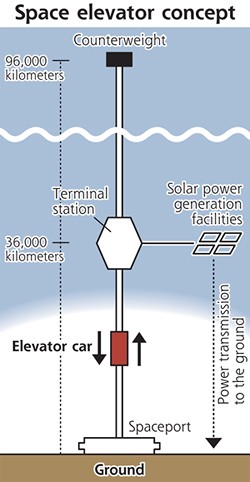
And in 2012, the Obayashi Corporation of Japan announced that in 38 years it could build a space elevator using carbon nanotube technology. Their detailed plan called for a 96,000 long tether, supported by a counterweight, that could hold a 30-passenger climber that would travel 200 km/h, reaching the GSO after a 7.5 day trip. However, no cost estimates, finance plans, or other specifics were made at this point.

space-elevator-schematics-largeDespite these efforts, the problems of building are still marred by several technical issues that have yet to be resolved. These include the problems of tensile strength, dangerous vibrations along the tether line, climbers creating wobble, dangers posed by satellites and meteoroids, and the fact that such a structure would be vulnerable to a terrorist or military attack.

Other Possibilities:
Though we may never be able to resolve the problems of building a space elevator on Earth, scientists are agreed that one could be made on other planets, particularly the Moon. This idea was first devised by Jerome Pearson, one of the concepts many original proponents, who proposed a smaller elevator that would be anchored by Earth’s gravity field.

LiftPort1This is a necessity since the Moon does not rotate and could therefore not maintain tension along a tether. But in this scenario, the cable would be run from the moon and out through the L1 Lagrangian point. Once there, it would be dangled down into Earth’s gravity field where it would be held taught by Earth gravity and a large counterweight attached to its end.

Since the Moon is a far different environment than planet Earth, it presents numerous advantages when building a space elevator. For starters, there’s the strength of the materials needed, which would be significantly less, thus resolving a major technical issue. In addition, the Moon’s lower gravity would mean a diminished weight of the materials being shipped and of the structure itself.

space_elevator_lunarAs Pearson explained:

[T]o lift a thousand tons per day off the lunar surface, it would take less than 100,000 tons of elevator to do it — which means it pays back its own mass in just 100 days, or somewhere between three and four times its own mass per year — which is not a bad rate of return… You don’t need nanotubes and very, very high strength materials. But the higher the strength, the more of the ratio you can get for hauling stuff on the moon.

In fact, LiftPort is already deep into developing a “Lunar Elevator”. Plans to build one by 2020 were announced back in 2010, and since that time, the company launched a Kickstarter campaign to get the funding necessary to conduct tests that will get them closer to this goal. These consisting of sending a tethered robot 2km from the surface to conduct stress and telemetry tests.

Ultimately, the company estimates that a Lunar Elevator could be made at the cost of $800 million, which is substantially less than a “Terran Elevator” would cost. Similarly, it is likely that any manned missions to Mars, which will include eventual settlement and plans to terraform, will involve a Martian elevator, possibly named the “Ares Elevator”.

Much like SpaceX’s attempts to resolve the costs of sending rockets into space, the concept of a space elevator is another means of reducing the cost of sending things into orbit. As time goes on and technology improves, and humanity finds itself in other terrestrial environments where resources need to be exported into space, we can expect that elevators that pierce the sky will become possible.

In the meantime, we can always dream…

space_elevator_conceptSources: en.wikepedia.org, gizmag.com, io9.com, forbes.com, universetoday.com, futuretimeline.com

New Movie Trailer – 300: Rise of an Empire

300-rise-of-an-empire-thumbIt seems that Zack Snider and Frank Miller are back for another round of comic book adaptations! After bringing us 300, Watchmen, Sucker Punch, and Man of Steel, Snider has signed on for a sequel named 300: Rise of an Empire. This time around, the movie will adapting material from Frank Miller’s own comic sequel to 300, which was entitled “Xerxes”.

As you can see from the trailer, Lena Headey is back to reprise her role as Queen Gorgo of Sparta, while Roderigo Santoro is back as well, reprising the role of the ridiculously tall and pierced man-god Xerxes. David Wehnam is reprising the role of the narrating Dilios. Meanwhile, the beautiful Eva Green plays Artemisia, Xerxes’ ally and naval commander, and Sullivan Stapleton plays General Themosticles – commander of the Greek navy.

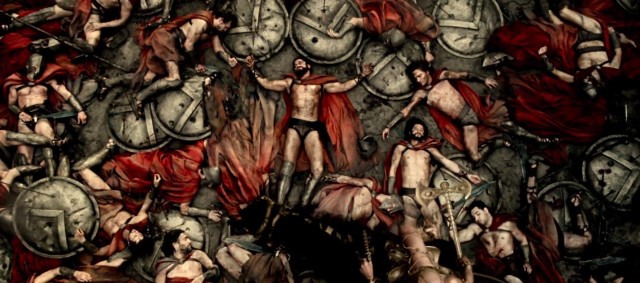
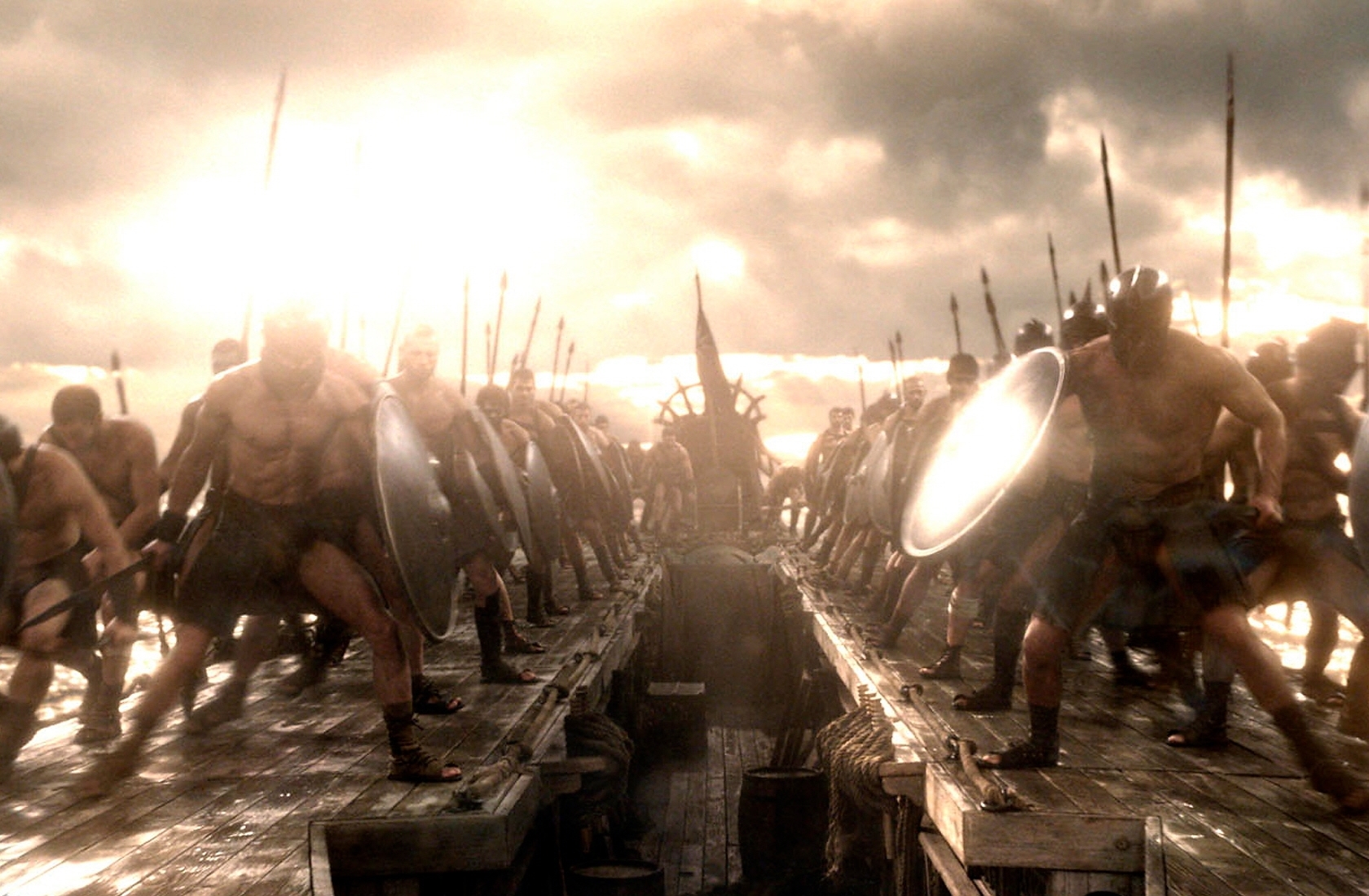
300-Rise-of-an-Empire1As you can also see, the movie picks up where events in the first movie left off, after the Battle of Thermopylae where King Leonidas and his 300 were eventually wiped out. In adapting real history to an over-the-top format yet again, Snider and Miller give us a souped-up version of the Battle of Salamis, the war at sea that followed shortly thereafter.

This confrontation between the Greek and Persian navies occurred off the tip of the Greek mainland, just 20 km away from Athens which had been abandoned to the Persians. It was a desperate fight, but in the end, the Greeks proved victorious, using the home field advantage to trap and defeat the larger Persian forces.

300-Rise-of-An-Empire3In many ways, this battle would prove to be the beginning of the end for the Persian army, since defeat at sea now meant they could no longer launch offensives into the Peloponnese (home of Sparta and where the Greek Allies were now based) by both land and sea. Marching across the thin and fortified isthmus of Corinth would prove slow and difficult, and Thermopylae had demonstrated that frontal assaults against fortified phalanxes were not effective.

In addition, Xerxes now feared the Greeks could mount a naval offensive on the Hellespont (the land bridge between modern day Turkey and Greece) and cut off his forces from their overland supply routes. On top of that, he was dealing with rebellions within the conquered territories and had to tend to those as well.

300: BATTLE OF ARTEMESIUMAs a result, the war would consist of sieges against rebelling states until the decisive land battle of Plataea, north of Athens, (shown at the end of 300) and the naval battle at Mycale off the coast of Turkey would take place a year later and drive the Persians out of Greece and the Aegean for good.

Honestly, not sure if I’ll catch this one. Sure, the last one was cinematic action porn, and fun if you ignored the historical inaccuracies and alleged attempts to draw a connection between the past and the “war on terror”. But I think its fair to say this is Snider and Miller’s attempt to cash in again and really doesn’t have much magic to it. And without Gerard Butler screaming martial slogans, it just seems flat.

“THIS IS SPARTAAAA!” No, this is a sequel. And oftentimes, they suck! But then again, I do love the history and there have been cases where the sequel was even better than the original… we shall see! And of course, we can all enjoy the trailers in the meantime!

Epic Rap Battles of History – Science Edition

epic_rap_battlesIt occurs to me that I really haven’t given the ERB site its due over the years. They’ve provided me with endless hours of enjoyment and all I ever did was post about one of their videos. Granted, I have nowhere near the kind of following that would needed to actually give their traffic a shot in the arm, but it’s the thought that counts!

And so I thought I’d a little compilation here of some of their funniest, and educational, videos. Whether it was the match ups between Steve Jobs and Bill Gates (made shortly after Jobs death as a tribute to his life), Einstein and Stephen Hawking, or Thomas Edison and Nikola Tesla, these guys have shown a real commitment to their art and are clearly willing to do their homework!

Enjoy!

Steve Jobs vs. Bill Gates:


Einstein vs. Stephen Hawking:


Thomas Edison vs. Nikola Tesla:


Note: Though I am well aware of their existence, I have assiduously avoided posting the videos of Darth Vader vs. Adolph Hitler. Though I found them hilarious, such material is bound to offensive to some. Although, if people were willing to give me permission… 😉 😉

Alan Turing Pardoned… Finally!

Alan TuringWhen it comes to the history of computing, cryptography and and mathematics, few people have earned more renown and respect than Alan Turing. In addition to helping the Allied forces of World War II break the Enigma Code, a feat which was the difference between victory and defeat in Europe, he also played an important role in the development of computers with his “Turing Machine” and designed the Turning Test – a basic intelligence requirement for future AIs.

Despite these accomplishments, Alan Turing became the target of government persecution when it was revealed in 1952 that he was gay. At the time, homosexuality was illegal in the United Kingdom, and Alan Turing was charged with “gross indecency” and given the choice between prison and chemical castration. He chose the latter, and after two years of enduring the effects of the drug, he ate an apple laced with cyanide and died.

turing-science-museum-2Officially ruled as a suicide, though some suggested that foul play may have been involved, Turing died at the tender age of 41. Despite his lifelong accomplishments and the fact that he helped to save Britain from a Nazi invasion, he was destroyed by his own government for the simple crime of being gay.

But in a recent landmark decision, the British government made a historic ruling by indicating that they would support a backbench bill that would clear his name posthumously of all charges. This ruling is not the first time that the subject of Turing’s sentencing has been visited by the British Parliament. Though for years they have been resistant to offering an official pardon, Prime Minister Gordon Brown did offer an apology for the “appalling” treatent Turing received.

Sackville_Park_Turing_plaqueHowever, it was not until now that it sought to wipe the slate clean and begin to redress the issue, starting with the ruling that ruined the man’s life. The government ruling came on Friday, and Lord Ahmad of Wimbledon, a government whip, told peers that the government would table the third reading of the Alan Turin bill at the end of October if no amendments are made.

Every year since 1966, the Turing Award – the computing worlds highest honor and equivalent of the Nobel Prize- has been given by the Association for Computing Machinery for technical or theoretical contributions to the computing community. In addition, on 23 June 1998 – what would have been Turing’s 86th birthday – an English Heritage blue plague was unveiled at his birthplace in and childhood home in Warrington Crescent, London.

Alan_Turing_Memorial_CloserIn addition, in 1994, a stretch of the A6010 road – the Manchester city intermediate ring road – was named “Alan Turing Way”, and a bridge connected to the road was named “Alan Turing Bridge”. A statue of Turing was also unveiled in Manchester in 2001 in Sackville Park, between the University of Manchester building on Whitworth Street and the Canal Street gay village.

This memorial statue depicts the “father of Computer Science” sitting on a bench at a central position in the park holding an apple. The cast bronze bench carries in relief the text ‘Alan Mathison Turing 1912–1954’, and the motto ‘Founder of Computer Science’ as it would appear if encoded by an Enigma machine: ‘IEKYF ROMSI ADXUO KVKZC GUBJ’.

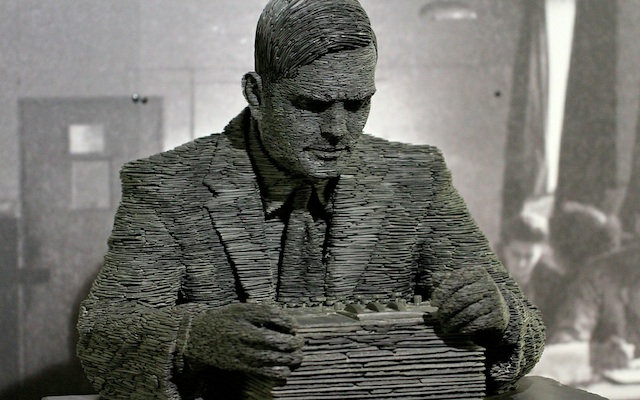
turing-statueBut perhaps the greatest and most creative tribute to Turning comes in the form of the statue of him that adorns Bletchley Park, the site of the UK’s main decryption department during World War II. The 1.5-ton, life-size statue of Turing was unveiled on June 19th, 2007. Built from approximately half a million pieces of Welsh slate, it was sculpted by Stephen Kettle and commissioned by the late American billionaire Sidney Frank.

Last year, Turing was even commemorated with a Google doodle last year in honor of what would have been his 100th birthday. In a fitting tribute to Turing’s code-breaking work, this doodle designed to spell out the name Google in binary. Unlike previous tributes produced by Google, this one was remarkably complicated. Those who attempted to figure it out apparently had to consult the online source Mashable just to realize what the purpose of it was.

google_doodle_turing

For many, this news is seen as a development that has been too long in coming. Much like Canada’s own admission to wrongdoing in the case of Residential Schools, or the Church’s persecution of Galileo, it seems that some institutions are very slow to acknowledge that mistakes were made and injustices committed. No doubt, anyone in a position of power and authority is afraid to admit to wrongdoing for fear that it will open the floodgates.

But as with all things having to do with history and criminal acts, people cannot be expected to move forward until accounts are settled. And for those who would say “get over it already!”, or similar statements which would place responsibility for moving forward on the victims, I would say “just admit you were wrong already!”

Rest in peace, Alan Turing, and may continued homophobes who refuse to admit they’re wrong find the wisdom and self-respect to learn and grow from their mistakes. Orson Scott Card, I’m looking in your direction!

Sources: news.cnet.com, guardian.co.uk

Tweeting Aliens: The Lone Signal Array

gliese-581-eIn what could be called a case of serious repurposing – beating swords into plowshares and so forth – or something out of science-fiction, a crowdfunded project has sought to turn a Cold War era dish into a deep-space communications array. This array will send messages to that’s relatively near to us, and potentially inhabited. And assuming anything sufficiently advanced lives there, we could be talking to them soon enough.

dishantennaThe project is known as Lone Signal, a crowdfunded effort to send a continuous stream of messages to the folks at Gliese 526, a red dwarf star 17.6 light-years away in the constellation of Bootes (aka Wolf 498). And the dish with which they intend to do this is known as the Jamesburg Earth Station, a nuke-proof satellite relay station in California that dates from the 1960s and even helped broadcast images of Neil Armstrong on the moon.

Long Signal, it should be noted, is the brainchild of The Blue Marble Space Institute of Science, non-profit virtual research institute that networks scientists from across the globe and multiple disciplines for the purpose of expanding the boundaries of knowledge, science and astronomy and promoting an open dialogue on the subject of exploration and settlement.Towards this end, they arranged for a 30-year lease on the Cold War-era dish (for a cool $3 million) and set up a project that will allow participants who contribute money to send a personalized message into space.

exoplanetsUltimately, they plan to direct two beams at Gliese 526: a continuous wave with fundamental physics laws and basic information about Earth, and another consisting of crowdsourced greetings. The project is open to anyone and a series of initial short message (the equivalent of a 144-character tweet) will be available free of charge. Subsequent messages, images, and longer greetings, however, will cost money (about $1 for four texts) that will help the project fund itself.

The project’s website also lets participants track their messages and share them via social media, dedicate messages to others, and view signal stats. In an interview with Universe Today, Lone Signal co-founder Pierre Fabre, told people:

Our scientific goals are to discover sentient beings outside of our solar system. But an important part of this project is to get people to look beyond themselves and their differences by thinking about what they would say to a different civilization. Lone Signal will allow people to do that.

Indeed. Nothing like the prospect of facing another life form, a potential space invader even, to make people forget about all their petty bickering!

Gliese_581_-_2010As our knowledge of the universe expands, we are becoming aware of the existence of more and more exoplanets. Many of these exist within the Habitable Zones of their parent star, which means two things. On the one hand, they may be candidates for potential settlement in the future. On the other, they may already be home to sentient life. If said life is sufficiently advanced, its entirely possible they could be looking back at us.

For some time, the human race has been contemplating First Contact with potential extra-terrestrial life, which was the very purpose behind the creation of NASA’s SETI (Search for Extra-Terrestrial Intelligence) program in 1961. The Pioneer space probes were another attempt at making contact, both of which carried small metal plaques identifying their time and place of origin for the benefit of any other spacefarers that might find them in the distant future.

SETIFollowing in that tradition, Voyager 1 and 2 space probes contained even more ambitious messages, otherwise known as the Golden Record. These phonograph records – two 12-inch gold-plated copper disks – contained both sounds and images selected to portray the diversity of life and culture on Earth that would give any civilization that found them a good idea of what the people of Earth were capable of.

The contents of the records were selected for NASA by a committee chaired by Carl Sagan of Cornell University, and consisted of 115 images and a variety of natural sounds – surf, wind, thunder, birds, whales, and other animals. To this they added musical selections from different cultures and eras, and spoken greetings from Earth-people in fifty-five languages, and printed messages from then-President Carter and U.N. Secretary General Waldheim.

golden_record_cover_smIn this respect, Lone Signal represents the latest step in promoting contact and communication with other life forms. And in keeping with the trend of modern space exploration, it is being opened to the public via crowdfunding and personalized messages. But unlike SETI, which lost its government funding in 1995 and had to turn to private supporters, crowdfunded space exploration is something directly accessible by all citizens, not just corporate financiers.

Update: The Lone Signal project is now operational and on 9:00 PM EDT Monday, June 17 at a press event in New York, the team announced the transmission of the first interstellar message. The message was sent by none other than Ray Kurzweil, noted Futurist and science guru. That message was then read during his welcome talk to the Singularity University class of 2013, from the Computer History Museum in Mountain View, California:

Greetings to Gliese 526 from Singularity University. As you receive this, our computers have made us smarter, the better to understand you and the wisdom of the universe.

What he means by this is that by the time the message is recieved – roughly 18 years from now, assuming it ever is – humanity is likely to have taken the first steps towards merging our brains with computers via biotech, artificial intelligence, or other means of computer-assisted brain augmentation. At least, that’s what guys like Kurzweil hope for.

Other “alpha beamers” — including Dan Aykroyd, Alicia Keys, and Jason Silva — also sent beams Monday night. And for the time being, anyone can send a “crowdsourced” 144-character beam and pic. Better get on it before they start charging. If texting and phone rates are any indication, the price is likely to go up as the plan improves!

And be sure to enjoy this promotional video from Lone Signal:


And also check out this time-lapse video of the Jamesburg Earth Station in operation:

Sources: cnet.news.com, universetoday.com, voyager.jpl.nasa.gov, bmsis.org, kurzweil.net

A Tribute to Valentina Tereshkova

valentina_tereshkovaOn June 16th, 1963, in what was to become a first amongst firsts, Russian Cosmonaut Valentina Tereshkova made history by being the first woman to go into space. Today, exactly fifty years later, Tereshkova’s achievements continue to serve as a reminder that all people – regardless of their gender – are capable of doing just about anything. And at the age of 76, Tereshkova lives on as a national and historic icon, inspiring younger generations of women to follow their dreams.

On Friday, President Vladimir Putin praised Tereshkova during a meeting at his residence. Tereshkova was on hand for the event, which was covered by several major networks and global news agencies, during which time Putin awarded her accomplishments in space by giving her the Order of Alexander Nevsky for meritorious public service, one of the highest Russian honors.

tereshkova_putin_50thannHer historic flight came a little more than two years after the Soviet Union put the first man – Cosmonaut Yuri Gagarin – into orbit. Shortly thereafter, Soviet space officials started considering a space mission by a woman, seeing it as another chance to advertise the nation’s prowess. Much like Gagarin, Tereshkova was part of the Vostok program, the earliest Soviet space missions, and her flight (Vostok-6) was the final mission of the program.

Vostok-6 rocket
Vostok-6 rocket

Of over four hundred candidates, Tereshkova was selected for a number of reasons. In addition to conforming to the height and weight specifications needed to fit within the Vostok capsule, she was also a qualified parachutist – which given the nature of the Vostok space craft (the re-entry craft was incapable of landing) was absolutely essential. But perhaps most important reason was her background, since she was the daughter of war hero Vladimir Tereshkova who died in Finland during the Second World War.

To make the mission even more spectacular for propaganda purposes, Moscow decided to score another first by making it the first simultaneous flight of two spaceships. Valery Bykovsky blasted off aboard the Vostok-5 ship on June 14, 1963, and Tereshkova followed him on June 16. During her flight, Tereshkova orbited the Earth forty-eight times and spent almost three whole days in space.

Vostok-6 craft
Vostok-6 craft

Aside from some nausea, which she would later claim was the result of tainted food, she maintained herself for the full duration and successfully parachuted down upon re-entry. Her landing was a little rough, however, and she experienced some serious bruising of her face. Tereshkova also claimed that during the flight, she noticed a fault in the ship’s controls, which she corrected to prevent from being stranded in space.

With this single flight, Tereshkova logged more flight time than the combined times of all American astronauts who had flown before that date. Tereshkova also maintained a flight log and took photographs of the horizon, which were later used to identify aerosol layers within the atmosphere. Many of the details of her flight, including her nausea, the technical problems, and the hard landing she made, were kept a secret until the collapse of the Soviet Union, since government officials feared they would expose flaws in their program.

tereshkova_historicTereshkova received a hero’s welcome after the flight and was showered with awards. A few months later she married cosmonaut Andrian Nikolayev with Soviet leader Nikita Khrushchev presiding over the wedding party. She now holds a Parliament seat on the ticket of the main Kremlin party, serving as deputy chairman of the foreign affairs committee in the lower house.

Tereshkova’s story is all the more poignant due to the fact that none of the other planned missions involving female cosmonauts took place and the Soviet’s cancelled the pioneering woman cosmonaut program in 1969. It would be many years before another woman would go into space, once again with the Soviet space program when Svetlana Savitskaya participated in the Soyuz-T7/T5 space mission on August 19th, 1982. Less than a year later, Sally Ride would become the first American woman to go into space as part of the STS-7  mission that went up on Jun. 18, 1983.

???????????????????????????????????????????????????????????????????????????????????????????????????????????????????????????????????????????????????????????????????????????????????????????????????????????????????????????????????????????????????????????????????????????????????????????????????????????????????????????????????????????????????????????????????????????????????????????????????????????????????????????????????????????????????????????????????????????????????????????????????????????????????????????????However, as time progressed, more and more women have come to join the space profession, and Tereshkova has been on hand to honor some of them. One such person was South Korea’s first astronaut, biosystems engineering student Yi So-Yeon (picture above). Tereshkova is seen accompanying her while she boards the spacecraft that would take her to the ISS on April 8th, 2008 from the Baikonur Cosmodrome in modern-day Kazakhstan.

Since her time, a total of 56 women have gone into space, and that doesn’t even count the female astronauts who have taken part in mission that didn’t go up or offered technical assistance to crewed missions from the ground. In all cases, these women owe an undeniable debt to Tereshkova, the first woman to enter what was (and still is) considered a man’s profession and who helped pave the way for all those that followed.yuri_gagarin1And in what is an interesting twist, the anniversary of her spaceflight comes just days after the release of a series of declassified documents which reveal the truth of Yuri Gagarin’s death. This seems appropriate since Tereshkova and Gagarin’s stories are connected in so many ways. In truth, it’s virtually impossible to speak of one without mentioning the other, as their careers and destinies were so very intertwined.

In addition to both individuals being pioneering space cosmonauts with the Soviet space program, Gagarin’s death also led to some serious changes in Tereshkova’s career in space. Though she remained an important figure within the program, she was barred from taking part in any more space missions, and for obvious reasons. Having lost one historic figure to tragic circumstances, the Soviet government did not want to lose her as well.

valentina_tereshkova_1However, Tereshkova expressed nothing but relief to hear the truth about Gagarin’s death, which was apparently caused by a mid-air collision when another pilot accidentally steered his jet plane into the path of Gagarin’s training plane. After 45 years of official silence on the matter, she claimed that “The only regret here is that it took so long for the truth to be revealed. But we can finally rest easy.”

At 76, she is still a model of dignity and class, and in pretty good health too for someone her age! I think I speak for all of us in wishing her many more years of health, happiness and accomplishments. One of the most tragic realities of our time is the loss of people who not only witnessed major turning points in history, but made them happen. As such, I hope the world can continue to hang on to Valentina a little while longer…

Source: cbc.ca

Cyberwars: Snowden Reveals NSA’s Been Hacking China

nsa_aerialEdward Snowden, the man who blew the whistle on the NSA and its domestic surveillance program – aka. PRISM – has reemerged to reveal some additional secrets. It seems that in addition to spying on their own citizens, the NSA has been using its resources to spy on tens of thousands of operations around the world. Not surprising, but what Snowden revealed showed that when it comes to nations like China, surveillance was just the tip of the iceberg.

Snowden, who has been hiding in Hong Kong since May 20th, revealed in an interview on Thursday with the South China Morning Post that the NSA has been hacking computers in Hong Kong and mainland China since 2009. Among the targets in Hong Kong were the Chinese University of Hong Kong, public officials, businesses and even students in the city.

?????????????All told, Snowden estimated that there are more than 61,000 NSA hacking operations globally, with at least hundreds of targets in Hong Kong and on the mainland. The tactics, he claimed, involve selecting large targets and infiltrating in many places at once:

We hack network backbones – like huge internet routers, basically – that give us access to the communications of hundreds of thousands of computers without having to hack every single one.

Snowden also explained his motivation for blowing the whistle on the NSA’s foreign operations. It seems that in light recent tensions between the US and China, which has been characterized by ongoing accusations and recrimination, he felt the need to tell the truth behind the lies. As he told the SCMP, his motivation was based on:

the hypocrisy of the U.S. government when it claims that it does not target civilian infrastructure, unlike its adversaries….Not only does it do so, but it is so afraid of this being known that it is willing to use any means, such as diplomatic intimidation, to prevent this information from becoming public.

Edward-Snowden-660x367Though Snowden also discussed possible plans to seek asylum in Iceland or elsewhere during an interview last week, he told the SCMP  that he’s staying put in Hong Kong for now. He emphasized that his stay in China was not an attempt to avoid justice, but to reveal criminal behavior.  He also expressed admiration for countries that have offered asylum (such as Russia), claiming that he was “glad there are governments that refuse to be intimidated by great power.”

The Guardian newspaper, which has published information from documents leaked by Snowden, has said that it has more than a thousand other documents that Snowden managed to smuggle out or download from the NSA using a series of laptops and a thumb drive. These documents are to be disclosed in the coming weeks, according to the paper, so more revelations are expected to come.

secret_documentsThough there are those who question his motivations and methods, no one can deny that thanks to Snowden, some very questionable  behavior has been revealed that involved people at the top echelons of government. One can’t help but be reminded of Richard Clarke, former head of the NSA, who came forward in 2004 to testify before to the 9/11 Commission and reveal the extent to which the Bush Administration failed to prevent the largest terrorist attack in history, or how it sought to pin that attack on the Iraqi government.

And for those who have lived long enough to remember, these events also call to mind the Pentagon Papers of 1969. In this case, it was another whistle blower named Daniel Ellsberg who, through the publication of hundreds of government documents, revealed that the US government had been lying about the Vietnam war, the number of casualties, and the likelihood of its success. And let’s not forget  former FBI Ass. Dir. Mark Felt – aka. “Death Throat” – the man who blew the whistle on the Nixon Administration.

whistleblower-protectionIn the end, whistle blowers have a long history of ending wars, exposing corruption, and force administrations to take responsibility for their secret, unlawful policies. Naturally, there were those who are critical men such as Felt, Clarke, and Ellsberg, both then and now, but they have never been able to refute the fact that the men acted out of conscience and achieved results. And while I’m sure that their will be fallout from Snowden’s actions, I too cannot dispute that what he did needed to be done.

As Edmund Burke famously said: “The only thing necessary for the triumph of evil  is for good men to do nothing.”

Sources: wired.com, scmp.com

The Truth of Yuri Gagarin’s Tragic Death Revealed

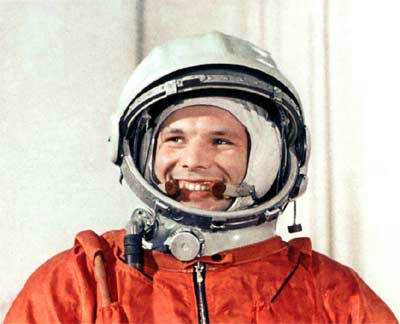
yuri_gagarin1On the morning of April 12, 1961, Soviet cosmonaut Yuri Gagarin lifted off aboard Vostok 1 to become the first human in space, becoming an instant hero to many and an historic figure. Tragically, his life was cut short when just seven years later (on March 27th, 1968) the MiG-15 UTI he was piloting crashed. Ever since, his death has been shrouded in confusion and controversy, with many theories being posited as to what actually cause.

And now, some 45 years after the fact, the details about what really happened to cause the death of the first man in space have come out — from the first man to go out on a spacewalk, no less. In an article published online on Russia Today, former cosmonaut Aleksey Leonov — who performed the first EVA on March 18, 1965 — has revealed details about the accident that killed both Yuri Gagarin and his flight instructor Vladimir Seryogin in March 1968.

yuri_gagarinA soft-spoken and well-mannered man, Gagarin began his journey into space in 1960 when he and 19 other pilots were selected to take part in the Soviet space program. Just three years after making history with the launch of the first artificial satellite into space (Sputnik-1), the Russians were eager to follow this up with a mission that would put a man into low-Earth orbit.

After a grueling selection process involving physical and psychological tests, Gagarin was selected to take the pioneering flight inside the Vostok-1 space capsule. The launch, which was eagerly monitored by people all over Russia and around the world, took place at exactly 9:07 am local time (06:07 UT) on 12 April 1961. After spending just under two hours in orbit, the capsule made reentry, Gagarin exited it and parachuted to the ground, landing at around 11:05 am (08:05 UT) in a farmer’s field outside of Engels.

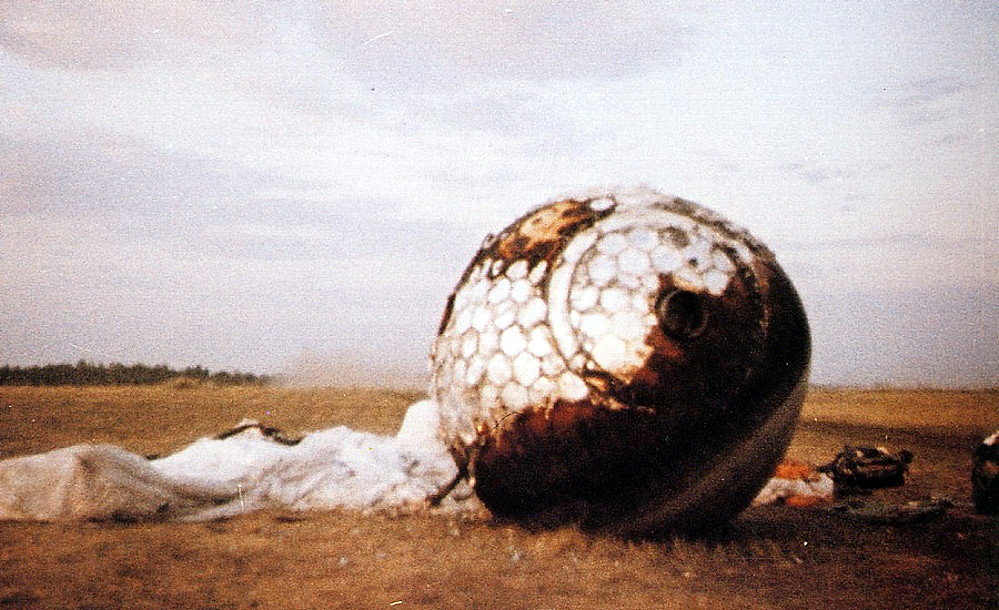
vostok-1_landingObserving the landing of Vostok-1 were two school girls, who recalled the site of the capsule hitting the ground with a combination of fascination and fear:

It was a huge ball, about two or three metres high. It fell, then it bounced and then it fell again. There was a huge hole where it hit the first time.

Elsewhere, a farmer and her daughter observed the strange scene of a figure in a bright orange suit with a large white helmet landing near them by parachute. Gagarin later recalled:

When they saw me in my spacesuit and the parachute dragging alongside as I walked, they started to back away in fear. I told them, ‘Don’t be afraid, I am a Soviet like you, who has descended from space and I must find a telephone to call Moscow!’

After the flight, Gagarin became a worldwide celebrity, touring widely abroad to promote the Soviet’s accomplishment in putting a man into space. Upon returning home, he found himself relegated to training and other tasks, due in part to the death of his friend, Vladimir Komarov in the first flight involving a Soyuz spacecraft. Shortly thereafter, he began to re-qualify to become a fighter pilot, and died during one of his training flights.

Su-15_FlagonOfficially, reports about Gagarin and Seryogin’s death claim that the plane crashed when Gagarin manuevered the two-seated training version of the MiG-15 fighter craft to avoid a “foreign object”. The report does not specify what this object was, but the term refers to  anything from balloons and flocks of birds to airborne debris or another airborne craft. And as you can imagine, people have made some very interesting suggestions as to what this object could have been.

Now, a declassified report, which Leonov has been permitted to share, shows what actually happened during the training flight. Apparently, an “unauthorized Su-15 fighter” flew too close to Gagarin’s MiG, disrupting its flight and sending it into a spin. In his article, Leonov went on to explain in further detail:

In this case, the pilot didn’t follow the book, descending to an altitude of 450 meters. While afterburning the aircraft reduced its echelon at a distance of 10-15 meters in the clouds, passing close to Gagarin, turning his plane and thus sending it into a tailspin — a deep spiral, to be precise — at a speed of 750 kilometers per hour.

The pilot of the SU-15 survived the incident, is apparently still alive, and was not named – a condition of Leonov’s permission to share the information.

valentina_tereshkova_1Afterwards, the first woman into space, Valentina Tereshkova (also a Soviet cosmonaut) was officially grounded by the government after Gagarin’s death to avoid a loss of another prominent cosmonaut. After the revelation was made about the true cause of Gagarin’s death, she responded by saying that the details come as a bittersweet relief. “The only regret here is that it took so long for the truth to be revealed,” Tereshkova said. “But we can finally rest easy.

Indeed. Rest in peace, Yuri. Like many who have since come and gone, you’re a part of an extremely select few who went into space at a time when doing so was still considered by many to be an impossible dream. And regardless of the Cold War atmosphere in which this accomplishment occurred, it remains an historic first and one of the greatest accomplishments ever made by a human being.

Source: universetoday.com