Climate Crisis: City Farms

dragonfly-vertical-farm-for-a-future-new-york-1Hello again, folks. As you all know, this summer has brought some rather dire news on the climate front as unpredictable weather patterns have led to flooding in many parts of the world. And as climatological researchers and scientists have predicted, this is just the tip of the iceberg, as rising global temperatures will lead to melted icecaps, higher sea levels, severe droughts, wildfires and coastal storms.

But as I always like to point out, there are solutions to these problems, or at least ways to mediate them. Given the central role played by overpopulation and urban sprawl in climate change, many of these proposed solutions have to do with finding new ways to house, feed, and provide from future generations – ones which emphasize sustainability and clean energy.

city_farmsWhen it comes to feeding future generations of people, the question of what will be on the menu and where it comes from are paramount. In recent decades, massive crop failures, protracted droughts, and numerous food-borne disease outbreaks caused by microbes such as salmonella, E. coli, toxoplasma and listeria have forced people to contemplate where their food comes from and how it is produced.

The proposed solution is to rethink farming, moving out of the old paradigm of farming the lands around human settlements and moving them inside. These city-based agricultural projects include rooftop gardens, rooftop greenhouses, planting beds, empty lots as farmland, and vertical farms that occupy tall buildings and abandoned warehouses. Collectively, these examples show the validity of growing food in the city. Not only could be they be carried out efficiently, but they could also operate without the pollution associated with outdoor farming.

city_farms1In truth, the concept is not entirely new, as “victory gardens” or other variants have been a means of producing agricultural goods whenever national farms found themselves overburdened. These were all the rage in Britain, Canada, the US and Germany during World War I and II when naval blockades and military demand forced people to plant their own vegetables in their backyards.

In addition, after the collapse of the Soviet Union, Cuba found itself in a serious agricultural crisis. As a result, they turned to a vast network of ‘organoponicos’ – growing food for city dwellers in spare plots. These miniature agricultural operations not only staved off starvation and malnutrition during times of shortages, but became a model for sustainable local efforts that are currently being used around the world.
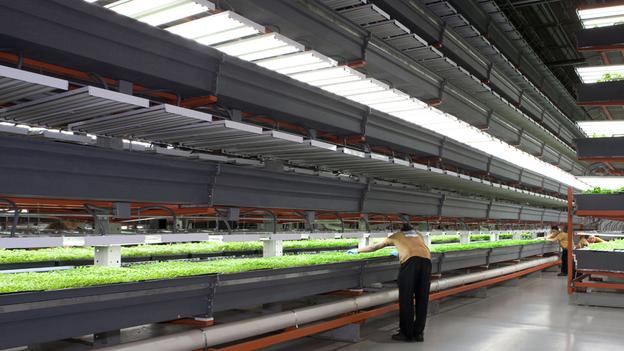
city_farms2For example, in Wilcox, Arizona, their is the EuroFresh Farms indoor-operation – a 318 acres (1.3 square km) of one-storey-high hydroponic greenhouses that supplies fresh tomatoes and cucumbers.  Similarly, the FarmedHere operation in Bedford Park, Illinois consists of a 8,360 square meter (90,000 square foot) empty warehouse that is several storeys tall that produces tilapia, a variety of leafy green vegetables, and several value-added products.

And in Sweden, the company known as Plantagon is building a vertical farm in the city of Linkoping, and has partnered with a Chinese company to research similar methods for the state of China. In addition, limited forms of vertical farming also exist in Japan, Korea, Singapore, the United States, and Canada, with new farms being planned for a number of cities in the United States.

city_farms4As always, technological innovation is assisting in the process. This includes such things as grow lights that have replaced expensive fluorescent fixtures with light-emitting diodes that can be adapted to emit light spectra tailored for growing green plants. In addition to costing less to run, their yields are demonstrably higher, especially where leafy greens and tomatoes are concerned.

Another concept which is being embraced is aquaculture – indoor fish hatcheries – which could provide meat protein to go with all these vegetables. Such operations include Hazorea Acquatics, a koi farming operation, as well as the carp and mullet farm pictured below, both of which are located in Israel . Similar operations are popping up in the US, Netherlands, Denmark, Scotland and Canada, where barramundi, sturgeon, tilapia, eels, catfish, trout and salmon are being raised.

city_farms5Looking to the long-run, urban agriculture has the potential to become so pervasive within our cities that by the year 2050 they may be able to provide its citizens with up to 50% of the food they consume. In doing so, ecosystems that were fragmented in favor of farmland could be allowed to regain most of their ecological functions, forests could recover, and the impact on the environment would very beneficial, for the planet as well as humanity.

In addition to ensuring that the greatest consumers of CO2 – trees and other flora – could re-advance on the landscape, allowing natural spaces to recover from the damages of agriculture would also bring countless species back from the brink of extinction. Loss of habitat is one of the chief causes of wildlife becoming endangered, and farm runoff is one of the greatest factors effecting our rivers and fish stocks.

Combined with water treatment and recycling that also happens on-site, solar, wind and peizoelectric power, and carbon capture that can turn CO2 into biofuel, skyscrapers and urban environments may very well advance to become at the forefront of the sustainability, environmental and clean energy movement. What was once the problem would thus become the solution. Truly innovative…

Source: bbc.com/future

Climate Crisis: Population Growth in Coming Years

trafficWhen it comes to populations and environmental problems, cities are at the very heart of the issue. Not only are they where the majority of humanity lives, a reality which will only get worse as time goes on, they are also the source of most of our pollution, waste, and land use. People require space to live and work, as well as food, water and

Last year, the world’s population increased to 7 billion, which represents a seven-fold increase in the space of the last two centuries. What’s more, the proportion of people living in urban centers (as opposed to rural) shot up from 3% to almost half of the world’s people. This rate of population growth and redistribution is unprecedented, and is not likely to slow down anytime soon.

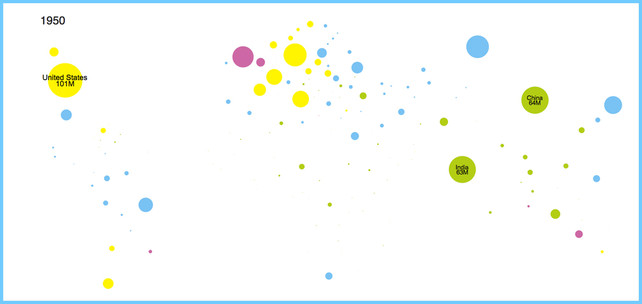
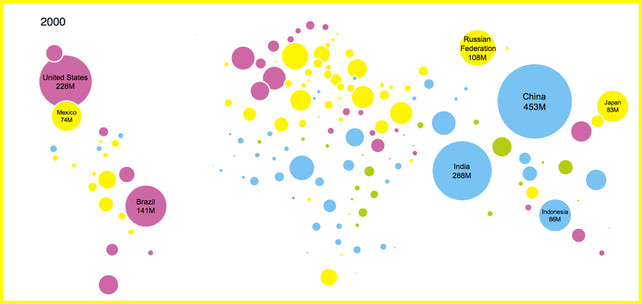
urbanworld_50Consider the following series of infographics which were released by Unicef with the help of the design studio Periscopic. Titled “An Urban World”, they illustrate the issues of population growth and distribution. This interactive, HTML5 visualization of the world covers the years of 1950-2050. But rather than showing our geographic boundaries, every country* is depicted only by their population living in urban environments.

As you can see, each country is represented by a circle that depicts the number of people living in urban environments. As these populations grow, the circles get bigger. And as urban populations get more dense, the circles shift from green to blue to yellow to fuchsia. Immediately, a glaring fact is made clear: the problem is getting worse and at an alarming rate.

urbanworld_2000In addition, there are several nuggets of info which are staggering and particularly worrisome. For example, by 2050, both China and India will have about a billion people living in cities alone. In addition, since the 1990s, more than 75% of the U.S. population has lived in cities. At one time, the US was an outlier in this regard, but found ourselves joined over the next two decades by France, Spain, the U.K., Mexico, Korea, Australia, and Brazil.

But of course, this growth need not be a bad thing. When all is said and done, humanity has a choice. One the one hand, these megacities can take the form of smartly scaled communities of loosely populated expanses and efficient agriculture. On the other, they could easily take the form of urban slums and underdeveloped countrysides that are stricken by poverty and filthy.

urbanworld_2050It’s a complex issue, no doubt about it, especially when you consider the flip side to the whole equation. As the saying goes, every new life means a new mouth to feed, but also a pair of working hands. What’s more, studies have shown that people living in cities tend to be far more energy efficient, and that energy surplus is usually directed toward more and more technological growth and innovation.

Seen in this light, the massive cities of the future could be hubs for the ongoing development of new energies and creative living solutions. And with more people living in large, connected, interdependent environments, the more business startups, ideas, and contributions were likely to get. Part of the reason we have seen so much progress in solar, piezoelectric motors, and bio-electricity is because of this trend. More growth will conversely mean more clean energy.

overpopulation Quite the paradox, really. Who knew people could be both the cause and solution to the world’s worst problem! In the meantime, feel free to head on over to the Unicef site and watch this interactive infographic. Just press play, and watch the cities of the world swell at the edges, competing for room on the page as they compete for room on this planet.

Also, be sure to take a gander at this infographic from BBC Future that demonstrates the current population of the world’s major cities per square meter, the projected population per square meter by 2050, and the livability rating of the city in question. They even provide some context at the bottom by showing the size of relative spaces – from prison cells to Olympic swimming pools, and comparing that to the average space an urban dweller enjoys.

city_spaces
Sources:
bbc.com, fastcodesign.com
, unicef.org

Drone Wars: New Revelations and Broken Promises

???????????????????????????????????????????????????????????????????????????????????????????????????????????????????????????????????????????????????????????????????????????????????????????????????????????????????????????????????????????????????????????????????????????????????????????????????????????????????????????????????People concerned about the use of drones might remember fondly how President Obama, in a speech held late last month, promised that the “drone surge” was effectively at an end. As it turns out, it took the President and his administration only eight days to break that promise. In a new strike, which killed four people it has been made clear that the clandestine war continues.

In Obama’s speech, he contended that “Beyond the Afghan theater, we only target al-Qaida and its associated forces, and even then, the use of drones is heavily constrained.” Among those constraints are the use of detainment instead of execution, and “respect for state sovereignty”. Perhaps most importantly, Obama underscored the drones will for now on only target “terrorists who pose a continuing and imminent threat to the American people.”

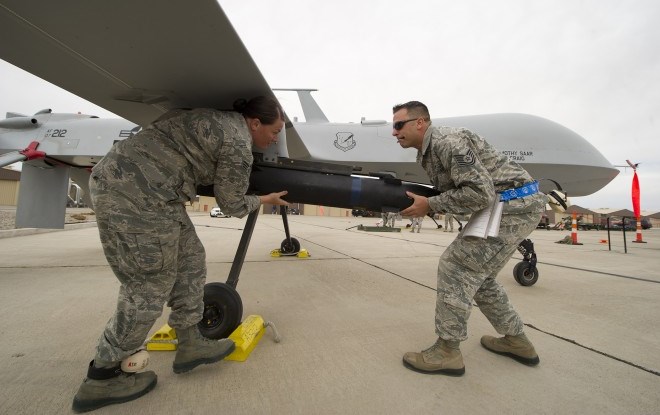
(U.S. Air Force photo/Staff Sgt. Brian Ferguson)(Released)To clarify this point, the White House even released a fact sheet clarifying whom it will and will not kill in the future. It stated that:

[T]he United States will use lethal force only against a target that poses a continuing, imminent threat to U.S. persons. It is simply not the case that all terrorists pose a continuing, imminent threat to U.S. persons; if a terrorist does not pose such a threat, the United States will not use lethal force.

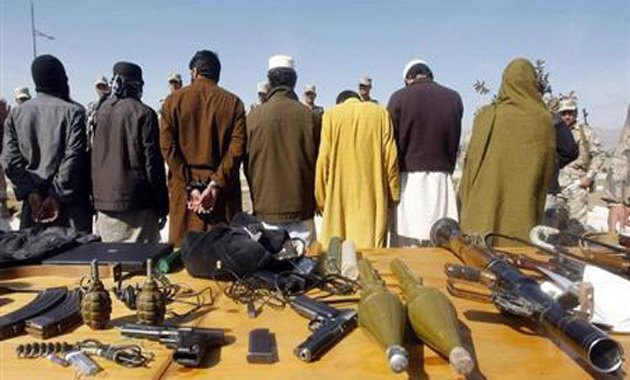
However, this latest strike, which took out Wali ur-Rehman – the second in command of the Pakistani Taliban – and three other members shows that this is anything but the case. Rehman and his ilk are not members of Al-Qaeda, nor do they represent a terrorist group that is targeting the US and its citizens. Most importantly, they are not operating inside Afghanistan.

talibanFact is, Rehman and his compatriots pose a threat to only Pakistan, which is involved in an ongoing war with fundamentalist factions in its western provinces. They are the enemies of the Pakistani state, which is a nominal ally in the war on terror and with the war in Afghanistan. This makes his execution at the hands of the US a matter of protecting political and strategic interests, not anti-terrorism.

What’s more, there are indications that this strike may have been counterproductive for Pakistan. Pakistani military sources told Reuters in December that Rehman was “a more pragmatic” leader than incumbent Hakimullah Mehsud, with whom Rehman was said to be feuding. While Rehman was said to pursue reconciliation with the Pakistani government, the Pakistani military officers speculated that his rise “might lead to more attacks across the border in Afghanistan” on U.S.-led forces.

drone_warSo any way you slice it, this latest drone strike was a clandestine operation made by a government that claimed to be finished with such things. Lucky for us, there may be a way to gleam the truth about the secret history of the drone war and their ongoing use as tools of government policy.

As it turns out, there are ways to hack and record drone video feeds to see what they see right before they unleash death and destruction. And in an ironic twist, much of the credit for this revelation may go to a group of Iraqi insurgents. In 2008, U.S. troops in Iraq declared that Shi’ite insurgents had figured out how to tap and record video feeds from overhead American drones.

Hackers-With-An-AgendaBuilding on this, Josh Begley, a 28-year-old NYU grad student, is creating a software application that will allow anyone with basic coding skills to organize, analyze and visualize drone-strike data from Pakistan, Yemen and Somalia dating back to 2002. Based on information collected by the U.K. Bureau of Investigative Journalism, the Applicable Programing Interface (API) can be used to create interactive Websites that elaborate on the information and give it context.

The drone API, which is actually Begley’s master’s thesis, is not his first foray into capturing robot-attack data. His @dronestream Twitter feed documents all reported UAV attacks. Last year Begley created an iPhone app that tracks drone strikes, but Apple rejected it. Other developers have jumped on the bandwagon, too. London-based artist James Bridle runs a Tumblr blog that matches overhead satellite imagery to reports of drone attacks.

drone_target_1In an interview with Wired’s Danger Room, Begley explained that the purpose behind this software is the desire to bridge the “empathy gap” between Western audiences and drone-attack victims:

To Americans like me, what may have previously been blank spots on the map all of a sudden have complex stories, voices of their own. From 30,000 feet it might just be cars and buildings. But there are people in them. People who live under the drones we fly.

The public release of Begley’s API, which took five months to complete, is timed to coincide with the White House-promoted National Day of Civic Hacking on June 1. Hacking Day aims to “liberate government data for coders and entrepreneurs.” The ACLU, for one, is commemorating the event with an API linked to the group’s vast database of documents related to U.S.-sanctioned torture of terror suspects.
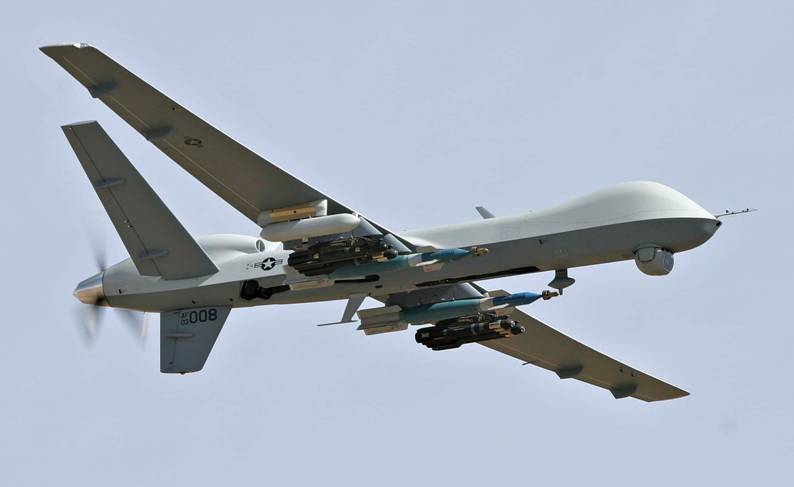
drone_map1After twelve years of drone strikes and promises that don’t appear to be being honored, the arrival of this app might just be what the public needs. And even though software giants like Apple may not be interested in developing it further, there are no shortages of talented individuals, professional hackers and hobby labs that will take up the cause.

It wouldn’t be too farfetched to think that a plethora of websites will begin to emerge that can track, monitor, and record all drone strikes, perhaps even as they happen. And combined with recent revelations about state-run data mining operations and software that is being designed to combat it, private citizens may be able to truly fight back against clandestine operations and government surveillance.

Sources: Wired.com, (2)

Climate Crisis: Rising Tides and Sinking Cities

climate_changetideWith all the population, urban sprawl, and consumption that we as a species are imposing on the planet, there are those who argue that we’ve entered a new geological era – known as the Anthropocene. It’s an age we’ve lived in since the neolithic revolution and the advent of farming, one where the human race is the dominant force shaping our planet. Since the industrial revolution, this era has been accelerating and escalating, and things are not likely to get better anytime soon.

It is because of this that we need to contemplate what the near future will look like. Consider the recent floods in the Canadian Prairies, or last year’s wildfires which raged across the American midwest. Consider the famines and shortages that led to a world food price crisis in 2007-8 which had serious political consequences, especially in the Middle East (i.e. the Arab Spring).
climate_changesandyWhen you add to this the fact that rising tides and the increased risk of storms are already effecting coastal communities in severe ways, you begin to understand just how turbulent the next few decades are likely to be. Already, incidents like Hurricane Katrina and Sandy, which rocked the Gulf of Mexico and the Eastern Seaboard in just the past decade, have shown just how extensive the damage can be.


Historically speaking, cities have been built in fertile river valleys and at river mouths to take advantage of fertile conditions, maritime resources and trade. Agricultural run-offs of sediment, water and nutrients created rich coastal deltas that could support greater food production. This and the good maritime and river connections for trade and transport made these ideal places to live.

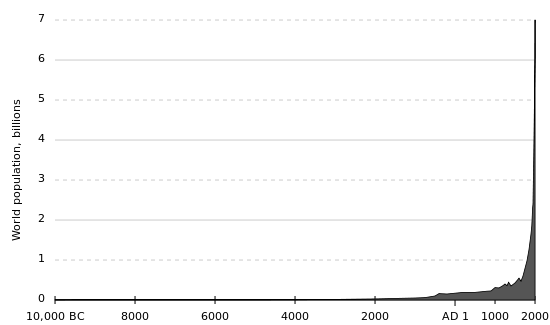
Population_curve.svgBut as populations grew, rivers were tapped and diverted for irrigation, industry and canal transport. They were also trapped behind dams and reservoirs for energy and water storage, and depleted by droughts and other extractions. Meanwhile groundwater is increasingly being extracted from beneath cities, and sea levels are rising because of the run-off from the melting of glaciers and thermal expansion of the oceans.

As a result of these changes, many major cities are slowly sinking into the oceans. Our rapid industrialization over the past century has sped these processes, so that now, many urban centers face inundation by storm surges, and we stand to lose many of the most economically important parts of our planet. The loss of these cities will mean a terrible loss of life, economic fallout, and a massive refugee crisis.

Population_densityCities from Bangkok to New York have already experienced emergency flood conditions, and many more are to follow. Those most at risk include Mumbai, Guangzhou, Shanghai, Miami, Ho Chi Minh City, Calcutta, New York City, Osaka-Kibe, Alexandria and New Orleans. More than 3 billion people currently live in coastal areas at risk of global warming impacts such as rising sea levels – a number expected to rise to 6 billion by 2025.

And as was recently learned, the carbon levels in the upper atmosphere have surpassed 400 ppm (parts per million). The last time the atmosphere boasted this concentration of greenhouse gases was the Pliocene Era, a time when sea levels were as much as 60 to 80 feet higher than they current are. If sea levels rise to that level again, we can say goodbye to all these major cities, as well as any that sit on major waterways.

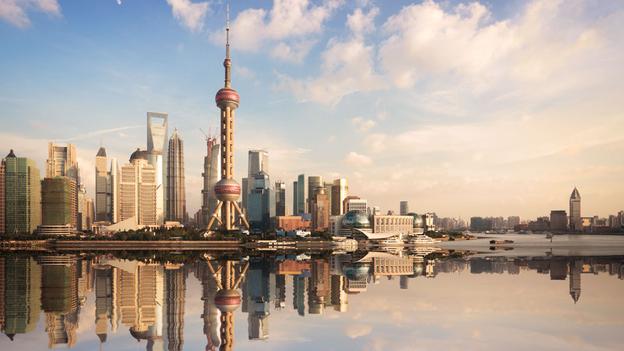
climate_changeshanghaiIt’s not just a matter of water rising up to swallow the coastlines, you see. As the flooding in southern Alberta and the Canadian Prairies demonstrated this week, there’s also the threat of flooding due to increased precipitation and of sewage systems backing up from increased storms and rainfall. These threats make shoring up river deltas and waterways effectively useless, since its not simply a matter of blocking the tides and rivers.

In terms of solutions, a number of major cities are investing in new sea walls, dykes and polders, or high-tide gates – like London’s Thames Barrier – to hold back high waters. In poorer places, people simply endure the problem until they are forced to abandon their homes. As the problem gets worse though, coordinated efforts to rescue people caught in flood zones will need to be mounted.

climate_changedykesAnd there are those who speculate that underwriting the damage will be a waste of time, since no government will be able to afford to compensate its citizens for the untold billions in property damage. In reality, many of these place will simply have to be abandoned as they become unlivable, and those forced out resettled to higher ground or protected communities.

At this point in any lecture on the fate of our planet, people are about ready to abandon hope and hang themselves. Hence, I should take this opportunity to point out that plans for dealing with the problem at the root – cutting our carbon footprint – are well underway. In addition to clean energy becoming more and more feasible commercially, there are also some very viable concepts for carbon capture.

These include inventions like artificial trees and ecoengineering, which will no doubt become absolutely essential in coming years. At the same time though, urban planning and architecture are beginning to embrace a number of alternative and clean technology concepts as part of their design. Not only will future buildings be designed to provide for the needs of their residents – food, water, electricity – in sustainable ways, they will also incorporate devices that can trap smog and turn it into biofuels and other useful products.

Of this, I will be saying more in the next post “Thinking, Breathing Cities of the Future”. Stay tuned!

Source: bbc.com

Patenting Genes: US Supreme Court Says No

dna_doublehelixLast week, in a landmark decision that is expected to have far-reaching consequences, the United States Supreme Court announced in a unanimous decision that no part of the human DNA sequence – or the DNA of any living organism – is patentable. This decision came after thirty years of patents being issued on genes for the sake of genetic research, and which was spurred on by recent developments, such as the publication of the human genome.

Specifically, the case came down to a claim made by Myriad Genetics, the company that discovered the BRCA-1 and BRCA-2 genetic mutations that can lead to higher incidences of breast cancer. They patented these sequences in the hopes of having a lucrative investment when it came to future screenings and treatments. But for many, this signaled that a line was being crossed, and the case went to court.

us_supremecourtFor critics of Myriad’s attempt to patent the genetic mutations, they claimed that this made screening often prohibitively expensive. Angelina Jolie was one such person, who drew attention to the fact that her mother – who died of breast cancer – and women like her would be unable to afford the treatment if Myriad got it’s way. Myriad fought back by saying that without the possibility of future financial gain, there would be no incentive for companies to sink money into searching for these genes.

In the end, the Supreme Court voted 9 to 0 that genes are products of nature and not human-made inventions, which makes them ineligible for a patent. For many, this decision has temporarily closed Pandora’s Box and prevented corporations from obtaining the right to carve up the human genome and lay claim to it, a process which many believed would lead to monopolies of gene treatments and the potential ownership of human beings themselves.

GMO_seedsOn the other hand, the court’s ruling did not apply to one other key issue: synthetic genes. Basically, genetic modifications that are made my companies for the sake of modifying foods, agricultural produce, and even animals are still up for grabs. And at least one major corporation is pretty pleased about this. In allowing for synthetic genes to remain a grey area, Monsanto is likely to continue seeking to patent its genetically-modified seeds.

Just over a month ago, the Supreme Court ruled in favor of the giant agribusiness in one of the most important lawsuits filed by the company in recent years. In essence, the court’s ruled that an Indiana soybean farmer was infringing on Monsanto’s soybean patent by buying the seeds from a nearby grain elevator and then saving them.

agribusinessOf the 144 lawsuits filed against 410 farmers and 56 small farm businesses throughout the U.S. in the past few years (according to the Center for Food Safety), this case was especially important. It essentially set the precedent that anyone selling genetically-modified grains had to pay royalties to the company responsible for their creation. This in turn has long-reaching implications which go far beyond agribusiness.

Though it is still a grey area, the legal battle over modified genes seems all but decided at this point. Whereas natural genes cannot be subject to patents, anything a company modifies in a lab already have been. But given the growth of skunkworks and biohacking labs around the world, there is still time for small operations and independent companies to get in on the action.

As time has shown, diversification is the natural enemy of monopolization. But by far the most important thing of all, whether it’s about patenting genes or modifying them for our use, is for people to remain informed on the issue. As long as people know what decisions are being made behind closed doors, they will have a shot at controlling the outcome.

Sources: fastcoexist.com, (2)

Cyberwars: Massive Government Surveillance Uncovered!

wire_tappingOn Friday, Washington DC found itself embroiled in controversy as revelations were made about the extent to which US authorities have been spying on Americans in the last six years. This news came on the heels of the announcement that the federal government had been secretly cataloging all of Verizon’s phone records. No sooner had the dust settled on that revelation that it became known that the scope of the Obama administration’s surveillance programs was far greater than anyone had imagined.

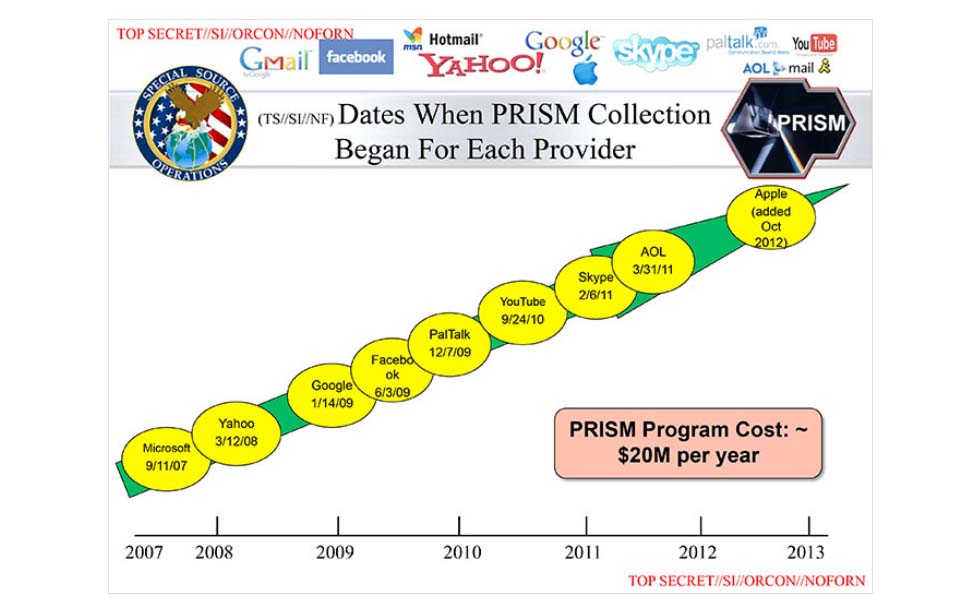
According to updated information on the matter, it is now known that The National Security Agency (NSA) and the FBI have been tapping directly into the central servers of nine leading U.S. Internet companies, extracting everything from audio and video chats, photographs, e-mails, documents, and connection logs that would enable their analysts to track foreign targets.

prism3This information was revealed thanks to a secret document that was leaked to the Washington Post, which shows for the first time that under the Obama administration, the communication records of millions of US citizens are being collected indiscriminately and in bulk – regardless of whether they are suspected of any wrongdoing. Equally distressing is the names being named: U.S. Service Providers such as Microsoft, Yahoo, Google, Facebook, PalTalk, AOL, Skype, YouTube, Apple.

The document further indicates that all of this has been taking place since 2007, when news disclosures, lawsuits and the Foreign Intelligence Surveillance Court forced then-president George W. Bush to look for new authority to justify his program warrantless domestic surveillance. It’s continuance and expansion under Obama has created a great deal of understandable intrigue, and not only because of promises made that “illegal wiretapping” would not take place under his watch.

prism1The joint FBI-NSA program responsible for mining all the data is known as PRISM, and it may very well be the first of its kind. While the NSA and FBI have a long history of monitoring suspects via phone records and computer activity, and are both accustomed to corporate partnerships that help it divert data traffic or sidestep barriers, such a vast program has never before been possible. In the current information age, there is an immense wealth of information out there, and where better to access all of this than in Silicon Valley?

Not long after the news broke in Washington, London’s Guardian reported that GCHQ, Britain’s equivalent of the NSA, also has been secretly gathering intelligence from the same internet companies through an operation set up by the NSA. According to the same leaked information, PRISM appears to allow the GCHQ to circumvent the formal legal process required in Britain to seek personal material such as emails, photos and videos from an internet company based outside of the country.

prism2But perhaps worst of all is the fact that this process is entirely above board, at least for the companies involved. Back in 2007, Congress passed the Protect America Act, and then in 2008 followed it up with the FISA Amendments Act, both of which immunized private companies that cooperated voluntarily with U.S. intelligence collection against prosecution. And late last year, when critics in Congress sought changes in the FISA Amendments Act, the only lawmakers who knew about PRISM were bound by oaths of office to hold their tongues.

An anticipated, a bi-partisan amalgam of Senators came out to defend the initial reports of phone record monitoring shortly after it was announced. In a rare display of solidarity that cut across party lines, Democrats and Republicans from both the Senate and House came forward to say that the program was justified, only spied on terrorists, and that law-abiding citizens need not worry.

National Security Agency - aerial view
National Security Agency – aerial view

Once again, the argument “if you’ve done nothing wrong, you’ve got nothing to fear” finds itself employed by people who do not want to voice criticisms about a government spying program. Echoes of the Bush administration and McCarthy era all over again. Needless to say, all of this has many people worried, not the least of which are people opposed to government intrusion and the protection of privacy for the past decade.

Ever since it became possible to “mine data”  from numerous online digital sources, there has been fear that corporations or governments might try to ascertain the habits and comings and goings of regular people in order to effectively monitor them. For some time now, this sort of monitoring has been somewhat benign, in the form of anticipating their spending habits and using targeted advertising. But always, the fear that something more sinister and totalitarian might emerge.

government-surveillanceAnd with the “War on Terror”, the Patriot Act, domestic warrantless wiretapping, the legitimization of torture, and a slew of other crimes the Bush administration was indicted in, people all over the world have become convinced that “Big Brother” government is just around the corner, if indeed it is not already here.

The fact that such processes have continued and even expanded under Obama, a man who originally pledged not to engage in such behavior, has made a bad situation worse. In many ways, it demonstrates that fears that he too would succumb to internal pressure were justified. Much as he was won over by the Pentagon and CIA to continue the war in Afghanistan and UAV programs, it seems that the constellation of FBI and NSA specialists advising him on domestic surveillance has managed to sway him here as well.

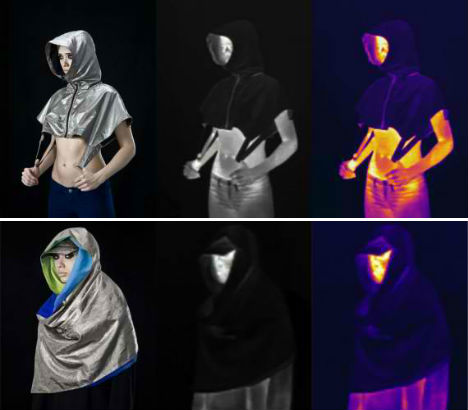
Stealth-Wear1One can only hope that this revelation causes the federal government and the Obama administration to reconsider their stances. After all, these are the same people who were convinced to stand down on the use of UAVs in oversees operations and to take measures that would ensure transparency in the future. We can also hope that the NSA and FBI will be required to once again have to rely on the court system and demonstrate “just cause” before initiating any domestic surveillance in the future.

Otherwise, we might all need to consider getting our hands on some stealth wear and personal cameras, to shield ourselves and create an environment of “sousveillance” so we can spy on everything the government does. Might not hurt to start monitoring the comings and goings of every telecommunications and Silicon Valley CEO while were at it! For as the saying goes, “who watches the watchers?” I’ll give you a hint: we do!

Also, be sure to check out the gallery of artist Adam Harvey, the man who pioneered “stealth wear” as a protest against the use of drones and domestic surveillance. To learn more about sousveillance, the concept of a society monitored by common people, check out Steve Mann’s (inventor of the EyeTap) blog.

Sources: washingtonpost.com, guardian.co.uk, policymic.com, ahprojects.com, eyetap.blogspot.ca


The Future of the Classroom

virtual_learning2As an educator, technological innovation is a subject that comes up quite often. Not only are teachers expected to keep up with trends so they can adapt them into their teaching strategies, classrooms,and prepare children in how to use them, they are also forced to contend with how these trends are changing the very nature of education itself. If there was one thing we were told repeatedly in Teacher’s College, it was that times are changing, and we must change along with them.

And as history has repeatedly taught us, technological integration not only changes the way we do things, but the way we perceive things. As we come to be more and more dependent on digital devices, electronics and wireless communications to give us instant access to a staggering amount of technology, we have to be concerned with how this will effect and even erode traditional means of information transmission. After all, how can reading and lecture series’ be expected to keep kid’s attention when they are accustomed to lighting fast videos, flash media, and games?

envisioning-the-future-of-education

And let’s not forget this seminal infographic, “Envisioning the future of educational technology” by Envisioning Technology. As one of many think tanks dedicated to predicting tech-trends, they are just one of many voices that is predicting that in time, education will no longer require the classroom and perhaps even teachers, because modern communications have made the locale and the leader virtually obsolete.

Pointing to such trends as Massive Open Online Courses, several forecasters foresee a grand transformation in the not too distant future where all learning happens online and in virtual environments. These would be based around “microlearning”, moments where people access the desired information through any number of means (i.e. a google search) and educate themselves without the need for instruction or direction.

virtual_learning3The technical term for this future trend is Socialstructured Learning = an aggregation of microlearning experiences drawn from a rich ecology of content and driven not by grades but by social and intrinsic rewards. This trend may very well be the future, but the foundations of this kind of education lie far in the past. Leading philosophers of education–from Socrates to Plutarch, Rousseau to Dewey–talked about many of these ideals centuries ago. The only difference is that today, we have a host of tools to make their vision reality.

One such tool comes in the form of augmented reality displays, which are becoming more and more common thanks to devices like Google Glass, the EyeTap or the Yelp Monocle. Simply point at a location, and you are able to obtain information you want about various “points of interest”. Imagine then if you could do the same thing, but instead receive historic, artistic, demographic, environmental, architectural, and other kinds of information embedded in the real world?

virtual_learningThis is the reasoning behind projects like HyperCities, a project from USC and UCLA that layers historical information on actual city terrain. As you walk around with your cell phone, you can point to a site and see what it looked like a century ago, who lived there, what the environment was like. The Smithsonian also has a free app called Leafsnap, which allows people to identify specific strains of trees and botany by simply snapping photos of its leaves.

In many respects, it reminds me of the impact these sorts of developments are having on politics and industry as well. Consider how quickly blogging and open source information has been supplanting traditional media – like print news, tv and news radio. Not only are these traditional sources unable to supply up-to-the-minute information compared to Twitter, Facebook, and live video streams, they are subject to censorship and regulations the others are not.

Attractive blonde navigating futuristic interfaceIn terms of industry, programs like Kickstarter and Indiegogo – crowdsources, crowdfunding, and internet-based marketing – are making it possible to sponsor and fund research and development initiatives that would not have been possible a few years ago. Because of this, the traditional gatekeepers, aka. corporate sponsors, are no longer required to dictate the pace and advancement of commercial development.

In short, we are entering into a world that is becoming far more open, democratic, and chaotic. Many people fear that into this environment, someone new will step in to act as “Big Brother”, or the pace of change and the nature of the developments will somehow give certain monolithic entities complete control over our lives. Personally, I think this is an outmoded fear, and that the real threat comes from the chaos that such open control and sourcing could lead to.

Is humanity ready for democratic anarchy – aka. Demarchy (a subject I am semi-obsessed with)? Do we even have the means to behave ourselves in such a free social arrangement? Opinion varies, and history is not the best indication. Not only is it loaded with examples of bad behavior, previous generations didn’t exactly have the same means we currently do. So basically, we’re flying blind… Spooky!

Sources: fastcoexist.com, envisioningtech.com

Drone Wars: New Promises, Same Problems

(U.S. Air Force photo/Staff Sgt. Brian Ferguson)(Released)The practice of using UAV’s as part of a targeted strategy in Pakistan, Afghanistan, Somalia and Yemen has become so frequent that its come to characterize the Obama administration’s handling of the “War on Terror”. Reaction to this policy has been increasingly critical, due in no small part to unanswered questions surrounding civilian death tolls and the rapid escalation of deployment. In response, the Obama administration announced this past week that the surge is at an end.

In a speech made to the National Defense University in Washington on Thursday, Obama emphasized that from now on, the use of UAV’s would be in the hand of the military instead of clandestine intelligence organizations such as the CIA. He also indicated that the rules for launching the strikes would be stricter. For instance, there must be a “near certainty” that no civilians will be killed, and the strikes are to become less frequent.

predator_profileWhile Obama would not declare an end to the war on terrorism, he did offer to work with Congress to constrain some of his own authorities for waging it, which may include the creation of a court modeled on the secretive one used by the NSA to oversea the surveillance of suspected foreign agents. He also expressed a preference to constrain “and ultimately repeal” the broad latitude of warmaking powers granted in the Authorization to Use Military Force (AUMF), an act that was created in 2001 by the Bush administration which is considered the wellspring of the “War on Terror”.

And above all, issues of legality are to take a backseat to the moral and ethical implications raised by ongoing use. Or as he put it: “To say a military tactic is legal, or even effective is not to say it is wise or moral in every instance.”

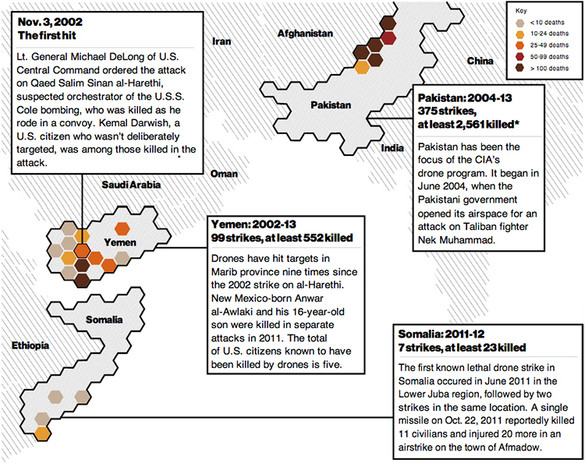
Naturally, a great many questions remain. In addition to how drones will be used in the years to come to combat terrorism and militants, there’s also questions surrounding their use thus far. Despite pledges made by Obama that changes will be made, the history of the program is still shrouded in mystery. Fittingly, Bloomberg Businessweek created a map to serve as a reminder of the scope of that program, calling it the first ever “comprehensive compilation of all known lethal U.S. drone attacks.”

drone_map

It should be noted though that the numbers represent an estimate which were compiled with the help of the nonprofit Bureau of Investigative Journalism. Sources in Washington apparently offer a wide range of numbers, and the State Department remains hush hush on the issue of casualties. However, the estimates presented in this infographic still present a stark and sobering picture:

  • Yemen: at least 552 killed between 2002 and 2013. The site of the first ever drone strike in 2002.
  • Pakistan: at least 2,561 killed between 2004 and 2013.
  • Somalia: at least 23 killed between 2011 and 2012.

drone_map1Naturally, it is hoped that Obama’s promise to curb the use of drones represents a renewed commitment to comply with international law, treaties and human rights. However, what was apparently missing from the speech was an indication about how easy it will be to get information about strikes that are made in the future. According to the New York Times’ Mark Mazzetti, who provided live analysis of the speech, Obama’s speech didn’t address the issue:

One of the big outstanding questions is just how transparent the Obama administration will be about drone strikes in the future. Will administration officials begin to publicly confirm strikes after they happen?

There was no mention of this in the speech, and it is telling that the president did not mention the C.I.A. at all. It seems quite certain that past operations in Pakistan, Yemen and elsewhere are not going to be declassified anytime soon.

Also, moving operations from the C.I.A. to the Pentagon does not automatically mean that the strikes will be publicly discussed. The Pentagon is carrying out a secret drone program in Yemen right now, and it is very difficult to get information about those operations.

So… promises to curb the use of drones have been made, as well as promises to create some kind of oversight for future operations. And this does seem consistent with many of the criticisms made about the ongoing war on terrorism, specifically the Bush administrations handling of it and how his reliance on special executive powers were unlawful and unconstitutional.

But until such time as information on how these strikes occur and who is being killed, the issue will remain a contentious and divisive one. So long as governments can wage war with automated or remote machinery and kill people without transparency and in secrecy, will this not constitute a form of illegal – or at the very least, a very opaque – warfare?

Sources: wired.com, fastcoexist.com, businessweek.com

Update: 3D-Printed Gun Faces Crackdown

defense-distributed-liberator,Z-M-383602-13Just a few days ago, Defense Distributed announced the creation of the world’s first gun that is made entirely out of 3D-printed parts. And as anticipated, it didn’t take long for a crackdown to ensue. The group’s leader Cody Wilson, after conducting the first successful firing test of “The Liberator”, claimed that the blueprints would be uploaded to the open-source website Defcad so they would be available to anyone.

Yesterday, less than a week after the announcement was made, Mr. Wilson claimed that Defcad is “going dark” at the request of the U.S. Department of Defense Trade Controls. Defense Distributed runs the website, which has been a provider of weapons-related 3D printer blueprints since the group was founded.

Defense Distributed new magazines

As of yesterday, the site contained only a brief message explaining why it the Liberator blueprints were no longer available:

Defcad files are being removed from public access at the request of the U.S. Department of Defence Trade Controls. Until further notice, the United States government claims control of the information.

The group’s twitter feed also contained the following message:

#DEFCAD has gone dark at the request of the Department of Defense Trade Controls. Take it up with the Secretary of State.

The weapon itself was the result of eight months of research and testing on behalf of Wilson and his group. In that time, the group has become a source of controversy due to their dedication to making blueprints for printable gun parts available online. These include components for AR-15 assault weapon and extended magazines for an AK-47 assault rifle.

defense_distmagHowever, the Liberator, named in honor of the single-shot pistols that were dropped on France during the Second World War, was the first set of blueprints that was made entirely out of ABS plastic, making it the first open-source “Wiki-weapon” that would be available to anyone with the means to print it.

As a result of their commitment to open-source weaponry, Defense Distributed has become the subject of penalties and restrictions. In fact, Defcad was created after Makerbot Industries chose to purge all of the group’s gun blueprints from the website. Shortly after they test-fired an AR-15 that included printed parts, Wilson and his associates also had their 3D printer, which they had been leasing, seized.

defense_dist1This latest decision targets their activities at their source. However, the decision to take the plans off of Defcad did not present an estimated 10,000 downloads. However, it is not clear if those who obtained the plans will be able to print them off at their local printing shop. Only those who already possess a 3D printing unit, which is likely to run them between $1000 and $3000 dollars will be able to produce their own version of the Liberator.

In short, this issue is not yet resolved. Knowing Wilson and his admirers, open-source, printable weapons are likely to remain a contentious issue for some time to come…

Source: cbc.ca

People Shooting at You: There’s an App For That!

gun-firing

If the collapse of gun legislation in the US concerns you, fear not! Computer engineers at Vanderbilt University have developed a lightweight module that works in combination with a smartphone. This device, which about the size of a pack of cards, can pick up the “sonic signature” of a gun going off, and then sense shockwaves from the bullet. It sends the combined information to an Android phone, where it is plotted on a map.

So if you’re on the street and find yourself caught in the middle of a gang war, or are just randomly targeted by a sniper or gunman on a psychotic break, you will be able to pinpoint where the bullets are coming from. This should come in handy if you plan on returning fire. But if you’re planning on sitting tight and letting the police handle it, that’s good too. Chances are, they’ll have their own units on them, as will soldiers.

gang_violence

The device is essentially a commercialized version of military technology under development by DARPA. And aside from ordinary citizens, it’s likely to be picked up for use by bodyguards and the police. Earlier versions were tested with the US armed forces, but the team has since developed two versions of the device, one for commercial use that requires four units to located where a shooter is coming, and the militarized version that requires only two.

These and other subsequent versions are likely to be incorporated into all Future Force Warrior designs, giving soldiers the ability to detect where snipers and enemy combatants are shooting at them from. These are likely to come handy in densely populated areas, or in areas where insurgents and guerrillas constitute the majority of enemy combatants – as has been the case in Iraq and Afghanistan.

ghost_recon_future_soldier-1920x1080

Granted, a far easier solution would solution would be to get the guns off the streets. But seeing as how that’s not likely to happen anytime soon, due in large part to the powerful pro-gun lobby in Washington, people may want to invest in some of these boxes. After all, if there’s a lesson in the most recent deadlock, it is that citizens have the right to protect themselves. This way, they can do so without having to buy a hand gun, assault weapon, or body armor!

Source: fastcoexist.com