Star Wars: The Old Republic trailer

As far as the gaming world is concerned, this trailer is old news! But, it’s news to me, and I thought it was pretty darned cool. Not sure how I missed it, since during 2010 I felt I was pretty up on all the news surrounding SWTOR, the third installment in the Knights Of The Old Republic  (or KOTOR, for short) video-game series. Guess not. And of course, when fan reviews began to pour in saying that the game was not all it was cracked up to be, I kind of lost interest.

However, news is beginning to circulate that the KOTOR franchise might actually be the basis for the next Star Wars trilogy. I kid you not, not only is LucasArts deep into deals with Disney to produce the next three installments, there’s also a great deal of speculation as to whether or not they will be sequels or further prequels. But more on that soon enough. Right now, enjoy this video. It’s like Star Wars meets 300 with some Matrix for good measure!

The Superhero Challenge

Earlier today, my wife and I started having a conversation. It was one of those moments where an idea pops into your head, totally irrelevant and unimportant, but fun nonetheless. I asked her, if she could be a superhero and have her choice of three superhero abilities, what would they be. Come to think of it, it doesn’t seem that irrelevant does it? I mean, let’s face it. We’ve all dreamed about being superheroes at one time or another, haven’t we? To have superhuman abilities that would allow us to fight crime, save the world, or just beat people up and make us feel big.

So based on the assumption that there are other people out there who think like I do and have actually dedicated some thought to this question, I have prepared the following list. The goal here is to pick the three abilities that you think would make an ideal, well-rounded, or at least interesting superhero. Remember, you only get three, so choose wisely (and please note that the following list is merely the product of superheroes that I can recall and is by no means complete):

  1. Ability to Fly
  2. Acrobatics
  3. Advanced Technology (i.e. Ironman suit)
  4. Alien Technology (i.e. Green Lantern)
  5. Animal Control
  6. Babel Ear (understand any language)
  7. Camouflage
  8. Cybernetics
  9. Elasticity
  10. Elemental Control (weather)
  11. Energy Absorption
  12. Energy Emission (i.e. shoot energy from your body)
  13. External Shell
  14. Fire control
  15. Gadgets
  16. Godhood (i.e. Thor, Loki)
  17. Guns (i.e. Punisher)
  18. Gills
  19. Healing (others)
  20. Heat vision
  21. High-tech vehicles (i.e. Batmobile, Batjet, etc)
  22. Inertia (i.e. Juggernaut)
  23. Invincibility
  24. Invisible means of conveyance
  25. Invisibility
  26. Mad Fighting Skills
  27. Magnetism
  28. Multiplication (ability to make many of you)
  29. Precognitive
  30. Regeneration (self)
  31. Suggestion (i.e. mind control)
  32. Super Smarts
  33. Super Speed
  34. Super Strength
  35. Telepathy
  36. Teleportation
  37. Telekinesis
  38. Transmutation (shape shifting)
  39. Vampirism
  40. X-ray vision

Good! Now that you’ve selected your three abilities, it’s time to pick a name. What monicker best represents your hero, your abilities, and your particular manifesto. Is it truth, justice and the American Way (holy cliche, Batman!), fighting crime and protecting the citizens of your city (now that’s Batman!), or terrorizing the piddly folk and making them piss your pants at the sheer sight of your face (that sounds like the Joker)? Once again, be sure to choose wisely. The right kind of name can make your career, the wrong kind of name can make you a pariah!

Iron Man 3 Trailer!

There has been some serious buzz surrounding the upcoming release of the new Iron Man movie. This is to be expected seeing as how the movie is less than a year from release, and the studios are making sure that just enough information leaks out to keep prospective viewers and fans speculating! However, if this new trailer is any indication, the movie promises to be the darkest of the series, with Tony Stark and everything he cares about being put in mortal danger.

As for the details which are clear, the following details are now known. Guy Pierce and Ben Kingsley are the movie’s new villain couple, representing two initially cooperative, but ultimately incompatible, efforts to bring Stark down. This is a familiar theme in the series, with Stark battling both corporate rivals and personal enemies at the same time. Whereas Guy Pierce represents a nanotech scientists who’s no doubt after Stark’s empire, Kingsley plays a Chinese national named the Mandarin who has his own Iron Man suit and wants to kill Stark.

Of course, Don Cheadle and Gwyneth Paltrow are back, reprising their roles as James Rhodes and Pepper Potts – the voices of reason in Stark’s life. And if what I’ve read is true, Rhodes also comes standard with the new “War Machine” variant of the Iron Man suit, which means we can expect some cooperative firing like we got at the end of the last movie! And last, but not least, writer/director Shane Black (of Lethal Weapon and Kiss Kiss Bang Bang fame), is on hand for this one, and some pretty over-the-top visuals are promised.

But don’t take my word for it, watch the trailer. It’s sure to jump start your day!

True Skin: A Cyborg Short

Hello again all. You know that feeling you get when you sense that you’re getting swept up in a trend? Well, it seems that the trend of making futuristic and predictive videos has captured me in its wake. The latest comes from Vimeo, courtesy of N1ON Productions, and is entitled True Skin. The concept is quite intriguing too: a near-future where cybernetic enhancements are all the rage, and people who are purely organic are discriminated against and looked down upon.

Filmed entirely in Bangkok, this video has a real nitty gritty feel to it, something that no cyberpunk tale would be complete without! And of course, there’s plenty of social commentary too, showing how cybernetic augmentation is tantamount to status and the poor are easily recognized by their lack of physical enhancements. And in the end, the story is told from the point of view of a man who knew he had to get upgraded if he was not going to slip through society’s cracks, even if that meant breaking the law.

No more spoilers, check out the video. And enjoy the scenery, courtesy of Bangkok’s Red Light District!

New Music Video Tells the Theory of Panspermia

Those who saw Prometheus recently, or witnessed the cinematic spectacle known as 2001: A Space Odyssey, will be instantly familiar with the concept. Basically, it asserts that life exists throughout the Universe and is distributed by meteoroids, asteroids and planetoids. In the more fantastic and imaginative version of this story, the distribution process is being helped along by alien “Engineers” or “Firstborn” who make it a point to seed worlds with their own genetic material, or tamper with existing life to promote evolution.

This new music video, produced by Tom Walsh, is a new and interesting take on the concept. Here, set to the music of “The Last Human on Earth” (by Swimming & Alex Herington), tells the story of a human engineer who is busy distributing human DNA throughout the Universe. Many times over, the name HERA comes up, which refers to Human Evolution Recovery Administration, a group that was formed in 1950 with the purpose of ensuring that humanity survives the death of our sun, our world, and any cataclysms that might come our way.

Check out the video below, and be sure to look up HERA at its website as well. Some very cool reading and watching!

Source: IO9

Batman: Nightwing Short

There’s something to be said about short fan videos. Oftentimes, they are of low-quality and really don’t boast a lot of thought or creativity. But every so often, you get something of real value. Star Wars fans have been treated to some rather appealing videos over the years where fans, using their own imaging and rendering software, produced videos of lightsaber fights that weren’t half bad. And more recently, I came across this video which is the first in a proposed series of Batman shorts that were inspired by the original comics.

This one is entitled Batman: Nightwing and follows the exploits of Dick Grayson, the original Robin who went on to become his own superhero after leaving Batman’s side. Here we see him being called in to deal with the Red Hood, a villain in that emerged relatively recently in the franchise who turned about to be Jason Todd, the second Robin. For those who are unfamiliar with the comics, this is the Robin who was murdered by the Joker and then was resurrected, and returned to Gotham as a villain.

Personally, I like the video because it takes two characters who are important in their own right, but rarely the focus in the franchise, and squares them off against each other. There’s also a sense of generational conflict since we basically have the original Robin and his successor fighting, the one who went independent fighting the one who went bad. It just feels appropriate and significant, don’t you think?

The producer, Danny Shepherd, indicated that this video would become part of a series, and that was when it reached its first 100,000 hits. Now, it’s hovering at just over 540,000! Yeah, I’m thinking there’s going to be a sequel or two 😉 Check out the video:

How Prometheus Should Have Ended

I came across this video some time ago on the HISHE website, but hesitated to post it with the others. For one, I liked the movie, and these guys, in their signature, trademark way, dealt it some pretty smarting blows. But of course, all they were doing was highlighting the plot holes which were pretty clear to anyone who has seen Alien and remembers the particulars of that classic. For one, the Engineer/Space Jockey was discovered in the pilot’s seat, was he not?

But then again, the planet where the Derelict was discovered in Alien and the Sulaco returns to in Aliens was LV-426, not LV-223 where the Prometheus traveled to. So… what gives? Clearly, this is not the planet where Alien took place, but that just raises more questions, questions which are rumored to be answered in subsequent prequels. Now didn’t they say that Prometheus would be the movie that answered all these questions?

Yeah, basically I feel that enough time has passed that I can raise these plot holes and not worry about spoiling the movie for anyone. And this video is a pretty good start. In addition, it’s also quite funny. Enj0y!

Arcology in Popular Culture

arcologyHello and good evening. Welcome to the third and final installment in my Arcology series, addressing the use of the concept in various popular culture sci-fi franchises. After researching the term and learning all about Paolo Soleri and the concept he created, I’ve come to see that his vision of future cities where the needs of ten of thousands of inhabitants could be met in sustainable ways helped to inspire the a great deal of speculative fiction.

Here are just a few examples that I can recall or have been able to find…

Chi-Town:

Many years ago, some friends of mine came to me with a new RPG by the name of RIFTS. A sort of sci-fi/fantasy crossover, the game was set in a post-apocalyptic world where inter-dimensional gateways, known as “Rifts” had led demons, monsters and mythical creatures into our universe, where they began wreaking havoc. After many years, several new nations emerged, the most powerful of which were the Coalition States, a dictatorship dedicated to fighting the invasion and reestablishing order.

The seat of this government is a large arcological city known as Chi-Town, which was built on the ruins of Old Chicago (hence the name). A self-contained city, the structure is somewhere between a pyramid and a rectangle in terms of shape. And of course, its hierarchical structure mirrors the social divisions at work within. The lower levels are the most densely populated, have the most indigents, and experience the most crime, while the upper levels are more spacious, opulent, and well-maintained.

In addition to being a fortress city and a safe haven for human beings in the ruins of the United States, Chi-Town is also a fitting example of an arcology. Within its walls, all things, including water, air, food and energy, are providing by internal systems and subject to recycling and treatment. Again, the issue of quality is dependent on where someone finds themselves within the structure, but the principle is still the same. In a world that has been devastated and rendered inhospitable, the response was to create a mega-structure that could both shield and provide for its many, many inhabitants.

Coruscant:

coruscantFans of the Star Wars franchise are certainly familiar with this planet-encompassing city, even before it was featured in the prequel trilogy. As the capitol of the Old Republic, Empire and New Republic, respectively, it has a very long history of habitation, and a very sizable population! As a result, its architects and engineers had to get very creative with the use of space on this planet, and several massive buildings were the result.

In truth, Coruscant was not so much a single city as thousands upon thousands of interconnected arcologies that ran across its surface. These various mega structures measured roughly a kilometer in height, dwarfing even the nearby mountain chains, and housed hundreds of thousands of residents each. In addition, the need to feed and provide for the staggering number of inhabitants required that every structure come equipped with a massive network for recycling water, waste and food.

Officially divided into megablocks and levels, every section of the city had its own means for providing food, water, and manufactured goods. This in turn required the presence of internal systems for processing air, drinking water, food waste, human waste, and industrial waste from its manufacturing warrens. In addition, in the sub-city where natural light did not reach, holograms and artificial lights were also built in to the environment to provide its inhabitants with illumination. In addition, it is also indicated in a number of sources that agricultural operations were housed in various sections and relied on recycled water and either artificial or filtered light.

Though food and waste still required a great deal of shipping and processing, which resulted in a staggering amount of transport traffic, much of the cities needs were taken care of by means of these internal measures. This ensured that the roughly three trillion inhabitants of the planet would never become wholly dependent on outside sources of food and goods, as well as ensuring that pollution and harmful waste wouldn’t accumulate to disastrous levels.

Habitats:

In the works of Peter F. Hamilton, particularly the Night’s Dawn Trilogy, much attention is given to the kinds of futuristic living spaces humanity will someday occupy. For starters, there is planet Earth in this future setting, which is so overrun by human beings that all cities have evolved to become self-contained arcologies. On top of that, there are what’s known as “Habitats”, floating megacities which exist out amongst the stars.

One of the most notable of these is Eden, the first ever habitat to be created, and in orbit around Jupiter. As the closest thing to a capitol in the Edenic culture, it was built using Bitek – aka. Biotechnology – which resulted in a living structure that was psychically linked to its inhabitant through a process known as affinity.

Here, as with other Habitats, the structures are massive, measuring several kilometers in length and width. In addition, each is entirely self-supporting, providing food, water, electricity and artificial gravity to its inhabitants. The latter is created through the rotation of the whole structure around its axis, while a central light tube which runs the length of the station provides light. Food and water are produced via biological processes and are recycled to ensure minimal waste, which in turn is also processed and converted for later use. In addition, interstellar material is frequently intercepted by the habitat and converting into any and all goods which its people require.

Ultimately, the only thing a habitat needs is a supply of external matter which it will use to grow and mature during its formative cycle, and an external power supply to maintain its functions. This is last necessity is provided by a series of external conductor cables which grow on the outer hull of the structure where they are positioned to pick up charges. Due to the rotation, these cables then cross the electromagnetic flux of the nearby gas giant and thus produce electrical energy. All is provided and nothing goes to waste. A true future city!

Urban Monads:
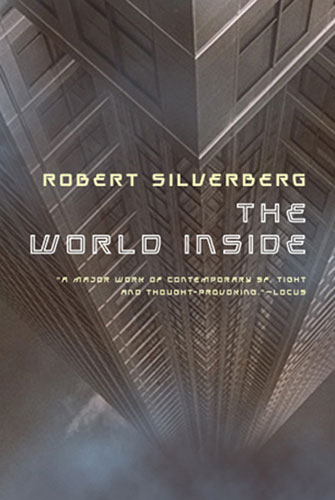
The setting of Robert Silverberg’s fictional study in overpopulation, The World Inside occurs almost entirely within the hyperstructure known as Urban Monad 116. As the name implies, this massive, three-kilometer high city tower is but one of many on the planet, which have become necessary now that war, disease and starvation have been eliminated, but people still continue to procreate without restriction. During the telling of the story, which takes place in 2381, the total population has reached 75 billion.

Much attention is given in the novel to how urban monads (or “Urbmons”) are arranged and meet the needs of their 800,000 respective inhabitants. For starters, groups of these skyscrapers are arranged in “constellations” so that one’s shadow does not fall upon another. Each Urbmon is divided into 25 self-contained “cities” with 40 floors each, in ascending order of status, with administrators occupying the highest level with population and production centers sequestered below.

In order to see to the needs of this rapidly expanding population, all arable land not currently occupied by Urbmons is dedicated to agriculture. However, within the Urbmon communities,  resource management still counts for a lot, with all foods and goods being held in common and the people expected to share them. Beyond that, however, sustainability is not exactly the name of the game, as the right to engage in free expressions and sex and reproduction are considered the highest forms of activity.

Hence, Silverberg’s Monads break a few of the basic rules of arcology, but the basic premise is still there. Designed to house a rapidly expanding population that threatens to overpower the Earth, Urbmons take advantage of the concepts of megastructures and 3-D planning to ensure that every living soul is housed and provided for. Now if they could just stop reproducing so much, they’d be in business!

Tyrell Corp Building:
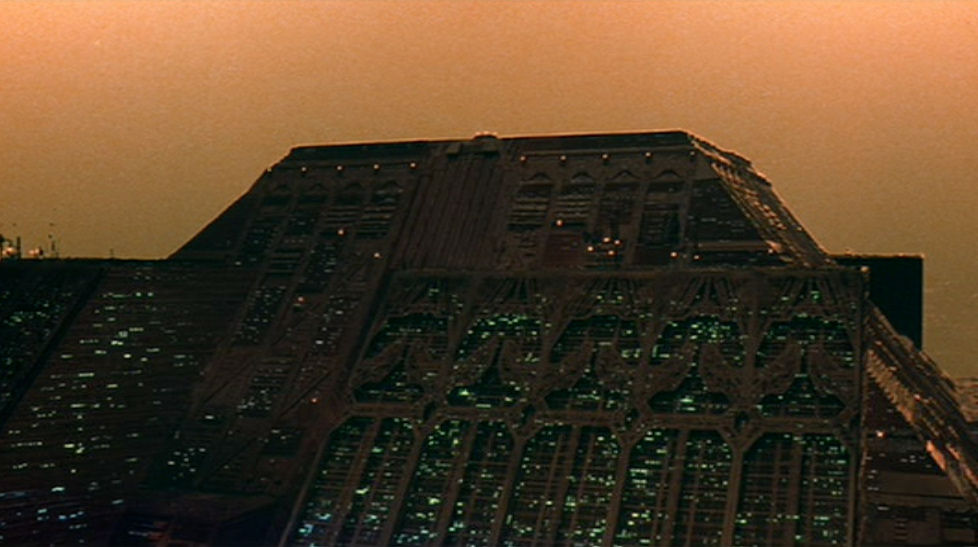
Though not specified as an arcology in the strictest sense, I couldn’t possibly make this list without including the infamous Tyrell Corp building. I mean just look at the thing. Imposing, Gothic, and very, very big! And let’s not forget highly symbolic, as the design, size and scale of the thing was meant to evoke the feeling of awesome power that the corporation held.

Though not much is made clear of what life inside the building is like, it was clear that it was made up of many, many levels and sections, each of which fulfilled a different purpose. At ground level, the building was protected by automated systems which “fried” one of the story’s Nexus 6’s when they tried to break in. Farther up are various industrial areas that are dedicated to the production of the company’s Replicants, as well as office spaces and administrative areas. Another Replicant was detected in one of these sections, right before it shot the man who had detected it – Detective/Blade Runner Holden.

At the apex of the building is the living area for Tyrell and Rachel, the experimental Nexus unit that was modeled on his niece. This level is accessible only by elevator which runs along the outer edge of the building, and can only be accessed by authorized personnel. Here, Tyrell lives amidst opulent surroundings, vast marble floors, stone columns, and even an aviary for his pet owl. Although it is not explicitly said, it appears that Tyrell spends all of his time here, never venturing to the outside city or to another domicile. Hence, we can only assume that all of his needs are seen to here, even if everything he consumes is flown in and all the waste produced is shipped out.

Mega-City One:
judge-dredd-megacity-oneThe setting of the Judge Dredd franchise, Mega-City One is essentially a massive urban sprawl which stretches from the Quebec-Windsor City corridor to the peninsula of Florida in the south, growing out of the Northeast Megalopolis to occupy Southern Ontario the entire Eastern Seaboard. And in addition to stretching so very far and wide, this city is also made up of arcologies in order to see to the needs of its roughly 800 million inhabitants.

These arcologies come in the form of huge apartment blocks which house roughly 50,000 people each. Within each block, citizens are attended to by automated systems which recycle everything, waste, water, and even food. As for manufactured products and consumer goods, these too are largely created in industrial warrens that housed within specific blocks.

This system of every need being handled by automated systems and machines was designed to ensure that the survivors of the nuclear holocaust (aka. The Apocalypse War) would be tended to. However, it had the unwanted side-effect of also leading to rampant unemployment and listlessness amongst the population. This is one of the main reasons why Mega-City One is awash in petty criminals and organized crime syndicates. This, in turn, is what led to the creation of the Judicial System and its army of Street Judges.

Trantor:
Perhaps the first example of a ecumenopolis appearing in fiction, Trantor went on to become a source of inspiration for many science fiction franchises. And according to Asimov, it represented what he believed would be the end result of industrialization and human technology, which was an encapsulated population living in cities that spanned entire planets.

Consisting of buildings that reached deep into the ground and reached several kilometers above sea level, Trantor was home to roughly 45 billion people at the height of the Empire. It’s overall population density was 232 per km², and just about every human being was dedicated to the administration of the Empire or the needs of its population. Though by the time of Foundation, most of the population’s needs were met by importing food and basic necessities from every major planet in the region.

However, according to Prelude to Foundation, Trantor’s basic food needs were once fulfilled by the planet’s vast system of subterranean microorganism farms. Here, yeast and algae were produced as basic nutrients, which were then processed with artificial flavors to create palatable food sources. These farms were tended to entirely by automated robots, but their eventual destruction during an uprising forced the planet to turn to external sources

The Sprawl:
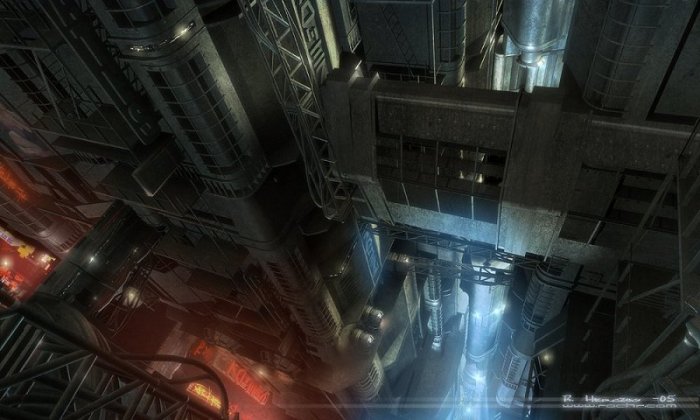
Also known as the Boston-Atlanta-Metropolitan-Axis (or BAMA for short), this mega-city is the setting for the majority of William Gibson’s Sprawl Trilogy. Encompassing the classic cyberpunk tales of Neuromancer, Count Zero, and Mona Lisa Overdrive, the concept of arcology is raised on numerous occasions in reference to the massive apartment blocks that make up the city.

On such building is Barrytown, an arcology in the projects which is the setting for much of the second novel. Throughout the novel, it is indicated that the people here generate their own food, such as the catfish farms that exist near the top of the building. Trees are also grown on specific levels to generate oxygen which is then fed into the building’s air recirculation system. And finally, mentions are made that there are air turbines on the roof of many project buildings which generate electricity for the inhabitants.

Being such a massive, futuristic city, the Sprawl features many such structures, all of which are described as giant skyscrapers that house tens of thousands of people within their tall frames. And ultimately these are all contained beneath the a series of geodesic domes which encapsulate the city and generate peculiar weather patterns consistent with micro-climates. In this way, the BAMA itself is one massive structure, containing hundreds of millions of people under a single roof.

Zion:
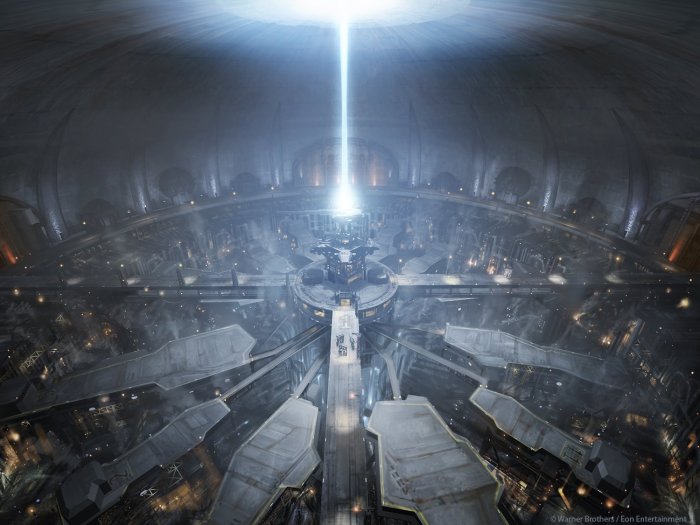
The last remaining free city that humanity could still call home, Zion was not a megastructure per se, but nevertheless fit the definition of an arcology to a tee. An underground habitat that was home to roughly 250,000 men, women and children, Zion was the picture perfect representation of a self-contained living space that handled all the needs of its inhabitants internally.

As Councilman Hamann intimated in Matrix Reloaded as he and Neo walked along the Life0-Support Level, all of Zion’s needs are attended to by machines. These provide power, heat, water, and are constantly recirculating and recycling them.  Meanwhile, food seems to be either grown in special hydroponic areas, or synthesized in bio facilities dedicated to that purpose.

In terms of its internal layout, Zion is ovoid in structure and consists of many levels, each with its specific purpose. At the apex rests the Dock, where Zion’s army of hovercrafts are stationed and automated defenses protect against intruders. Beneath that are the Gathering Spaces, where new arrivals who have not yet been assigned permanent quarters are temporarily housed.

The middle section is entirely dedicated to habitation, made up of family quarters, and the Council Chambers which houses Zion’s ruling council. The lower levels consist of the Meeting Hall, Life-Support Level, and Geo-Thermal Generation, where the cities power and heat are supplied from. At the very bottom lies the Temple, a large cavern where religious gatherings are held and people gather to hold celebrations and mourn the dead. This area also serves as a last defensive position in the event that the automated defenses were destroyed and the Dock overrun. This of course became the case in Matrix: Revolutions when the machines attacked Zion and nearly destroyed it.

___

What did I tell ya? Clearly, the idea has made the rounds since Soleri’s time. And in all likelihood, we are sure to see the concept popping up more and more as the problems of overpopulation and environmental impact become more acutely felt. There are some who might express disgust and even fear at the idea of living an encapsulated existence, but given the growing need for sustainability and places to put people, will we really have a choice? One can only hope!

Favorite Cult Classics (Part the Second)

Welcome back! As promised, the second half of my nostalgic, cult classic favorites for you to peruse! Let me know what you think, and feel to add some contenders of your own. Cult hits are nothing if not personal, and what constitutes a classic is open to interpretation. Okay, six to ten, here goes:

2001: A Space Odyssey:
Yes, this movie deserves top billing for being a classic! And yet, the movie really doesn’t seem to garner much appreciation from audiences, not unless they are self-professed film buffs or hard sci-fi fans. Not sure I qualify for either, but I loved this movie for the simple reason that it was packed full of mind-blowing themes. Much like Akira, it was chock-full of things that got my young mind thinking and completely shaped my outlook on science fiction.

Sure, there are those who complain that this movie is boring and esoteric, but I found all that a fitting price for the kick-ass subject matter, not to mention the mind-blowing climax. You got a mystery, speculations about human evolution, ancient aliens, space exploration, and existential singularities! All the while, the weight of the philosophical implications are weighing at your mind…

And let’s not forget how inspiration this movie proved to be. Today, the concept of ancient astronauts, aliens who came to Earth millions of years ago and tampered with human evolution, has become all the rage. From Star Trek to Stargate, Battlestar Galactica to Prometheus, the concept of ancient astronauts has played out. And frankly, 2001 has them all beat! Between Kubrick and Clarke, their concept of the aliens and how they altered the course of evolution on Earth was the most realistic I have ever seen.

But I think what I liked best about was the fact that the movie was the subtle nature of the whole thing. At once speculative, philosophical, and visually stunning, this movie was characteristic of Kubrick, who preferred to convey things visually rather than coming out and telling people what was going on. You never really quite knew what happened during that eye-popping final scene, but those who love sci-fi and imaginative filmaking were sure to have ideas!

Alien:
Granted, this movie wasn’t exactly under-appreciated, but compared to the lavish attention the rest of the franchise has garnered- even though it was all downhill after Aliens – this first installment truly was the diamond in the rough. Not only did it have a cool concept, awesome set designs and a kick-ass back story, the direction and cinematography captures the story’s sense of dread and claustrophobia perfectly.

Little wonder then why this movie spawned an entire franchise, because it really did have everything. You had your blue-collar peeps working for the major interstellar company (Weyland-Yutani), a frightening discovery made on an uncharted planet, a mysterious derelict belonging to an unknown race, and a terrifying creature awakened from its slumber. And not just any kind of creature, but a complex symbiote that was designed for and possessed of a single purpose.

Or as Ash put it: “Perfect organism. Its structural perfection is matched only by its hostility.” He had a point didn’t he? In fact, all structures in this movie were pure genius, whether it was the Nostromo, the Derelict, or the Facehugger and Chestbuster combo. As with everything Scott does, attention to detail and the careful construction of a universe was paramount. Every set was richly detailed, well shot, and clearly made to elicit the right feel and impressions on the audience.

Much of the credit for this goes to H.R. Giger as well, the surrealist artist who brought Lovecraftian horror to the alien concept and set of the alien ship. Years later, I still find myself tuning in just to get a glimpse of that Gothic reconstruction, or to see the Space Jockey sitting in its chair, the tell-tale hole punching through its chest. Few movies have managed to capture that same sense of awe and wonder for me, with the possible exceptions of 2001 and Akira

Johnny Mnemonic:
Some people might think I’m crazy for listing this movie as a personal classic, but it can’t be helped! And my reasons are pretty simple. On the one hand, this movie kind of has that “so bad, it’s good” thing going on, but at the same time, I also felt it possessed some real signs of quality. Sure, the acting was pretty wooden, the fight choreography total crap, and the low-budget nature apparent throughout. But it was still a pretty faithful adaptation of Gibson’s work and introduced to that world at a still-young age. Hence why I come back to it every few years just to see it again.

Filmed in the mid-90’s, this movie is an adaptation of the short story by William Gibson and previewed a lot of what he wrote in Neuromancer. For example, you’ve got the big bad corporations, the cyberspace jockeys, freelance assassins, Yakuza, and the character Molly Millions. Things are also set in “The Sprawl”, the megapolis that stretches from Boston to Atlanta and is contained in geodesic domes, and the look and feel is definitely of the cyberpunk variety.

Into all this, Gibson introduced the revolutionary concept of mnemonic couriers, people who have “wetwire” implants in their brains that allow them to carry vast quantities of data from point A to point B. Basically, these couriers are the answer of what to do in a world where information is the most precious commodity, and all databases are vulnerable to hacking and protected by “Black ICE” – hostile Intrusion Countermeasure Electronics (aka. viruses)

And, in keeping with Gibson’s style, the story involves a titanic corporation that is fighting to maintain its monopolistic grip, while freelancers, smugglers and assorted little people are fighting to undermine them and distribute the information freely. Naturally, the main character of Johnny is an unlikely hero who is forced to take a break from looking out for number one and help others for a change. Might sound cheesy, and a little cliche, but it works and delivers on Gibson’s style. At the very least, it’s a guilty pleasure flick for me.

Screamers:
Now here’s a movie that’s high on the pleasure, low on the guilt. While a low-budget sci-fi flick that was (like Johnny Mnemonic) produced and filmed entirely in Canada, it had many signs of quality that immediately made it a cult hit. There’s the post-apocalyptic setting, the frightening tone, and the Cold War feel of the thing, updated for the 90’s. All the while, there is the knowledge that this is an adaptation of Philip K. Dick’s Second Variety, which sort of makes it a must-see of PKD fans.

Much like in the original story, the plot of the film involves a race of self-producing, self-upgrading machines that are designed to infiltrate enemy territory and eliminate all combatants. But of course, things begin to go awry when the people who produced them realize that they have upgraded to the point where they can impersonate human beings. And whereas the original story was set on Earth and took place between the US and Russia, the updated story takes place on Sirius 6b, a pining planet that became the front line between a the political-economic entity known as the NEB  and those who chose to resist its rule.

Personally, I felt the updated version works. Not only does the conflict seem more relevant, being between a mega-corporate entity and a coalition of workers and dissenters, but the off-world setting also feels more realistic. Perhaps it was the fact that in the post-Cold War world, nuclear war between two superpowers didn’t seem a likelihood anymore. Or it could just be that the whole NEB angle was reminiscent of Weyland-Yutani and Alien. All I know is, I liked it!

What’s more, a good deal of attention went into creating the setting and modelling the Screamers – aka. the automated machines that kill people. Designed to be the perfect terror weapons, they emit a high-pitched “scream” before making their attack, and can toy with their targets for some time before moving. This concept, combined with some good shooting, really created a sense of tension which is felt throughout. And of course, the paranoia which is engendered by the appearance of human-like machines was a very nice touch! A good movie, and a fitting adaptation which managed to capture PKD’s cautionary tale about the dangers of runaway progress.

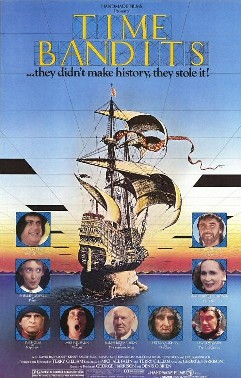
Time Bandits:
And last, here is the classic time traveling tale that I first saw in my childhood. Recently, my wife was told by a coworker that she should ought to see it, and my memory was jogged! Yes, this is indeed a cult classic, and one which is deserving of plenty of kudos and praise. Well cast, well written, witty and poignant, it’s one of those quintessential 70’s movies which has been rediscovered by several generations of film buffs and sci-fi fans.

The story opens with an imaginative and historically-minded child who lives in an overly-bourgeois neighborhood with his materially-possessed family. But upon realizing that there is a time-portal in his wall and that people from the past and future can come through it, his world is turned upside down. Quickly, he become the unwitting companion in a group of dwarves who are traveling through time, stealing precious artifacts, and being pursued by both the “Supreme Being” and an evil sorcerer.

Immediately, one can see the layered and inspired plot taking shape here. On the one hand, you have some decidedly Judea-Christian elements, plus a tale of childhood imagination and escapism. The dichotomy of the Supreme Being who possesses the power of time travel and the sorcerer who wants it for himself are representative of God and Lucifer, after a fashion. The dwarves who stole this power for themselves are a sort of Icaran allegory, or possibly Adam and Eve once they ate from the tree of knowledge. And ultimately, the way they are saved in the end from evil represents their redemption.

All the while we are left wondering if the boy is merely dreaming, or if what he is experiencing is real, which is an element that is intrinsic to all tales of childhood fantasies. On the one hand, the protagonists flights of fancy are seen as a weakness and immaturity to those around them, whereas we tend to see as it a rare gift to see past the surface. Should it all be a fantasy, then the story is left without a formal sense of resolution; but if it is real, then the hero has been vindicated and proven right. Appropriately, the movie plays with the two possibilities, going back and forth, but then giving strong hints at the end that it was in fact real. So really, you have a story that is inspired, imaginative, and also suspenseful!

___

Well, that’s my top ten list for the best cult classic movies of all time. What’s yours? I know I have a few in common with some people ’round these parts, and I also know that a few were previously unheard of. Hence why I want to here from others. I have a feeling there are some which I need to see and would very much enjoy. Already, I’m poised to watch Sunshine, A Boy and His Dog, and a few others which I’ve heard good things about. And I hope that in the course of swapping lists, I might be able to find a few more I’d like to see. Take care, and enjoy the rest of the long-weekend, those of who are reading this in Canada. As for the Yanks in the audience, and the rest of the world for that matter, enjoy the work week 😉

Favorite Cult Classics (Part The First)

It might be that I’m feeling nostalgic, or it might be that since my wife and I sprung for Netflix, I’ve been finding my way back to several of my favorite old movies. Hard to say exactly. All I know for sure is, I want to talk about the cult classic movies that I like best. You know what I’m talking about! Those rare gems, those diamonds in the rough, the movies that few seem to know about, but those who do always seem to love.

Yes, THOSE movies! Sure, we’ve all seen plenty of big hits, but these movies are the ones that occupy a special place in our hearts. Perhaps it’s because they are not so widely known, like the Star Wars’ and and Indiana Jones‘ of our time. Perhaps it’s because they didn’t get the recognition or the money they deserved, at least in their own time. Or it could be that they were simply the kind of things that got better with time.

In any case, I’ve compiled a list of my top 10 favorite cult classics, movies which I saw during my childhood, teen years and even in my twenties, and keep coming back too. Some were adventurous, some were funny, some were downright cheesy. But all have two things in common: One, none of them are known beyond a select group of appreciators, at least in this country. And two, those who like them, like them a lot! Check out the list below and see if you agree, and feel free to tell me your own favorites as well. I know we all got em!

Akira:
One of the greatest animes I have ever seen, and with a very poignant and intriguing story to boot, Akira starts this list off right! The movie adapted several volumes of manga to screen, and did so in such a way that didn’t skimp on either story or detail. Even shortened, the plot still manages to convey the sense of awe and dread of atomic war, revolution, and evolutionary cataclysm. And the fact that the bulk of it is told from the point of view of disillusioned orphans who are all part of a bier gang only heightens the sense on confusion and angst of little people being thrown into situations far greater than they can handle.

And then there was the quality of the movie itself. Having seen this movie several times now and different versions thereof, I can tell you that no matter what the format, every single frame was animated in such a way as to be saturated. And not with digital effects, mind you, but with hand-drawn animations that really manage to capture the post apocalyptic and cyberpunk feel of Katsuhiro Otomo’s original graphic novel.

All in all, I consider this movie to be compatible in many respects to 2001: A Space Odyssey in that they both deal with grandiose of questions of existence, biological evolution, and both managed to blow my mind! And having first been exposed to both of them in my teen years, they are partly responsible for kindling my love of science fiction.

Army of Darkness:
Here’s a movie I kept being told to see, but did not get around to seeing until I was in university. And truth be told, it took me two viewings to really get the appeal of it. After that, it grew on me until I finally found myself thinking it hilarious, and quoting from it whenever I could. “Come get some!” “Groovy!” “This be my BOOMSTICK!” and “Good? Bad? I’m the one with the gun!” All classic lines!

Yeah, this movie is definitely filed in the guilty pleasure section, the space reserved for movies that are deliberately cheesy, over the top, and have a robust sense of humor about themselves. It’s also one of the many that gave Sam Raimi (director of the Spiderman trilogy) his start, and established Bruce Campbell (who appeared in all three) as a gifted ham actor.

Taking the position that decapitations and flesh-eating demons can be funny, this movie tells the story of a blue-collar, rough and tumble, one-liner spouting man named Ash who’s been sent back in time to fight an army of the undead. Automatically, hijinks ensue as he tries to convince people he’s not a demon himself, but instead chooses to establish who’s boss by demonstrating the power of his chainsaw and “boomstick” (aka. his sawed-off double-barrel shotgun).

But predictably, this anti-hero rises to the challenge and becomes a real hero, and does so with as little grace as possible! And of course, there’s a love story as well, which is similarly graceless thanks to Ash’s lowbrow romantic sensibilities. Nothing is left untouched by the ham and cheese! And all throughout, the gun fights, duels, and confrontations with creepy, evil forces are hilarious, made possible by Campbell’s hammy acting, facial expressions, one-liners and some wonderfully bad cinematography. Think Xena: Warrior Princess, but with guns and foul language!

Blade Runner:
Another personal favorite, and one which I wish I had come to know sooner. But lucky for me I was still a teen when I saw this movie, hence I can say that I saw it while still in my formative years. And today, years later, I still find myself appreciating it and loving it as one can only love a cult hit. It’s just that kind of movie which you can enjoy over and over again, finding new things to notice and appreciate each time.

And once again, my appreciation for this movie is due to two undeniable aspects. On the one hand, Ridley Scott created a very rich and detailed setting, a Los Angeles of the 21st century dominated by megastructures, urban sprawl, pollution and polarized wealth. It was the picture perfect setting of cyberpunk, combining high-tech and low-life.

On the other hand, there was the story. Loosely adapted from PKD’s Do Androids Dream of Electric Sheep?, this version of a future differed greatly in that the artificial humans, the antagonists of the original story, were about the only sympathetic characters in the story. The result was not a cautionary tale on the dangers of creating life in our own image as much as a commentary about the line between the artificial and the real.

The question it asked was: if you overcome all boundaries, if machines possess memory, feelings and a fear of death, is there anything at all to separate them from the rest of us? Will their lives be worth any less than ours, and what will it even mean to be alive?

Conan The Barbarian:
Here’s a movie which has appeared in some friends “guilty pleasure” list, usually next to Predator, Commando and other Anrie classics. But I am here today to tell you it really doesn’t belong. Unlike many 80’s Arnie movies that were so bad, they were good, this movie had some genuine quality and depth to it.

Examples? Well, for starters, this movie was a faithful adaptation of Robert E. Howard’s original concept, Conan the Cimmerian, which was first published in 1932. This franchise, which went through countless adaptations over the ensuing decades, wove real history and myth together with fantasy to create a tale of a bronze age adventurer who traveled across the ancient world, seeking fortune and glory.

One can see this in the movie as well. To create the setting and the various people that make up the universe, imagery, mythology and even names were borrowed from various real sources. For example, the Cimmerians (Conan’s people) were inspired by Celtic and Norse sources. The followers of Thulsa Doom, black-clad warriors from the East, were meant to resemble the Huns, the Goths, and other Eastern invaders. There are also several scenes showing a warlike people meant to resemble the Mongol Hoards, and much of the setting was made to resemble ancient cities of lore – Babylon, Jerusalem, Antioch, et al.

Add to all this some pretty damn good writing and good storytelling, and you can see why this movie has remained enduringly popular with many people over the years. Arnie excelled as the stone-faced barbarian of few words, but who made them count when he chose to spoke. James Earl Jones was exceptional as the amoral, Nietzschean warlord Thulsa Doom, and the production value was surprisingly good for a low-budget flick.

Serenity:
Yeah, I get the feeling everybody knows what I’m talking about with this one! After losing the wonderful show in the midst of its first season, every fan of Firefly was pleased to know that Joss Whedon would be making a full length movie. And personally, I th0ught he did a pretty good job with it too!

Picking up where the show left off, we are reunited with our favorite characters as they continue to work freelance jobs and try to stay one step ahead of the law and the expanding Alliance. From the outset, it is clear that things are getting desperate, as the jobs are proving more risky, and the Reavers are moving in from the Outer Rim. At the same time, a new threat has been thrown in in the form of an Alliance agent known only as the “Operative”, who has made it his business to bring River in at any cost.

And I personally loved how all these threads came together in a singular way, showing how the Reavers, River’s condition, and the Alliance’s ultimate agenda were all connected. Not only was it a tight and entertaining plot that captured the same sense of loss and desperation as the show, it also gave a sense of closure to the series, which ended before its time.

Yes, for myself and many fans, this movie is a way of commemorating a truly great show and idea that faltered because of insensitive boobs couldn’t see the value in it. But that seemed thematically consistent with the series itself, which was all about rebels in a hopeless fight against an evil empire. Take a lesson from this Fox Network, sooner or late,r the bad guys lose!

___

For brevity’s sake and the fact that I’m a busy man, I’ve decided to divide this list in half. Stay tuned for entries six through ten, coming up tomorrow! Happy Thanksgiving y’all!