
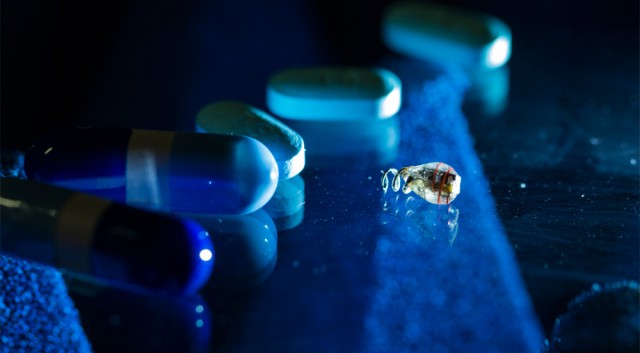
 Hard on the heels of their proposed BRAIN initiative – a collaborative research initiative to map the activity of every neuron in the human brain – DARPA has announced a bold new program to develop tiny electronic implants that will be able to interface directly with the human nervous system to control and regulate many different diseases and chronic conditions, such as arthritis, PTSD, Crohn’s disease, and depression.
The program, called ElectRx (pronounced ‘electrics’), ultimately aims to replace medication with “closed-loop” neural implants which monitor the state of your health and then provide the necessary nerve stimulation to keep your organs and biological systems functioning properly. The work is primarily being carried out with US soldiers and veterans in mind, but the technology will certainly percolate down to civilians as well.
 The ElectRx program will focus the relatively new area of medical therapies called neuromodulation, which seeks to modulate the nervous system to improve neurological problem. Notable examples of this are cochlear implants which restore hearing by modulating your brain’s auditory nerve system, and deep brain stimulation (DBS) which is apparently capable of curing/regulating conditions like depression and Parkinson’s by overriding erroneous neural spikes.
So far, these implants have been fairly large, which makes implantation fairly invasive and risky. Most state-of-the-art implants also lack precision, with most placing the stimulating electrodes in roughly the right area, but which are unable to target a specific bundles of nerves. With ElectRx, DARPA wants to miniaturize these neuromodulation implants so that they’re the same size as a nerve fiber.
 This way they can be implanted with a minimally invasive procedure (through a needle) and attached to specific nerve fibers, for very precise stimulation. While these implants can’t regulate every condition or replace every medication (yet), they could be very effective at mitigating a large number of conditions. A large number of conditions are caused by the nervous system misfiring, like inflammatory diseases, brain and mental health disorders.
Currently, a variety of drugs are used to try and cajole these awry neurons and nerves back in-line by manipulating various neurotransmitters. However, the science behind these drugs is not yet exact, relying heavily on a trial-and-error approach and often involving serious side-effects. Comparatively, an electronic implant that could “catch” the misfire, cleans up the signal, and then retransmits it would be much more effective.
 As DARPA’s Doug Weber explained:
The technology DARPA plans to develop through the ElectRx program could fundamentally change the manner in which doctors diagnose, monitor and treat injury and illness. Instead of relying only on medication — we envision a closed-loop system that would work in concept like a tiny, intelligent pacemaker. It would continually assess conditions and provide stimulus patterns tailored to help maintain healthy organ function, helping patients get healthy and stay healthy using their body’s own systems.
Despite requiring a lot of novel technological breakthroughs, DARPA is planning to perform human trials of ElectRx in about five years. The initial goal will be improving the quality of life for US soldiers and veterans. And while they have yet to announce which conditions they will be focusing on, it is expected that something basic like arthritis will be the candidate – though there are expectations that PTSD will become a source sooner other than later.
 And this is just the latest neurological technology being developed by DARPA. Earlier in the year, the agency announced a similar program to develop a brain implant that can restore lost memories and experiences. A joint fact sheet released by the Department of Defense and the Veteran’s Association revealed that DARPA also secured 78 million dollars to build the chips as part of the government’s Brain Research through Advancing Innovative Neurotechnologies (BRAIN) program.
While DARPA’s ElectRx announcement is purely focused on the medical applications of miniature neural implants, there are of course a variety of other uses that might arise from elective implantation – for soldiers as well as civilians. With a few well-placed implants in a person’s spine, they could flip a switch and ignore any pain reported by your limbs, allowing them to withstand greater physical stress or ignore injuries.
 Implants placed in muscle fibers could also provide added electrostimulation to provide extra boosts of raw muscle power. And With precision-placed implants around the right nerve fibers, people could gain manual control of their organs, allowing them to speed up or slow down their hearts, turbo-charge their livers, or tweak just about any other function of their bodies.
The age of the Transhuman looms, people!
Source: extremetech.com, motherboard.vice.com, darpa.mil
 In a first amongst firsts, a team of international researchers have
 This is a phenomenon whereby a person sees flashes of light, without light actually hitting the retina. The recipient “sees” these phosphenes at the bottom of their visual field, and by decoding the flashes — phosphene flash = 1, no phosphene = 0 — the recipient can “read” the word being sent. While this is certainly a rather complex way of sending messages from one brain to another, for now, it is truly state of the art.
 Desertification is one of the biggest threats associated with Climate Change. In places like North Africa and the Middle East, where countries already import up to 90% of their food, the spread of the desert due to increasing temperatures and diminished rainfall is made worse by the fact that cities in the region continue to grow. It’s a situation that is getting more expensive and energy-intensive at a time when things need to be getting more cost-effective and sustainable.
 Conceived by Forward Thinking Architecture, a Barcelona-based firm, the concept seeks to combine flexibility with a minimal carbon footprint. Towards this end, they chose to forgo usual transportation and create a unique conveyor system that would deliver produce without the use of any fossil fuels. The conveyor belt would be underground so it could keep running in a straight line even if buildings were in the way.
 Ideally, desert populations would be small enough that the region’s sparse rainfall could support local crops. But that’s not the reality. In addition, a small part of the recycled water would also be used to create an outdoor garden for education. As architect Javier Ponce, principal and founder of Forward Thinking Architecture, explained:
 These regions in particular have felt the pressure brought on by the escalating price of importing food. This pressure is exacerbated due to the disappearance of peak oil, which accounted for the vast majority of this region’s wealth. However, the project has farther-reaching implications, as Climate Change threatens to turn much of the world’s arable land into dry, drought-ridden plains.
 Anyone who has ever observed a lizard must not have failed to notice that they are capable of detaching their tails, and then regenerating them from scratch. This propensity for “spontaneous regeneration” is something that few organisms possess, and mammals are sadly not one of them. But thanks to a team of Arizona State University scientists, the genetic recipe behind this ability has finally been unlocked.


 This is the largest known attack to involve hospital patient information since the US government began tracking these types of data breaches in 2009. According to Elysium Digital data security expert Joseph Calandrino:





 , glioblastoma, and colon cancer–that’s the sweet spot for this technology.


 Stories by Williams