New Trailer: Elysium!

elysium_posterLast weekend, while the wife, our friend and I were all watching the new Star Trek movie, a number of trailers came on that made us antsy for other “coming attractions”! One of them was one I instantly recognized and began saying the title of long before they flashed it across the screen. Months back, when this movie was first announced, I posted the trailer here because it looked to have all the things I love in sci-fi story. And they have since come out with a longer, more detailed trailer which I share now…

Elysium tells the story of a dystopian future, set in 2154, where the wealthy and privileged live in an orbital colony that is peaceful, serene, idyllic, and sees to all their needs (and looks a lot like the station from Space Odyssey). Meanwhile, the remaining 99% of humanity live planetside, where pollution, environmental collapse and economic ruin have made Earth into a veritable hellhole.

elysium_stationEnter into this Max De Costa (played by a cueballed Matt Damon), a man who is near death who comes to learn of a secret that could topple the whole system and achieve a degree of social justice. In order to do this, he has to break into Elysium, a facility that is heavily guarded and run by Secretary Rhodes (Jodie Foster), and undergoes a radical surgery to get an exoskeleton and some powerful weaponry permanently attached.

Directed by Neil Blomkamp – the South-African director who brought us District 9 and provided visual effects for such shows as Star Gate: SG-1, Smallville and Dark Angel – this movie clearly boasts the same kind of gritty, realistic texture he has come to be known for. And after the 2008 Financial Crisis and the subsequent Occupy Movement, it’s message is pretty timely and likely to be well-received.

elysium-1As for me? You can keep your social commentary and comparisons to other movie franchises, I wanna see me some exoskeleton battles! Enjoy the trailer:

The Truth of Yuri Gagarin’s Tragic Death Revealed

yuri_gagarin1On the morning of April 12, 1961, Soviet cosmonaut Yuri Gagarin lifted off aboard Vostok 1 to become the first human in space, becoming an instant hero to many and an historic figure. Tragically, his life was cut short when just seven years later (on March 27th, 1968) the MiG-15 UTI he was piloting crashed. Ever since, his death has been shrouded in confusion and controversy, with many theories being posited as to what actually cause.

And now, some 45 years after the fact, the details about what really happened to cause the death of the first man in space have come out — from the first man to go out on a spacewalk, no less. In an article published online on Russia Today, former cosmonaut Aleksey Leonov — who performed the first EVA on March 18, 1965 — has revealed details about the accident that killed both Yuri Gagarin and his flight instructor Vladimir Seryogin in March 1968.

yuri_gagarinA soft-spoken and well-mannered man, Gagarin began his journey into space in 1960 when he and 19 other pilots were selected to take part in the Soviet space program. Just three years after making history with the launch of the first artificial satellite into space (Sputnik-1), the Russians were eager to follow this up with a mission that would put a man into low-Earth orbit.

After a grueling selection process involving physical and psychological tests, Gagarin was selected to take the pioneering flight inside the Vostok-1 space capsule. The launch, which was eagerly monitored by people all over Russia and around the world, took place at exactly 9:07 am local time (06:07 UT) on 12 April 1961. After spending just under two hours in orbit, the capsule made reentry, Gagarin exited it and parachuted to the ground, landing at around 11:05 am (08:05 UT) in a farmer’s field outside of Engels.

vostok-1_landingObserving the landing of Vostok-1 were two school girls, who recalled the site of the capsule hitting the ground with a combination of fascination and fear:

It was a huge ball, about two or three metres high. It fell, then it bounced and then it fell again. There was a huge hole where it hit the first time.

Elsewhere, a farmer and her daughter observed the strange scene of a figure in a bright orange suit with a large white helmet landing near them by parachute. Gagarin later recalled:

When they saw me in my spacesuit and the parachute dragging alongside as I walked, they started to back away in fear. I told them, ‘Don’t be afraid, I am a Soviet like you, who has descended from space and I must find a telephone to call Moscow!’

After the flight, Gagarin became a worldwide celebrity, touring widely abroad to promote the Soviet’s accomplishment in putting a man into space. Upon returning home, he found himself relegated to training and other tasks, due in part to the death of his friend, Vladimir Komarov in the first flight involving a Soyuz spacecraft. Shortly thereafter, he began to re-qualify to become a fighter pilot, and died during one of his training flights.

Su-15_FlagonOfficially, reports about Gagarin and Seryogin’s death claim that the plane crashed when Gagarin manuevered the two-seated training version of the MiG-15 fighter craft to avoid a “foreign object”. The report does not specify what this object was, but the term refers to  anything from balloons and flocks of birds to airborne debris or another airborne craft. And as you can imagine, people have made some very interesting suggestions as to what this object could have been.

Now, a declassified report, which Leonov has been permitted to share, shows what actually happened during the training flight. Apparently, an “unauthorized Su-15 fighter” flew too close to Gagarin’s MiG, disrupting its flight and sending it into a spin. In his article, Leonov went on to explain in further detail:

In this case, the pilot didn’t follow the book, descending to an altitude of 450 meters. While afterburning the aircraft reduced its echelon at a distance of 10-15 meters in the clouds, passing close to Gagarin, turning his plane and thus sending it into a tailspin — a deep spiral, to be precise — at a speed of 750 kilometers per hour.

The pilot of the SU-15 survived the incident, is apparently still alive, and was not named – a condition of Leonov’s permission to share the information.

valentina_tereshkova_1Afterwards, the first woman into space, Valentina Tereshkova (also a Soviet cosmonaut) was officially grounded by the government after Gagarin’s death to avoid a loss of another prominent cosmonaut. After the revelation was made about the true cause of Gagarin’s death, she responded by saying that the details come as a bittersweet relief. “The only regret here is that it took so long for the truth to be revealed,” Tereshkova said. “But we can finally rest easy.

Indeed. Rest in peace, Yuri. Like many who have since come and gone, you’re a part of an extremely select few who went into space at a time when doing so was still considered by many to be an impossible dream. And regardless of the Cold War atmosphere in which this accomplishment occurred, it remains an historic first and one of the greatest accomplishments ever made by a human being.

Source: universetoday.com

Flash Fiction Anyone?

FlashThis year has led to some very interesting things for this blog of mine, and that’s just been in the past sixth months. In addition to hitting some milestones, like passing 250,000 hits, 1000 posts, and 2000 followers, it was also the second anniversary of this blog’s creation. And on top of all that, it was the year that Whiskey Delta was published and sold its first 1000 copies (1167 and counting!)

A2Z-2013-BADGEBut there’s one item that kind of got lost in the mix. Back in April, I took part in the April 2013 A to Z Challenge, where bloggers are expected to produce 26 pieces of flash fiction with the short space of 30 days. Though I came to the challenge a little late and started at G, I was pretty thankful for the opportunity to create short pieces that really explored the kind of subjects and writing I want to tackle.

And the end result was a slew of shorts I wanted to put together in a single volume. At the time, I was still struggling with a title, and considered Fast Forward or Tomorrow(cubed) to be the front place runners. Neither one really worked though, since one has been used by many different people and the other was impossible to put on a front cover. However, I have since found a title that works and is – at present – unclaimed. Flash Forward!

As you can see below, I have worked up the cover based on Alex Popescu’s awesome artwork. Everything else fell into place behind, and I am still in the process of adding stories to it. No telling when that will finished though, since I currently have a number of other projects on my plate which demand completion – Pappa Zulu edits, writing and editing the Yuva anthology, and a crap load of other smaller tasks. However, I hope to get it done before the year is out.

FlashForwardAlso, after finishing the A to Z challenge, I thought that I might try to keep the train going by doing flash fiction as a regular thing. Originally, I planned to do a Flash Friday, like many indie authors I follow. However, I have since lost the groove and kind of pooped out on the first installment, which was to be named Arcology since I thought I should go back and cover all the letters I missed during the A to Z challenge (in my case, A to F).

But there’s time and I would still like to do it. So I put it to my friends, colleagues and followers who take the time to read this thing known as Stories By Williams, do you think it could stand to have a Flash Friday segment? Perhaps not something that’s not even so rigidly scheduled; say just a Flash Fiction segment every once in awhile?

I think it would be good as a way of exploring some small ideas that crop up and wouldn’t get exposure otherwise. That’s was what I liked about the A to Z challenge and it might be good to make it a regular feature. And who knows? I even could guest feature some other writer’s bits from time to time as well.

The Future is Here: The Electric Hover-Bike!

flyingbikeInventors Chris Malloy and Mark DeRoche turned quite a few heads back in 2012 when they displayed their hoverbike prototypes to the world. But, you know how it is with cool, new ideas. Its only a matter of time before  it catches on and others are coming up with their own versions of it. And that’s exactly what happened at Prague convention center this week, where a design firm unveiled their own concept of the hoverbike.

The design firms goes by the name of Design Your Dreams Flying Bike, an amalgamation of three Czech engineering firms who joined together to fulfill a shared childhood dream. Last June, the firm shared their design specs for the electric bike which would be capable of vertical takeoff and hover-flight. And less than a year later, their efforts have resulted in something functional, and very, very cool!

flyingbike_conceptGranted, the prototype isn’t quite as sleek and sophisticated as the original drawings themselves. But the project is still in the early phases, and already it has shown that the concept works. Using six horizontally mounted propellers, the 220-pound electric bike was able to lift itself into the air while an engineer on the ground controlled it with a handheld remote.

According to Milan Duchek of Design Your Dreams, the prototype will fly remotely with a dummy on the seat for now, but a version that can be piloted by a human will be ready this fall. In addition, the design team said that the final product should be as easy to maneuver as a regular bicycle, but will also have the ability to fly for between three and five minutes, using solely electric power. It will include “foolproof” stability control for takeoff and landing, and a fly-by-wire system that isn’t susceptible to outside interference.

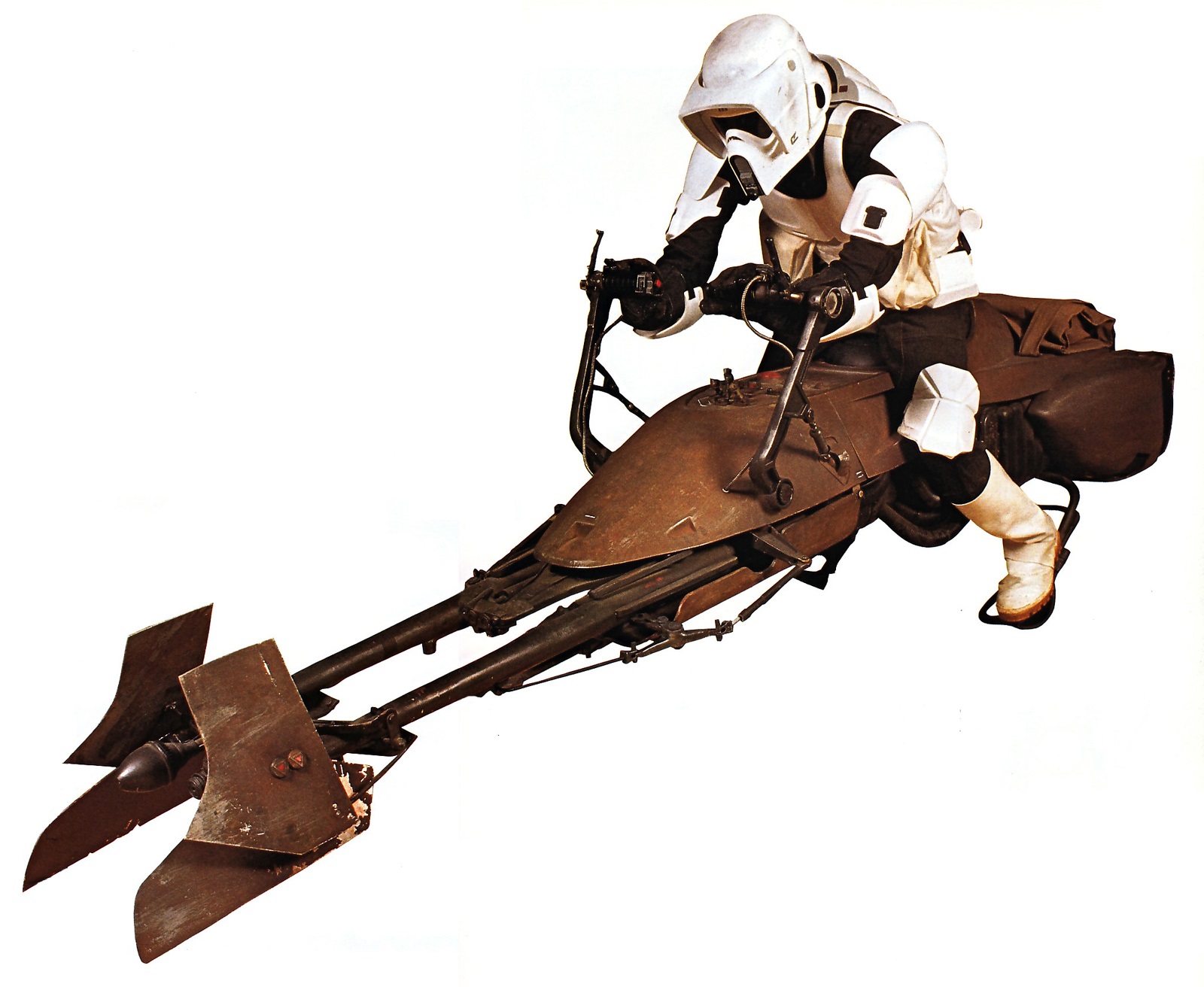
speeder_bike1 Though the prototype bike looks like a homemade version of something out of Star Wars, the designers told the press that their inspiration came from two Czech works of science fiction: a series of books by Jaroslav Foglar about a boy with a flying bicycle, and a 1966 Karel Zeman film based on a Jules Verne novel.

Bad news though: even when the flying bike is complete, it won’t be available for commercial use. According to the engineers who built it, the purpose of the project was to bring a flying bike to fruition to see if the technology would work. Or as DYD engineer Ales Kobylik said:

Our main motivation in working on the project was neither profit nor commercial interest, but the fulfillment of our boyish dreams.

Hard to argue with that kind of logic. But for those who absolutely must own one, early indications put the cost of the prototype in the low five-figures – say, anywhere from $10,000 to $30,000. Make the team an offer, we’ll see what they have to say 😉 In the meantime, check out this video of the hoverbike performing a demonstration in Prague:


Sources:
wired.com, (2)


Glowing Plants and the Future of Gene Patenting

DNA-1Synthetic biology – also known as biohacking – is an emerging and controversial scientific field that uses gene-writing software to compile DNA sequences. And thanks to a recent ruling handed down by the US Supreme Court, it is a process which is now entirely legal. All told, the potential applications of synthetic biology are largely useful, leading to lifesaving cures, or altered crops that survive in any environment.

However, there are numerous potential (and potentially harmful) commercial applications that could emerge from this as well. One such advancement comes from a DIY synthetic biology lab known as Glowing Plant, one that specializes in synthetic bio hacking. Basically, the project was one of many that emerged out of Singularity University – a research institute dedicated future technologies today.

glowing_plantsGlowing Plant was  originally created to show the power of DIY synthetic biology, and has since sets its sights on developing a species of glowing house plant for consumers. To fund their goal, they opened up a Kickstarter campaign – the first of its kind – with the goal of $65,000. Based on research from the University of Cambridge and the State University of New York, the Glowing Plants campaign promised backers that they would receive seeds to grow their own glowing Arabidopsis plants at home.

glowing_plants2Glowing Plant also announced that if the campaign reaches its $400,000 stretch goal, glowing rose plants will also become available. As of the publication of this article, they passed that goal with a whopping $484,013 from a total of 8,433 backers. It seems there are no shortage of people out there who want to get their hands on a glowing house plant.

But Glowing Plant, the laboratory behind the project, has no intention of stopping there. As Antony Evans, co-founder of the project explained:

We wanted to test the idea of whether there is demand for synthetic biology projects. People are fundamentally excited and enthusiastic about synthetic biology.

Given the thousands of people backing the project, I’d say he’s right! But rest assured, Evans and his team have no intention of stopping there. The ultimate goal is to create larger species of glowing plants.

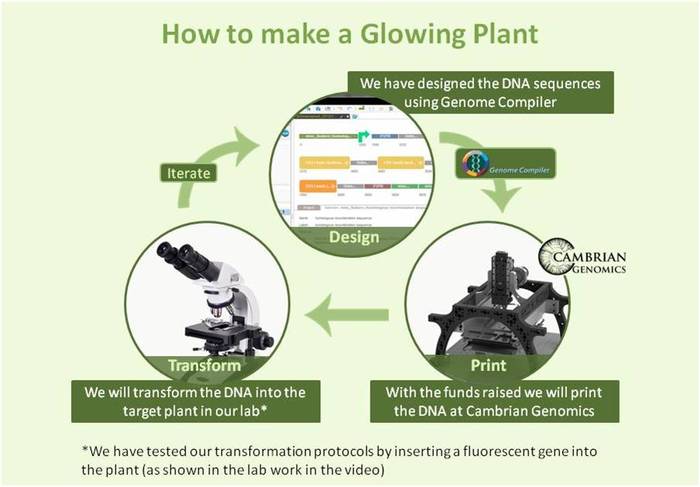
glowing_plants1The method used to achieve this is really quite interesting. It starts with the team downloading the luciferase-lucifern genes – the firefly DNA that allows them to glow – into a Genome Compiler, and then rewiring the DNA so that the proteins can be read by plants. The DNA sequences are then sent off to DNA printing company Cambrian Genomics, which has developed a relatively low-cost laser printing system. Those sequences are printed, put on a little spot of paper, and mailed back to the team.

After that, the team relies on one of two methods to transmit the firefly DNA into the Arabidopsis’ themselves. One way is to use a bacteria solution that is capable of injecting its own DNA into plants and rewriting theirs, which then causes the altered plants to germinate seeds of the new glowing strain. The other involves gold nano-particles coated with a DNA construct that are then fired at the plant cells, which are then absorbed into the plant chromosomes and alters their DNA.

NanoparticlesThis second method was devised to do an end run around specific Department of Agriculture regulations that govern the use of viruses or other pathogens to modify DNA. Though technically legal, the process has attracted resistance from environmental groups and the scientific community, fearing that the DNA of these altered plants will get into the natural gene pool with unknown consequences.

In fact, an anti-synthetic biology group called ECT has emerged in response to this and other such projects – and is centered in my old hometown of Ottawa! They have countered Glowing Plant’s Kickstarter campaign (which is now closed) with a fundraising drive of their own, entitled “Kickstopper”. In addition, the group has started a campaign on Avaaz.org to force the Supreme Court to reconsider the ruling that allows this sort of bioengineering to take place.

At present, their fundraising campaign has raised a total of  $1,701 from 58 backers – rougly 9% of its overall goal of $20,000 – and their Avaaz campaign has collected some 13,000 signatures. With 36 days left, there is no telling if they’re efforts will succeed in forcing a legal injunction on Glowing Plant, or if this is the first of many synthetic biology products that will make it to the market through private research and crowdfunding.

A fascinating time we live in, and potentially frightening…

Sources: fastcoexist.com, (2), kickstarter.com, glowingplant.com

Towards a Cleaner Future: The Strawscaper and The Windstalk

strawscaperAs the world’s population continues to grow and climate change becomes a greater and greater problem, urban planners and engineers are forced to come up with increasingly creative solutions. On the one hand, the population is expected to rise to an estimated 8.25 billion people by 2030 and 9.25 by 2050, and they will need places to live. On the other, these people will require energy and basic services, and these must be provided in a way that is clean and sustainable.

One such solution is known as the Strawscaper. The brainchild of designer Rahel Belatchew Lerdel, this building would be able to provide its own electricity using only wind and a series of piezoelectric fronds that rustle in the wind. Thanks to this method, the building would get all the power it needs from wind passing through its exterior, and would therefore not need to be attached to the city grid.

strawscaper2In a press release by Belatchew labs, Rahel claimed that the inspiration “came from fields of wheat swaying in the wind”. He also described the building he envisions as one that would give “the impression of a body that is breathing”. Details as to how it would generate its own electricity were also described:

By using piezoelectric technology, a large number of thin straws can produce electricity merely through small movements generated by the wind. The result is a new kind of wind power plant that opens up possibilities of how buildings can produce energy.

strawscaper1The full plan calls for the completion of the Söder Torn, a building in Stockholm that began construction in 1997 but was forcibly scaled down after its architect, Henning Larsen, lost control of the project. Completing it at this point would involve adding an additional 14 stories, thus bringing it from 26 to 40, and adding the piezoelectric fronds to make it electrically self-sufficient.

Though piezoelectricity has never been used in this way, the concept is well understood and backed by a number of research reports. In addition, Belatchew is not the only one considering it as a possible means of generating clean energy. Over in Masdar City, a planned community in Abu Dhabi, something very similar is being proposed to suit their energy needs.

windstalkIt’s known as the Windstalk, another means of generating electricity from wind without the needs for turbines. Though wind farms have long been considered an effective means of generating sustainable energy, resident living near large-scale operations have voiced concerns about the aesthetics and low-frequency vibrations they claim are generated by them. Thus, the concept of the Windstalk, created by New York design firm Atelier DNA.

The concept consists of 1,203 carbon fiber reinforced resin poles which stand 55 meters (180 feet) high and are anchored to the ground in concrete bases. The poles measure 30cm (12 in.) in diameter at the base and taper up to a diameter of 5cm (2 in.) at the top. Each pole is packed with piezoelectric ceramic discs, between which are electrodes that are connected by cables that run the length of each pole.

windstalk-2Thus, instead of relying on turbines to move magnets and create electrical current, each pole merely sways in the wind, compressing the stack of piezoelectric discs and generating a current through the electrodes. And just to let people know how much – if any – power the poles are generating, the top 50cm (20 in.) of each pole is fitted with an LED lamp that glows and dims relative to the amount of electrical power being generated.

As a way to maximize the amount of electricity the Windstalk farm would generate, the concept also places a torque generator within the concrete base of each pole. As the poles sway, fluid is forced through the cylinders of an array of current generating shock absorbers to convert the kinetic energy of the swaying poles into additional electrical energy. But of course, storage is also an issue, since wind power (like solar) is dependent on weather conditions.

windstalk-3Luckily, the designers at Atelier DNA have that covered too. Beneath a field of poles, two large chambers are located, one on top of the other. When the wind is blowing, part of the electricity generated is used to power a set of pumps that moves water from the lower chamber to the upper one. Then, when the wind dies down, the water flows from the upper chamber down to the lower chamber, turning the pumps into generators.

At the moment, the Windstalk concept, much like the Strawscaper, is still in the design phase. However, the design team estimates that the overall electricity output of the concept would be comparable to that of a conventional wind turbine array because, even though a single wind turbine that is limited to the same height as the poles may produce more energy than a single Windstalk, the Windstalks can be packed in much denser arrays.

Though by all accounts, the situation with our environment is likely to get worse before it gets better, it is encouraging to know that the means exist to build a cleaner, more sustainable future. Between now and 2050, when the worst aspects of Climate Change are expected to hit, the implementation of a better and more sustainable means of living is absolutely crucial. Otherwise, the situation will continue to get worse indefinitely, and the prospects of our survival will become bleak indeed!

Sources: fastcoexist.com, gizmag.com

Ending Cancer: Cell-Phone Sized Cancer Detector!

ISEF2012-Top-Three-WinnersThe name Jack Andraka is already one that researchers and medical practitioners are familiar with. Roughly a year ago, the 16-year old boy developed a litmus test that was capable of detecting pancreatic cancer, one of the most lethal forms of the disease and one of the most difficult to treat. And given that his method was 90% accurate, 168 times faster than current tests and 1/26,000th the cost, it’s title wonder why he’s considered something of a wonder kid.

Well, it seems boy genius is at it again! Shortly after receiving first place at the 2012 Intel International Science and Engineering Fair (ISEF), Andraka assembled a crack team of young scientists and began working on a handheld, non-invasive device that could help detect cancer early on. Much like Scanadu, the company that recently release a sensor for testing vitals, Andraka and his team were looking to create a genuine tricorder-like device.

Tricorder X_prizeAnd while their group – known as Generation Z and which was formed from the other 2012 finalists – is working towards such a device, Andraka presented his own concept at this year’s ISEF. Apparently, what he built is modeled on a tradition raman spectrometer –  a device that can be used to detect explosives, environmental contaminants, and cancer in the human body.

A conventional raman spectrometer is extremely delicate, can be as large as a small car, and cost up to $100,000. By contrast, the one designed by Andraka costs only $15 and is the size of a cell phone. According to Andraka, a raman spectrometer works by “[shooting] a powerful laser at a sample and tells the exact chemical composition.” Such a device also relies on a liquid nitrogen cooled photodector to examine the chemical composition of whatever material is currently being examined.

Those powerful lasers alone can cost up to $40,000, so Andraka swapped out the big lasers for an off-the-shelf laser pointer and replaced the photodetector with an iPhone camera. According to Andraka, the results are comparable, at a fraction of the size and, more importantly, the cost. So once more, the boy genius has presented medical science with a cheap, effective means of early detection, something which could save lives and millions in health care costs.

Tricorder XAndraka admits that this device was pretty much all his, but he plans to incorporate it into the tricorder design that he and his colleagues in Generation Z are developing. Once realized, the resulting device will be competing for the Tricorder X Prize – a ten million dollar grant that is given to any entrant that can create a handheld mobile platform that can diagnose 15 diseases across 30 patients in just three days.

But of course, they will have some stiff competition, not the least of which will come from Scanadu, which just happens to have the backing of NASA’s Ames Center.  But then again, the world loves an underdog. And when it comes to medical devices, cancer, and other diseases of the body, its clear that Andraka and his peers are just getting started!

And be sure to check out this video with highlights from the 2013 ISEF:


Sources:
fastcoexist.com(2)

News From Space: China’s Launches Shenzou 10 Manned Spaceship

shenzou_10Yesterday, at approximately 5:38 am ET, China took yet another step towards establishing itself as a major player in space. It’s latest manned spacecraft, known as the Shenzhou 10, departed the Jiuquan Satellite Launch Center at the edge of the Gobi Desert, carrying three astronauts on what is planned to be a fifteen day mission that will see them rendezvousing with the prototype Tiangong-1 space lab in Earth’s orbit.

This is China’s fifth manned mission into space and will be its longest to date. The purpose of the mission is to educate young people about science, but for the Chinese state, it also presents an opportunity to flex its muscles as one of the new leaders in space exploration. Much of this has to do with the Tiangong-1, which is intended to serve as an experimental prototype for a much larger Chinese space station that will be launched in 2020.

shenzhou-10-crewIn this respect, China is hoping to reach beyond its membership as on the three nations to send manned craft into space and join the United States and Russia by being able to send independently maintained space stations into orbit as well. If all goes well, China’s space station will join the likes of Mir and the ISS in Earth’s lower orbit. And with this kind of infrastructure in place, China will be well suited to play a role in future missions to Mars and the outer Solar System.

The craft carried two men, mission commander Nie Haisheng and Zhang Xiaoguang, and China’s second female astronaut, Wang Yaping. After rendezvousing with the space lab, the crew will spend a total of 12 days living in zero-gravity and conducting scientific experiments, the results of which will be shared with people on Earth.

shenzou_10_dockBorrowing a page from astronaut Chris Hadfield and his many popular Youtube videos that cataloged his crew’s mission aboard the ISS, the Chinese crew plans to deliver a series of talks to students while aboard the Tiangong. This development of “space classrooms” marks the boldest step so far for the Chinese space program, turning what was a military-backed program into something that will impact on the lives of ordinary Chinese citizens.

Here too, China is following in the footsteps of NASA, which uses student outreach to inspire interest in space exploration and sustain support for its budgets. At a news conference on Monday, Wang said she was “eager to explore and feel the magic and splendor of space with young friends.” Her fellow astronaut Zhang told reporters they would conduct dozens of space science experiments and would “enjoy personalized space foods especially designed by our nutritionists.

China_launchcenterOn the day of the launch, President Xi Jinping was shown live on television at the launch center. State television showed Xi watching the launch, as well as Premier Li Keqiang who was at the space command center in Beijing. Prior to the launch, Xi delivered a statement to the astronauts, commending them on their efforts and wishing them luck on their journey:

You have made [the] Chinese people feel proud of ourselves. You have trained and prepared yourselves carefully and thoroughly, so I am confident in your completing the mission successfully. I wish you success and look forward to your triumphant return.

The space program is a source of enormous national pride for China, reflecting its rapid economic and technological progress and ambition to rank among the world’s leading nations. Little wonder then why the launch was met with such fanfare and overseen by both the President and Premier. The mission comes at the height of ten years of Chinese space exploration and if successful, will mark China as a true superpower in the space race of the 21st century.

And be sure to check out the video of the launch of the Shenzou 10:


Source:
cbc.ca, news.xinhuanet.com

News From Mars: Curiosity Leaving “Mars Rat” Behind

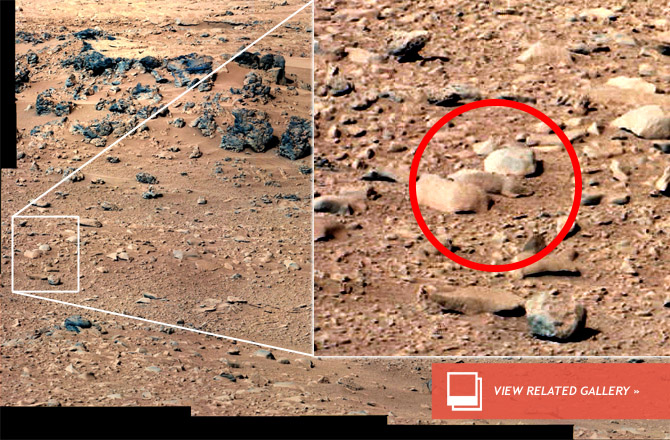
mars_ratIt seems that a new field of study was threatening to emerge with the “discovery” of what appeared to be a Martian rat. The technical term for it is Martian mammology, the study of mammals that are native to Mars. Luckily, proponents of this field did not manage to overpower the good people at NASA, who remain dedicated to serious scientific research. And now, the Curiosity rover is moving on to study bigger and better things.

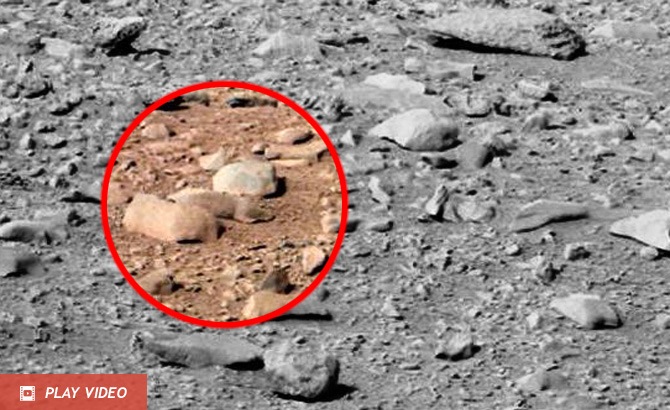
Yes, the appearance of this would-be rodent did generate a lot of buzz on the internet of late, with some UFO buffs claiming that it may be an indigenous Red Planet lifeform or an Earth rodent Curiosity carried to Mars as part of a secret experiment. But Curiosity scientists were relatively certain that the rat, which was spotted in a zoomed-in portion of a photo taken by the rover in September 2012, was just a rock.

mars_rat1Curiosity deputy project scientist Joy Crisp, of NASA’s Jet Propulsion Laboratory in Pasadena, Calif., told reporters on Wednesday, June 5, what they believed the curiously-shaped rock was the result of:

Clearly, it results from, you know, a lot of things like wind erosion and mechanical abrasion and breakdown chemical weathering of the rocks, as to why they get these weird shapes.

Under the circumstances, NASA does not feel the need to conduct any further studies. And the window to do so will last just a few more weeks, as the Curiosity rover is set to begin an epic drive that will take it far away from the petrified rodent. At the moment, the robot is gearing up for a year-long trek that will take it to the base of Mount Sharp, a mysterious mountain that rises 5.5 km (3.4 miles) into the Red Planet sky.

mars_faceCuriously (no pun!), this is not the first time people have seen faced in the rock surfaces of Mars. Remember the elusive “Face on Mars”? Originally taken by the Viking 1 spacecraft in 1976, this low-resolution picture of the Cydonia region of Mars ignited the imaginations of people all over the world. For years, the face was mentioned in feature films, television series’, video games, comics, and even pop music.

Even after a series of high-resolution photos – taken some twenty years later by a succession of space craft – proved it to just be a simple rock formation, many people still insisted that the “face” was real and proved the existence of intelligent life on Mars. And such examples are hardly reserved to the Red Planet. Every year, there are stories of people witnessing “miracles” as divine visions appear to them in seemingly random objects, either of religious figures or personal heroes.

pareidoliaIt’s whats known as pareidolia, a psychological phenomenon which refers to the human brain’s tendency to spot familiar things in random images. According to Crisp, this is not necessarily a bad thing. In truth, she claims NASA scientists get amused when this happens:

It’s fun in a way, too, in that it will attract a lot of the public to look at the images and learn a little bit about Mars by pulling them in this way.

So much like people seeing the Virgin Mary in a wall-stain, Mother Teresa in a cinnamon bun, or the face of Jesus and/or Elvis in their grilled cheese sandwich, the Mars Rat is likely to be with us for awhile yet. Perhaps he’ll go beyond the current internet meme and start a trend, with t-shirts and apparel for all. All he needs is a slogan: “Mars Rat Says ‘That’s My Cheese!'” …I’ll work on it 😉

Source: space.com

News From Mars: Revelations on Radiation

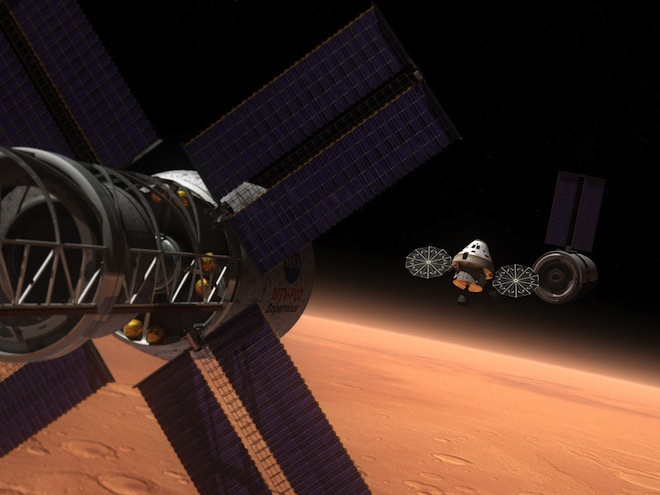
mars_astronauts1As the projected date for a manned mission to the Red Planet approaches, the Mars Science Laboratory and Curiosity team continue to conduct vital research into what a human team of explorers can expect to find. Unfortunately, earlier last month, that research led to a discouraging announcement which may force NASA and a number of private companies to rethink their plans for manned missions.

Earlier in May, a number of scientists, NASA officials, private space company representatives and other members of the spaceflight community gathered in Washington D.C. for a three day meeting known as the Humans to Mars (H2M) conference. Hosted by the spaceflight advocacy group Explore Mars, the attendees met to discuss all the challenges that a 2030 manned mission would likely encounter.

mars_astronautsFor starters, the human race currently lacks the technology to get people to Mars and back. An interplanetary mission of that scale would likely be one of the most expensive and difficult engineering challenges of the 21st century. Currently, we don’t have the means to properly store enough fuel to make the trip, or a vehicle capable of landing people on the Martian surface. Last, and most importantly, we aren’t entirely sure that a ship will keep the astronauts alive long enough to get there.

This last issue was raised thanks to a recent confirmation made by the Curiosity rover, which finished calculating the number of high-energy particles that struck it during its eight month journey to Mars. Based on this data, NASA says that a human traveling to and from Mars could well be exposed to a radiation dose that is beyond current safety limits.

NASAsolar_radiationThis was performed with the rover’s Radiation Assessment Detector (RAD) instrument, which switched on inside as the cruise vessel began its 253-day, 560-million-km journey. The particles of concern fall into two categories – those that are accelerated away from our Sun and galactic cosmic rays (GCRs) – those that arrive at high velocity from outside of the Solar System. This latter category is especially dangerous since they impart a lot of energy when they strike the human body, can cause damage to DNA and are hard to shield against.

What’s more, this calculation does not even include time spent on the planet’s surface. Although Curiosity has already determined that planetary levels were within human tolerances, the combined dosage would surely lead to a fatal case of cancer for any career astronaut looking to take part in an “Ares Mission”. Cary Zeitlin from the Southwest Research Institute in Boulder, Colorado, and colleagues reported the Curiosity findings in the latest edition of Science magazine.

They claim that engineers will have to give careful consideration to the type of shielding that will need to be built into a Mars-bound crew ship. However, they concede that for some of the most damaging radiation particles, there may be little that can be done, beyond delivering them to Mars as quickly as possible. This presents an even greater challenge, which calls for the development of something better than existing propulsion technology. Using chemical propellants, Curiosity made the trip in eight months.

spaceX_elonmusk However, the good news is that at this juncture, nothing is technologically impossible about a manned Mars mission. It’s just a matter of determining what the priorities are and putting the time and money into developing the necessary tools. Right now NASA, other space agencies, and private companies are working to bring Mars within reach. And with time and further developments, who knows what will be possible by the time the 2020’s roll around?

Some alternatives include plasma and nuclear thermal rockets, which are in development and could bring the journey time down to a number of weeks. What’s more, SpaceX and other agencies are working on cheaper deliver systems, such as the grasshopper reusable rocket, to make sending ships into space that much more affordable. In addition, concepts for improving radiation shielding – like Inspiration Mars’ idea of using human waste – are being considered to cut down on the irradiation factor.

So despite the concerns, it seems that we are still on track for a Mars mission in 2030. And even if there are delays in the implementation, it seems as though a manned mission is just a matter of time at this point. Red Planet, here we come!

Sources: bbc.co.uk, wired.com