Big News in Quantum Computing!

^For many years, scientists have looked at the field of quantum machinery as the next big wave in computing. Whereas conventional computing involves sending information via a series of particles (electrons), quantum computing relies on the process of beaming the states of these particles from one location to the next. This process, which occurs faster than the speed of light since no movement takes place, would make computers exponentially faster and more efficient, and lead to an explosion in machine intelligence. And while the technology has yet to be realized, every day brings us one step closer…

One important step happened earlier this month with the installment of the D-Wave Two over at the Quantum Artificial Intelligence Lab (QAIL) at the Ames Research Center in Silicon Valley, NASA has announced that this is precisely what they intend to pursue. Not surprisingly, the ARC is only the second lab in the world to have a quantum computer.  The only other lab to possess the 512-qubit, cryogenically cooled machine is the defense contractor Lockheed Martin, which upgraded to a D-Wave Two in 2011.

D-Wave’s new 512-qubit Vesuvius chip

And while there are still some who question the categorization of the a D-Wave Two as a true quantum computer, most critics have acquiesced since many of its components function in accordance with the basic principle. And NASA, Google, and the people at the Universities Space Research Association (USRA) even ran some tests to confirm that the quantum computer offered a speed boost over conventional supercomputers — and it passed.

The new lab, which will be situated at NASA’s Advanced Supercomputing Facility at the Ames Research Center, will be operated by NASA, Google, and the USRA. NASA and Google will each get 40% of the system’s computing time, with the remaining 20% being divvied up by the USRA to researchers at various American universities. NASA and Google will primarily use the quantum computer to advance a branch of artificial intelligence called machine learning, which is tasked with developing algorithms that optimize themselves with experience.
nasa-ames-research-center-partyAs for what specific machine learning tasks NASA and Google actually have in mind, we can only guess. But it’s a fair bet that NASA will be interested in optimizing flight paths to other planets, or devising a safer/better/faster landing procedure for the next Mars rover. As for Google, the smart money says they will be using their time to develop complex AI algorithms for their self-driving cars, as well optimizing their search engines, and Google+.

But in the end, its the long-range possibilities that offer the most excitement here. With NASA and Google now firmly in command of a quantum processor, some of best and brightest minds in the world will now be working to forward the field of artificial intelligence, space flight, and high-tech. It will be quite exciting to see what they produce…
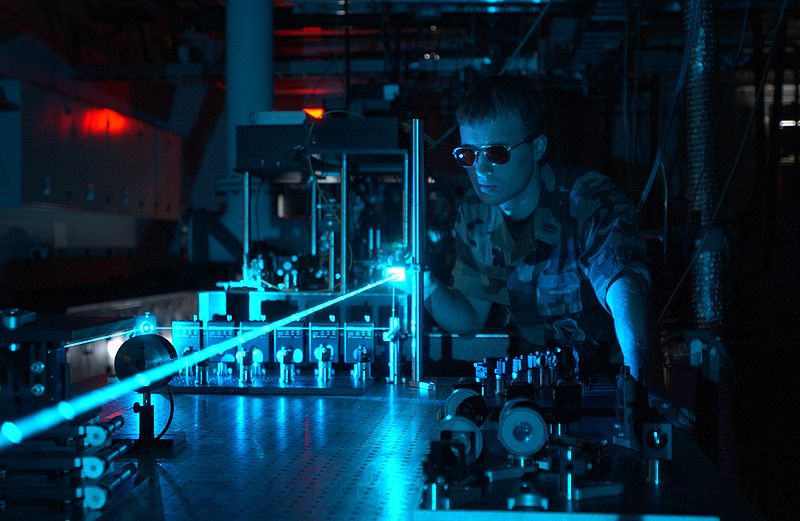
photon_laserAnother important step took place back in March, when researchers at Yale University announced that they had developed a new way to change the quantum state of photons, the elementary particles researchers hope to use for quantum memory. This is good news, because it effectively demonstrated that true quantum computing – the kind that utilizes qubits for all of its processes – has continually eluded scientists and researchers in recent years.

To break it down, today’s computers are restricted in that they store information as bits – where each bit holds either a “1″ or a “0.” But a quantum computer is built around qubits (quantum bits) that can store a 1, a 0 or any combination of both at the same time. And while the qubits would make up the equivalent of a processor in a quantum computer, some sort of quantum Random Access Memory (RAM) is also needed.

Photon_follow8Gerhard Kirchmair, one of Yale researchers, explained in a recent interview with Nature magazine that photons are a good choice for this because they can retain a quantum state for a long time over a long distance. But you’ll want to change the quantum information stored in the photons from time to time. What the Yale team has developed is essentially a way to temporarily make the photons used for memory “writeable,” and then switch them back into a more stable state.

To do this, Kirchmair and his associates took advantage of what’s known as a “Kerr medium”, a law that states how certain mediums will refract light in a different ways depending on the amount shined on it. This is different from normal material materials that refract light and any other form of electromagnetic field the same regardless of how much they are exposed to.
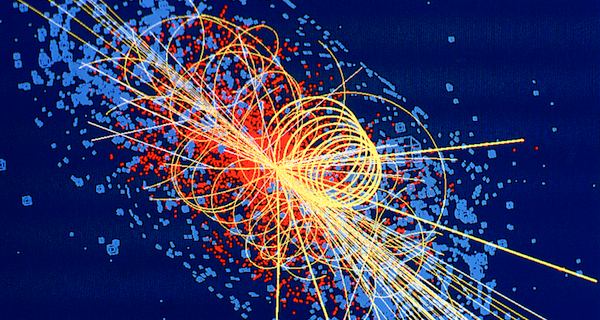
Higgs-bosonThus, by exposing photons to a microwave field in a Kerr medium, they were able to manipulate the quantum states of photons, making them the perfect means for quantum memory storage. At the same time, they knew that storing these memory photons in a Kerr medium would prove unstable, so they added a vacuum filled aluminum resonator to act as a coupler. When the resonator is decoupled, the photons are stable. When resonator is coupled, the photons are “writeable”, allowing a user to input information and store it effectively.

This is not the first or only instance of researchers finding ways to toy with the state of photons, but it is currently the most stable and effective. And coupled with other efforts, such as the development of photonic transistors and other such components, or new ways to create photons seemingly out of thin air, we could be just a few years away from the first full and bona fide quantum processor!

Sources: Extremetech.com, Wired.com, Nature.com

Whiskey Delta, 2nd Edition!

zombie-wallpaperWell let me start by saying that Whiskey Delta continues to do well. And though the sales appear to be slowing down a bit, the overall number has just passed 900 copies! Good news, but in truth, I am concerned that interest is waning and I can’t help but wonder if the mixed reviews are to blame. After a total of ten, the overall rating is now at a 3.4 out of 5 stars, which puts it in the good, but not great section.

So here’s what some of the latest reviewers have had to say on the subject of the 1st edition. As you can see, it was more of the same:

J. York (3.0 out of 5 stars):
As others have said, i enjoyed the story itself but stumbled a lot in the reading due to the editing. It didn’t read smoothly as there were so many words misspelled and put in the wrong part of a sentence. As i said, I totally liked the plot but found the flow of it hard to read.

Bob Gawler (3.0 out of 5 stars):
The plot and story were actually pretty good, but the edititing let the store down. Too many grammatical and spelling errors.

Can’t help but notice some typos in these comments, glaring ones too. I know, I need to stop mocking commenters who are just being honest. But the irony, man, the irony! Ah, but then there was this one, which was the second five star review this book earned:

Rosie Reader (5.0 out of 5 stars):
This is a really gripping read; awesome story, great characters. Yes, there were typos, but the story kept the pages turning quickly. Great work Matthew S. Williams!
I’m looking forward to the next one.

That makes for a grand total of two 5 star reviews, three 4 star reviews, 2 three star reviews, and 2 two star reviews; which as I said, averages out to a total of 3.4 stars out of 5. Like I said, good, but not great.

Luckily, as the title suggests, my wife and I finally finished work on the 2nd edition of Whiskey Delta, the one that doesn’t have so many typos and errors. Yes, after a few short weeks of tinkering, the process of creating a novel that I can truly be proud of is finally complete. Good thing too, because I can’t take another comment about how my “story is good but it desperately needs editing”!

And of course, now that the 2nd edition is complete, I will be getting to work on turning Papa Zulu, the second installment in the series, into an typo=free, error-proof manuscript. Then I will be making it available on Amazon-Kindle for all to see. May it receive a greater reception than the first…

News From Space: Opportunity Hits New Record!

opportunityWith the Curiosity Rover blazing a trail across Mars to find evidence of what the planet once looked like, people often forget about it’s venerable predecessor – the Opportunity Rover. Luckily, Opportunity recently broke a record that put it back in the public eye and into the history books. After nine years into what was initially meant to be a 90 day mission, Opportunity smashed yet another space milestone this week by establishing a new distance driving record.

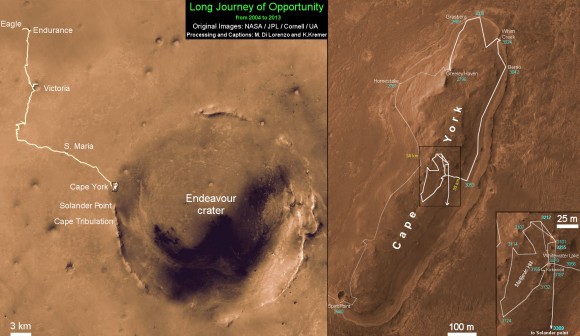
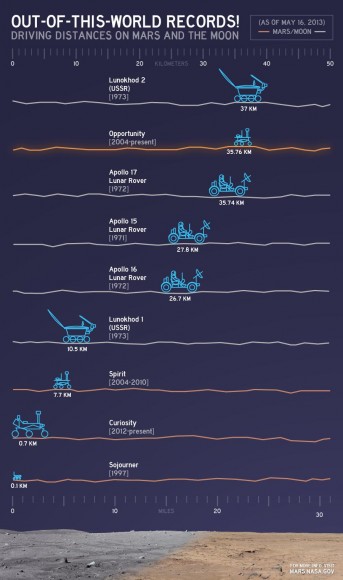
On Thursday, May 16, the Opportunity rover drove another 80 meters (263 feet) on the Martian surface, bringing her total odometry since landing on the 24th of January, 2004 to 35.760 kilometers (22.220 miles). This effectively put her ahead of the 40 year old driving record set by the Apollo 17 astronauts Eugene Cernan and Harrison Schmitt back in December of 1972.

Apollo_17_lunar-rover-577x580On that mission, Cernan and Schmitt performed America’s final lunar landing mission and drove their Lunar Roving Vehicle (LRV-3) a total of 35.744 kilometers (22.210 miles) over the course of three days on the moon’s surface at the Taurus-Littrow lunar valley. And interestingly enough, Cernan was a very good sport about his record being broken. In a statement made at NASA’s Goddard Space Flight Center in Greenbelt, Md, he said:

The record we established with a roving vehicle was made to be broken, and I’m excited and proud to be able to pass the torch to Opportunity.

And since Opportunity still has plenty of juice left, it is now eying the ‘Solar System World Record’ for driving distance on another world, a record that is currently held by the Soviet Union’s remote-controlled Lunokhod 2 rover. In 1973, Lunokhod 2 traveled 37 kilometers (23 miles) on the surface of Earth’s nearest neighbor. With Opportunity setting course for her next crater rim destination, named “Solander Point”, she is likely to overtake Lunokhod 2’s record in short order!

Opportunity-Route-Map_Sol-3309_Ken-Kremer-580x336Thereafter, Opportunity will rack up ever more distance as the rover continues driving further south to a spot called “Cape Tribulation”. This point is believed to hold caches of clay minerals that formed eons ego when liquid water flowed across this region of the Red Planet. In so doing, Opportunity will not only establish a new record that will last for years to come, it will also be obtaining data that will assist in Curiosity’s own efforts to determine what life was like on Mars in the past.

Far greater than this record-breaking news is the fact that Opportunity has lasted so far beyond her design lifetime, 37 times longer in fact than her initial 3 month “warranty”.

And be sure to check out the full list of record holders for “out-of-this-world” driving, below:

out-of-this-world_recordsSources: universetoday.com, news.cnet.com

The Future is Here: Cellular Computers!

dnacomputingComputing has come so far in such a relatively short space of time. Beginning with comparatively basic models, which relied on arrangements of analogue circuits (such as capacitors and resistors), scientists were able to perform complex calculations, crack impenetrable cyphers, and even know how and where to deploy counter-measures against incoming missiles. And as we all know, sometimes you have to look back to the fundamentals if you want to move any farther ahead.

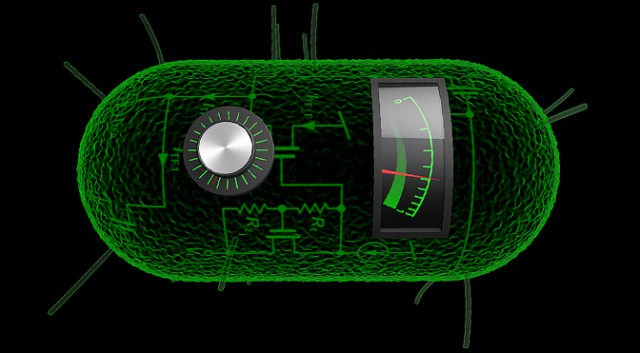
And that’s precisely what researchers at MIT have done with their latest innovation: an analog computer that works inside a living cell! A massive step towards a future where machinery and biology are one and the same, these “cellular computers” were not only able to perform arithmetic, but also more complex functions like taking logarithms, square roots, and even do power law scaling.

biological-analog-computers-in-cells-640x353This news comes on the heels of researchers at Stanford who were able to create a biological transistor inside a cell. Relying on DNA and RNA to create a “transcriptors”, the Standford researchers were able to create a biological logic gate, and all on the microscopic scale. When combined the sorts of digital and analog circuits common to computing, this research could lead to powerful sensing and control platforms built on very small scales.

And like many recent innovations and developments made within the world of computing and biotechnology, the possibilities that this offers are startling and awesome. For one, all cells work with a certain biological clock, which regulates growth, circadian rhythms, aging, and numerous biological process. Thus far, the researchers in question have been hosting their biological computers in bacterial cells. But if they were to develop analogous circuits that operate in mammalian cells, these functions might be brought into better use.

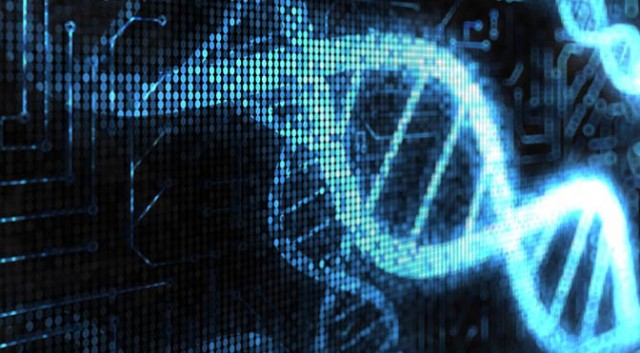
DNA-molecule2What this means is that we could be very well seeing the beginning of biology that is enhanced and augmented by the addition of technology on the cellular level. And not in the sense of tiny machines or implants, things made of silicon and minerals that would regulate our blood flow, administer drugs or monitor or vitals. No, in this case, we would be talking about machines that are composed of self-regulating DNA and RNA and work in the same way our organic tissues do.

On top of that, we would be able to create things like flash drives and computation software from living tissue, cramming thousands of terabytes of into into a few cells worth of genetic material. Human beings would no longer need smartphones, PDAs or tablets, since they would be able to carry all the information they would ever need in their body. And the ability to do this could very well lead to the creation of AI’s that are not build, but grown, making them virtually indistinguishable from humans.

caprica_6And you know what that means, don’t you? The line between biological and artificial would truly begin to dissolve, Voight-Kampff and genetic tests might have to become mandatory, and we could all be looking at robots that look something like this…

Man the future is awesome and scary!

Sources: Extremetech.com, (2)

Fundawear: A New Era of Cybersex!

long_distanceloverHave you ever experienced the frustrations and difficulty of a long-distance relationship? My wife and I did during the first few years of our courtship. And let me tell you, there’s few things worse than to be in love with someone and not be able to see them. And even in this age of high-tech communications, where we are able to talk, Skype, instant message, email and text, the physical barrier created by space can still be a killer. Luckily, the condom company Durex is working on a  solution…

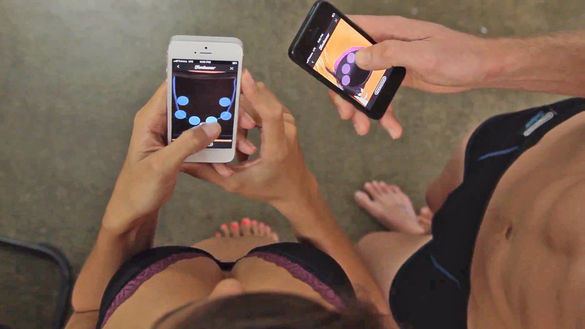
It’s called Fundawear, a new type of undergarment that is outfitted with electronic pulses that lets couples – or willing cybersexers – send physical touches to each other via remote control. Using a smartphone or tablet, the sender initiates contact by simply stroking the touchscreen, and the recipient receives a mild shock on their sensitive spots.  To make things fun, the jolt can happen anywhere the underwear has contact with the skin.

fundawearThe key word here is mild, just in case anyone is thinking that the underwear is for those who have an extreme BDSM fetish! But then again, stranger things have happened haven’t they? Of course, it should be noted that the Fundawear is not yet a mass-market product, but the company is having a contest on its Australian Facebook page and hints that those who enter will be eligible to win a pair.

Created in conjunction with the advertising firm Havas Sydney, Fundawear is Durex’s first attempt at a connected product. It comes in both women’s and men’s designs, offering stimulation for men around the nether regions, and for women in both the chest and nether area. And who knows? Given time and added guarantees of safety, we could be looking at the future of cybersex. I guess guys like Gibson were wrong, cyber stuff really isn’t all dark!

cybersexTo check it the FB contest, click here, and be sure to watch the video of the Fundawear in action below:


Source:
fastcocreate.com

The Future is Here: Blood Monitoring Implants!

nanorobot1

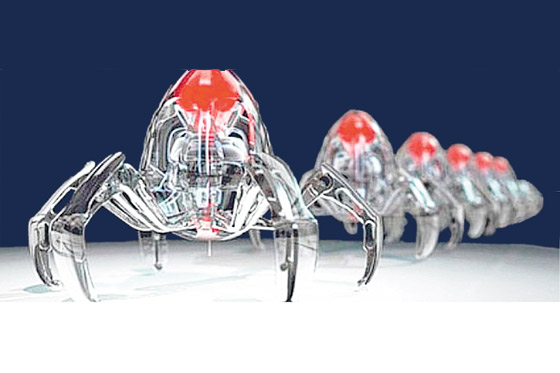
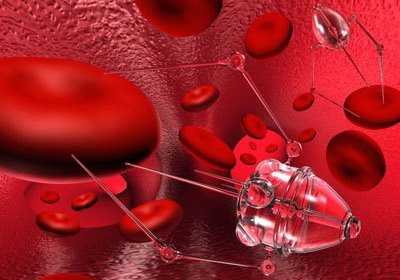
The realm of nanotechnology, which once seemed like the stuff of science fiction, is getting closer to realization with every passing year. And with all the innovations taking place in tiny-scale manufacturing, molecular research, and DNA structures, we could be looking at an age where tiny machines regulate our health, construct buildings, assemble atomic structures, and even contain enough hardware to run complex calculations.

One such innovation was announced back in March by the Ecole Polytechnique Fédérale de Lausanne (EPFL) in Switzerland, where researchers created the world’s smallest medical implant capable of monitoring critical chemicals in the blood. Measuring a mere 14mm in length, the device is capable of measuring up to five indicators, like proteins, glucose, lactate, ATP, and then transmit this information to a smartphone via Bluetooth.

implantable-sensor-640x353

In short, it is capable of providing valuable information that may help track and prevent heart attacks and monitor for indications of harmful conditions, like diabetes. Each sensor is coated with an enzyme that reacts with blood-borne chemicals to generate a detectable signal, and is paired with a wearable battery that provides the 100 milliwatts of power that the device requires by wireless inductive charging through the skin.

For patient monitoring, such a device has so many useful applications that it is likely to become indispensable, once introduced. In cancer treatment for example, numerous blood tests are often required to calibrate treatments according the to the patient’s particular ability to break down and excrete drugs. And since these parameters often change due the patient’s reaction to said treatments, anything that can provide up-to-the-minute monitoring will spare the patient countless invasive tests.

nanotech-2

In addition, in cases of heart attacks, the signs are visible in the hours before the event occurs. This occurs when fatigued or oxygen-starved muscle begins to break down, releasing fragments of the heart-specific smooth muscle protein known as troponin. If this protein can be detected before disruption of the heart rhythm begins, or the actual attack, lifesaving preemptive treatment can be initiated sooner.

At the moment, the sensors are limited by the number of sensors they hold. But there is no theoretical limit to how any sensors each implant can hold. In the future, such a device could be equipped with electronics that could monitor for strokes, blood clots, high cholesterol, cancer cells, HIV, parasites, viruses, and even the common cold (assuming such a thing continues to exist!) Just think about it.

You’re going about your daily activities when suddenly, you get a ringtone that alerts you that you’re about to experience a serious a health concern. Or maybe that the heavy lunch you just ate raised the level of LDL cholesterol in your bloodstream to an unwanted level. Tell me, on a scale of one to ten, how cool would that be?

Source: Extremetech.com

Towards a Cleaner Future: The Molten Salt Reactor

nuclear-power

What if you heard that there was such a thing as a 500 Megawatt reactor that was clean, safe, cheap, and made to order? Well, considering that 500 MWs is the close to the annual output of a dirty coal power station, you might think it sounded too good to be true. But that’s the nature of technological innovations and revolutions, which the nuclear industry has been in dire need of in recent years.

While it is true that the widespread use of nuclear energy could see to humanity’s needs through to the indefinite future, the cost of assembling and maintaining so many facilities is highly prohibitive. What’s more, in the wake of the Fukushima disaster, nuclear power has suffered a severe image problem, spurred on by lobbyists from other industries who insist that their products are safer and cheaper to maintain, and not prone to meltdowns!

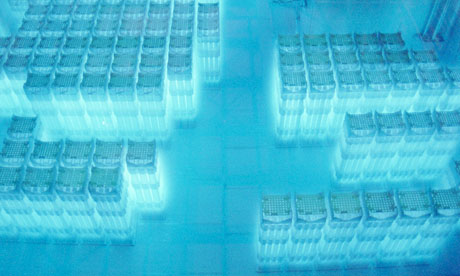
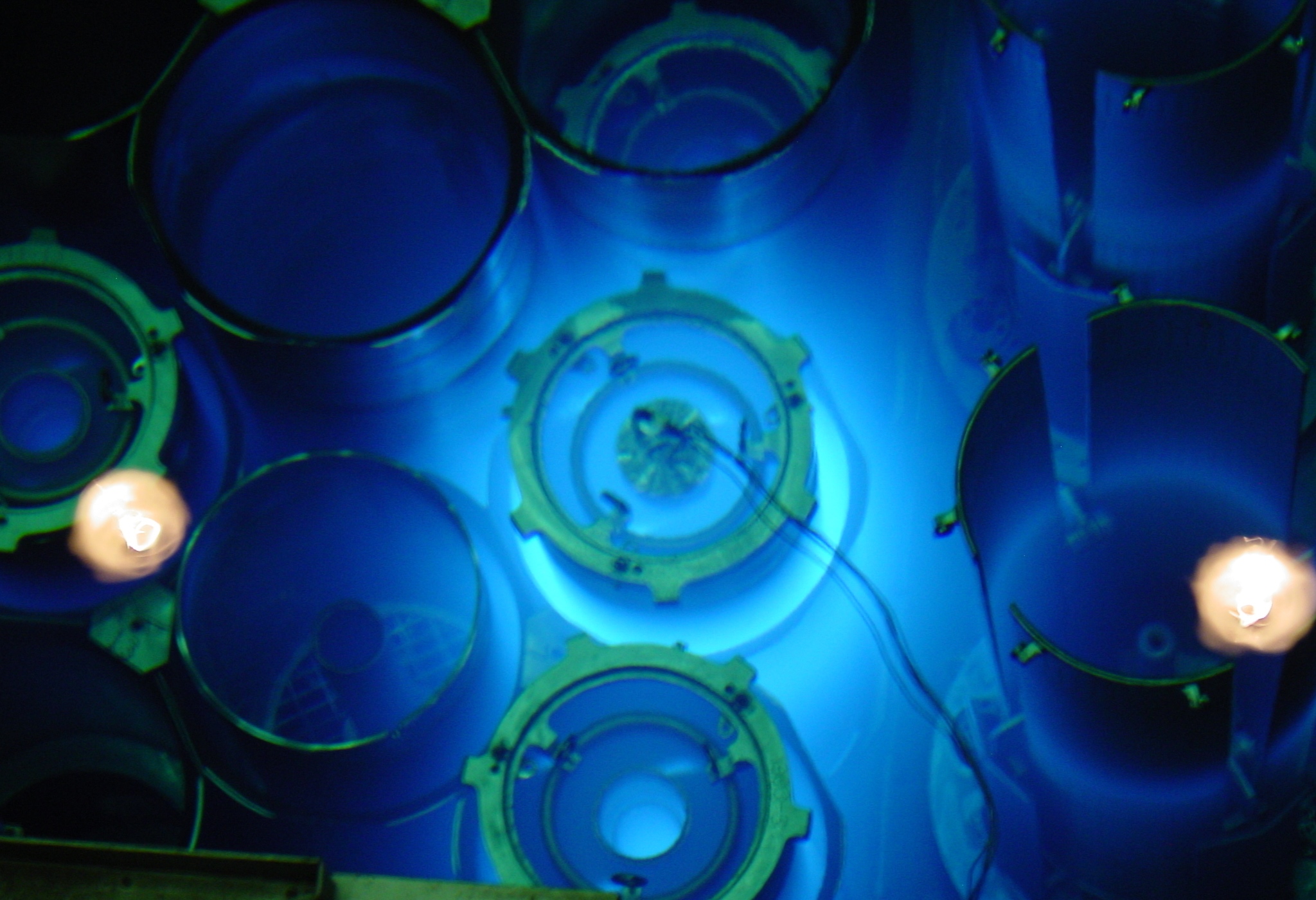
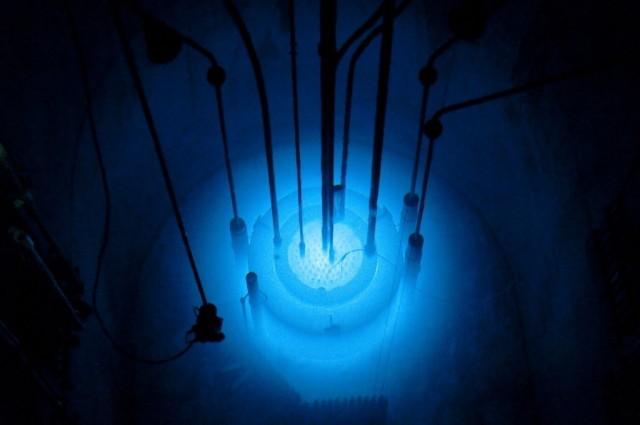
Nuclear MOX plant : recycling nuclear waste : Submerged Spent Fuel Elements with Blue Glow

As a result of all this, the stage now seems set for a major breakthrough, and researchers at MIT and Transatomic’s own Russ Wilcox seems to be stepping up to provide it. Last year, Wilcox said in an interview with Forbes that it was “a fabulous time to do a leapfrog move”. Sounded like a bold statement at the time, but recently, Transatomic went a step further and claimed it was mobilizing its capital to make the leap happen.

Basically, the plan calls for the creation of a new breed of nuclear reactor, one which is miniaturized and still produces a significant amount of mega-wattage. Such efforts have been mounted in the past, mainly in response to the fact that scaling reactors upwards has never resulted in increased production. In each case, however, the resulting output was quite small, usually on the order of 200 MW.

???????????????????????????????

Enter into this the Transatomic’s Molten Salt Reactor (MSR), a design that is capable of producing half the power of a large-scale reactor, but in a much smaller package. In addition, MSRs possess a number of advantages, not the least of which are safety and cost. For starters, they rely on coolants like flouride or chloride salts instead of light or heavy water, which negates the need to pressurize the system and instantly reduces the dangers associated with super-heated, pressurized liquids.

What’s more, having the fuel-coolant mixture at a reasonable pressure also allows the mixture to expand, which ensures that if overheating does take place, the medium will simply expand to the point that the fuel atoms too far apart to continue a nuclear reaction. This is what is called a “passive safety system”, one that kicks in automatically and does not require a full-scale shutdown in the event that something goes wrong.

moltensalt_reactor1

Last, but not least, is the addition of the so-called freeze plug – an actively cooled barrier that melts in the event of a power failure, leading all nuclear material to automatically drain into a reinforced holding tank. These reactors are “walk away safe,” meaning that in the event of a power failure, accident, or general strike, the worst that could happen is a loss of service. In a post-Fukushima industry such disaster-proof measures simply must be the future of nuclear power.

Then, there is the costs factor. Transatomic claims their reactor will be capable of pumping out 500 megawatts for a total initial cost of about $1.7 billion, compared to 1000 megawatts for an estimated $7 billion. That’s about half the cost per megawatt, and the new reactor would also be small enough to be built in a central factory and then shipped to its destination, rather than requiring a multi-year construction project to build the plant and reactor on site.

The project has raised $1 million dollars of investment so far, and Transatomic appears to be putting all their eggs in this one basket. Their researchers also claim their design is production-ready and they are just waiting for orders to come in. And given the current energy crisis, it’s not likely to be long before government and industry comes knocking!

Source: Extremetech.com

The Future is Here: The RP-VITA Robo-doc

RP-VITA

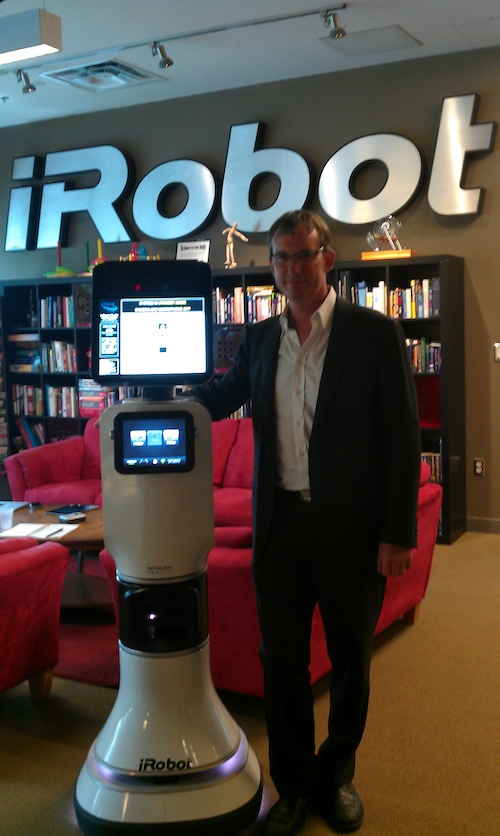
Just to put some fears to rest right away, I should inform you that the RP-VITA, aka. the robo-doc, is not actually a robotic doctor. What it is is a revolutionary new telepresence robot that allows doctors to examine and treat patients from a distance. Earlier this year, the design received approval from the FDA, and has since been picked up by seven hospitals across the United States and one in Mexico City.

RP-VITA, which stands for Remote Presence Virtual + Independent Telemedicine Assistant, was developed collaboratively by iRobot and InTouch Health. InTouch Health specializes in telemedicine, the pursuit of bringing telepresence technology to medical centers all around the world. As for iRobot, they are predominantly known for making the Roomba robotic vacuum cleaner, not to mention the Robotic Fabricator – the world’s first robot-assisted 3D printer.

rp-vita1

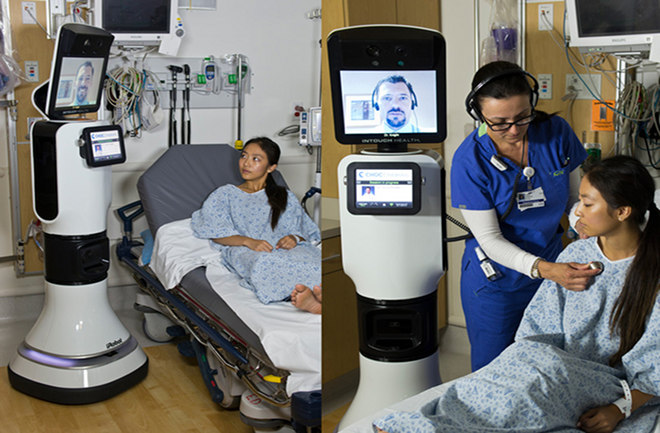
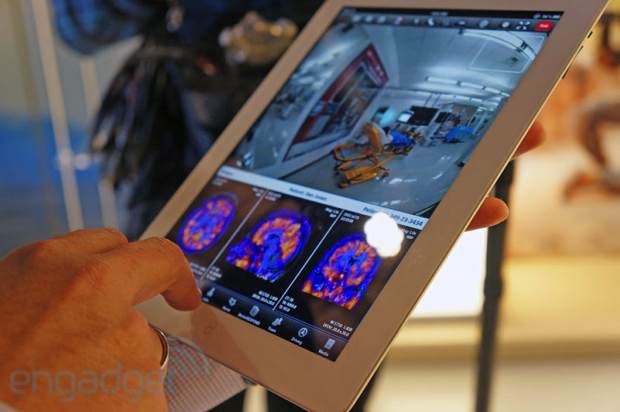
As seen in the pics above, the 5-foot robot is basically a roving Webcame that projects a remote doctor’s face and voice for interaction with patients, doctors and nurses. It is also iPad-controlled, but can navigate hospital wards autonomously and even find patients on its own, since it has a map that’s integrated with hospital wards. This makes it the first telepresence robot that’s functions promise not to disrupt existing hospital procedures.

rp-vita_portraitAnd since the RP-VITA was designed with telepresence in mind, it has had no trouble merging in with existing programs such as TeleStroke, TeleICU, TelePsych, and TelePediatric. All of these programs specialize in connecting medical specialists to patients even though they are not on sight. But by adding mobility to the equation, the robot offers a good deal of enhancement to these programs by being able to go where its needed and free up patient care space.

In a press release statement, iRobot and InTouch quoted Paul Vespa, director of neurocritical care at the Reagan Center, citing the benefits of this new robot:

During a stroke, the loss of a few minutes can mean the difference between preserving or losing brain function… The new technology enables me to concentrate on caring for my patient without being distracted by the need to set up and manage its technological features.

So for those fearing that this was the beginning of the end, or that robots were being entrusted with life and death decisions effecting human being, rest assured that this is merely an example of enhancing patient care and that human controllers are still (largely) in control of the process. We’re safe for now…

Source: news.cnet.com


Preventing the Apocalypse: NASA’s Asteroid Lasso Mission

asteroid_lasso

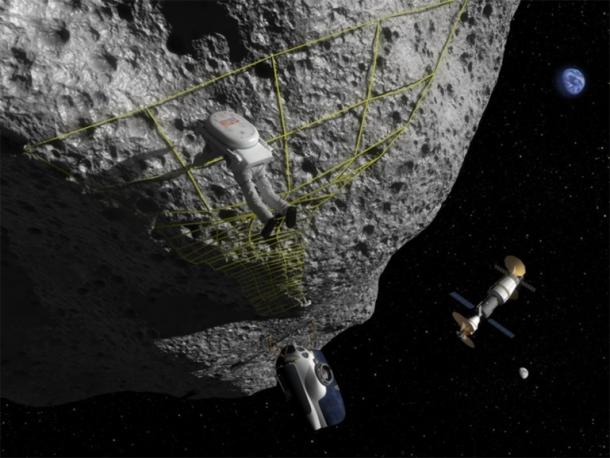
Shortly after that large meteor hit Russia, President Obama and NASA administrator Charles Bolden both announced that work would begin on a series of asteroid tracking technologies that would ensure that more severe Earth collisions would be prevented. Earlier this month, Bolden spoke at the Mars Summit in Washington, D.C. and said that a robotic spacecraft mission is currently being planned with this goal in mind.

The plan calls to mind such films as Armageddon and Deep Impact, but differs in that it involves lassoing an asteroid instead of detonating a small nuke inside it. The ultimate goal here is to tow an asteroid out of the path of Earth, but then to deposit it in orbit so that it can be visited by astronauts. These astronauts will then collect samples and conduct research that could one day assist in a mission to Mars or save Earth from a catastrophic collision.

Asteroid-Toutatis

This is in keeping with the Obama administrations’ pledge of putting a man on a near-Earth asteroid by 2025 and a manned mission to Mars by 2030. It’s also in the same vein as NASA’s plan to catch and deposit an asteroid around the Moon, an idea that was proposed back in January of this year as part of the agencies plan to establish an outpost at Lagrange Point 2 early in the next decade.

And even though NASA has expressed that the massive 22 million ton asteroid Apophis will not impact planet Earth in 2036, it didn’t rule out that other, smaller rocks could possibly reach us in that time. Capturing them and towing them to where they could be safely deposited in orbit would present many opportunities, not the least of which could be commercial.

asteroid_foundry

For example, asteroid prospecting is slated to begin in 2015, with companies like SpaceX and Deep Space Industries leading the charge. Once property rights are assigned to various celestial bodies, these and other companies hope to send missions out to mine them and establish automated 3D manufacturing facilities, places that use “sintering” to process ore into metal and other materials that can then be shipped back.

NASA’s science mission directorate associate administrator John Grunsfeld also spoke about the importance of the lasso mission at the Human to Mars Summit on Monday. Above all else, he emphasized the importance of using the knowledge and skills gained from the research to achieve the long-term goal of survival:

We have a pretty good theory that single-planet species don’t survive. We don’t want to test it, but we have some evidence of that happening 65 million years ago [when an asteroid killed much of Earth’s life]. That will happen again someday … we want to have the capability [to leave the planet] in case of the threat of large scale destruction on Earth.

Yeah, its a rocky universe. And if we intend to survive in it, we had best learn how to deflect, capture and destroy any that come our way and get too close. And of course, we need to learn how to harness their endless supply of minerals and trace elements.

asteroid_belt1Source: news.cnet.com

News from Space: Chris Hadfield Says Goodbye to the ISS with a Music Video

chris_hadfield

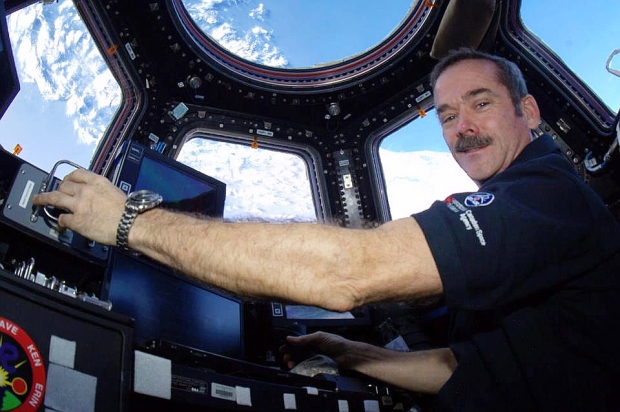
How do you say goodbye to the International Space Station after five months in orbit? Well, if you’re Chris Hadfield, the commander of the latest mission to the ISS, you do so with a musical rendition! Yes, the Commander who back in February via telepresence with the Barenaked Ladies and Wexford Gleeks, is at it again. Back then, it was the original song “I.S.S. (Is Somebody Singing)” that captured the hearts and minds of Canadians and people around the world.

This time around, it was his rendition of David Bowie’s “Space Oddity” that blew people away. Changing the lyrics just a little to make for a more positive tone, the version Hadfield sings here is essentially a farewell to the ISS and an expression of anticipation about his impending trip home. And as usual, he played his own guitar, sang all of his own the lyrics, and managed to capture the perfect combination of happiness and poignancy.

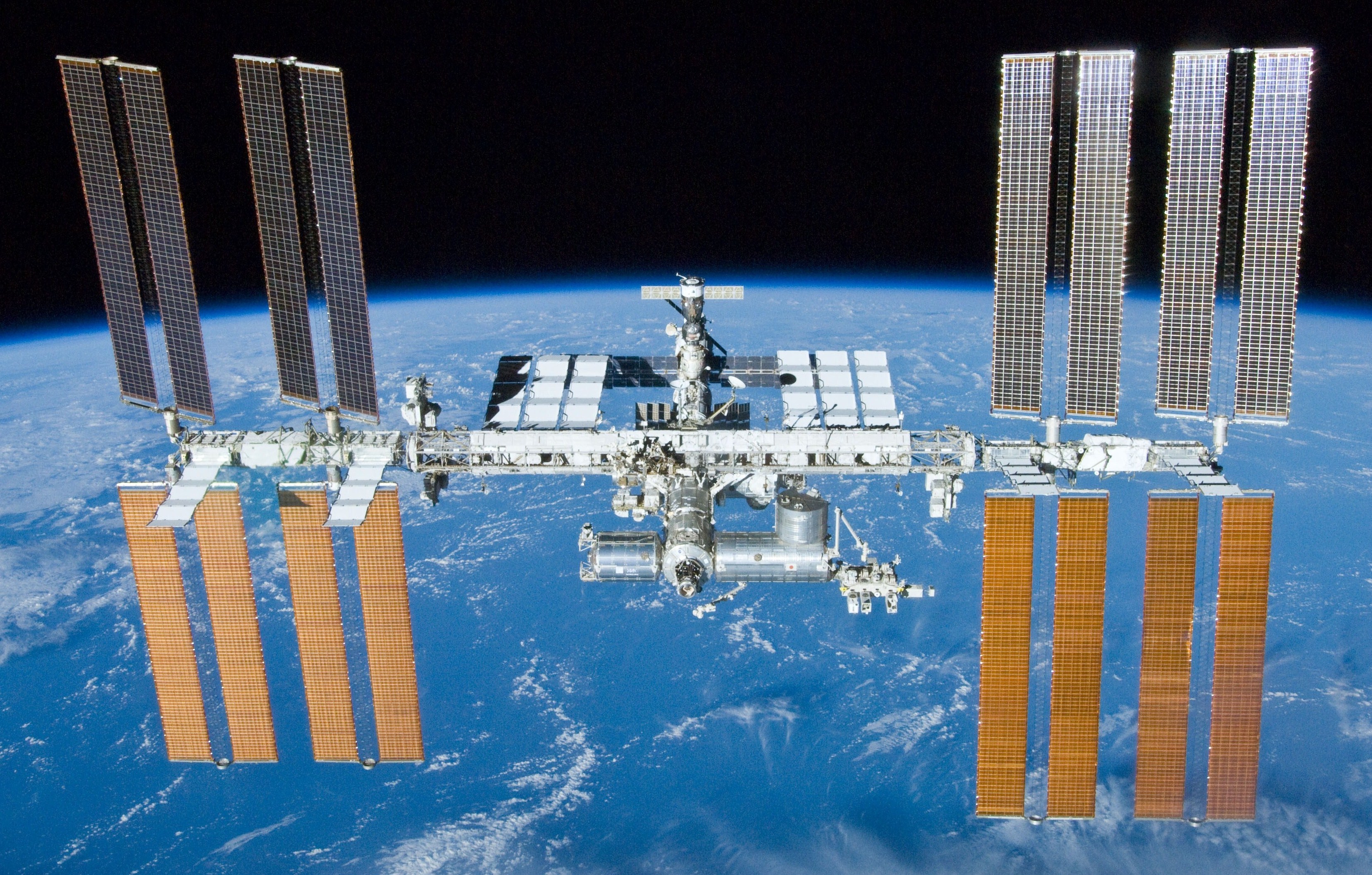
ISS

And it was a bittersweet event, when you get right down to it. Though Hadfield acknowledges that he will be coming home after many months of being away, he also repeatedly acknowledges in his musical rendition that this is the last time he will be seeing the ISS or looking down at Earth from orbit. One cannot help but feel that, under those circumstances, that Hadfield was expressing some mixed emotions, and this song is quite sad as well as upbeat as a result.

But of course, he had some help from people back home. On the YouTube post where the video was uploaded, Hadfield thanked Canadian musician Emm Gryner, his son Evan Hadfield, music producer Joe Corcoran, and TV producer Andrew Tidby “for all their hard work.” A link to the music video was also Tweeted out from his Twitter account about one hour after he formally turned over command of the ISS to Russian cosmonaut Pavel Vinogradov with the message:

With deference to the genius of David Bowie, here’s Space Oddity, recorded on Station. A last glimpse of the World.

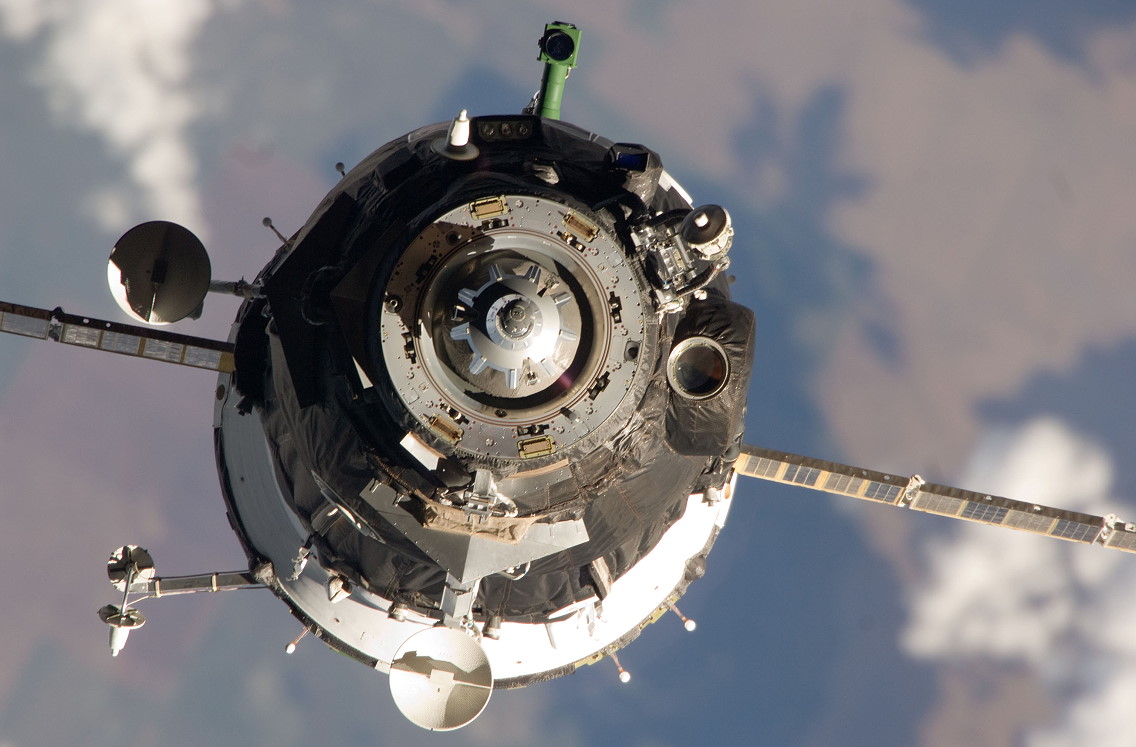
Soyuz_capsule

Some of Hadfield’s own lyrics refer to his impending return, such as “Lock your Soyuz hatch and put your helmet on” or “Detach from station and may God’s love be with you.”  Along with the two other members of his mission crew, the departure took place shortly after 7 p.m. ET, yesterday. The trio then landed under a large parachute in the flat steppes of Kazakhstan at 10:31 p.m. ET where they were picked up by helicopter and flown to Karaganda, Kazakhstan for medical checkups.

What’s next for Hadfield and his crew? Late tomorrow, Hadfield and Marshburn will be arriving via a NASA flight back in Houston while Romanenko will board a Russian aircraft for a flight to Star City (aka. Zvyozdny gorodok), just outside of Moscow. And when Hadfield finishes the last leg of his trip home, I am sure he can look forward to a hero’s welcome, not to mention a lifetime of endorsements an fond memories.

After all, if he’s demonstrated anything in the past five months, its that he’s quite the performer in addition to being an astronaut and commander. And given the impact he has had, I’d be very surprised if Canadians or the world at large stopped thinking about him anytime soon. In the meantime, check out the video of his cover of “Space Oddity” below. The production values and Hadfield’s singing are pretty damn awesome, if I do say so myself!


Source:
ctvnews.ca
, cbc.ca