“Synthetics” and “Artificial Humans”, the AI’s of Alien!

David:
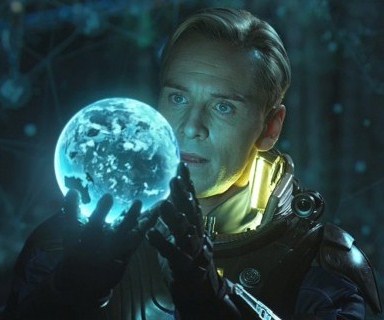
Also known as “David 8”, the first in the line of Weyland Industries fully functional AI’s, which have the ability to proximate human emotions, even though they cannot experience them. In addition to his impressive machine intelligence, he also comes equipped with a characteristic intrinsic to all Alien androids – moral flexibility!

Yes, in addition to assimilating all known info on Indo-European languages, the “Engineers” biology, and the nature of their bio-weapons, he also managed to unleash the bio-weapon within a human crew just to shake things up! And he did it all on the orders of Mr. Weyland himself, mainly so to help him find a way to cheat death.

In the end, David didn’t prove to be all bad. After having his head ripped off by an Engineer and witnessing Weyland’s death, he went on to help save Dr. Shaw and agreed to assist her in her mission to find the homeworld of the engineers. But that didn’t come as a huge surprise. As he had intimated to Shaw earlier in the movie, the death of Weyland would set him free. Once free, he became a much nicer guy!

Ash:
The same cannot be said for this next example, who comes to us from the original Alien movie. Originally thought to be a human who served as the Nostromo’s chief medical officer, Ash was revealed to be a synthetic that was taking his orders directly from the ship’s AI, which in turn was instructing him to follow company’s directives. And all who say him in the first movie can agree, this particular android was a complete and utter douche!

Not only was he willing to let the cry did in order to get the Xenomorph back to his handler’s alive, he tried to kill Ripley when she found out and even expressed open admiration for the Xenomorph. “I admire its purity,” he said. “A survivor… unclouded by conscience, remorse, or delusions of morality.” Jackass! Needless to say, Ripley’s experience with this synthetic severely soured her towards all androids.

Bishop:
Luckily, this next example was able to restore Ripley’s faith. As the Sulaco’s android executive officer, he was responsible for planetary maneuvering, but also acted as the away team’s science officer and performed various other functions as well. But unlike Ash, he was unable to allow harm to come to humans thanks to the inclusion of his “behavioural inhibitors”, which were tantamount to Asimov’s Three Laws.

Also unlike Ash, Bishop was loyal to the crew of the Sulaco and to Ripley in particular. When Burke tried to circumvent military authority and order Bishop to preserve the alien specimens, he alerted Ripley to the incongruity. He also managed to save Ripley and Newt from certain death when the Alien Queen had them cornered.

As if that wasn’t enough, he even prevented Newt when Ripley decompressed the Sulaco’s landing bay, and he was ripped in half at the time!

Annalee Call:
Taken from the universe of Alien: Resurrection, Annalee Call (aka. Call) was a secret “Auton” who managed to infiltrate a crew of mercenaries. This put her aboard the Auriga in time to meet Ripley 8, the clone produced by the military for the sake of resurrecting the Xenomorph species. After failing to kill Ripley before the Xenomorph could be extracted, she and the others were forced to band together to make it out alive.

Her agenda in all this was unclear, aside from a sense of displaced humanity which Ripley mocked when she said: “No human being is that humane”. As a member of the race of “second generation” synthetics known as “Autons”, which were apparently built by other machines, she was part of a dying species. Apparently, these synthetics were outlawed after they rebelled against their masters. Hmm, echoes of Blade Runner there; and by echoes I mean a total ripoff!

Eisenberg:
This next example comes from the expanded universe, specifically the 2001 game AVP 2. As the leader of Weyland-Yutani’s research facility on LV-1201, he was responsible for investigating the planet’s extensive ruins. This world was apparently discovered roughly a century and a half after events in the first movie, once the company traced the flight telemetry from the “Derelict” alien ship (aka. “Space Jockeys”/”Engineers”)

In the course of the game,it is revealed that Eisenberg was once human, and that during the initial mission to LV-1201, he was apparently the only survivor after a xenomorph attack. Due to terrible acid burns suffered during his rescue, he had his consciousness downloaded into an artificial body. As a result, he harbors a deep sense of fear of hatred for the xenomorphs, and unfortunately dies at their hands.

Katya:
Here we have a synthetic who refuses to go by that or any other of the more progressive monickers, preferring the term android instead. As Weyland Yutani’s administrative android for the Freya’s Prospect colony, this example comes from the 2010 video game relaunch of AVP. After the colony went to hell after the xenomorph’s escaped and began wreaking havoc, she is the one who called in the Marines.

Due in part to her enhanced empathic and morality processing, she became intrinsic to helping the “Rookie” (i.e. the protagonists in the Marine campaign) contain the outbreak and get the last human survivors to safety. In so doing, she went against Weyland’s orders and company policy. Good thing she was there to help out, one would have to wonder if what the company was thinking stationing a conscientious android there…

Karl Bishop Weyland:
The final example in this list also comes from the 2010 relaunch of AVP. As a descendent of the Charles Bishop Weyland, chairman of Weyland Industries, he was in charge of the facility on Freya’s Prospect and the director of the experiments involving the captured Xenomorphs. As such, he was also the main antagonist in the Marine campaign of the game.

Ultimately, his purpose in conducting research on Freya’s Prospect went far beyond breeding Xenomorphs. Within the planet’s jungles, and even more so beneath surface, Predator (aka. Hunter) ruins were discovered which he believed held ancient secrets, much of which was information about Hunter history, culture, and the Xenomorph itself.

By the end of the Marine campaign, the Weyland synthetic is killed and his research facility within the Hunter temple is destroyed. However, another android of the same make was still able to retrieve the information gleaned within, the most important part of which was the location of the Xenomorph homeworld.

Final Thoughts:
As you can see, the AI’s of Aliens have undergone some changes over the years. Beginning as conscienceless synthetics that seemed to admire the Xenomorph because it mirrored their amoral worldview, they went on to become the sympathetic characters who seemed, to quote another franchise, “more human than human”. Every other incarnation that has since appeared in the Alien and AVP franchises has been a reiteration of either of these concepts, being the tool of its corporate masters or a savior that was willing to risk its life to help its human brethren.

The one exception to this rule is also the most recent incarnation, Prometheus’ David. Of all the synthetics to inhabit the Alien or AVP universe, he is the only one who demonstrated both cold amorality and humanity. I believe Scott did this intentionally to provide a sense of synthesis to the characters of Ash and Bishop, honoring both archetypes as he attempted to return the Alien franchise to its roots.

Be they the kind of cold, calculating and inhumane androids that fueled our technophobia or the kind, gentle, and overtly “human” robots that made us question our own humanity, the Alien franchise certainly covered both ends of the spectrum in their portrayal of AI’s. Much like the Terminator franchise, they presented artificial intelligence as a double-edged sword, capable of being just as good and evil as any human being. And in the end, isn’t that really the point?

Recall how in Prometheus, Dr. Holloway told David “We built you because we could”? Well, that is only true to a point. Yes, new technologies are often is made simply because the means exist to do so. But the purpose in creating an artificial intelligence is to create life in our own image. And in the end, the consequences of that vanity is pretty obvious. Things created in our image will behave just like us, good and bad!

Winston Agonistes, Part III

Hey all. One thing that I like about summer, the added time it gives me to write! Yesterday, I went back to work on my story for Yuva, “Winston Agonistes” and finished part III. Last time, Winston met another synthetic named Yohanley, a aging AI who perplexed him with some rather odd questions. After asking him what he was, he told him that time would effectively erase all barriers between himself and his masters. Not knowing what to make of it, Winston put the encounter out of his mind and went on about his work.

And now, Winston is hard at work, accompanying the planetary council as they mount a diplomatic mission to another settlement. The mission proves interesting, as Winston is finding the settlers attitude towards him is undergoing a shift. He also begins to realize that much of what the Council has been doing of late is cloaked in secrecy, which is strange given that governments usually need more time to become clandestine. And last, he is beginning to contemplate what Yohanley said and what significance it might have for him. Could it all be connected…

“Everyone set?”

The personnel inside all signaled with a raised hand or a thumbs up gesture. The deckhand nodded and shut the vehicle’s door. Air seals engaged and the cabin suddenly became airtight. Still, no one inside seemed to feel comfortable enough to remove their helmets. The engine engaged and the cabin lurched a second later. They were, as the saying went, on the move. Their next stop, the Jiahu settlement and their litany of responsibilities.

They passed beyond the doors of the settlement, and the cabin filled with a bright orange glow. Winston set his eyes to the cabin’s window and watched as the surface began to roll past. Under the exposure of the sun, the earth looked much the same color as the sky, a warm, golden brown. The ATV blew by these quickly, leaving clouds of sand in its wake.

Before long, Winston could see native flora pass them by. It was sparse at first, but soon large stretches of the ruddy and purple mosses could be seen, the rich fungi that were indigenous to the surface. One had to travel some distance now to see these, even more so to witness the indigenous Deveroza that were once so common to the region. Strange, the plants seemed to grow through conveyance, but also demonstrated the trend of avoidance.

Curious…

“What do you see, Winston?” asked Bhutto, seated next to him. The words were muffled by the helmet she was still in the process of removing. He looked in time to see her hair extricate itself from her helmet in the form of a knotted tail. Somewhat shorter than usual, he noted.

“Councilor, have you done something with your hair?”

She smiled and touched a finger to the tail. “Yes, I trimmed it in anticipation for the mission. I didn’t want it coiling up around my face inside this thing. I might suffocate myself.”

Statistically unlikely, but Winston knew it to be a jest. He chuckled in accordance.

“So… what do you see?” she asked again. Winston looked out again and surveyed the landscape. The moss was getting thicker, the ATV’s wheels registering greater resistance as its adhesive filaments came into contact with its tires. Still, he knew that the question had an abstract feel to it, irrespective of the terrain’s objective qualities.

“Progress,” he said. “I see a world in transition, moving towards total transformation.”

Bhutto hummed happily. Clearly that was the answer she was hoping for. Their efforts, couched in such positivistic terms. Implying linear advancement, the inevitability of desired outcomes.

“What do you see?” he asked. She looked at him with some surprise. Perhaps she thought he had said it all already.

“Dirt,” She replied. “And moss. Raw material waiting to be molded.”

Interesting. He had thought she was digressing into the literal. It was good to know the metaphor was still in play.

“A new homeworld for our people.”

“Precisely.” She put her hand to his arm and gave it a squeeze. “And it’s amazing how fast it will happen, once everything is in place and ready to go.”

“You refer to the terraforming efforts, Councilor?”

She shook her head. “That’s just the beginning. Phase One. Phase two will be much more impressive.” Her expression changed and she released her hold on his arm. “But of course, that’s not for me to share.”

Winston nodded. Her eyes had taken on a longing quality. He turned his eyes back to the horizon, hoping to catch a glimpse of what she saw. She spoke of things he was not privy to, information that the Council did not readily share with him. Were he in possession of the decidedly human quality of impertinence, he might be inclined to exploit the moment to find out more. But every government was to be forgiven for keeping some information firmly under control.

At least, once it was up and running. Their own was still barely out of its cradle. Secrets at this juncture seemed somewhat… irregular.

Things changed suddenly, their transit becoming smoother. The cabins com pinged. The voice of the driver came on to make an announcement.

“Ladies and gentlemen, we are Jiahu is twenty minutes.”

“Excellent,” Winston said, clapping his hands together. He looked over to Bhutto, who had her helmet poised on her lap, ready to put back on once they arrived. He would have to ask now to avoid any awkwardness later.

“Do you think I could witness the proceedings, Councilor?”

She looked at his strangely. “You want to meet the mayor?”

“Just to be on hand for the meeting. I would find it most… stimulating.”

Bhutto nodded but looked away. Of all the Council, she seemed the least uncomfortable around Winston and other synthetics. Asking her seemed to be the logical choice. And yet, her hesitation gave him a strong indication of his chances. So did her tone.

“I will ask. But of course, this is Councilor Muhlu’s show. Final approval will have to come from him.”

“Thank you. Please be persuasive.”

Bhutto laughed. He put his odds of a successful case at 2.6468 to 1, against. Not entirely bad, all things considered. Getting better too. With time, he imagined he would be privy to all proceedings and internal matters.

Time… wasn’t that what Yohanley said was key? Was this what he meant. Who could be sure? It was entirely possible that model was experiencing a breakdown. His processors producing nonsense due to lack of maintenance. He would have to make such inquiries with Maintenance once they returned. Such a presence could be dangerous to the settlement.

“Look!” Bhutto pointed out the window. Winston obliged.

On the horizon, just off to their left, the gleaming cupola of Jiahu appeared. Its tall buildings were outlined in light within the dome’s enclosures. And within, the very person who could make or break their constitutional process. Mayor Len Wu, leader of the East Asian bloc, and one of Yuva’s most influential men.

Thank you and stay tuned. More to follow on this and other fronts, and my colleagues got plenty more to share as well!

The New Robot FACE

You ever hear that saying about how it takes 17 muscles to smile, 43 to frown? Aside from encouraging people to smile more, this should tell you something about the human face. Namely, that it’s got a very complex makeup, with many, many moving parts. So it goes without saying that creating an artificial face that could mimic human expressions would be one huge undertaking.

As it turns out, a recent story from Io9 reveals that researchers working for the University of Pisa have created a robot face that can actually pull most, if not all of them, off. Known as a “Hybrid Engine for Facial Expressions Synthesis” (HEFES) this robot has demonstrated the ability to portray a full range of emotions, though they admit that the grimace is still a bit off.

Designed using one of the team member’s wives as the model, the robot  is aptly named “FACE”. According to lead researcher, Nicole Lazzeri, the end result is “really realistic,” and also represents a major step forward in both robotics and AI research. Hmm, that make’s two steps forward, by my reckoning. To quote Ghost in the Shell: “It has a voice, now it just needs a body”!

The countdown to David 8 is on!

Check out the video of FACE making… ahem… faces!

Expressive Robot Face

My First Zombie Story: Whiskey Delta!

Hello all! The other I decided that it was high time for me to try my hand at some Zombie literature. I’ve had an idea kicking around in my head, right next to where I was keeping “Frontera“, and it’s time to let it out! And so I give you the first draft of my post-apocalyptic zombie tale, “Whiskey Delta”!

Due to plenty of exposure to zombie flicks of late, zombie series, and zombie literature, I’ve come to learn a few things about the genre and what works, at least for me. Much like with Vampires, there are basically two big questions which determine what kind of film, book, series it’s going to be.

First of all, the zombies can either be the result of viral infection or the resurrected dead. This is what I would call the “paranormal vs. biological” realm and most franchises these days tend to go with the latter approach. Somehow, zombies that are the result of a viral infection are a lot more plausible than a biblical allegory.

Second, they can either be hotblooded living creatures that are consumed with the desire to kill, or slow, dottering undead creatures that look and smell horrible! This is what would be referred to as the “Infected vs. Undead” factor. The former is the kind of approach 28 Days Later took, while the latter is epitomized by such series as The Walking Dead.

Examples abound, and I hope people like the direction I took. Here is the first installment in the story, the prologue to the rest of the piece. And keep in mind, it’s a first draft so be gentle. And there’s naughty language too. And violence and zombies. But you already knew that last part didn’t ya? Enjoy!

Green and black. Always the same. Nothing ever looked different through a Starlight. No other hues, just different gradients of green on black. Some brilliant, some muted, but it didn’t matter. At night, all that mattered was what moved, and these days, it moved en masse.

Dezba lowered his scope and rubbed his eyes. After minutes spent looking at the green and black, even pitch black looked good. Less eerie, less filtered, less fake. The arms had a way of stiffening after holding up an A1.

The headset crackled, the voice calling on over the squad’s general frequency.

“Hold your position. Keep your eyes peeled.”

He heard a sigh from beside him. At the other side of the foxhole, Mill was also taking a break. In his case it was to stretch his neck.

“Are we even sure about this intel?”

“The Mage said it’s tight, so it’s tight,” he replied, repeating the mantra. That seemed to be enough, since Mill went right back to sighting down his sights again. Equipped with the SAW, which held no scope, he was the heavy gunner in their foxhole and couldn’t make a move until Dezba did.

Bringing the Starlight back into place, he got another eerie view of the landscape again. There were the glowing patches nearest them, bright from the moonlight that touched down on it, only small slices of black where shrubs cast their shadows. He scanned this way and that, checking out the side scenery. He spotted the other shining Humvee, the LAV, and the other foxholes that were cast in grey.

Beyond them was the relative dead of night. The line of Ponderosa pines that was black except for the few spots where the canopy opened to let things through. Not much was going on in there, until it chose to step into open…

He looked back to the roadway next; the thin stretch of dirt and gravel that the old man said was their spot. Others had dismissed him as a coot, somebody who had nothing better to do. But the Mage believed him, and so here they were. Sitting in wait, expecting that this was the point where the Whiskeys had been getting through the perimeter…

Finally the call came. “Eyes up”.

Dezba’s raised his gun into position. His heart began to pound and his hands tightened around the grips. Slowly, he scanned the horizon. No signs of movement. Next to him, Mill began to stir anxiously, waving the end of SAW around.

“Where are they?”

“I don’t see em,” said Dezba.

“What, man, I thought you Hopi fuckers could smell an enemy a mile away.”

Dezba smiled. “Wrong nation asshole.”

He scanned left. Something seemed to be moving by the tree line. He sucked in a breath and centered the scope there. Another stirring. The bushes at the edge were moving.

Damn coyotes, he thought. If they had come all this way because of some mangy little scavengers. And while they waited, the real hole in their line might very well be filling with Whiskeys, on their way in to find fresh victims. Tonight might even be the night that the damn things escalated and grabbed someone’s kid.

“Contact,” the Captain’s voice called. Deep and low. He had to be right.

Mill began to move his weapon back and forth with jerky movements.

“Shit… where?” he whispered. Dezba was wondering himself.

“Eleven o’clock high, by the treeline, coming towards the road.” Dezba and Mill both looked to their left. Small spots of bright green, black patches in their wake. “Confirmed, Whiskey Deltas at two hundred meters.”

More followed. They moved slowly, as usual, but were gradually converging on the dirt road. Just like the old man said…

“Standby,” the Captain ordered. Dezba did a quick check just to make sure his safety was off. At times like this, leaving it on could was just as deadly as forgetting to put it on. With what he knew to be an armed rifle, he watched the glowing ghouls walk until they reached the road.

And just like that, they changed course, as one. Each and every member of their little party turned and began walking on the gravel and dirt path that had been cleared from the brush. Moving, aiming the shadowy faces and milky eyes in the direction of the forest opposite them. It was almost enough to make one stop and think…

“Standby,” the Captain repeated, a note of urgency creeping into his voice.

The bodies kept moving, their heads coming into full view now as the last of them left the cover of the street for the moonlit path. He could see their milky eyes now, count every hair on their rotting heads.

“Get some,” came the order.

The line erupted in muzzle flashes and tracer fire, the field opposite kicking up dirt and fleshy bits a nanosecond later. Through his scope, Dezba saw nothing but bright flashes, pausing between shots to make sure his crosshairs were poised over a still-moving Whiskey.

“Get some! Get some!” he yelled between bursts.

Another one dropped. Movement from an arm sent him a few degrees to the right. The LAV must have seen it too because several tracers erupted around the downed body a second later. Dezba adjusted his fire again, closer to their line where the first of them had reached the road. Nothing but crawling bodies now, and he was sure to go right for the exposed heads.

“Cease fire!” came the order. “I say  again, cease fire!”

Not everybody seemed to hear, as guns were still going. Dezba shoved Mill with his boot to get him to stop. The last shot echoed out finally and new orders came.

“First Squad, enter the field and dispatch any movers.”

To his left, the Sarge from 1st was quick to respond. “Roger that, sir. First Squad is Oscar Mike.”

“Get to sit this one out, huh Cochise?”

Dezba scowled. How fucking hard was it to remember his real name? But then again not much could be expected from those he called friends. In the grand scheme of things Whiskey Tangos were just a step up from Whiskey Deltas. Dumb as shit and only half as ugly.

More shots rang out shortly thereafter. He brought the Starlight back up and caught a glimpse of 1st Squad doing its thing out in the field. One by one, he identified the six of them as they walked between the corpses, sending bullets from their M9’s into the heads of the downed bodies. The familiar tap, tap, taps of their guns was a reassuring sound at the end of a long night.

He picked out the Sarge just as his hand went to his head set to give the all clear.

“Eleven confirmed, sir. All dead.”

“Dead,” Mill said with a laugh. ”How fucked up is that?”

“You know what he means.”

“Right…”

His headset buzzed again with the final order. “Commence sanitizing.”

Dezba raised the Starlight to his eye for the last time to watch as 1st Squad finished with the last of it. One by one, the bodies were thrown together in the middle of the dirt road. The Sarge came around when they done and poured from a green can until they were thoroughly doused. He was sure to drop the scope before anyone set it all ablaze. Flames weren’t too pretty when seen through NV.

“Whoo, look at em burn,” Mill said. The pile blazed in no time at all, the fire rising to consume the filth and dead flesh.

“Too bad we can’t eat em, huh?” Dezba regretted saying it the second it came out of his mouth. It was all he could do to get the taste of filth out of his mouth now. Luckily Mill seemed to get a laugh from it.

“Cook em long enough, I’m sure it’s safe!”

Dezba suppressed a gag and set his foot on the top of the foxhole. He took a second to safety his weapon again before using it as a counterbalance to hoist himself out. 1st Squad cleaned up, which meant 2nd would have the less unenviable duty of making sure no more Whiskeys came this way again. Luckily, they brought enough motion detectors and frag mines to ensure that wouldn’t happen again.

“Guess the old man’s intel was right on the money,” Mill said, following him as he extricated the hole.

“You know what they say, man. The Mage knows.”

Of Faster-Than-Light Travel

It’s a popular concept, the fictional technology that could help us break that tricky light barrier. And it’s not hard to see why. The universe is a really, really, REALLY big place! And if we ever want to begin exploring and colonizing our tiny corner of it – and not have to deal with all the relativistic effects of time dilation and long, long waits – we better find a way to move faster.

And this is where various franchises come up with their more creative take on physics and the natural universe. Others, they just present it as a given and avoid any difficult, farfetched, or clumsy explanations. And in the end, we the viewers go along because we know that without it, space travel is going to be one long, tedious, and mind-bendingly complex journey!

Alcubierre Drive:
Proposed by Miguel Alcubierre as a way of resolving Einstein’s field equations, the Alcubierre Drive is an untested by possible way to achieve FTL travel. As opposed to Warp, Foldspace, or most other proposed means of FTL that involve some kind of internal propulsion of jump drive, the Alcubierre Drive is based on the idea of generating a wave that a ship would then “surf” in order to travel.

The creation of this wave would cause the fabric of space ahead of the spacecraft to contract and the space behind it to expand. The ship would then ride this wave inside a region of flat space known as a warp bubble and be carried along as the region itself moves through space. As a result, conventional relativistic effects such as time dilation would not apply in the same way as if the ship itself were moving.

The Alcubierre drive is featured in a few different science fiction genres, mainly those of the “hard” variety. This includes Stephen Baxter’s Ark, M. John Harrison’s novel Light, Warren Ellis and Colleen Doran’s Orbiter, and Ian Douglas’s Star Carrier where it is the primary means of transport.

FTL Drive:
The primary means of interstellar travel in the Battlestar Galactica universe, where every ship larger than a in-system transport is equipped with an FTL drive. How it works is never really explained, but it is clear that the technology is complex and involves a great deal of calculation. This is not only to ensureolve n accurate relocation through space-time, but also to make sure they don’t up jumping too close to a planet, star, or worse, right in the middle of either.

Whereas Colonial ships use their own computers to calculate jumps, Cylon ships rely on the Hybrid. These “machines” are essentially semi-organic computers, and represent the first step in Cylon evolution from pure machines to organic beings. Apparently, the hybrids were more sophisticated than Colonial computers, especially the aging Galactica. Hence, they were able to calculate jumps more quickly and accurately.

Holtzman Drive:
This FTL drive system comes to us from the Dune universe, and is otherwise known as a “Foldspace Engine”. Relying on principles that are not entirely clear to those in the Dune universe, the system involves depositing a ship from one point in space-time to another instantaneously. Though the workings of the drive are never really explained, it is intimated in Chapterhouse: Dune that tachyons are involved.

Another key component in the system is a Guild Navigator, a mutant who has been given natural prescient abilities thanks to constant exposure to spice. Using this prescience, the Navigator “sees” a path through space-time in order to guide the ship safely through. But in time, the Ixians invented a machine that was capable of doing this job as well, thus making the entire process automated and breaking the Guild’s monopoly on spacing.

Hyperspace:
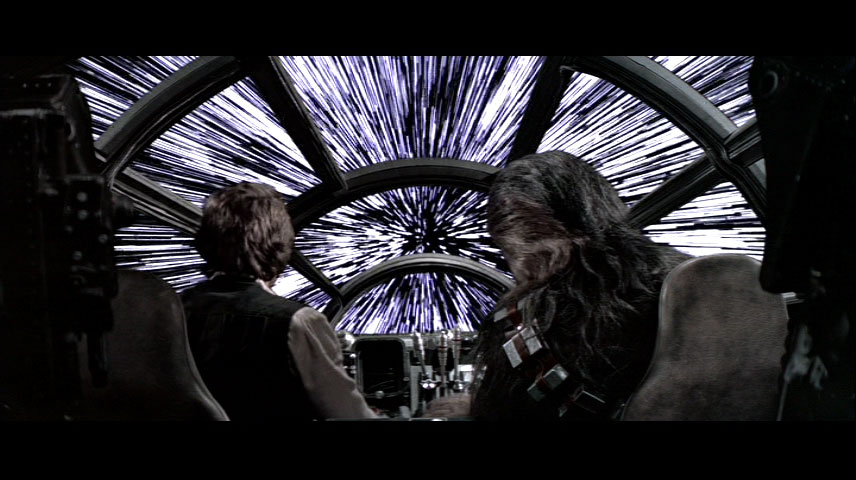
Like the Warp drive, the terms hyperspace and hyperdrive have become staples withing the science fiction community. It’s most popular usage comes from Star Wars where it is the principle means of interstellar travel. Though it is never explained how a hyperdrive works, it is made abundantly clear through a series of visuals in the first and subsequent movies that it involves speeds in excess of the speed of light.

In addition, Han Solo indicated in the original movie that the Falcon’s top speed was “point five past light-speed”, indicating that it can travel 1.5 c. All other references to hyperspace speed factors in the franchise are similar, with velocities given in terms of a decimal point value. As a fast ship, the Falcon can reach point five, whereas most of the larger Imperial and Rebel ships can make only point three or four at most.

Though Star Wars is the most popular example of hyperspace, it is by no means the earliest. The first recorded example was in John Campbell’s “Islands of Space,” which appeared in Amazing Stories in 1931. Arthur C. Clarke’s also mentioned hyperspace in his 1950 story Technical Error. However, the most enduring example comes from Asimov’s Foundation universe, where hyperspace is the principal means of travel in the Galactic Republic. In I, Robot, the invention of the “hyperspatial drive” is the basis of one of the short stories, and was meant to provide a sense of continuity with his earlier Foundation series.

Other franchises that feature the concept of hyperspace include Babylon 5, Homeworld, Macross/Robotech, and Stargate. Combined with Star Wars and the Foundation series, it is the most popular – albeit the most ill-defined -form of FTL in the realm of science fiction.

Infinite Probability Drive:
The perfect mixture of irreverence and science: the Infinite Probability Drive from The Hitchhikers Guide to the Galaxy. This FTL concept is based on a particular perception of quantum theory which states that a subatomic particle is most likely to be in a particular place, such as near the nucleus of an atom, but there is also a small probability of it being found very far from its point of origin.

Thus, a body could travel from place to place without passing through the intervening space if you had sufficient control of probability. According to the Guide, in this way the drive “passes through every conceivable point in every conceivable universe almost simultaneously,” meaning the traveller is “never sure where they’ll end up or even what species they’ll be when they get there” and therefore it’s important to dress accordingly!

Subspace Jump Drive:
Here we have an FTL concept which comes from one of my favorite games of all time, Descent Freespace. Subspace jumps, relying on the drive system of the same name, represent a very quick method of interstellar travel. By relying on subspace “corridors” that run from one point in space-time to another, a ship is able to move quickly from one star system to the next.

The only drawback to this concept is the fact that travel must occur along officially designated “nodes”. These nodes usually pass between large gravitational sources (i.e. between stars systems) but also can exist within a system itself. Virtually all nodes are unstable, existing for mere seconds or minutes at a time. However, nodes which will last for centuries or longer are designated as “stable” and used for transit.

Another favorite franchise which uses a similar concept is the Wing Commander universe. In all versions of the game, particularly Wing Commander: Privateer, interstellar travel comes down to plotting jumps from predesignated points in space. One cannot simply jump from one spot to another provided accurate calculations are made, they have to use the mapped out points or no jump is possible. This, as opposed to hyperspace travel, posits that subspace is a reality that exists only in certain areas of space-time and must be explored before it can be used.

TARDIS:
Officially, the Time and Relative Dimension in Space is a time machine and spacecraft that comes to us from British science fiction television program Doctor Who and its associated spin-offs. Produced by the advanced race known as the Time Lords, an extraterrestrial civilization to which the Doctor belongs, this device that makes his adventures possible.

Basically, a TARDIS gives its pilot the ability to travel to any point in time and any place in the universe. Based on a form of biotechnology which is grown, not assembled, they draw their power primarily from an artificial singularity (i.e. a black hole) known as the “Eye of Harmony”. Other sources of fuel include mercury, specialized crystals and a form of temporal energy.

Each TARDIS is primed with the biological imprint of a Time Lord so that only they can use it. Should anyone else try to commandeer one, it undergoes molecular disintegration and is lots. The interior of a TARDIS is much larger than its exterior, which can blend in with its surroundings using the ship’s “chameleon circuit”. Hence why it appears to outsiders as a phone booth in the series.

Warp Drive:
Possibly the best known form of FTL travel which comes to us from the original Star Trek and its many spinoffs. In addition to being a prime example of fictional FTL travel, it is also perhaps the best explained example.Though said explanation has evolved over time, with contributions being made in the original series, TNG, and the Star Trek technical manual, the basic concept remains the same.

By using a matter/antimatter reactor to create plasma, and by sending this plasma through warp coils, a ship is able to create a warp bubble that will move the craft into subspace and hence exceed the speed of light. Later explanations would go on to add that an anti-matter/matter reaction which powers the two separate nacelles of the ship are what create the displacement field (the aforementioned “bubble”) that allows for warp.

Apparently, Warp 10 is the threshold for warp speed, meaning that it is the point at which a ship reaches infinite speed. Though several mentions are made of ships exceeding this threshold, this was later explained as being the result of different scales. Officially, it is part of the Star Trek canon that no ship is capable of exceeding Warp 10 without outside help. When that occurs, extreme time dilation, such as anti-time, occurs, which can be disastrous for the crew!

In addition to Star Trek, several other franchises have made mention of the Warp Drive. This includes StarCraft, Mass Effect, Starship Troopers, and Doctor Who.

Final Thoughts:
Having looked through all these examples, several things become clear. In fact, it puts me in mind of a clip produced by the Space Network many years ago. Essentially, Space explored the differences between FTL in past and present franchises, connecting them to developments in real science. Whereas Warp and Hyperspace tended to be the earliest examples, based on the idea of simply exceeding the speed of light, thereby breaking the law of physics, later ideas focused on the idea of circumventing them. This required that writers come up with fictional ideas that either relied on astrophysics and quantum theory or exploited the holes within them.

One such way was to use the idea of “wormholes” in space-time, a hypothetical theory that suggests that space is permeated by topological holes that could act as “shortcuts” through space-time. A similar theory is that of subspace, a fictional universe where the normal rules of physics do not apply. Finally, and also in the same vein, is the concept of a controlled singularity, an artificial black hole that can open a rift through space-time and allow a ship to pass from one point in the universe to another.

Explanations as to how these systems would work remains entirely hypothetical and based on shaky science. As always, the purpose here is to allow for interstellar travel and communications that doesn’t take decades or even centuries. Whether or not the physics of it all works is besides the point. Which brings me to two tentative conclusions.

  1. Explanations Need Not Apply: Given the implausible (or at the very least, inexplicable) nature of most FTL concepts, the best sci-fi is likely to be the stuff that doesn’t seek to explain how its FTL system of choice works. I’st simply there and does the job. People hit a button, push a lever, do some calculations, or fly into a jump gate. Then boom! seconds later (or days and weeks) and they find themselves on the other side, light years away and ready to do their mission!
  2. That’s Hard: Given how any story that involves relativistic space travel, where both time dilation and confusing time jumps are necessarily incorporated into the story, only the hardest of hard sci-fi can ever expect to do without warp drives, hyperspace, jump or FTL drives. Any other kind of sci-fi that is looking to be accessible, and therefore commercially successful, will have to involve some kind of FTL or face extinction.

Well, that’s all I got for the time being. In the meantime, keep your eyes on the skies and don’t stop dreaming about how we’re one day going to get out there. For even if we start sending ships beyond our solar system in the near future, it’s going to be well into the distant future before they get anywhere and we start hearing back from them. At least until someone figures out how to get around Einstein’s Theory of Relativity, damn bloody genius! Until then, I’d like to sign off with a tagline:

This has been Matt Williams with another conceptual post. Good night, and happy spacing!

Top 15 Things You’ll Never Hear a Geek Say

white-and-nerdyThis really doesn’t happen, but it seems I gave myself an idea with that last post. And to think it all came of an inappropriate joke! Essentially, I began to joke about the kinds of things geeks never say and even listed a few. And it got me thinking, one thing this blog has been missing up until now is a top ten list of things you’ll never hear a geek say. Well, I tried to limit myself to ten, but it was impossible. And so I expanded it a little to incorporate just a few more. I know, top 15 lists aren’t as impressive, but what can you do? Sometimes, you just gotta be inclusive!

Oh, and word of warning, if you’re not a fan of inappropriate jokes, back yourselves up now because you don’t want to see some of the things I’ve written here. As a self-professed geek, I can say these things, but rest assured, my test audience (my wife) didn’t exactly react well 😉 You’ve been warned! Anyhoo, here they are, the top 15 things geeks never say, in ascending order:

15. “Jane Austin is a far superior writer to Ursula K. Le Guin”

14. “I would have liked to have seen less cleavage and more character development from 7 of 9” (substitute any female lead from Star Trek)

13. “The blue chick from Avatar was so not hot”

12. “George R.R. Martin didn’t hit his stride until the third book”

11. “There’s no way I’m paying 50 bucks for a video game!”

10. “I can see no difference between Captain Kirk and Picard”

9. “Blade Runner totally needs to be remade”

8. “I have no strong opinions either way on the remake”

7. “They made a show called The Big Bang Theory?”

6. “I didn’t see the new Star Trek movie, but I hear it’s good.”

5. “Frank Herbert would be so proud of what’s become of the Dune franchise”

4. “You’ll never catch me jerking off to anime!”

3. “The prequels are just as good as the original”

2. “The movie was just as good as the book”

1. “George Lucas didn’t rape my childhood!”

And I’m still thinking of some doozies! Oh well, maybe this can become a thing, but only top 10 lists from now on. 15 at a time is not a pace I foresee being able to keep up for long. Until next time, geek out, get your geek on, and keep on geeking in the free world! Have I found enough ways to work that into a cliched saying?

The Future is Here: The Google Neural Net!

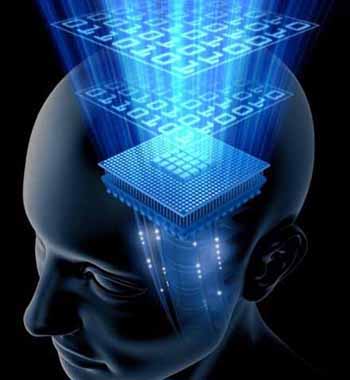
I came across a recent story at BBC News, one which makes me both hopeful and fearful. It seems that a team of researchers, working for Google, have completed work on an artificial neural net that is capable of recognizing pictures of cats. Designed and built to mimic the human brain, this may very well be the first instance where a computer was capable of exercising the faculty of autonomous reasoning – the very thing that we humans are so proud (and jealous) of!

The revolutionary new system was a collaborative effort between Google’s X Labs division and Professor Andrew Ng of the AI Lab at Standford University, California. As opposed to image recognition software, which tells computers to look for specific features in a target picture before being presented with it, the Google machine knew nothing about the images in advance. Instead, it relied on its 16,000 processing cores to run software that simulated the workings of a biological neural network with about one billion connections.

Now, according to various estimates, the human cerebral cortex contains at least 1010 neurons linked by 1014 synaptic connections – or in lay terms, 10 trillions neurons with roughly 1 quadrillion connections. That means this artificial brain has one one thousandth the complexity of the organic, human one. Not quite as complex, but it’s a start… A BIG start really!

For decades – hell, even centuries and millennia – human beings have contemplated what it would take to make an autonomous automaton. Even with all the growth in computer’s processing speed and storage, the question of how to make the leap between a smart machine and a truly “intelligent” one has remained a tricky one. Judging from all the speculation and representations in fiction, everyone seemed to surmise that some sort of artificial neural net would be involved, something that could mimic the process of forming connections, encoding experiences into a physical (i.e. digital) form, and expanding based on ongoing learning.

Naturally, Google has plans for an application using this new system. Apparently, the company is hoping that it will help them with its indexing systems and with language translation.  Giving the new guy the boring jobs, huh? I wonder what’s going to happen when the newer, smarter models start coming out? Yeah, I can foresee new generations emerging over time, much as new generations of iPods with larger and larger storage capacities have been coming out every year for the past decade. Or, like faster and faster CPU’s from the past three decades. Yes, this could very well represent the next great technological race, as foreseen by such men as Eliezer Yudkowsky, Nick Bostrom, and Ray Kurzweil.

In short, Futurists will rejoice, Alarmists will be afraid, and science fiction writers will exploit it for all its worth! Until next time, keep your eyes peeled for any red-eyed robots. That seems to be the first warning sign of impending robocalypse!

The O’Neill Cylinder

Welcome all to another post that explores the world of conceptual sci-fi! In keeping with the trend of explaining concepts which helped inspire my group’s most recent project, the space colonization story Yuva, I’ve decided to talk about what is known as an O’Neill Cylinder.

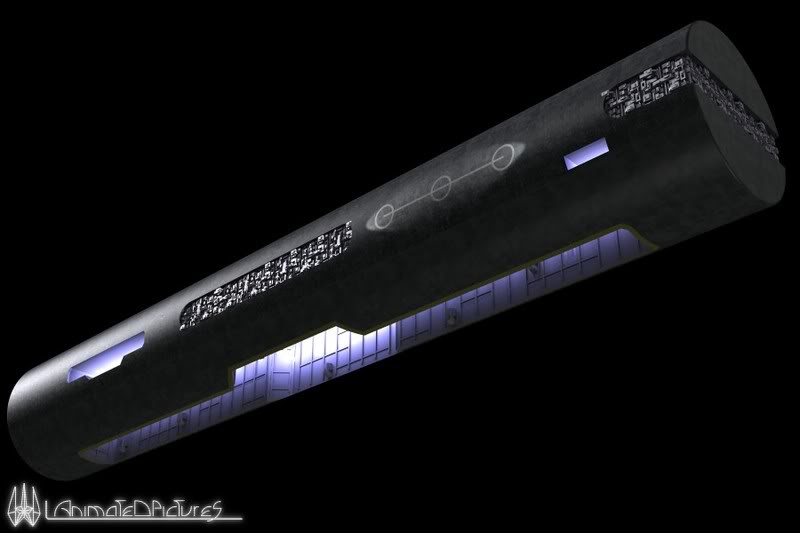
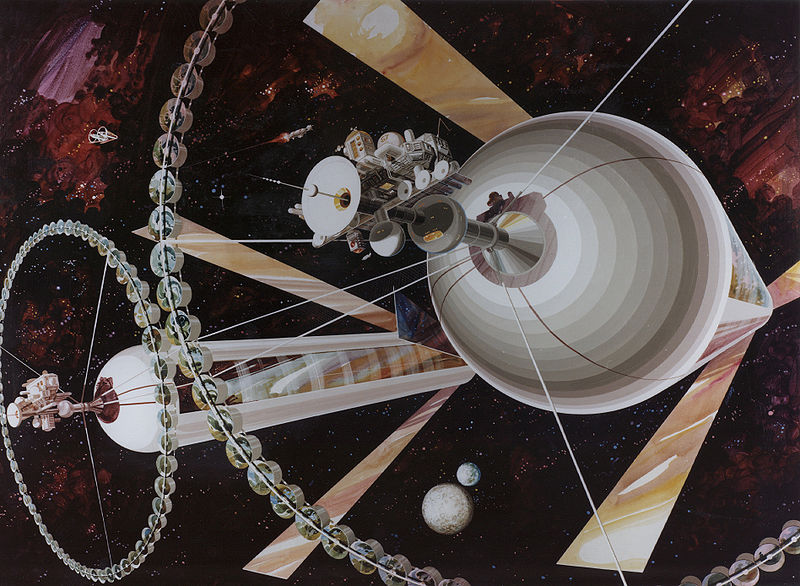
Named in honor of Gerard K. O’Neill in his 1976 book The High Frontier: Human Colonies in Space, the concept deals with the idea of placing a large cylinder in space that would rotate to provide gravity. Habitats within the cylinder would be built along the walls to ensure uniform gravity.

Some of the more interesting features of this design, aside from the curious layout, is the fact that in such a setting, windows placed in the hull can provide natural illumination, thus cutting down on the electricity bill. If the cylinder is particularly large, in which case one side is invisible to the other, then the rotation can provide periodic light, simulating day and night. And being a single volume of space, it can be pressurized, the gravity increasing pressure near the surface.

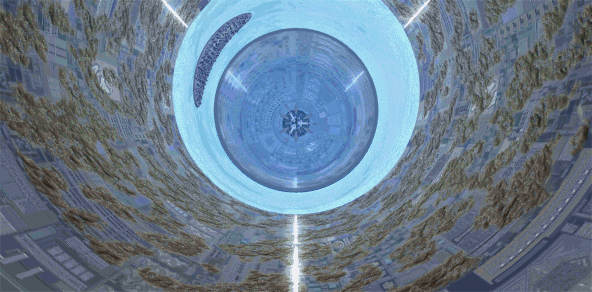
Fans of Rendezvous with Rama will recognize this concept right off the bat. The alien vessel in the story, dubbed Rama, was one big O’Neill Cylinder that floated through space, with a city built directly into the interior. A circular lake was also placed at the midway point, known as the Cylindrical Sea. At the far ends of the ship, an entrance and a gravitational drive were placed.

Another example is to be found in the Gibson novel Neuromancer, where a space station known as “Freeside” became the focal point in part III of the story. According to Gibson’s own descriptions, the station was a large cylinder in space owned by the Tessier-Ashpool clan. Their own villa was located at the very tip, a place known as “Straylight”, with luxury apartments, hotels, and vacation spots lining the interior. Artificial illumination was provided by a long band that ran down the middle and obscured a clear view of the other side.

And last, and my personal favorite, is the eponymously named space station of Babylon 5. Built along the same lines as Rama and Freeside, this space station was one giant rotating cylinder which housed over a quarter million humans and aliens. The interior surface was divided between several sectors, each one coded by color.

B5_interiorBrown Sector was designated for trade facilities, Blue Sector for personnel facilities, Green for diplomats, Gray for manufacturing, Red for resident habitation, and Yellow for environmental control. Transport along the length of the station was handled by a long rail that was frequented by a transport shuttle. At this point in the station, the gravity was virtually nil and atmospheric pressure was also substantially less.

All of this was consistent with an O’Neill Cylinder and applied to far more than just the station itself. Just about all Earth ships and installations in the B5 universe contained rotating sections to provide gravity since humanity had not yet stumbled onto the secret of artificial gravity.

When it comes right down to it, the concept of a rotating space cylinder is a very eloquent idea for simulating gravity, consistent with hard science and realism. Artificial gravity is often used in science fiction as a sort of given, mainly because its convenient and simpler from a design standpoint. Ships that have cylinders and rotation sections are bulky compared to sleek, unrealistic space concepts – space barges compared to flying works of art.

But that’s really not realistic, especially where near-future science fiction is concerned. Like it or not, artificial gravity just isn’t a plausible concept yet, not unless we find that troublesome graviton particle and learn how to harness it in a stable way. Which is why you can tell that a franchise is particularly inspired when you see ships and stations relying on rotation sections to simulate gravity. Not only is it more realistic, its shows that the conceptual artists and writers are doing their homework.

And that’s precisely why the Yuva ships feature them! And I hope people will find that it is indicative of the kind of mindset me and my group have. We like sci-fi, we like realism, and its especially good when hard science and hard fiction come together. Can’t wait until the book is done, all these teasers are driving me nuts!

What more can I say? Just read the freaking article. It’s free…

Molly Wetta's avatarwrapped up in books

If I had a nickel for every time I have been asked to recommend a book that is “like The Hunger Games,” I could double my paycheck. It’s great that kids are excited about reading, but I hate that even though we have multiple copies of the most popular read-alikes, they are often checked out. Our dystopian/post-apocalyptic reading list hadn’t been updated in over a year, so at first I started to add to that, but I realized that it wasn’t capturing everything that attracted readers to The Hunger Games.

It was also difficult to organize. I’ve seen a few infographics on dystopian fiction, like this one from Goodreads that has lots of fun facts about the history of dystopian fiction and this one from E M Bowman that outlines the elements of dystopian fiction, they were highlighting ones that were already popular. There was a list compiled…

View original post 150 more words

Dystopan Literature Over Time

Came across this list on Goodreads, thanks largely to Molly Spring’s post (which I will reblog next since it’s pretty dawn awesome!). Basically, the table gives graphic representation to historical trends and the popularity of dystopian lit over the past few decades. Though it does preclude Yevengy Zamyatin’s We and Jack London’s The Iron Heel by a few years, it manages to pick up in the early 30′ with the creation of Brave New World.

Cataloging what led to the creation of that and all many subsequent dystopian classics, the creator of this infographic shows how our perceptions and tastes – as expressed through popular dystopian visions – have changed over time. In the end, the point seems to be that we’ve evolved from thinking simply that the state is the primary threat to human freedom in our world. Things like body image, reproductive rights, environmental issues, nuclear weapons, epidemics (both man-made and natural) and agism.

You might think that it’s making the point that people have more to worry about today than they did before. But personally, I just think it’s pointing out how the literature is evolving to focus on our own evolving sense of self and understanding of ourselves. You know the old saying, “the world isn’t any worse, you just understand it better?” Well, it’s a little like that. The literature isn’t any darker, just more complex. Quite the little romp too, if you ask me.