Epic Rap Battles of History – Science Edition

epic_rap_battlesIt occurs to me that I really haven’t given the ERB site its due over the years. They’ve provided me with endless hours of enjoyment and all I ever did was post about one of their videos. Granted, I have nowhere near the kind of following that would needed to actually give their traffic a shot in the arm, but it’s the thought that counts!

And so I thought I’d a little compilation here of some of their funniest, and educational, videos. Whether it was the match ups between Steve Jobs and Bill Gates (made shortly after Jobs death as a tribute to his life), Einstein and Stephen Hawking, or Thomas Edison and Nikola Tesla, these guys have shown a real commitment to their art and are clearly willing to do their homework!

Enjoy!

Steve Jobs vs. Bill Gates:


Einstein vs. Stephen Hawking:


Thomas Edison vs. Nikola Tesla:


Note: Though I am well aware of their existence, I have assiduously avoided posting the videos of Darth Vader vs. Adolph Hitler. Though I found them hilarious, such material is bound to offensive to some. Although, if people were willing to give me permission… 😉 😉

The Future is Here: Lab-Grown Burger Gets a Taste Test

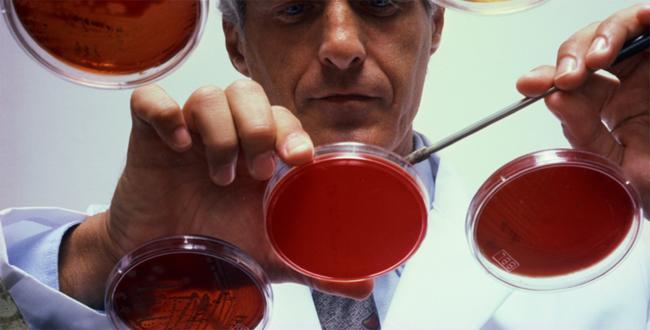
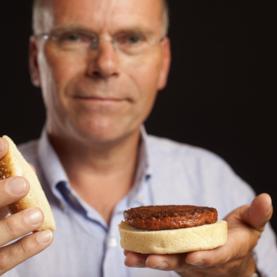
labmeat0Yesterday, the world’s first lab-grown hamburger was cooked, served, and eaten. And according to an article from The Week, it passed the taste test. The taste test took place in London, where Mark Post, the man who had grown the patty in his lab at Maastricht University in the Netherlands, allowed two independent tasters to sample one of his hamburger patties.

The samplers were food writer and journalist Josh Schonwald and Austrian food trends researcher Hanni Rützler. After biting into a piece of the cooked meat in front of reporters, Schonwald claimed that “It had a familiar mouthfeel. [The difference] is the absence of fat.” Naturally, both tasters were careful not to comment on whether the burger was “good” or not, as any such judgements might seem premature and could hurt its chances for sales at this point.

lab-grown-burgerThis lab-grown patty took two years and $325,000 to produce. And as sources revealed, the money came from Google co-founder and TED speaker Sergey Brin. Worth an estimated $20 billion, Brin has a history of investing in cooky projects – everything from driverless cars to trips to the moon. And as he told The Guardian, he was moved to invest in the technology for animal welfare reasons and believes it has “the capability to transform how we view the world”.

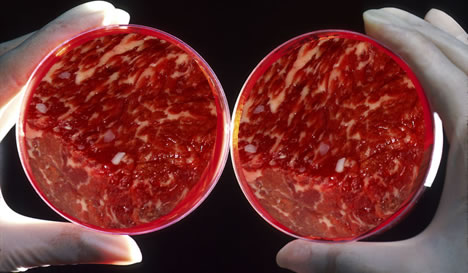
lab-grown-burger_postThe hamburger was grown in Post’s lab using bovine skeletal muscle stem cells that were collected from a piece of fresh beef. The cells were grown by “feeding” them calf serum and commercially available growth medium to initiate multiplication and prompt them to develop into muscle cells over time. Once they differentiated into muscle cells, they were given simple nutrient sources and exercised in a bioreactor, helping the muscle to “bulk up.”

The resulting five-ounce burger, cooked by chef Richard McGeown for Schonwald and Rützler, was made using 20,000 strips of cultured meat – about 40 billion cow cells – and took about three months to produce. As Post joked, this is significantly less time than it takes to raise a cow. And while the arrival of in-vitro meat has been predicted and heralded for decades, but now that it’s finally here, people are not sure how to respond.

labmeat1On the one hand, it offers a range of possibilities for producing sustainable, cheap meat that could help meet global needs using only a laboratory. On the other, there’s no telling how long it will be before consumers will be comfortable eating something grown in a petri dish from stem cells. Between the absence of fat and the stigma that is sure to remain in place for some time, getting people to buy “lab-grown” might be difficult.

But then again, the same issues apply to 3D printed food and other forms of synthesized food. Designed and developed as a means of meeting world hunger and future population growth, and with sustainability and nutritional balance in mind, some degree of hesitation and resistance is to be expected. However, attitudes are likely to shift as time goes on and increased demand forces people to rethink the concept of “what’s for dinner”.

And while you’re thinking the issue over, be sure to check out this video of Mark Post speaking about his lab-grown burger at TEDx Haarlem:


Sources:
scientificamerican.com, theweek.co.uk, theguardian.com
, blog.ted.com,

News From Space: MAVEN’s “Time-Machine” for Mars

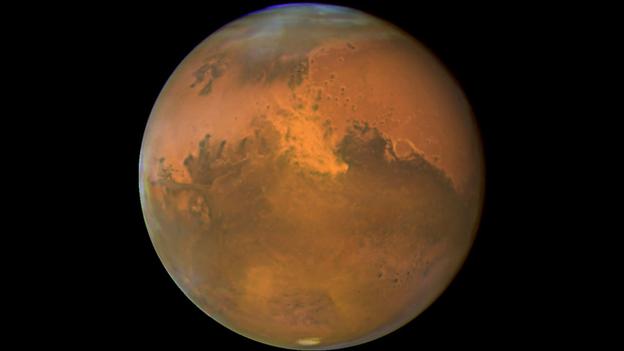
marsYes, the name is a bit of a attention-getter, but when you come to understand the purpose behind Lockheed Martin’s new spacecraft, the description does appear to be quite apt. It’s known as MAVEN, which stands for Mars Atmosphere and Volatile EvolutioN, and it is currently being produced in Lockheed Martin’s Martin Space Systems facility in Denver, Colorado.

People may recall how earlier this year, MAVEN was mentioned as part of the “Going to Mars” campaign. A project that is being organized by the University of Colorado at Boulder’s Laboratory for Atmospheric and Space Physics (CU/LASP), the Martian orbiter will be carrying a DVD featuring the names of everyone who applies, as well as three specially-selected haikus.

However, it is MAVEN’s larger mission which is now the focus of much interest. Later this year, NASA will be launching the orbiter to Mars for the sake of examine the atmosphere and answering some burning questions that remain about the planet. Thanks to evidence provided by Curiosity, Opportunity, and other missions, scientists now know that the Martian surface once boasted conditions suitable for life, including liquid water.

maven_orbitHence, Maven’s ultimate purpose, which will be will to orbit the planet and examine whether the atmosphere could also have provided life support. Scientists working on the Maven mission want to understand what this atmosphere was like, and the processes that led to its destruction. As Guy Beutelschies, Maven Programme Manager at Lockheed Martin, put it:

What we know from our missions looking at the surface of Mars is that there used to be water there. We can see the outlines of ancient rivers, the shorelines of ancient oceans. But water can’t exist there now – the atmosphere is too thin and too dry, any water would just evaporate or freeze. 

So the big question is what happened to Mars’ atmosphere? Short of being able to travel back in time into the Martian past, how would anyone go about tackling these questions with a mission today? Beutelshcies explained it as follows:

[The atmosphere] used to be thicker, warmer, wetter, now it’s thin and dry. How did we get there? In a sense we are building a little bit of a time machine. What we’re doing is understanding the processes.

maven_atmosphereJust last week, evidence provided by the Curiosity rover supports the theory that Mars may have lost most of its atmosphere billions of years ago. Still, scientists remain skeptical that Mars once had an atmosphere comparable to that of Earth. Today, that atmosphere is roughly one-hundredth the thickness of Earth’s, made up mostly of carbon dioxide and a tiny fraction of water vapor. What little remains is being stripped away by the solar wind.

And unlike Earth, Mars does not have a magnetosphere to protect its atmosphere from being blown away – at least not anymore. Such a fragile, thin band around is now unlikely to support any sort of life, as far as we know. But the atmosphere in the past must have been more substantial to allow the formation of rivers, lakes and oceans.

mars_sunsetBruce Jakosky, the Principal Investigator for Maven who is based at the University of Colorado’s CU/LASP lab in Boulder, claims:

We think that Mars used to have a magnetic field. We see places on the surface that retain some remnant magnetism, they were imprinted when they formed with whatever magnetism was there. We think that some four billion years ago, when the magnetic field turned off, that turn-off of the magnetic field allowed [for the] turn-on of the stripping by the solar wind.

To investigate the processes taking place today, Maven will dip into the Martian upper atmosphere with each orbit, measuring the particles, sampling gases, monitoring the magnetic field and solar wind. Whereas the rovers have looked at the atmosphere from the ground up, MAVEN will look at it from the top down. At this point, both are needed to put together a picture of what’s controlling the Mars environment.

maven_atmo1As well as filling in the blanks about Mars’ depleted atmosphere, Maven will also provide clues to the habitability of other planets beyond the solar system. As Jakosky said, the research conducted will have far-reaching implication for our understanding:

In trying to understand the distribution of life throughout the Universe, this is a really important indicator. Understanding the environmental conditions that allow [life] to exist, or don’t allow it to exist, is key to being able to extrapolate elsewhere.

What’s more, understanding what happened to Mars will provide some key insight into the history of our Solar System, and how it went from being a star with two planets that had oceans and atmospheres to just one. Knowing why things continued to operate on Earth, while on Mars they went horribly wrong, is likely to be quite the eye-opener, and make us all thankful we evolved here on Earth.

Source: bbc.com


The Future of Medicine: Curing Blindness

curing_blindnessAccording to a recent study in Nature Biotechnology, a significant leap has been made towards the curing of blindness. Using stem cells, researchers at the Moorfields Eye Hospital and University College London claim that the part of the eye which actually detects light can be repaired. An animal study revealed that it could be done, and human trials are now a realistic prospect.

Experts described it as a “significant breakthrough” and “huge leap” forward, and for good reason. In the past, stem cell research has shown that the photoreceptors in the eye that degrade over time can be kept healthy and alive longer. But this latest trial shows that the light-sensing cells themselves can be replaced, raising the prospect of reversing blindness.

The Moorfields research team used a new technique for building retinas in the laboratory, collecting thousands of stem cells, which were primed to transform into photoreceptors, and injecting them into the eyes of blind mice. The study showed that these cells could hook up with the existing architecture of the eye and begin to function.

rods_and_cones_of_the_retina-splHowever, with ongoing trials, the results remain limited. Of the 200,000 or so stem cells injected into the eyes of the blind mice, only about 1,000 cells actually hooked up with the rest of the eye. Still, the margin for success and the fact that they were able to rehabilitate receptors thought to be dead was quite the accomplishment.

As lead researcher Prof. Robin Ali told the BBC News website:

This is a real proof of concept that photoreceptors can be transplanted from an embryonic stem cells source and it give us a route map to now do this in humans. That’s why we’re so excited, five years is a now a realistic aim for starting a clinical trial.

The eye remains one of the most advanced fields of stem cell research, with clinical trials aiming to correct macular degeneration, astigmatism, and other degenerative and inherited traits. And compared to other fields, like neurological disorders and impairments, it is a relatively simple one. Hence, much less cells would also be needed to make a difference, as opposed to other organs, like a failing liver or kidney.

photoreceptorsWhereas reversing something like dementia requires stem cells to hook up and repair far more cells across the brain, light sensing cells are easier to deal with, since they only have to pass their electrical message to one or more cells. What’s more, the immune system is relatively weak in the eye, which means the chances for stem cell rejection.

 As Chris Mason, a Professor from the University College London, told the BBC:

I think they have made a major step forward here, but the efficiency is still too low for clinical uses. At the moment the numbers of tiny and it will take quite a bit of work to get the numbers up and then the next question is ‘Can you do it in man?’ But I think it is a significant breakthrough which may lead to cell therapies and will give a much expanded knowledge on how to cure blindness.

In short, the results are encouraging and human trials could begin within five years. And given the likelihood for success, blindness could very become a thing of the past within a decade or so.

Source: bbc.co.uk

The Future is Here: “Spiber” Silk

spider-silkFor years, scientists and researchers have been looking for a way to reproduce the strength of spider silk in the form of a synthetic material. As an organic material, spider silk is tougher than kevlar, strong as steel, lighter than carbon fiber, and can be stretched 40 percent beyond its original length without breaking. Any material that can boast the same characteristics and be massed produced would be worth its weight in gold!

Recently, a Japanese startup named Spiber has announced that it has found a way to produce the silk synthetically. Over the next two years, they intend to step up mass production and created everything from surgical materials and auto arts to bulletproof vests. And thanks to recent developments in nanoelectronics, its usages could also include soluble electronic implants, artificial blood levels and ligaments, and even antibacterial sutures.

spiber-synthetic-spider-silkSpider silk’s amazing properties are due to a protein named fibroin. In nature, proteins act as natural catalyst for most chemical reactions inside a cell and help bind cells together into tissues. Naturally, the process for creating a complex sequence of aminoacids that make up fibroin are very hard to reproduce inside a lab. Hence why scientists have been turning to genetic engineering in recent years to make it happen.

In Spiber’s case, this consisted of decoding the gene responsible for the production of fibroin in spiders and then bioengineering bacteria with recombinant DNA to produce the protein, which they then spin into their artificial silk. Using their new process, they claim to be able to engineer a new type of silk in as little as 10 days, and have already created 250 prototypes with characteristics to suit specific applications.

SpiderSilkModelNatureThey begin this process by tweaking the aminoacid sequences and gene arrangements using computer models to create artificial proteins that seek to maximize strength, flexibility and thermal stability in the final product. Then, they synthesize a fibroin-producing gene modified to produce that specific molecule.

Microbe cultures are then modified with the fibroin gene to produce the candidate molecule, which is turned into a fine powder and then spun. These bacteria feed on sugar, salt and other micronutrients and can reproduce in just 20 minutes. In fact, a single gram of the protein produces about 5.6 miles (9 km) of artificial silk.

spiber_qmonosAs part of the patent process, Spiber has named the artificial protein derived from fibroin QMONOS, from the Japanese word for spider. The substance can be turned into fiber, film, gel, sponge, powder, and nanofiber form, giving it the ability to suit a number of different applications – everything from clothing and manufacturing to nanomedicine.

Spibers says it is building a trial manufacturing research plant, aiming to produce 100 kg (220 lb) of QMONOS fiber per month by November. The pilot plant will be ready by 2015, by which time the company aims to produce 10 metric tons (22,000 lb) of silk per year.

spiber_dressAt the recent TedX talk in Tokyo, company founder Kazuhide Sekiyama unveiled Spiber’s new process by showcasing a dress made of their synthetic silk. It’s shiny blue sheen was quite dazzling and looks admittedly futuristic. Still, company spokesperson Shinya Murata admitted that it was made strictly for show and nobody tried it on.

Murata also suggested that their specialized slik could be valuable in moving toward a post-fossil-fuel future:

We use no petroleum in the production process of Qmonos. But, we know that we need to think about the use of petroleum to produce nutrient source for bacteria, electric power, etc…

Overall, Sekyama lauded the material’s strength and flexibility before the TedX audience, and claimed it could revolutionize everything from wind turbines to medical devices. All that’s needed is some more time to further manipulate the amino acid sequence to create an even lighter, stronger product. Given the expanding use for silks and its impeccable applicability, I’d say he’s correct in that belief.

In the meantime, check out the video from the TedX talk:


Sources:
gizmag.com, fastcoexist.com

What Would Hyperspace Really Look Like?

hyperspaceRemember those iconic scenes in Star Wars when the Millennium Falcon made the jump to hyperspace? Remember how cool it looked when the star field stretched out and then the ships blasted off? And of course, every episode of Star Trek was punctuated by a jump to warp, where once again, the background stars seemed to stretch out and then hurl on past the Enterprise.

Yes, for generations, this is how people envisioned Faster-Than-Light travel. Whether it consisted of rainbow-colored streaks shooting past, or a quick distortion followed by a long, blue tunnel of bright light, these perceptions have become a staple of science fiction. But one has to wonder… in a universe where FTL was really possible, would it really look anything like this?

hyperspace3Using Einstein’s Theory of Relativity, four students from the University of Leicester produced a paper in January of last year where they theorized what a jump to light-speed would really look like. Based on the theory that the speed of light is the absolute threshold at which elementary particles can move in this universe, the four students – Riley Connors, Katie Dexter, Joshua Argyle, and Cameron Scoular – claimed that a ship that can exceed c would have an interesting view.

In short, they claim that the crew wouldn’t see star lines stretching out past the ship during the jump to hyperspace, but would actually see a central disc of bright light. This is due to the Doppler effect, specifically the Doppler blue shift, that results in the wavelength of electromagnetic radiation, including visible light, shortening as the source of the light moves towards the observer.

Hyperspace. Nuff said?

As the ship made the jump to hyperspace, the wavelength of the light from the stars would shift out of the visible spectrum into the X-ray range. Meanwhile, Cosmic Background Radiation (CBR), which is thermal radiation that is spread fairly uniformly across the universe and is thought to be left over from the Big Bang, would shift into the visible spectrum, appearing to the crew as a central disc of bright light.

What’s more, even a ship like the Millennium Falcon would require additional energy to overcome the pressure exerted from the intense X-rays from stars that would push the ship back and cause it to slow down. The students say the pressure exerted on the ship would be comparable to that felt at the bottom of the Pacific Ocean.

red-shift-03However, if the ship in question took its time getting up to speeds in excess of the speed of light, there would be some interesting visual effects. Given how light and the color spectrum works, as a ship continued to speed up, the stars in front of the ship would experience blueshift (shifting towards the blue end of the spectrum), while those behind it would experience redshift (shifting towards the red end).

But the moment the threshold of light speed was passed, background radiation would be all that was left to see. And once that happened, the crew would experience some rather intense radiation exposure. As Connors put it:

If the Millennium Falcon existed and really could travel that fast, sunglasses would certainly be advisable. On top of this, the ship would need something to protect the crew from harmful X-ray radiation.

And as Dexter suggested, referring to Disney’s purchase of Lucasfilm for a cool $4.05 billion: “Disney should take the physical implications of such high speed travel into account in their forthcoming films.” I won’t be holding my breath on that one. Somehow, star lines look so much cooler than a mottled, bright disc in the background, don’t you think?

Hyperspace_HomeOneSources: gizmag.com, le.ac.uk.com

News From Mars: Curiosity and Opportunity On the Move

marsMars has been quite the source of news in recent weeks. And perhaps its the fact that I got to witness some truly interesting astronomical phenomena yesterday – i.e. Sunspots through a telescope – but all of them seem to have caught my attention at once. And given their importance to the ongoing exploration of Mars and our Solar System, I would be remiss if I didn’t pass them on.

The first bit of news began late last month, when the High Resolution Imaging Science Experiment (HiRISE) camera on the Mars Reconnaissance Orbiter snapped this image of the Curiosity rover as it made its way through the “Glenelg” area of Gale Crater. The rover appeared as a little more than a blueish dot in the picture, but much more visible was the rover’s tracks.

curiosity_hirise_tracks This unique photo was made possible thanks to a little maneuvering and a some serious alignment. Basically, the folks working at the Mars Science Laboratory were able to bring the Mars Reconnaissance Orbiter (MRO) into position between the Sun and curiosity, bringing the Sun, MRO, and the rover on the surface were in a near-perfect alignment.

HiRISE principal investigator Alfred McEwen addressed the photos on the HiRISE website and explained how it was all made possible:

The rover tracks stand out clearly in this view, extending west to the landing site where two bright, relatively blue spots indicate where MSL’s landing jets cleared off the redder surface dust. When HiRISE captured this view, the Mars Reconnaissance Orbiter was rolled for an eastward-looking angle rather than straight downward. The afternoon sun illuminated the scene from the western sky, so the lighting was nearly behind the camera. Specifically, the angle from sun to orbiter to rover was just 5.47 degrees.

Curiosity has since moved on and is now heading towards the large mound in Gale Crater officially named Aeolis Mons (aka. Mount Sharp).
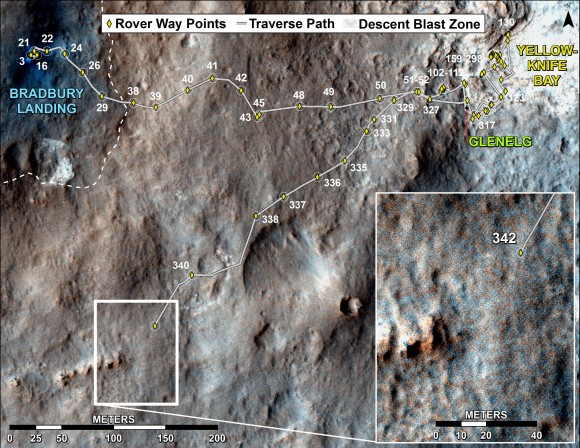
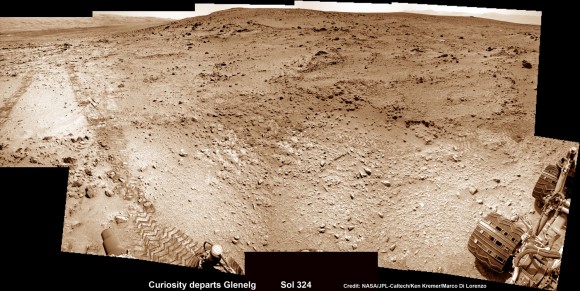
curiosity_roadmapWhich brings us to the second news item in this week’s Mars bulletin. It seems that since July 4th, after finishing up a seven months survey in Yellowknife Bay, Curiosity has achieved a long-distance driving record as it made its way to Mount Sharp. This took place on Saturday July 21st (Sol 340), when Curiosity drove a distance of 100.3 meters (109.7 yards) in a single day.

To give you some perspective, that’s the length of a football field (at least in the US), a distance that is without equal since she first landed inside the Gale Crater nearly a year ago. The previous record for a one-day drive was about half a football field – 49 meters (54 yards) – and was achieved on Sept. 26, 2012 (Sol 50), roughly seven weeks after Curiosity made its tense, nail-biting landing.

Curiosity-departs-Glenelg-Sol-324_2a_Ken-Kremer--580x291Paolo Bellutta, a rover planner at NASA’s Jet Propulsion Laboratory, Pasadena, Calif, explained what made the feat possible in a statement:

What enabled us to drive so far on Sol 340 was starting at a high point and also having Mastcam images giving us the size of rocks so we could be sure they were not hazards. We could see for quite a distance, but there was an area straight ahead that was not clearly visible, so we had to find a path around that area.

A combination of increased experience by the rover’s engineers and a series of intermediate software upgrades have also played a key role in getting Curiosity on its way to the 5.5 kilometer (3.4 mile) high Mount Sharp. This is expected to improve even more as soon as new driving software called autonomous navigation (or autonav) finishes development and is incorporated.

mountsharp_galecraterFollowing another lengthy drive of 62.4 meters (68.2 yards) on Wednesday, July 23 (Sol 342), the mission’s total driving distance  stands at 1.23 kilometers (0.81 mile) so far. But Mount Sharp still lies about another 8 km (5 miles) away at this point, so we can be expect to be hearing plenty from the rover between now and when it arrives.

For the record, it has already been discovered that the mountain contains vast caches of minerals that could potentially support a habitable environment. So when Curiosity arrives, we can expect another string of exciting finds!
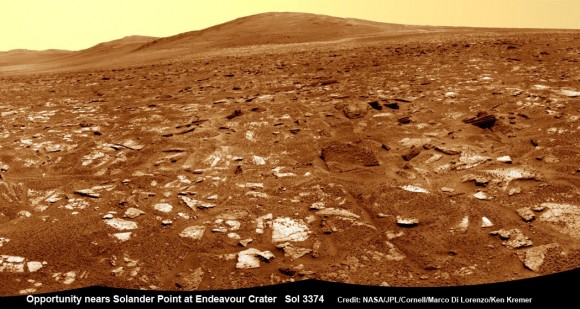
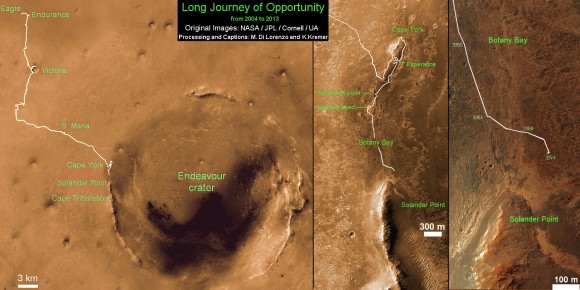
Opportunity-nears-Solander-Point-Sol-3374-N1-crop_Ken-Kremer-580x309And it is this subject of mountain goals which brings me to the last, but by no means least, of the Martian updates. While Curiosity has been making its way towards Mt. Sharp to conduct research on potentially habitable environments, Opportunity is just days away from reaching Solander Point, another Martian mountain which NASA seeks to learn more about.

This comes on the heels of the rover’s ten year, ongoing mission that was only ever expected to last ninety days. According to an update from Ray Arvidson earlier today, the mission’s deputy principal scientific investigator from Washington University in St. Louis, the rover is now just 180 meters away from the new mountain.
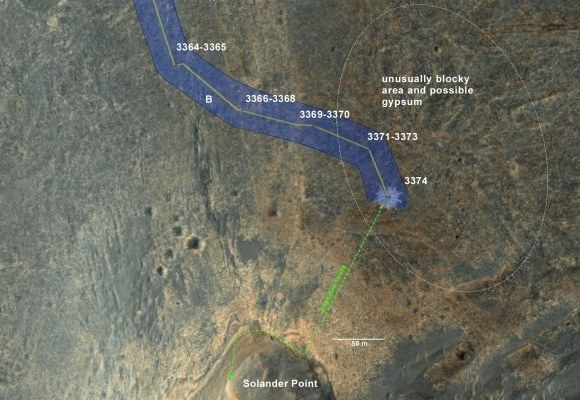
opportunity_roadmapAs NASA had previously stated, Solander Point represents ‘something completely different’ for the rover, being the first mountain it will ever climb. What’s more, the mountains mineral wealth may possess the key chemical ingredients necessary to sustain Martian life forms, and the area exhibits signatures related to water flow.

In many ways, you could say Solander Point represents a chance for the Mars Science Laboratory to find the elusive “organic molecules” they’ve been searching for since Curiosity first landed. And if it’s the veteran rover that finds the first hard evidence of their existence, it would be quite the feather in the Opportunity team’s cap.

opportunity_bdayBut before moving onto the first leg of ascent, Arvidson explained that the rover will be making a brief pause in its current location to conduce some exciting experiments. Thanks to observations made of the area by the Mars Reconnaissance Orbiter with its CRISM instrument (Compact Reconnaissance Imaging Spectrometers for Mars), the rover will be conducting some on-the-spot analysis to see if there is indeed evidence of water.

This past spring, Opportunity made the historic discovery of clay minerals and a habitable environment on a low hill called Cape York, the rover’s prior stop along the rim of Endeavour Crater. Solander was selected as the robot’s next destination because it also offers a goldmine of scientific data. Another reason was because its north facing slopes will be a boon to Opportunity’s solar wings, ensuring it more power before Martian winter sets in.

opportunity_missionmapBut since Opportunity is currently sitting on a healthy supply of power and has some time before the onset of her 6th Martian winter, the team decided to take a small detour to the southeast and spend several days exploring the area for more evidence of water-bearing minerals.

If successful, this will be yet another accomplishment for the rover during its long tenure of service to NASA. Today marks the 3380th day of continuous service for the rover – aka. Sol 3380 – a mission which has resulted in numerous scientific finds, over 182,000 images, and a driving distance of roughly 38 kilometers (23.6 miles). This, as already mentioned, puts Opportunity in the top spot for the longest distance traveled on another planet.

Yes, it seems that the Red Planet is certainly doing all it can to keep explorers and scientists intrigued. No telling what we might learn between now and the point when manned missions take place, and human astronauts are able to see the surface and study its mysteries close up. Personally, I’m hoping for signs of existing supplies of water, not to mention those tricky organic molecules. If settlement and terraforming are ever to take place, we need to know we’ve got something to work with!

Sources: universetoday.com, (2) , (3), nasa.gov, space.com

News From Space: Cassini Snaps Shots of Distant Earth

You are there
You are here

For those who follow my site, or just pay attention to a reliable news source, you may recall that NASA announced an opportunity to take part in a long-range photo op. REALLY long range. A few weeks ago, in an attempt to raise awareness about Jupiter and space exploration, NASA announced that the Cassini Space Probe would be rounding Saturn and snapping photos of a distant Earth.

The worldwide “Wave at Saturn” campaign encouraged people to look up at the skies as the probe took its shots. Junior astronomers were also encouraged to watch with their telescopes to see if they could spot the distant satellite performing its route around the massive, ringed planet. This marked the first time that NASA was able to give the people of Earth advanced warning about a space photo op, and the turnout was impressive.

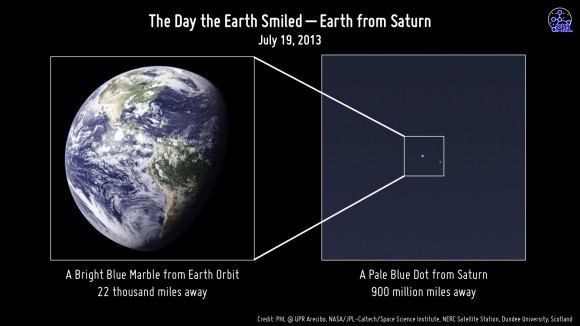
Earth_July_19_2013_Saturn-580x326Granted, North America and part of the Atlantic Ocean were the only illuminated parts of Earth at the time, but NASA claims that more than 20,000 people came out to wave at Saturn and post pictures of themselves online. Given the enormous distance involved, Earth itself appeared only 1.5 pixels wide in the photos. So congratulations if you got in the picture, but don’t expect to be able to see you face.

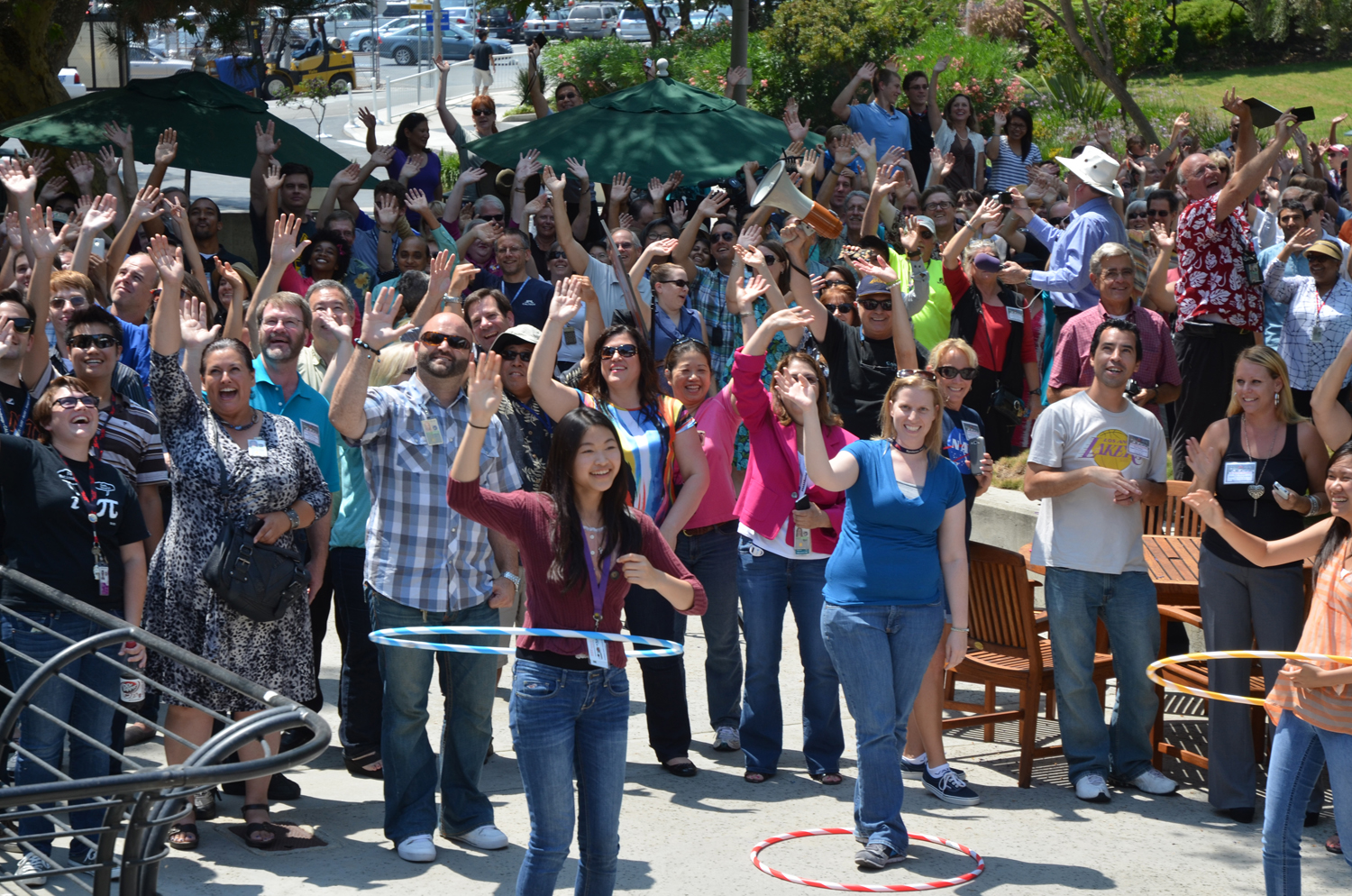
Not to be left out, members of NASA’s Jet Propulsion Laboratory in Pasadena gathered outside of the facility to wave at Cassini on July 19th as it rounded the Saturnalian system and snapped shots of North America. Camping out on the front lawn, researchers and scientists set up a pavilion for the afternoon and enjoyed some outdoor fun until the moment arrived to wave at the heavens.

cassini-wave20130After being beamed back to Earth from 1.5 billion km away (over a billion miles), NASA science teams got right to work processing the many photos shot by Cassini so they could create individual color composites and a panoramic view of the ‘pale blue dot’ of Earth as well as the entire Saturnalian system. And as you can see from the image posted at the beginning of this article, the first color composite was pretty damn spectacular!

Cassini took a total of 323 images using different spectral filters. The snapshots it took of Earth happened between 2:27 and 2:42 p.m. PDT on Friday, July 19 from a distance of about 1.44 billion kilometers (898 million miles). The images show the Earth and the Moon as dots barely about a pixel wide but do reveal the ‘pale blue dot’ that is home to all of humanity and our whitish colored neighbor.

saturn_cassini2006Distant views of the Earth from robotic space probes, especially from the outer reaches of our Solar System, are few and far between, and are therefore events for space and astronomy enthusiasts and everyone else to savor. The last time Cassini took mosaic pictures of Saturn and Earth was back in 2006, and those were pretty spectacular too. But on this occasion, the benefits went beyond stunning photographs.

Linda Spilker, Cassini project scientist of NASA’s Jet Propulsion Laboratory, explained:

One of the most exciting Cassini events in 2013 will be the unusual opportunity on July 19 to image the whole Saturn system as it is backlit by the sun. With Saturn covering the harsh light of the sun, we will be gathering unique ring science and also catching a glimpse of our very own home planet.

Coincidentally, the first humans (Neil Armstrong and Buzz Aldrin) set foot on the Moon 44 years ago nearly to the day of Cassini’s new images on July 20, 1969. In short, this occasion reminds us that not only do we live in a very vast universe, but that we are part of a very proud and ongoing tradition of exploration.

I Saw Sunspots Today!

solar1Today, I achieved a personal first and got to see an astronomical phenomena that few people will. While attending an open house event at my local Aviation Museum, I managed to meet up with a man who had set up a stargazing station and was showcasing some serious equipment. After waiting my turn, I got to peer through his special telescope with a sun filter. And what I saw, as the title would suggest, was something truly amazing – sunspots!

As some may know, sunspots have remained something of a mystery to astronomers and philosophers until the Scientific Revolution of the 16th century. It was at this time that Galileo observed them using his own telescope, which he did by projecting the image onto sheets of paper and recording the imperfections in the light.

sunspots1The discovery was important in helping to disprove the prevailing theory that the Earth was at the center of the universe – aka. the Geocentric theory. Up until this time, European philosophers were living under the impression that the Sun, like all celestial bodies that were believed to orbit the Earth, was a perfect sphere. By showing it to be riddled with imperfections, Galileo placed an additional nail in the philosophical basis of this idea.

This in turn helped pave the way for the acceptance of Copernicus’ theory of a Heliocentric universe. As with his observations that Jupiter had its own set of moons, that the Moon itself did not have a polished crystalline surface, and that Copernicus’ theory resolved numerous logical inconsistencies in the other model, Galileo helped to establish the field of truly scientific astronomy.

sunspot_activityToday, I learned that observing sunspots continues to be a difficult thing, since direct observation with a telescope is impossible without sun filter. Not only that, but many people mistake high-magnification for high-power, which in turn leads to images that are not of the best quality. And observing them can by difficult since they go through cycles.

As the kind host of the solar observation explained, and this NASA graph shows, sunspot activity goes through a cycle that repeats every eleven years. As we are currently at the edge of a peek in the cycle, its prime time to get a look at sunspots in the sky. The last time anyone could get a good look was in 2001, and the next opportunity won’t come until 2023.

So I feel pretty privileged, both as a geeky, space-enthusiast and a regular person. If you know someone who has access to a telescope with a solar filter, or just happen to live near an observatory that conducts tours, get out there and spot those surface imperfections. I’m not exaggerating when I say its a rare treat!

Towards a Greener Future: The Desalination Chip

?????????????????????????????????????????When it comes to providing for the future, clean, drinkable water is one challenge researchers are seriously looking into. Not only is overpopulation seriously depleting the world’s supply of fresh water, Climate Change threatens to make a bad situation even worse. As sea levels rise and flooding threatens population centers, water tables are also drying up and being ruined by toxic chemicals and runoff.

One idea is to take sea water, which is in growing supply thanks to the melting polar ice caps, and making it drinkable. However, desalination, in its traditional form, is an expensive and difficult process. Typical large-scale desalination involves forcing salt water through a membrane are costly, can be fouled, and which require powerful pumps to circulate the water.

desalination_chipHowever, scientists from the University of Texas at Austin and Germany’s University of Marburg are taking another approach. Working with a process known as “electrochemically mediated seawater desalination”, they have developed a prototype plastic “water chip” that contains a microchannel which branches in two, separating salt from water chemically without the need for membranes.

The process begins with seawater being run into the microchannel where a 3-volt electrical current is applied. This causes an electrode embedded at the branching point of the channel to neutralize some of the chloride ions in the water, which in turn increases the electrical field at that point. That area of increased current, called an ion depletion zone, diverts the salt to one branch in the channel while allowing the water to continue down another.

waterchip-1In its present form, the system can run on so little energy that a store-bought battery is all that’s required as a power source. Developed on a larger scale, such chips could be employed in future offshore developments – such as Lillypad cities or planned coastal arcologies like NOAH, BOA, or Shimizu Mega-City – where they would be responsible for periodically turning water that was piped in from the sea into something drinkable and useable for crops.

Two challenges still need to be overcome, however. First of all, the chip currently removes only 25 percent of the salt from the water. 99 percent must be removed in order for seawater to be considered drinkable. Second, the system must be scaled up in order to be practical. It presently produces about 40 nanoliters of desalted water per minute.

That being said, the scientists are confident that with further research, they can rectify both issues. And with the involvement of Okeanos Technologies – a major desalination research firm – and the pressing need to come up with affordable solutions, it shouldn’t be too long until a fully-scaled, 99 percent efficient model is developed.

Source: gizmag.com