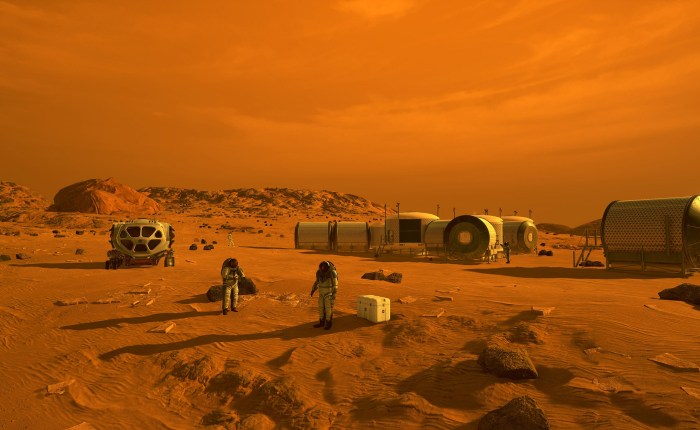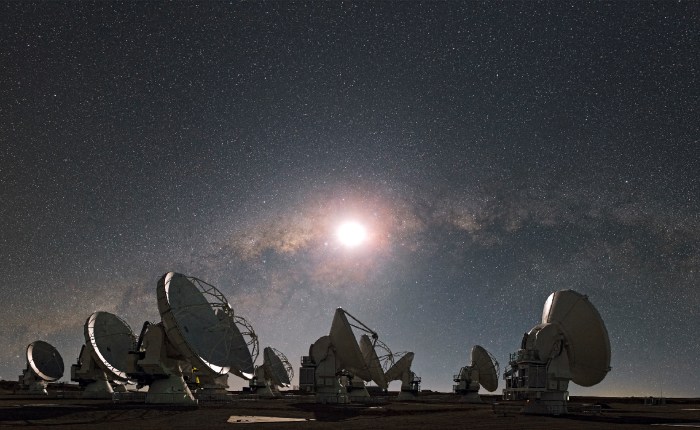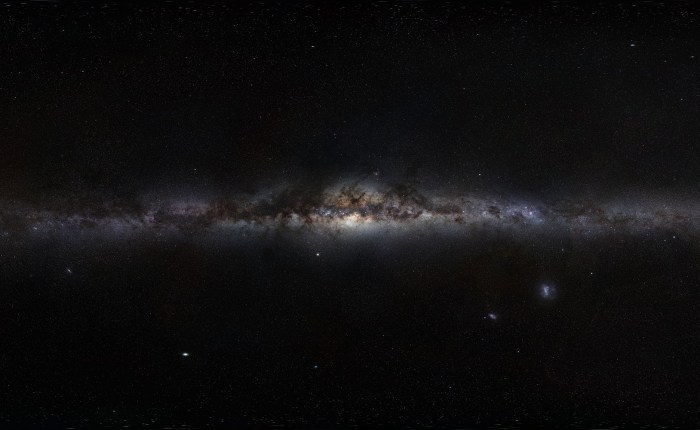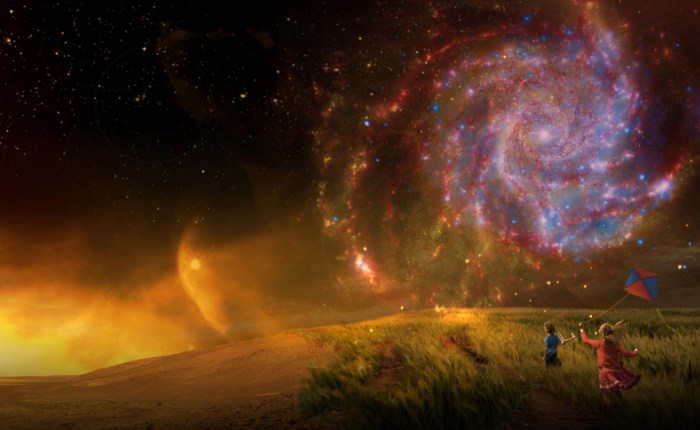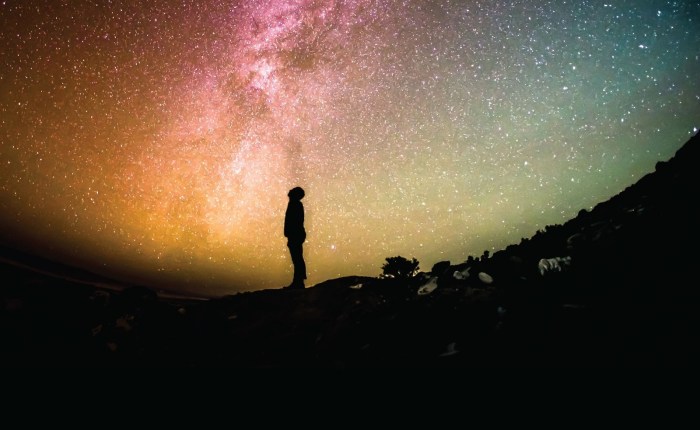
In the search for life and intelligence beyond Earth, astronomers look for telltale “signatures.” These include the chemical elements that we associate with life as we know it and its biological functions (“biosignatures), and indications of technological activity (“technosignatures”) as we would recognize it. At present, the search for signatures is limited by two factors: the limits of our instrumentation, and the limits of our frame of reference.
Episode 4: The Planetarium Hypothesis
Is it possible that humanity hasn’t heard from advanced extraterrestrials because they have us trapped in some grand simulation? Or perhaps they have enclosed our region of space and are simulating an empty Universe. This is known as the Planetarium Hypothesis, originally proposed by scientist and science fiction author Stephen Baxter in 2001. While this possibility is likely unprovable, it has an internal logic that is hard to ignore. If you were a super-advanced extraterrestrial intelligence, isn’t this what you’d do?
Episode 3: The Transcension Hypothesis
Is it possible that we haven’t heard from any advanced alien civilizations because they’ve “transcended” – i.e., achieved a state of existence so advanced that we can no longer perceive them? This is the essence of the Transcenion Hypothesis, first proposed by John Smart in a 2002 paper, titled “Answering the Fermi Paradox: Exploring the Mechanisms of Universal Transcension.”
Podcast Episode 2: The Kardashev Scale!
In this episode, I discuss one of the most well-known concepts in the Search For Extraterrestrial Intelligence – the Kardashev Scale. Named for famed Soviet-Russian astrophysicist Nikolai Kardashev, who died in 2019, this three-level classification system was introduced in his seminal study, “Transmission of Information by Extraterrestrial Civilizations,” published in 1964. The Scale characterizes extraterrestrial civilizations based on the amount of energy they can harness, ranging from the energy of an entire planet to a star system or a galaxy.
In the almost sixty years since it was first proposed, many additions, variations, and articulations have been added to the Scale. Combined with related ideas, like Dyson Structures (or “Megastructures), the Scale has had significant implications for the Search for Extra-Terrestrial Intelligence (SETI) and is considered foundational to the field of study.
Enjoy! Audio:
And with video:
My First Podcast: The Great Filter!
At last, I’ve taken the plunge and decided to continue my vlog series as a podcast series! Picking up from where I left off, Episode 1 addresses one of the most famous proposed resolutions to the Fermi Paradox – The Great Filter Hypothesis! First proposed in 1996 by Robert Hanson (Future of Humanity Institute, Oxford University), the theory is best described as follows:
“The Great Filter can be thought of as a probability barrier. It consists of [one or] more highly improbable evolutionary transitions or steps whose occurrence is required in order for an Earth-like planet to produce an intelligent civilization of a type that would be visible to us with our current observation technology.”
The possibility that all advanced life faces this filter has significant implications for human life today, none of which are particularly pleasant! Depending on where the filter resides along the evolutionary pathway, we may either be past it (indicating that we are a fluke), or we could be headed straight for it (indicating that we are on borrowed time).
All this and more in Episode 1! Here’s the audio track:
The same episode, with video:
I Finally Get Relativity – Part the Last!
Alright! Welcome back to my short series on finally getting Relativity! In the first installment, I addressed the background to Einstein’s revolutionary breakthrough, which covered Galileo, Newton, and the birth of Classic Physics (aka. Newtonian Physics). In the second installment, I addressed how the problems of reconciling electromagnetism with established theories of motion led Einstein to propose his groundbreaking Special Theory of Relativity.
Hopefully, I did them justice while also presenting them in a way that met Einstein’s challenge (“If you can’t explain it to a six-year-old…”). This brings us to the last lap, wherein I attempt to explain how Einstein generalized his theory to account for gravity and thereby made sense of the Universe (well, not quite, but he definitely pushed that ball farther downfield!)
Continue reading “I Finally Get Relativity – Part the Last!”I Finally Get Relativity – Part II
Welcome back! If you made it through Part I, I will assume that I still got the ball and everything there made sense to you – or you’re just a glutton for punishment! Either way, things are about to get real weird, real fast! Here goes…
Continue reading “I Finally Get Relativity – Part II”Personal Milestone: I Finally Get Relativity!
In life, it is good to set personal goals. Not just the big and life-changing kind, mind you, I’m talking about the little things that help you to measure your growth as an individual. A few years ago, I set one of these little goals for myself: I wanted to be able to explain Relativity. As Einstein said, “If you can’t explain it to a six-year-old, you don’t understand it yourself.”
The other day, while practicing explaining Relativity, I finally felt the dots connecting. E=mc2, mass-energy equivalence, inertial reference frames, gravitation, spacetime, etc. Basically, I was finally able to explain to myself in a way where what and why came together. While I’m positive my grasp lives up to Einstein’s metric just yet, I’m not sure anyone could explain Relativity to a six-year-old.
Maybe he could, and maybe he did. I really don’t know! In any case, reaching this milestone actually raised a lot of the challenges I face as a science communicator.
Continue reading “Personal Milestone: I Finally Get Relativity!”The First Ones!
Consider the following. The Universe as we know it is estimated to be 13.8 billion years old. The first stars emerged roughly 100 million years later, which were short-lived by our standards. These stars were almost entirely made up of hydrogen and helium, and the fusing of these elements in their cores gave rise to heavier elements. These include lithium, carbon, nitrogen, oxygen, silicon, and iron, key elements that would become the building blocks of planets and life!
A consequence of this was that second-generation stars (aka. Population II) and third-generation (Population III) stars would contain traces of metal. Another consequence was the formation of planets in new star systems. At this point, roughly 4 billion years after the Big Bang, the Universe was seeded with the elements for life and places for it to emerge. That was just shy of 10 billion years ago, about 5.5 billion years before our Solar System formed.
Continue reading “The First Ones!”(Updated) Advice for Aspiring Writers!
Good morning! There’s something I’ve wanted to do for a long time now but never got around to it. And that is, share some tidbits of wisdom that I have learned over the years about writing. Most of these tidbits are things I learned from people who really knew what they were talking about, so I was sure to listen! Some others are just things I concluded along the way.
And wouldn’t you know it, the list has grown to include another important item since I originally scrawled them down. In any case, almost twenty years after I began writing, I’ve managed to condense the most important lessons I’ve learned down to six main tips. Here they are…
Continue reading “(Updated) Advice for Aspiring Writers!”