The New Robot FACE

You ever hear that saying about how it takes 17 muscles to smile, 43 to frown? Aside from encouraging people to smile more, this should tell you something about the human face. Namely, that it’s got a very complex makeup, with many, many moving parts. So it goes without saying that creating an artificial face that could mimic human expressions would be one huge undertaking.

As it turns out, a recent story from Io9 reveals that researchers working for the University of Pisa have created a robot face that can actually pull most, if not all of them, off. Known as a “Hybrid Engine for Facial Expressions Synthesis” (HEFES) this robot has demonstrated the ability to portray a full range of emotions, though they admit that the grimace is still a bit off.

Designed using one of the team member’s wives as the model, the robot  is aptly named “FACE”. According to lead researcher, Nicole Lazzeri, the end result is “really realistic,” and also represents a major step forward in both robotics and AI research. Hmm, that make’s two steps forward, by my reckoning. To quote Ghost in the Shell: “It has a voice, now it just needs a body”!

The countdown to David 8 is on!

Check out the video of FACE making… ahem… faces!

Expressive Robot Face

Of Mechanical Minds

A few weeks back, a friend of mine, Nicola Higgins, directed me to an article about Google’s new neural net. Not only did she provide me with a damn interesting read, she also challenged me to write an article about the different types of robot brains. Well, Nicola, as Barny Stintson would say “Challenge Accepted!”And I got to say, it was a fun topic to get into.

After much research and plugging away at the lovely thing known as the internet (which was predicted by Vannevar Bush with his proposed Memor-Index system (aka. Memex) 50 years ago, btw) I managed to compile a list of the most historically relevant examples of mechanical minds, culminating in the development of Google’s Neural Net. Here we go..

Earliest Examples:
Even in ancient times, the concept of automata and arithmetic machinery can be found in certain cultures. In the Near East, the Arab World, and as far East as China, historians have found examples of primitive machinery that was designed to perform one task or another. And even though few specimens survive, there are even examples of machines that could perform complex mathematical calculations…

Antikythera mechanism:
Invented in ancient Greece, and recovered in 1901 on the ship that bears the same name, the Antikythera is the world’s oldest known analog calculator, invented to calculate the positions of the heavens for ancient astronomers. However, it was not until a century later that its true complexity and significance would be fully understood. Having been built in the 1st century BCE, it would not be until the 14th century CE that machines of its complexity would be built again.

Although it is widely theorized that this “clock of the heavens” must have had several predecessors during the Hellenistic Period, it remains the oldest surviving analog computer in existence. After collecting all the surviving pieces, scientists were able to reconstruct the design (pictured at right), which essentially amounted to a large box of interconnecting gears.

Pascaline:
Otherwise known as the Arithmetic Machine and Pascale Calculator, this device was invented by French mathematician Blaise Pascal in 1642 and is the first known example of a mechanized mathematical calculator. Apparently, Pascale invented this device to help his father reorganize the tax revenues of the French province of Haute-Normandie, and went on to create 50 prototypes before he was satisfied.

Of those 50, nine survive and are currently on display in various European museums. In addition to giving his father a helping hand, its introduction launched the development of mechanical calculators all over Europe and then the world. It’s invention is also directly linked to the development of the microprocessing circuit roughly three centuries later, which in turn is what led to the development of PC’s and embedded systems.

The Industrial Revolution:
With the rise of machine production, computational technology would see a number of developments. Key to all of this was the emergence of the concept of automation and the rationalization of society. Between the 18th and late 19th centuries, as every aspect of western society came to be organized and regimented based on the idea of regular production, machines needed to be developed that could handle this task of crunching numbers and storing the results.

Jacquard Loom:
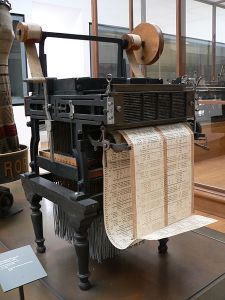
Invented by Joseph Marie Jacquard, a French weaver and merchant, in 1801, the Loom that bears his name is the first programmable machine in history, which relied on punch cards to input orders and turn out textiles of various patterns. Thought it was based on earlier inventions by Basile Bouchon (1725), Jean Baptiste Falcon (1728) and Jacques Vaucanson (1740), it remains the most well-known example of a programmable loom and the earliest machine that was controlled through punch cards.

Though the Loom was did not perform computations, the design was nevertheless an important step in the development of computer hardware. Charles Babbage would use many of its features to design his Analytical Engine (see next example) and the use of punch cards would remain a stable in the computing industry well into the 20th century until the development of the microprocessor.

Analytical Engine:
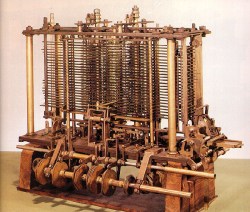
Also known as the “Difference Engine”, this concept was originally proposed by English Mathematician Charles Babbage. Beginning in 1822 Babbage began contemplating designs for a machine that would be capable of automating the process of creating error free tables, which arose out of difficulties encountered by teams of mathematicians who were attempting to do it by hand.

Though he was never able to complete construction of a finished product, due to apparent difficulties with the chief engineer and funding shortages, his proposed engine incorporated an arithmetical unit, control flow in the form of conditional branching and loops, and integrated memory, making it the first Turing-complete design for a general-purpose computer. His various trial models (like that featured at left) are currently on display in the Science Museum in London, England.

The Birth of Modern Computing:
The early 20th century saw the rise of several new developments, many of which would play a key role in the development of modern computers. The use of electricity for industrial applications was foremost, with all computers from this point forward being powered by Alternating and/or Direct Current and even using it to store information. At the same time, older ideas would be remain in use but become refined, most notably the use of punch cards and tape to read instructions and store results.

Tabulating Machine:
The next development in computation came roughly 70 years later when Herman Hollerith, an American statistician, developed a “tabulator” to help him process information from the 1890 US Census. In addition to being the first electronic computational device designed to assist in summarizing information (and later, accounting), it also went on to spawn the entire data processing industry.

Six years after the 1890 Census, Hollerith formed his own company known as the Tabulating Machine Company that was responsible for creating machines that could tabulate info based on punch cards. In 1924, after several mergers and consolidations, Hollerith’c company was renamed International Business Machines (IBM), which would go on to build the first “supercomputer” for Columbia University in 1931.

Atanasoff–Berry Computer:
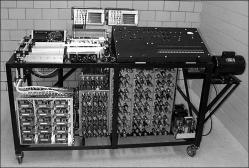
Next, we have the ABC, the first electronic digital computing device in the world. Conceived in 1937, the ABC shares several characteristics with its predecessors, not the least of which is the fact that it is electrically powered and relied on punch cards to store data. However, unlike its predecessors, it was the first machine to use digital symbols to compute and was the first computer to use vacuum tube technology

These additions allowed the ABC to acheive computational speeds that were previously thought impossible for a mechanical computer. However, the machine was limited in that it could only solve systems of linear equations, and its punch card system of storage was deemed unreliable. Work on the machine also stopped when it’s inventor John Vincent Atanasoff was called off to assist in World War II cryptographic assignments. Nevertheless, the machine remains an important milestone in the development of modern computers.

Colossus:
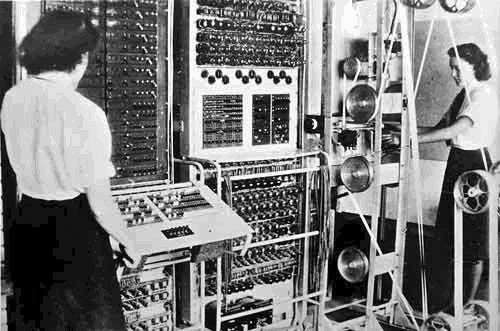
There’s something to be said about war being the engine of innovation. The Colossus is certainly no stranger to this rule, the machine used to break German codes in the Second World War. Due to the secrecy surrounding it, it would not have much of an influence on computing and would not be rediscovered until the 1990’s. Still, it represents a step in the development of computing, as it relied on vacuum tube technology and punch tape in order to perform calculations, and proved most adept at solving complex mathematical computations.

Originally conceived by Max Newman, the British mathematician who was chiefly responsible fore breaking German codes in Bletchley Park during the war, the machine was a proposed means of combatting the German Lorenz machine, which the Nazis used to encode all of their wireless transmissions. With the first model built in 1943, ten variants of the machine for the Allies before war’s end and were intrinsic in bringing down the Nazi war machine.

Harvard Mark I:
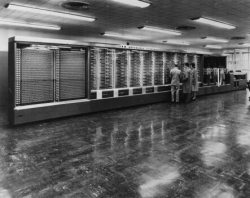
Also known as the “IBM Automatic Sequence Controlled Calculator (ASCC)”, the Mark I was an electro-mechanical computer that was devised by Howard H. Aiken, built by IBM, and officially presented to Harvard University in 1944. Due to its success at performing long, complex calculations, it inspired several successors, most of which were used by the US Navy and Air Force for the purpose of running computations.

According to IBM’s own archives, the Mark I was the first computer that could execute long computations automatically. Built within a steel frame 51 feet (16 m) long and eight feet high, and using 500 miles (800 km) of wire with three million connections, it was the industry’s largest electromechanical calculator and the largest computer of its day.

Manchester SSEM:
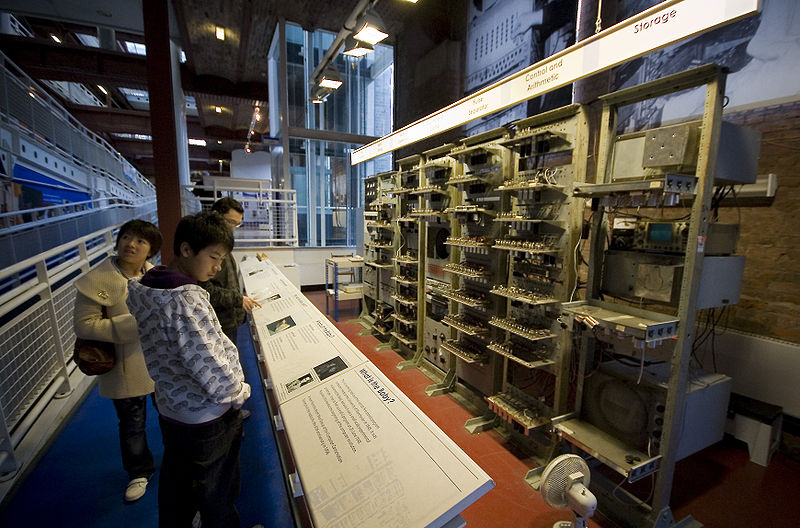
Nicknamed “Baby”, the Manchester Small-Scale Experimental Machine (SSEM) was developed in 1948 and was the world’s first computer to incorporate stored-program architecture.Whereas previous computers relied on punch tape or cards to store calculations and results, “Baby” was able to do this electronically.

Although its abilities were still modest – with a 32-bit word length, a memory of 32 words, and only capable of performing subtraction and negation without additional software – it was still revolutionary for its time. In addition, the SSEM also had the distinction of being the result of Alan Turing’s own work – another British crytographer who’s theories on the “Turing Machine” and development of the algorithm would form the basis of modern computer technology.

The Nuclear Age to the Digital Age:
With the end of World War II and the birth of the Nuclear Age, technology once again took several explosive leaps forward. This could be seen in the realm of computer technology as well, where wartime developments and commercial applications grew by leaps and bounds. In addition to processor speeds and stored memory multiplying expontentially every few years, the overall size of computers got smaller and smaller. This, some theorized would lead to the development of computers that were perfectly portable and smart enough to pass the “Turing Test”. Imagine!

IBM 7090:
The 7090 model which was released in 1959, is often referred to as a third generation computer because, unlike its predecessors which were either electormechanical  or used vacuum tubes, this machine relied transistors to conduct its computations. In addition, it was an improvement on earlier models in that it used a 36-bit word length and could store up to 32K (32,768) words, a modest increase in processing over the SSEM, but a ten thousand-fold increase in terms of storage capacity.

And of course, these improvements were mirrored in the fact the 7090 series were also significantly smaller than previous versions, being about the size of a desk rather than an entire room. They were also cheaper and were quite popular with NASA, Caltech and MIT.

PDP-8:
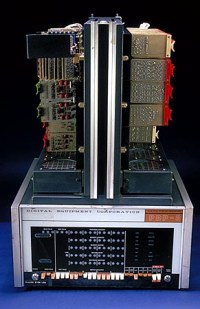
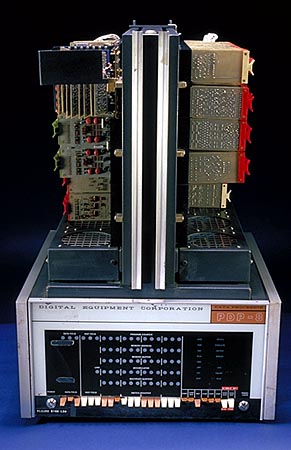
In keeping with the trend towards miniaturization, 1965 saw the development of the first commercial minicomputer by the Digital Equipment Corporation (DEC). Though large by modern standards (about the size of a minibar) the PDP-8, also known as the “Straight-8”, was a major improvement over previous models, and therefore a commercial success.

In addition, later models also incorporated advanced concepts like the Real-Time Operating System and preemptive multitasking. Unfortunately, early models still relied on paper tape in order to process information. It was not until later that the computer was upgraded to take advantage of controlling language  such as FORTRAN, BASIC, and DIBOL.

Intel 4004:
Founded in California in 1968, the Intel Corporation quickly moved to the forefront of computational hardware development with the creation of the 4004, the worlds first Central Processing Unit, in 1971. Continuing the trend towards smaller computers, the development of this internal processor paved the way for personal computers, desktops, and laptops.

Incorporating the then-new silicon gate technology, Intel was able to create a processor that allowed for a higher number of transistors and therefore a faster processing speed than ever possible before. On top of all that, they were able to pack in into a much smaller frame, which ensured that computers built with the new CPU would be smaller, cheaper and more ergonomic. Thereafter, Intel would be a leading designer of integrated circuits and processors, supplanting even giants like IBM.

Apple I:
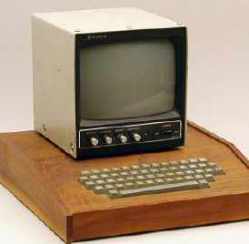
The 60’s and 70’s seemed to be a time for the birthing of future giants. Less than a decade after the first CPU was created, another upstart came along with an equally significant development. Named Apple and started by three men in 1976 – Steve Jobs, Steve Wozniak, and Ronald Wayne – the first product to be marketed was a “personal computer” (PC) which Wozniak built himself.

One of the most distinctive features of the Apple I was the fact that it had a built-in keyboard. Competing models of the day, such as the Altair 8800, required a hardware extension to allow connection to a computer terminal or a teletypewriter machine. The company quickly took off and began introducing an upgraded version (the Apple II) just a year later. As a result, Apple I’s remain a scarce commodity and very valuable collector’s item.

The Future:
The last two decades of the 20th century also saw far more than its fair of developments. From the CPU and the PC came desktop computers, laptop computers, PDA’s, tablet PC’s, and networked computers. This last creation, aka. the Internet, was the greatest leap by far, allowing computers from all over the world to be networked together and share information. And with the exponential increase in information sharing that occurred as a result, many believe that it’s only a matter of time before wearable computers, fully portable computers, and artificial intelligences are possible. Ah, which brings me to the last entry in this list…

The Google Neural Network:
googleneuralnetworkFrom mechanical dials to vacuum tubes, from CPU’s to PC’s and laptops, computer’s have come a hell of a long way since the days of Ancient Greece. Hell, even within the last century, the growth in this one area of technology has been explosive, leading some to conclude that it was just a matter of time before we created a machine that was capable of thinking all on its own.

Well, my friends, that day appears to have dawned. Already, Nicola and myself blogged about this development, so I shan’t waste time going over it again. Suffice it to say, this new program, which thus far has been able to identify pictures of cats at random, contains the necessary neural capacity to acheive 1/1000th of what the human brain is capable of. Sounds small, but given the exponential growth in computing, it won’t be long before that gap is narrowed substantially.

Who knows what else the future will hold?  Optical computers that use not electrons but photons to move information about? Quantum computers, capable of connecting machines not only across space, but also time? Biocomputers that can be encoded directly into our bodies through our mitochondrial DNA? Oh, the possibilities…

Creating machines in the likeness of the human mind. Oh Brave New World that hath such machinery in it. Cool… yet scary!


The Zombie Graph

Hey folks, remember this infographic from a few years back? I seem to remember posting about months ago, possibly in reference to 28 Days Later because I thought it was just so clever. Well, yesterday as I was typing out my zombie story, I got to thinking about this graph and how it applied to the basic rules I’ve seen in zombie movies.

As you can see, they not only classify zombies based on how fast and how smart they are, but also what form their zombie-hood takes. The basic breakdown they use involves three categories – undead, diseased, or possessed. This is one more than I acknowledged and I wonder if its apt. Can you really distinguish between diseased and undead when so many examples are both?

For example, the dead in The Walking Dead were the result of a disease, but they were totally undead creatures. A lot of time goes into explaining just how undead they are when they show that even dismembered and beheaded zombies are alive so long as their brains are still intact. This puts them apart from the zombies in 28 Days Later who were also the result of a virus but were still very much alive.

And then you’ve got the zombies in Dawn of the Dead (the 2004 remake) which were clearly the result of a virus (since the infection spread through bites) but were also undead. Shaun of the Dead follows the exact same pattern, with zombies who can withstand getting a pipe through the chest and losing a limb, but who won’t die until you shatter their brain pan. And even though I’ve never seen any of the Resident Evil movies, my understanding was they too were both undead and the result of a virus.

Am I picking nits here, because I’ve been known to do that. Or this could all just be the result of over-analysis as a result of over-research. I tend to do that as well. Yeah, it really doesn’t matter much, unless you’re trying to write for the genre and insist on understanding all the ins and outs of zombie creation. Mainly I just wanted to share the graph again because its fun and it puts people in mind of their favorite zombie flicks.

One question though… where would a Bath Salts zombie fall into all this? And how about that drunken weirdo in China? Do we need to revise this graph to take into account “substance abuse zombies”?


My First Zombie Story: Whiskey Delta!

Hello all! The other I decided that it was high time for me to try my hand at some Zombie literature. I’ve had an idea kicking around in my head, right next to where I was keeping “Frontera“, and it’s time to let it out! And so I give you the first draft of my post-apocalyptic zombie tale, “Whiskey Delta”!

Due to plenty of exposure to zombie flicks of late, zombie series, and zombie literature, I’ve come to learn a few things about the genre and what works, at least for me. Much like with Vampires, there are basically two big questions which determine what kind of film, book, series it’s going to be.

First of all, the zombies can either be the result of viral infection or the resurrected dead. This is what I would call the “paranormal vs. biological” realm and most franchises these days tend to go with the latter approach. Somehow, zombies that are the result of a viral infection are a lot more plausible than a biblical allegory.

Second, they can either be hotblooded living creatures that are consumed with the desire to kill, or slow, dottering undead creatures that look and smell horrible! This is what would be referred to as the “Infected vs. Undead” factor. The former is the kind of approach 28 Days Later took, while the latter is epitomized by such series as The Walking Dead.

Examples abound, and I hope people like the direction I took. Here is the first installment in the story, the prologue to the rest of the piece. And keep in mind, it’s a first draft so be gentle. And there’s naughty language too. And violence and zombies. But you already knew that last part didn’t ya? Enjoy!

Green and black. Always the same. Nothing ever looked different through a Starlight. No other hues, just different gradients of green on black. Some brilliant, some muted, but it didn’t matter. At night, all that mattered was what moved, and these days, it moved en masse.

Dezba lowered his scope and rubbed his eyes. After minutes spent looking at the green and black, even pitch black looked good. Less eerie, less filtered, less fake. The arms had a way of stiffening after holding up an A1.

The headset crackled, the voice calling on over the squad’s general frequency.

“Hold your position. Keep your eyes peeled.”

He heard a sigh from beside him. At the other side of the foxhole, Mill was also taking a break. In his case it was to stretch his neck.

“Are we even sure about this intel?”

“The Mage said it’s tight, so it’s tight,” he replied, repeating the mantra. That seemed to be enough, since Mill went right back to sighting down his sights again. Equipped with the SAW, which held no scope, he was the heavy gunner in their foxhole and couldn’t make a move until Dezba did.

Bringing the Starlight back into place, he got another eerie view of the landscape again. There were the glowing patches nearest them, bright from the moonlight that touched down on it, only small slices of black where shrubs cast their shadows. He scanned this way and that, checking out the side scenery. He spotted the other shining Humvee, the LAV, and the other foxholes that were cast in grey.

Beyond them was the relative dead of night. The line of Ponderosa pines that was black except for the few spots where the canopy opened to let things through. Not much was going on in there, until it chose to step into open…

He looked back to the roadway next; the thin stretch of dirt and gravel that the old man said was their spot. Others had dismissed him as a coot, somebody who had nothing better to do. But the Mage believed him, and so here they were. Sitting in wait, expecting that this was the point where the Whiskeys had been getting through the perimeter…

Finally the call came. “Eyes up”.

Dezba’s raised his gun into position. His heart began to pound and his hands tightened around the grips. Slowly, he scanned the horizon. No signs of movement. Next to him, Mill began to stir anxiously, waving the end of SAW around.

“Where are they?”

“I don’t see em,” said Dezba.

“What, man, I thought you Hopi fuckers could smell an enemy a mile away.”

Dezba smiled. “Wrong nation asshole.”

He scanned left. Something seemed to be moving by the tree line. He sucked in a breath and centered the scope there. Another stirring. The bushes at the edge were moving.

Damn coyotes, he thought. If they had come all this way because of some mangy little scavengers. And while they waited, the real hole in their line might very well be filling with Whiskeys, on their way in to find fresh victims. Tonight might even be the night that the damn things escalated and grabbed someone’s kid.

“Contact,” the Captain’s voice called. Deep and low. He had to be right.

Mill began to move his weapon back and forth with jerky movements.

“Shit… where?” he whispered. Dezba was wondering himself.

“Eleven o’clock high, by the treeline, coming towards the road.” Dezba and Mill both looked to their left. Small spots of bright green, black patches in their wake. “Confirmed, Whiskey Deltas at two hundred meters.”

More followed. They moved slowly, as usual, but were gradually converging on the dirt road. Just like the old man said…

“Standby,” the Captain ordered. Dezba did a quick check just to make sure his safety was off. At times like this, leaving it on could was just as deadly as forgetting to put it on. With what he knew to be an armed rifle, he watched the glowing ghouls walk until they reached the road.

And just like that, they changed course, as one. Each and every member of their little party turned and began walking on the gravel and dirt path that had been cleared from the brush. Moving, aiming the shadowy faces and milky eyes in the direction of the forest opposite them. It was almost enough to make one stop and think…

“Standby,” the Captain repeated, a note of urgency creeping into his voice.

The bodies kept moving, their heads coming into full view now as the last of them left the cover of the street for the moonlit path. He could see their milky eyes now, count every hair on their rotting heads.

“Get some,” came the order.

The line erupted in muzzle flashes and tracer fire, the field opposite kicking up dirt and fleshy bits a nanosecond later. Through his scope, Dezba saw nothing but bright flashes, pausing between shots to make sure his crosshairs were poised over a still-moving Whiskey.

“Get some! Get some!” he yelled between bursts.

Another one dropped. Movement from an arm sent him a few degrees to the right. The LAV must have seen it too because several tracers erupted around the downed body a second later. Dezba adjusted his fire again, closer to their line where the first of them had reached the road. Nothing but crawling bodies now, and he was sure to go right for the exposed heads.

“Cease fire!” came the order. “I say  again, cease fire!”

Not everybody seemed to hear, as guns were still going. Dezba shoved Mill with his boot to get him to stop. The last shot echoed out finally and new orders came.

“First Squad, enter the field and dispatch any movers.”

To his left, the Sarge from 1st was quick to respond. “Roger that, sir. First Squad is Oscar Mike.”

“Get to sit this one out, huh Cochise?”

Dezba scowled. How fucking hard was it to remember his real name? But then again not much could be expected from those he called friends. In the grand scheme of things Whiskey Tangos were just a step up from Whiskey Deltas. Dumb as shit and only half as ugly.

More shots rang out shortly thereafter. He brought the Starlight back up and caught a glimpse of 1st Squad doing its thing out in the field. One by one, he identified the six of them as they walked between the corpses, sending bullets from their M9’s into the heads of the downed bodies. The familiar tap, tap, taps of their guns was a reassuring sound at the end of a long night.

He picked out the Sarge just as his hand went to his head set to give the all clear.

“Eleven confirmed, sir. All dead.”

“Dead,” Mill said with a laugh. ”How fucked up is that?”

“You know what he means.”

“Right…”

His headset buzzed again with the final order. “Commence sanitizing.”

Dezba raised the Starlight to his eye for the last time to watch as 1st Squad finished with the last of it. One by one, the bodies were thrown together in the middle of the dirt road. The Sarge came around when they done and poured from a green can until they were thoroughly doused. He was sure to drop the scope before anyone set it all ablaze. Flames weren’t too pretty when seen through NV.

“Whoo, look at em burn,” Mill said. The pile blazed in no time at all, the fire rising to consume the filth and dead flesh.

“Too bad we can’t eat em, huh?” Dezba regretted saying it the second it came out of his mouth. It was all he could do to get the taste of filth out of his mouth now. Luckily Mill seemed to get a laugh from it.

“Cook em long enough, I’m sure it’s safe!”

Dezba suppressed a gag and set his foot on the top of the foxhole. He took a second to safety his weapon again before using it as a counterbalance to hoist himself out. 1st Squad cleaned up, which meant 2nd would have the less unenviable duty of making sure no more Whiskeys came this way again. Luckily, they brought enough motion detectors and frag mines to ensure that wouldn’t happen again.

“Guess the old man’s intel was right on the money,” Mill said, following him as he extricated the hole.

“You know what they say, man. The Mage knows.”

10 Sci-Fi Novels People Pretend to Have Read

Came across this article in Io9 recently, then again over at Scoop.it. You can tell something is important not only when it speaks to you, but when like-minded individuals begin referencing it! And if you own a blog, you definitely want to get on that! In any case, I found the list especially interesting for two reasons. One, many of the books I have already read. And two, I haven’t even heard of the rest.

I’d say a list like this is long overdue, but it’s still highly subjective isn’t it? The books we pretend we’ve read all comes down to what we consider important and relevant, not to mention popular. And even within the genre of sci-fi, I’d say that list is too big to boil down to a simple top ten. Even so, it’s interesting to read and compare, and find out just how many you’ve read yourself. So please, check this out and tell me which of these you have read and which you think you’ll want to check out:

1. Cryptonomicon:
Read it! This book is Neal Stephenson’s groundbreaking piece of historical fiction, combining narratives involving World War II cryptographers with modern day IT geeks who are looking to establish a data haven in the South Pacific. The story tells the tale of a massive shipment of Nazi gold that got lost on its way to Japan, ran aground in the Philippines, and remained hidden until the late 90’s.

Personally, I loved this book because of the way it weaves history, both recent and distant, into a seamless narrative and draws all the characters into the same overarching plot. One would think that Stephenson was making a point about how we are all subjects of our shared history, but it could just be he’s that good a writer!

2. Dune:
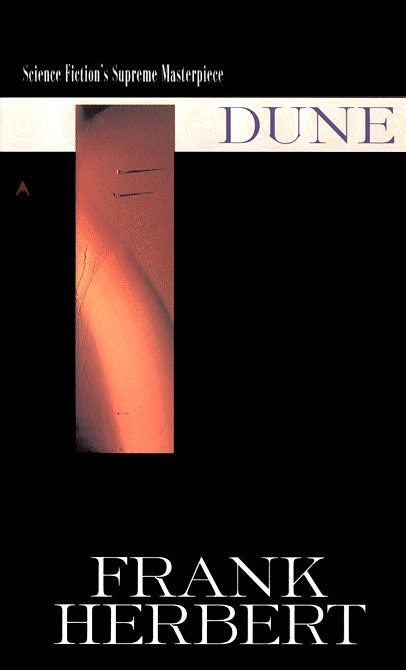
Read it thrice! In Dune, Frank Herbert draws upon an immense store of classical sci-fi themes, a grand awareness of human nature and history, and a keen grasp of ecology and the influence environment has on shaping its inhabitants to create the classic that forever established him as one of the greatest sci-fi minds of all time.

Sci-fi geeks everywhere know this one and it saddens to me to think that it’s even on this list. Anyone who’s willing to pretend that they read this book clearly considers it important, which is why they should have read it, dammit! Not only is it a classic, it’s from the guy who literally wrote the book on science fiction that was meant to be taken seriously.

3. Gravity Rainbow:
Never heard of it! Apparently, the story came out in 1974 and deals with the German V2 rocket program near the end of World War II. Pat Murphy, author of The City, Not Long After and The Wild Girls, went so far as to compare this book to James Joyce, a the great Irish modernist writer who was also renowned for being brilliant and inaccessible.

In addition to be classified as enriching, it is known for being odd and hard to get through, with many authors themselves claiming to have started it several times but never being able to finish it. The plot is also rather unique, combining transgressive sexuality with the idea of total war and technological races. But one look at the dust jacket will tell you all of that, right? Crazy Germans!

4. Foundation:
Read it myself, and also am somewhat sad that it made the list. Sure, the fact that it’s a classic means that just about everyone who’s eve shown the slightest interest in sci-fi would want to read it. But I can’t for the life of me understand why people would claim to have read it. Jesus, it’s not a hard read, people. And Amazon sells used copies for cheap and handles shipping. No excuses!

And having just reviewed it, I shall say nothing of the plot, except that it in many ways inspired fellow great Frank Herbert in his creation of Dune. Like Frank, Asimov combined the idea of a Galactic Empire with a keen awareness of human history, eternal recurrence, and prescient awareness.

5. Johnathon Strange & Mr. Norrell:
Now this one I have heard of, but never felt compelled to pick up and read. Apparently, its size and bulk are the reason many people react the same. This 2004 book is the first novel by British writer Susanna Clarke which deals with the nature of the English character and the boundary between reason and irrationality.

Set in 19th-century England during the time of the Napoleonic Wars, the story is an alternative history that is based on the idea that at one time, magic existed in England and has thanks to the help of two men – the namesakes of the story, Jonathan Strange and Gilbert Norrell. At once interesting and speculative, it also presents the rather romantic vision of romance returning to a world increasingly characterized by modernity and cold reason.

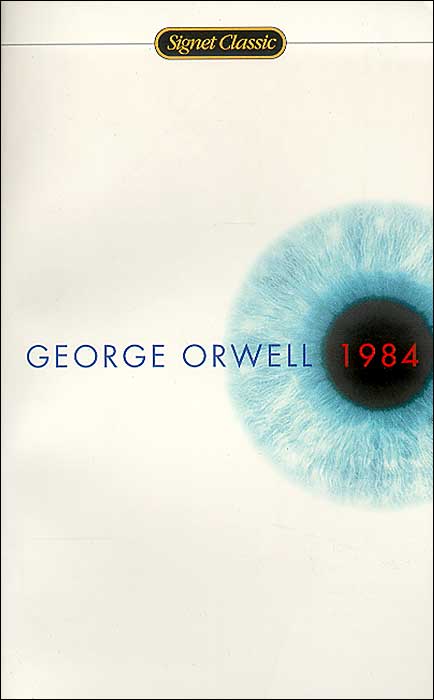
6. 1984:
Yep, read this one thrice as well! And given it’s reputation and place in the annals of literary history, I can totally see why people pretend to have read it. Oh, and let’s not forget the way people love to reference and abuse it’s message for the sake of making a quick and easy political point! But none of that excuses not reading it.

Set in an alternate history where WWIII and revolution have led to totalitarian governments in every corner of the world, the story tells the tale of one man’s quest to find answers and facts in a world permeated by lies and absolute repression. Of course, this meager description doesn’t do it justice. In the end, so much comes into play that it would take pages and pages just to provide an adequate synopsis. Suffice it to say, it’s a book that will change your life. READ IT!

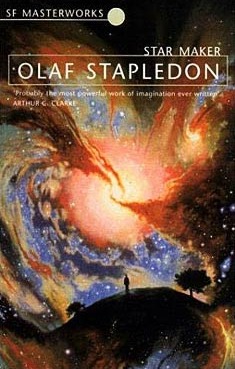
7. First and Last Men and Star Maker:
Another one which I’m not too sure about. Much of what is described within are concepts I have heard of in other places, and some of the content sounds familiar. Still, can’t say I’ve ever heard of Stapledon or these two works by name. But after reading about his work, I’m thinking I ought to check him out now. Tell me if you’d agree…

Published in 1930 and 1937, these two books tackled some rather broad ground. The first deals with the history of humanity, covering 18 species of humanity from the present to two billion years into the future. Based on Hegelian concept of history, humanity goes through several different types of civilizations and passes between stability and chaos over the course of it all. However, undeniable progress is made, as each civilization reaches further the last, culminating in leaps in evolution along the way.

In Star Maker, the plot revolves around a man who is able to leave his body and venture throughout the universe. He is able to merge with more minds along the way, a snowballing effect which allows him and his companions to explore more and worlds through time and space. This leads to a climax where a cosmological mind is created and makes contact with the “Star Maker” – the creator of the universe.

Sounds cool huh? And they appear to have no shortages of accolades. For example, Arthur C. Clarke called Star Maker one of the finest works of science fiction ever written, and the concept explored therein had a profound influence on many subsequent sci-fi minds, not the least of which were Gene Roddenberry and J.M. Straczynski.

8. The Long Tomorrow:
This one, I have heard of, mainly because it’s on my list as an example of post-apocalyptic fiction. I have yet to read it, but after reading about it, I think I would like to. Set in a post-apocalyptic world devastated by nuclear war, the story takes place within a society that is controlled by religious groups preaching a technophobic message.

Inevitably, the story comes to a head when young people, intrigued by stories of a neighboring community, go out in search of it, braving punishment and even exile. Sounds familiar? Well, it should. This book, which was published in 1955, has gone on to inspire countless variations and pop culture renditions. It also attempts to illustrate the connection between natural disasters and regression, traditionalism and repression.

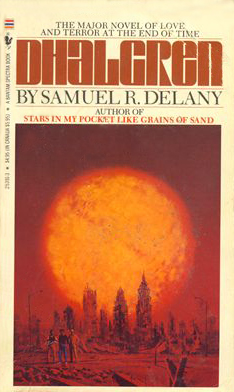
9. Dhalgren:
Yet another book that’s compared to James Joyce, largely by people that haven’t read it. I’m one of them! Apparently, this 1975 story by Samuel R. Delany takes place in a fictitious Midwestern town that has become cut off from the outside world by an event horizon. All communications are cut off, and the population become frightened by the night sky reveals two moons, and the morning sun is many times larger than our own.

More strange is the fact that street signs and landmarks shift constantly, while buildings that have been burning for days are either never consumed or show signs of damage. Gangs also begin to roam the nighttime streets, their members hidden within holographic projections of gigantic insects or mythological creatures. Against this backdrop, a group of people come together and try to make sense of what has happened as they struggle to survive.

Told from the point of view of a partial amnesiac, dysmetric, schizophrenic, as well as a bunch of other people who find themselves stranded in the city, the story is an exercise is confusion, dissociation, and a really just a big mystery. In the end, what is truly going on is never revealed, thus leaving the reader with their own interpretations. This is one of the selling points of the book, with William Gibson himself saying that it was “A riddle that was never meant to be solved.” Yeah, I definitely need to read this one!

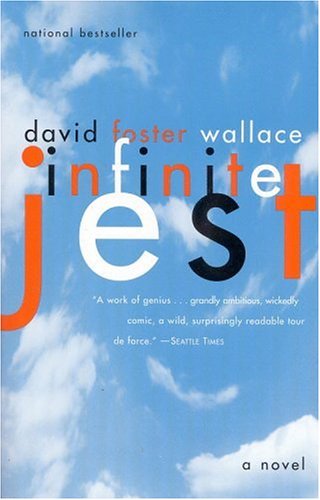
10. Infinite Jest:
This last novel is more recent, having been released in 1996. Once again, haven’t heard of it, but given its content, praise, and the fact that the author’s low life was cut tragically short, it doesn’t surprise me that its one of those books that everyone feels they must read. But given the length, complexity and the fact that story contains 388 numbered end notes, I can see why they’ve also held back!

The story focuses on the lives of a celebrity family known as the Incandezas, a clear pun on their, shall  we say… luminous fame? The family is deeply involved in tennis, struggles with substance abuse, and in a state of disrepair since the father – a famous film director – committed suicide with a microwave. His last work was apparently a film (entitled “Infinite Jest”, but known throughout the story as “The Entertainment”) which is so entertaining, it causes viewer to lose all interest in everything besides watching the movie.

Clearly meant as a satire on North American culture, particularly celebrity families, entertainment, substance abuse and the sideshow that is celebrity rehab, the story is all about various people’s search for the missing tape of “The Entertainment” and what they plan to do with it. The novel received wide recognition and praise after its publication and became a testament to Wallace’s talent after he committed suicide in 2008.

Okay, that’s four out of ten for me. How did you do? And even if you could say that you’ve read most of the books on this list, or at least the one’s you’ve heard of, I’d say we’ve all come away with a more additions to our reading lists, hmmm? Yeah, I guess its back to Amazon for me!

50,000 Hits!

photo by tt83x at deviantART

Well wouldn’t you know it, another milestone has happened this week and I almost missed it! Yes, today, after roughly two years and four months of keeping this blog up, I passed the 50,000 mark! Woooooo! Yay for me! And yay for the people who have nothing better to do than read my thoughts. I would pity you, but right now I’m too happy!
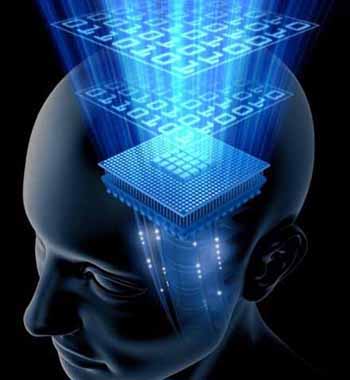
Of course, I would like to thank all those people who have chosen to follow me since this blog first went up. But according to my stock ticker, that’s like a thousand people. So instead of naming names and risk leaving anyone out, let me just send a grand digital hug out there and hope everyone catches some of it.

However, I must thank one person, Mr. Fraser Cain over at Universetoday.com who inspired me to start this blog in the first place. It was he who convinced me to bring my message directly to the good people and avoid the needlessly long and inopportune process of waiting on a publisher. And so I take this opportunity to thank him for all the good stuff that has come of it. Thanks Fraser, hope to see you and the family again soon!

And of course, I would also like to take this opportunity to say that there’s still lots of work to be done. Though I could pack up now and say I’ve explored the crap out of the world of sci-fi, the real point of this site is to share ideas, promote my and others’ works of literature, and make connections with people. I can’t foresee that ending any time soon, nor would I want to. The work and connecting must go on!

And I look forward to it. I’ve made many great friends and been able to liaise with many great talents since I got here. So why stop now? I want to success, I want to be able to share it with people. Yes, I totally plan to let it go to my head, but I also plan on spreading the good fortune around. You might want to be there, just in case… 😉 Thanks you all and let’s keep this ball rolling!

Of Faster-Than-Light Travel

It’s a popular concept, the fictional technology that could help us break that tricky light barrier. And it’s not hard to see why. The universe is a really, really, REALLY big place! And if we ever want to begin exploring and colonizing our tiny corner of it – and not have to deal with all the relativistic effects of time dilation and long, long waits – we better find a way to move faster.

And this is where various franchises come up with their more creative take on physics and the natural universe. Others, they just present it as a given and avoid any difficult, farfetched, or clumsy explanations. And in the end, we the viewers go along because we know that without it, space travel is going to be one long, tedious, and mind-bendingly complex journey!

Alcubierre Drive:
Proposed by Miguel Alcubierre as a way of resolving Einstein’s field equations, the Alcubierre Drive is an untested by possible way to achieve FTL travel. As opposed to Warp, Foldspace, or most other proposed means of FTL that involve some kind of internal propulsion of jump drive, the Alcubierre Drive is based on the idea of generating a wave that a ship would then “surf” in order to travel.

The creation of this wave would cause the fabric of space ahead of the spacecraft to contract and the space behind it to expand. The ship would then ride this wave inside a region of flat space known as a warp bubble and be carried along as the region itself moves through space. As a result, conventional relativistic effects such as time dilation would not apply in the same way as if the ship itself were moving.

The Alcubierre drive is featured in a few different science fiction genres, mainly those of the “hard” variety. This includes Stephen Baxter’s Ark, M. John Harrison’s novel Light, Warren Ellis and Colleen Doran’s Orbiter, and Ian Douglas’s Star Carrier where it is the primary means of transport.

FTL Drive:
The primary means of interstellar travel in the Battlestar Galactica universe, where every ship larger than a in-system transport is equipped with an FTL drive. How it works is never really explained, but it is clear that the technology is complex and involves a great deal of calculation. This is not only to ensureolve n accurate relocation through space-time, but also to make sure they don’t up jumping too close to a planet, star, or worse, right in the middle of either.

Whereas Colonial ships use their own computers to calculate jumps, Cylon ships rely on the Hybrid. These “machines” are essentially semi-organic computers, and represent the first step in Cylon evolution from pure machines to organic beings. Apparently, the hybrids were more sophisticated than Colonial computers, especially the aging Galactica. Hence, they were able to calculate jumps more quickly and accurately.

Holtzman Drive:
This FTL drive system comes to us from the Dune universe, and is otherwise known as a “Foldspace Engine”. Relying on principles that are not entirely clear to those in the Dune universe, the system involves depositing a ship from one point in space-time to another instantaneously. Though the workings of the drive are never really explained, it is intimated in Chapterhouse: Dune that tachyons are involved.

Another key component in the system is a Guild Navigator, a mutant who has been given natural prescient abilities thanks to constant exposure to spice. Using this prescience, the Navigator “sees” a path through space-time in order to guide the ship safely through. But in time, the Ixians invented a machine that was capable of doing this job as well, thus making the entire process automated and breaking the Guild’s monopoly on spacing.

Hyperspace:
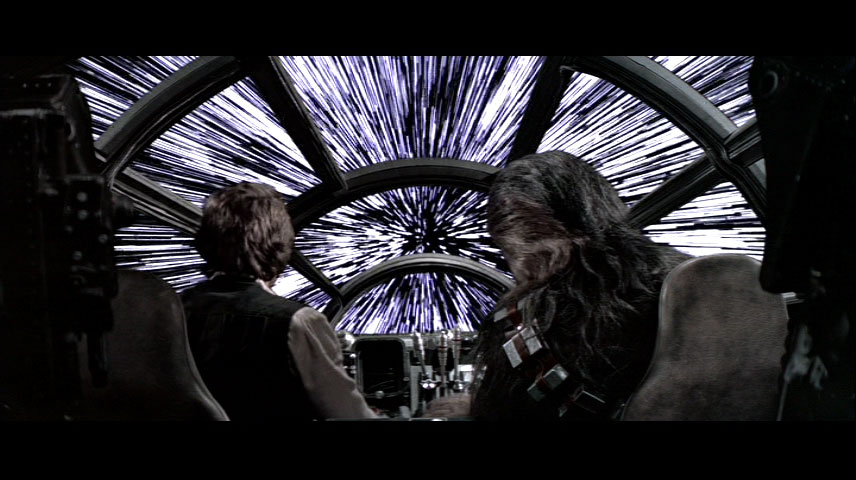
Like the Warp drive, the terms hyperspace and hyperdrive have become staples withing the science fiction community. It’s most popular usage comes from Star Wars where it is the principle means of interstellar travel. Though it is never explained how a hyperdrive works, it is made abundantly clear through a series of visuals in the first and subsequent movies that it involves speeds in excess of the speed of light.

In addition, Han Solo indicated in the original movie that the Falcon’s top speed was “point five past light-speed”, indicating that it can travel 1.5 c. All other references to hyperspace speed factors in the franchise are similar, with velocities given in terms of a decimal point value. As a fast ship, the Falcon can reach point five, whereas most of the larger Imperial and Rebel ships can make only point three or four at most.

Though Star Wars is the most popular example of hyperspace, it is by no means the earliest. The first recorded example was in John Campbell’s “Islands of Space,” which appeared in Amazing Stories in 1931. Arthur C. Clarke’s also mentioned hyperspace in his 1950 story Technical Error. However, the most enduring example comes from Asimov’s Foundation universe, where hyperspace is the principal means of travel in the Galactic Republic. In I, Robot, the invention of the “hyperspatial drive” is the basis of one of the short stories, and was meant to provide a sense of continuity with his earlier Foundation series.

Other franchises that feature the concept of hyperspace include Babylon 5, Homeworld, Macross/Robotech, and Stargate. Combined with Star Wars and the Foundation series, it is the most popular – albeit the most ill-defined -form of FTL in the realm of science fiction.

Infinite Probability Drive:
The perfect mixture of irreverence and science: the Infinite Probability Drive from The Hitchhikers Guide to the Galaxy. This FTL concept is based on a particular perception of quantum theory which states that a subatomic particle is most likely to be in a particular place, such as near the nucleus of an atom, but there is also a small probability of it being found very far from its point of origin.

Thus, a body could travel from place to place without passing through the intervening space if you had sufficient control of probability. According to the Guide, in this way the drive “passes through every conceivable point in every conceivable universe almost simultaneously,” meaning the traveller is “never sure where they’ll end up or even what species they’ll be when they get there” and therefore it’s important to dress accordingly!

Subspace Jump Drive:
Here we have an FTL concept which comes from one of my favorite games of all time, Descent Freespace. Subspace jumps, relying on the drive system of the same name, represent a very quick method of interstellar travel. By relying on subspace “corridors” that run from one point in space-time to another, a ship is able to move quickly from one star system to the next.

The only drawback to this concept is the fact that travel must occur along officially designated “nodes”. These nodes usually pass between large gravitational sources (i.e. between stars systems) but also can exist within a system itself. Virtually all nodes are unstable, existing for mere seconds or minutes at a time. However, nodes which will last for centuries or longer are designated as “stable” and used for transit.

Another favorite franchise which uses a similar concept is the Wing Commander universe. In all versions of the game, particularly Wing Commander: Privateer, interstellar travel comes down to plotting jumps from predesignated points in space. One cannot simply jump from one spot to another provided accurate calculations are made, they have to use the mapped out points or no jump is possible. This, as opposed to hyperspace travel, posits that subspace is a reality that exists only in certain areas of space-time and must be explored before it can be used.

TARDIS:
Officially, the Time and Relative Dimension in Space is a time machine and spacecraft that comes to us from British science fiction television program Doctor Who and its associated spin-offs. Produced by the advanced race known as the Time Lords, an extraterrestrial civilization to which the Doctor belongs, this device that makes his adventures possible.

Basically, a TARDIS gives its pilot the ability to travel to any point in time and any place in the universe. Based on a form of biotechnology which is grown, not assembled, they draw their power primarily from an artificial singularity (i.e. a black hole) known as the “Eye of Harmony”. Other sources of fuel include mercury, specialized crystals and a form of temporal energy.

Each TARDIS is primed with the biological imprint of a Time Lord so that only they can use it. Should anyone else try to commandeer one, it undergoes molecular disintegration and is lots. The interior of a TARDIS is much larger than its exterior, which can blend in with its surroundings using the ship’s “chameleon circuit”. Hence why it appears to outsiders as a phone booth in the series.

Warp Drive:
Possibly the best known form of FTL travel which comes to us from the original Star Trek and its many spinoffs. In addition to being a prime example of fictional FTL travel, it is also perhaps the best explained example.Though said explanation has evolved over time, with contributions being made in the original series, TNG, and the Star Trek technical manual, the basic concept remains the same.

By using a matter/antimatter reactor to create plasma, and by sending this plasma through warp coils, a ship is able to create a warp bubble that will move the craft into subspace and hence exceed the speed of light. Later explanations would go on to add that an anti-matter/matter reaction which powers the two separate nacelles of the ship are what create the displacement field (the aforementioned “bubble”) that allows for warp.

Apparently, Warp 10 is the threshold for warp speed, meaning that it is the point at which a ship reaches infinite speed. Though several mentions are made of ships exceeding this threshold, this was later explained as being the result of different scales. Officially, it is part of the Star Trek canon that no ship is capable of exceeding Warp 10 without outside help. When that occurs, extreme time dilation, such as anti-time, occurs, which can be disastrous for the crew!

In addition to Star Trek, several other franchises have made mention of the Warp Drive. This includes StarCraft, Mass Effect, Starship Troopers, and Doctor Who.

Final Thoughts:
Having looked through all these examples, several things become clear. In fact, it puts me in mind of a clip produced by the Space Network many years ago. Essentially, Space explored the differences between FTL in past and present franchises, connecting them to developments in real science. Whereas Warp and Hyperspace tended to be the earliest examples, based on the idea of simply exceeding the speed of light, thereby breaking the law of physics, later ideas focused on the idea of circumventing them. This required that writers come up with fictional ideas that either relied on astrophysics and quantum theory or exploited the holes within them.

One such way was to use the idea of “wormholes” in space-time, a hypothetical theory that suggests that space is permeated by topological holes that could act as “shortcuts” through space-time. A similar theory is that of subspace, a fictional universe where the normal rules of physics do not apply. Finally, and also in the same vein, is the concept of a controlled singularity, an artificial black hole that can open a rift through space-time and allow a ship to pass from one point in the universe to another.

Explanations as to how these systems would work remains entirely hypothetical and based on shaky science. As always, the purpose here is to allow for interstellar travel and communications that doesn’t take decades or even centuries. Whether or not the physics of it all works is besides the point. Which brings me to two tentative conclusions.

  1. Explanations Need Not Apply: Given the implausible (or at the very least, inexplicable) nature of most FTL concepts, the best sci-fi is likely to be the stuff that doesn’t seek to explain how its FTL system of choice works. I’st simply there and does the job. People hit a button, push a lever, do some calculations, or fly into a jump gate. Then boom! seconds later (or days and weeks) and they find themselves on the other side, light years away and ready to do their mission!
  2. That’s Hard: Given how any story that involves relativistic space travel, where both time dilation and confusing time jumps are necessarily incorporated into the story, only the hardest of hard sci-fi can ever expect to do without warp drives, hyperspace, jump or FTL drives. Any other kind of sci-fi that is looking to be accessible, and therefore commercially successful, will have to involve some kind of FTL or face extinction.

Well, that’s all I got for the time being. In the meantime, keep your eyes on the skies and don’t stop dreaming about how we’re one day going to get out there. For even if we start sending ships beyond our solar system in the near future, it’s going to be well into the distant future before they get anywhere and we start hearing back from them. At least until someone figures out how to get around Einstein’s Theory of Relativity, damn bloody genius! Until then, I’d like to sign off with a tagline:

This has been Matt Williams with another conceptual post. Good night, and happy spacing!

Top 15 Things You’ll Never Hear a Geek Say

white-and-nerdyThis really doesn’t happen, but it seems I gave myself an idea with that last post. And to think it all came of an inappropriate joke! Essentially, I began to joke about the kinds of things geeks never say and even listed a few. And it got me thinking, one thing this blog has been missing up until now is a top ten list of things you’ll never hear a geek say. Well, I tried to limit myself to ten, but it was impossible. And so I expanded it a little to incorporate just a few more. I know, top 15 lists aren’t as impressive, but what can you do? Sometimes, you just gotta be inclusive!

Oh, and word of warning, if you’re not a fan of inappropriate jokes, back yourselves up now because you don’t want to see some of the things I’ve written here. As a self-professed geek, I can say these things, but rest assured, my test audience (my wife) didn’t exactly react well 😉 You’ve been warned! Anyhoo, here they are, the top 15 things geeks never say, in ascending order:

15. “Jane Austin is a far superior writer to Ursula K. Le Guin”

14. “I would have liked to have seen less cleavage and more character development from 7 of 9” (substitute any female lead from Star Trek)

13. “The blue chick from Avatar was so not hot”

12. “George R.R. Martin didn’t hit his stride until the third book”

11. “There’s no way I’m paying 50 bucks for a video game!”

10. “I can see no difference between Captain Kirk and Picard”

9. “Blade Runner totally needs to be remade”

8. “I have no strong opinions either way on the remake”

7. “They made a show called The Big Bang Theory?”

6. “I didn’t see the new Star Trek movie, but I hear it’s good.”

5. “Frank Herbert would be so proud of what’s become of the Dune franchise”

4. “You’ll never catch me jerking off to anime!”

3. “The prequels are just as good as the original”

2. “The movie was just as good as the book”

1. “George Lucas didn’t rape my childhood!”

And I’m still thinking of some doozies! Oh well, maybe this can become a thing, but only top 10 lists from now on. 15 at a time is not a pace I foresee being able to keep up for long. Until next time, geek out, get your geek on, and keep on geeking in the free world! Have I found enough ways to work that into a cliched saying?

The Walking Dead Viewing Guide

Found this over at Cracked.com, where some smart-ass nerd who obviously knows the comic backwards and forwards thought he’d mock the show. Having never read the comic, I can’t comment on the rightness of this little guide, but let’s just say I intend to now. Being a fan of the show,  much like most people I’ve talked to here on the subject, saying that they are vastly inferior to the comics makes me think that I’m missing something.

But of course its called comedy for a reason. And as I’m sure we are all aware, every franchise geek since the beginning of time has had the same thing to say vis a vis adaptations. In fact, if you were to make a top 10 list of things franchise geeks never say, number one would be “The movie was just as good as the book”… right after, “the prequel was just as  good as the original” and “George Lucas didn’t rape my childhood” 😉

The Future is Here: The Google Neural Net!

I came across a recent story at BBC News, one which makes me both hopeful and fearful. It seems that a team of researchers, working for Google, have completed work on an artificial neural net that is capable of recognizing pictures of cats. Designed and built to mimic the human brain, this may very well be the first instance where a computer was capable of exercising the faculty of autonomous reasoning – the very thing that we humans are so proud (and jealous) of!

The revolutionary new system was a collaborative effort between Google’s X Labs division and Professor Andrew Ng of the AI Lab at Standford University, California. As opposed to image recognition software, which tells computers to look for specific features in a target picture before being presented with it, the Google machine knew nothing about the images in advance. Instead, it relied on its 16,000 processing cores to run software that simulated the workings of a biological neural network with about one billion connections.

Now, according to various estimates, the human cerebral cortex contains at least 1010 neurons linked by 1014 synaptic connections – or in lay terms, 10 trillions neurons with roughly 1 quadrillion connections. That means this artificial brain has one one thousandth the complexity of the organic, human one. Not quite as complex, but it’s a start… A BIG start really!

For decades – hell, even centuries and millennia – human beings have contemplated what it would take to make an autonomous automaton. Even with all the growth in computer’s processing speed and storage, the question of how to make the leap between a smart machine and a truly “intelligent” one has remained a tricky one. Judging from all the speculation and representations in fiction, everyone seemed to surmise that some sort of artificial neural net would be involved, something that could mimic the process of forming connections, encoding experiences into a physical (i.e. digital) form, and expanding based on ongoing learning.

Naturally, Google has plans for an application using this new system. Apparently, the company is hoping that it will help them with its indexing systems and with language translation.  Giving the new guy the boring jobs, huh? I wonder what’s going to happen when the newer, smarter models start coming out? Yeah, I can foresee new generations emerging over time, much as new generations of iPods with larger and larger storage capacities have been coming out every year for the past decade. Or, like faster and faster CPU’s from the past three decades. Yes, this could very well represent the next great technological race, as foreseen by such men as Eliezer Yudkowsky, Nick Bostrom, and Ray Kurzweil.

In short, Futurists will rejoice, Alarmists will be afraid, and science fiction writers will exploit it for all its worth! Until next time, keep your eyes peeled for any red-eyed robots. That seems to be the first warning sign of impending robocalypse!