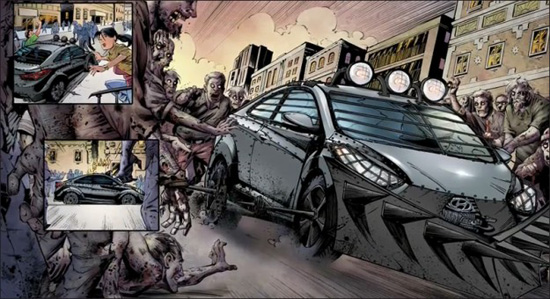
Just yesterday I was busy hearing about the new Zombie Car, an invention which is going to be unveiled at the next Comic Con. A collaboration between The Walking Dead’s Robert Kirkman and Hyundai, the car will essentially incorporate all the zombie-fighting features that a post-apocalyptic vehicle needs.
As it happens, one of my followers mentioned how this vehicle reminded her of the Batmobile and other cool cars. Between that and the allusions to Mad Max that the Zombie Car inevitably inspires, I got to thinking that this site is in need of a list of Cool Cars! And here it is, all the cool vehicles that have appeared in pop culture over the years, more often than not, as part of a science fiction franchise.
M577 APC:
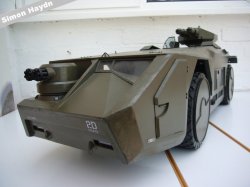 Not so much a car as a tank, but she drives on four wheels and is VERY cool. So I don’t see why the M577 from the Aliens franchise shouldn’t be included on this list. Much like all APC’s, the purpose of this low-sitting but heavy hitting vehicle was to act as a battle taxi, deploying a squad of Marines to the field and then pulling them out in a hurry if things got harry. Designed to fit aboard a Cheyenne Dropship, it was part of the Colonial Marines quick deployment strategy.
As Hudson so righteously bragged in the movie, the M577 is decked out with some pretty impressive weaponry. For instance, the foldable turret mounted on the top carries a twin 20mW Boyars PARS-150 phased plasma cannon which is capable of making 1000 discharges. At the front end of the vehicle, a dual set of RE700 20mm Gatling cannons is built on a small swivel turret. In addition, it also carries plenty of small arms and munitions for its Marine compliments, consisting of pulse rifles, smart guns, flame units, grenades, rockets and even canisters of nerve gas.
Batmobile:
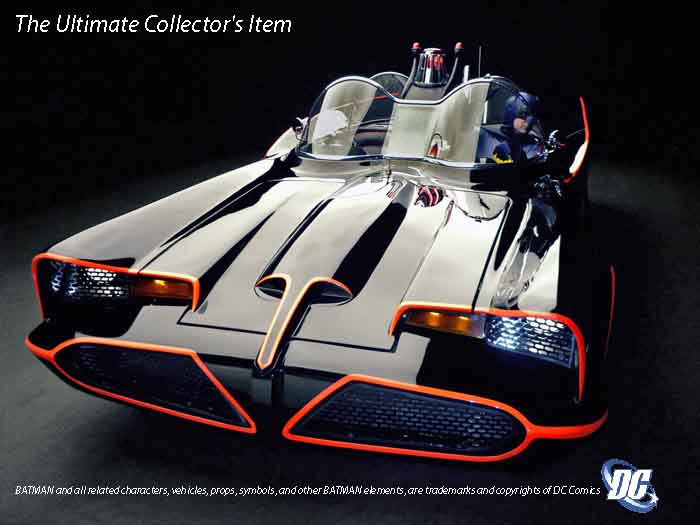
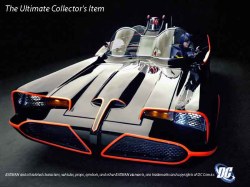 Now here’s a popular vehicle, so popular that’s gone through several variations over the years. From the campy 60’s version of the original Adam West series to the sculpted Burton remake to the Tumbler of the Nolan series, the Batmobile is a nostalgic icon which is constantly being reinvented. But all versions have two things in common. One, they’re crime-fighting specials, which means they have all kinds of gadgets and features. Two, they’re none to shabby to look at and probably a hell of a lot of fun to drive!
In the earliest Batman comics, the Batmobile was simply a sedan that served as Batman’s car. As time went on, it began to reflect Batman’s motif, including wing-shaped tailfins, dark colors, and even armor. Additional customizations, like crime-fighting gadgets also found their way into the design, and soon, a classic was born!
By the time of the original series, the Batmobile was based around the chassis of a Lincoln Futura and featured fully-functioning gadgets. These included a gas turbine, a Cable Cutter Blade, the Bat Ray Projector, a Batscope, Bat Eye Switch, Antenna Activator, Police Band Cut-In Switch, Automatic Tire Inflation Device, the Remote Batcomputer, the Batphone, Emergency Bat Turn Lever, Anti-Fire Activator, Bat Smoke, Bat Photoscope, and two rear-mounted ten-foot Deist parachutes.
 Updated for the relaunch, Burton’s Batmobile built around the original concept but recieved a does of his characteristic grit and Gothic nature. As such, the new Batmobile’s aesthetics and gadgets were updated for the modern era and included a sleeker design, a more comprehensive turbine system, a sliding canopy, and of course retractable body armor! It also retained the idea of a 180 degree “Bat turn”, which this time around was made possible from lateral harpoons, and two .30 cal machineguns.
As the second movie demonstrated, the vehicle was also capable of shedding much of its body and collapsing into a narrow version of itself in case it needed to fit through tight spots. By the third movie, the design concept had changed considerably to feature bright sections beneath its segmented chassis. Over the top and impractical, this design was in keeping with Schumacher’s vision of a Batman where everything glittered and was campy, like the original series.
 And last, the Nolan version. Here, the Batmobile was apparently inspired by Frank Miller’s The Dark Knight Returns, where it was depicted as a tank rather than a car, and the Spinners of the Blade Runner movie. In the first film, it is indicated that the design came from a military vehicle known as “The Tumbler”, which Bruce Wayne then modified for his personal use.
It’s features included a propane fueled jet engine, front-firing rockets, autocannons, caltrops, rear airbrakes, and a stealth mode. In the Dark Knight, it was also shown that in emergency situations, the front wheels can deploy to form the Batpod. Rumors also abound that the new version featured in The Dark Knight Rises will be capable of flight as well. Oooooh, five more days!
Delorean:
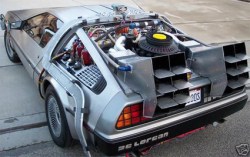 This time-traveling vehicle has placed this short-lived 80’s experiment permanently on people’s radar. Were it not for Back to the Future and it’s unapologetically 80’s feel, the Delorean would probably have faded into obscurity a long time ago. Much like the Futura, it was a short-lived concept that caught on because of its appearance on screen.
But of course, were it not for its unusual design features, such as the gull-wing doors, stainless steel paneling and fiberglass underbody, it would never have made its cinematic appearances in the first place. The set designers were looking for something futuristic-looking to fashion a time-machine out of, and this is what they found!
It’s futuristic features are quite straightforward: A flux capacitor which allows for time travel, a plutonium engine that fuels it, a series of internal controls to set and monitor the time computations, and some rear facing exhaust fans to give it that ultra-futuristic look! Only three remain in existence once filming of the three movies was finished. Two are the property of Universal Studios and are display items, the third is owned by a private collector who assembled and restored the original model.
Ecto-1:
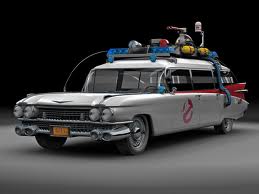
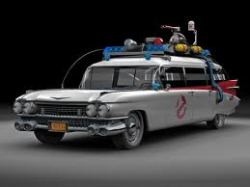 I shall not be making a “Who you gonna call?” reference here! Too obvious! Instead, let me just say that this car ought to be instantly familiar to anyone who grew up in the 80’s. If not, I’d be forced to wonder if you spent the entire decade in a cave or a cell somewhere, in which case, my sincere condolences!
Moving on, the Ecto-1 was the primary means of transport for the Ghostbusters. The car was built around the chassis of a 1959 Cadillac Miller-Meteor, which had been converted to act as an ambulance car. This is apparent from the realoader trunk and the car’s siren, which was retained by the Ghostbusters so they could make sure people stayed out of their way, and also to announce their arrival!
Additional features including a a special pull-out rack in the rear containing the staff’s proton packs, which facilitates a quick retrieval without the complication of having to reach into the vehicle’s rear. There are also various gadgets mounted on the top, whose function is never revealed in the movies. However, in the course of the cartoon adaptation, it is said that the vehicle carries a “proton cannon” on its roof, and has a vertical jump system built into the bottom. These allow the Ghostbusters to take on ghost with some heavy artillery, as well as clearing fences and other obstacles that lie between them and their deployment.
KITT:
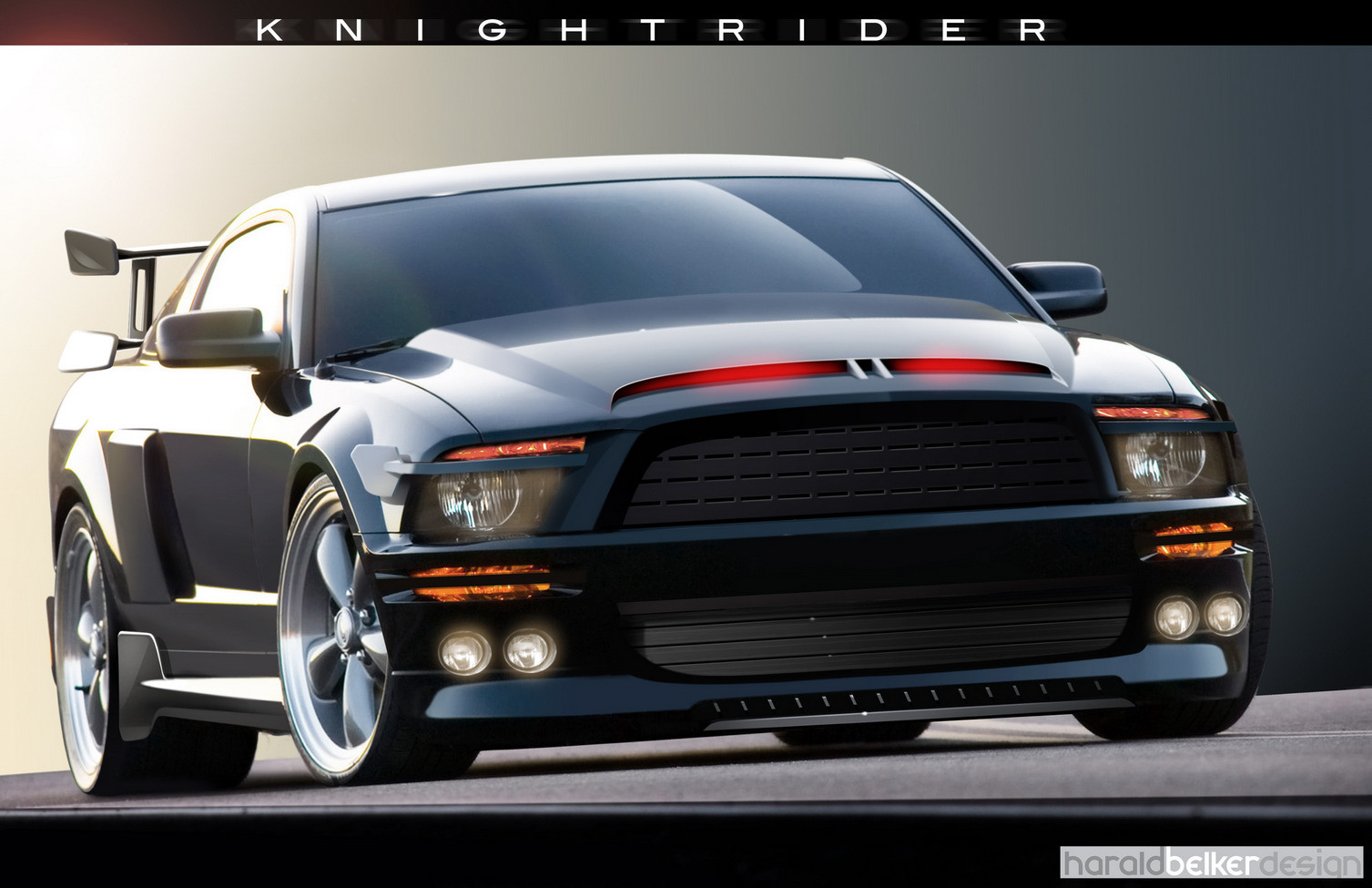
 Also known as Knight Industries Two Thousand, this talking car was featured in the popular 80’s show Knight Rider. In addition to being the “vehicle” (ha!) that launched Hasselhoff’s career, this car is one of the earliest instances where an AI was merged with a high-performance car.
Built around the chassis of a 1982 Pontiac Trans Am, the car was souped up with a number of features to give it that AI look and feel. These included the red-laser scanner bar at the front – which like the Cylons’, allowed KITT to “see” – a turbo boost that allowed him to make big jumps, an “alpha circuit” which allows KITT to drive himself, a Tri-Helical Plasteel 1000 MBS (molecular bonded shell) plating, a flame thrower, tear gas launcher, and even a laser.
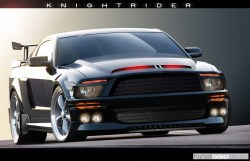 Inspiring several TV movies and a 2008 relaunch, the vehicle has gone through several redesigns and upgrades. In the updated series, the Trans Am chassis was traded in for a Mustang GT500KR and the molecular armor was traded in for nanotech polymer skin which is not only impregnable, but also capable of regeneration. Much of the other features, including the AI, scanners and defensive systems remained very much the same. However, the show only lasted single season, a possible indication that not all things 80’s are an instant success anymore.
Pursuit Special:
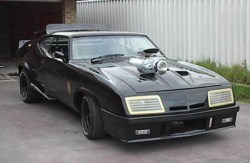 With all this talk about Mad Max, it was only a matter of time before this one crept into the list! Making multiple appearances in the franchise, the first car to hold this name was a modified Holden Monaro that was stolen and used by the “Night Rider” (not to be confused with Haffelhoff’s character). However, the more famous model was a modified 1973 Ford Falcon XB GT.
It was this car that Mad Max was offered as an incentive to stay with the force as their top pursuit man. Thought he initially refused it, he later used this same vehicle as his personal revenge weapon when evil men murdered his wife and child and had to be dealt with!
In terms of features, the main modifications on this car were the front nosecone, the eight individual exhaust side pipes, and a supercharger protruding through the bonnet. All of these alluded to the fact that the Pursuit Special was the fastest car in the force, capable of chasing down any road warriors that happened to be barreling down the highway.
In the sequel, the car was modified even further thanks to the success of the first film and a correspondingly larger budget. The new features included large petrol tanks fitted in the back to show that just how important a steady supply of petrol was to this car, not to mention within the context of the post-apocalyptic setting of Mad Max. The front end was also modified by removing the bottom section, which was in keeping with the design concept of making the car look more used and stressed.
Spinner:
 So… it’s the 21st century, and yet there aren’t any flying cars. Screw hybrids and electrics, I was promised FLYING CARS! Well, according to the movie Blade Runner, we still have seven years before they are supposed to be a regular feature, at least as far as police cars go. And that’s the concept of a Spinner, in a nutshell – a flying car used by the police of the future noire city of LA.
In addition to being able to drive as a ground car, the Spinner is also capable of vertical takeoff and landings and hovering at relatively high altitudes. Conceived by Syd Mead, the same man who designed concepts for Tron and Aliens, the vehicle was originally described as an “aerodyne” – a vehicle which directs air downward to create lift, though press kits for the film stated that the spinner was propelled by three engines: “conventional internal combustion, jet, and anti-gravity”.
I hope for their sake, they exaggerate! It’s going to be hard to come up with anti-gravity engines in just seven years time! In any case, the concept designs were built by Gene Winfield, the man who brought concepts to life for Batman, The Last Starfighter and Robocop as well as this. No indication was given as to what they used for a chassis, so I can only assume they built it up from spare parts and a classic was born!
So… seven years before these cars are supposed to be available, right? Ford, Toyota, GM, Hyundai, Subaru; all of you guys, get on it! Don’t make me come down there!
XXX GTO:
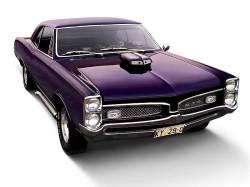 Last, but not least, we have the super-charge spy car on steroids from the movie XXX. As anyone who has seen this movie knows, Mr Vin Diesel, once undercover amongst a bunch of Russian mafia scumbags, decided he needed to have a classic muscle car. This he found in a 1967 Pontiac GTO hardtop. When circumstances demanded he start kicking some ass, he demanded that his spy buddies take all their precious gear and put it into the car.
Yes, that’s exactly how it happened. A table of guns, harpoons launchers, and assorted high tech gear lay in front of them. Behind the wheel, Diesel said “I want all of that… in here!” Within a few days, he got his wish. Featuring a folding seat which turns over to reveal a weapons rack, missiles mounted behind the lights, a flame thrower, and built-in machineguns.
And of course, all of this equipment had corresponding controls in the interior. These were to be found in a confusing array of millions of buttons and switches, along with an on-board GPS system built into the dashboard. Unfortunate that the car made only a brief appearance as part of the final chase scene.
Well that’s I got for this first installment in the series. I imagine people might have suggestions so please send them my way. Between ships, robots, guns, and now cars, I think we can just pay homage to just about every cool thing that’s ever come out of the realm of sci-fi and pop culture!

 When people think of NASA, what automatically comes to mind are images of planets, stars, space shuttles and outer space. But what of inner space? How do we account for the fact that right here at home, there are depths and expanses wich remain largely unexplored? For some time, this has been a subject of lively speculation, where writers and scientists have ventured that exploration in this century will consist of underwater as well as interplanetary missions.










 Stories by Williams