A new video was recently posted online that shows North Korean dictator Kim Jong Un breaking out the dance moves, getting pranked, and engaging in some serious fight scenes. The video has gone absolutely viral and has everybody laughing – except for Kim Jong Un himself. In fact, the “Great Leader’s” outrage was such that North Korea made a public statement denouncing the video and demanding it be taken down.
According to the English-language Korean newspaper The Chosun Ilbo, the video was made by a Chinese man bearing the surname Zhang who reportedly studied at a university in South Korea. The paper goes on to cite a source in China saying North Korea felt the clip “seriously compromises Kim’s dignity and authority” and asked China to stop the spread of the video, but that “Beijing was unable to oblige.”
The reaction is predictable, and the request certainly betrays the North Korean regime’s internet-phobic tendencies, not to mention their ignorance of how the internet actually works. For starters, once something is posted on the internet, it becomes part of the digital ether and can never be destroyed. In addition, drawing attention to an internet phenomenon only makes it stronger! By condemning it, Kim Jong Un’s people just ensured it’s viral nature!
The video consists of the Dear Leader’s head being spliced onto a variety of bodies that see him getting down on a ball field, getting karate-kicked by Obama (who also has his head spliced onto various heads), skipping through a field with Osama Bin Laden, and doing some serious kung fu fighting. And it all takes place to a Chinese pop hit by the Chopstick Brothers, who have made viral videos of their own in the past.
Needless to say, it’s really quite funny. And it’s only made more so by the fact that the man-child leading the world’s most backward and ridiculous regime finds its so infuriating. So be sure to watch it, enjoy it, and contribute to its circulation!
It’s no secret that Brazil’s decision to host the 2014 World Cup was the source of controversy. With roughly $4 billion spent on renovating and constructing the stadiums needed to host the international event, many wondered why that money could not have been spent addressing other infrastructure concerns – such as providing housing and utilities for its many impoverished citizens.
However, drawing inspiration from the social issues plaguing much of the publicity around the event, a pair of French architects have developed a proposal to re-invent the structures as complexes for low-cost housing. While most of the stadiums constructed for the World Cup will continue to host football matches, Brazil’s local teams stand to draw a fraction of the crowds that attended the event, doing little to assuage concerns of wasted resources.
Other buildings, such as the Arena da Amazonia, face a less certain future. Located in the jungle city of Manaus, the 44,500 seat stadium is perhaps the most contentious of Brazil’s World Cup creations. A local judge proposed converting it into a center for temporary detainees to tackle the city’s overflowing prisons, though this was met with fervent opposition from government officials.
The proposal by Axel de Stampa and Sylvain Macaux is perhaps the most ambitious. Dubbed Casa Futebol, it involves transforming each of the 12 World Cup Stadiums into affordable housing for Brazil’s poor and displaced. As Stampa explained in an interview with Gizmag:
The project covers 12 Brazilian stadiums. There are actually six stadiums where we can colonize the exterior facade. Five of these have an exterior structure composed of concrete and metal columns separated by seven or eight meters (23 to 26 ft). We just have to insert pre-fabricated housing using the existing structures.
The remaining stadiums would see housing modules that are 105 m2 (1,130 ft2) fitted to the interior at the expense of rows of seating, the only difference between these and those receiving exterior additions being the installation process. Conscious of Brazil’s adoration for the world game, the proposal would see the stadiums altered slightly, but continue to host matches with profits going towards ongoing maintenance and construction of the housing.
The project is based on modular pre-fabricated houses. So the only thing that changes is the implantation of the houses… We think that the concept is achievable in all 12 stadiums. You just have to take up some seating and reduce their capacity a little bit.
The team guesses that if converted, the stadiums could each house between 1,500 and 2,000 people per building, and a total of approximately 20,000 across the entire project. This bold proposal for Brazil’s stadiums forms part of a year-long architecture project called 1 week 1 project, where the pair endeavor to produce spontaneous architecture projects every week for one year.
While they don’t have current plans to take the Casa Futebol beyond the concept stage, it is hoped that the project can inspire more socially-conscious approaches to problems of this kind. Combined with 3-D printed housing and other prefab housing projects, this kind of re-purposing of existing infrastructure is a way of addressing the problem of slums, something which goes far beyond the developing world.
For decades, bone marrow transplants have been used for the treatment of cancer, particularly lymphoma, leukemia, and multiple myeloma. However, after three years of receiving transplants, two Australian men who were previously diagnosed with HIV have shown no signs of the AIDS virus. Moreover, one of the patient’s is the first recorded case of clearing the virus without the presence of a rare anti-HIV gene in the donor marrow.
The two patients, a 53-year-old and 47-year-old male, were diagnosed with leukaemia and lymphoma respectively at St Vincent’s Hospital in Sydney, Australia, which has been working in partnership with the University of New South Wales’ Kirby Institute. To date, there have been several reported cases of patients cleared of HIV that were related to bone marrow transplants, but this is something new entirely.
Timothy Ray Brown, a US citizen, was treated in 2007/8 for leukaemia with transplanted stem cells from a donor with the CCR5 delta32 mutation – which is resistant to HIV – and was reported clear of the virus. Afterward, Brown stopped taking his antiretroviral medication and remained HIV-free. In 2012, two other US patients were treated with marrow that did not contain the mutation and initially tested clear. But when they ceased taking antiretroviral medication, the virus returned.
The Australian lymphoma patient, treated in 2010, did receive one transplant of bone marrow that contained one of two copies of a gene that is possibly resistant to HIV. However, the leukaemia patient, treated in 2011, received donor marrow with no resistive gene. Both patients remain on antiretroviral medication as a precaution, since the virus may be in remission rather than completely cured.
The next step is to figure out why the body responds to a bone marrow transplant in a way that makes the virus retreat. One possible explanation is that the body’s immune response to the foreign cells of the transplant causes it to fight harder against HIV. This is because, while bone marrow transplant seems to be the most effective means of clearing the AIDS virus to date, it is not an acceptable risk for patients whose lives aren’t already endangered by bone cancer.
As Professor David Cooper, the study’s senior author and the director of the UNSW Kirby Institute, explained:
We’re so pleased that both patients are doing reasonably well years after the treatment for their cancers and remain free of both the original cancer and the HIV virus… The procedure itself has an up to 10 percent mortality rate. But you take that risk in someone with leukemia or lymphoma because they’re going to die without it, and the transplantation will result in cure. For someone with HIV, you would certainly not transplant them when they have an almost normal life span with standard antiretroviral therapy.
The team of researchers plans to replicate the immune response to bone marrow transplantation in a laboratory setting in the hope of devising a less invasive and less dangerous immunotherapy against the virus. They will also be studying the two patients to help figure out where in the body the virus is hiding. As Cooper said, the big scientific question in HIV/AIDS research today and the key to finding the cure is learning where the remains of the virus is hides.
Kersten Koelsch, a doctor at the Kirby Institute and the study’s first author, added:
We still don’t know why these patients have undetectable viral loads. One theory is that the induction therapy helps to destroy the cells in which the virus is hiding and that any remaining infected cells are destroyed by the patient’s new immune system.. We need more research to establish why and how bone marrow transplantation clears the virus. We also want to explore the predictors of sustained viral clearance and how this might be able to be exploited without the need for bone marrow transplantation.
The team will be presenting their research 19 July 2014 at the 20th International AIDS Conference in Melbourne, Australia. There, they will be amongst such high-profile speakers as former President Bill Clinton, UNAIDS Executive Director Michel Sidibé and artist and activist Sir Bob Geldof, as well as thousands of the world’s top AIDS researchers, community leaders, people living with HIV and policy-makers at AIDS 2014.
This past weekend was the 45th anniversary of the Moon Landing. To mark that occasion, NASA mounted the @ReliveApollo11 twitter campaign, where it recreated every moment of the historic mission by broadcasting updates in “real-time”. In addition to commemorating the greatest moment in space exploration, and one of the greatest moments in history, it also served to draw attention to new efforts that are underway.
Perhaps the greatest of these is one being led by Buzz Aldrin, a living-legend and an ambassador for current and future space missions. For decades now, Aldrin has been acting as a sort of elder statesman lobbying for the exploration of the cosmos. And most recently, he has come out in favor of a mission that is even grander and bolder than the one that saw him set foot on the Moon: putting people on Mars.
It’s no secret that NASA has a manned mission planned for 2030. But with space exploration once again garnering the spotlight – thanks in no small part to commercial space companies like SpaceX and Virgin Galactic – Aldrin is pushing for something even more ambitious. Echoing ideas like Mars One, his plan calls for the colonization of Mars by astronauts who would never return to Earth.
To be sure, the spry 84 year-old has been rather busy in the past few years. After going through a very public divorce with his wife 0f 23 years in January of last year, he spent the past few months conducting a publicity blitz on behalf of the 45th anniversary of Apollo 11. In between all that, he has also made several appearances and done interviews in which he stressed the importance of the Martian colonization project.
A few months ago, Aldrin wrote an op-ed piece for Fast Company about innovation and the need for cooperation to make a new generation of space exploration a reality. During a more recent interview, which took place amidst the ongoing crisis in the Ukraine, he once again stressed the importance of cooperation between the United States, Russia, China, and their respective space programs.
As he told Fast Company in the interview:
I think that any historical migration of human beings to establish a permanent presence on another planet requires cooperation from the world together. That can’t be done by America competing with China… Just getting our people back up there is really expensive! We don’t compete but we can do other things close by with robots, which have improved tremendously over the past 45 years (since Apollo 11). You and I haven’t improved all that much, but robots have. We can work together with other nations in design, construction, and making habitats on both the near side and far side of Mars. Then when we eventually have designs, we’ll have the capacity to actually build them.
Similarly, Aldrin took part in live Google Hangout with Space.com’s managing editor Tariq Malik and executive producer Dave Brody. This took place just eight days before the 25th anniversary of the Landing. During the broadcast, he discussed his experiences as an astronaut, the future of lunar exploration, future missions to Mars and beyond, and even took questions via chatwindow on Google+’s webpage.
At this juncture, its not clear how a colonization mission to Mars would be mounted. While Mars One is certainly interested in the concept, they (much like Inspiration Mars) do not have the necessary funding or all the technical know-how to make things a reality just yet. A possible solution to this could be a partnership program between NASA, the ESA, China, Russia, and other space agencies.
Such ideas did inform Kim Stanley Robinson’s seminal novel Red Mars, where an international crew flew to the Red Planet and established the first human settlement that begins the terraforming process. But if international cooperation proves too difficult, perhaps a collaboration between commercial space agencies and federal ones could work. I can see it now: the Elon Musk Martian Dome; the Richard Branson Habitat; or the Gates colony…
With that in mind, I think we should all issue a prayer for international peace and cooperation! And in the meantime, be sure to check out the video of the Google Hangout below. And if you’re interested in reading up on Aldrin’s ideas for a mission to Mars, check out his book, Mission to Mars: My Vision for Space Exploration, which is was published by National Geographic and is available at Amazon or through his website.
Earlier this year, Google announced that it was developing a contact lens that would be capable of monitoring blood glucose levels. By monitoring a person’s glucose levels through their tears, and sending that information to a smartphone, the device promised to do away with tests that require regular blood samples and pinpricks. And now, a partnership has been announced between that will help see this project through to completion.
Alcon, the eye care division of Novartis – a Swiss multinational pharmaceutical company – recently joined Google’s project to commercialize “smart contact lens” technology. The project, which came out of the Google X blue-sky innovation arm of the company, aimed to utilize a “tiny wireless chip and miniaturized glucose sensor that are embedded between two layers of soft contact lens material,” in order to detect glucose levels present in tears.
At the time of the initial announcement in January, Google said its prototypes were able to take one glucose reading per second and that they was investigating ways for the device to act as an early warning system for the wearer should glucose levels become abnormal. All that was needed was a partner with the infrastructure and experience in the medical industry to see the prototypes put into production.
Under the terms of the new agreement, Google will license the technology to Alcon “for all ocular medical uses” and the two companies will collaborate to develop the lens and bring it to market. Novartis says that it sees Google’s advances in the miniaturization of electronics as complementary to its own expertise in pharmaceuticals and medical device. No doubt, the company also sees this as an opportunity to get in on the new trend of digitized, personalized medicine.
As Novartis said in a recent press release:
The agreement marries Google’s expertise in miniaturized electronics, low power chip design and microfabrication with Alcon’s expertise in physiology and visual performance of the eye, clinical development and evaluation, as well as commercialization of contact and intraocular lenses.
The transaction remains subject to anti-trust approvals, but assuming it goes through, Alcon hopes it will help to accelerate its product innovation. And with that, diabetics can look forward to yet another innovative device that simplifies the blood monitoring process and offers better early warning detection that can help reduce the risk of heart disease, stroke, kidney failure, foot ulcers, loss of vision, and coma.
When it comes to the gaming industry, there appears to be something of a glass ceiling. According to a developer satisfaction survey that was released last month from the International Game Developers Association, only 22 percent of people working in the gaming industry are women. And while this presents a twofold increase from five years ago (11.5%), it’s proportionally low considering that women make up some 48% of the gaming community.
This disparity is pretty common across software, app development, and tech startups (even though startups led by women produce 12 per cent higher returns). The logical next step would be to encourage more women to enter these fields. This is where Girl Geek Academy comes in, an initiative aimed at teaching women the skills they need to start their own ventures – everything from coding classes to mentoring programs from successful start-ups.
And there’s definitely demand for it, according to co-founder, programmer and senior digital strategist Tammy Butow:
We have seen over the years that female-focused groups have helped increase the number of women attending technology events and learning technology skills. Over the last few years I have run Girl Geek Dinners Melbourne – in January 2013 we had 350 members – and we then ran a series of tech workshops to teach skills such as HTML, CSS and JS…
Girl Geek Dinners Melbourne now has over 1000 members. [Fellow co-founder] April [Staines] and I also ran Australia’s first all-female hackathon She Hacks in Melbourne. She Hacks sold out in one week, a few weeks later we also ran Australia’s first Startup Weekend Women event and that sold out too.
After running these workshops and discovering just how many women were interested in learning these skills, Butow and her associates decided to widen their scope. This they did by opening up a series of classes and programs for women of all ages (above the age of 18) and skill levels with a target of achieving a total of one million women building apps and learning to create startups by the year 2025.
As Butow explained, it’s all about taking the next step in the development of the internet as we know it:
The internet we know now was primarily built by men. We are interested in finding out what women would like to create. At the Startup Weekend Women event we recently ran, there were several teams that created apps focusing on flexible work opportunities for women. This was a very clear theme for the weekend. We had several women in attendance who were expecting children or had small children; they are interested in using technology to solve the problems they are experiencing.
Partnered with Google, Aduro and 99Designs, the Academy offers a number of classes – either as face-to-face workshops, or via Google Hangouts and Aduro. The two-hour classes include learning different programming languages, such as JavaScript and Ruby, down to the basics of founding a startup, such as a public speaking class and how to manage your finances.
More experienced women are encouraged to teach classes, and the Academy already boasts a variety of events, ranging from hackathons, makerfests, code getaways and study tours. The team is already organising the very first study tour, hoping to take Australian women to visit global startup hotspots such as Silicon Valley and Tel Aviv. And though women are the focus, men are welcome too, as long as they attend with a girl geek and are willing to lend a helping hand.
The first class took place on July 15th in Richmond, Victoria. For the price of AU$35, people got a healthy dinner and a seminar that focused on the very first issue relating to development: how to pitch an idea. For an additional AU$10, people were able to get tickets for the Google Hangout. For those interested in getting in on events held in the next 12 months, they can look them up on the Girl Geek Academy website.
Personally, I think this is a great initiative with a noble purpose. Despite great strides being made by women in all walks of professional life, certain industries remain tougher than others to crack. By creating an organization and atmosphere that fosters support, guidance and welcomes contribution, the gaming industry is likely to see a lot more women on the supply side in coming years.
Perhaps then we can look forward to more positive representations of women in games, yes?
With all the publicity New Zealand has been getting from the Lord of the Rings and Hobbit franchises, both of which use the scenic land as the setting of Middle Earth, it was only a matter of time before the country’s air carrier began pimping it for all it was worth! Entitled “An Unexpected Briefing”, this safety briefing video is being used by New Zealand Air to both entertain and inform their passengers.
I think you’ll agree, it’s equal parts satire, thinly-veiled references, safety information, and good ol’ comic cheekiness. I dp wonder how JRR Tolkien would react… most likely, I think he’d be angry he wasn’t alive long enough to cash in on it! And pay special attention to all the costumes too, that’s the real money went as far as I am concerned. And thanks to my friend Janice Monk for turning me onto it! Check it out below:
As the exploration of Mars goes on, the small army of robotic rovers, satellites and orbiters continue to provide us with information, photographs and discoveries that remind us of how great a mystery the Red Planet truly is. For instance, in the past month, two major stories have been announced concerning the nature of Martian soil, its ancient history, and some of the more exciting moments in it’s exploration.
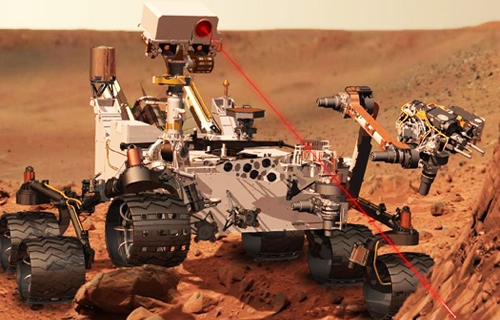
For example, Curiosity made news as its high resolution camera caught an image of sparks being generated as it zapped a Martian rock. In it’s lifetime, the rover has used its million watt Chemistry and Camera (ChemCam) laser to zap over 600 rock or soil targets as part of its mission. However, this was the first time that the rover team was able to get the arm-mounted Mars Hand Lens Imager (MAHLI) to capture the action as it occurred.
The ChemCam laser is used to determine the composition of Martian rocks and soils at a distance of up to 8 meters (25 feet). By hitting targets with several high-energy pulses, it is able to yield preliminary data for the scientists and engineers back at Earth to help them decide if a target warrants a closer investigation and, in rare cases, sampling and drilling activities.
ChemCam works through a process called laser-induced breakdown spectroscopy. The laser hits a target with pulses to generate sparks, whose spectra provide information about which chemical elements are in the target. Successive laser shots are fired in sequence to gradually blast away thin layers of material. Each shot exposes a slightly deeper layer for examination by the ChemCam spectrometer.
As Curiosity fired deeper into the target rock – named “Nova” – it showed an increasing concentration of aluminum as the sequential laser blasts penetrated through the uninteresting dust on the rock’s surface. Silicon and sodium were also detected. As Sylvestre Maurice, ChemCam’s Deputy Principal Investigator at the Research Institute in Astrophysics and Planetology, said in a statement:
This is so exciting! The ChemCam laser has fired more than 150,000 times on Mars, but this is the first time we see the plasma plume that is created… Each time the laser hits a target, the plasma light is caught and analyzed by ChemCam’s spectrometers. What the new images add is confirmation that the size and shape of the spark are what we anticipated under Martian conditions.
During it’s first year on Mars, Curiosity has already accomplished its primary objective of discovering a habitable zone on Mars that contains the minerals necessary to support microbial life billions of years ago when Mars was wetter and warmer. Currently, the rover is driving swiftly to the base of Mount Sharp at the center of Gale Crater, where it hopes to find more.
In that same vein, according to new geological information obtained by Curiosty’s images and soil examinations, samples that were pulled out of a crater that is estimated to be some 3.7 billion years old contain more evidence that Mars was once much warmer and wetter. These findings were announced in a recent paper published in the online edition of Geology by University of Oregon geologist Gregory Retallack.
Unlike Earth, the Martian landscape is littered with loose rocks from impacts or layered by catastrophic floods. However, recent images from Curiosity from the Gale Crater reveal Earth-like soil profiles with cracked surfaces lined with sulfate, ellipsoidal hollows and concentrations of sulfate comparable with soils in Antarctica’s McMurdo Dry Valleys and Chile’s Atacama Desert.
Retallack, the paper’s lone author, studied mineral and chemical data published by researchers closely tied with the Curiosity mission. As a professor of geological sciences and co-director of paleontology research at the UO Museum of Natural and Cultural History, he internationally known as an expert on the recognition of paleosols – ancient fossilized soils contained in rocks.
As he explains in the paper:
The pictures were the first clue, but then all the data really nailed it. The key to this discovery has been the superb chemical and mineral analytical capability of the Curiosity Rover, which is an order of magnitude improvement over earlier generations of rovers. The new data show clear chemical weathering trends, and clay accumulation at the expense of the mineral olivine, as expected in soils on Earth. Phosphorus depletion within the profiles is especially tantalizing, because it attributed to microbial activity on Earth.
The ancient soils do not prove that Mars once contained life, but they do add to growing evidence that an early, wetter and warmer Mars was more habitable than the planet has been in the past 3 billion years. Surface cracks in the deeply buried soils suggest typical soil clods. Vesicular hollows, or rounded holes, and sulfate concentrations, he said, are both features of desert soils on Earth.
Since Curiosity is currently on its way to Mount Sharp, future missions will be needed to fully explore these features. But as Retallack explained, the parallels with Earth are quite exciting:
None of these features is seen in younger surface soils of Mars. The exploration of Mars, like that of other planetary bodies, commonly turns up unexpected discoveries, but it is equally unexpected to discover such familiar ground.
The newly discovered soils indicate that more benign and habitable soil condition existed on Mars than previously expected. What’s more, their dating to 3.7 billion years ago places them within a transition period when the planet went from an early, benign water cycle to the acidic and arid Mars of today. This is especially important since major changes were taking place on Earth at around the same time.
Roughly 3.5 billion years ago, life on Earth is believed to have emerged and began diversifying. But some scientists have theorized that potential evidence that might indicate that life existed on Earth earlier may have been destroyed by tectonic activity, which did not occur on Mars. Basically, it may offer some credence to the theory that while flourished on Earth, it originated on Mars.
One person who supports this theory is Steven Benner of the Westheimer Institute of Science and Technology in Florida. In the past, he has speculated that life is more likely to have originated on a soil planet like Mars than a water planet like Earth. In an email interview with Science Daily, Benner wrote that Retallack’s paper:
[S]hows not only soils that might be direct products of an early Martian life, but also the wet-dry cycles that many models require for the emergence of life.
So in addition to shedding light on the mysteries of Mars, Curiosity has also been pivotal in addressing some major questions which only increase the mystery of our own existence. Did life as we know it originate on Mars but flourish on Earth? Are there still some remnants of this microbial “Eden” being preserved deep within the soil and rocks? And could life exist there again some day?
All good questions that will no doubt keep robotic rovers, orbiters, landers, and even manned missions busy for many decades to come! In the meantime, check out the video from NASA’s Jet Propulsion Laboratory of Curiosity’s spark-generating laser blast being caught on tape:
In the new age of space travel and exploration, commercial space companies are not only boasting immense growth and innovation, but are reaching out to fill niche markets as well. In addition to launchers that can send orbiters and payloads into space, there are also new breeds of commercial satellites, new engines, and a slew of other concepts that promise to make the industry more promising and cost effective.
A case in point is the small satellite launch company Firefly Space Systems, which recently unveiled its planned Alpha launcher. Aimed at the small satellite launch market, it’s designed to launch satellites into low-Earth orbit (LEO) and Sun-synchronous orbits for broadband communication using an unconventional aerospike engine, it is also the first orbital launcher to use methane as fuel.
The Firefly Alpha is a specialized design to launch light satellites at low cost into low Earth Designed to carry payloads of up to 400 kg (880 lb), the Alpha features carbon composite construction and uses the same basic design for both of its two stages to keep down costs and simplify assembly. Methane was chosen because it’s cheap, plentiful, clean-burning and (unlike more conventional fuels) self-pressurizing, so it doesn’t require a second pressurization system.
But the really interesting thing about the two-stage rocket assembly is that the base of the engine is ringed with rocket burners rather than the usual cluster of rocket engines. That’s because, while the second stage uses conventional rocket engines, the first stage uses a more exotic plug-cluster aerospike engine that puts out some 400.3 kN (or 40,800 kg/90,000 lb) of thrust.
Aerospike engines have been under development since the 1960s, but until now they’ve never gotten past the design phase. The idea behind them is that rockets with conventional bell-shaped nozzles are extremely efficient, but only at a particular altitude. Since rockets are generally used to make things go up, this means that an engine that works best at sea level will become less and less efficient as it rises.
The plug aerospike is basically a bell-shaped rocket nozzle that’s been cut in half, then stretched to form a ring with the half-nozzle forming the profile of a plug. This means that the open side of the rocket engine is replaced with the air around it. As the rocket fires, the air pressure keeps the hot gases confined on that side, and as the craft rises, the change in air pressure alters the shape of the “nozzle;” keeping the engine working efficiently.
The result of this arrangement is a lighter rocket engine that works well across a range of altitudes. Because the second stage operates in a near vacuum, it uses conventional rocket nozzles. As Firefly CEO Thomas Markusic put it:
What used to cost hundreds of millions of dollars is rapidly becoming available in the single digit millions. We are offering small satellite customers the launch they need for a fraction of that, around US$8 or 9 million – the lowest cost in the world. It’s far cheaper than the alternatives, without the headaches of a multi manifest launch.
Meanwhile, SpaceX has been making headlines with its latest rounds of launches and tests. About a week ago, the company successfully launched six ORBCOMM advanced telecommunications satellites into orbit to upgrade the speed and capacity of their existing data relay network. The launch from Cape Canaveral Air Force Station in Florida had been delayed or scrubbed several times since the original launch date in May due to varying problems.
However, the launch went off without a hitch on Monday, July 14th, and ORBCOMM reports that all six satellites have been successfully deployed in orbit. SpaceX also used this launch opportunity to try and test the reusability of the Falcon 9′s first stage and its landing system while splashing down in the ocean. However, the booster did not survive the splashdown.
SpaceX CEO Elon Musk tweeted about the event, saying that the:
Rocket booster reentry, landing burn & leg deploy were good, but lost hull integrity right after splashdown (aka kaboom)… Detailed review of rocket telemetry needed to tell if due to initial splashdown or subsequent tip over and body slam.
SpaceX wanted to test the “flyback” ability to the rocket, slowing down the descent of the rocket with thrusters and deploying the landing legs for future launches so the first stage can be re-used. These tests have the booster “landing” in the ocean. The previous test of the landing system was successful, but the choppy seas destroyed the stage and prevented recovery. Today’s “kaboom” makes recovery of even pieces of this booster unlikely.
This is certainly not good news for a company who’s proposal for a reusable rocket system promises to cut costs exponentially and make a whole range of things possible. However, the company is extremely close to making this a full-fledged reality. The take-off, descent, and landing have all been done successfully; but at present, recovery still remains elusive.
But such is the nature of space flight. What begins with conceptions, planning, research and development inevitably ends with trial and error. And much like with the Mercury and Apollo program, those involved have to keep on trying until they get it right. Speaking of which, today marks the 45th anniversary of Apollo 11 reaching the Moon. You can keep track of the updates that recreate the mission in “real-time” over @ReliveApollo11.
As of the writing of this article, the Lunar module is beginning it’s descent to the Moon’s surface. Stay tuned for the historic spacewalk!
Today, July 20th, marks the 45th anniversary of the first step being taken on the Moon. And even though the coming decades may involve astronauts setting foot on Mars or a nearby asteroid, the Moon landing will forever remain one of humanity’s greatest accomplishments. And the many speeches, footage and images associated with the mission remain firmly rooted in public consciousness.
Born during the closing months of the Eisenhower administration as a follow-up to Project Mercury – which successfully put astronauts into orbit – Project Apollo was conceived when spaceflight was still very much in its infancy. However, it was under President Kennedy that the goal of “landing a man on the Moon and returning him safely to the Earth” by the end of the decade truly began.
And though some within NASA were already doing some preliminary planning for a manned mission to the Moon in the late 1950s, there was no hardware that could see the mission fly, no rockets large enough to launch a manned spacecraft all the way to the Moon, and no provisions for managing a program of that magnitude. The men and women who brought the lunar landing to fruition were forced to invent almost everything as they went along.
And in the nine years between President Kennedy promising America the Moon and Neil Armstrong’s small step, NASA developed an unprecedented amount of technology and know-how that continues to shape the way NASA and other space agencies plan and implement missions today. These include the Saturn V multistage rockets, which are currently being refurbished for a manned mission to Mars by 2030.
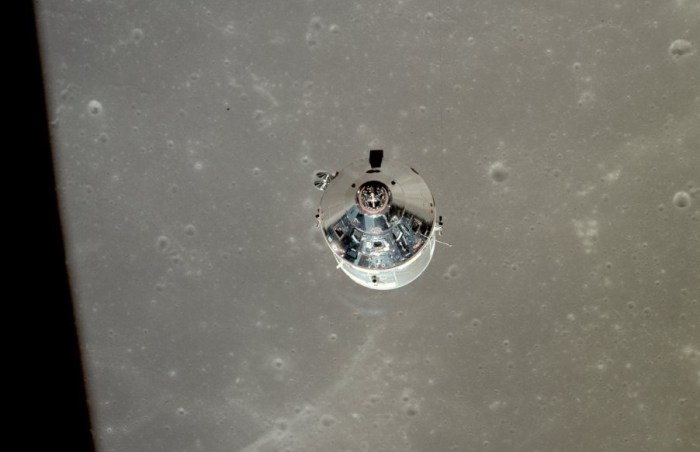
Launching on from Cape Kennedy on the morning of July 16th, 1969, the mission sent Commander Neil Armstrong, Command Module Pilot Michael Collins and Lunar Module Pilot Edwin “Buzz” Aldrin into an initial Earth-orbit. Then, just two hours and 44 minutes after launch, another engines burn put Apollo 11 into a translunar orbit. Four days later, the Lunar Module touched down and the three men – with Armstrong in the lead – stepped onto the Lunar surface.
And for those looking to participate in the anniversary, there are several ways you can participate. On Twitter, @ReliveApollo11 from the Smithsonian National Air and Space Museum is reliving the highlights from Apollo 11 mission to the Moon in “real time”. Also, @NASAHistory is tweeting images and events from the mission, and journalist Amy Shira Teitel (@astVintageSpace) is tweeting pictures, facts and quotes from the mission, again in “real time”.
At 7:39 p.m. PDT (10:39 p.m. EDT), when Armstrong opened began the first spacewalk on the Moon, NASA TV will replay the restored footage of Armstrong and Aldrin’s historic steps on the lunar surface. On Monday, July 21 at 7 a.m. PDT (10 a.m. EDT) NASA TV will be broadcasting live from Kennedy Space Center in Florida, where they will be renaming the center’s Operations and Checkout Building in honor of Armstrong, who passed away in 2012.
The renaming ceremony will include NASA Administrator Charles Bolden, Kennedy Center Director Robert Cabana, Apollo 11′s Collins, Aldrin and astronaut Jim Lovell, who was the mission’s back-up commander. International Space Station NASA astronauts Wiseman and Steve Swanson, who is the current station commander, also will take part in the ceremony from their orbiting laboratory 260 miles above Earth.
On Thursday, July 24 at 3 p.m. PDT (6 p.m. EDT), which is the 45th anniversary of Apollo 11′s return to Earth, the agency will host a panel discussion – called NASA’s Next Giant Leap – from Comic-Con International in San Diego. Moderated by actor Seth Green, the panel includes Aldrin, NASA Planetary Science Division Director Jim Green, JPL systems engineer Bobak Ferdowsi, and NASA astronaut Mike Fincke.
In addition to Aldrin recounting his experiences, Fincke and the other NASA staff are slated to talk about the new Orion space capsule and the Space Launch System rocket – both of which will carry humans on America’s next great adventure in space – and what the future holds for space exploration. These will no doubt include talk of the planned missions to an asteroid, Mars, and quite possibly the construction of a settlement on the Moon.
The NASA.gov website will host features, videos, and historic images and audio clips that highlight the Apollo 11 anniversary, as well as the future of human spaceflight. You can find it all by clicking here. And if you don’t have NASA TV on your cable or satellite feeds, you can catch it all online here. Plenty has been happening already, marking the anniversary of the launch and recapturing the mission in “real-time”.
Forty five years later, and Apollo 11 still holds a special place in our collective hears, minds, and culture. One can only hope that the next generation of astronauts prove as equal to the task as those who made the Moon Landing were. And I’m sure that when they do make history, Neil Armstrong (may he rest in peace) will be watching approvingly.
And be sure to check out this video from Spacecraft Films, showing the entire Apollo 11 mission in 100 seconds:

 A new video was recently posted online that shows North Korean dictator Kim Jong Un breaking out the dance moves, getting pranked, and engaging in some serious fight scenes. The video has gone absolutely viral and has everybody laughing – except for Kim Jong Un himself. In fact, the “Great Leader’s” outrage was such that North Korea made a public statement denouncing the video and demanding it be taken down.
 The reaction is predictable, and the request certainly betrays the North Korean regime’s internet-phobic tendencies, not to mention their ignorance of how the internet actually works. For starters, once something is posted on the internet, it becomes part of the digital ether and can never be destroyed. In addition, drawing attention to an internet phenomenon only makes it stronger! By condemning it, Kim Jong Un’s people just ensured it’s viral nature!


 While they don’t have current plans to take the Casa Futebol beyond the concept stage, it is hoped that the project can inspire more socially-conscious approaches to problems of this kind. Combined with 3-D printed housing and other prefab housing projects, this kind of re-purposing of existing infrastructure is a way of addressing the problem of slums, something which goes far beyond the developing world.

 The next step is to figure out why the body responds to a bone marrow transplant in a way that makes the virus retreat. One possible explanation is that the body’s immune response to the foreign cells of the transplant causes it to fight harder against HIV. This is because, while bone marrow transplant seems to be the most effective means of clearing the AIDS virus to date, it is not an acceptable risk for patients whose lives aren’t already endangered by bone cancer.




 Such ideas did inform Kim Stanley Robinson’s seminal novel Red Mars, where an international crew flew to the Red Planet and established the first human settlement that begins the terraforming process. But if international cooperation proves too difficult, perhaps a collaboration between commercial space agencies and federal ones could work. I can see it now: the Elon Musk Martian Dome; the Richard Branson Habitat; or the Gates colony…
 At the time of the initial announcement in January, Google said its prototypes were able to take one glucose reading per second and that they was investigating ways for the device to act as an early warning system for the wearer should glucose levels become abnormal. All that was needed was a partner with the infrastructure and experience in the medical industry to see the prototypes put into production.


 As Butow explained, it’s all about taking the next step in the development of the internet as we know it:
 More experienced women are encouraged to teach classes, and the Academy already boasts a variety of events, ranging from hackathons, makerfests, code getaways and study tours. The team is already organising the very first study tour, hoping to take Australian women to visit global startup hotspots such as Silicon Valley and Tel Aviv. And though women are the focus, men are welcome too, as long as they attend with a girl geek and are willing to lend a helping hand.
 With all the publicity New Zealand has been getting from the Lord of the Rings and Hobbit franchises, both of which use the scenic land as the setting of Middle Earth, it was only a matter of time before the country’s air carrier began pimping it for all it was worth! Entitled “An Unexpected Briefing”, this safety briefing video is being used by New Zealand Air to both entertain and inform their passengers.















 The NASA.gov website will host features, videos, and historic images and audio clips that highlight the Apollo 11 anniversary, as well as the future of human spaceflight. You can find it all by clicking
  Stories by Williams