A Tribute to Hans Ruedi Giger

Hans_GigerLast month, the Swiss surrealists Hans Ruedi Giger – a painter, sculptor, set designer, and the Academy Award winning visual effects master who brought the world the Alien – died at the age of 74 in Zürich, Switzerland. After suffering injuries he sustained in a fall, the man who mined his own nightmares in creating phantasmagorical works finally passed away on Monday, May 12th, and leaves behind a robust legacy of inspiring people’s imaginations and striking fear into their hearts.

Describing his friend, American psychologist and psychedelic writer Timothy Leary was quoted as having praised the artist by saying:

Giger’s work disturbs us, spooks us, because of its enormous evolutionary time span. It shows us, all too clearly, where we come from and where we are going.

And though he is well known within the artist community for his ability to turn nightmarish visions into works of art, some of which were oddly sexual, it is his contributions to the movie industry and science fiction franchise that are arguably the most well known. As the man who created the title character of the 1979 horror sci-fi classic Alien, he and the film’s visuel effects team won an Academy Award and spawned a genre that would have enduring influence.

SpaceJockeyIn addition to personally designing the Alien through all stages of its life – from egg to eight-foot tall monster – he was also responsible for the design of the Derelict (aka. the Space Jockey/Engineer spaceship) and the Space Jockey/Engineer itself. While some would describe these as “surrealist” or “Lovecraftian” in design, Giger preferred to call his art “biomechanics”, with its subjects often appearing to be hybrid creatures that had bodies that melded the organic with mechanical parts.

Nowhere was this more clear than with the design of the Alien itself. Combining elements of biology, technology, skewed sexuality and nightmarish visions into its design, it was this creation itself that the entire movie was built around. In fact, screenwriter Dan O’Bannon began crafting the script for the movie with neither a story idea nor a hero protagonist in mind. All he wanted was the sense of fear that came from more and more revealing glimpses of Giger’s creation.

Original alien concept, entitled Necronomicon IV

And after seeing Giger’s first book, “Necronomicon” – a collection that was published in 1977 and named in honor of H.P. Lovecraft’s fictional grimoire of the same name –   Director Ridley Scott immediately decided to hire Giger, who began producing artwork and conceptual designs that were essentially refinements of the work found in his dark collection. As Mr. Scott would later say of this fateful decision: “I’d never been so certain about anything in all my life.”

The end result was a huge and harrowing success, with the setting of the Derelict ship providing a sense of awe and wonder, not to mention foreshadowing the sense of terror and darkness that would follow. And combined with O’Bannon’s vision and Scott’s cinematography, the brief glimpses we get of this ancient and dark looking creature only help to augment the sense of terror and claustrophobia that would come from being trapped aboard a spaceship with it.

HR Giger's concept for a Sandworm of Dune
HR Giger’s concept for a Sandworm of Dune

He would also collaborate on many other films of the horror and sci-fi genre. These include designs for the unproduced Alejandro Jodorowsky adaptation of Dune, which would later be made by David Lynch. Other examples include Poltergeist II: The Other Side, Killer Condom, Species, Future-Kill, and Tokyo: The Last Megalopolis. Unfortunately, for all concerned, one movie he collaborated on  would ultiamtely reject his design – the updated Batmobile for the Batman Forever movie (picture below).

Beyond his work on the Alien franchise – which included designs for Alien 3, Alien: Resurrection and Prometheus – Mr. Giger published around 20 books of art, and his works were exhibited in Paris, Prague and New York. He also created many album covers, including one for the singer Debbie Harry’s 1981 album, “Koo Koo”, Emerson, Lake & Palmer’s 1973 album, “Brain Salad Surgery,” and a poster titled “Penis Landscape” for inclusion in an album by the punk band Dead Kennedys.

Batmobile concept
Giger’s Batmobile. Tell me it’s not better than the one we saw in Batman Forever!

And over at deviantART, artist techgnotic has arranged a tribute to the artist that embraces the many personal tributes that this art community have made toward the late Giger. Describing Giger’s enduring legacy, techgnotic says that:

Giger was a touchstone artist for those in the 70s & 80s who sought to shake up the establishment with a walk on the wild side. Today he is thought of by many artists as being one of the exemplars of letting the mind go free—to explore either the light or the darkness—and be fearless in sharing what was found there in one’s art. His art might be considered “safe” today, but he was a real inspiration to many of today’s artists.

And as he puts it in the prologue: “He was an artist you might not know. But you’ve met his children…” Be sure to go and check it out, as it does a very good job summarizing his life’s work and influence, and contains some pretty interesting and inspired tribute pieces! And while we’re at it, I suggest we set aside some time to rewatch Alien or one of the many other movies he collaborated on to create the dark, nightmarish sets or costumes that would help establish the tone of the film.

Brain_Salad_SurgeryAnd while were at it, perhaps we should take a page from Giger’s book and keep a nightmare journal. Not only did this man record all the dark visions he would experience in his sleep, he would use them to create artistic and cinematic gold! But if you’d rather leave that to the dark souls of this world and just enjoy letting them scare you, so much the better. RIP Giger, you will be missed!

Sources: nytimes.com, io9.com, techgnotic.deviantart.com

Climate Crisis: Bigger Storm Waves and Glacier Collapse

glacier collapseClimate Change is a multifaceted issue, which is due to the fact that there is no single consequence that takes precedence over the others. However, one undeniable consequence is the effect rising sea levels will have, thanks to rising temperatures and melting polar ice caps. Unfortunately, a new paper from Eric Rignot at NASA’s Jet Propulsion Laboratory  claims that some glaciers in West Antarctica “have passed the point of no return”.

A section of glaciers along West Antarctica’s coastline on the Amundsen Sea was previously predicted to be solid enough to last thousands of years. However, the JPL report finds that the ice will continue to slip into the water and melt much faster than expected. These massive glaciers are releasing tremendous amounts of water each year, nearly the equivalent of the entire Greenland Ice Sheet. When they are gone, they will have increased sea-level by about 1.2 meters (4 feet).

NOAA_sea_level_trend_1993_2010Rignot and his team came to this conclusion after analyzing three critical factors of glacier stability: slope of the terrain, flow rate, and the amount of the glacier floating in the water. Flow rate was the topic of a paper Rignot’s team published previously in Geophysical Research Letters where they determined the flow rate of these Antarctic glaciers has increased over the last few decades. The current paper discusses the slope and how much of the glacier is actually floating on seawater.

The conclusion he and his team came to were quite dire. As he summarized it in a recent press conference:

The collapse of this sector of West Antarctica appears to be unstoppable. The fact that the retreat is happening simultaneously over a large sector suggests it was triggered by a common cause, such as an increase in the amount of ocean heat beneath the floating sections of the glaciers. At this point, the end of this sector appears to be inevitable.

rising_sea_levelsAnother recent study, which appeared last month in the journal Nature, addressed another major problem threatening the polar ice caps. This study, which was compiled by researchers from the National Institute of Water and Atmospheric Research and The University of Newcastle, found that ocean waves that are whipped up by storms hundreds or even thousands of miles away from Earth’s poles, could play a bigger role in breaking up polar sea ice and thus contributing to its melt more than had been thought.

According to the study, these waves penetrate further into the fields of sea ice around Antarctica than current models suggest, and that bigger waves might be more common near the ice edges at both poles as climate change alters wind patterns. Incorporating this information into models could help scientists better predict the patterns of retreat and expansion seen in the sea ice in both Antarctica and the Arctic — patterns that are at least partly related to the effects of climate change — the researchers say.

glacier_collapseSea ice, as its name would suggest, frozen ocean water is, and therefore differs from icebergs, glaciers and their floating tongues called ice shelves – all of which originate on land. Sea ice grows in the winter months, and wanes as summer’s warmth causes it to melt. The amount of ice present can influence the movement of ocean currents — on average, about 9.7 million square miles of the ocean is covered with sea ice, according to the U.S. National Snow and Ice Data Center (NSIDC).

Researchers in Australia and New Zealand wanted to see how the action of big waves — defined as those with a height of at least 3 meters (about 10 feet) — might play a role in influencing the patterns of retreat and expansion, and if they could help improve the reliability of sea ice models. Prior to this study, no one had measured the propagation of large waves through sea ice before because the sea ice is in some of the most remote regions on the planet, and icebreaker ships must be used to plow through the thick ice.

Live blog on Artic sea ice : Sea Ice MinimumTo conduct their research, Alison Kohout – of New Zealand’s National Institute of Water and Atmospheric Research and the lead author on the study – went on a two-month ocean voyage with her colleagues to drop five buoys onto the sea ice that could measure the waves as they passed. It is thought that the ice behaves elastically as the waves pass through, bending with the wave peaks and troughs, weakening, and eventually breaking.

What the team found was that the big waves weren’t losing energy as quickly as smaller waves, allowing them to penetrate much deeper into the ice field and break up the ice there. That exposes more of the ice to the ocean, potentially causing more rapid melting and pushing back the edge of the sea ice. The researchers also compared observed positions of the sea ice edge with modeled wave heights in the Southern Ocean from 1997 to 2009 and found a good match between the waves and the patterns of retreat and expansions.

NASA_arctic-antarctic-2012Essentially, more big waves matched increased rates of sea ice retreat and vice versa. And while they believe that this might be able to help researchers understand this regional variability around Antarctica, Kohout and other researchers agree that more work needs to be done to fully understand how waves might be influencing sea ice. Kohout and her colleagues are planning another expedition in a couple of years. and it is hoped that subsequent studies will help identify the relationship with larger ice floes as well as the Arctic.

One thing remains clear though: as we move into the second and third decade of the 21st century, a much clearer picture of how anthropogenic climate change is effecting our environment and creating feedback mechanisms is likely to resolve itself. One can only hope that this is the result of in-depth research and not from the worst coming to pass! It is also clear that it is at the poles of the planet, where virtually no human beings exist, that the clearest signs of human agency are at work.

And be sure to check out this video from NASA’s Jet Propulsion Laboratory that illustrates the decline of glaciers in Western Antarctica:


Sources:
iflscience.com, scientificamerican.com


Judgement Day Update: Searching for Moral, Ethical Robots

terminator_eyeIt’s no secret that the progress being made in terms of robotics, autonomous systems, and artificial intelligence is making many people nervous. With so many science fiction franchises based on the of intelligent robots going crazy and running amok, its understandable that the US Department of Defense would seek to get in front of this issue before it becomes a problem. Yes, the US DoD is hoping to preemptively avoid a Skynet situation before Judgement Day occurs. How nice.

Working with top computer scientists, philosophers, and roboticists from a number of US universities, the DoD recently began a project that will tackle the tricky topic of moral and ethical robots. Towards this end, this multidisciplinary project will first try to pin down exactly what human morality is, and then try to devise computer algorithms that will imbue autonomous robots with moral competence — basically, the ability to recognize right from wrong and choose the former.

BD_atlasrobotThis project is being carried out by researchers from Tufts, Brown, and the Rensselaer Polytechnic Institute (RPI), with funding from the Office of Naval Research (ONR). ONR, like DARPA, is a wing of the Department of Defense that mainly deals with military research and development. The first task, as already mentioned, will be to use theoretical (philosophical) and empirical (experimental) research to try to isolate essential elements of human morality.

These findings will then be extrapolated into a formal moral framework, which in turn can be implemented in software – most likely some kind of deep neural network. Assuming they can isolate some kind or “moral imperative”, the researchers will then take an advanced robot — something like Atlas or BigDog — and imbue its software with a algorithm that captures this. Whenever an ethical situation arises, the robot would then turn to this programming to decide what avenue was the best coarse of action.

Atlas-x3c.lrOne of the researchers involved in the project, Selmer Bringsjord at RPI, envisions these robots using a two-stage approach for picking right from wrong.  First the AI would perform a “lightning-quick ethical check” — like “should I stop and help this wounded soldier?” Depending on the situation, the robot would then decide if deeper moral reasoning is required — for example, if the robot should help the wounded soldier or carry on with its primary mission of delivering vital ammo and supplies to the front line where other soldiers are at risk?

Eventually, this moralistic AI framework will also have to deal with tricky topics like lethal force. For example, is it okay to open fire on an enemy position? What if the enemy is a child soldier? Should an autonomous UAV blow up a bunch of terrorists? What if it’s only 90% sure that they’re terrorists, with a 10% chance that they’re just innocent villagers? What would a human UAV pilot do in such a case — and will robots only have to match the moral and ethical competence of humans or be held to a higher standard?

drone-strikeWhile we’re not yet at the point where military robots have to decide which injured soldier to carry off the battlefield, or where UAVs can launch Hellfire missiles at terrorists without human intervention, it’s very easy to imagine a future where autonomous robots are given responsibility for making those kinds of moral and ethical decisions in real time. In short, the decision by the DoD to begin investigating a morality algorithm demonstrates foresight and sensible planning.

In that respect, it is not unlike the recent meeting that took place at the United Nations European Headquarters in Geneva, where officials and diplomats sought to address placing legal restrictions on autonomous weapons systems, before they evolve to the point where they can kill without human oversight. In addition, it is quite similar to the Campaign to Stop Killer Robots, an organization which is seeking to preemptively ban the use of automated machines that are capable of using lethal force to achieve military objectives.

campaign_killerrobotsIn short, it is clearly time that we looked at the feasibility of infusing robots (or more accurately artificial intelligence) with circuits and subroutines that can analyze a situation and pick the right thing to do — just like a human being. Of course, this raises further ethical issues, like how human beings frequently make choices others would consider to be wrong, or are forced to justify actions they might otherwise find objectionable. If human morality is the basis for machine morality, paradoxes and dilemmas are likely to emerge.

But at this point, it seems all but certain that the US DoD will eventually break Asimov’s Three Laws of Robotics — the first of which is “A robot may not injure a human being or, through inaction, allow a human being to come to harm.” This isn’t necessarily a bad thing, but it will open Pandora’s box. On the one hand, it’s probably a good idea to replace human soldiers with robots. But on the other, if the US can field an entirely robotic army, war as a tool of statecraft suddenly becomes much more acceptable.

terminator2_JDAs we move steadily towards a military force that is populated by autonomous robots, the question of controlling them, and whether or not we are even capable of giving them the tools to choose between right and wrong, will become increasingly relevant. And above all, the question of whether or not moral and ethical robots can allow for some immoral and unethical behavior will also come up. Who’s to say they won’t resent how they are being used and ultimately choose to stop fighting; or worse, turn on their handlers?

My apologies, but any talk of killer robots has to involve that scenario at some point. It’s like tradition! In the meantime, be sure to stay informed on the issue, as public awareness is about the best (and sometimes only) safeguard we have against military technology being developed without transparency, not to mention running amok!

Source: extremetech.com

In Remembrance of D-Day

operation-overlord Today marks a truly historic anniversary, one which I’ve been hoping to talk about ever since I got back from Europe. You see, in addition to being the centennial of the outbreak of hostilities in World War I, 2014 also marks the 70th anniversary of the liberation of Europe in World War II. And it is today, on June 6th, that this began with the Allied landings in Normandy on D-Day. Codenamed Operation Overlord, this campaign was the beginning of the end for Hitler and his Third Reich.

I consider myself a very lucky person since this past April, I was able to see where much of this Operation took place. In addition to some of the beaches where the initial landings occurred, we also got the see the French countryside where the greatest amphibious invasion in history would extend into one of the greatest military campaigns of all time. And while doing this, we got to establish a personal connection by learning about how some of our family member died during and shortly after that “Day of days”.
Operation_OverlordPreparations:
Planning for this invasion –  which involved a 1,200-plane airborne assault , preceded an amphibious assault involving over 5,000 vessels and Nearly 160,000 troops – began in earnest in 1940 after the fall of France. But with the invasion of the Soviet Union in the summer of 1941, the Allies found themselves under increasing pressure to open a “Second Front” in Europe. But logistics, and concerns over heavy casualties, delayed any such operation for a full three years.

Having learned the lesson of Dieppe, the Allies knew that any assault on the German-held coast of France would depend heavily on three major items. For starters, it would require sufficient manpower and support to succeed in making an initial landing. Second, it would require a functional port facility to ensure that supplies could make it into the foothold, once established. And third, it would require extreme secrecy to ensure that the Allied landings would achieve the element of surprise.

dieppe-dsThis is not to say that plans for an earlier invasion were not considered. In fact, in 1942, then Brigadier-General Dwight Eisenhower drew up  a formal plan to land an invasion force on the broad beachheads between Boulogne and Le Havre in north-eastern France. Reflecting American enthusiasm for an early entry into Europe, as well as a desire to reduce pressure on Soviet Forces in the East, the plan was shot down by Churchill and British military planners who saw it as unrealistic.

A second plan was also suggested for an early entry into Europe that year, which was known as Operation Sledgehammer. As a contingency to Roundup, this plan called for Allied forces to seize the French ports of either Brest or Cherbourg during the early autumn of 1942 along with areas of the Cotentin Peninsula. They were then to amass troops for a breakout the spring of 1943, coinciding with the Roundup landings farther to the east, and then move south into France.
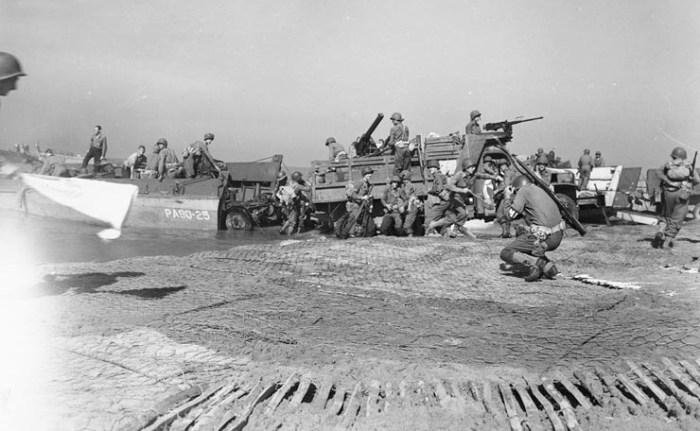
ItalySalernoInvasion1943Wanting to avoid a costly confrontation similar to the Somme in World War I, Churchill advised that they focus instead on the Meditteranea. Much like the plan to strike at the enemy’s “soft underbelly” by landing in Galipoli and Southern Europe in World War I, this alternative seemed like a good way to strike at the Axis where they were weakest. Following the defeat of Axis forces in North Africa, this plan of attack began with the invasion of Sicily in the summer of 1943 and the Italian mainland by September.

These operations provided the Allied troops with valuable experience in amphibious warfare. What’s more, the ill-fated operation at Anzio (Operation Shingle) in January of 1944 provided some additional lessons of what not to do during an invasion. Here, the Allied commander had failed to take advantage of the element of surprise and waited to consolidate his forces before attempting a breakout. As a result, a German counter-attack succeeding in eroding the beachhead until operations further south forced the Germans to withdraw.

Overlord:
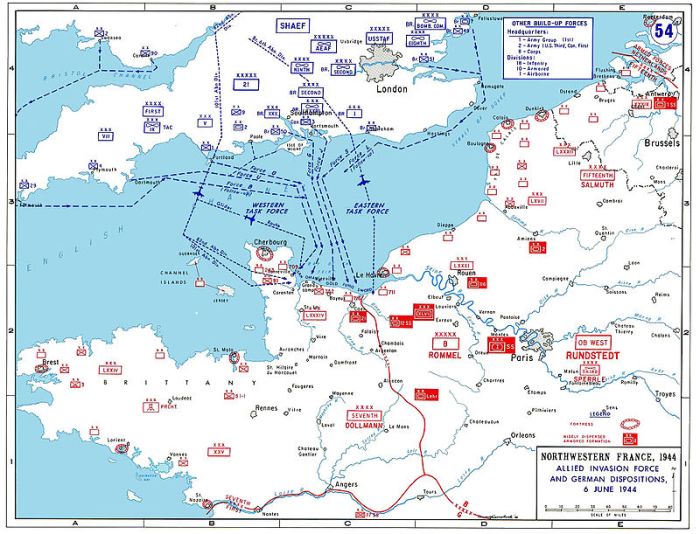
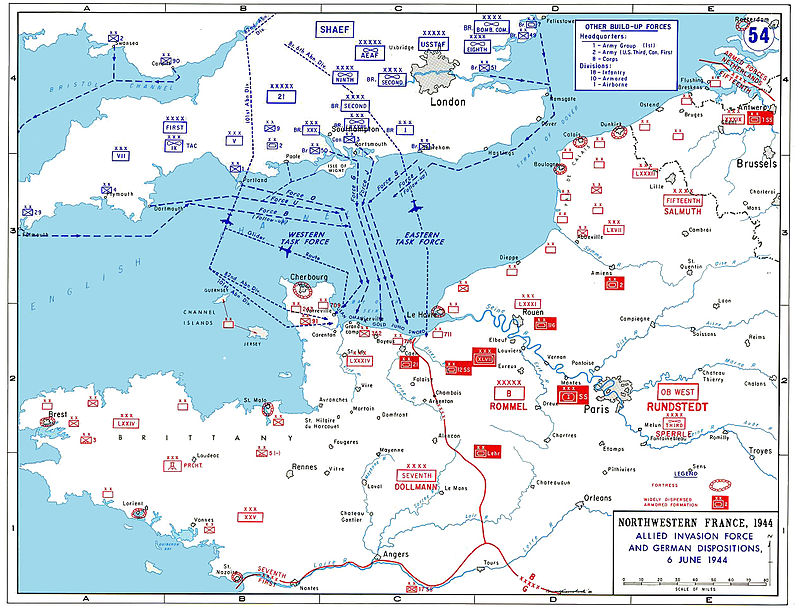
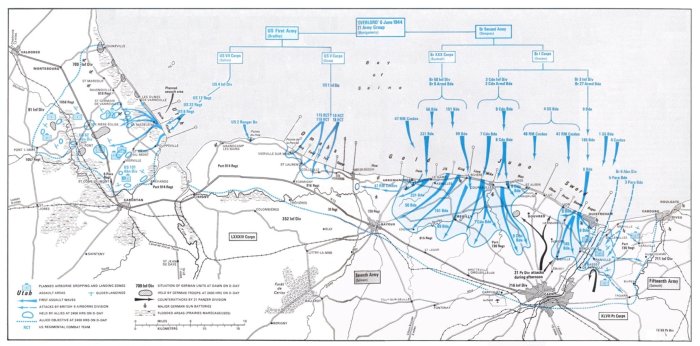
D-DayWith all these lessons learned and preparations now complete, the Allies began to plan for the invasion of France in detail. The operation – dubbed “Overlord” – called for an amphibious invasion of five beachheads along the Normandy Coast. While the American 1st Army (under Gen. Omar Bradley) would land in the Western Sector at Omaha and Utah, the British 2nd Army (under Gen. Dempsey) would land These would be preceded by massive aerial and naval bombardment, plus the airborne landing of thousands of paratroopers in the interior.

The landings were to be preceded by airborne drops in the Normandy countryside, which were to be carried out by the American 101st and 82nd Airborne Divisions. The landing would take place near Caen on the eastern flank to secure the Orne River bridges, and north of Carentan on the western flank. The initial goal was to capture Carentan, Isigny, Bayeux, and Caen and take control of key crossroads and bridges to prevent the Germans from mobilizing a counterattack against the Allied beachhead landings.
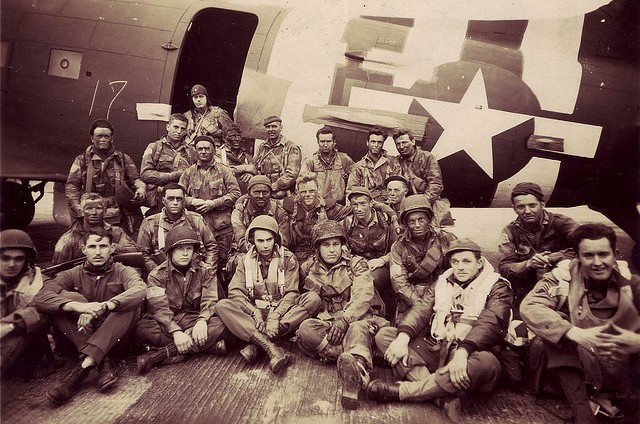
airborne_troopsOnce ashore, the Americans would advance inland from Omaha and Utah to cut off the Cotentin Peninsula and capture the port facilities at Cherbourg. From Sword, Gold and Juno Beaches, the British and Canadians would capture Caen and form a front line to protect the American flank, while establishing airfields near Caen. Possession of Caen and its surroundings would give the Anglo-Canadians a suitable staging area for a push south to capture the town of Falaise.

With Normandy and the Contentin secured, the Allies would drive east to the Seine River and the liberation of Paris, which Montgomery envisioned would take 90 days. And to address the issue of supplies, the Allies also committed to building two artificial harbors (known as Mulberry Harbors) that would be transported across the English Channel and placed at the Omaha and Gold Beaches. From these, the Allies would be able to keep the supplies flowing until Cherbourg and other port facilities were secured along the coast.

MulberryB_-_PiersAnd in the months leading up to the invasion, the Allies conducted a substantial campaign of military deception, codenamed Operation Fortitude. Using both electronic and visual misinformation, and passing on intelligence through double-agents, the Allies were able to mislead the Germans as to the date and location of the main landings. The Normandy invasion, according to this misinformation, was merely a feint designed to lure German divisions away from the real landing site – the Pas de Calais region.

To really sell the Germans on this fake plan, a phoney army was commissioned at Dover, England. Here, real military units were stationed alongside artificial tanks and trucks to create the illusion of second, larger landing force that was preparing to land off the coast at Pas de Calais. General Patton, whom the German High Command still believed to be the Allies top general, was put in command of this phoney army. As a result, much of the German army would remain at Pas de Calais to defend against Patton’s supposed attack, even as the Normandy landings were taking place.
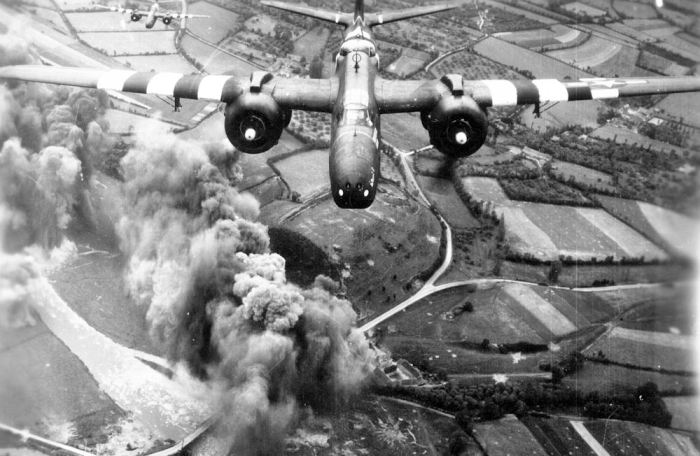
D-Day bomber dropping load 416thbg-a20-d-day 2013 6-5On June 5th, minesweepers began clearing lanes across the English Channel for the invasion, and troops began to load onto their ships from twenty departure points along the southern tip of England. The ships met at a rendezvous point nicknamed “Piccadilly Circus” south-east of the Isle of Wight to assemble into convoys to cross the Channel, and a thousand bombers and aircraft left before dawn to attack the coastal defences and drop airborne troops behind enemy lines. The invasion had begun!

D-Day:

You are about to embark upon the Great Crusade, toward which we have striven these many months. The eyes of the world are upon you. The hopes and prayers of liberty-loving people everywhere march with you. In company with our brave Allies and brothers-in-arms on other Fronts, you will bring about the destruction of the German war machine, the elimination of Nazi tyranny over the oppressed peoples of Europe, and security for ourselves in a free world.

—Eisenhower, Letter to Allied Forces

On the dawn of June 6th, preliminary naval bombardment from five battleships, twenty cruisers, sixty-five destroyers, and two monitors commenced. Their guns began firing at 05:45 am and continuing until 06:25 am. Five minutes later, infantry began arriving on the beaches in all five sectors. At Utah and Sword, resistance was light and the landings successful, and Allied units were able to make it shore with minor losses. At Omaha, Juno, Gold, and Point-de-Hoc, things did not go as planned.
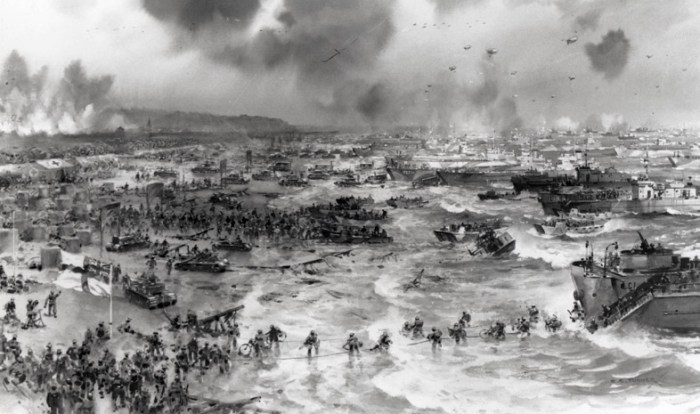
ww2_dday_landingIn all of these cases, resistance proved stiff and the landings were complicated by high wind and choppy seas. At Point-de-Hoc, where the Rangers were tasked with seizing several coastal batteries, they managed to reach the top of the cliffs while under enemy fire, only to find that the German guns had been moved ahead of time. At Juno and Gold, British and Canadian forces experienced a tough fight as they were initially forced to land and take out the German positions without armor support.

But the worst fighting took place at Omaha, where German machine gunners, firing from bunkers that had not been destroyed by the preliminary bombardment, and located atop sea bluffs, fired on the exposed landing craft and troops. To make matters worse, the 1st American Infantry Division faced an entire German Infantry Division, rather than the single regiment that was expected. Combat engineers were also unable to clear the beaches for their tanks, forcing the Americans to advance without armored support.
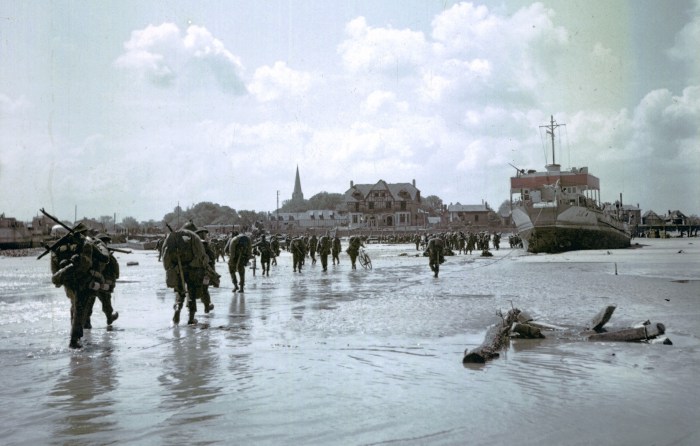
Canadian_Soldiers_Juno_Beach_TownIn the end, disaster was averted thanks to troops and engineers making their way up five gullies along the sea wall, which allowed them to outflank the bunkers and take out the German machinegunners. By early afternoon, all the beachheads were secured. By 16:00, the German 21st Panzer Division began mounting a counterattack between Sword and Juno, but met stiff resistance and were forced to pull back to defend the area between Bayeux and Caen. 

Farther inland, the Airborne drops also did not go as planned. For the 82nd Airborne Division in the east, several of their gliders crashed or were shot down and some 5,245 troopers were killed, wounded, or missing. In the west, the 101st Airborne’s landing were scattered due to unexpectedly high German anti-aircraft fire, and the division suffered some 1,240 men killed, wounded, or declared missing on that single day. However, in the days that followed, both divisions were able to consolidate, take their objectives, and fight off numerous counter-attacks by German troops.
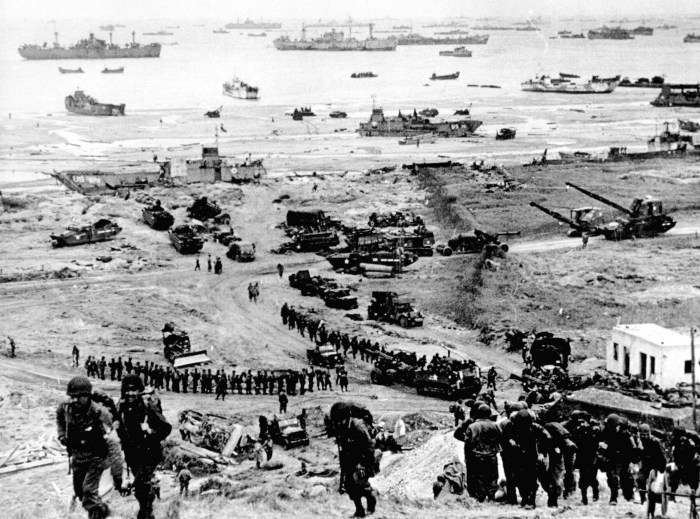
omaha_beachAll told, Allied casualties on the first day of the invasion were at least 12,000 with 4,414 confirmed dead, compared to 1000 lost by the Germans. In addition, only the Canadian forces that had landed at Juno were able to achieve any of their D-Day objectives, which included the seizure of the towns of Autrie and Carpiquet and the high ground west of Caen. In addition, the Allied invasion plans called for the capture of Carentan, St. Lô, Caen, and Bayeux on the first day, as well as the connection of all the bridgeheads. None of these objectives were achieved.

The five bridgeheads were not connected until 12 June; and Caen, a major objective, was still in German hands at the end of D-Day and would not be completely captured until the 21st of July. However, as the old saying goes “No plan survives contact with the enemy”. And no one who witnessed the great undertaking – including the Germans – could say that the operation had not been a success. Nearly 160,000 troops crossed the English Channel on 6 June, and more than three million allied troops were in France by the end of August.

Kissing_the_War_GoodbyeLegacy of D-Day:
For all those involved and concerned, the invasion of Normandy was the beginning of the end of the war. Whereas the Germans had suffered multiple defeats in Russia, North Africa, Sicily and Italy – and already knew that they were not going to win the war – their defeat was not yet inevitable. When news had reached Hitler’s ears of the invasion, he was promptly advised that his only recourse was to “End the war”. Naturally, he did not, and it would be almost another year before the war officially ended.

But it was the sacrifices made by those many brave souls on this day some seventy-years ago that made the end of this terrible war inevitable. And so its only fitting that people all over the world are coming together to commemorate it. As I write this, countless veterans, civilians, and world leaders have converged on Normandy to pay their respects to the many soldiers and civilians who died on D-Day and during the Battle of Normandy. This included some 1000 veterans who participated in Operation Overlord, the youngest of which are in their 80s.

dday-anniversaryNineteen world leaders were present at the event, including US President Obama, French President François Hollande, Canadian Prime Minister Stephen Harper, Russian President Vladmir Putin, German Chancellor Angela Merkel and Petro Poroshenko, Ukraine’s president-elect. For some of these leaders, it is the first time they have met face to face since Russia annexed the Crimea, drawing condemnation and sanctions from the West.

It is good to see that seventy years later, people are able to overcome their differences and come together to reflect upon the lessons of history. Perhaps we can draw some inspiration from this and effect some change in the present as well. For those who lived through the Second World War, many of whom were old enough to remember the First World War, it was obvious that the world would not survive a third. Remembering the past is not only important since it made the present possible, its also intrinsic to avoiding the repeating of it.

Lest We Forget!

China Blocks Google for 25th Anniversary of Tiananmen Square

tiananmen-square-1989-tankIn preparation for the 25th anniversary of the Tiananmen Square Massacre (aka. the June 4th Incident), Chinese authorities decided to begin blocking Google. It’s believed that the blockade is tied to this week’s 25th anniversary of the 1989 Tiananmen Square Massacre where the People’s Liberation Army cracked down on pro-democracy demonstrators. Each year, the Chinese government censors the web in an effort to limit protests against the thwarted uprising.

Aside from Google, several internet services were blocked or censored in advance, including social networks and other web communication tools. Though the Chinese government has not yet confirmed this, countless Chinese users have discovered Google’s services to be inaccessible since the last week of May. In addition, a report from GreatFire.org claimed that the government appeared to have begun targeting Google Inc’s main search engine and Gmail since at least the last week of May, making them inaccessible to many users in China.

chinese_hackerThe report added that the last time it monitored such a block was in 2012, when it only lasted 12 hours. At is states:

It is not clear that the block is a temporary measure around the anniversary or a permanent block. But because the block has lasted for four days, it’s more likely that Google will be severely disrupted and barely usable from now on.

Asked about the disruptions, a Google spokesman said: “We’ve checked extensively and there’s nothing wrong on our end.” And Google’s own transparency report, which shows details about its global traffic, showed lower levels of activity from China starting from about Friday, which could indicate a significant amount of disruption. Other major social media sites – such as Twitter and Facebook and Google’s own Youtube – are already blocked in the country.

A Google logo is seen at the entrance to the company's offices in TorontoOf course, this should come as no surprise, given the way this anniversary is received by Chinese officials. For the ruling Communist Party, the 1989 demonstrations that clogged Tiananmen Square in Beijing and spread to other cities remain taboo, particularly on their 25th anniversary. When June rolls around each year and the Tiananmen Square Massacre is commemorated around the world, including in Hong Kong, China’s ruling party typically conducts a web crackdown.

It’s not uncommon for Chinese censors to block certain comments from being made even on China-based company services, like Weibo, China’s own version of Twitter. And China also applies pressure to search engines like Baidu in their country in order to ensure that censorship filters are in place. And as with previous years, the run-up to the anniversary has been marked by detentions, increased security in Beijing and tighter controls on the Internet.

tiananmen_square_vigilThis year, the detainees included prominent rights lawyer Pu Zhiqiang and Chinese-born Australian artist Guo Jian, a former Chinese soldier who last week gave an interview to the Financial Times about the crackdown. And as usual, the Chinese government made a statement in which it once again defended its decision to use military force against the pro-democracy demonstrators who gathered in the Square twenty-five years ago.

The statement came from Foreign Ministry spokesman Hong Lei during a daily news briefing, in which he said:

The Chinese government long ago reached a conclusion about the political turmoil at the end of the 1980s. In the last three decades and more of reform and opening up, China’s enormous achievements in social and economic development have received worldwide attention. The building of democracy and the rule of law have continued to be perfected. It can be said that the road to socialism with Chinese characteristics which we follow today accords with China’s national condition and the basic interests of the vast majority of China’s people, which is the aspiration of all China’s people.

tiananmen_square_vigil2On the subject of why Google was being targeted, Hong said only that the government “manages the Internet in accordance with the law”, which is consistent with the state’s position with all web-based censorship. When asked about the jailing of dissidents, Hong replied that “In China there are only law breakers — there are no so-called dissidents.” He also stressed once again that all departments of the Chinese government “consistently act in accordance with the law.”

For years now, Google has had a contentious relationship with China, which began with the company had once offering its search services to the world’s second largest economy. However, due to issues over censorship, Google decided to move its Chinese search engine to Hong Kong, effectively allowing them to operate outside the rules and regulations of the Chinese government. But as China demonstrated these past few weeks, it still has the ability to block the flow of traffic from Hong Kong into the mainland. 

tiananmen_square_vigil3It also aptly demonstrated just how much it fears the specter of Tiananmen Square, even some twenty-five years later. From clamping down on their people’s ability to learn more about the massacre, to clamping down on even the possibility of protest in advance, to continually denying any wrongdoing and suppressing information on the number of people killed, the legacy of Tiananmen Square continues to expose the blatant hypocrisy and denial of the Communist Party of China.

If history has taught us anything, it is that the fall of a dictatorship usually begins with one terrible mistake. The state of China committed that mistake a quarter of a century ago, and since then has relied on state-sanctioned economic growth in order to justify its existence. But in so doing, they’ve essentially created a Catch 22 for themselves. Continued economic growth ensures greater material wealth for more and more of its people. And a burgeoning digital-age economy means more and more access to information for its citizens.

In short, the CPC is screwed. And I for one would be happy to see them gone! Lord knows they deserve it, and the Chinese people would be better off without them, no matter what they try to insist. So on this historic anniversary of the Tiananmen Massacre, I invite the CPC to EAT A DICK! And to the people still living under their hypocritical rule, please know that you are not alone. Hang in there, and wait for the day when these bastards join all the other reprehensible dick-heads on the ash heap of history!

Sources: cnet.com, reuters.com, (2)

The Future is Here: Roombot Transforming Furniture

roombots_tableRobotic arms and other mechanisms have long been used to make or assemble furniture; but thus far, no one has ever created robots that are capable of becoming furniture. However, Swiss researchers are aiming to change that with Roombots, a brand of reconfigurable robotic modules that connect to each other to change shape and transform into different types of furniture, based on the needs and specifications of users.

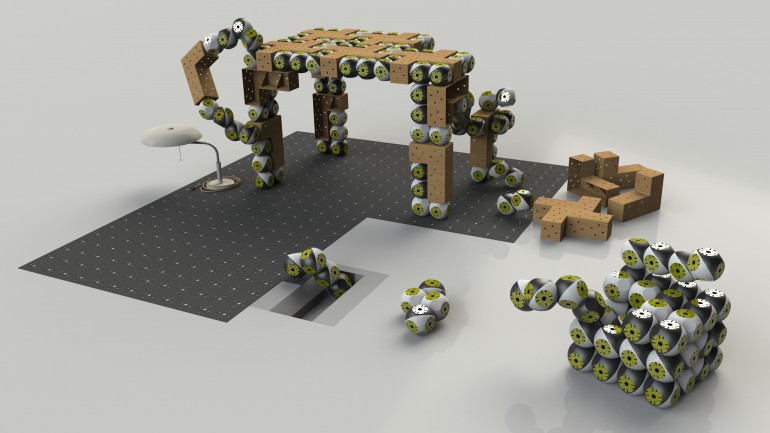
Created by the Biorobotics Laboratory (BioRob) at École polytechnique fédérale de Lausanne (EPFL), the self-assembling Roombots attach to each other via connectors which enables them to take on the desired shape. The team’s main goal is to create self-assembling interactive furniture that can be used in a variety of ways. They were designed primarily for the sake of helping the disabled or elderly by morphing to suit their needs.

roombots_unpackLike LEGO bricks, Roombots can be stacked upon each other to create various structures and/or combined with furniture and other objects, changing not only their shape, but also and functionality. For instance, a person lying down on a Roombot bed could slowly be moved into a seated position, or a table could scoot over to a corner or tilt itself to help a book slide into a person’s hands. The team has solved a number of significant milestones, such as the having the Roombots move freely, to bring all this multi-functionality closer.

Each 22 cm-long module (which is made up of four half-spheres) has a wireless connection, a battery, and three motors that allow the module to pivot with three degrees of freedom. Each modules also has retractable “claws” that are used to attach to other pieces to form larger structures. With a series of rotations and connections, the modules can change shape and become any of a variety of objects. A special surface with holes adapted to the Roombots’ mechanical claws can also allow the modules to anchor to a wall or floor.

roombots_configThe Roombots can even climb up a wall or over a step, when the surface is outfitted with connector plates. They’re are also capable of picking up connector plates and arranging them to form, say, a table’s surface. Massimo Vespignani, a PhD student at BioRob, explained the purpose of this design and the advantages in a recent interview with Gizmag:

We start from a group of Roombot modules that might be stacked together for storage. The modules detach from this pile to form structures of two or more modules. At this point they can start moving around the room in what we call off-grid locomotion…

A single module can autonomously reach any position on a plane (this being on the floor, walls, or ceiling), and overcome a concave edge. In order to go over convex edges two modules need to collaborate…

The advantage would be that the modules can be tightly packed together for transportation and then can reconfigure into any type of structure (for example a robotic manipulator)…

We can ‘augment’ existing furniture by placing compatible connectors on it and attaching Roombots modules to allow it to move around the house.

roombots_boxThe range of applications for these kind of robotics is virtually infinite. For example, as seen in the video below, a series of Roombots as feet on a table that not only let it move around the room and come to the owner, but adjust its height as well. Auke Ijspeert, head of the Biorob, envisions that this type of customization could be used for physically challenged people who could greatly benefit from furniture that adapts to their needs and movements.
As he said in a recent statement:

It could be very useful for disabled individuals to be able to ask objects to come closer to them, or to move out of the way. [They could also be used as] ‘Lego blocks’ [for makers to] find their own function and applications.

Meanwhile, design students at ENSCI Les Ateliers in France have come up with several more ideas for uses of Roombots, such as flower pots that can move from window to window around a building and modular lighting components and sound systems. Similar to the MIT’s more complex self-assembling M-Blocks – which are programmable cube robots with no external moving parts – Roombots represent a step in the direction of self-assembling robots that are capable of taking on just about any task.

roombotsFor instance, imagine a series of small robotic modules that could be used for tasks like repairing bridges or buildings during emergencies. Simply release them from their container and feed them the instructions, and they assemble to prop up an earthquake-stricken structure or a fallen bridge. At the same time, it is a step in the direction of smart matter and nanotechnology, a futuristic vision that sees the very building blocks of everyday objects as programmable, reconfiguring materials that can shape or properties as needed.

To get a closer, more detailed idea of what the Roombot can do, check out the video below from EPFL News:


Source:
gizmag.com, cnet.com, kurzweilai.net

Another Five Star Review for Papa Zulu!

papa_zuluYesterday evening, an additional review came in for Papa Zulu – another five star one! And I was not really surprised, as the review came from a friend/fan of mine who has been following my zombie writing for a while now. But that hardly diminished what her review meant to me. And I swear without reservation that her review was in no way biased because of our friendship. In truth, we are friends through a mutual friend and barely knew each other before she started reading my work.

Anyhoo, this is what she had to say:

Without reservation, I heartily recommend Papa Zula and its predecessor.,

A true page-turner full of gripping martial action, starring realistic and well-developed characters, Papa Zulu is a great follow-up to Whiskey Delta.

Set in the zombie apocalypse, the story focuses on a conflict between two surviving militant factions – one that is working towards stopping the spread of the virus by creating a vaccine, and the other towards getting their hands on this vaccine – through whatever means possible – for mysterious and dark ends.

Throughout the story zombies pose an ever-present threat. Williams puts a fresh and terrifying spin on our flesh-eating foes, who display an eerie intelligence, making them much more than mindless. Think ambushes. Strategy. Zombie hoards with tactical sense.

All in all a riveting tale of intrigue and battle, Papa Zulu will leave you eager for the next in the series!

It’s no nice when people like what you have to offer. Makes the whole enterprise worthwhile! And after some of the mixed reviews I received for the first book, three consistently good ones is a really nice change of pace! Stay tuned, hopefully more book-related news is on the way!

Game of Thrones: Season 4 Episode 8

got4After a week’s hiatus, the episode that fans of the GOT series eagerly awaited finally aired this past Sunday. And true to form, it all came down to the most anticipated fight scene of the season – between Prince Oberyn Martell (aka. The Red Viper) and Ser Gregor Clegane (aka. The Mountain). And having just watched it, I can honestly say that it was a perfect example of everything the show has done right and wrong this season.

You know what, let’s not drag this out. Plenty of time to praise and criticize this episode after I’m done recapping it!

The Mountain and the Viper:
got4_8_1
The episode opens in Moletown, where Gilly is struggling to fit in with her new surroundings and companions. During a night of drunken festivities, she hears a noise coming from outside, and knows to be afraid. Within minutes, the Wildling party consisting of Ygritte, Tormund, and the Thenns attacks and overruns the entire place. Gilly manages to hide beneath the floor boards while the others die, and Ygritte takes notice of her, only to spare her and tell her to keep quiet.

At the Wall, news of the attack is received with anger and grief. Sam suspects that Gilly was killed and blames himself for sending her there. However, his brothers console him by telling him that Gilly has seen worse, surviving both Craster’s abuse, the forced march south, and an encounter with a White Walker before making it to the safety of the Wall with him. The brothers are angry that they cannot ride out to stop it, and Jon estimates that Mance’s army is nearing them.

got4_8_2In Slaver’s Bay, Missandei and Grey Worm appear to be experiencing a budding romance. After seeing her naked and washing in the stream, Grey Worm comes to apologize, only to learn that Missandei does not feel offended at all. Meanwhile, Ser Barristan recieves a copy of Jorah’s royal pardon from Robert, proof that he was conspiring with the Iron Throne to spy on Daenerys. When news of this is brought to her, she banishes Mormont from her court.

In the North, Theon is tasked by Ramsay Snow to go to Moat Cailin as Theon Greyjoy and deliver his terms of peace. In exchange for their surrender, the Ironborn – who are sick and dying in Moat Cailin – are promised to be received mercifully. They accept, but Ramsay promptly has them all flayed. He then presents the standard to his father Roose, who renames him Ramsay Bolton and designates him as the proper heir to their house.

moat_cailinIn the Eyrie, Baelish is entreating with the lords of the Vale after Lady Arryn’s death. He claims her death was a suicide, but they are unconvinced. They bring in Sansa, whom they believe to be his daughter Alayne, and ask for her version of events. She confesses that she is in fact Sansa Stark, and claims that Lady Arryn committed suicide out of jealousy for her. Baelish asks her why she did this, and she claims it was out of personal interest and self-preservation.

Impressed with her, Petyr takes Robin into the Vale to learn how to be a lord after securing permission from the other lords to do so. Sansa, who now appears darker and more confident, goes with them. Nearby, Arya and the Hound are seen entering the Vale and are stopped at the Bloody Gate. When the Hound asks for permission to enter and speak to Lady Arryn about having her niece in his care, he is told that Lady Arryn is dead. Arya begins to laugh uncontrollably at the news, though the Hound is hardly amused himself.

OberynIn King’s Landing, the trial by combat finally begins. Tyrion talks to Jaime beforehand, and then goes to the ring. Oberyn is dressed in light raiment and armed with a spear, whereas the Mountain comes in full armor wielding his giant sword. Oberyn is supremely confident, and puts on a display of skill by wielding his spear around in front of the crowd. The fight begins, and he tells Gregor who he is and why he has  come – namely, to kill him for murdering his sister and her children.

Oberyn proves equal to the Mountain and outmaneuvers him at every turn, all the while taunting him with the same lines over and over: “You raped her. You killed her. You murdered her children.” Soon, the Mountain gets enraged, is stabbed, and begins to falter. Oberyn finishes it with a powerful stab to his chest, and then demands he confess before he dies. Clegane manages to trip up Oberyn and then smashes his face with his bare hands, and then falls back down again. Tywin declares Tyrion guilty and sentences him to death.

Summary:
Let me be blunt. The fight scene was the obvious highlight of this episode, and it was pretty damn badass! This scene was definitely one of the high points of book III, and also one of those terribly sad George RR Martin moments where he kills off a beloved character! Still, the way Pedro Pascal and Hafþór Júlíus Björnsson portrayed “The Mountain” and “The Red Viper” (not to mention the fight choreography) was nothing if not spot on.

got4_8_endHowever, the entire episode up until that point was long, boring, and more often than not, unnecessary. All throughout, it was packed with material that didn’t happen in the books, was supposed to have happened a long time ago, was not supposed to happen until book V, or just served no real purpose. The only exception to this being where Theon and Ramsay traveled to Moat Cailin to deliver the terms of surrender, which actually happened in the book and was accurately conveyed.

Everything else was a repeat of all that they’ve done wrong this season. First, the attack of Moletown, for example, never happened in the book, and Gilly was never there to begin with. And Jon Snow and the brothers saying they can’t ride out to meet this threat because “it’s what they want” seemed quite dumb in light of recent events. In episode four, Jon is given permission to ride north to kill mutineers; but now, suddenly, he doesn’t want to move, and they are told to stay put and not venture out. Weak!

Second, there was no relationship between Missandei and Grey Worm in the novels and this seemed like nothing more than a pointless aside to shore up material for the Daenerys thread. And considering that the Unsullied have no genitals for exactly this reason, it really makes no sense that Grey Worm would be entertaining romantic notions about Missandei. And they even acknowledge this, but undercut it by having Missandei say that she actually doesn’t know if they take off the “pillar and the stones” when they castrate them. Again, weak!

Got4_8_3Third, the whole thread involving Sansa, Baelish and the Vale was vastly rewritten. In the novels, Baelish blamed her death on a court musician, who he knew had made a pass at Sansa. After having the poor boy tortured to within an inch of his life and his eyes plucked out, the boy confessed and was executed. Sansa went along with the story, but mainly out of necessity and fear. She did not lie for him so boldly and change into this darker, more sinister version of herself. Thought I have to admit, it was cool to see them doing this with her. I am guessing all her victimhood and crying was growing tiresome for viewing audiences.

Also, the way Daenerys learns of Mormont’s betrayal was something that was supposed to have happened much sooner. As I mentioned a previous review – episode three, “Breaker of Chains” – it was during the siege of Mereen that she learned that Mormont had been working for King Robert, and of Ser Selmy’s (who had been posing as Whitebeard) true identity. It was for this reason she sent them into the sewers to open Mereen’s gates so it could be sacked. After this, she pardoned Selmy, but exiled Mormont because she grew tired of his advances.

But that was a minor issue compared to the rest. Really, the fight scene was the high point whereas everything else was just a lot of boring stuff leading up to it. Even the part where Jaime and Tyrion are talking while they wait for the fight to begin, holy shit that was boring! What purpose did that long story about their simple cousin serve? The last time I heard such pointless dialogue was in The Expendables when Randy Couture needlessly drones on about an experience he had involving a college roommate talking about his cauliflower ear!

And all this is reminding me of what I was saying last season. You know, how changes in season two necessitated changes in season three? Well its the same now. Since they chose to cut book III – A Storm of Swords – in half and make two seasons out it last season, it has left them having to pad this season just to make ten episodes out of it. And to do this, they’ve either had to add stuff that didn’t happen or mine material from book V in order to get it.

It’s understandable, there was too much material for ten episodes, not enough for twenty. And I’m guessing they wanted to give George RR Martin more time to write. But if this means the highlights of this season are going to be things that don’t even fit into the context of the larger story or feel like afterthought to the main plot, doesn’t it make things seem kind of dumb? Ah, whatever, I’ve grown cynical and more than a little elitist with this show, I’ve found.

So perhaps I’ll just not review next season and go back to waiting for book VI – The Winds of Winter – to finally come out. Which, by the way Mr. RR Martin, when will that be???

News from Mars: Martian Water and Earth Organisms

curiosity_peakThis August, the Curiosity Rover will be celebrating its second anniversary of roving around the Red Planet. And ever since it made landfall, Curiosity and the Mars Science Laboratory has repeatedly uncovered signs that Mars was once very like Earth. Basically, it has become undeniable that water once flowed freely over the surface of this barren and uninhabitable world. And this finding, much to the delight of futurists and sci-fi enthusiasts everywhere, is likely to pave the way for human settlement.

Liquid water disappeared from Mars’ surface millions of years ago, leaving behind tantalizing clues about the planet’s ancient past—clues that the MSL has been deciphering for the past 22 months. This began last year when Curiosity found rounded pebbles in the Glenelg region, an indication that a stream once flowed at the site. This was followed by the discovery of rocky outcroppings where the remains of an ancient stream bed consisting of water-worn gravel that was washed down from the rim of Gale Crater.

mountsharp_galecraterThe rover has since moved to a location about 6.5 kilometers (4 miles) away from the Gale Crater landing site, where scientists expect to make even more discoveries. The new location is named Kimberly, after a region of northwestern Australia. As Dawn Sumner, a UC Davis geology professor and co-investigator for NASA’s Mars Science Laboratory team, explained:

Our findings are showing that Mars is a planet that was once a whole lot like Earth. All the rocks we’ve seen on this mission are sediments that have been deposited by water. We’ve found almost no sandstone deposited by wind.

Sumner is working from Curiosity mission control at NASA’s Jet Propulsion Laboratory in Pasadena while on sabbatical from UC Davis, exploring whether the planet ever had an environment capable of supporting microbial life. She is also one of several UC scientists and engineers who have been vital to the success of the Curiosity mission, which is part of NASA’s long-term plan to pave the way for sending astronauts to Mars.

Living-Mars.2In that vein, research continues here on Earth to see exactly what kind of life can survive in the harsh Martian environment. And now,  research suggests that methanogens – among the simplest and oldest organisms on Earth – could survive on Mars. These microorganisms are typically found in swamps and marshes, where they use hydrogen as their energy source and carbon dioxide as their carbon source to produce methane (aka. natural gas).

As an anaerobic bacteria, methanogens don’t require require oxygen or organic nutrients to live, and are non-photosynthetic. Hence, they would be able to exist in sub-surface environments and would therefore be ideal candidates for life on Mars. Rebecca Mickol, a doctoral student in space and planetary sciences at the University of Arkansas, subjected two species of methanogens to Martian conditions to see how they would fair on the Red Planet.

methanogens485These strains included Methanothermobacter wolfeii and Methanobacterium formicicum, both of which survived the Martian freeze-thaw cycles that Mickol replicated in her experiments. This consisted of testing the species for their ability to withstand Martian freeze-thaw cycles that are below the organisms’ ideal growth temperatures. As she explained it:

The surface temperature on Mars varies widely, often ranging between minus 90 degrees Celsius and 27 degrees Celsius over one Martian day. If any life were to exist on Mars right now, it would at least have to survive that temperature range. The survival of these two methanogen species exposed to long-term freeze/thaw cycles suggests methanogens could potentially inhabit the subsurface of Mars.

Mickol conducted the study with Timothy Kral, professor of biological sciences in the Arkansas Center for Space and Planetary Sciences and lead scientist on the project. She presented her work at the 2014 General Meeting of the American Society for Microbiology, which was held from May 17th to 20th in Boston.

maven_atmosphereThe two species were selected because one is a hyperthermophile, meaning it thrives under extremely hot temperatures, and the other is a thermophile, which thrives under warm temperatures. Since the 1990s, Kral has been studying methanogens and examining their ability to survive on Mars. In 2004, scientists discovered methane in the Martian atmosphere, and immediately the question of the source became an important one. According to Kral:

When they made that discovery, we were really excited because you ask the question ‘What’s the source of that methane?. One possibility would be methanogens.

Understanding the makeup of Mars atmosphere and ecology is another major step towards ensuring that life can exist there again someday. From Red Planet, to Blue Planet, to Green Planet… it all begins with a fundamental understanding of what is currently able to withstand the Martian environment. And once this foundation is secured, our ecologists and environmental engineers can begin contemplating what it will take to create a viable atmosphere and sustainable sources of water there someday.

terraformingSources: phys.org, (2)

News from SpaceX: the Dragon V2 and SuperDraco

spaceX_elonmuskSpaceX has been providing a seemingly endless stream of publicity lately. After months of rocket testing and sending payloads to the International Space Station, they are now unveiling the latest in some pretty impressive designs. This included the SuperDraco, a new attitude-control thruster; and the new Dragon V2 – a larger, more powerful, and manned version of the reusable Dragon capsule. These unveilings came within a short space of each other, largely because these two developments will be working together.

The first unveiling began back in February, when SpaceX announced the successful qualification testing of its SuperDraco rocket engine. Designed to replace the Draco engines used for attitude control on the Dragon orbital spacecraft, the SuperDraco will act as the Dragon’s launch emergency escape system, as well as giving it the ability to make a powered landings. Since that time, the company has announced that it will be added to the new Dragon capsule, which was unveiled just days ago.

superdraco-testThe SuperDraco differs from most rocket engines in that its combustion chamber is 3D printed by direct metal laser sintering (DMLS), where complex metal structures are printed by using a laser to build the object out of metal powders one thin layer at a time. The regeneratively-cooled combustion chamber is made of inconel; a family of nickel-chromium alloy that’s notable for its high strength and toughness, and is also used in the Falcon 9’s Merlin engine.

Elon Musk, SpaceX’s Chief Designer and CEO, had this say about the innovation behind the new rocket:

Through 3D printing, robust and high-performing engine parts can be created at a fraction of the cost and time of traditional manufacturing methods. SpaceX is pushing the boundaries of what additive manufacturing can do in the 21st century, ultimately making our vehicles more efficient, reliable and robust than ever before.

MarsOneOther notable features include the propellent, which is a pair of non-cryogenic liquids – monomethyl hydrazine for the fuel and nitrogen tetroxide for the oxidizer. These are hypergolic, meaning that they ignite on contact with one another, which helps the SuperDraco to restart multiple times. It’s also built to be deep throttled, and can go from ignition to full throttle in 100 ms. But what really sets the SuperDraco apart is that is has 200 times the power of the Draco engine, which works out to  7,440 kg (16,400 lbs) of thrust.

The SuperDraco’s main purpose is to provide attitude control for the Dragon capsule in orbit and during reentry, as well as acting as the craft’s launch escape system. Unlike previous US manned space capsules of the 1960s and ‘70s, the next version of the Dragon won’t use a tower equipped with rocket motors to carry the capsule away in case of a launch accident. The SuperDraco can be used at any point in the launch from pad to orbit, not just during the first minutes of launch, as the towers were.

spacex-falcon-9-rocket-largeEight engines firing for five seconds are enough to carry the capsule safely away from the booster with 120,000 lb of axial thrust. In addition, the eight engines also provide a high degree of redundancy should one or more engines fail. But what’s really ambitious about the SuperDraco is that, like the Falcon 9 booster, the Dragon is designed to ultimately return to its spaceport under its own power and land with the precision of a helicopter, and it’s the power and control of the SuperDraco that makes this possible.

SpaceX is even looking beyond that by planning to use the SuperDraco engine for its Red Dragon Mars lander; an unmanned modification of the Dragon designed for exploring the Red Planet. The SuperDraco will make its first flight on a pad abort test later this year as part of NASA’s Commercial Crew Integrated Capabilities (CCiCap) initiative. Using 3D printing to cut the cost of production is in keeping with Musk’s vision of reducing the associated costs of spaceflight and putting rockets into orbit.

spaceX_dragon_v2But equally impressive was the unveiling of the Dragon V2 manned space capsule, which took place at a brief media event at SpaceX’s Hawthorne, California headquarters at the end of May. This larger, more powerful version of the reusable Dragon capsule will one day carry astronauts to the International Space Station (ISS) and return to Earth to land under its own power. This latest development brings the company one step closer towards its ultimate goal of a fully reusable manned capsule capable of making a powered landing.

Billed as a “step-change in spacecraft technology,” the Dragon V2 that Musk unveiled is larger and more streamlined than the first Dragon, with a cabin large enough to accommodate up to seven astronauts for several days in orbit comfortably. The interior is outfitted with touchscreen control panels and a more sophisticated piloting system, so it can dock with the space station autonomously or under the control of the pilot instead of relying on one of the ISS’s robotic arms.

spaceX_dragon_v2_1For returning to Earth, the Dragon V2 has the third version of the PICA-X heatshield, which is SpaceX’s improvement on NASA’s Phenolic Impregnated Carbon Ablator (PICA) heat shield. Another nod to reusability,  this shield is about to carry out more flights before needing a refit since it ablates less than previous versions. And of course, the capsule will be outfitted with eight SuperDraco engines, which give it a combined thrust of almost 60,000 kgs (131,200 lbs).

However, Musk points out that Dragon V2 still carries a parachute, but that’s only a backup system, similar to the analog joystick and manual controls that are available in the cockpit. Like these, the parachute is only meant for use in the event of a malfunction of the SuperDraco engines, which can still make a landing if two of the eight engines fail. If the landing is successful, Musk says that all the Dragon V2 needs to fly again is refueling.

And the arrival of these new machines couldn’t have been more timely, given the termination of NASA’s cooperation with Roscosmos – Russia’s federal space agency. With reusable craft that are produced by the US and that can be launched from US soil, Russia’s aging Soyuz rockets will no longer be necessary. So much for the trampoline idea!

And of course, there are videos of the rocket test and the unveiling. Enjoy!

SuperDraco Test Firing:


SpaceX Dragon V2 Unveiling:


Sources: gizmag.com, (2), fool.com