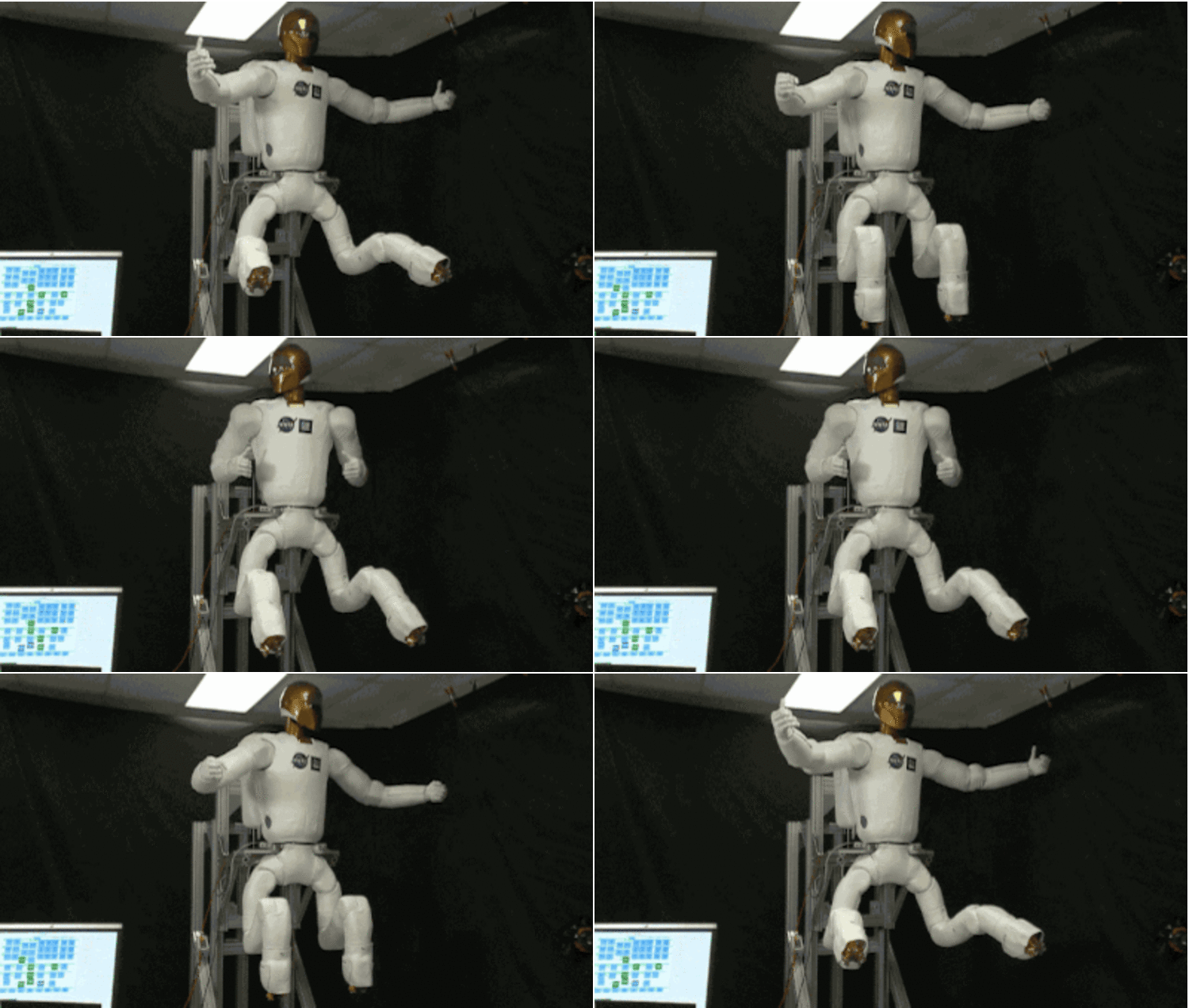
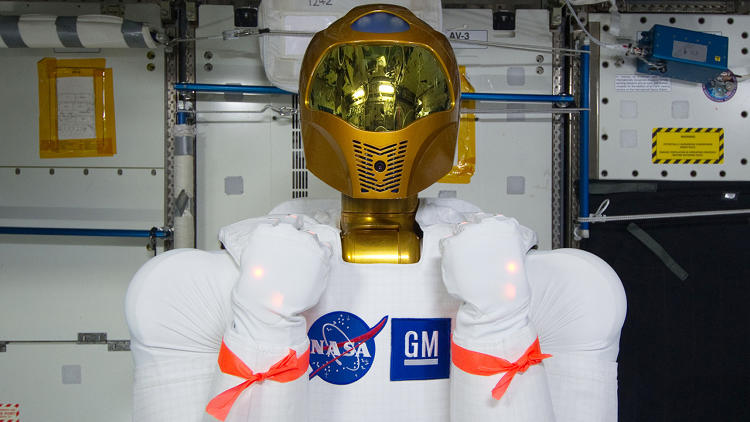
SpaceX’s latest delivery to the International Space Station – which was itself pretty newsworthy – contained some rather interesting cargo: the legs for NASA’s robot space station helper. Robotics enthusiasts know this being as Robonaut 2 (R2), a humanoid robot NASA placed on the space station to automate tasks such as cleaning and routine maintenance. Since its arrival at the station in February 2011, R2 has performed a series of tasks to demonstrate its functionality in microgravity.
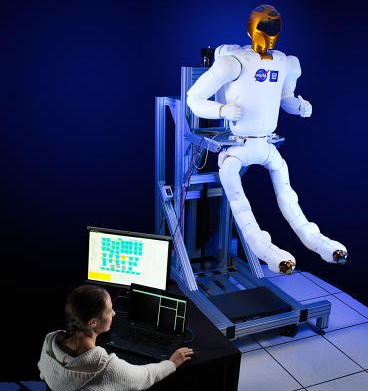
Until now, Robonaut navigated around the ISS on wheels. But thanks to a brand-new pair of springy, bendy legs, the space station’s helper robot will now be able to walk, climb, and perform a variety of new chores. These new legs, funded by NASA’s Human Exploration and Operations and Space Technology mission directorates, will provide R2 the mobility it needs to help with regular and repetitive tasks inside and outside the space station. The goal is to free up the crew for more critical work, including scientific research.
NASA says that the new seven-jointed legs are designed for climbing in zero gravity and offer a considerable nine-foot leg span. Michael Gazarik, NASA’s associate administrator for space technology in Washington, explained:
NASA has explored with robots for more than a decade, from the stalwart rovers on Mars to R2 on the station. Our investment in robotic technology development is helping us to bolster productivity by applying robotics technology and devices to fortify and enhance individual human capabilities, performance and safety in space.
Taking their design inspiration from the tethers astronauts use while spacewalking, the legs feature a series of “end effectors” – each f which has a built-in vision system designed to eventually automate each limb’s approaching and grasping – rather than feet. These allow the legs to grapple onto handrails and sockets located both inside the space station and, eventually, on the ISS’s exterior. Naturally, these legs don’t come cheap -costing $6 million to develop and an additional $8 million to construct and test for spaceflight.
Robonaut was developed by NASA’s Johnson Space Center in collaboration with General Motors and off-shore oil field robotics firm Oceaneering. All that corporate involvement isn’t accidental; Robonaut isn’t designed to simply do chores around the space station. NASA is also using R2 to showcase a range of patented technologies that private companies can license from Johnson Space Center.
The humanoid, task-performing robot is also a NASA technology showcase. In a webcast, the space agency advertised its potential uses in logistics warehouses, medical and industrial robotics, and in toxic or hazardous environments. As NASA dryly puts it:
R2 shares senses similar to humans: the ability to touch and see. These senses allow it to perform in ways that are not typical for robots today.
In addition to these legs, this latest supply drop – performed by a SpaceX Dragon capsule – included a laser communication system for astronauts and an outer space farming system designed to grow lettuce and other salad crops in orbit. We can expect that the Robotnaut 2 will be assisting in their use and upkeep in the coming months and years. So expect to hear more about this automated astronaut in the near future!
And in the meantime, be sure to check out this cool video of the R2 robotic legs in action:
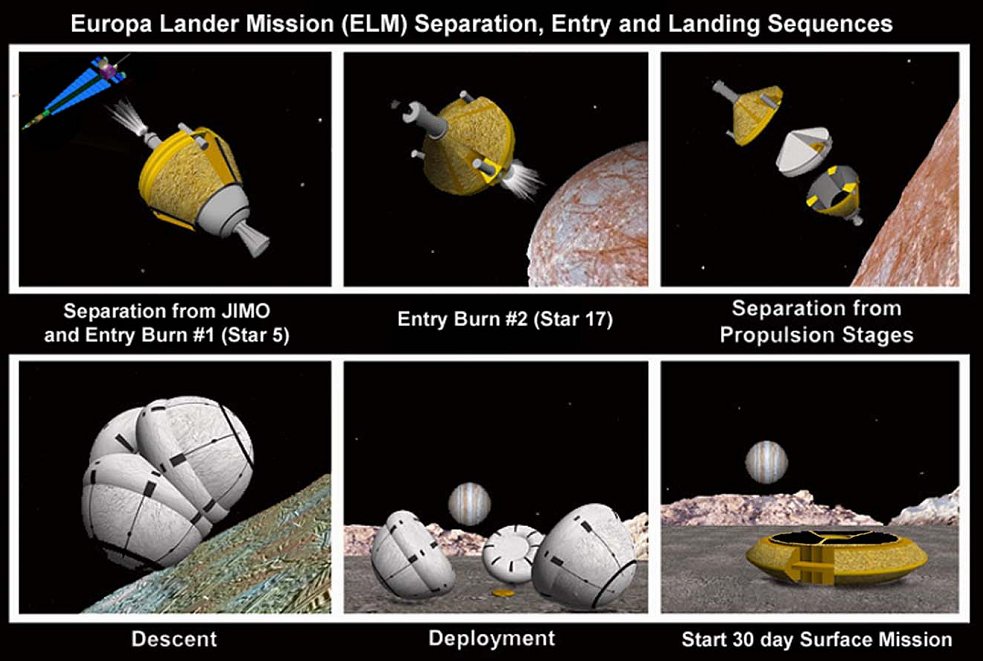
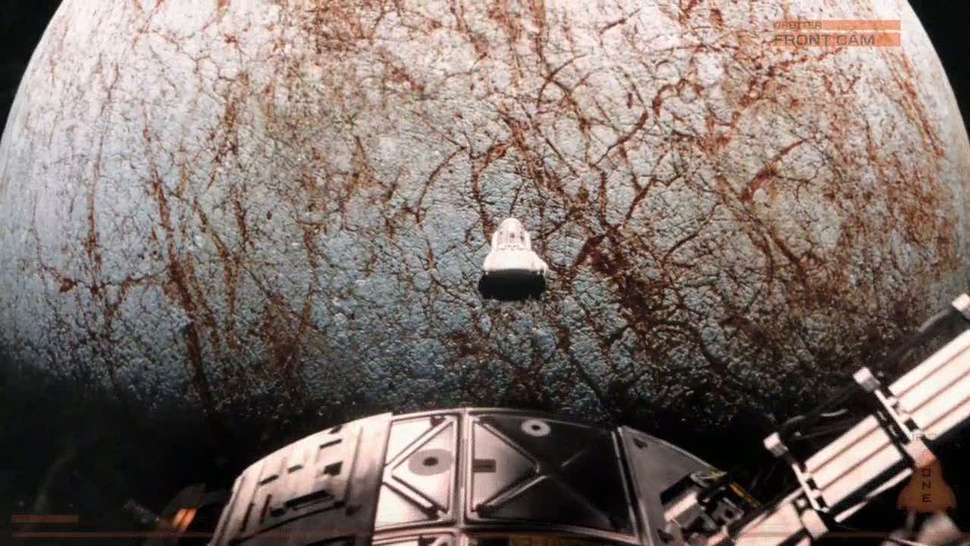
Jupiter’s moon of Europa has been the subject of much speculation and intrigue ever since it was first discovered by Galileo in 1610. In addition to having visible sources of (frozen) surface water and a tenuous oxygen atmosphere, it is also believed to boast interior oceans that could very well support life. As evidence for this mounts, plans to explore Europa using robot landers, miners, submersibles, or even manned missions have been floated by various sources.
However, it was this past December when astronomers announced that water plumes erupting 161 kilometers (100 miles) high from the moon’s icy south pole that things really took a turn. It was the best evidence to date that Europa, heated internally by the powerful tidal forces generated by Jupiter’s gravity, has a deep subsurface ocean. In part because of this, NASA recently issued a Request for Information (RFI) to science and engineering communities for ideas for a mission to the enigmatic moon. Any ideas need to address fundamental questions about the subsurface ocean and the search for life beyond Earth.
This is not the first time that NASA has toyed with the idea of investigating the Jovian moon for signs of life. Last summer, an article by NASA scientists was published in the peer-reviewed journal Astrobiology, which was entitled “Science Potential from a Europa Lander“. This article set out their research goals in more detail, and speculated how they might be practically achieved. At the time, the article indicated NASA’s ongoing interest, but this latest call for public participation shows that the idea is being taken more seriously.
This is positive news considering that NASA’s planned JIMO mission – Jupiter Icy Moon Orbiter, which was cancelled in 2005 – would be taking place by this time next year. Originally slated for launch between May and January of 2015/16, the mission involved sending a probe to Jupiter by 2021, which would then deploy landers to Callisto, Ganymede, Io and Europa for a series of 30 day studies. At the end of the mission in 2025, the vehicle would be parked in a stable orbit around Europa.
John Grunsfeld, associate administrator for the NASA Science Mission Directorate, had the following to say in a recent press release:
This is an opportunity to hear from those creative teams that have ideas on how we can achieve the most science at minimum cost… Europa is one of the most interesting sites in our solar system in the search for life beyond Earth. The drive to explore Europa has stimulated not only scientific interest but also the ingenuity of engineers and scientists with innovative concepts.
By opening the mission up to public input, it also appears that NASA is acknowledging the nature of space travel in the modern age. As has demonstrated with Chris Hadfield’s mission aboard the ISS, the Curiosity rover, as well as private ventures such as Mars One, Inspiration Mars, and Objective Europa – the future of space exploration and scientific study will involve a degree of social media and public participation never before seen.
The RFI’s focus is for concepts for a mission that costs less than $1 billion, but will cover five key scientific objectives that are necessary to improve our understanding of this potentially habitable moon. Primarily, the mission will need to:
Characterize the extent of the ocean and its relation to the deeper interior
Characterize the ice shell and any subsurface water, including their heterogeneity, and the nature of surface-ice-ocean exchange
Determine global surface, compositions and chemistry, especially as related to habitability
Understand the formation of surface features, including sites of recent or current activity, identify and characterize candidate sites for future detailed exploration
Understand Europa’s space environment and interaction with the magnetosphere.
Although Europa has been visited by spacecraft and imaged distantly by Hubble, more detailed research is necessary to understand the complexities of this moon and its potential for life. NASA’s Galileo spacecraft, launched in 1989 was the only mission to visit Europa, passing close by the moon fewer than a dozen times. Ergo, if we’re ever to determine conclusively whether or not life exists there, we’re going to have to put boots (robotic or human) onto the surface and start digging!
To read the full Decadal Survey report on NASA’s website, click here.
It’s no secret that amongst its many cooky and futuristic projects, self-driving cars are something Google hopes to make real within the next few years. Late last month, Google’s fleet of autonomous automobiles reached an important milestone. After many years of testing out on the roads of California and Nevada, they logged well 0ver one-million kilometers (700,000 miles) of accident-free driving. To celebrate, Google has released a new video that demonstrates some impressive software improvements that have been made over the last two years.
Most notably, the video demonstrates how its self-driving cars can now track hundreds of objects simultaneously – including pedestrians, an indicating cyclist, a stop sign held by a crossing guard, or traffic cones. This is certainly exciting news for Google and enthusiasts of automated technology, as it demonstrates that the ability of the vehicles to obey the rules of the road and react to situations that are likely to emerge and require decisions to be made.
In the video, we see the Google’s car reacting to railroad crossings, large stationary objects, roadwork signs and cones, and cyclists. In the case of the cyclist — not only are the cars able to discern whether the cyclist wants to move left or right, it even watches out for cyclists coming from behind when making a right turn. And while the demo certainly makes the whole process seem easy and fluid, there is actually a considerable amount of work going on behind the scenes.
For starters, there are around $150,000 of equipment in each car performing real-time LIDAR and 360-degree computer vision – a complex and computing-intensive task. The software powering the whole process is also the result of years of development. Basically, every single driving situation that can possibly occur has to be anticipated and then painstakingly programmed into the software. This is an important qualifier when it comes to these “autonomous vehicles”. They are not capable of independent judgement, only following pre-programmed instructions.
While a lot has been said about the expensive LIDAR hardware, the most impressive aspect of the innovations is the computer vision. While LIDAR provides a very good idea of the lay of the land and the position of large objects (like parked cars), it doesn’t help with spotting speed limits or “construction ahead” signs, and whether what’s ahead is a cyclist or a railroad crossing barrier. And Google has certainly demonstrated plenty of adeptness in the past, what with their latest versions of Street View and their Google Glass project.
Naturally, Google says that it has lots of issues to overcome before its cars are ready to move out from their home town of Mountain View, California and begin driving people around. For instance, the road maps needed to be finely tuned and expanded, and Google is likely to be selling map packages in the future in the same way that apps are sold for smartphones. In the mean time, the adoption of technologies like adaptive cruise control (ACC) and lane keep assist (LKA) will bring lots of almost-self-driving cars to the road over the next few years.
In the meantime, be sure to check out the video of the driverless car in action:
Scientists have come up with the best computer model to date of the universe, one which maps the evolution of the cosmos in unprecedented detail. Known as Illustris, this virtual cosmos – which was created by U.S., English and German researchers using a network of supercomputers – includes details never before achieved in a simulation. All told, the numerical-based model covers the 13-billion-year evolution of the universe, beginning just 12 million years after the Big Bang took place.
While cosmologists have been developing and employing computer models of the universe for several decades, the outcome is usually a rough approximation of the universe that scientists observe in reality. Illustris, however, has produced a universe that looks uncannily like the real on. Among other things, it models how the universe expands, how galaxies are formed, their composition and distribution, and the mechanics of how stars and black holes are formed.
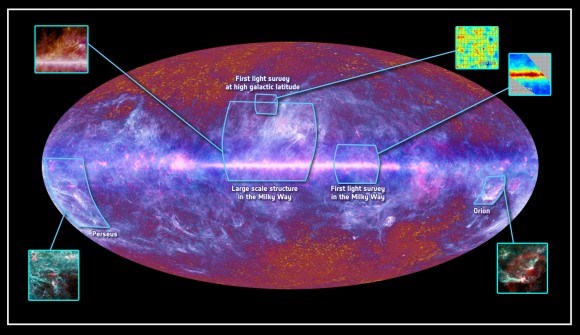
Given all the recent breakthroughs in physics and cosmology, this ultra-detailed virtual model should come as no surprise. For example, this past April, scientists made not only made the first-ever observation of gravitational waves, they also processed data that is believed to be the first real indication of the existence of Dark Matter. In addition, the ESA’s Planck mission released the most detailed thermal imaging map of the universe last year that placed an accurate date on the universe’s age and confirmed the validity of the Big Bang Theory.
The Illustris creators say it represents “a significant step forward in modelling galaxy formation”, and provides a good visual representation of our ever-expanding (no pun!) understanding of the universe. A recent article that appeared last Wednesday in the journal Nature describes Illustris, and several videos (like those below) have been released that show the simulation in action. Check them out below:
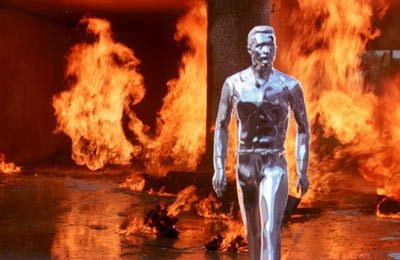
For ideal physical rehab, it might be necessary to go a little “cyborg”. That’s the reasoning a Chinese biomedical firm used to develop a new method of repairing damaged nerve endings. Borrowing a page from Terminator 2, their new treatment calls for the use of liquid metal to transmit nerve signals across the gap created in severed nerves. The work, they say, raises the prospect of new treatment methods for nerve damage and injuries.
Granted, it’s not quite on par with the liquid-metal-skinned cyborgs from the future, but it is a futuristic way of improving on current methods of nerve rehab that could prevent long-term disabilities. When peripheral nerves are severed, the loss of function leads to atrophy of the effected muscles, a dramatic change in quality of life and, in many cases, a shorter life expectancy. Despite decades of research, nobody has come up with an effective way to reconnect them yet.
Various techniques exist to sew the ends back together or to graft nerves into the gap that is created between severed ends. And the success of these techniques depends on the ability of the nerve ends to grow back and knit together. But given that nerves grow at the rate of one mm per day, it can take a significant amount of time (sometimes years) to reconnect. And during this time, the muscles can degrade beyond repair and lead to long-term disability.
As a result, neurosurgeons have long hoped for a way to keep muscles active while the nerves regrow. One possibility is to electrically connect the severed ends so that the signals from the brain can still get through; but up until now, an effective means of making this happen has remained elusive. For some time, biomedical engineers have been eyeing the liquid metal alloy gallium-indium-selenium for some time as a possible solution – a material that is liquid at body temperature and thought to be entirely benign.
But now, a biomedical research team led by Jing Liu of Tsinghua University in Beijing claims they’ve reconnected severed nerves using liquid metal for the first time. They claim that the metal’s electrical properties could help preserve the function of nerves while they regenerate. Using sciatic nerves connected to a calf muscle, which were taken from bullfrogs, they’ve managed to carry out a series of experiments that prove that the technique is viable.
Using these bullfrog nerves, they applied a pulse to one end and measured the signal that reached the calf muscle, which contracted with each pulse. They then cut the sciatic nerve and placed each of the severed ends in a capillary filled either with liquid metal or with Ringer’s solution – a solution of several salts designed to mimic the properties of body fluids. They then re-applied the pulses and measured how they propagated across the gap.
The results are interesting, and Jing’s team claim that the pulses that passed through the Ringer’s solution tended to degrade severely. By contrast, the pulses passed easily through the liquid metal. As they put it in their research report:
The measured electroneurographic signal from the transected bullfrog’s sciatic nerve reconnected by the liquid metal after the electrical stimulation was close to that from the intact sciatic nerve.
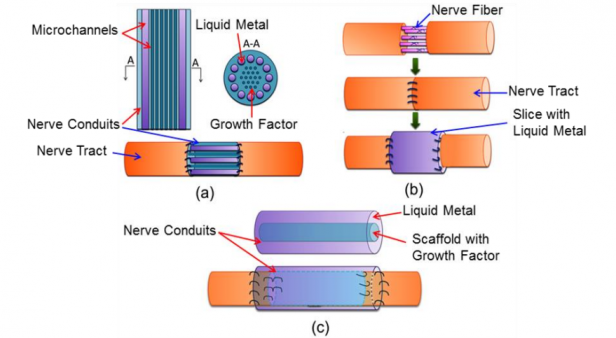
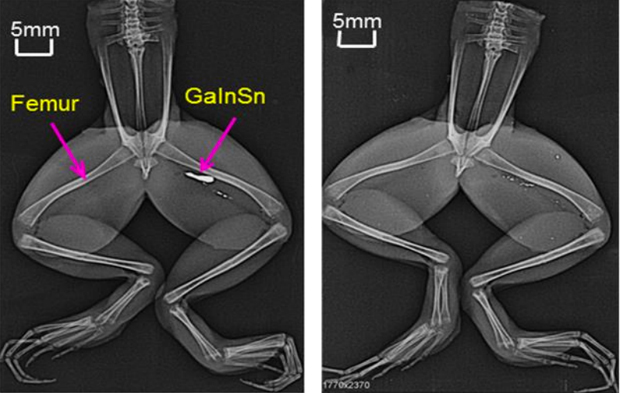
What’s more, since liquid metal clearly shows up in x-rays, it can be easily removed from the body when it is no longer needed using a microsyringe. All of this has allowed Jing and colleagues to speculate about the possibility of future treatments. Their goal is to make special conduits for reconnecting severed nerves that contain liquid metal to preserve electrical conduction and therefore muscle function, but also containing growth factor to promote nerve regeneration.
Naturally, there are still many challenges and unresolved questions which must be resolved before this can become a viable treatment option. For example, how much of the muscle function can be preserved? Can the liquid metal somehow interfere with or prevent regeneration? And how safe is liquid metal inside the body – especially if it leaks? These are questions that Jing and others will hope to answer in the near future, starting with animal models and possibly later with humans..
Welcome back to the latest edition on the Williams’ Family Eurotrip 2014! Today, in what I hope will be the second-last post in this segment, I will be covering some of my favorite aspects of the trip. These included our visit to the Caen Memorial Museum, our overnight in Chartres, and our arrival in Paris which was accompanied by some very interesting times in the Latin Quarter. Here’s how it all well down…
Friday, April 18th – Sunday, April 20th – Caen and Chartres and Paris: The day started with us packing up and saying goodbye to the Lion D’Or, which for the past few days had been our home away from home, complete with feline company! Then, we hit the road on our way to Chartres; and unlike previous days, we only made one stop along the way. However, it was an important stop, since it was the last stop on our tour of World War II sites and memorials. Initially, we had talked about visiting the Ardennes Abbey, where 20 Canadian POWs had been murdered by SS troops on July 8th, 1944.
The Abbey has since been converted into a museum that pays homage to these individuals and commemorates the sacrifices made by countless people during the Battle of Normandy. However, my father had visited it twice now and cautioned that it was quite depressing. So instead, we decided to detour through the northern part of Caen to visit the Mémorial deCaen, a museum and memorial which was by far the largest and most detailed museum we had seen on the trip.
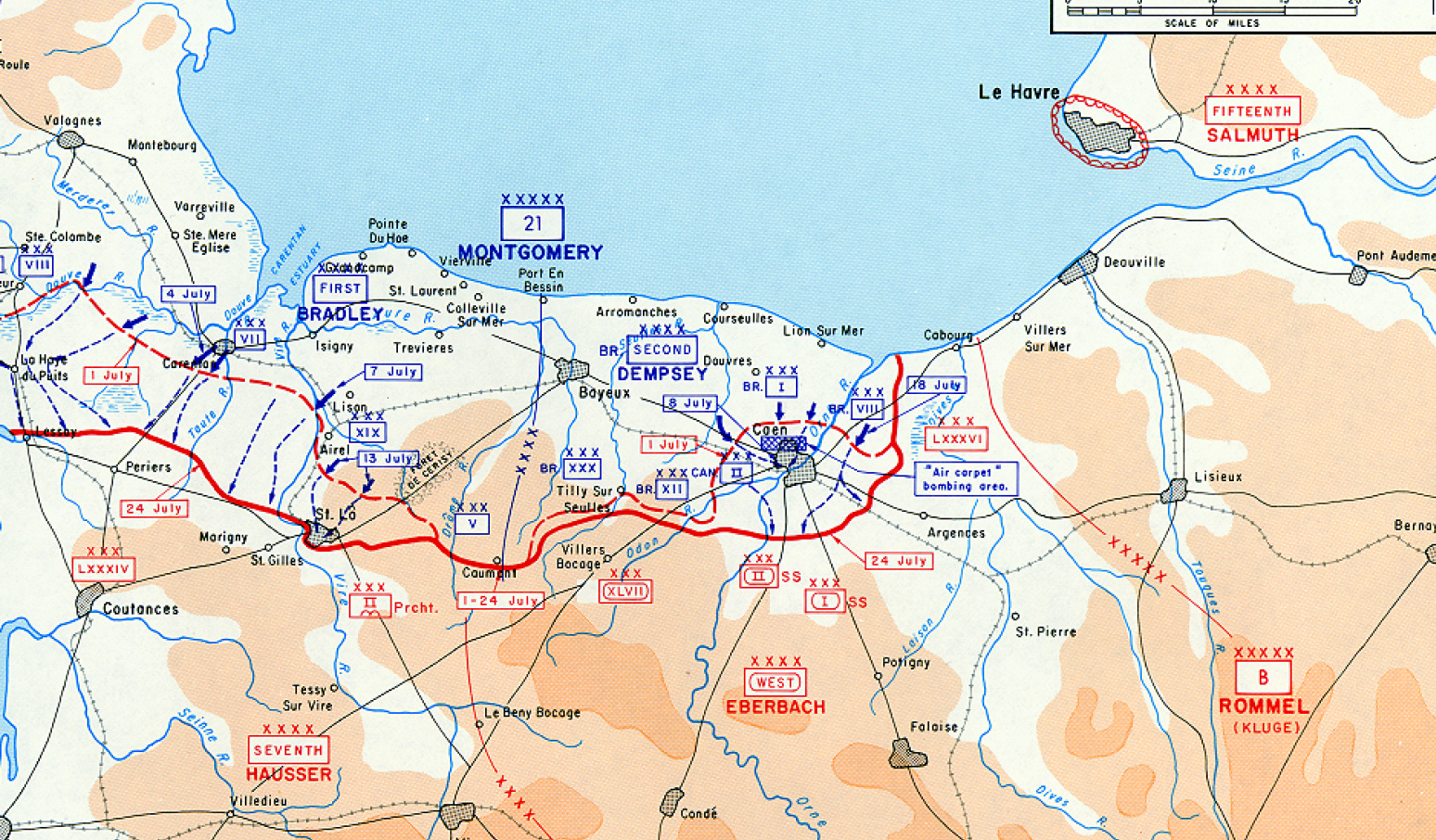
Mémorial de Caen, map out front of all the events around Caen during the Battle of Normandy 1944
Outside the museum, we found a lovely map where I concluded explaining the events surrounding the Battle of Caen – one of the most intensive battles to take place during Operation Overlord and the liberation of France. This proved to be a good time to share what I knew, since the museum was immensely more detailed on the subject and would have made my little talk pointless! And picking up where we had left off during our visit to Juno Beach and the Normandy countryside, I began sharing with my wife and olks exactly how hard it had been in 1944 to take the city.
Initially a D-Day objective, it would take the British, Canadian and Allied forces a total of 45 days to secure the city of Caen. Its strategic position in the Eastern Sector of Normandy, as well being a major crossing point over the Orne river, made capturing it an absolute necessity. To the Allies, taking the city was a matter of securing a solid beachhead and preventing a German counter-attack. To the Germans, holding it was a matter of ensuring that the Allied forces would be denied the ability to venture father south.
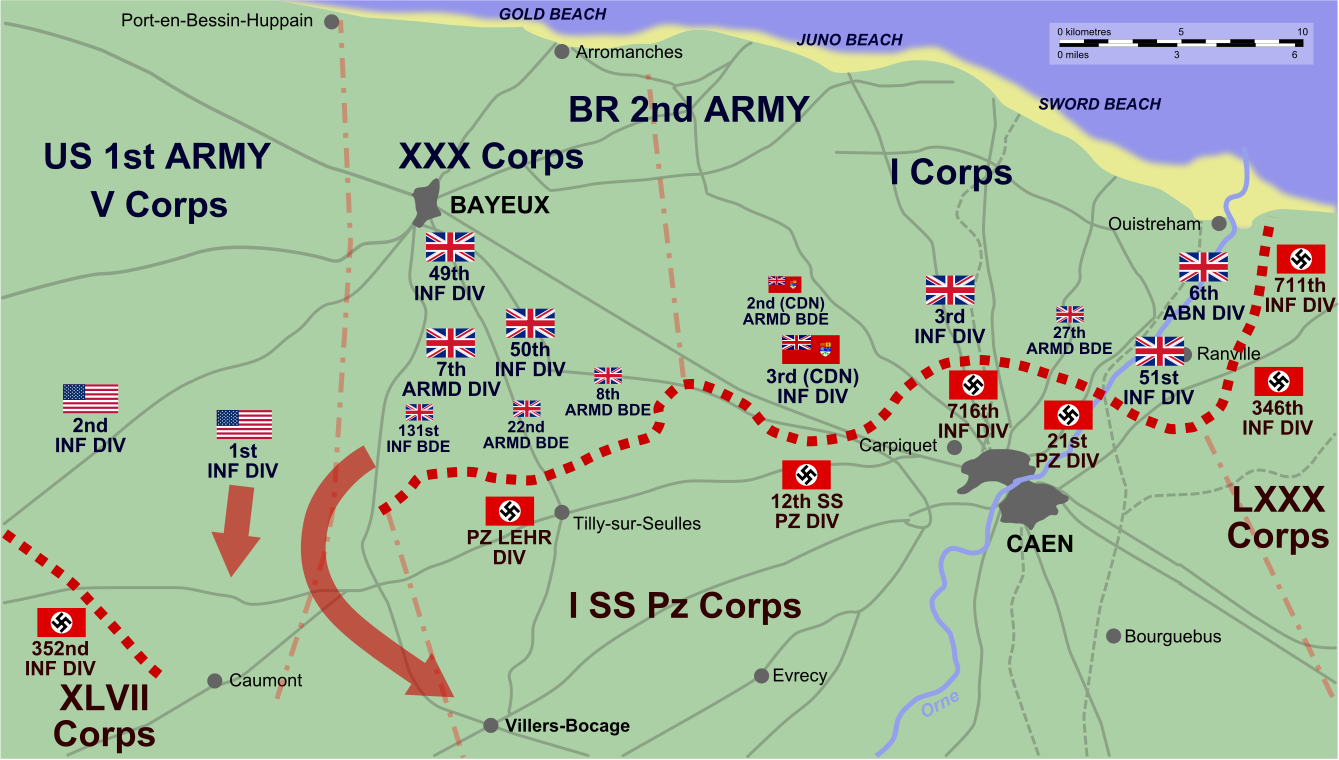
In June, the Canadian 3rd Division managed to secure the high ground to the west and south-west of the city, including the towns of Carpiquet, Authrie and Rots. To the north, the British I Corps had also seized all land outside of the city, but still faced tough resistance from the German 12th SS Panzers, the 21st Panzer Division, and the 716th Infantry Division. Since their attempt to take the city by a direct assault on D-Day had failed, General Montgomery now looked to take the city with a pincer movement.
Thus began Operation Perch, which commenced on the 7th of June (D-Day+1) and aimed at achieving a breakout west around Bayeux. As the I Corps attacked the town of Cagny some 5 km south-east of Caen, the British XXX Corps (located 20 km to the west) would push south of Bayeux and cross the Odon river, in an attempt to outflank the Germans south of the city. Almost immediately, the attack ran into problems, which would force further delays in liberating Caen.
In the west, the XXX Corps was delayed after reaching the town of Tilly-sur-Seulles, where they became bogged down by hedgerows and stiff resistance from the 12th SS Panzers and the Panzer-Lehr Division – an elite unit with many of Germany’s most advanced tanks (such as the Panzer V “Panther” tank, pictured above). In the east, the I Corps’ advance was stalled thanks to tough resistance from the battle-hardened 21st Panzer Division. By the 13th of June, the offensive was called off.
However, on the following day, the German line broke to the west of the XXX Corps, thanks to the efforts of the American 1st Infantry Division (Big Red One). After withdrawing south, the Germans opened a 12 km gap in their lines, which the British 7th Armored Division sought to exploit by pushing south. In an attempt to outflank the Panzer-Lehr Division, the 7th Armored aimed to capture the town of Villers-Bocage some 15 kms south of Bayeux.
However, the British once again experienced severe resistance and after two days of intense fighting, they fell back on June 14th. It was hoped that with some reinforcements, they would resume the attack on the 19th and push through. However, a terrible storm fell on the English Channel, which caused severe disruption to beach supply operations and damaged the artificial harbor at Arromanches (see “Part the Fourth”, specifically the stuff dealing with Mulberry Harbor).
Because of this, offensive operations were postponed until July, at which point, General Montgomery would once again plan to seize Caen by a direct assault. The first phase of this assault was known as Operation Windsor, and called for the Canadian and British forces west of Caen to retake the town of Carpiquet from the 12th SS and then secure the Carpiquet Airfield to the south. The second phase, known as Operation Charnwood, would see the I Corps clearing the north end of Caen and seizing the bridgeheads into the southern part of the city.
On July 4th, the attack commenced, with Canadian and British forces braving mines, anti-tank guns, and machine gun nests to take Carpiquet. By the following day, the town had been secured and several German counterattacks had been repulsed. By July 8th, acting on intelligence provided by the French Resistance, the Canadian and British forces marched on the airfield and found it abandoned. Operation Windsor was a success.
Operation Charnwood, by contrast, met with limited success, and caused significant damage to the city of Caen. On July 7th, the began with a massive aerial bombardment where the first wave of bombers dropped over 1,800 tons of munitions on the city. The Allies hoped to minimize civilian deaths by dropping leaflets prior to the bombing. However, the drop took place just a day prior, and due to complications caused by the weather, only a few thousands leaflets reached their destination and only a few hundred townspeople left.
On the following morning, the I Corps mobilized and reached the outskirts of town by nightfall. The Germans immediately began evacuating across the Orne river, leaving elements of their forces behind to fight a rearguard action in the rubble-filled streets. Despite fierce resistance, the English and Canadian forces secured the northern half of Caen by the 9th of July and decimated the 16th Luftwaffe Field Division. However, the bridges across the Odon were not secured, and were either blocked by rubble or heavily defended from the south bank.
Because of this, the Operation was called off by the 9th of July since no further gains were possible. Though it had been delcared a success, Caen was not yet fully liberated and the city had suffered extensive damage. It’s civilian population which had been roughly 60,000 before the battle – had now dropped to 17,000, which caused widespread resentment towards the liberators. Nevertheless, the townspeople in the northern half of the city still came out in force to celebrate the defeat of the Germans.
Later than month, Monty once again planned to take the rest of the city with a pincer movement. Known as Operation Atlantic, this assault involved the 3rd Canadian Infantry Division advancing to the east of Caen to secure the suburb of Colombelles while the 2nd Canadian Infantry Division drove south to seize the high ground of Verrieres Ridge. Once again, these assaults would coincide with a British offensive farther east. On the 18th and 19th of July, the Canadian 3rd Division managed to secure the town of Colombelles from the 21st Panzers and drove them over the Orne river, effectively liberating all of Caen.
Unfortunately, the 2nd Division was stalled while trying to take Verrieres Ridge, thanks in part to heavy rains that turned the ground to mud – which bogged down their armor support and grounded the RAF – and because the Germans were well fortified and had artillery support. After several days of fighting, the 2nd Division fell back and were reinforced by elements of the 3rd Divisions; and together, they were able to halt the counter-attacks launched by the 12th SS Panzers.
Meanwhile, the I and VIII British Corps initiated Operation Goodwood on July 18th, which sought to capture the town of Bourguébus and the high ground south of the city. Once again, the operation was preceded by extensive bombing, which harried the German forces that had fallen back from Caen. However, the advance stalled due to numerous factors and the British lost the element of surprise. For starters, the British only had six bridges over the Orne river, which slowed the crossing of the 1000+ vehicles taking part in the offensive considerably.
Once they reached the other side, they were forced to contend with minefields that had been lain by the 51st Highland Division to defend their positions just a few days prior. But since the element of surprise was already lost, British command decided to order the mines cleared. Two days later, the attack resumed. However, the Germans had recovered from the bombing by then, and the British were forced to clear several well-defended towns that were connected by underground tunnels.
In addition, the German artillery on Bourguébus ridge had not been destroyed by the Allied bombing. And thanks to their numerous observation posts stationed throughout the villages in the region, they were able to observe the British advance and call in artillery support on their armor. Between the 18th and the 20th, they also mounted numerous counter-attacks, and by the end of the day, Montgomery brought the operation to a close, citing bad weather.
All told, Goodwood did not go as planned and was a failure in terms of achieving a breakout. Some 4000-5000 Allied troops and 250-350 tanks were also lost in the assault. The German losses are unknown, but some 2500 men were captured (mostly by the British since the Canadians were no longer taking SS prisoners) and between 75 and 100 tanks were destroyed. However, these two operations did manage to secure important strategic ground, liberated the rest of Caen, and effectively bled the Germans dry in the region.
But most importantly of all, the sustained British, Canadian and Allied efforts in and around Caen managed to tie down four German Corps, which included important armored divisions, while the Americans were planning their own breakout to the west. On July 25th, just one day after the Canadians and British were told to dig in, the 1st US Army launched Operation Cobra, which effectively achieved a breakout around the town of Saint-Lô.
This breakout would allow the American forces to drive south and east, effectively outflanking what was left of the German forces, while the British 2nd Army – with the Canadian 4th and 1st Polish Armored Divisions leading the way – closed in on them from the north. This encirclement maneuver, which would come to be known as the Battle Falaise Pocket, effectively decimated what was left of the German army and signaled the liberation of France. Thereafter, the Allies would advance onto Paris and by the 30th of August, they were marching down the Champs d’Elysee. A massive crowd of jubilant Parisians turned out to welcome their arrival, and the liberation of France was declared.
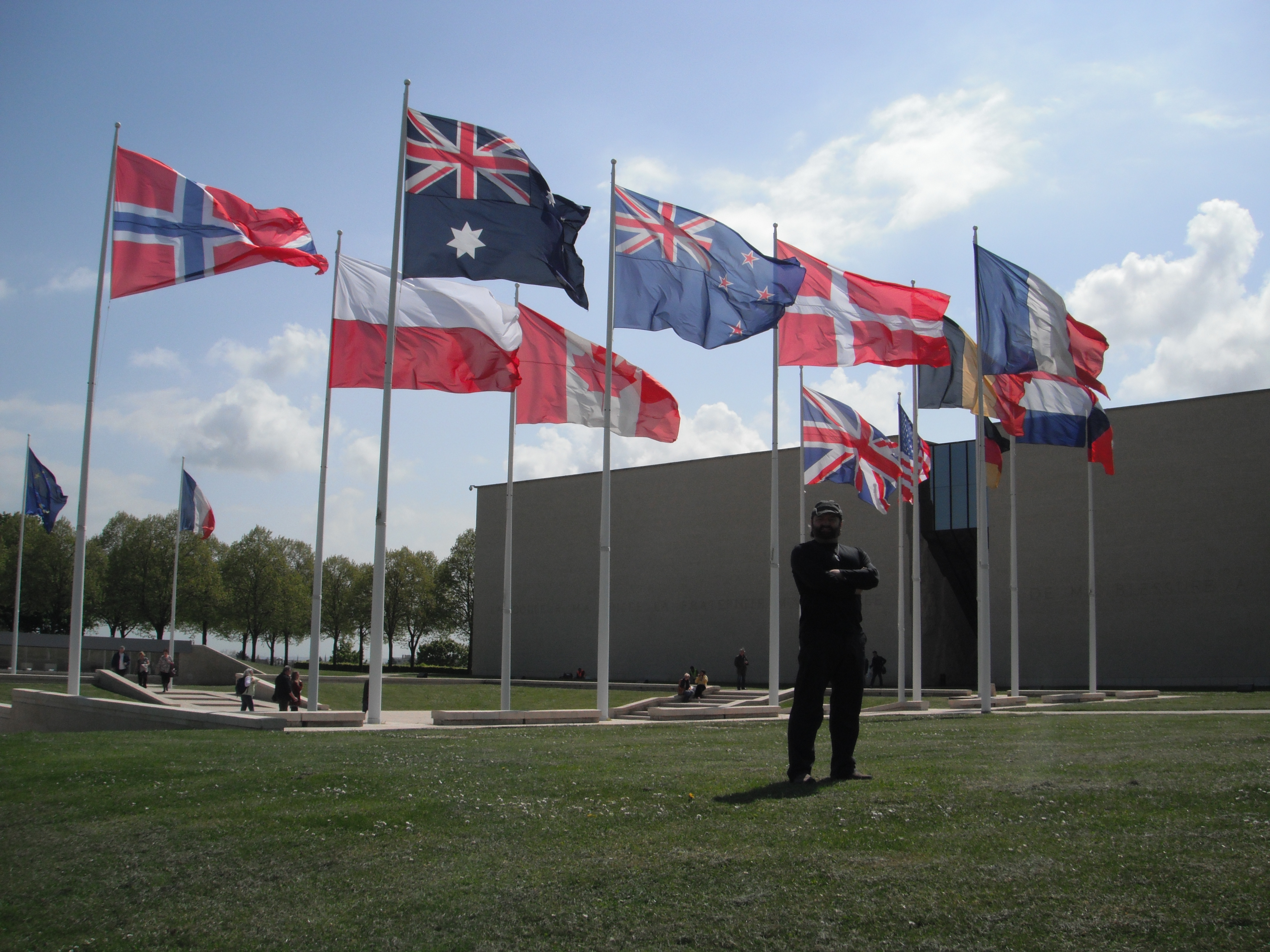
Mémorial de Caen, out front afterwards
All of this and more was covered in beautiful detail inside the museum, which began with a movie called “”. We then proceeded through a series of rooms with pictures, artifacts, infographics and write-ups that explained every aspect of the war – ranging from the prelude and the build-up to every event that took place between 1939 and 1945. And of course, considerable space and resources were committed to the aftermath, which included the Cold War, Peacekeeping, and war in peace in the modern world.
The entire experience then closed with a movie entitled “Hope”, which gave an audio-visual rundown of the conflicts and major historical events that have taken place since 1945. And though the tone of the movie didn’t seem particularly hopeful, it seem to contain some hints that lessons had been learned and the state of the world had improved somewhat since. At least, that was the impression I chose to take away, others in our party disagreed.
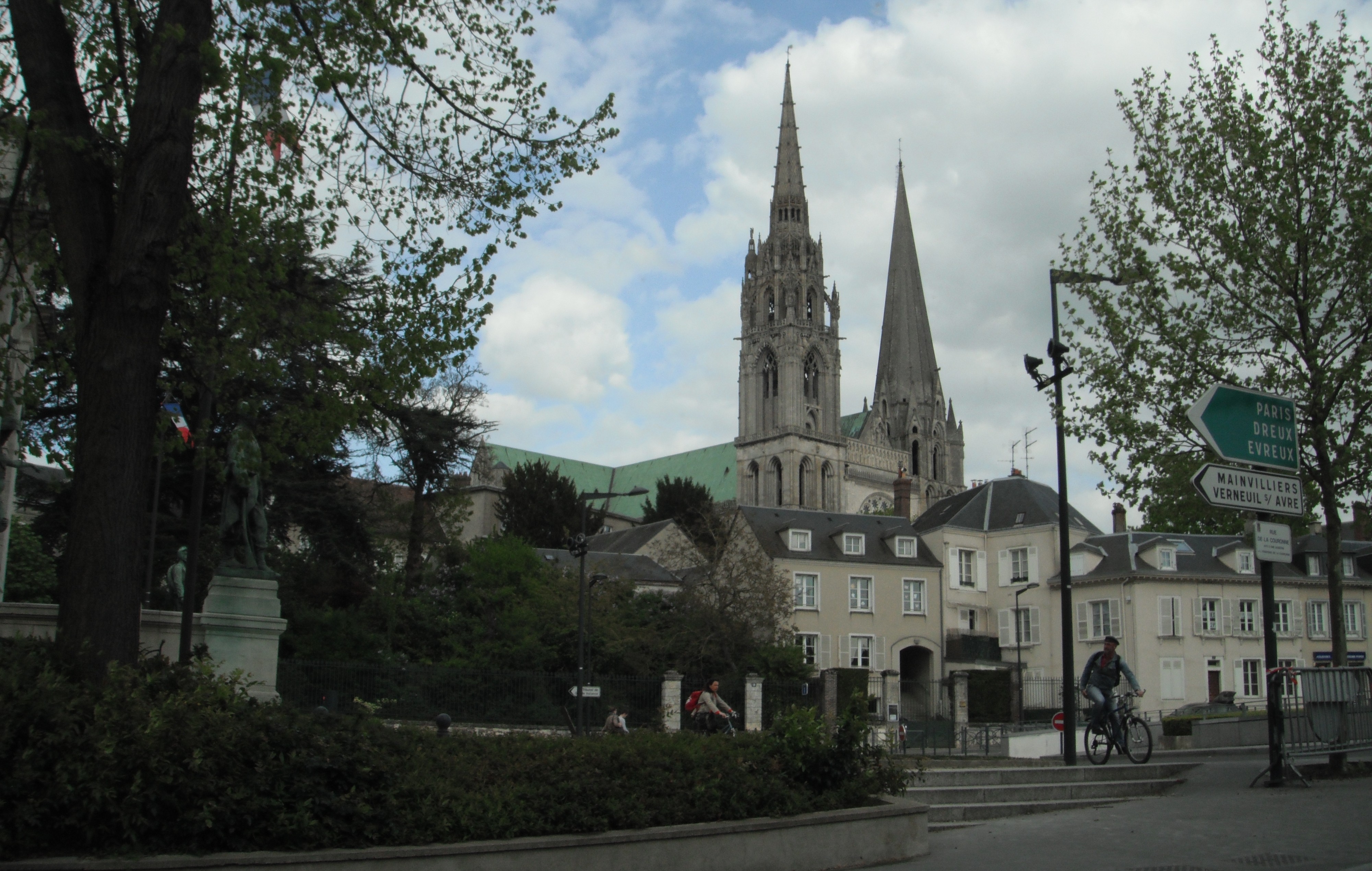
The Cathedral of Chartres in the distance
And then, it was on to Chartres, lock, stock and barrel! Compared to the town where we spent the previous week and a half, this city was significantly bigger. As such, it took some time to navigate through the morass of major streets and burbs before we finally came to the old town, which is instantly identifiable by the ancient stone wall and mote that surround it, not to mention the fact that it sits on the high-ground. And in the distance, we could see the spires of the looming at the crest of the hill.
Once inside the walls, the streets instantly narrowed, and getting to our hotel – which was awesomely located next to the Cathedral – involved going along some winding back-streets that proceeded ever uphill. Betty (our GPS) had some issues, mainly because the tight streets and high walls made it hard for her to get a signal. And yet, we somehow found our way to the top and street with our hotel on it. And once we had unpacked and entered, the nice lady who ran the place took on another climbing adventure.
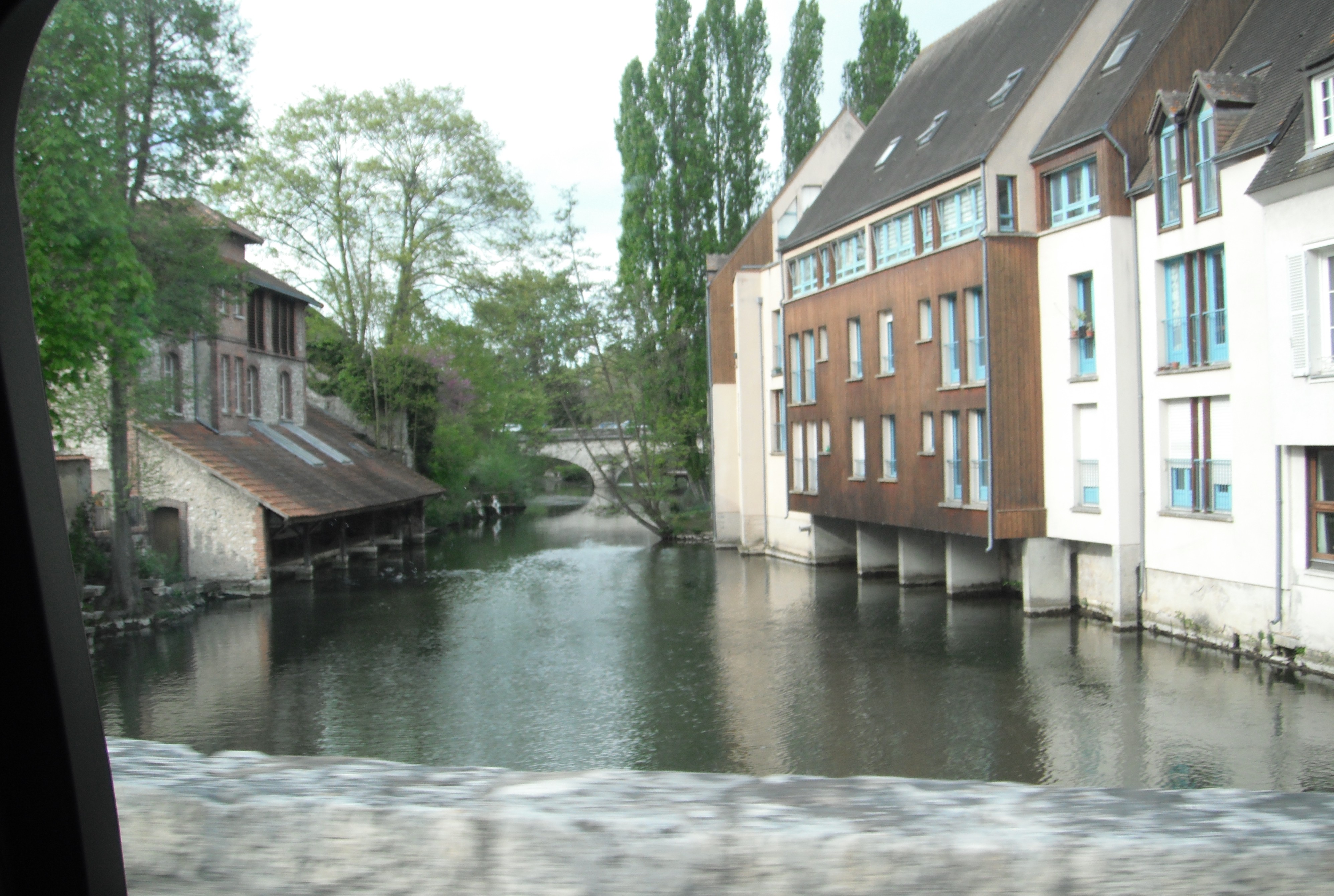
The moat that surrounds the old city
Basically, this hotel (which overlooks the Cathedral) is a narrow, stacked house. On the ground floor, there’s the restaurant and bar, with the rooms stacked vertically above and below it. My folks were in the room one floor up, while Carla and I got the appropriately-named “Ange” room (Angel) that was at the very top, and had the best view of the Cathedral. It also had something we hadn’t seen in days and were looking forward to using – a tub with jets!
The room was also very traditional looking – with wallpaper that looked like plaster coating and old wooden beams in the ceiling that woke us up with their creaking! My folks room was a little different. In addition to a strange 80’s deco scheme, it had a circular bed, a stand-up shower and no tub, and a wall-mounted fire place that took some time to figure out. In fact, it wasn’t even immediately apparent that it WAS a fireplace.
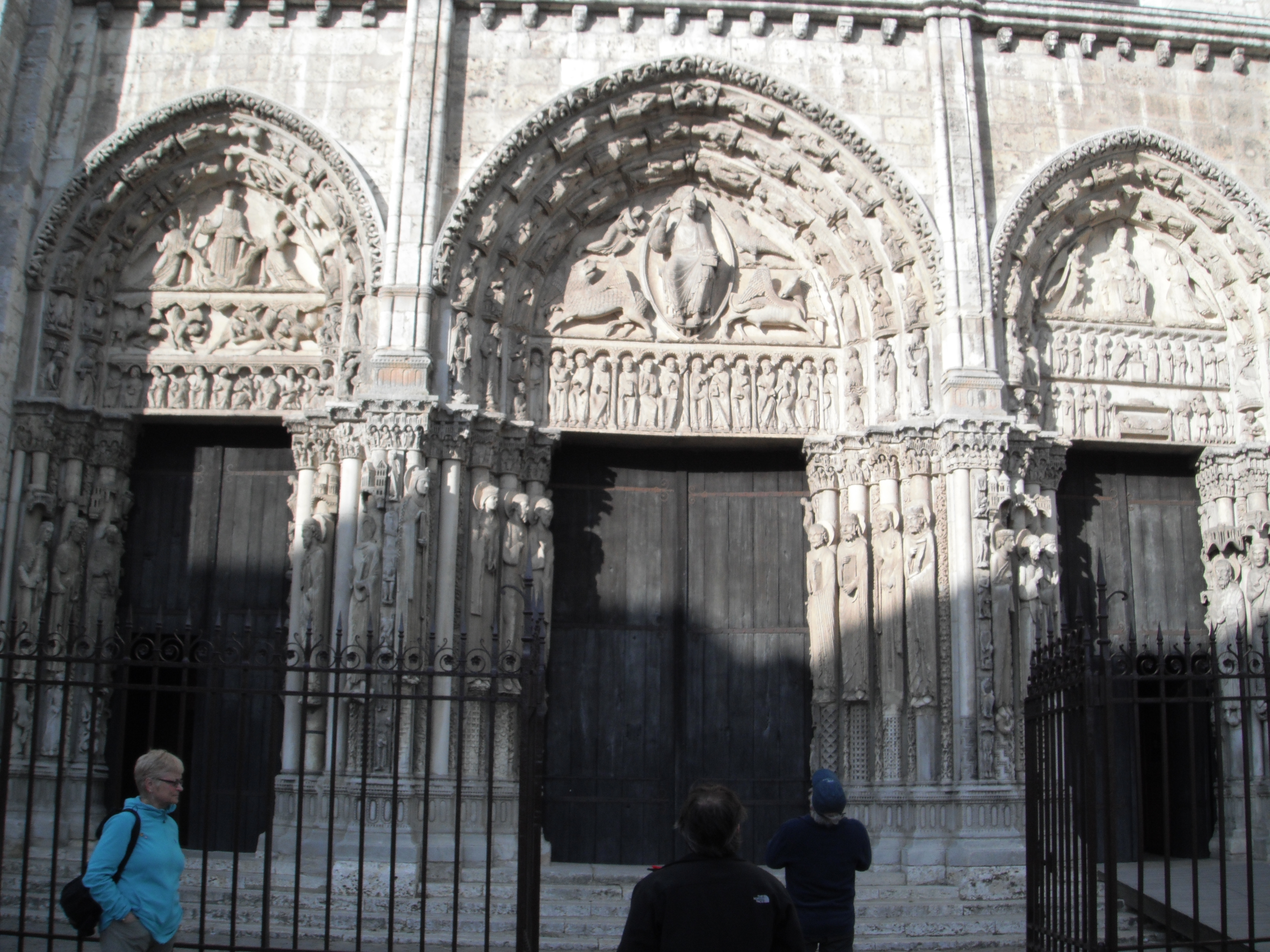
The Cathedral entrance
After unpacking and uncorking the cider and Calvados in our room (an experience that left us a little shaken), the four of us proceeded to take a walk around the Cathedral before having dinner. In many ways, the Chartres Cathedral was similar to what we had seen in Ypres and Bayeux – in that their designs were a combination of Romanesque and Gothic architecture. This is owing to their immense longevity and the fact that they’ve been renovated and had additions put on over the centuries.
However, Chartres was bigger by comparison, and had what my father noted were true examples of flying buttresses. Did I mention he’s an architect? That kind of seems like something worth mentioning. In any case, these are basically load-bearing arches that are attached to the outside of the building, a common feature in Gothic cathedrals. And this baby had plenty of them! And of course, the stain-glass windows – which according to information provided inside contain the first blue glass ever made – were breathtakingly impressive.
The stained-glass windows located at the Nave
After noting the labyrinth pattern on the stone floor – and some strange symbols in the center of it that we joked were evidence of the da Vinci Code – we walked around to the Nave (my father pointed out all the architectural features and names) and noticed the stone wall that was covered with intricate carvings. We also noted the renovations that were taking place, where the columns and stonework were all getting a “facelift”. This amounted to stripping the top layers off to remove the 1000+ years worth of soot that had built up them.
To save time, I should also note that we came back the next day and scale the steps of the bell tower. This is something you have to pay for, but we seriously wanted to mount those 350 steps to take in the view. And so we could say we did it! Now let me tell you, scaling a Gothic Cathedral’s 350-step winding staircase is no picnic! The going was cramped, the air moldy, and the steps a little slippery. Still, we couldn’t help but feel we were breathing in centuries of history, even if it did cause some coughing afterward.
Carla at the top of the bell tower
At the top, we got a bird’s eye view of the old section of town, not to mention the new town and the countryside beyond. Once again, there were plenty of golden canola fields to be seen between grassy fields. And of course, we got a pretty good close-up of the flying buttresses, gargoyles and other Gothic external features. And then, we descended, which proved to be almost but not quite as difficult as going up. We also watched the Cathedral fill with people as the locals prepared for the Easter Sunday service.
Getting back to the night before, we then had dinner at the restaurant, which had an interesting feature of the menu. My mother spotted “Filet de Loup”, which roughly translates to “filet of wolf”, or so we thought. Naturally, we were a little concerned and suspected we might have wandered into a cultural difference. But our server resolved this when she explained that this is actually the name for a whitefish filet, and found our misunderstanding to be quite perplexing. Seriously, she looked at us like we were on drugs!
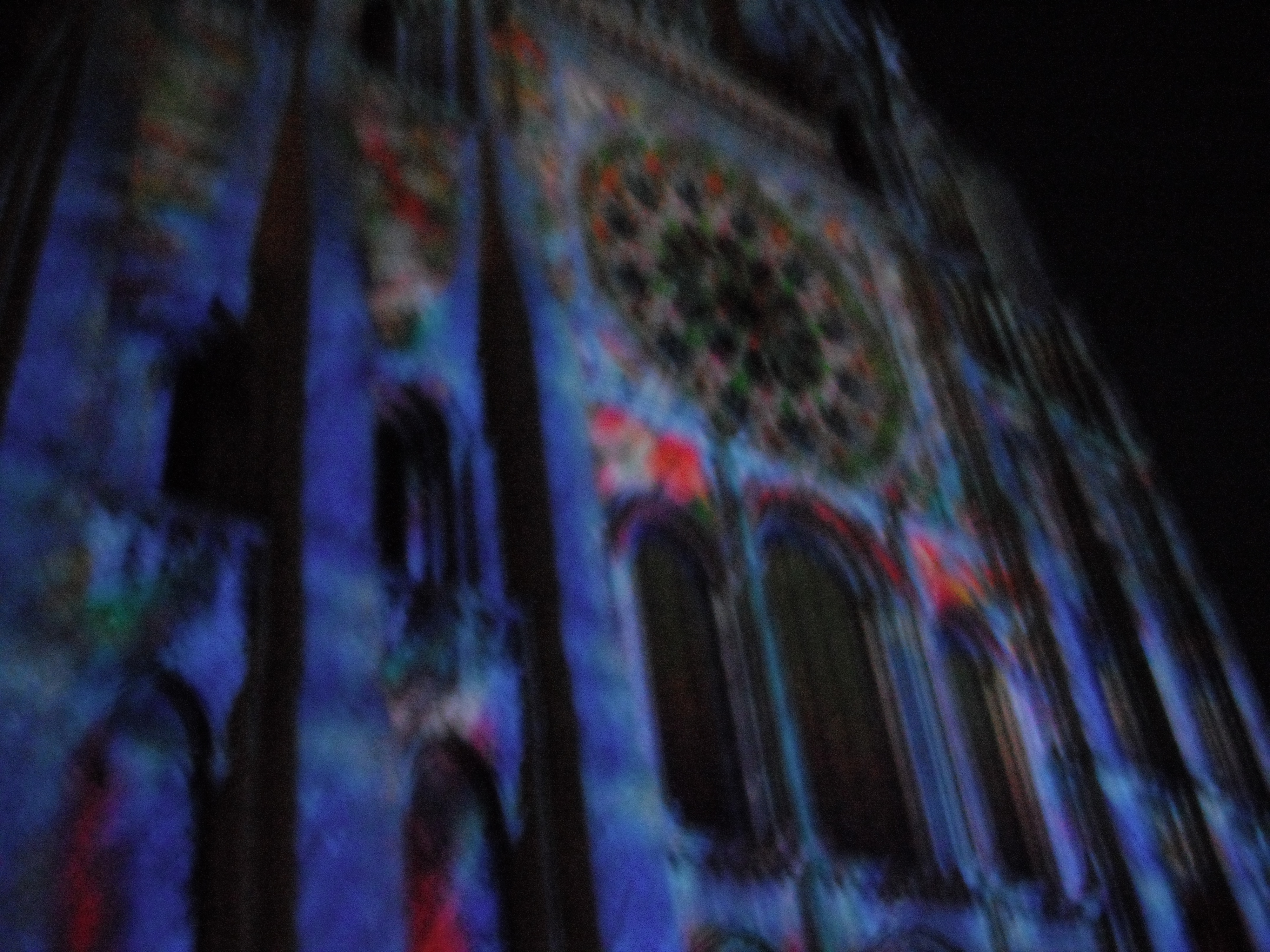
The light show on the Cathedral facade that took place that night
My wife and mother had the lasagna, which they didn’t really like, while my father enjoyed the filet de loup, and I enjoyed a filet of monkfish with chorizo. This was all washed down with glasses of Affligem, which were necessary after the Caldavos incident. And then, we popped back outside because we noticed an interesting light show happening on the front of the cathedral. At first, we thought someone was throwing rolls of TP down the front. But upon closer inspection, it turned out to be a dazzling visual display that was being projected onto the facade.
We snapped some photos of the show, but as you can see, they didn’t turn out to well owing to the need for low light to capture all the vivid colors. Then it was back to our rooms, a nice hot bath, and a sound sleep. Well, mostly sound, since the popping noise in the ceiling did wake us up and one point and make us wonder if the old building was about to fall down around our ears. Lucky for us, it didn’t, and the popping noises abated long enough for us to get back to sleep.
l’Academie de la Biere
In the morning, we packed up (mournfully), did our second tour of the Cathedral (complete with the stair climb), and then said good-bye to the hotel. While we waited for my father to secure the car from a lot down the road, I spotted a building that bore the name “l’Academie de la Biere”, which I suspected was a bar with some serious taps and bottles. I ventured down to snap some photos of it. Too bad we hadn’t noticed it the night before!
And then, with the car packed and the bill paid, we set off for Paris! Our first stop was the Charles de Gaulle Airport where we needed to return the car. Our time in Paris would be spent car-free, as we knew that public transit there is quite extensive, and to drive there is to take one’s life in one’s hands! Predictably, getting into the airport was about as hard as getting out, and it took a few roundabouts on the highway to get to the rental lot on the bottom level.
Us on the train from CDG Airport to Paris
From the airport, we hopped the train into the city, where he began subway surfing from train to train. It was here that we came to understand exactly what is meant by “mass transit”, which in Paris equates to the crush of humanity trying to make its way through congested platforms, trains and tunnels. And we had all our bags with us, to boot, which were quite heavy. Wanting to be the good son, I carried a few heavy bags, and was offered help repeatedly.
Eventually, to end the flurry of concern and proferred aid, I said: “The next person who offers me help will be mentioned, by name, in the suicide note.” That’s not an original quote, fyi, and it didn’t quite get the laughs I was hoping for. And after much hauling and walking, we eventually found our exit and ascended into the Paris city streets. From there, we walked the few blocks that would take us to our hotel in the Latin Quarter – la Hôtel des Grandes Ecoles.
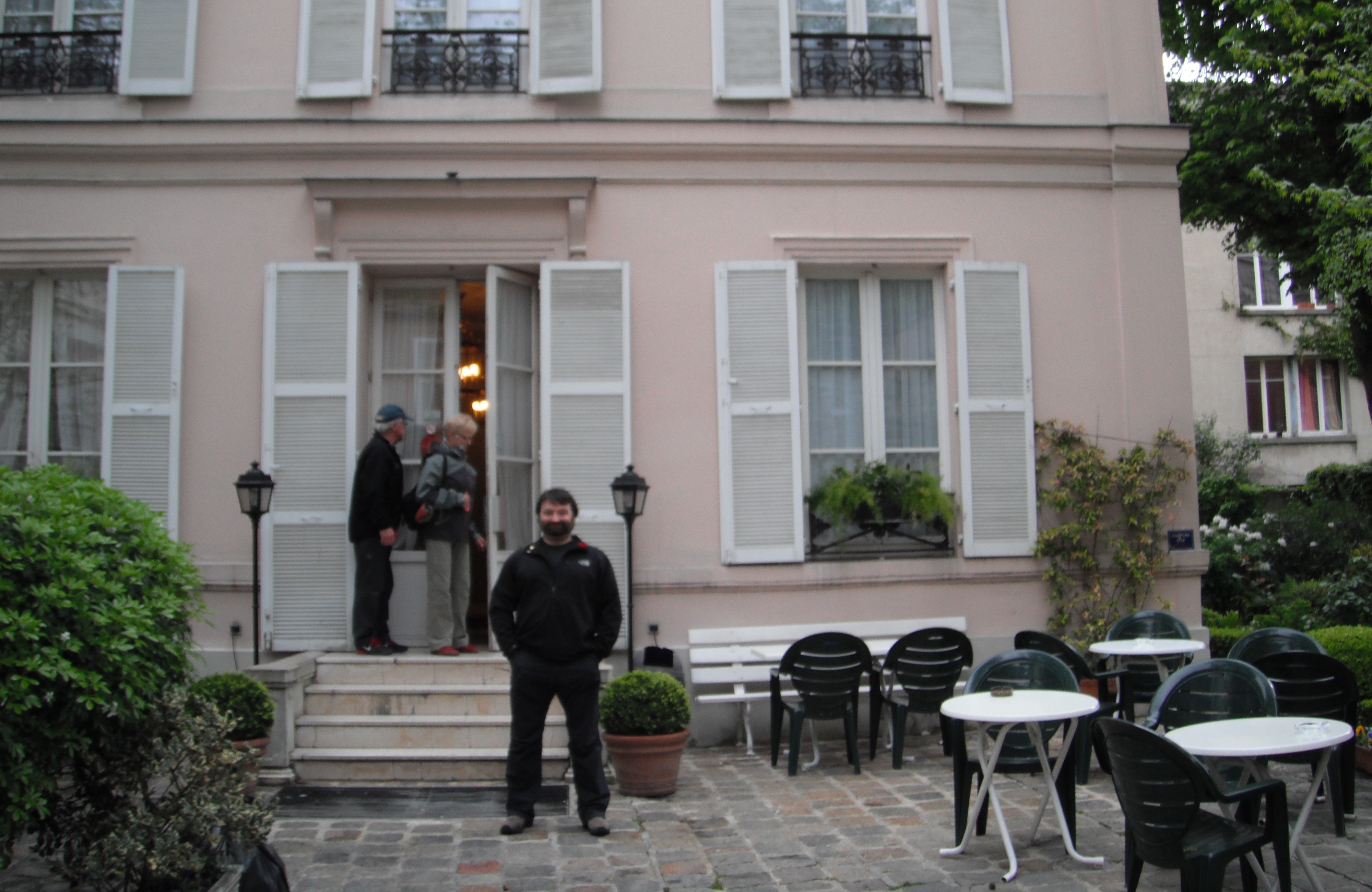
Hotel Grandes Ecoles Courtyard
I’ll be honest, our rooms were a bit tight, but the hotel did have a lovely courtyard paved with cobblestones. And not far away, there was a lovely roundabout with plenty of restaurants, all of which had extensive patios that faced the fountain in the middle. We took a look at all this and selected one based on my wife’s craving for nachos. It was called la Petit , a place that specialized in gourmet burgers and did make a good nacho plate. Instead of sour cream and cheddar, they used crème fraîche and melted Emmental.
Much like in Bayeux, we would dine here twice. Some places just make a lasting impression I guess! Oh, and the beer of choice around the Latin Quarter was yet another Abbey Blonde ale known as Grimbergen, though Kronenbourg certainly got top billing at the local bars as well. With our bellies full and our feet and backs tired of walking and carrying bags, we once again retired for the night and planned for a full day of adventure on the morrow.
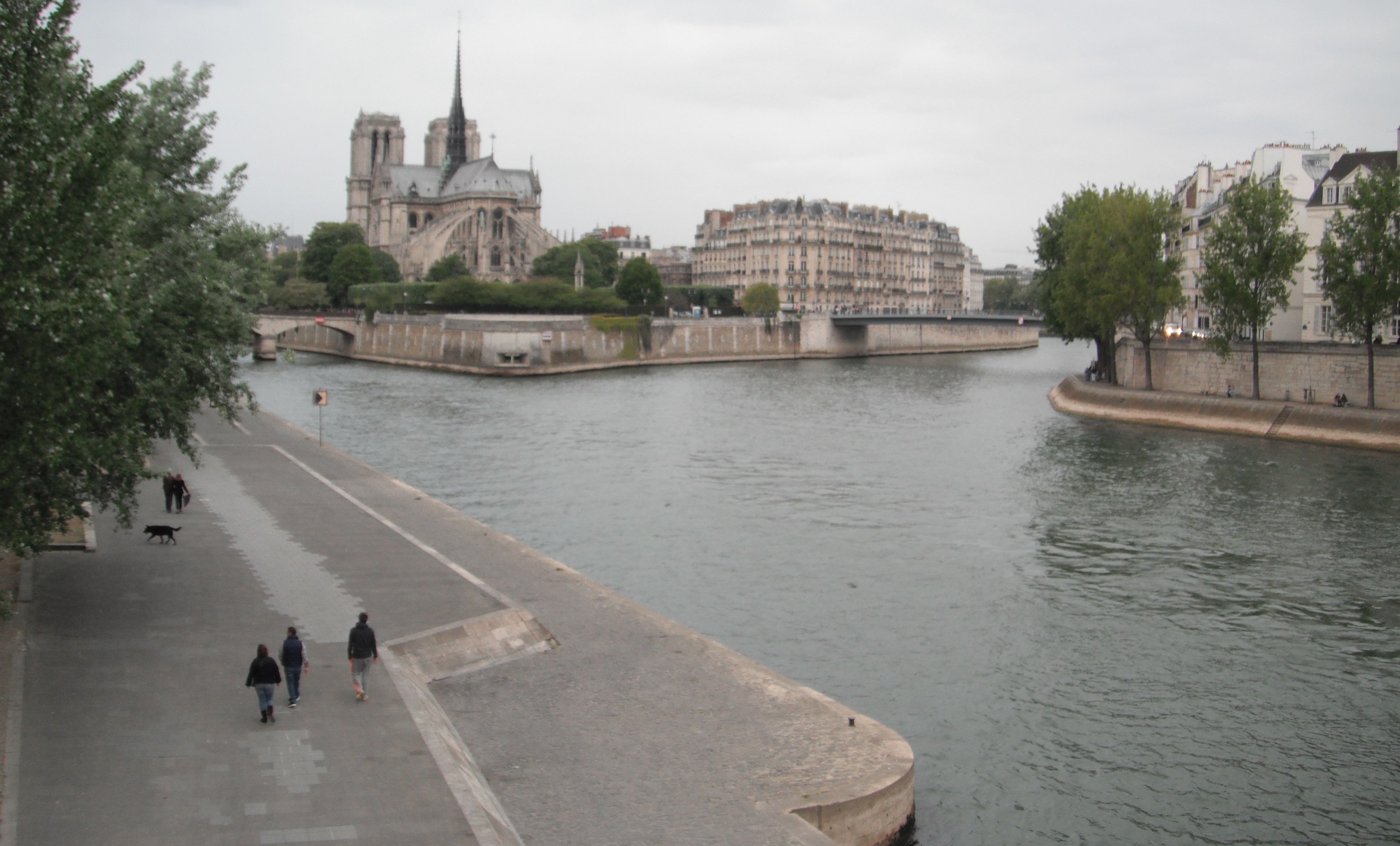
La Seine, with the Notre Dame de Paris Cathedral in the distance
This consisted of us taking a walk down to the Seine to take in all the sights and sounds of Paris. We arrived on Quai St. Bernard, with the Cathedral of Notre Dame to the west by a few leagues. We headed their immediately, and found some serious crowds assembled out front. Since it was Easter Weekend, there was quite a lineup to get in, and we decided we’d have to wait until another day to see the place from the inside. So instead, we decided to catch a bus to see all of the major sights in one afternoon.
As a sidenote, people looking to book a Paris bus tour have the option of doing a single 2 hour roundabout trip, or a day-long trip that where people can jump on and off the bus at any of the major sights. We opted for the former, and rode around on a double-decker and listened to a audio guide through uncomfortable earbuds tell us about what we were seeing. These included the Musee d’Orsay, the Place de Concorde, the Tour Eiffel, the Champs d’Elysee, the Arc de Troimphe, the Hotel des Invalides, the Louvre, the Pont d’Alexandre III, the Galerie Lafayette, the Opera Nationale, the Écoles Militaires, the Field of Mars, and the Hotel des Invalides, amongst others…
Streets of the Latin Quarter
I shall NOT be giving historical background on all of these. Suffice it to say, this blog aint long enough and you people know how to use Google. But I will say, the roundabout tour was fun, scenic, and really drives home the fact that Paris is packed to the gills with heritage and living examples of its long and turbulent history. Seriously, one cannot drive or walk down the street without spotting a plaque, monument or statue that tells the story of something immensely significant that happened there.
Afterwards, we returned to our hotel and met a lovely man named Jaeger. This attorney, who hailed from Australia, was in Paris on business, and after being chatted up by my father, invited us to dinner. The place he took us was a few blocks over from the hotel, and was rather famous! Known as the Maison de Verlaine, a restaurant that is famous for having been frequented by countless literary, political and showbiz personalities – like Hemingway, Marilyn Monroe and the Kennedy’s, to name a few.
La Maison de Verlaine, where we ate Sunday night
And after a rather sumptious meal and a bottle of red that was both subtle and robust, we dropped Jaeger off at a bar in the roundabout near our hotel and retired to our beds for some sleep. Having toured all the major sights that day, we decided we would visit those we were particularly intrigued by on the following day. Only this time, we’d be going by foot and we planned to beat the lines. We had only a few days to go, and planned to see as much as we possibly could before our departure.
But more on that next time. I sincerely hope it’s the last! 😉
DC Animated Original Movies has put out some fairly decent flicks in recent years, especially when it comes to the Batman universe. These include Batman: Gotham Knight, Batman: Under the Red Hood, Batman: Year One, and Batman: The Dark Knight Returns. And in this latest installment, which is based on the popular Batman: Arkham video game franchise, we see Batman and the Suicide Squad team up to take down the Joker and stop him from blowing up the asylum and Gotham City.
In anticipation of its upcoming release, which is scheduled for August 12, 2014, DC Entertainment released the following teaser trailer a few weeks ago. I just stumbled onto it myself, and so I pass it on to all those fellow fans who – if they are like me – would not dare miss this! Enjoy!
During my usual morning consultation of my email and internet subscriptions, I came across a new video by ERP. In this latest showdown, which is once again pop-culture gold, we get cable TVs most popular fathers – Rick Grimes of The Walking Dead and Walter White of Breaking Bad. What better way to generate comedy than to match up a post-apocalyptic dad who was forced to kill his wife’s reanimated corpse, and a chemist who began cooking meth to ensure his family’s future and then became a ruthless kingpin?
And as usual, Nice Peter and EpicLLOYD are just awesome in their roles! Seriously, they just BECOME whoever they’re imitating. Enjoy!
The nation of Japan has long been regarded as being at the forefront of emerging technology. And when it comes to solar energy, they are nothing if not far-sighted and innovative. Whereas most nations are looking at building ground-based solar farms in the next few years, the Japanese are looking at the construction of vast Lunar and space-based solar projects that would take place over the course of the next few decades.
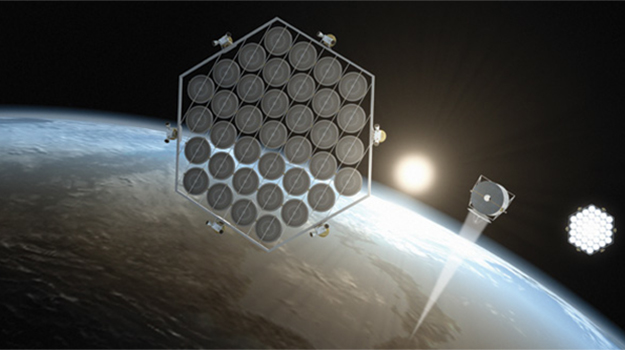
The latest proposal comes from the Japan Aerospace Exploration Agency (JAXA), which recently unveiled a series of pilot projects which, if successful, should culminate in a 1-gigawatt space-based solar power generator within just 25 years. Relying on two massive orbital mirrors that are articulated to dynamically bounce sunlight onto a solar panel-studded satellite, the energy harvested would then be beamed wirelessly to Earth using microwaves, collected Earth-side by rectifying antennas at sea, and then passed on to land.
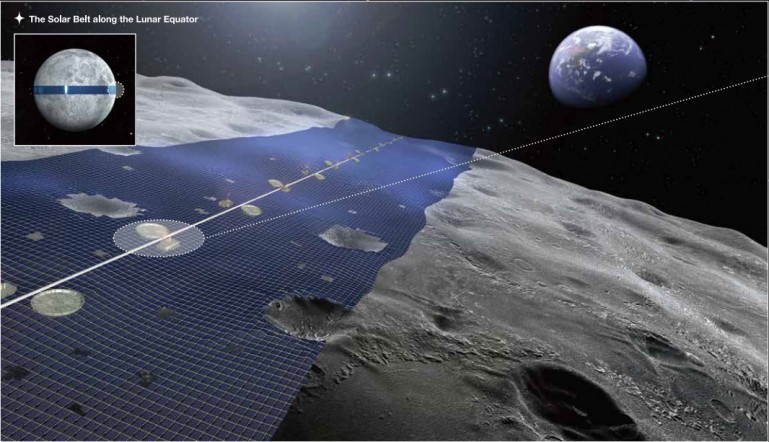
JAXA has long been the world’s biggest booster of space-based solar power technology, making significant investments in research and rallying international support for early test projects. And in this respect, they are joined by private industries such as the Shimizu Corporation, a Japanese construction firm that recently proposed building a massive array of solar cells on the moon – aka. the “Lunar Ring” – that could beam up to 13,000 terawatts (roughly two-thirds of global power consumption) to Earth around the clock.
Considering that Japan has over 120 million residents packed onto an island that is roughly the size of Montana, this far-sighted tendency should not come as a surprise. And even before the Fukushima disaster took place, Japan knew it needed to look to alternative sources of electricity if it was going to meet future demands. And considering the possibilities offered by space-based solar power, it should also come as no surprise that Japan – which has very few natural resources – would look skyward for the answer.
Beyond Japan, solar power is considered the of front runner of alternative energy, at least until s fusion power comes of age. But Until such time as a fusion reaction can be triggered that produces substantially more energy than is required to initiate it, solar will remain the only green technology that could even theoretically provide for our global power demands. And in this respect, going into space is seen as the only way of circumventing the problems associated with it.
Despite solar power being in incredible abundance – the Earth’s deserts absorb more energy in a day than the human race uses in an entire year – the issue of harnessing that power and getting it to where it is needed remain as stumbling blocks. Setting up vast arrays in the Earth’s deserts would certainly deal with the former, but transmitting it to the urban centers of the world (which are far removed from it’s deserts) would be both expensive and impractical.
Luckily, putting arrays into orbit solves both of these issues. Above the Earth’s atmosphere, they would avoid most forms of wear, the ground-based day/night cycle, and all occluding weather formations. And assuming the mirrors themselves are able to reorient to be perpetually aimed at the sun (or have mirrors to reflect the light onto them), the more optimistic estimates say that a well-designed space array could bring in more than 40 times the energy of a conventional one.
The only remaining issue lies in beaming all that energy back to Earth. Though space-based arrays can easily collect more power above the atmosphere than below it, that fact becomes meaningless if the gain is immediately lost to inefficiency during transmission. For some time, lasers were assumed to be the best solution, but more recent studies point to microwaves as the most viable solution. While lasers can be effectively aimed, they quickly lose focus when traveling through atmosphere.
However, this and other plans involving space-based solar arrays (and a Space Elevator, for that matter) assume that certain advances over the next 20 years or so – ranging from light-weight materials to increased solar efficiency. By far the biggest challenge though, or the one that looks to be giving the least ground to researchers, is power transmission. With an estimated final mass of 10,000 tonnes, a gigawatt space solar array will require significant work from other scientists to improve things like the cost-per-kilogram of launch to orbit.
It currently costs around $20,000 to place a kilogram (2.2lbs) into geostationary orbit (GSO), and about half that for low-Earth orbit (LEO). Luckily, a number of recent developments have been encouraging, such as SpaceX’s most recent tests of their Falcon 9R reusable rocket system or NASA’s proposed Reusable Launch Vehicle (RLV). These and similar proposals are due to bring the costs of sending materials into orbit down significantly – Elon Musk hopes to bring it down to $1100 per kilogram.
So while much still needs to happen to make SBSP and other major undertakings a reality, the trends are encouraging, and few of their estimates for research timelines seem all that pie-eyed or optimistic anymore.

 SpaceX’s latest delivery to the International Space Station – which was itself pretty newsworthy – contained some rather interesting cargo: the legs for NASA’s robot space station helper. Robotics enthusiasts know this being as Robonaut 2 (R2), a humanoid robot NASA placed on the space station to automate tasks such as cleaning and routine maintenance. Since its arrival at the station in February 2011, R2 has performed a series of tasks to demonstrate its functionality in microgravity.
 NASA says that the new seven-jointed legs are designed for climbing in zero gravity and offer a considerable nine-foot leg span. Michael Gazarik, NASA’s associate administrator for space technology in Washington, explained:
 Robonaut was developed by NASA’s Johnson Space Center in collaboration with General Motors and off-shore oil field robotics firm Oceaneering. All that corporate involvement isn’t accidental; Robonaut isn’t designed to simply do chores around the space station. NASA is also using R2 to showcase a range of patented technologies that private companies can license from Johnson Space Center.
 In addition to these legs, this latest supply drop – performed by a SpaceX Dragon capsule – included a laser communication system for astronauts and an outer space farming system designed to grow lettuce and other salad crops in orbit. We can expect that the Robotnaut 2 will be assisting in their use and upkeep in the coming months and years. So expect to hear more about this automated astronaut in the near future!





















 Beyond Japan, solar power is considered the of front runner of alternative energy, at least until s fusion power comes of age. But Until such time as a fusion reaction can be triggered that produces substantially more energy than is required to initiate it, solar will remain the only
  Luckily, putting arrays into orbit solves both of these issues. Above the
 Stories by Williams