Back from Europe – Continued…

lest-we-forgetAnd I’m back, with the second installment of what the family and I did on our recent trip to Europe. Like I said before, there is a lot to cover and I couldn’t possibly deal with it all in one post. And after we flew in and did our first day of driving and visiting the Beaumont-Hamel Memorial Park, we drove to the first town where we would be rooming on our trip. This is the historic town of Ypres, Belgium (pronounced either as Eep, or Ee-pairs, depending on whether its spoken in French or Flemish).

And arguably, some of our best times and experiences were here. Not only were the townspeople incredibly friendly, the food and accommodations good, and the local culture something to behold, the way the war is commemorated and those who fell honored is truly astounding. For those of us who only mourn the losses of the Great War and observe the lessons obtained therein once a year, it truly boggles the mind. But I digress, here’s what happened…

Saturday, April. 12th – Sunday, April. 13th –
The Ypres Experience:
As I said last time, Ypres was our first stop after two days of ongoing travel and very little sleep. And after we rested up and showered, we had some pretty full days experiencing the town and the many cemeteries, memorials and museums that dot the landscape. It was also while touring Flemish city and the surrounding countryside that we made what was perhaps the biggest find of our trip – pieces of shrapnel from the war!

Now for those unfamiliar, this ancient town is the municipal capitol of West Flanders that dates back to before the time of the Roman conquest. During the Middle Ages, it was renowned for its cloth and textile industry, and was even mentioned in the Canterbury Tales due to its extensive trade with England. However, the town is best known due to the fact that it was contested ground for three separate battles during the Great War.

The_Second_Battle_of_YpresDuring the First Battle of Ypres, which took place from October 19th to November 22nd, the Allies retook the town from the Germans, who had captured it during their initial advance through Belgium. The Second Battle of Ypres – April 22nd and May 25th, 1915 – was where the German army attempted to break the stalemate in the west by using poisonous gas for the first time. It was at this time, as already mentioned, that the 1st Canadian Infantry Division distinguished itself by standing their ground and beating back the German assault.

To put this in perspective, the Canadians were an untested unit that had recently arrived in Flanders to witness the terrible carnage that had become of the war. When the Germans unleashed the poisonous clouds of chlorine gas into the city, these soldiers did not yet have gas masks (or proper helmets) and thousands of men began to die. The French and British lines crumbled under the onslaught; but at St. Julien, where the Canadian Division was stationed, an inventive Canadian officer came up with a novel idea that saved them from death and retreat.

Battle_of_St.JulienRemembering a lesson from chemistry class, he ordered his men to urinate on rags and apply them to their faces. Knowing that ammonia, which urine contains, neutralizes chlorine by turning it into harmless ammonium chloride crystals, the Canadian soldiers simply breathed naturally through their urine-soaked rags and waited for the gas to roll over them. When it did, they took up their positions and were there to meet to the Germans when they assaulted.

Because of this, the German attack failed, and led Sir George Perley (Canada’s High Commissioner in Britain) to state that the “saved the situation”. British Lieutenant General Smith-Dorrien followed this up with the conciliatory statement that had it not been for the Canadian troop’s gallantry, the initial German breakout that took place early in the battle “might well have been converted into a serious defeat for our troops.” All told, this gallantry came at a terrible cost – with some 5,975 casualties, of whom roughly 1,000 were killed.

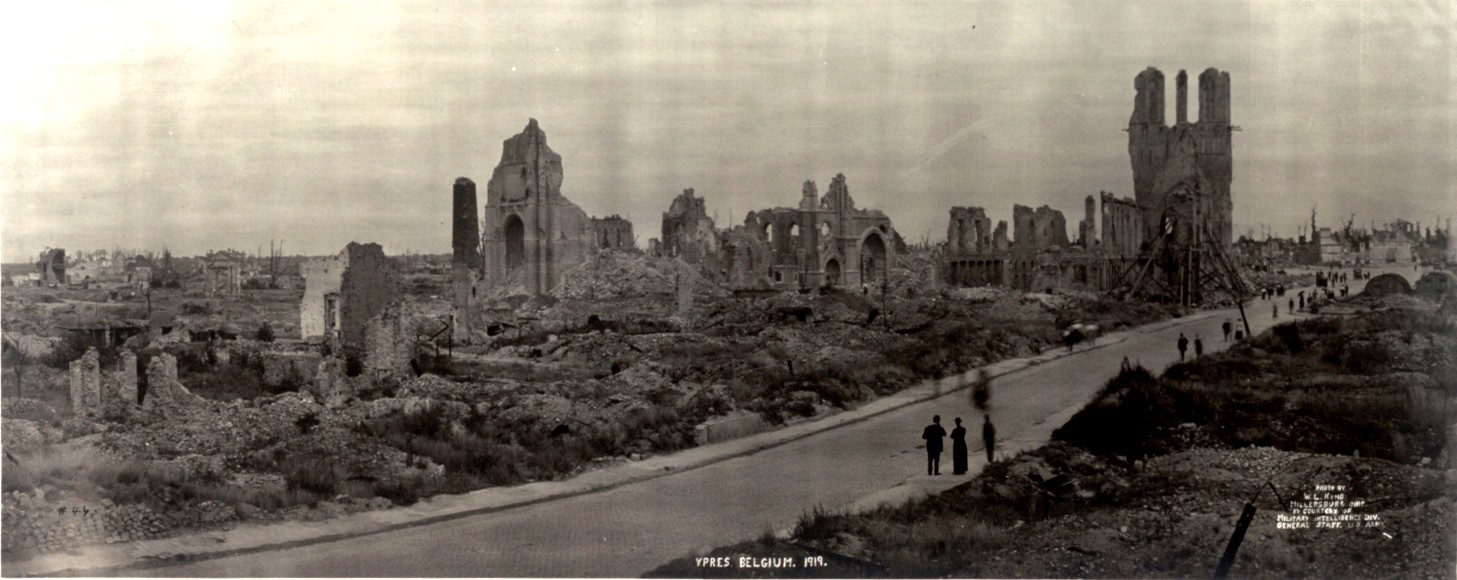
Ypres in 1919
The ruins of Ypres in 1919

The battle raged on for many more months, with some 100,000 men being killed, captured or wounded before the end. However, it was The Third Battle of Ypres – also known as the Battle of Passchendaele (July 21st – November 6th, 1917) that was the best-known and bloodiest of the war. After months of fighting, this battle resulted in nearly half a million casualties on all sides, and only a few miles of ground were won by the Allied forces. During the course of the war, the town was also all but obliterated by the artillery fire.

These events are commemorated on a daily basis by the town’s people, and the names of those who fell are inscribed on the Mennin Gate, which sits at the east end of the old city. But I’m getting ahead of myself here! Before I can cover all the historic sites we took during the course of our stay, I should mention the hotel where we slept, which was none other than the Hotel Albion. In addition to being located in a building in the old city, the rooms were spacious and beds king-size, which came in handy upon arrival!

The old city, as it is today

After waking up on Saturday and getting some much-needed shower time, we enjoyed the hotel’s traditional Belgian breakfast spread. This consisted of hard boiled eggs, sliced meats, cheeses, assorted breads (baguette, croissants, pain au chocolat, etc.), jams, and of course some really good coffee. After eating and drinking our fill, we set out about town, and our first stop was the Cathedral located next to our hotel. After appreciating the centuries-old architecture, we lit some candles and headed for the center of the old town.

Next up was the bookshop my parents had seen on their last visit and wanted to see again, a place called The British Grenadier, which specializes in war memorabilia, books, and historic keepsakes. The guy who runs its, a man by the name of Steve Douglas, just happens to hail from Waterloo, Ontario, where my parents lived and studied for many years before I was born. While there, we chatted with Steve (a rather stoic figure who nevertheless seemed to remember meeting my folks) bought some postcards, poppies, a hat for myself, and marveled at his large collection of wartime artifacts and commemorative goods.

The Ypres Market, with the spires of the Cloth Museum (left) and Cathedral (right) in the distance

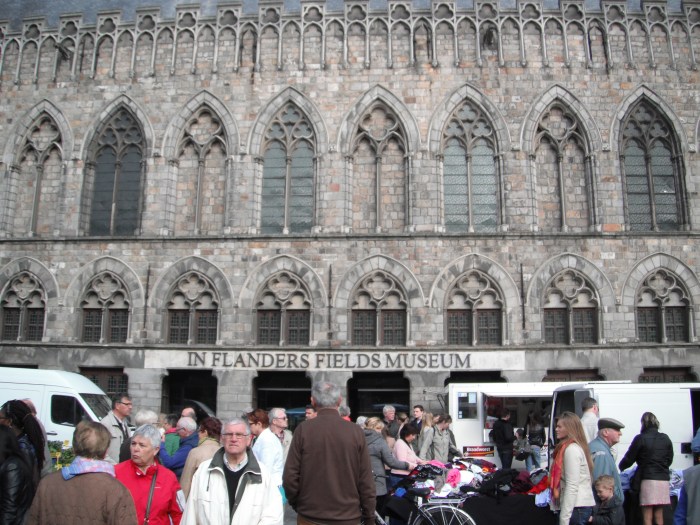
After that, it was off to the town market which, since it was a Saturday, was out in full force! Basically, the center of the old town was filled with vendors of every kind peddling snacks, clothing, shoes, fresh meats, fish, cheeses, and even some livestock. After walking through this crush of human activity, we came upon the Cloth Museum. This massively long medieval structure was the heart of the city’s linen and textile trade, and was made incredibly long so that bolts of cloth could be unwound completely to check for authenticity.

After being almost completely destroyed in the war, the town rebuilt it and renamed it the In Flanders Fields Museum, in honor of the John McCrae poem of the same name. Once inside, we got to see just how amazing it was. The entire museum is kept dark, somber music plays in the background, and multimedia displays show reenactments of various aspects of the war.  There are also photographs, maps, and artifacts as far as the eye can see. And every visitor is asked to make an account for themselves in the museum database and given a poppy-shaped wrist band that is programmed to identify you.

DSCF2152These identifying wristbands not only allow you to get in and out, they also let you access to terminals and have what they call “Personal Encounters”. Basically, this amounts to you accessing various terminals throughout the library and being given information on people who served in the war. Once obtained and compiled to your account, you can request that the museum email it all to you, which I naturally chose to do. The names of my Personal Encounters were Elsbeth Schragmuller, William Flack, and Mike Mountainhorse.
Click here to see the museum certificate that contains their bios, and be sure to check out the museum’s website for more information on who they are and what they do. After exiting the museum, we had some lunch from a sausage cart (foot longs with fried onions and some interesting choices of sauce) and headed over to the Cathedral located next door, which was also destroyed during the war. Here, we watched as the local choir was warming up for a big show and lit some more candles.

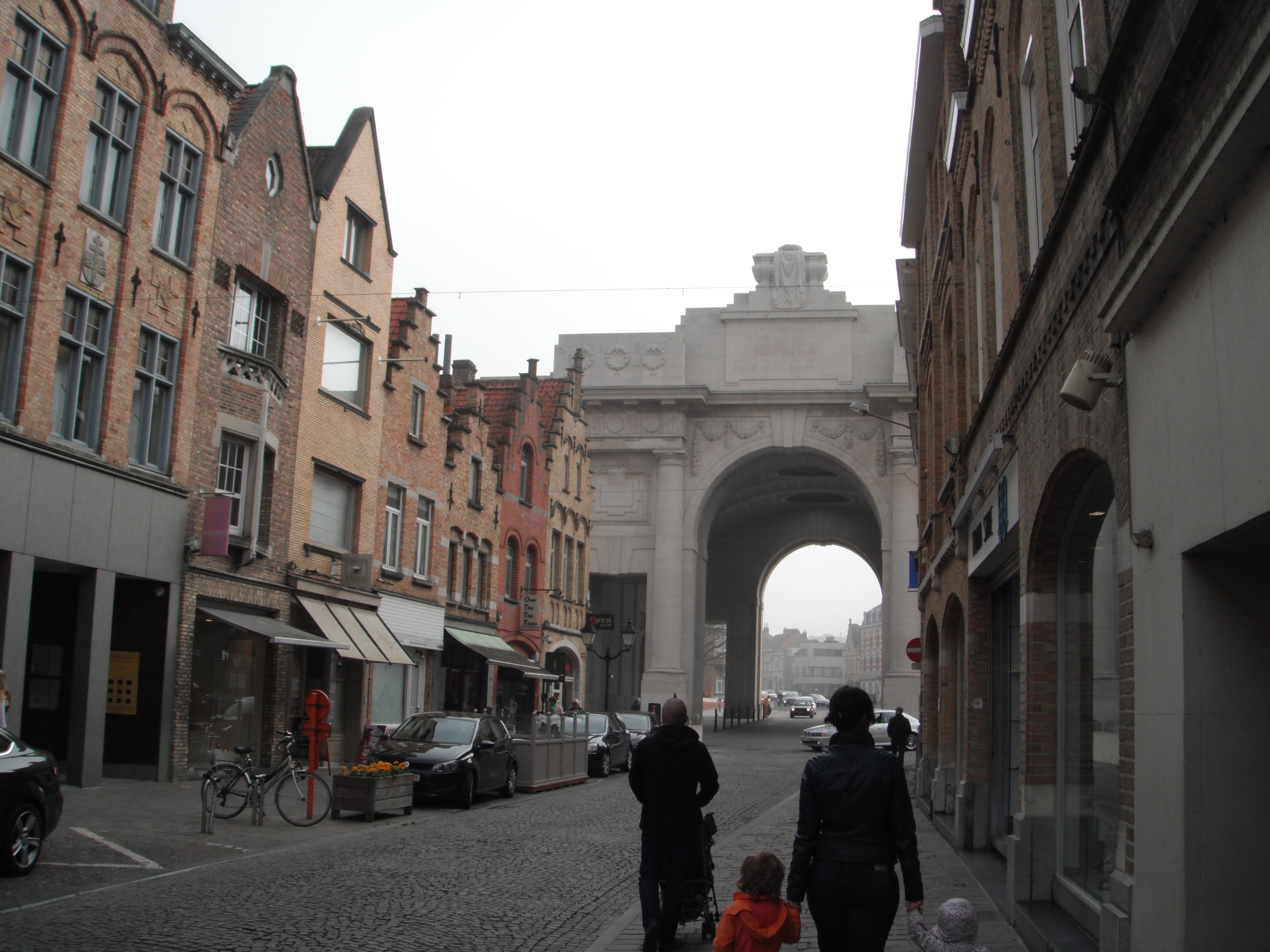
The Mennin Gate, seen from the street
The Mennin Gate, as seen from the street

Then it was a quick nap back at the hotel to combat the lingering effects of jet lag followed by some dinner in the market at a place known as Antonio Vivaldis, which my parents had been to the night before. We drank Leffe Blonde, which is available here in Canada but is something of the beer of choice in Flanders. Last time my folks came back, they made it quite clear that this and Kronenbourg (also a local favorite) were now their beers of choice!

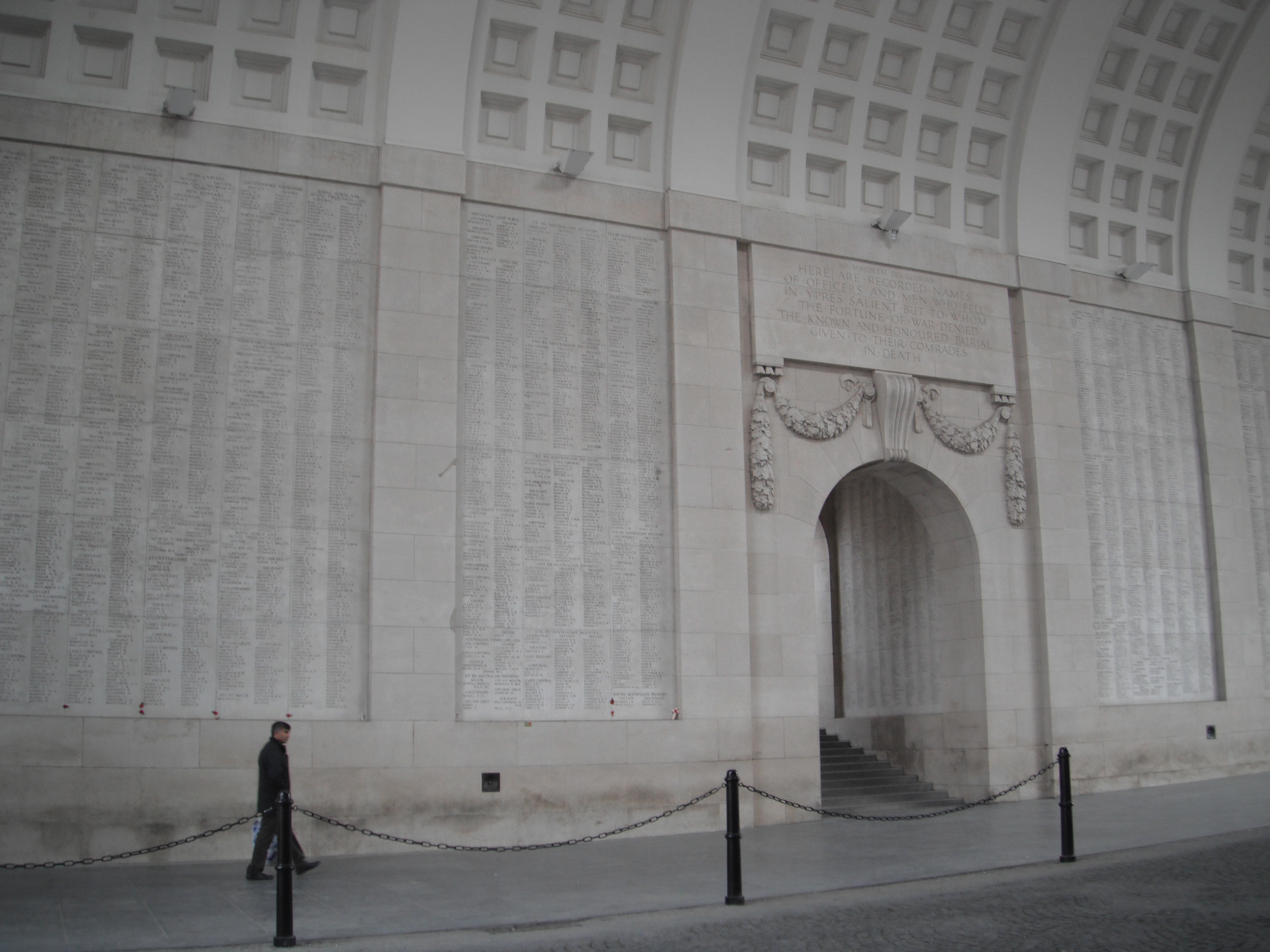
Then, we walked down to the Mennin Gate to take in the Saturday night ceremony that honors all the Commonwealth soldiers who died during the Great War. This great archway, which you can see above, has the names of every single soldier inscribed on it, and ceremonies to honor their sacrifice take place every night. Yes, you read that right. EVERY SINGLE NIGHT the people of the town gather at the gate, the local choir sings songs, the Mayor comes out to speak, The Last Post is played, and wreaths are lain.

Inside the Mennin Gate. Note the names inscribed on the walls

And even though this is a daily occurrence, Saturday is a special night, when the largest and most elaborate ceremony takes place. I should also note that in Ypres, the poppy – as a symbol of remembrance – is worn year round and can be seen just about everywhere one looks. To put that in perspective for us foreign folks, its like having Remembrance Day (Veterans Day, Poppy Day, Armistice Day) every day. None of this once-a-year on November 11th stuff.

We then walked the wall, which overlooks the moat that circles the old part of town and also has its share of commemorative plaques and statues. I tell you, every corner of the town pays homage to its long and rich history, and even a short walk can reveal all kinds of interesting things! And that was Saturday. Sunday morning, we woke up, had another sumptuous breakfast, and headed out of town to visit all the Commonwealth Cemeteries we could find, as well as a German one.

Yorkshire Trench
Yorkshire Trench

We began with the Concrete Farm Cemetery, a smaller Commonwealth cemetery located outside of town. After stopping here to pay our respects to these soldiers and lay some Canadian flag pins on the Canadian graves, we continued on to Yorkshire Trench. This trench and the park that now features it was first uncovered in 1992 by a group of amateur archaeologists known as “The Diggers”, people who are dedicated to finding the bodies of the fallen that were never retrieved and giving them a proper burial.

Between 1998 and 2000 they spent many hours digging and examining the trench, which also had tunnelled dugouts. At the time major construction work for new buildings in Ypres’ northern industrial zone was also being carried out. Hence, like so many other trenches, graves and unexploded munitions, this small piece of the Ypres Salient was discovered entirely by accident. And in addition to many artifacts “The Diggers” discovered, the remains of 155 First World War soldiers were uncovered – the bodies of British, French and German that were lost in battle and never recovered for seventy years.

Outside Langemark Cemetary
Outside Langemark Cemetery

Then, it was off to Langemark, the German cemetery that was set aside by the Belgian government. Compared to the Commonwealth grave sites, this cemetery was very somber. Pruned trees surrounded the outer edge of it, the concrete bunkers that had served as dugouts during the war were now filled with leaves and detritus, and the many, many German fallen were interred four to a grave marker. And near the front gate, a single, mass grave known as the “Comrades Grave” contains the bodies of no less than 24,917 servicemen, including the flying ace Werner Voss.

Inside the gatehouse, the names of the more than 44,000 soldiers who died during the many battles of Ypres are etched into the wooden walls. Of particular interest were the names of the 3000 German students who fell while crossing the field that next to the cemetery. Legend has it that these German students walked arm in arm and sang “Deutschland, Deutschland über alles” as they charged across the battlefield, and to their deaths. Yet another reminder of the futility and folly that characterized the Great War for all sides.

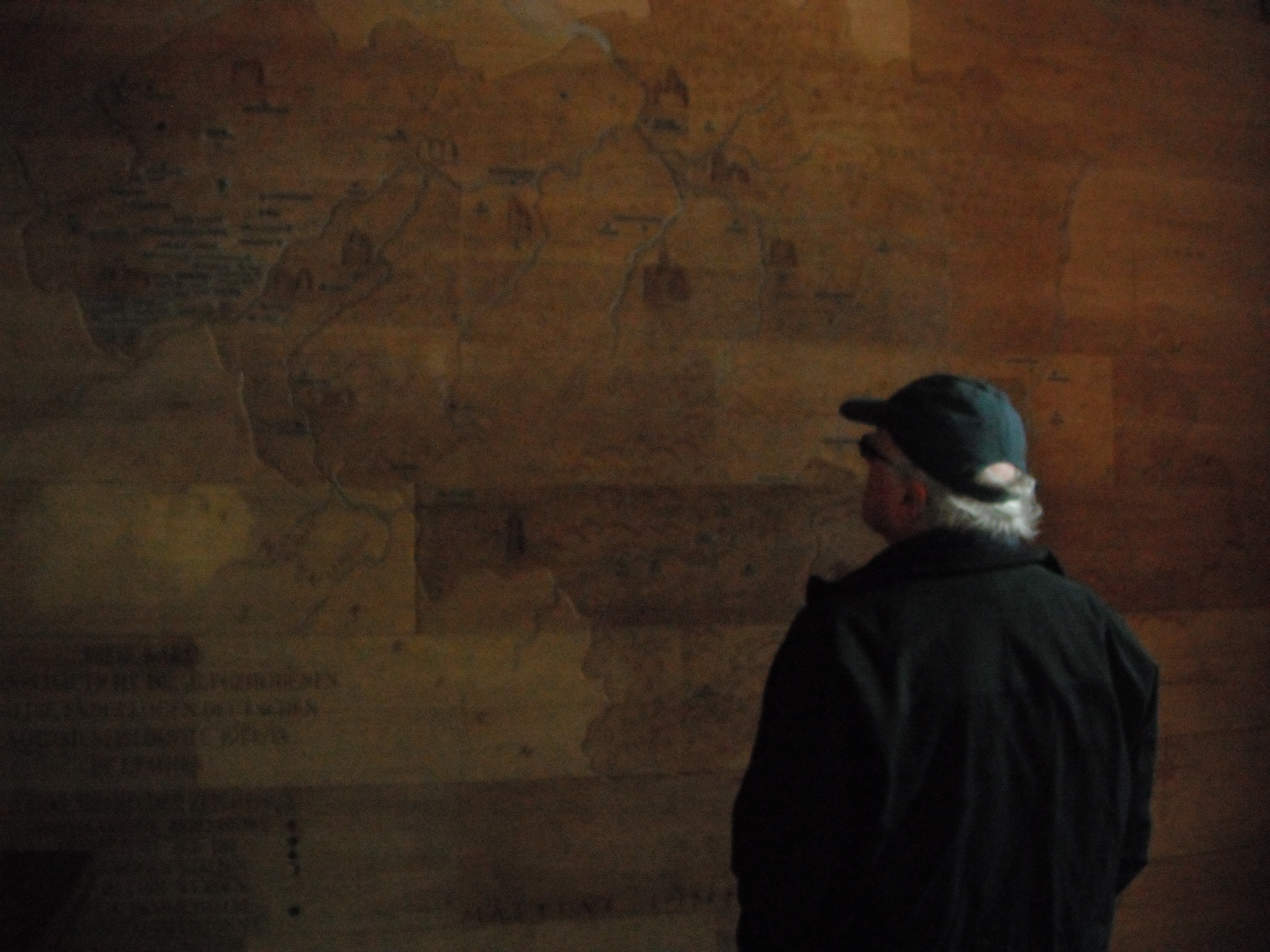
My father examining the map of the Ypres Salient inside the cemetery's entrance foyer
My father examining the map of the Ypres Salient inside the cemetery’s gatehouse

It was also here that my father and I, while searching in the farmers field next to the cemetery, came across our most important keepsakes from our trip. As he knew from his previous visits to the countryside, the fields that once made up the Ypres Salient constantly turn up pieces of shrapnel, spent shell casings, and even unexploded munitions when the weather changes. In this last case, farmers come across these shells when the winter weather causes the ground to freeze and the soil pushes these shells to the surface. Typically, these are then removed and placed by the side of the road to await for bomb disposal crews who take them away and detonate them.

But in the case of shrapnel, bullet casings and other pieces of wartime history, one doesn’t have to look very hard to uncover them. Simply walk into a farmer’s field or a dig anywhere in the region, and odds are good you will find something. We had a hard time searching the nearby field since a tractor was out turning the soil with some rather large blades. Still, we managed to find several fragments of exploded shells at the edge of the field, and after only a few minutes of looking.

The shell and bullet fragments we found by Langemark Cemetery

The grizzly significance of this was not lost on us: that so many artillery shells and bullets were fired in this region over a century ago that bits and pieces are still being found, and it took us only a few minutes of searching in a tiny parcel of land to find some. And of the four pieces that we pulled out of the ground, the first and largest was certainly the most recognizable. Roughly three inches long, an inch and a half wide, and over half an inch in thickness, this hunk of rusted metal had a curvature and striations on one side that indicated that it was an artillery shell.

We guessed that it was British, and given its size, it most likely came from a 18-pounder field gun. The other two, much smaller, looked to be large bullet fragments, in that they were cored in the center and not that big. Still, they appeared rather large for a standard rifle or machinegun, so it’s possible they were from a heavy machine gun. Of course, its difficult to say since 100 years of caked-on dirt, rust, and wear can kind of obscure a fragments true size and dimensions.

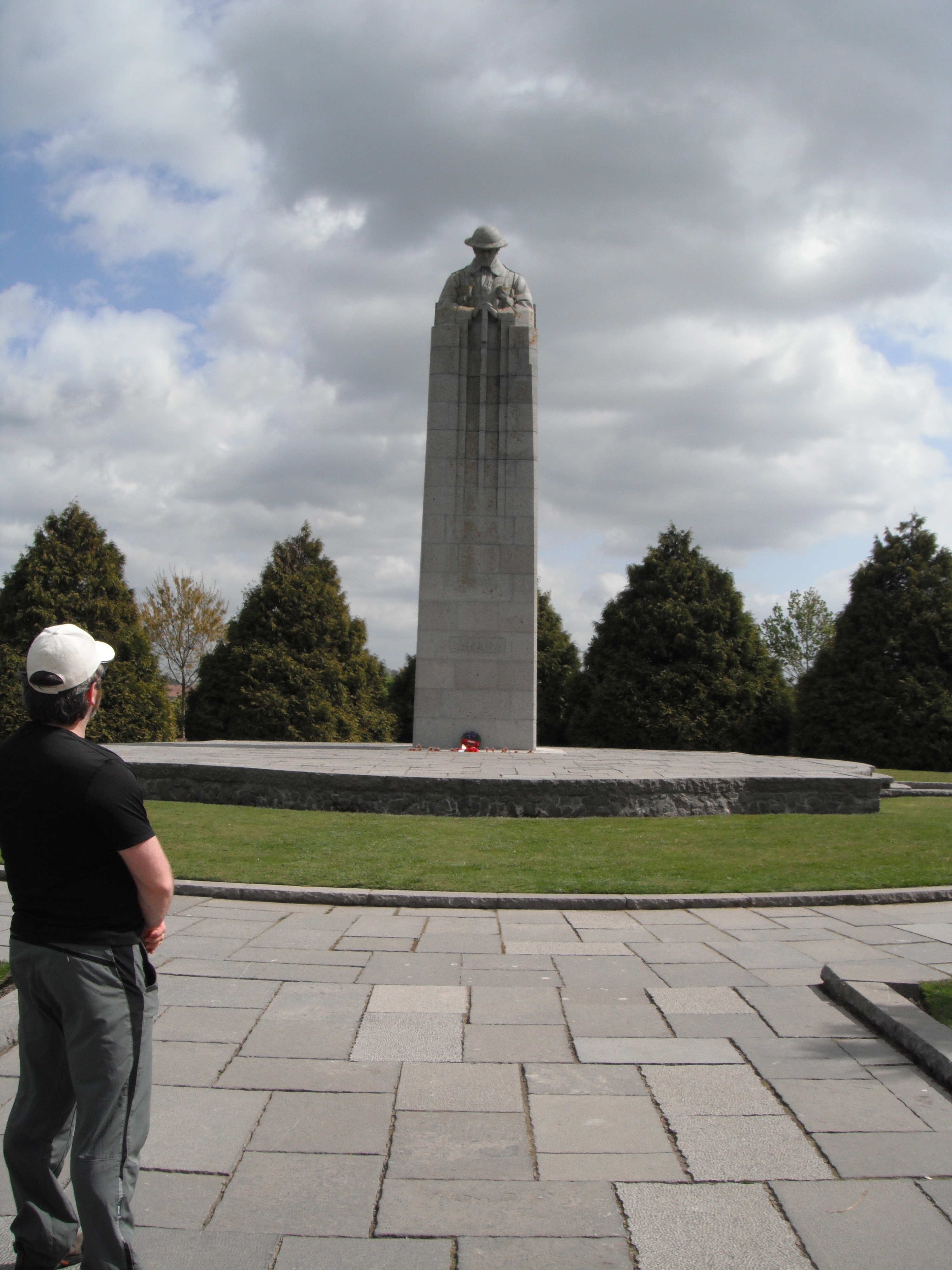
The St. Julien monument

After that, it was on to St. Julien, the town outside of Ypres where the monument to the Canadian soldiers who held their ground during the first gas attack is located. While admiring the monument, my father spotted a fellow Canuck, who was identifiable from his Hamilton Tiger Cats jacket (his hometown). After spotting him, my father went over and promptly chatted him up. He does that a lot! And then, it was off to our last stop for the day – the Tyne Cot Commonwealth Cemetery.

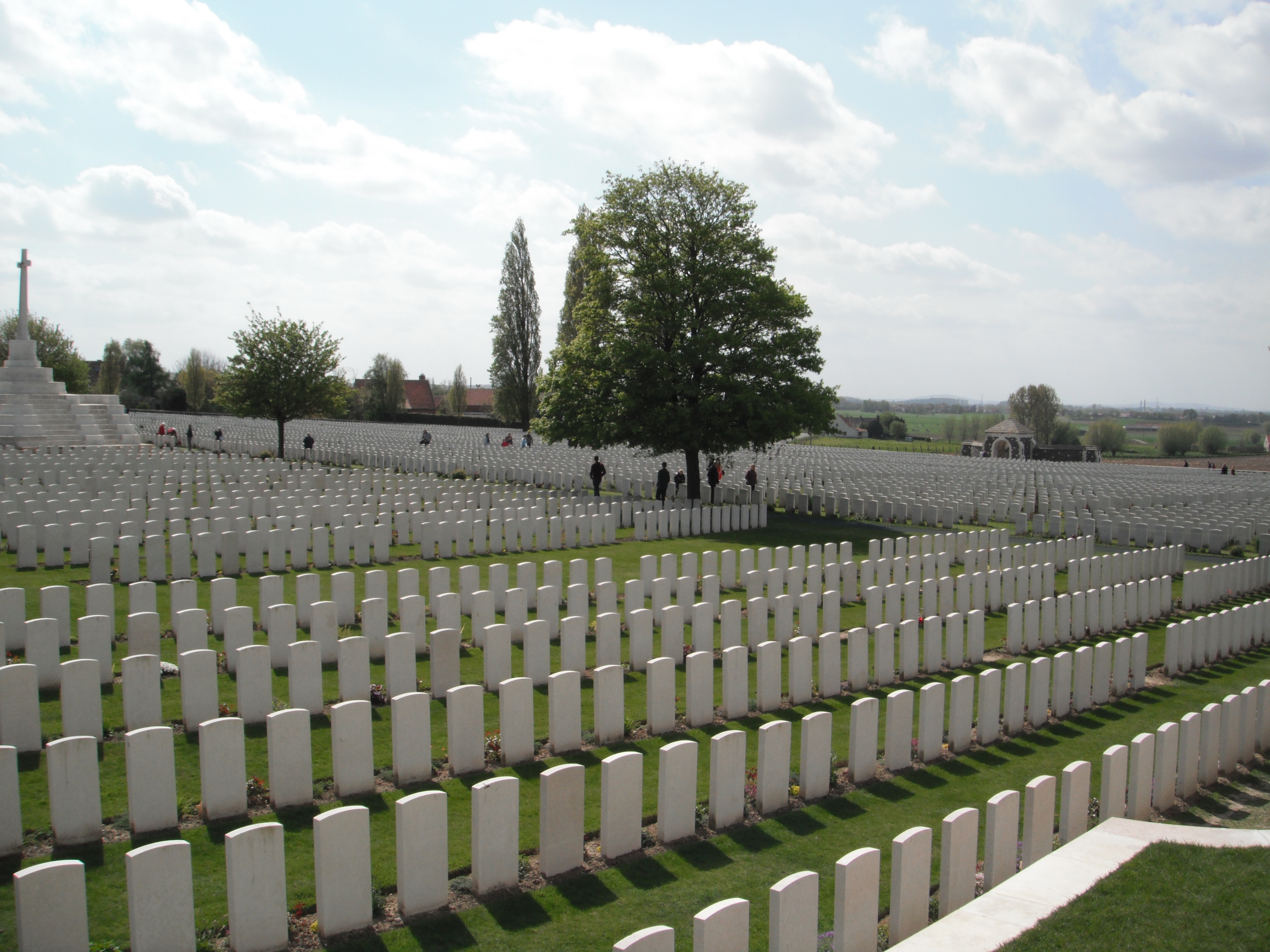
This cemetery, which is the final resting place of 11,954 soldiers who died in the Ypres Salient during the Great War, is the largest Commonwealth cemetery in the world. Of these, some 8,367 are unidentified, and their headstones are inscribed with the words “Known unto God”. In addition to these graves, there’s also the four memorial that honor the roughly 90,000 British and Commonwealth soldiers who died here – most of whom were never found or properly identified – with the names of each inscribed on the walls.

Tyne Cot Cemetery
Tyne Cot Cemetery

We started with the Visitor’s Center, a small and somber museum, before working our way into the cemetery proper. Inside and out, we heard a recording playing where the names of all those who fell in the Ypres Salient were spoken on a loop. To give you some sense of how many men that was, the recording takes a full FIFTEEN YEARS to get through the entire list. Yes, more men fell in this region within the space of four years than can be even be named in that same amount of time. Unbelievable!

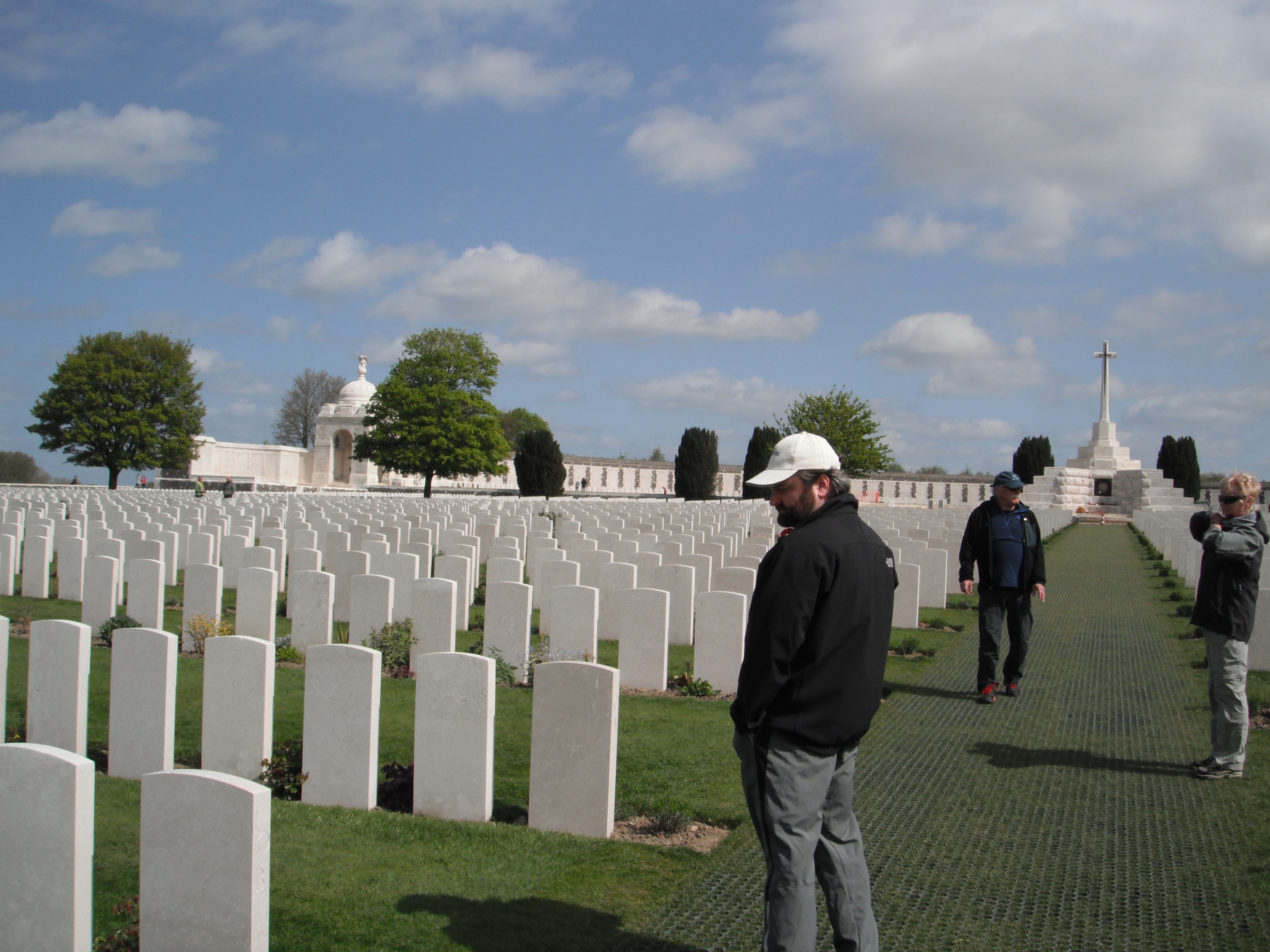
Once outside, we walked amongst the headstones and looked for the telltale Maple Leaf that indicated that it was a Canadian soldier who had been buried there. On these, we placed Canada flag pins and thanked them for their service. I can tell you, being surrounded by so much death, and knowing the sheer scale of it, was quite overwhelming. After we had run out of pins and written our names in the visitors book, we hopped back in the car and drove back into town.

My parents and I looking through the headstones

The rest of the day was spent separately, with my folks having dinner on their own and Carla and I going out for a run. We spent about an hour running around the wall that encircles the old city, visited the Cathedral again, found a place to eat (a nice bistro called “The Goose”), and gorged ourselves on curried chicken, chicken wings, and salad, all of which was washed down by some lovely Belgian Trappist beers and a tall Pilsner. It was a nice, gentle way to conclude a day characterized by sober reflection and somber reminders.

And then, the quiet sleep, knowing that it was our last night in Ypres and we would be leaving for the Normandy coast, and visiting the Vimy War Monument, the next day. It would be the day when we made our final visit to a monument dedicated to those who served and died in the Great War, and the first day of visiting World War II monuments, museums, and cemeteries. And to do it justice, I am going to need to give it it’s own post!

Until next time, thanks for reading, and always remember how fortunate we are to live in a world where total war is a thing of the past. May we never forget, and never be forced to repeat the mistakes of the past!

Game of Thrones – Season Four, Episode Three

got4And we’re back with another backlogged episode of Game of Thrones! As expected, the third episode of the season quickly picked up after the events of the “Purple Wedding”, following the escape of Sansa from King’s Landing, Tyrion’s arrest for Joffrey’s murder, and the Lannisters and Tyrells trying to pick up the pieces of their alliance. At the same time, we got to hear from some other threads characters, such as Arya and Sandor as they continue across the Riverlands, and Jon Snow and the Night’s Watch at the Wall.

But arguably, the most important thing to come out of this episode was Danaery’s and her long-awaited confrontation with the city of Mereen, the last great city of Slaver’s Bay. This was the highlight of the episode, which is why it bears the name…

Breaker of Chains:
GOT4_3_1The episode opens on the aftermath of the wedding, with Cersei ordering Tyrion’s arrest and that Sansa be found. She, meanwhile is ferried to the coast by Ser Dontos, who puts her on a small boat and rows her out to meet a larger vessel. Once on board, she finds Petyr Baelish waiting for her, and Ser Dontos is shot with a crossbow and killed. He reveals to her that her rescue was entirely his plan, and Ser Dontos his agent, and that they are now sailing for his home.

In the Grand Sept, Joffrey’s body is arrayed and Tommen, Cersei and Tywin stand over it. Tywin queries Tommen over what kind of king he will be now that his brother is dead. He teaches him that holiness, justice and strength – as epitomized by Baelor, Orys I, and Robert – must take a backseat to wisdom, which his brother lacked and which led to his death. He also councils him to marry soon so he can father an heir before long.

GOT4_3_2Jaime enters after and orders everyone leave him and Cersei alone with Joffrey’s body. Cersei accuses Tyrion of murdering their son and demands his death, but Jaime refuses to believe it. She tries to send him away, but Jaime forces himself on her on the Sept floor. Further north, Arya and Sandor are still on their way to the Eyrie, are discovered by a local land owner, and Arya talks them into getting room and board for the night.

Over dinner, the land owner tries to convince Sandor to stay around, claiming that Frey banner men are raiding all across the land and they are in need of protection. Sandor accepts, but in the morning, Arya finds that he’s assaulted the man and stolen his silver, and tells Arya they are leaving again. She calls him many names, but Sandor insists that the family won’t survive the winter and she needs to learn from her family’s fate that the world is a cruel place.

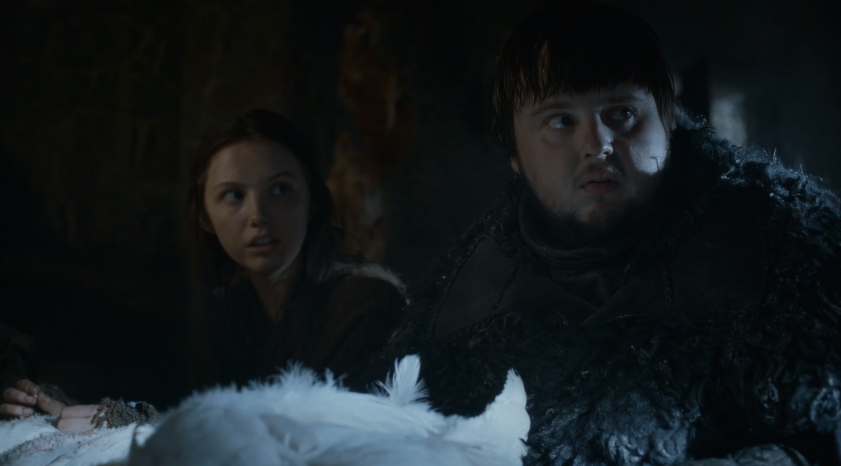
got4_3_5At the Wall, Sam and Gilly are settling back in. He urges her to go to Mole’s Town for her own safety, but she is hurt to think that he is sending her away. Once there, Sam arranges for her to work in the brothel as a maid and promises to come visit. On Dragonstone, Stannis tells Davos of Joffrey’s death and demands that they press his claim. Short of men and funds, Davos suggests they recruit the Golden Company, and decides to writes to the Iron Bank of Bravos to implore them for gold.

South of the Wall, the Wildling party wipes out a small village and Styr spares one boy, telling him to go to the Wall and inform them of their attack. At Castle Black, they debate what to do, and they agree that their main problem is stopping Mance’s army and that they must shore up the wall and its defenses. More survivors arrive from Craster’s Keep, and Jon orders that they ride there to kill the mutineers, who he fears will tell Mance of their true numbers once they are captured.

GOT4_3_6In King’s Landing, Tywin confronts Prince Oberyn about Joffrey’s murder. He naturally denies any involvement, and asks that he be allowed to meet the Mountain. Tywin agrees, but asks that in exchange, Oberyn act as one of Tyrion’s judges, sit on the Small Council, and bring Dorne back into the Seven Kingdoms, so that they may stands against all the unresolved threats to the Realm. In the dungeons, Pod meets Tyrion and tells him of his impending trial. Tyrion warns him to get out of King’s Landing and says his goodbyes.

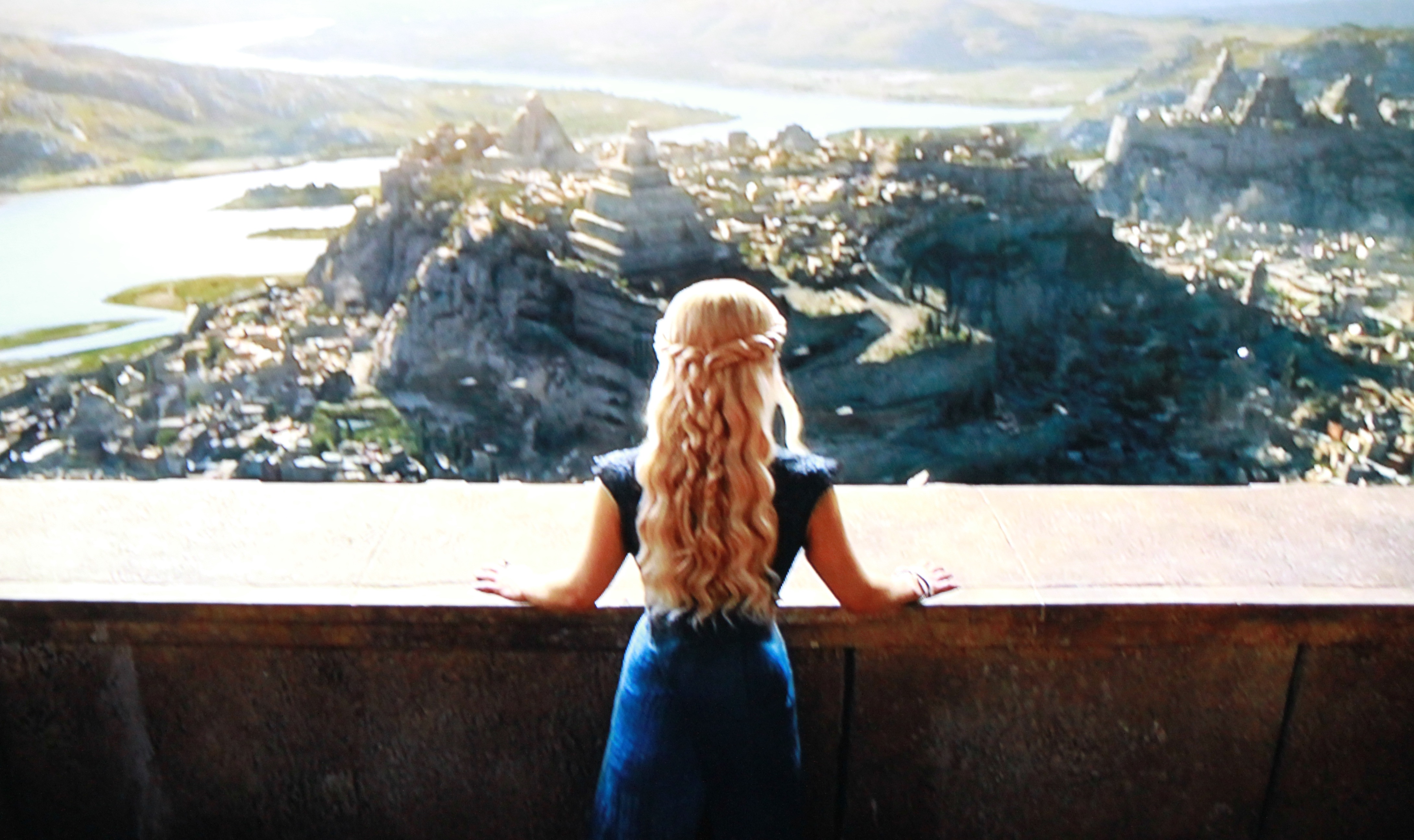
In Essos, Daenerys and her army arrive at Mereen at last and are met by a champion of Mereen. Grey Worm, Ser Mormont and Ser Selmy and Daario all volunteer, and Daenerys decides to send him he claims to be the least indispensable. Daario confronts him on foot, and when the champion charges, he takes down his horse with a thrown dagger and then slices his throat before he can recover. Returning the champions opening gesture, he then urinates in front of the crowd standing on the walls.

GOT4_mereenDaenerys then addresses the slaves of Mereen, telling them she has come to free them from their masters. She then has her catapults lob cases filled with broken chains and slave collars from Astapor and Yunkai into the city, which then break and are taken and inspected by the slaves. One slave picks up a broken collar, similar to the one he wears, and looks over his shoulder at a fearful master.

Summary:
All in all, this was a pretty good episode, which provided some pacing and build-up after the previous week’s “Purple Wedding” shocker. Though I must admit, I was a bit disappointed with the climax and how they bit it short. After all this time marching towards Mereen, I had hoped that they would at least show a little bit of the of the siege. However, it is clear that we will have to wait until the next episode to see all that. And there were the numerous changes they made this week from the text that sort of stuck out for me as well.

First off, Jaime never raped Cersei inside the Sept while Joffrey’s corpse lay before them. It was when he returned to King’s Landing, before the wedding, that they had consensual relations. There was none of this vindictive “you took too long” crap and she was naturally very happy to see him. That whole seen seemed odd and distasteful to me, and apparently it was quite controversial with audiences in general. One has to wonder why they did it.

Second, Jon Snow never proposed riding to Craster’s Keep in the books, and no additional survivors made it back from the north aside from him, Sam and Gilly. Given that they were expecting an impending attack from Mance north of the Wall, and they had the raiding party coming up from the south, leaving Castle Black was the last thing they could afford to do. What’s more, no one was believed to have survived up there, so there really was no point to it.

Third, when they reached Mereen, the confrontation was between the Mereenese champion and Strong Belwas, a former gladiator who had been travelling with Selmy. Daario was not the one to kill the champion, but since they’ve chosen to write Belwas out, they had to do a substitution. Also, the fight was short and anticlimactic compared to what happened in the book. It was here that Belwas, a rotund and heavy-set guy, impressed Daenerys and the others by outmaneuvering the man on horseback and slaying him with his arakh sword.

Which brings me to another point that is going to be relevant come next week. In addition to Selmy having Belwas as a traveling companion when he first met Daenerys in Qarth, he was also operating under the assumed identity of Aristan Whitebeard. After he and Belwas saved Daenerys from an assassination attempt in Qarth, she rewarded them by accepting them as her companions. It was only upon their arrival at Mereen that she learned the truth of his identity, which he kept secret since he was in the service of King Robert (her sworn enemy).

This played in an important role in what came next, but more on that in next episode’s review. While I am always likely to gripe about changes made, I did still enjoy this installment and have noted that many of their more profound changes in the past did work out in the end. So I plan to give them the benefit of the doubt as I move onto the fourth and latest episode of the season. A siege awaits, and plenty more intrigue and action on all the other fronts!

Game of Thrones – Season Four, Episode Two

GOT4_2_1Hello again all! In my effort to catch up on things that have happened while I was overseas, I now turn to the the any episodes of GOT that have aired in the past few weeks. Needless to say, their were some rather important ones, and ones which I was eagerly awaiting after last season’s bloody and brutal ending. And since I am several weeks behind, I think we can dispense with the usual spoiler warnings and I can say that I was really looking forward to seeing Joffrey die!

And now he has, thus showing the world that in George RR Martin’s universe, bad things occasionally happen to bad people as well. But enough of all that, I got episodes to review and this is just the first of three. So without further ado, here’s what happened in the second episode of the season, aptly titled…

The Lion and the Rose:
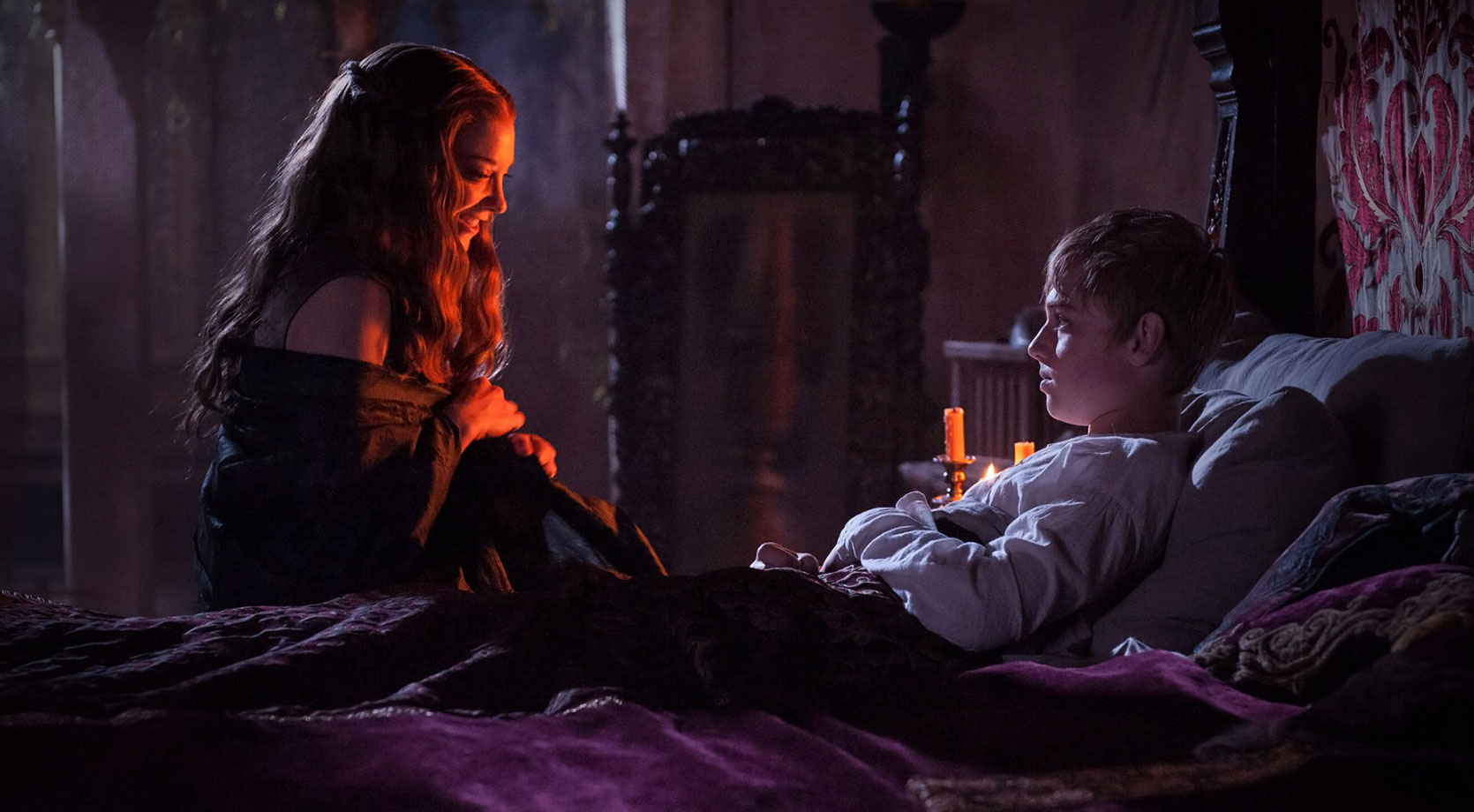
GOT4_2_2The episode opens with Ramsay Snow and Miranda hunting a young woman in the forest with Theon Greyjoy (who now answers to the name of Reek) following in tow. After chasing her down and putting an arrow through her leg, Ramsay’s dogs eat her. Shortly thereafter, Lord Roose Bolton returns and chides Ramsay for his behavior. He learns that Bran and Rickon are alive and that they be found, and orders Ramsay to ride to Moat Cailin to take it from Asha.

Back in King’s Landing, Tyrion meets with Jaime for the first time since his capture and comes up with a solution to his left-handed problem. Since he needs to train again in the use of a sword, and desires a trainer who will be discreet, Tyrion pairs him up with Bronn. Tyrion meets with Varys and once more discusses getting Shae out of the capitol and to Pentos, which has become necessary now that Cersei’s spies have identified her and both she and Tywin know of her existence.

GOT4_2_3The preparations for the wedding continue, and gifts are being conferred on Joffrey from all the houses. Tyrion gives him a copy of the rare book The Lives of Four Kings, which Joffrey reluctantly accepts.  Tywin’s gift of the Valyrian sword is next, which he uses to chop the book to pieces. Shae comes to meet him afterwards and Tyrion tells her that arrangements have been made to send her away. She resists, and Tyrion is forced to be brutal with her and tells her she’s a whore and can never bear his children.

Next day, Joffrey and Margaery are married in the Grand Sept of Baelor and the wedding feast follows. The usual machinations and posturing take place – between Jaime and Ser Loras, Brienne and Cersei, and especially between Prince Oberyn, Cersei and Tywin. Joffrey begins acting very abusive towards everyone, and then summons a group of dwarfs perform a terribly offensive rendition of the War of the Five Kings.

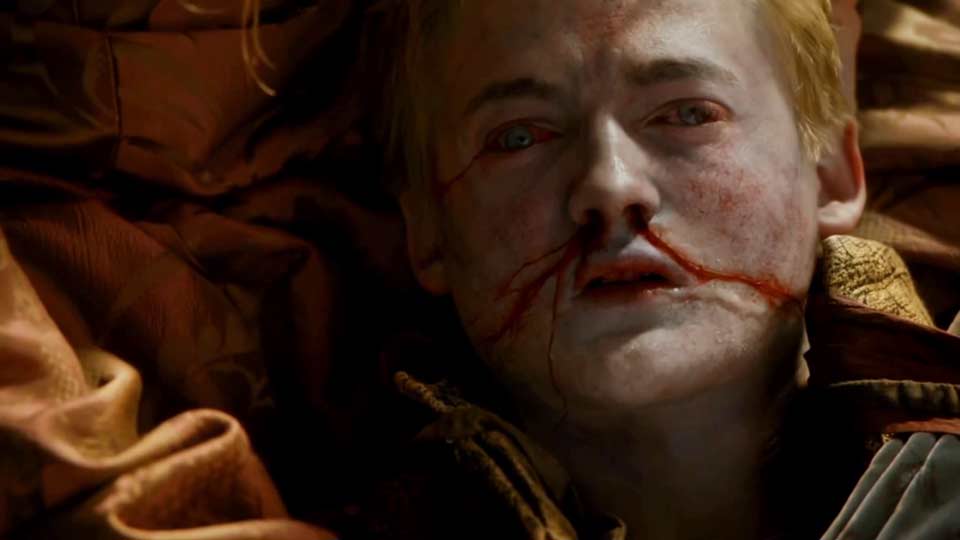
GOT4_2_4He then directs his abuse at Tyrion by pouring wine on his head and forcing him to become his cup bearer. To distract from the display, the pigeon pie is brought out and both Joffrey and Margaery take the first bites together. Joffrey orders Tyrion to fetch him wine, drinks, and is then begins choking violently. He dies pointing at Tyrion, who is then arrested. In the confusion, Ser Dontos hurries to Sansa and tells her to come with him if she wants to live.

To the north, Bran, Hodor and the Reeds continue their trek to the Wall. Bran has a greendream where he is inhabiting Summer’s body and the Reeds wake him and warn him that he could lose himself if he does it for too long. They come across a weirwood, Bran touches it, receives visions, and hears a voices saying “look for me beneath the tree” and “north”. Bran awakens from the vision and tells them he knows where they need to go.

Summary:
Obviously, this episode was quite satisfying for all concerned! For those who have not read the books, it was a real shocker and nice way to balance out the trauma of last season’s Red Wedding. For those who have, it was a chance to see the poetic justice of Joffrey’s death beautifully rendered. I for one loved what they did with it, both in terms of Joffrey’s terrible behavior leading up to his death, and then the way he died horribly. In addition to being true to the text, it was artfully one and very well acted!

GOT4_2_5As for everything else in the episode, what we got was mainly pacing and filler, and some changes which stuck out for me. For one, Jaime’s attempts to learn to fight with his left hand did not involve Bronn as his teacher. In fact, he sought out Ser Ilyn Payne for that job, mainly because the man has no tongue. Bronn at this point was far away, having been bought off by Tywin with a title and sent off so he couldn’t help Tyrion anymore.

Second, Shae was not sent away at this point. Though it was clear that Cersei had learned of her identity, Tyrion thought she was safe since Cersei had nabbed the wrong “whore” before. This, as we shall see soon enough, came back to bite him in the rear. And again, the material from Dragonstone and the Dreadfort felt like pure filler. But since we haven’t heard from these characters, I guess they felt the need to give them some screen time.

Other than that, the episode was a long time coming and I enjoyed it thoroughly! Onto episode Three – Breaker of Chains – and another long-awaited part, which is the seige of Mereen!

News From Space: Cosmic Inflation and Dark Matter

big bang_blackholeHello again! In another attempt to cover events that built up while I was away, here are some stories that took place back in March and early April of this year, and which may prove to be some of the greatest scientific finds of the year. In fact, they may prove to be some of the greatest scientific finds in recent history, as they may help to answer the most fundamental questions of all – namely, what is the universe made of, and how did it come to exist?

First up, in a development that can only be described as cosmic in nature (pun intended), back in March, astrophysicists at the Harvard-Smithsonian Center announced the first-ever observation of gravitational waves. This discovery, which is the first direct evidence of the Big Bang, is comparable to significance to CERN’s confirmation of the Higgs boson in 2012. And there is already talk about a Nobel Prize for the Harvard crew because of their discovery.

big_bangThis theory, which states that the entire universe sprung into existence from a tiny spot in the universe some 13.8 billion years ago, has remained the scientific consensus for almost a century. But until now, scientists have had little beyond theory and observations to back it up. As the name would suggest, gravitational waves are basically ripples in spacetime that have been propagating outward from the center of the universe ever since the Big Bang took place.

Originally predicted as part of Einstein’s General Theory of Relativity in 1916, these waves are believed to have existed since a trillionth of a trillionth of a trillionth of a second after the Big Bang took place, and have been propagating outward for roughly 14 billion years. The theory also predicts that, if we can detect some gravitational waves, it’s proof of the initial expansion during the Big Bang and the continued inflation that has been taking place ever since.

bicep2-640x425Between 2010 and 2012, the BICEP2 – a radio telescope situated at the Amundsen–Scott South Pole Station (pictured above) – the research team listened to the Cosmic Microwave Background (CMB). They were looking for hints of B-mode polarization, a twist in the CMB that could only have been caused by the ripples of gravitational waves. Following a lot of data analysis, the leaders announced that they found that B-mode polarization.

The work will now be scrutinized by the rest of the scientific community, of course, but the general consensus seems confident that it will stand up. In terms of scientific significance, the confirmation of gravitational waves would be the first direct evidence that the universe started out as nothing, erupted into existence 13.8 billion years ago, and has continued to expand ever since. This would confirm that cosmic inflation really exists and that the entire structure of the universe was decided in the beginning by the tiniest flux of gravitational waves.

planck-attnotated-580x372And that’s not only discovery of cosmic significance that was made in recent months. In this case, the news comes from NASA’s Fermi Gamma-ray Space Telescope, which has been analyzing high-energy gamma rays emanating from the galaxy’s center since 2008. After pouring over the results, an independent group of scientists claimed that they had found an unexplained source of emissions that they say is “consistent with some forms of dark matter.”

These scientists found that by removing all known sources of gamma rays, they were left with gamma-ray emissions that so far they cannot explain. And while they were cautious that more observations will be needed to characterize these emissions, this is the first time that potential evidence has been found that may confirm that this mysterious, invisible mass that accounts for roughly 26.8% of the universe actually exists.

darkmatter1To be fair, scientists aren’t even sure what dark matter is made of. In fact, it’s very existence is inferred from gravitational effects on visible matter and gravitational lensing of background radiation. Originally, it was hypothesized to account for the discrepancies that were observed between the calculations of the mass of galaxies, clusters and entire universe made through dynamical and general relativistic means, and  the mass of the visible “luminous” matter.

The most widely accepted explanation for these phenomena is that dark matter exists and that it is most probably composed of Weakly Interacting Massive Particles (WIMPs) that interact only through gravity and the weak force. If this is true, then dark matter could produce gamma rays in ranges that Fermi could detect. Also, the location of the radiation at the galaxy’s center is an interesting spot, since scientists believe that’s where dark matter would lurk since the insofar invisible substance would be the base of normal structures like galaxies.

fermi_gamma-raysThe galactic center teems with gamma-ray sources, from interacting binary systems and isolated pulsars to supernova remnants and particles colliding with interstellar gas. It’s also where astronomers expect to find the galaxy’s highest density of dark matter, which only affects normal matter and radiation through its gravity. Large amounts of dark matter attract normal matter, forming a foundation upon which visible structures, like galaxies, are built.

Dan Hooper, an astrophysicist at Fermilab and lead author of the study, had this to say on the subject:

The new maps allow us to analyze the excess and test whether more conventional explanations, such as the presence of undiscovered pulsars or cosmic-ray collisions on gas clouds, can account for it. The signal we find cannot be explained by currently proposed alternatives and is in close agreement with the predictions of very simple dark matter models.

Hooper and his colleagues suggest that if WIMPs were destroying each other, this would be “a remarkable fit” for a dark matter signal. They again caution, though, that there could be other explanations for the phenomenon. Writing in a paper submitted to the journal Physical Review D, the researchers say that these features are difficult to reconcile with other explanations proposed so far, although they note that plausible alternatives not requiring dark matter may yet materialize.

CERN_LHCAnd while a great deal more work is required before Dark Matter can be safely said to exist, much of that work can be done right here on Earth using CERN’s own equipment. Tracy Slatyer, a theoretical physicist at the Massachusetts Institute of Technology and co-author of the report, explains:

Dark matter in this mass range can be probed by direct detection and by the Large Hadron Collider (LHC), so if this is dark matter, we’re already learning about its interactions from the lack of detection so far.This is a very exciting signal, and while the case is not yet closed, in the future we might well look back and say this was where we saw dark matter annihilation for the first time.

Still, they caution that it will take multiple sightings – in other astronomical objects, the LHC, or direct-detection experiments being conducted around the world – to validate their dark matter interpretation. Even so, this is the first time that scientists have had anything, even tentative, to base the existence of Dark Matter’s on. Much like until very recently with the Big Bang Theory, it has remained a process of elimination – getting rid of explanations that do not work rather than proving one that does.

So for those hoping that 2014 will be the year that the existence of Dark Matter is finally proven – similar to how 2012 was the year the Higgs Boson was discovered or 2013 was the year the Amplituhedron was found – there are plenty of reasons to hope. And in the meantime, check out this video of a gamma-ray map of the galactic center, courtesy of NASA’s Goddard Space Center.


Sources:
extremetech.com, IO9.com, nasa.gov, cfa.harvard.edu, news.nationalgeographic.com

Climate Crisis: Terraforming the Desert

green_machineNow that I’m back from my European adventure, I finally have the time to catch up on some news stories that were breaking earlier in the month. And between posting about said adventure, I thought I might read up and post up on them, since they are all quite interesting to behold. Take, for example, this revolutionary idea that calls for the creation of a rolling city that has one purpose in mind: to replant the deserts of the world.

Desertification is currently one of the greatest threats facing humanity. Every year, more than 75,000 square kilometers (46,000 square miles) of arable land turns to desert. As deserts spread – a process that is accelerating thanks to climate change and practices like clear-cutting – the UN estimates that more than 1 billion people will be directly affected. Many of them, living in places like Northern Africa and rural China, are already struggling with poverty, so the loss of farmland would be especially hard to handle.

green_machine_balloonsAs a result, scientists are looking to come up with creative solutions to the problem. One such concept is the Green Machine – a floating, self-powered platform that would act as a mobile oasis. Rolling on treads originally designed to move NASA rockets. Designed by Malka Architecture and Yachar Bouhaya Architecture for the Venice Biennial, this mobile city would roam the drylands and plant seeds in an effort to hold back the desert.

The huge platform would be mounted on sixteen caterpillar treads originally made to move NASA rockets, while giant floating balloons that hover from it capture water condensation. As the first treads roll over the soil, the machine uses a little water from the balloons to soften the ground while the last set of treads injects seeds, some fertilizer, and more water. The entire platform would run on renewable power, using a combination of solar towers, wind turbines, and a generator that uses temperature differences in the desert to creates electricity.

green_machine_cityThe machine could theoretically capture enough energy that it can self-support an entire small city onboard, complete with housing, schools, businesses, parks, and more farmland to grow produce for the local area. This city would house and support the many researchers, agronomers, workers and their families that would be needed to oversee the efforts. Similar to what takes place in oil drilling, these individuals could be flown in for periods of work that could last up to sixth weeks at a time before rotating out.

The designers were inspired by Allan Savory, who has proposed a much lower-tech version of the same process that relied on cattle to naturally till and fertilize the soil. For the architects, building on this idea seemed like a natural extension of their work. If the machine went into action at desert borders, the designers say it could help formerly barren soil produce 20 million tons of crops each year, and could even help slow climate change by capturing carbon in soil.

green_machine_terraOver time, biodiversity could also gradually return to the area. The architects are currently working on developing the project on the Moroccan side of the Sahara Desert. As Stephane Malka, founder of Malka Architecture, put it, it’s all about using the neglected parts of the world to plan for humanity’s future:

For a long time, my studio has developed work around neglected spaces of the city. Deserts are the biggest neglected space on Earth, as they represent more than 40% of the terrestrial surface. Building the Green Machine units would be able to re-green half of the desert borders and the meadows of the world, while feeding all of humanity

As to the sheer size of their massive, treaded city, the designers stressed that it was merely an extension of the challenge it is seeking to address. Apparently, if you want to halt a worldwide problem, you need a big-ass, honking machine!

Sources: fastcoexist.com, dvice.comdesignboom.com

Back from Europe!

remembrance_day___poppy_day_by_daliscarHello all! It’s good to be home, and though I am nursing the worst case of jet lag I’ve experienced since… well, two weeks ago, I felt the time was right to let people know how my trip went. As I was sure to have said in my last post, things were mighty eventful and we saw some truly amazing things. In addition to the preserved battlefields, war memorials, war cemeteries and museums, there was also the staggering amount of preserved history to be found in every corner of the places we visited.

We also got a chance to sample some interesting food, delight in the customs and practices of the Belgian, Norman and Parisian people, and drink some very good beer (more on this last aspect of things over my beer blog). Point being, it was a life-changing experience and one which we agreed as a family we needed to do again someday. Only this time, we would pace ourselves a little better so we wouldn’t be spending the first day driving on no sleep! 😉

Us at Beaumont-Hamel
My mother, father and I at Beaumont-Hamel. All photos, unless otherwise indicated, by Carla Jack

To break it all down, we started by visiting cemeteries, memorials and museums in the Belgian countryside that commemorated the Great War and marked the centennial of its outbreak. We also managed to track down the last resting place of a relative of my mother’s, a young man named Wilmot Pettit who was shot down on D-Day over the Normandy countryside. And last, we visited two of the Normandy Beach landings and saw several museums and memorials that honored those who died during the Battle of Normandy in World War II.

This was the precise order of how we did things, which took us from Ypres to Dieppe, Bayeux to Chartres, and ended with us staying in Paris for several nights to take in the culture and history of the French capitol. Really, we couldn’t have packed more in, and now that this precis is over, let me get into the nitty gritty of this trip, with full background info and pictures. And since it’s too much to talk about in one posting, I’ve decided to break it down into a couple posts. Hopefully, I can cover more than a single day at a time, but no promises!

Wednesday, April. 9th – Friday, April 11th
(Nanaimo, BC to Ypres, Belgium):
Before the adventure could begin, there was the little matter of me and my wife meeting up with my folks and then flying to Paris. Now, this is not as easy as it sounds. First off, if you’re flying internationally from Vancouver Island, you either need to get to one of two cities (Comox or Victoria) or take the plane or ferry to Vancouver International Airport. And even then, there are likely to be one or more connecting flights along the way before flying the 8 or 9 hours to make it to Paris.

And once you get there, you’re nine hours ahead, which means you are stepping off the plane in midday when it feels in your head like its the wee hours of the morning. And chances are, you haven’t slept much the night before or on the plane, so you got a big ol’ sleep deficit to start with! Needless to say, that’s what happened to us. After meeting up with my folks the day before, we slept light the evening before the flight, and then set out on Thursday to the local airport before the sun was even up. After a quick trip over to Vancouver, we boarded our first flight, transferred in Montreal, and rode another plane into the sun for another nine hours.

French windmills, by Carla Jack
A few of the many wind turbines we saw

Upon our arrival, we were tired, greasy, and running on fumes. Nevertheless, we managed to grab a rental car and GPS at Charles de Gaulle International and started driving for the Belgium border.This took us through vast stretches of grassy green land, countless fields of golden canola, and many, many wind turbines. This was something that I noticed multiple times while touring the French and Belgian countryside, the large turbine operations that hovered above the flatlands like skyscrapers. I’m thinking we should get in on this in BC, and soon!

After driving northeast for several hours, we arrived in Belgium and began searching for our first set of sites. Having learned of some really cool stops during their previous visits, my folks wanted us to Avril Williams Guesthouse and Tea Room (no relation), a small BandB run by a British lady in the small town of Auchonvillers in the Somme region. In addition to providing food and accommodations, her business is also a de facto war museum due to its very interesting history.

town cellar used during the Great War
An Auchonvillers town cellar used during the Great War. Courtesy of http://www.avrilwilliams.eu

Having been built in the 17th century, graffiti found on the cellars walls and artifacts found on the floor indicated that the building served an important role during the Great War. Apparently, the cellar was one of 140 in the town that was used alternately by the French and British for ammo storage, signalling or for stretcher bearers. After the Armistice in 1923, the villagers returned and the house was rebuilt over the original cellar. It was the only one to have survived intact in Auchonvillers.

The cellar was rediscovered in 1992 when Avril Williams bought the property and some renovations were made. Artifacts found in the floor of the cellar – which included helmets, shell casings, swords, bags, insignia, and a slew of other items – have since been placed on display in the Tea Room itself behind plate glass. What’s more, out the back, a number of old trenches were dug up, restored, and incorporated into the place as part of its historical tour.

After lunch, we toured these and tried to imagine what it was like to have this kind of history in your own backyard! I should also note that Avril had some sheep grazing out the back, as well as several chickens and some very friendly cats. It was a strange and delightful pleasure to be seeing it all and talking to British and other tourists as we walked around and experienced all the reminders of such terrible events, all of which happened roughly 100 years ago but are a permanent part of the landscape. This is something we could to experience a lot on this trip.

Beaumont-Hamel Memorial

Then, it was off to Beaumont-Hamel, one of the many preserved battlefield parks within driving distance from Avril’s. For those who don’t know, it was here that the Royal Newfoundland Regiment (“The Blue Puttees”) fell during the Battle of the Somme. It was during this battle, which took place between July 1st and November 18th, 1916, that this small group of volunteers from the Dominion of Newfoundland (not yet part of Canada) stepped into No Man’s Land and was all but wiped out.

Several factors were to blame for this debacle. In the first place, the French and British plan of attack against the German lines was meant to take place in late June, but was postponed due to bad weather. Combined with the heavy bombardment which preceded the assault, the field between the German and British trenches was turned into mud. What’s more, the German troops on the other side had been occupying their position for 20 months, and used that time to fortify their positions against bombardment.

The Hawthorn Ride Mine exploding. Photo by Ernest Brooks
The Hawthorn Ridge Mine exploding. Photo by Ernest Brooks

The British attack began with the detonation of a large mine under a heavily fortified positing known as the Hawthorn Ridge Redoubt, which was caught on film and remains one of the most iconic bits of footage from the war. The explosion destroyed a major German strong point, but also alerted the German troops of the coming attack and led to their deployment. Moments later, when the British 29th Infantry Division advanced into No Man’s Land, they foundered due to German barbed wire, machine gun fire and artillery.

Back at the Divisional HQ, the British received confused reports, some of which stated that the German lines had been broken. To exploit this, General Beauvoir De Lisle ordered the Newfoundland Regiment and other units that were in reserve into the fray. Moving up from St. John’s Road, a support trench 230 meters (250 yards) behind the British forward line, the Newfoundlanders soon found that movement forward through the communication trenches was not possible because they were congested with the dead and wounded, and under shell fire.

The trenchlines and shell holes that still mark the lanscape
Note how the trench lines and craters still mark the landscape. Photo by Theitalinpen

Lieutenant Colonel Arthur Lovell Hadow, the battalion commander, decided to move immediately into attack formation and advance across the surface. As they moved out in the open, they were effectively the only troops moving on the battlefield and clearly visible to the German defenders. As a result, most of the Newfoundland Regiment who had started forward were dead, dying or wounded within 15 to 20 minutes of leaving St. John’s Road trench.

Most reached no further than the Danger Tree, a skeleton of a tree that lay in No Man’s Land that was being utilized as a landmark. As part of one of the most disastrous offensives during the war, the destruction of this regiment serves as a stark and sobering reminder of just how destructive the Great War was. Of the 780 men who went forward only about 110 survived unscathed, of whom only 68 were available for roll call the following day.

View of the battlefield, with the Danger Tree in the right hand
View of the battlefield from the memorial. The Danger Tree is visible on the right near the small group of visitors

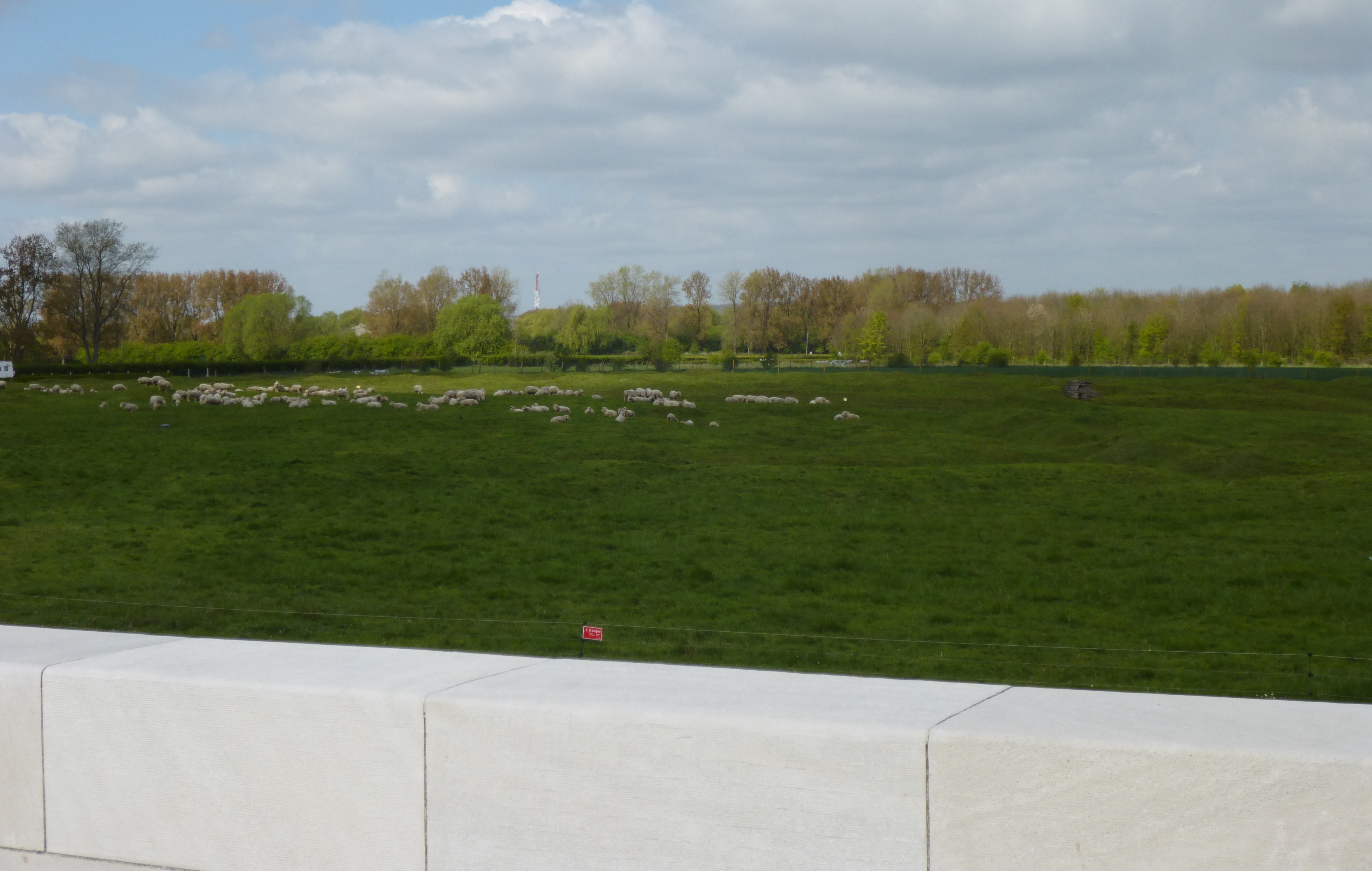
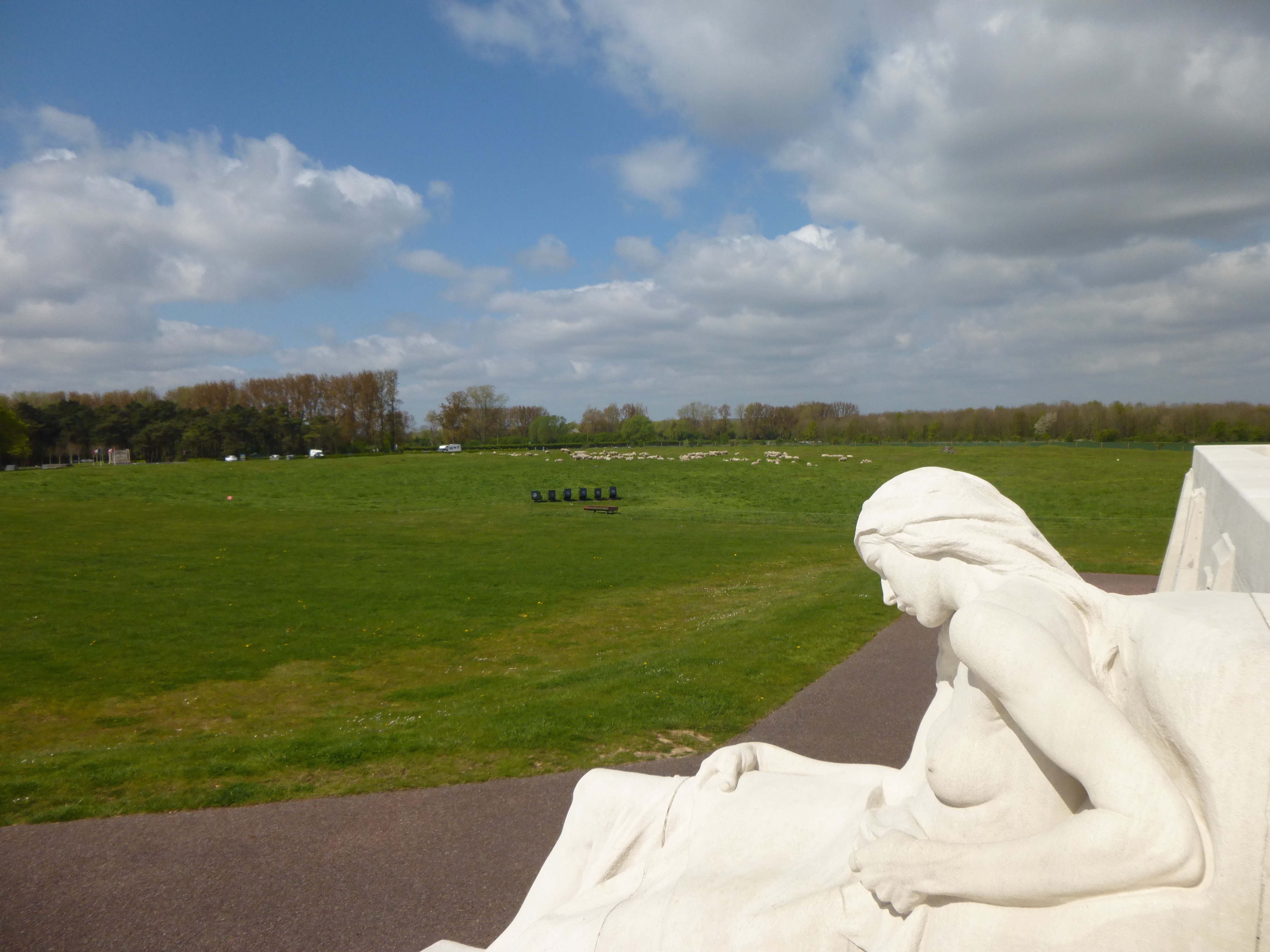
As you can probably tell from the photographs, the area in which this battle took place is really not that big. Having seen it close up, I can tell you that it is astounding to know that so much death and destruction happened within such a small area. But such was the nature of battles like the Somme. So many men died brutally and senselessly for the sake of a few meters, and every position taken on the field was paid for with thousands of lives.

The Beaumont-Hamel Newfoundland Memorial is a testament to one of the greatest wastes of life of the war and in human history. Officially opened by the British in 1925, the memorial site is one of only two National Historic Sites of Canada located outside of Canada. The other is the Canadian National Vimy Memorial, which we visited a few days later. This symbol of sacrifice is staffed by Canadian students and civil servants, and remains a symbol of Newfoundland’s identity.

After taking this all in, we went back to our car and set off for the town of Ypres where we would be staying for the next three days. For most of us, this consisted of sleeping in the car while my father had to slap himself to stay awake. But in the end, we made it to the Hotel Albion located in the city’s old quarter and quickly climbed into our beds. Carla and I slept while my folks chose to nap and head on out for some proper dinner.

_____

And that is what we did for the first two days of the trip. If it sounds like a lot, then I’ve conveyed the experience properly! Needless to say, it was all quite overwhelming and we were all emotionally and physically exhausted afterwards. Just telling it again now makes me feel like I’m trying to cook an elephant! Basically, the only way I’m going to be able to do it is a bit at a time. So stay tuned, because there is plenty more to follow.

Up next, our adventures in and around the historic town of Ypres, Belgium! And in the meantime, please listen to this lovely song – “Recruiting Sergeant”, by the Newfoundland band Great Big Sea. It is a lovely song that commemorates the sacrifice of these brave young men, an entire generation of young Newfoundlanders. The video consists of images compiled by Dr. Death1020, who used RNR pictures of Beaumont-Hamel and of the Battle of the Somme to set the tone. Enjoy, and may we never forget!

Lest We Forget

lest-we-forgetHey all! Just wanted to do a late trip update and let everybody know I’m still kicking, and to share some of the many experiences that were had so far on this trip. It’s been almost two weeks now since the family and I departed from Vancouver Island and landed on the Continent, and try as I might, I’ve been unable to resist my internet fix! So as long as I was surfing, checking messages and doing a little messaging myself, I figured I could at least post an update or two.

Currently, we are in Paris, where we arrived on Sunday after dropping off our rental car at Charles de Gaulle Airport. After finding our hotel in the Latin Quarter, we began taking in the local sites and sounds, which included the Tour Eiffel, the Arc de Troimphe, the Notre Dame Cathedral, the Louvre, and la Maison de Verlaine, a restaurant that is famous for having been frequented by countless literary, political and showbiz personalities (Hemingway, Marilyn Monroe and the Kennedy’s, to name a few).

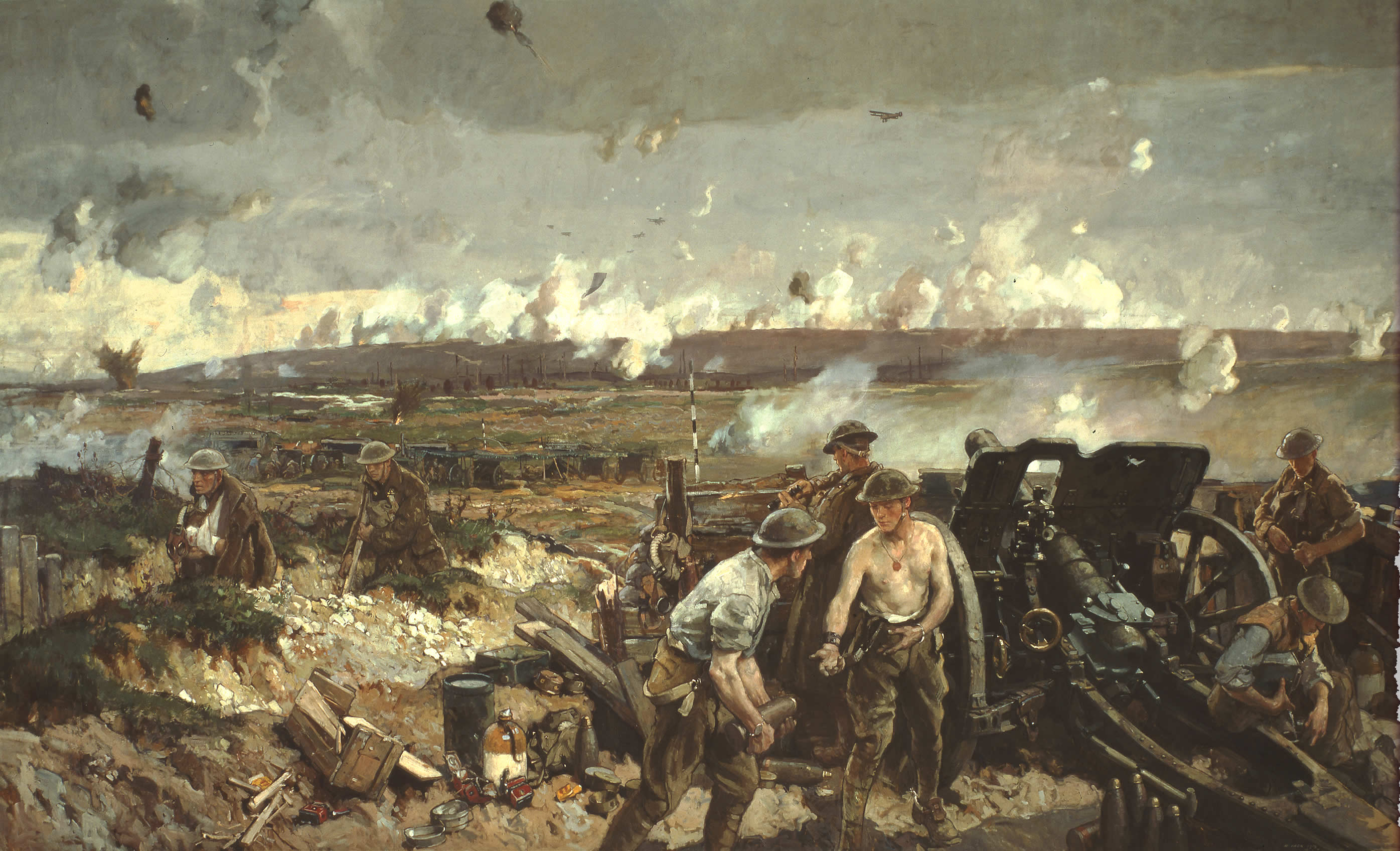
battle_of_vimy_ridge_field_gun_firingBut before that, we were in the Flanders region of Belgium and the Normandy region of France. We began with Ypres, a small city in Belgium that was the site of three major battles during the Great War. This began in 1914 when the Allies retook the town from the Germans after their great sweep into northern France failed. The second took place five months later when the Germans, hoping to break the stalemate in Belgium, used chlorine gas for the first time. It was during this gas attack that the Canadian 1st Division distinguished itself by holding its ground and repelling the attack, despite the fact that they had no gas masks. The third and final battle took place east of the city and is also known as the Battle of Passchendaele, one of the bloodiest of the war.

These and other terrible sacrifices which were endured during the war are all commemorated on a daily basis in the town. Every night, wreaths are laid at the Mennin Gate at one side of the old city where the names of the dead are inscribed and people gather to hear The Last post played. Having attended it on both a Saturday and the following Sunday, I can tell you that It is a very beautiful and moving event.

remembrance_day___poppy_day_by_daliscarWe were also sure to visit the cemeteries, battlefields and memorials at Beaumont-Hamel, Concrete Farm, Langemarck, St. Julien, and Tyne Cot. This last cemetery, which is the largest World War I cemetery ever, has a small museum where the names of every soldier who died in the Battle of Arras is named. The recording plays on a loop, and takes FIFTEEN YEARS to finish!

I should also note that within this landscape, visitors and farmers are routinely still finding small pieces of the battles that took place over a century ago. These include unexplored munitions – which have to be carefully removed and disposed of – and shrapnel, which my father and I found quite miraculously. I say this because the field we were going to search was being tilled by a large machine, forcing us to search at the very edge. But even with this small space to work with, we still managed to find a large chunk of a shell and some small pieces of shrapnel.

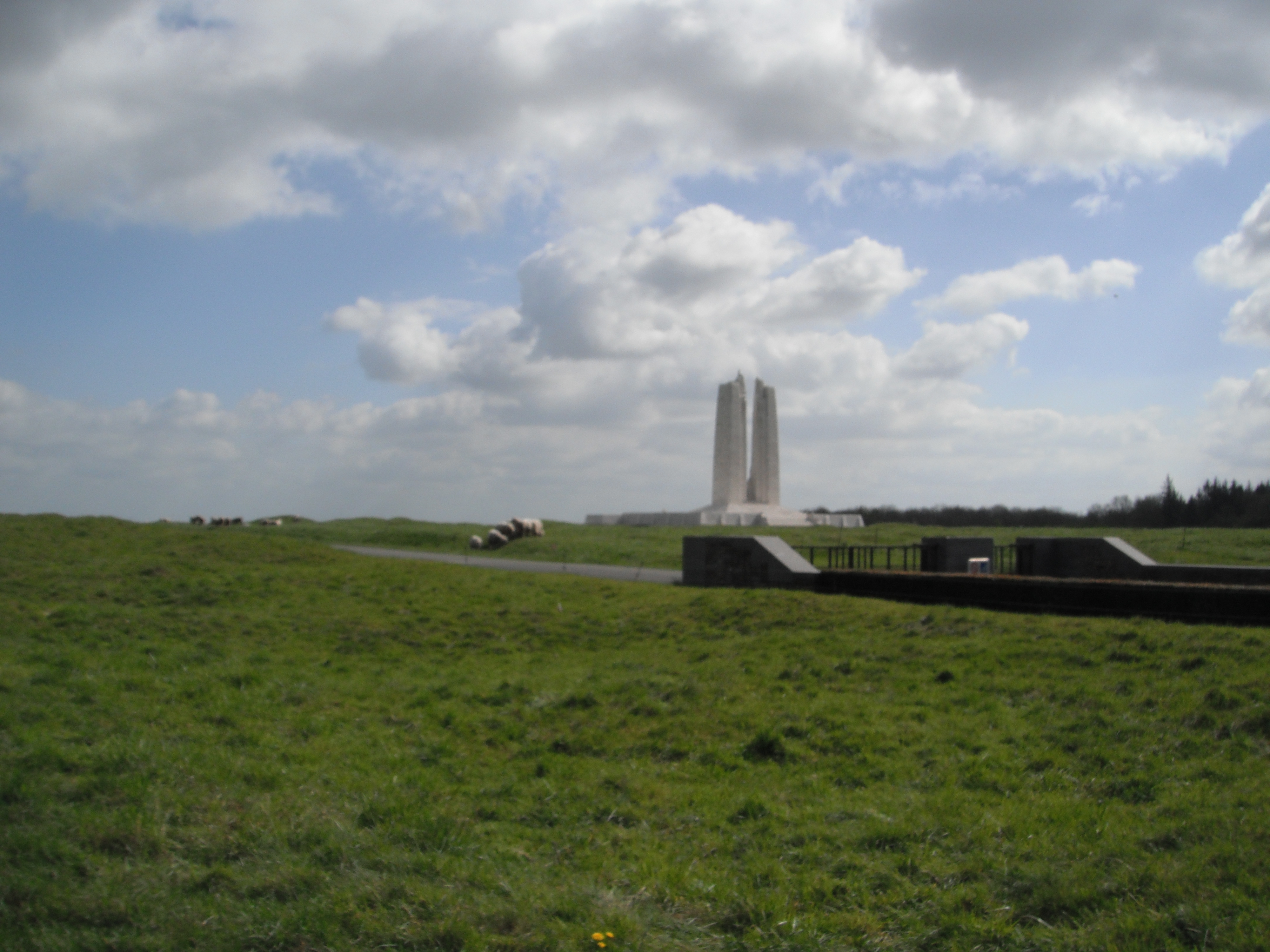
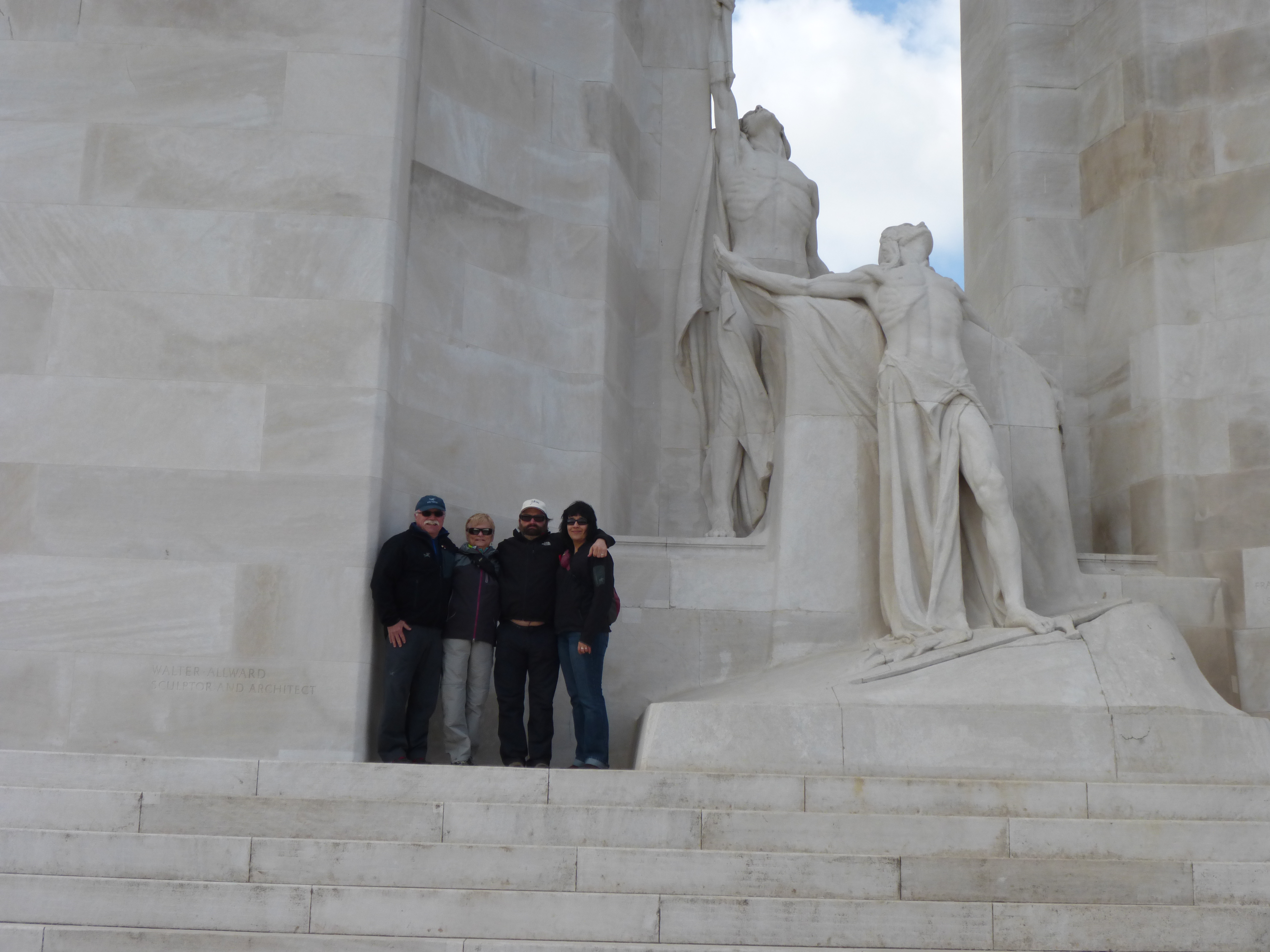
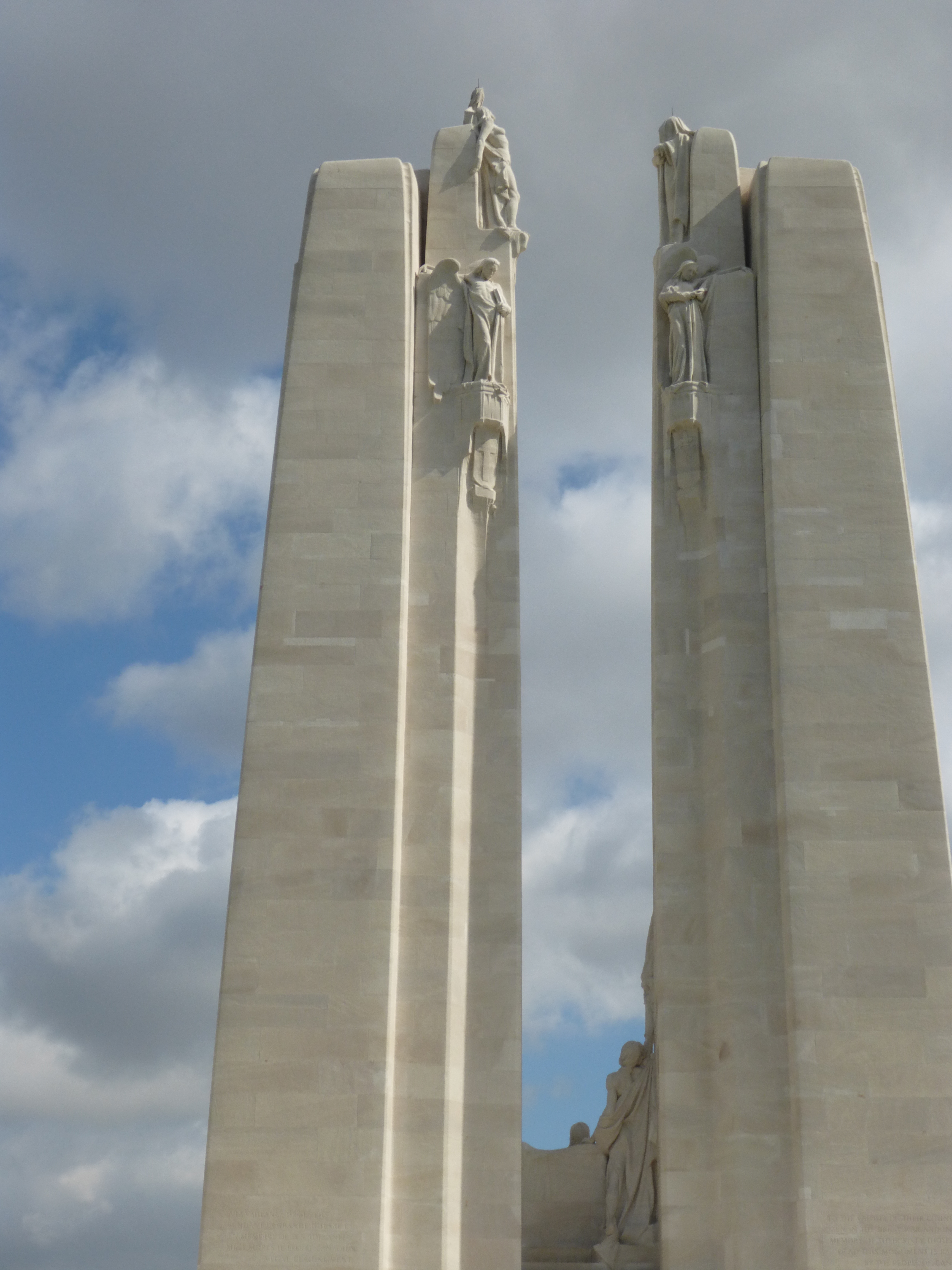
Vimy RidgeAfter that, we visited the Vimy Memorial in France, one of the greatest to come out of the war. This site, and the many preserved trenches, tunnels and craters that mark the landscape are preserved and attended to by Canadian students who hope to keep the memory of this historical battle alive. Not only was it a major victory for the allies – the first decisive offensive of the war – it also defined Canada as a nation. While being guided through the trenches and tunnel, my father and I once again paused to pick up some keepsakes. This time around, it was a piece of chalk and flint (which the ridge is made of) and a small bit of ceramic, possibly from an old teacup.

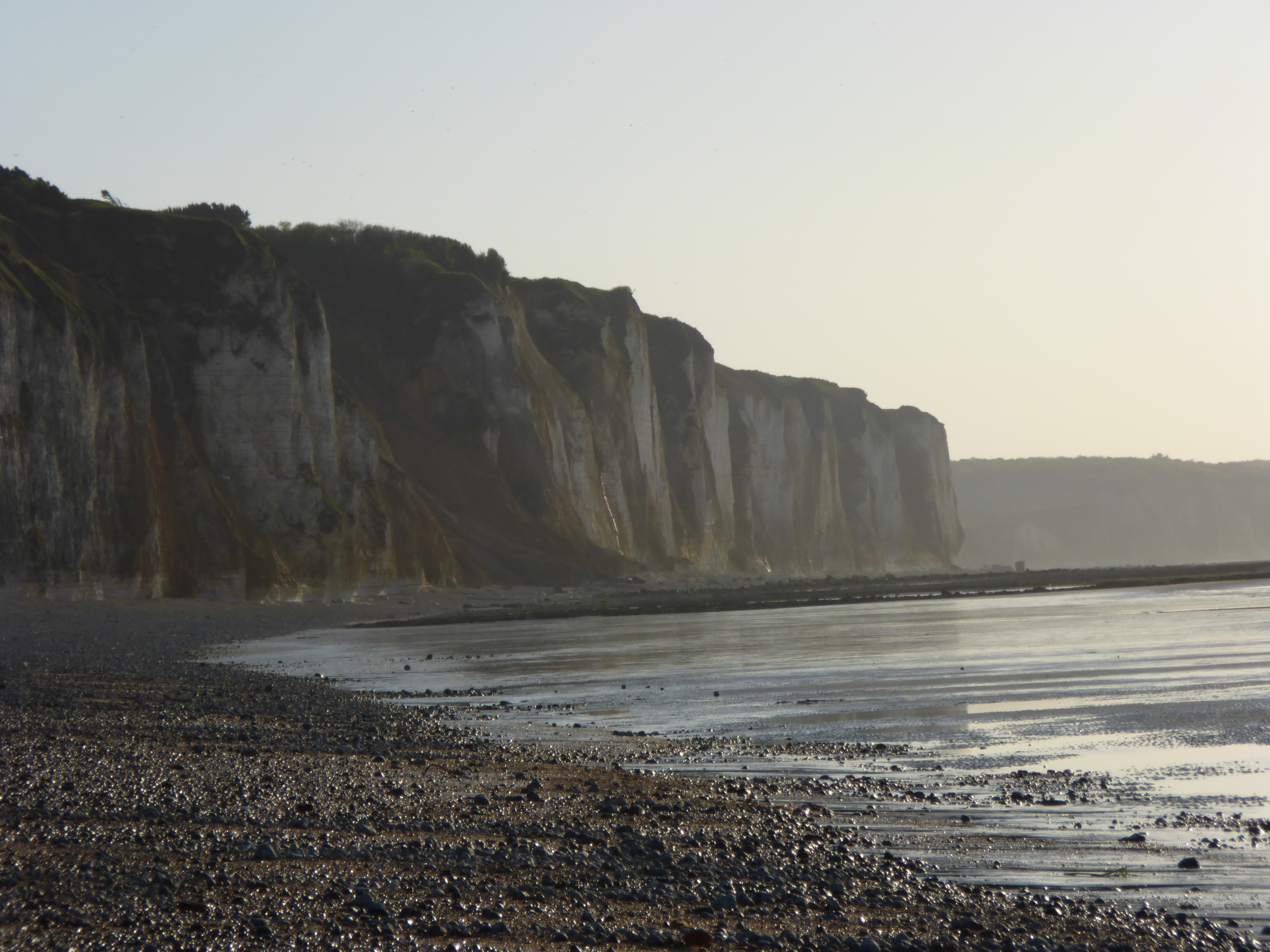
We then travelled to Dieppe in Normandy and began visiting the World War II sites and memorials. This included the beach of Dieppe where the ill-faired raid performed by the Canadian 2nd Division, British, French and Polish Commandos, and American Rangers. We then drove to the French countryside to the town of Grangues to see where my Grandmothers cousin (an RAF pilot who died on D-Day) was shot down.

dieppe-dsThis was perhaps the most interesting part of our journey since it involved retracing the path of an actual family member. His name was Wilmot Pettit, and on June 6th, 1944, he was shot down while towing a glider full of British Commandos into the Normandy countryside.  The mayor of Grangues was extremely helpful, and drove us to where the crash took place, told of how the survivors had been captured and executed by the SS, offered to send us some photos of the downed plane, and told us where Wilmott had been buried. We then drove to the cemetery at Ranville to pay our respects, before heading on to Bayeux.

From here, we visited Juno Beach, Gold Beach, and saw the museums set up at both that commemorated the D-Day landings of the Canadian, British and Commonwealth troops. We wanted to get around to seeing Omaha, but unfortunately there just wasn’t enough time. We also visited the war cemetery at Beny-sur-Mer, where the many Commonwealth troops who died during the Battle of Normandy were laid to rest. We also managed to walk inside the still-intact coastal batteries at Longues-sur-Mer, and took in the Bayeux Tapestry before leaving for Chartres.

Which brings us by commodious vicus back to the present. We still have a few more nights here in Paris and we intend to see as much as we can before leaving on Friday.  And when I get home, I hope to write about my experiences here in more depth. Trust me when I say that this is the explicated version. The full-length one comes with way more background info, and pictures! Until then, take care, and take care to remember…

BookofRemembrance_pg.479

Off to Europe!

remembrance_day___poppy_day_by_daliscarHey all! Sad to say, I will be away for the next two weeks as the wife and I, and my mother and father, tour the battlefields of Normandy and Flanders. This trip has been a long time in coming, and is a pretty big deal for obvious reasons. Not only is it an opportunity to see some major historic sites – ones which I have been hoping to see for some time – we are also getting the chance to do this tour during the Centenary of World War I.

As my father informed us after returning from doing the battlefields tour back in 2009, commemorating the Great War and World War II is a pretty big deal for the people who live in Northern France and Belgium. Here, the people live with the reminders of these terrible wars every single day, with farmers and villagers finding pieces of shrapnel, bullets, and even unexploded munitions on a regular basis. And in some areas, the evidence of the trenches is still visible, even where they haven’t been preserved.

The sites we will be visiting include Ypres, Beaumont-Hamel, Vimy Ridge, Dieppe, Bayeux, Juno Beach, Caen, Omaha Beach, Chartres, and of course, Paris – which we will be flying in and out of. I will be back on the 25th of April, no doubt with plenty of stories and pictures! Take care, and never forget the sacrifice made by so many for so many more!

Game of Thrones – Season Four Premiere!

got4Once again, and to the excitement of nerds and geeks everywhere, Game of Thrones has come back after an extended hiatus!  And after the events of last season, fans were no doubt hoping some bloody vengeance, some more answers, and plenty of resolution. Sad to say, they won’t be getting much of any! And for fans of the original novels, this is yet another opportunity to come together and nitpicks the ways in which the series isn’t living up to the original series… I am one of them!

In any case, the season premier picked up where things left off last season, roughly midway through the events told in A Storm of Swords. These include the royal wedding between Joffrey and Margaery Tyrell, Brienne and Jaime’s return to King’s Landing, Daenerys’s march on Meereen, and Arya’s ongoing misadventures in the Riverlands. And of course, there’s plenty of machinations, plots, and developments happening in between.

And now, onto the premier episode, aptly named…

Two Swords:
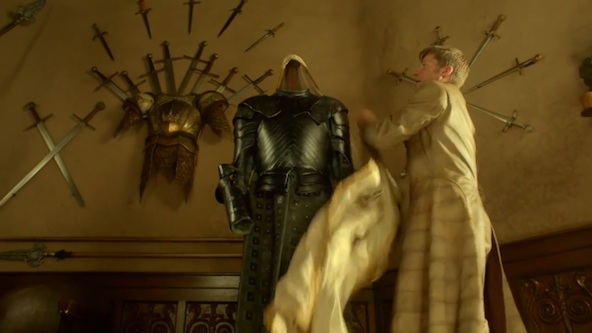
got4_1_1The episode opens with Tywin Lannister overseeing the destruction of Ned’s sword Ice, who melts it down and uses the Valyrian steel to forge two new swords. Afterwards, he meets with Jaime and gives him the longer of the two. He then offers his son Lordship over Casterly Rock, which Jaime refuses so he can remain a White Cloak, which displeases his father. Outside the city, Tyrion is waiting with Pod and Bronn to Prince Doran Martell of Dorne, who has been invited for Joffrey’s wedding.

However, Tyrion is informed that Doran could not come due to his ailing health, and that Prince Oberyn came in his stead many days prior. They then find him and his paramour, Ellaria Sand, at a brothel, where Oberyn is making trouble with some Lannister men. After pulling him outside to talk, Oberyn claims he’s come to the capitol to seek justice for the death of his sister and her children, and tells Tyrion to tell his father “the Lannisters are not the only ones who pay their debts.”

got4_1_3Afterward, Tyrion returns to Sansa, who is naturally distraught over the death of Robb and her mother. He tries to console her, but is unsuccessful. He then finds Shae in his bedroom, who demands to know if they will ever be together again. She leaves when Tyrion will not answer, and we that a spy was listening in on their conversation. Meanwhile, Jaime is fitted for a golden hand by Maester Qyburn and Cersei, who afterwards spurns him for “taking too long” to return. The spy then arrives to report to Cersei.

To the north, Ygritte and her party meet with the Thenns, another clan of Wildlings, who bring the body of a Nights Watchman to eat. At Castle Black, Jon is recovering from his injuries, and talks to Sam of his half-brother’s death. He then goes to the Lord Commander to answer for Qhorin Halfhand’s death and his actions with the Wildlings. He tells them it was Qhorin’s plan to learn their plans, and shares all he learned about Mance’s plans and the raiding party to the south. They stay his execution and let him go for the time being.

got4_1_2Over in Essos, we see Daenerys and her forces as they march towards Mereen. As they go, Daario continues in his efforts to woo Daenerys, which he does under the pretext of teaching her about the various flowers of the land. They come to a stop when they find a dead child tied to a post. Daenerys is told that there is a dead slave for every mile along their way, serving as a warning to her approaching army. She orders them to press on and refuses to be shielded from the sight.

Brienne meets with Margaery while in the capitol and tells her what happened to Renly, and vows to avenge him. Jaime discusses preparations for the wedding and how the war is not yet finished. He is then met by Brienne, who reminds him of the pledge he made to return the Stark daughters to safety. After praying near the shore, Sansa is surprised by Dontos Hollard, the former knight who’s life she saved, who gives her a family heirloom in thanks.

got4_1_5In the Riverlands, Arya and Sandor Clegane continue on their way, with the latter claiming he intends to ransom Arya to her aunt. They come to a tavern and Arya spots Poliver, the man who killed Lommy, stole Needle, and brought the rest of them to Harrenhal. Arya and Sandor go inside find Poliver and his men trying to rape the innkeepers daughters. Poliver sees Sandor and Arya and recognizes the Hound, and offers him the chance to come with them and raid and pillage their way towards King’s Landing.

The Hound declines and says “fuck the King”, and things go downhill fast. Poliver draws on him and Sandor knocks him down and kills all of his men. A few remain and Arya finishes them off, stabs Poliver in the back, and then retrieves her sword. Standing over him, she reminds him of how he took her captive and killed her friend, then stabs him in the throat. Stealing one of their ponies, Arya and Sandor ride off through the burning Riverlands.

Summary:
Overall, this was not a bad premier! Much like season two’s premier, things felt a little sparse in places and rushed. However, I saw the value in putting these small scenes in, in that they preview things that will be coming later on. These include Dontos reaching out to Sansa, Brienne pressuring Jaime to keep his word, the preparations for Joffrey and Margaery’s wedding, and Daenerys dragon troubles. And between and around all this, they managed to cover the major plot points.

At the same time, there were noticeable differences from the original text. For instance, Oberyn did arrive with the train from Dorne and met with Tyrion right off. There was no detour into a brothel where Oberyn picked a fight, or expressed some serious bicurious desires. In fact, to my knowledge, not a single hint was given that Oberyn as bisexual, nor his paramour Ellaria. However, they still did a very good job of capturing Oberyn’s character and his hopes to get revenge for his kin.

The_WallOn another front, the whole cannibalism thing with the Thenns – this was not in the original story, and felt like a forced attempt to make them evil. Personally, I felt they were menacing enough with their hard stares and decorative scars. Also, Jon Snow told the Lord Commander, Aemon and Trant that he killed Qhorin as part of a plan to earn the Wildling’s trust. But no such plan was ever hatched by Qhorin in the show (unlike the novels), thereby making Jon’s entire defense for killing him speculation.

And last, but not least, there was the way that Cersei spurned Jaime in this episode, which seemed to come from nowhere. In the book, Cersei and Jaime made love the moment he returned, even before he donned his White Cloak again. She continued to be amorous with him for some time, and only gradually did they become estranged. But there’s still plenty of time for them to factor that in, I’m just not sure why the writers had her acting this way. Did they think we needed another reason to hate her?

meereenHowever, these things seemed entirely topical to me and really didn’t distract or deter from the flow of things. Mainly, I found the episode enjoyable, especially the part where Arya gets some revenge for herself by stabbing Poliver in the throat. They also did a good job with Daenery’s march on Meereen, where she was forced to witness countless slaves being crucified to warm them away. And I really liked the fact that they cast a new actor in the role of Daario. The last one did not fit the bill AT ALL!

Oh yeah, and that sword forging scene was totally awesome! Other than that, I’m happy to see the show return and am looking forward to what they do with things this season. In particular, I am looking forward to the battle for Meereen, and the big wedding. No spoilers, but lets just say a whole lot of crap is still set to hit the fan, and on occasion – even in George RR Martins universe – bad things happen to bad people! Stay tuned…

The Future of Medicine: Replacement Ears and “Mini Hearts”

biomedicineBiomedicine is doing some amazing things these days, so much so that I can hardly keep up with the rate of developments. Just last month, two amazing ones were made, offering new solutions for replacing human tissue and treating chronic conditions. The first has to do with a new method of growing human using a patients own DNA, while the second involves using a patient’s own heart tissue to create “mini hearts” to aid in circulation.

The first comes from London’s Great Ormond Street Hospital, where researchers are working on a process that will grow human ears using genetic material taken from a patient’s own fat tissue. Building upon recent strides made in the field of bioprinting, this process will revolution reconstructive surgery as we know it. It also seeks to bring change to an area of medicine which, despite being essential for accident victims, has been sadly lacking in development.

replacement_earCurrently, the procedure to repair damaged or non-existent cartilage in the ear involves an operation that is usually carried out when the patient is a child. For the sake of this procedure, cartilage is extracted from the patient’s ribs and painstakingly crafted into the form of an ear before being grafted back onto the individual. Whilst this method of reconstruction achieves good results, it also comes with its share of unpleasant side effects.

Basically, the patient is left with a permanent defect around the area from where the cells were harvested, as the cartilage between the ribs does not regenerate. In this new technique, the cartilage cells are engineered from mesenchymal stem cells, extracted from the child’s abdominal adipose (fat) tissue. The benefit of this new system is that unlike the cartilage in the ribs, the adipose tissue regenerates, therefore leaving no long-term defect to the host.

stem_cells1There is also the potential to begin reconstructive treatment with stem cells derived from adipose tissue earlier than previously possible, as it takes time for the ribs to grow enough cartilage to undergo the procedure. As Dr. Patrizia Ferretti, a researcher working on the project, said in a recent interview:

One of the main benefits in using the patient’s own stem cells is that there is no need for immune suppression which would not be desirable for a sick child, and would reduce the number of severe procedures a child needs to undergo.

To create the form of the ear, a porous polymer nano-scaffold is placed in with the stem cells. The cells are then chemically induced to become chondrocytes (aka. cartilage cells) while growing into the holes in the scaffold to create the shape of the ear. According to Dr. Ferretti, cellularized scaffolds – themselves a recent medical breakthrough – are much better at integrating than fully-synthetic implants, which are more prone to extrusion and infection.

cartilage2Dr. Ferretti continued that:

While we are developing this approach with children with ear defects in mind, it could ultimately be utilized in other types of reconstructive surgery both in children and adults.

Basically, this new, and potentially more advantageous technique would replace the current set of procedures in the treatment of defects in cartilage in children such as microtia, a condition which prevents the ear from forming correctly. At the same time, the reconstructive technology also has the potential to be invaluable in improving the quality of life of those who have been involved in a disfiguring accident or even those injured in the line of service.

mini_hearts`Next up, there is the “mini heart” created by Dr. Narine Sarvazyan of George Washington University in Washington D.C.. Designed to be wrapped around individual veins, these cuffs of rhythmically-contracting heart tissue are a proposed solution to the problem of chronic venous insufficiency – a condition where leg veins suffer from faulty valves, which prevents oxygen-poor blood from being pumped back to the heart.

Much like process for creating replacement ears, the mini hearts are grown  by coaxing a patient’s own adult stem cells into becoming cardiac cells. When one of those cuffs is placed around a vein, its contractions aid in the unidirectional flow of blood, plus it helps keep the vein from becoming distended. Additionally, because it’s grown from the patient’s own cells, there’s little chance of rejection. So far, the cuffs have been grown in the lab, where they’ve also been tested. But soon, Sarvazyan hopes to conduct animal trials.

mini_hearts2As Sarvazyan explained, the applications here far beyond treating venous insufficiency. In addition, there are the long-range possibilities for organ replacement:

We are suggesting, for the first time, to use stem cells to create, rather than just repair damaged organs. We can make a new heart outside of one’s own heart, and by placing it in the lower extremities, significantly improve venous blood flow.

One of the greatest advantages of the coming age of biomedicine is the ability to replace human limbs, organs and tissue using organic substitutions. And the ability to grow these from the patient’s own tissue is a major plus, in that it cuts down on the development process and ensures a minimal risk of rejection. On top of all that, the ability to create replacement organs would also significantly cut down on the costs of replacement tissue, as well as the long waiting periods associated with donor lists.

Imagine that, if you will. A future where a patient suffering from liver, kidney, circulatory, or heart problems is able to simply visit their local hospital or clinic, donate a meager supply of tissue, and receive a healthy, fully-compatible replacement after an intervening period (days or maybe even hours). The words “healthy living” will achieve new meaning!


Sources: gizmag.com, (2), nanomedjournal.com