Climate News: World’s Most Potent Greenhouse Gas Found

NASA_global_warming_predFor over a century now, scientists have understood the crucial link that lies between greenhouse gases and the effect known as “Global Warming”. For decades, scientists have been focused on the role played by carbon dioxide and methane gas, the two principle polluters that are tied to human behavior and the consequences of our activities.

But now, a long-lived greenhouse gas, more potent than any other, has been discovered in the upper atmosphere by chemists at the University of Toronto. It’s known as Perfluorotributylamine (PFTBA), a gas that has a radiative efficiency of 0.86 – which is one measure of a chemical’s effectiveness at warming the climate (expressed in parts per million).

upper_atmosphereAt present, the biggest contributor to climate change is carbon dioxide, mainly because its concentrations are so high — 393.1 parts per million in 2012 and growing, thanks to human activity. However, many other gases contribute to this trend – such as nitrogen trifluoride and various chloroflurocarbons (CFCs) – but are less involved in the overall warming effect because their concentrations are lower.

According to the research article, which appeared in a recent issue of Geophysics Research Letters, the concentrations of PFTBA are very small — about 0.18 parts per trillion by volume in the atmosphere (at least in Toronto, where it was detected). But even though the overall contribution of PFTBA is comparatively small, its effect is “on the same scale as some of the gases that the monitoring community is aware of.”

Toronto Skyline With SmogAccording to 3M, a producer of PFTBA, the chemical has been sold for more than 30 years for the purpose of cooling semiconductor processing equipment and specialized military equipment, much in the same way that CFCs have been used. It is effective at transferring heat away from electronic components, and is stable, non-flammable, non-toxic, and doesn’t conduct electricity.

The chemical has an average lifespan of about 500 years in the lower atmosphere, and also like CFC’s, it has long been known to have the potential to cause damage to the ozone layer. But up until now its ability to trap heat in the atmosphere had not been measured, nor had it been detected in the atmosphere. The reason PFTBA is so potent compared to other gases is that it absorbs heat that would normally escape from the atmosphere.

electromagnetic-spectrumHeat, or infrared radiation comes, in different colors, and each greenhouse gas is only able to absorb certain colors of heat. PFTBA is different in that it manages to absorb colors that other greenhouse gases don’t. It was after some was discovered on the university grounds by Professor Scott Mabury that his team began to consider whether any had made it into the atmosphere as well.

Shortly thereafter, they conducted a series of tests to measure the radiative efficiency of the chemical and then began looking for samples of it in the air. This involved deploying air pumps to three locations – including the University of Toronto campus, Mt. Pleasant Cemetery and Woodbine Beach. The samples were then condensed and concentrated, and the PFTBA separated by weight.

airpollution1The end result was that PFTBA was found in all samples, including those upwind from the University of Toronto, suggesting that it wasn’t just coming from the chemistry building. However, the measurements were local and therefore not representative of the global average concentrations of the chemical. Still, its discovery is an indication that dangers might exist.

According to Angela Hong, a PhD student at the UofT department of chemistry and the lead author of the paper, this danger lies in the combined effect PFTBA could have alongside other gases:

If you’re suddenly going to add a greenhouse gas and it absorbs in that region. it’s going to be very potent.

Its effect is far more intense if its effect per molecule is considered, since it is about 15 times heavier than carbon dioxide. What’s more, PFTBA survives hundreds of years in the atmosphere, which means its effects are long-lasting. Fortunately, its use has been regulated under a U.S. Environmental Protection Agency program that promotes alternatives to chemicals that deplete the ozone layer.

pftba-toronto-537x402In addition, chemicals that deplete the ozone layer are recognized by the Kyoto Protocols. As such, it should be an easy matter (from a legal standpoint anyway) to legislate against its continued use. As 3M indicated in a recent press statement:

That regulation stipulates that PFCs [the class of chemical that PFTBA belongs to] should be used only where there are no other alternatives on the basis of performance and safety. 3M adheres to that policy globally.

It added that the company “has worked to limit the use of these materials to non-emissive applications” and emphasized that the concentration of PFTBA found in the atmosphere is very low.

????????????????Nevertheless, this represents good news and bad news when it comes to the ongoing issue of Climate Change. On the one hand, early detection like this is a good way of ensuring that gases that contribute to the problem can be identified and brought under control before they become a problem. On the other, it shows us that when it comes to warming, there are more culprits than previously expected to contributing to it.

According to the most recent IPCC report, which was filed in 2012, the likelihood of us reaching a critical tipping point – i.e. the point of no return with warming – this century is highly unlikely. But that still leaves plenty of room for the problem to get worse before it gets better. One can only hope we get our acts together before it’s too late.

Sources: cbc.ca, IO9

The Future is… Worms: Life Extension and Computer-Simulations

genetic_circuitPost-mortality is considered by most to be an intrinsic part of the so-called Technological Singularity. For centuries, improvements in medicine, nutrition and health have led to improved life expectancy. And in an age where so much more is possible – thanks to cybernetics, bio, nano, and medical advances – it stands to reason that people will alter their physique in order slow the onset of age and extend their lives even more.

And as research continues, new and exciting finds are being made that would seem to indicate that this future may be just around the corner. And at the heart of it may be a series of experiments involving worms. At the Buck Institute for Research and Aging in California, researchers have been tweaking longevity-related genes in nematode worms in order to amplify their lifespans.

immortal_wormsAnd the latest results caught even the researchers by surprise. By triggering mutations in two pathways known for lifespan extension – mutations that inhibit key molecules involved in insulin signaling (IIS) and the nutrient signaling pathway Target of Rapamycin (TOR) – they created an unexpected feedback effect that amplified the lifespan of the worms by a factor of five.

Ordinarily, a tweak to the TOR pathway results in a 30% lifespan extension in C. Elegans worms, while mutations in IIS (Daf-2) results in a doubling of lifespan. By combining the mutations, the researchers were expecting something around a 130% extension to lifespan. Instead, the worms lived the equivalent of about 400 to 500 human years.

antiagingAs Doctor Pankaj Kapahi said in an official statement:

Instead, what we have here is a synergistic five-fold increase in lifespan. The two mutations set off a positive feedback loop in specific tissues that amplified lifespan. These results now show that combining mutants can lead to radical lifespan extension — at least in simple organisms like the nematode worm.

The positive feedback loop, say the researchers, originates in the germline tissue of worms – a sequence of reproductive cells that may be passed onto successive generations. This may be where the interactions between the two mutations are integrated; and if correct, might apply to the pathways of more complex organisms. Towards that end, Kapahi and his team are looking to perform similar experiments in mice.

DNA_antiagingBut long-term, Kapahi says that a similar technique could be used to produce therapies for aging in humans. It’s unlikely that it would result in the dramatic increase to lifespan seen in worms, but it could be significant nonetheless. For example, the research could help explain why scientists are having a difficult time identifying single genes responsible for the long lives experienced by human centenarians:

In the early years, cancer researchers focused on mutations in single genes, but then it became apparent that different mutations in a class of genes were driving the disease process. The same thing is likely happening in aging. It’s quite probable that interactions between genes are critical in those fortunate enough to live very long, healthy lives.

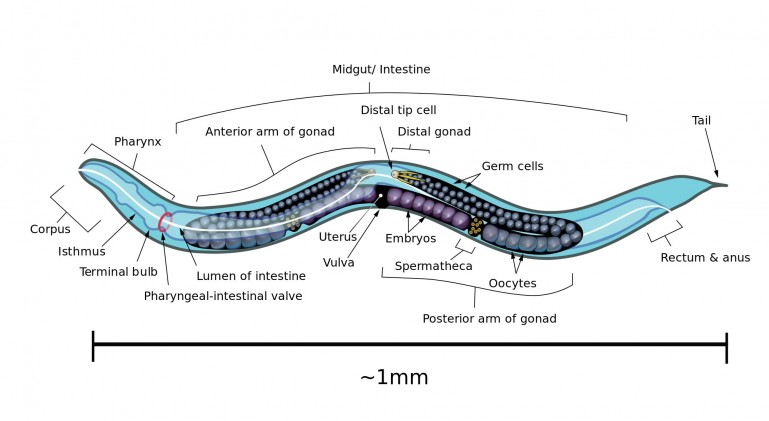
A second worm-related story comes from the OpenWorm project, an international open source project dedicated to the creation of a bottom-up computer model of a millimeter-sized nemotode. As one of the simplest known multicellular life forms on Earth, it is considered a natural starting point for creating computer-simulated models of organic beings.

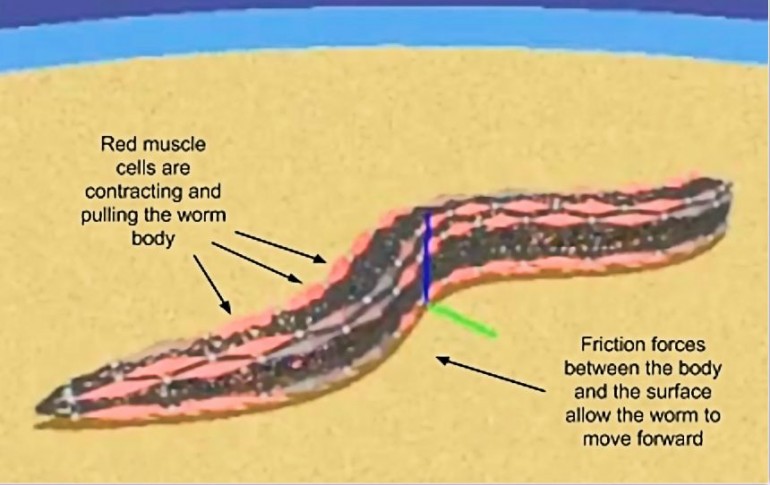
openworm-nematode-roundworm-simulation-artificial-lifeIn an important step forward, OpenWorm researchers have completed the simulation of the nematode’s 959 cells, 302 neurons, and 95 muscle cells and their worm is wriggling around in fine form. However, despite this basic simplicity, the nematode is not without without its share of complex behaviors, such as feeding, reproducing, and avoiding being eaten.

To model the complex behavior of this organism, the OpenWorm collaboration (which began in May 2013) is developing a bottom-up description. This involves making models of the individual worm cells and their interactions, based on their observed functionality in the real-world nematodes. Their hope is that realistic behavior will emerge if the individual cells act on each other as they do in the real organism.

openworm-nematode-roundworm-simulation-artificial-life-0Fortunately, we know a lot about these nematodes. The complete cellular structure is known, as well as rather comprehensive information concerning the behavior of the thing in reaction to its environment. Included in our knowledge is the complete connectome, a comprehensive map of neural connections (synapses) in the worm’s nervous system.

The big question is, assuming that the behavior of the simulated worms continues to agree with the real thing, at what stage might it be reasonable to call it a living organism? The usual definition of living organisms is behavioral, that they extract usable energy from their environment, maintain homeostasis, possess a capacity to grow, respond to stimuli, reproduce, and adapt to their environment in successive generations.

openworm-nematode1If the simulation exhibits these behaviors, combined with realistic responses to its external environment, should we consider it to be alive? And just as importantly, what tests would be considered to test such a hypothesis? One possibility is an altered version of the Turing test – Alan Turing’s proposed idea for testing whether or not a computer could be called sentient.

In the Turing test, a computer is considered sentient and sapient if it can simulate the responses of a conscious sentient being so that an auditor can’t tell the difference. A modified Turing test might say that a simulated organism is alive if a skeptical biologist cannot, after thorough study of the simulation, identify a behavior that argues against the organism being alive.

openworm-nematode2And of course, this raises an even larger questions. For one, is humanity on the verge of creating “artificial life”? And what, if anything, does that really look like? Could it just as easily be in the form of computer simulations as anthropomorphic robots and biomachinery? And if the answer to any of these questions is yes, then what exactly does that say about our preconceived notions about what life is?

If humanity is indeed moving into an age of “artificial life”, and from several different directions, it is probably time that we figure out what differentiates the living from the nonliving. Structure? Behavior? DNA? Local reduction of entropy? The good news is that we don’t have to answer that question right away. Chances are, we wouldn’t be able to at any rate.

Brain-ScanAnd though it might not seem apparent, there is a connection between the former and latter story here. In addition to being able to prolong life through genetic engineering, the ability to simulate consciousness through computer-generated constructs might just prove a way to cheat death in the future. If complex life forms and connectomes (like that involved in the human brain) can be simulated, then people may be able to transfer their neural patterns before death and live on in simulated form indefinitely.

So… anti-aging, artificial life forms, and the potential for living indefinitely. And to think that it all begins with the simplest multicellular life form on Earth – the nemotode worm. But then again, all life – nay, all of existence – depends upon the most simple of interactions, which in turn give rise to more complex behaviors and organisms. Where else would we expect the next leap in biotechnological evolution to come from?

And in the meantime, be sure to enjoy this video of the OpenWorm’s simulated nemotode in action


Sources:
IO9, cell.com, gizmag, openworm

The Future of Smart Living: Smart Homes

Future-Home-Design-Dupli-CasaAt this year’s Consumer Electronics Show, one of the tech trends to watch was the concept of the Smart Home. Yes, in addition to 4K televisions, curved OLEDs, smart car technology and wearables, a new breed of in-home technology that extends far beyond the living room made some serious waves. And after numerous displays and presentations, it seems that future homes will involve connectivity and seamless automation.

To be fair, some smart home devices – such as connected light bulbs and thinking thermostats – have made their way into homes already. But by the end of 2014, a dizzying array of home devices are expected to appear, communicating across the Internet and your home network from every room in the house. It’s like the internet of things meets modern living, creating solutions that are right at your fingertips (via your smartphone)

smarthomeBut in many ways, the companies on the vanguard of this movement are still working on drawing the map and several questions still loom. For example, how will your connected refrigerator and your connected light bulbs talk to each other? Should the interface for the connected home always be the cell phone, or some other wirelessly connect device.

Such was the topic of debate at this year’s CES Smart Home Panel. The panel featured GE Home & Business Solutions Manager John Ouseph; Nest co-founder and VP of Engineering Matt Rogers; Revolv co-founder and Head of Marketing Mike Soucie; Philips’ Head of Technology, Connected Lighting George Yianni; Belkin Director of Product Management Ohad Zeira, and CNET Executive Editor Rich Brown.

samsunglumenSpecific technologies that were showcased this year that combined connectivity and smart living included the Samsung Lumen Smart Home Control Panel. This device is basically a way to control all the devices in your home, including the lighting, climate control, and sound and entertainment systems. It also networks with all your wireless devices (especially if their made by Samsung!) to run your home even when your not inside it.

Ultimately, Samsung hopes to release a souped-up version of this technology that can be integrated to any device in the home. Basically, it would be connected to everything from the washer and dryer to the refrigerator and even household robots, letting you know when the dishes are done, the clothes need to be flipped, the best before dates are about to expire, and the last time you house was vacuumed.


As already noted, intrinsic to the Smart Home concept is the idea of integration to smartphones and other devices. Hence, Samsung was sure to develop a Smart Home app that would allow people to connect to all the smart devices via WiFi, even when out of the home. For example, people who forget to turn off the lights and the appliances can do so even from the road or the office.

These features can be activated by voice, and several systems can be controlled at once through specific commands (i.e. “going to bed” turns the lights off and the temperature down). Cameras also monitor the home and give the user the ability to survey other rooms in the house, keeping a remote eye on things while away or in another room. And users can even answer the phone when in another room.

Check out the video of the Smart Home demonstration below:


Other companies made presentations as well. For instance, LG previewed their own software that would allow people to connect and communicate with their home. It’s known as HomeChat, an app based on Natural Language Processing (NLP) that lets users send texts to their compatible LG appliances. It works on Android, BlackBerry, iOS, Nokia Asha, and Windows Phone devices as well as OS X and Windows computers.

This represents a big improvement over last year’s Smart ThinQ, a set of similar application that were debuted at CES 2013. According to many tech reviewers, the biggest problem with these particular apps was the fact that each one was developed for a specific appliance. Not so with the HomeChat, which allows for wireless control over every integrated device in the home.

LGHomeChatAura, a re-imagined alarm clock that monitors your sleep patterns to promote rest and well-being. Unlike previous sleep monitoring devices, which monitor sleep but do not intervene to improve it, the Aura is fitted a mattress sensor that monitors your movements in the night, as well as a series of multi-colored LED light that “hack” your circadian rhythms.

In the morning, its light glows blue like daytime light, signaling you to wake up when it’s optimal, based upon your stirrings. At night, the LED glows orange and red like a sunset and turn itself off when you fall asleep. The designers hopes that this mix of cool and warm light can fill in where the seasons fall short, and coax your body into restful homeostasis.

aura_nightlightMeanwhile, the Aura will send your nightly sleep report to the cloud via Wi-Fi, and you can check in on your own rest via the accompanying smartphone app. The entire body is also touch-sensitive, its core LED – which are generally bright and piercing – is cleverly projected into an open air orb, diffusing the light while evoking the shape of the sun. And to deactivate the alarm, people need only trigger the sensor by getting out of bed.

Then there was Mother, a robotic wellness monitor produced by French inventor Rafi Haladjian. This small, Russian-doll shaped device is basically an internet base station with four sensors packs that track 15 different parts of your life. It is small enough to fit in your pocket to track your steps, affix to your door to act as a security alarm, and stick to your coffee maker to track how much you’re drinking and when you need more beans.

mother_robotAnd though the name may sound silly or tongue-in-cheek, it is central to Haladjian’s vision of what the “Internet of things” holds for us. More and more, smart and sensor-laden devices are manifesting as wellness accessories, ranging from fitness bands to wireless BP and heart rate monitors. But the problem is, all of these devices require their own app to operate. And the proliferation of devices is leading to a whole lot of digital clutter.

As Haladjian said in a recent interview with Co.Design:

Lots of things that were manageable when the number of smart devices was scarce, become unbearable when you push the limit past 10. You won’t be willing to change 50 batteries every couple of weeks. You won’t be willing to push the sync button every day. And you can’t bear to have 50 devices sending you notifications when something happens to them!

keekerAnd last, but not least, there was the Keecker – a robotic video projector that may just be the future of video entertainment. Not only is this robot able to wheel around the house like a Roomba, it can also sync with smartphones and display anything on your smart devices – from email, to photos, to videos. And it got a battery charge that lasts a week, so no cords are needed.

Designed by Pierre Lebeau, a former product manager at Google, the robot is programmed to follow its human owner from room to room like a little butler (via the smartphone app). It’s purpose is to create an immersive media environment by freeing the screen from its fixed spots and projecting them wherever their is enough surface space.


In this respect, its not unlike the Omnitouch or other projection smartscreens, which utilizes projectors and motion capture technology to allow people to turn any surface into a screen. The design even includes features found in other smart home devices – like the Nest smoke detector or the Spotter – which allow for the measuring of a home’s CO2 levels and temperature, or alerting users to unusual activity when they aren’t home.

Lebeau and his company will soon launching a Kickstarter campaign in order to finance bringing the technology to the open market. And though it has yet to launch, the cost of the robot is expected to be between $4000 and $5000.

Sources: cnet.com, (2), (3), (4), fastcodesign, (2), (3), (4)

News from Space: Full Model of Exoplanet Created

gliese_581gEver since the Kepler space probe began finding hard evidence of the existence of exoplanets – i.e. planets orbiting suns outside of our Solar System – scientists have been working hard to determine what conditions on these worlds must be like. For instance, it is known that planets that orbit closely to their red dwarf parent suns are tidally locked – meaning they do not rotate on their axis.

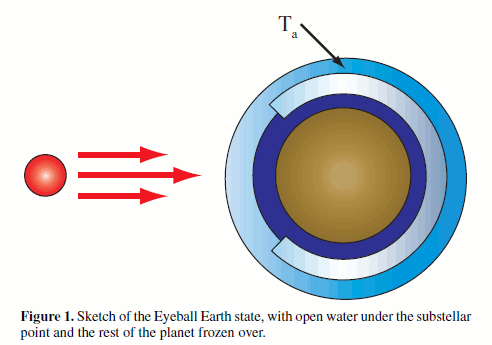
This, in turn, has led to the proposal that any watery worlds in the vicinity could form what’s called an “Eyeball Earth.” Being directly under the local star, with one side perpetually facing towards it, the light would be intense enough to melt a circular patch of water, while the rest of the planet would remain locked in a deep freeze. In short, not an ideal situation for supporting life.

eyeball_earthHowever, a new three-dimensional model has been created, thanks to the efforts of two researchers at Peking University. In their research paper, they suggest that ice and oceans on these planets would be dynamic, which is both good and bad. Basically, it means an Eyeball Earth has a narrower habitable zone, but that more of the surface has the potential to support life. It also means that the “eyeball” looks more like a lobster!

This paper represents the next step in scientific analysis of exoplanets. Initially, estimates of habitability – i.e. temperatures that could allow liquid water on the planet surface – were based on a single analysis of the planet’s atmosphere to see how much light reaches the surface. But, in the real world, atmospheres form clouds, distribute heat through winds and convection, and exhibit other sorts of complex behavior.

eyeball_earthThese are the sorts of things that are handled in the full, three-dimensional climate models built to study the Earth. Hence, the Peking research team adapted these same models to handle exoplanets that differed significantly from Earth. But these models didn’t capture a critical part of the distribution of heat on the Earth: the ocean circulation. Instead, it treated the entire ocean as a two-dimensional slab.

The new study corrects for that by using a coupled ocean-atmosphere climate model, the Community Climate System Model version 3. For their study, they used Gliese 581 g, a potentially Earth-like planet orbiting in the habitable zone of an red dwarf star 20 light years away. This planet, coincidentally, is ranked by NASA as being the most Earth-like exoplanet yet seen in the known universe.

Gliese_581_-_2010Critically for the model, it’s close enough to its host star to receive 866 Watts/square meter at the top of its atmosphere (whereas the Earth receives 1,366). Since it is not yet known what Gliese 581 g’s atmosphere looks like, the authors assumed an Earth-like composition, but varied the amount of CO2 to change the intensity of the greenhouse effect. From all this, the planet was assumed to be covered in a deep ocean.

After giving the model 1,100 years to come to equilibrium, the authors sampled a century of its climate. With carbon dioxide concentrations similar to the Earth’s (330 parts per million in the model), the “eyeball” vanished. That’s because ocean currents formed along the equator and brought in ice from the west that split the eyeball into two lobes that flanked the equator – which resemble the claws of the lobster.

eyeball_earth1The currents then transferred heat to the eastern portion of the planet, which melted the ice to form the lobster’s tail. In addition to the ocean current that altered ice distribution, an underwater circulation (similar to the one on Earth) formed, which sent warmer water toward the poles. In the atmosphere, a jet stream also formed over the equator, which also distributed some heat to the unlit side of the planet.

Ultimately, the new model suggests the habitable zone of watery planets near red dwarfs is a bit more narrow than previous studies had suggested. The good news is that, in this model, the ice never got more than 3m thick on the dayside of the planet. That’s thin enough to allow light to reach the water underneath, meaning photosynthesis is a possibility over the entire dayside of the planet.

OceanPlanetAlthough this model is a major improvement, it still lacks a key feature that’s likely to exist on planets – namely continents, or at least features on the seafloor that differ greatly in height. These will radically alter the currents on the planet, and thus radically alter the distribution of heat within the ocean. Unfortunately, this information is even harder to come by at present than atmospheric conditions.

So for the time being, all we really know about Gliese 581 g and other similar exoplanets is that their surfaces are icy, but habitable – not unlike the Jovian moon Europa. However, that is not to say that we won’t have more information in the near future. With Kepler still in operation and the Gaia space observatory now in space, we might be able to construct more detailed models of nearby exoplanets in the near future.

Also a coincidence, Gliese 581 g just happens to be the setting of my writers group’s upcoming anthology, known as Yuva. And with this latest bit of info under our belts (basically, that the entire planet is a big, watery ball), I imagine we’ll have to adjust our stories somewhat!

Source: arstechnica.com

How the Internet Works

undersea_internet1This video was passed onto me by my darling wife, who is a whiz at picking out videos and articles that I would find interesting! Entitled “There and Back Again: A Packet’s Tale, this educational video clip was produced by the World Science Festival – a New York City-based non-profit organization committed to scientific education and public awareness. And in it, they explain how this complex organism known as the internet actually works.

Using a single search item as an example, the clip lets the viewer see how a packet of data – one of trillions of internet interactions – goes from one side of the planet to the other and then back again, all in the space of a second. In addition to explaining how such volumes of data are handled, they also draw attention to the fact that the internet depends upon real physical connections.

This second aspect of the video is very important, in that it reminds us that despite what could computing and wireless teach us – that data is free-floating mass moving through the air – that the world-wide web is still grounded in solid objects, such as copper and optic cables, before it gets to your wireless router. And even though it is only three and a half minutes in length, the clip is quite informative. Enjoy!


Source:
worldsciencefestival.com

The Future is Here: 3-D Printed Brain Scanner

openbciWhen it comes to cutting-edge technology in recent years, two areas of development have been taking the world by storm. On the one hand, there’s 3-D printing (aka. Additive Manufacturing) that is revolutionizing the way we fabricate things. On the other, there’s brain-computer interfaces (BCI), which are giving people the power to control machines with their minds and even transfer their thoughts.

And now, two inventors – Conor Russomanno and Joel Murphy – are looking to marry the two worlds in order to create the first, open-source brain scanner that people can print off at home. Thanks to funding from DARPA, the two men printed off their first prototype headset this past week. It’s known as the OpenBCI, and it’s likely to make brain scanning a hell of a lot more affordable in the near future.

openbci1It includes a mini-computer that plugs into sensors on a black, skull-grabbing piece of plastic called the “Spider Claw 3000,” which can be created with a 3-D printer. Assembled, it operates as a low-cost electroencephalography (EEG) brainwave scanner that connects to a PC, compared to  high-grade EEG machines used by laboratories and researchers that cost thousands of dollars.

But over the past few years, cheaper models have been made by companies like Emotiv, which have in turn allowed a new era of DIY brain hackers to conduct brainwaves experiments. Since that time, everything from games, computer interfaces, personal tracking tools, and self-directed mind enhancement have been available to regular people.

openbci2But Russomanno and Murphy felt the community needed a completely open-source platform if it was truly going to take off – hence the OpenBCI. The hardware to build the headset can be ordered from the company, while the software to run it is available through GitHub, a popular code sharing site. Once procured, people will have the ability to print off, program, and adjust their own personal brain scanning device.

According to Russomanno, the greatest asset of the headset (aside from the price) is the freedom it gives to brain hackers to put their EEG probes anywhere they like:

You don’t want to limit yourself to looking to just a few places on the scalp. You can target up to 64 locations on the scalp with a maximum of 16 electrodes at a time.

As it stands, Russomanno and Murphy have built the prototype headset, but still need to raise money to build the mini-computer that it plugs into. To accomplish this, the two inventors launched a Kickstarter project to fund the development of the Arduino-compatible hardware. Last week, they reached their goal of $100,000, and expect to ship their first systems in March.

openbci3The current design of the hardware, which looks more like a hexagonly-shaped circuit board than a computer, is their third incarnation. In addition to being smaller and Adruino-compatible, the third version is also programmable via Bluetooth and has a port for an SD card. When the hardware starts shipping, Russomanno expects it to kick off a new round of experimentation:

We’ve got about 300 people that have already donated to receive the board. If you’re willing to spend $300 for a piece of technology, you’re definitely going to build something with it.

One of the hallmarks of technological revolutions is the ability to make the technology scalable and more affordable. In this way, its benefits (aka. returns) are able to multiply and expand. And with the help of open-source devices like these that people can create on 3-D printers (which are also dropping in prices) the returns on mind-controlled devices are likely to grow exponentially in the coming years.

In short, the age of mind-controlled machinery may be just around the corner. Good to know they will be obeying us and not the other way around!


Sources:
wired.com, kickstarter.com

New GOT Trailer – Season Four, Part II

GOT_4posterAt long last, after many months of waiting, fans of HBO’s Game of Thrones have finally been treated to the first teaser trailer for the second half of season four! And as you can see, the series producers decided to give the fans just enough to whet their appetites, while not giving too much away. But of course, us A Song of Ice and Fire geeks could tell what’s in store, not that it helps much!

As the preview opens, we see King’s Landing with a dragon’s shadow passing over it (purely symbolic, don’t worry!). We also get Joffrey speaking to the newly returned Jaime about the progress of the war, which – after the events of last season’s Red Wedding – he is claiming victory in. And of course, we hear from Daenerys, who continues in her campaign to overthrow the slave cities of Essos and build an army to retake the Iron Throne.

And between all that, we get hints and previews of other threads and plots, all punctuated with plenty of voiceovers. These include the trial of Tyrion (won’t say for what); the arrival of Prince Oberyn (Pedro Pascal) and his duel with Ser Gregor Clegane (now played by Hafþór Júlíus Björnsson); and of course, Jon Snow rallying the Night’s Watch for the Wildlings’ much anticipated attack on the Wall.

The show premiers on April 6th, and if their previous records are any indication, this one is sure to be one of the highest rated premiers of all time! Enjoy the trailer…

New Movie Trailer: Interstellar

interstellar-teaserposterI came across this trailer recently, thanks again to my bud over at Ellipsis Media. And although the clip is short, it does manage to intrigue and fascinate. And as the name would suggest, the movie is all about space exploration in the not-too-distant future, where humanity suddenly finds itself able to bridge the vast distance between the stars for the first time ever.

Here is the commercial description, courtesy of MOVIECLIPS:

Interstellar chronicles the adventures of a group of explorers who make use of a newly discovered wormhole to surpass the limitations on human space travel and conquer the vast distances involved in an interstellar voyage.

The movie is set for release in November 7th, 2014. Christopher Nolan is the director (Inception, Dark Knight trilogy), and the film has an all-star cast that includes Matthew McConaughey, Anne Hathaway, Casey Affleck, Topher Grace and Michael Caine. Enjoy!

Looking Forward: Science Stories to Watch for in 2014

BrightFutureThe year of 2013 was a rather big one in terms of technological developments, be they in the field of biomedicine, space exploration, computing, particle physics, or robotics technology. Now that the New Year is in full swing, there are plenty of predictions as to what the next twelve months will bring. As they say, nothing ever occurs in a vacuum, and each new step in the long chain known as “progress” is built upon those that came before.

And with so many innovations and breakthroughs behind us, it will be exciting to see what lies ahead of us for the year of 2014. The following is a list containing many such predictions, listed in alphabetical order:

Beginning of Human Trials for Cancer Drug:
A big story that went largely unreported in 2013 came out of the Stanford School of Medicine, where researchers announced a promising strategy in developing a vaccine to combat cancer. Such a goal has been dreamed about for years, using the immune system’s killer T-cells to attack cancerous cells. The only roadblock to this strategy has been that cancer cells use a molecule known as CD47 to send a signal that fools T-cells, making them think that the cancer cells are benign.

pink-ribbonHowever, researchers at Stanford have demonstrated that the introduction of an “Anti-CD47 antibody” can intercept this signal, allowing T-cells and macrophages to identify and kill cancer cells. Stanford researchers plan to start human trials of this potential new cancer therapy in 2014, with the hope that it would be commercially available in a few years time. A great hope with this new macrophage therapy is that it will, in a sense, create a personalized vaccination against a patient’s particular form of cancer.

Combined with HIV vaccinations that have been shown not only to block the acquisition of the virus, but even kill it, 2014 may prove to be the year that the ongoing war against two of the deadliest diseases in the world finally began to be won.

Close Call for Mars:
A comet discovery back in 2013 created a brief stir when researchers noted that the comet in question – C/2013 A1 Siding Springs – would make a very close passage of the planet Mars on October 19th, 2014. Some even suspected it might impact the surface, creating all kinds of havoc for the world’s small fleet or orbiting satellites and ground-based rovers.

Mars_A1_Latest_2014Though refinements from subsequent observations have effectively ruled that out, the comet will still pass by Mars at a close 41,300 kilometers, just outside the orbit of its outer moon of Deimos. Ground-based observers will get to watch the magnitude comet close in on Mars through October, as will the orbiters and rovers on and above the Martian surface.

Deployment of the First Solid-State Laser:
The US Navy has been working diligently to create the next-generation of weapons and deploy them to the front lines. In addition to sub-hunting robots and autonomous aerial drones, they have also been working towards the creation of some serious ship-based firepower. This has included electrically-powered artillery guns (aka. rail guns); and just as impressively, laser guns!

Navy_LAWS_laser_demonstrator_610x406Sometime in 2014, the US Navy expects to see the USS Ponce, with its single solid-state laser weapon, to be deployed to the Persian Gulf as part of an “at-sea demonstration”. Although they have been tight-lipped on the capabilities of this particular directed-energy weapon,they have indicated that its intended purpose is as a countermeasure against threats – including aerial drones and fast-moving small boats.

Discovery of Dark Matter:
For years, scientists have suspected that they are closing in on the discovery of Dark Matter. Since it was proposed in the 1930s, finding this strange mass – that makes up the bulk of the universe alongside “Dark Energy” – has been a top priority for astrophysicists. And 2014 may just be the year that the Large Underground Xenon experiment (LUX), located near the town of Lead in South Dakota, finally detects it.

LUXLocated deep underground to prevent interference from cosmic rays, the LUX experiment monitors Weakly Interacting Massive Particles (WIMPs) as they interact with 370 kilograms of super-cooled liquid Xenon. LUX is due to start another 300 day test run in 2014, and the experiment will add another piece to the puzzle posed by dark matter to modern cosmology. If all goes well, conclusive proof as to the existence of this invisible, mysterious mass may finally be found!

ESA’s Rosetta Makes First Comet Landing:
This year, after over a decade of planning, the European Space Agency’s Rosetta robotic spacecraft will rendezvous with Comet 67P/Churyumov-Gerasimenko. This will begin on January 20th, when the ESA will hail the R0setta and “awaken” its systems from their slumber. By August, the two will meet, in what promises to be the cosmic encounter of the year. After examining the comet in detail, Rosetta will then dispatch its Philae lander, equipped complete with harpoons and ice screws to make the first ever landing on a comet.

Rosetta_and_Philae_at_comet_node_full_imageFirst Flight of Falcon Heavy:
2014 will be a busy year for SpaceX, and is expected to be conducting more satellite deployments for customers and resupply missions to the International Space Station in the coming year. They’ll also be moving ahead with tests of their crew-rated version of the Dragon capsule in 2014. But one of the most interesting missions to watch for is the demo flight of the Falcon 9 Heavy, which is slated to launch out of Vandenberg Air Force Base by the end of 2014.

This historic flight will mark the beginning in a new era of commercial space exploration and private space travel. It will also see Elon Musk’s (founder and CEO of Space X, Tesla Motors and PayPal) dream of affordable space missions coming one step closer to fruition. As for what this will make possible, well… the list is endless.

spaceX-falcon9Everything from Space Elevators and O’Neil space habitats to asteroid mining, missions to the Moon, Mars and beyond. And 2014 may prove to be the year that it all begins in earnest!

First Flight of the Orion:
In September of this coming year, NASA is planning on making the first launch of its new Orion Multi-Purpose Crew Vehicle. This will be a momentous event since it constitutes the first step in replacing NASA’s capability to launch crews into space. Ever since the cancellation of their Space Shuttle Program in 2011, NASA has been dependent on other space agencies (most notably the Russian Federal Space Agency) to launch its personnel, satellites and supplies into space.

orion_arrays1The test flight, which will be known as Exploration Flight Test 1 (EFT-1), will be a  short uncrewed flight that tests the capsule during reentry after two orbits. In the long run, this test will determine if the first lunar orbital mission using an Orion MPCV can occur by the end of the decade. For as we all know, NASA has some BIG PLANS for the Moon, most of which revolve around creating a settlement there.

Gaia Begins Mapping the Milky Way:
Launched on from the Kourou Space Center in French Guiana on December 19thof last year, the European Space Agency’s Gaia space observatory will begin its historic astrometry mission this year. Relying on an advanced array of instruments to conduct spectrophotometric measurements, Gaia will provide detailed physical properties of each star observed, characterising their luminosity, effective temperature, gravity and elemental composition.

Gaia_galaxyThis will effectively create the most accurate map yet constructed of our Milky Way Galaxy, but it is also anticipated that many exciting new discoveries will occur due to spin-offs from this mission. This will include the discovery of new exoplanets, asteroids, comets and much more. Soon, the mysteries of deep space won’t seem so mysterious any more. But don’t expect it to get any less tantalizing!

International Climate Summit in New York:
While it still remains a hotly contested partisan issue, the scientific consensus is clear: Climate Change is real and is getting worse. In addition to environmental organizations and agencies, non-partisan entities, from insurance companies to the U.S. Navy, are busy preparing for rising sea levels and other changes. In September 2014, the United Nations will hold another a Climate Summit to discuss what can be one.

United-Nations_HQThis time around, the delegates from hundreds of nations will converge on the UN Headquarters in New York City. This comes one year before the UN is looking to conclude its Framework Convention on Climate Change, and the New York summit will likely herald more calls to action. Though it’ll be worth watching and generate plenty of news stories, expect many of the biggest climate offenders worldwide to ignore calls for action.

MAVEN and MOM reach Mars:
2014 will be a red-letter year for those studying the Red Planet, mainly because it will be during this year that two operations are slated to begin. These included the Indian Space Agency’s Mars Orbiter Mission (MOM, aka. Mangalyaan-1) and NASA’ Mars Atmosphere and Volatile EvolutioN (MAVEN) mission, which are due to arrive just two days apart – on September 24th and 22nd respectively.

mars_lifeBoth orbiters will be tasked with studying Mars’ atmosphere and determining what atmospheric conditions looked like billions of years ago, and what happened to turn the atmosphere into the thin, depleted layer it is today. Combined with the Curiosity and Opportunity rovers, ESA’s Mars Express,  NASA’s Odyssey spacecraft and the Mars Reconnaissance Orbiter, they will help to unlock the secrets of the Red Planet.

Unmanned Aircraft Testing:
A lot of the action for the year ahead is in the area of unmanned aircraft, building on the accomplishments in recent years on the drone front. For instance, the US Navy is expected to continue running trials with the X-47B, the unmanned technology demonstrator aircraft that is expected to become the template for autonomous aerial vehicles down the road.

X-47BThroughout 2013, the Navy conducted several tests with the X-47B, as part of its ongoing UCLASS (Unmanned Carrier Launched Airborne Surveillance and Strike) aircraft program. Specifically, they demonstrated that the X-47B was capable of making carrier-based take offs and landings. By mid 2014, it is expected that they will have made more key advances, even though the program is likely to take another decade before it is fully realizable.

Virgin Galactic Takes Off:
And last, but not least, 2014 is the year that space tourism is expected to take off (no pun intended!). After many years of research, development and testing, Virgin Galactic’s SpaceShipTwo may finally make its inaugural flights, flying out of the Mohave Spaceport and bringing tourists on an exciting (and expensive) ride into the upper atmosphere.

spaceshiptwo-2nd-flight-2In late 2013, SpaceShipTwo and passed a key milestone test flight when its powered rocket engine was test fired for an extended period of time and it achieved speeds and altitudes in excess of anything it had achieved before. Having conducted several successful glide and feathered-wing test flights already, Virgin Galactic is confident that the craft has what it takes to ferry passengers into low-orbit and bring them home safely.

On its inaugural flights, SpaceShipTwo will carry two pilots and six passengers, with seats going for $250,000 a pop. If all goes well, 2014 will be remembered as the year that low-orbit space tourism officially began!

Yes, 2014 promises to be an exciting year. And I look forward to chronicling and documenting it as much as possible from this humble little blog. I hope you will all join me on the journey!

Sources: Universetoday, (2), med.standford.edu, news.cnet, listosaur, sci.esa.int

New Reviews for Whiskey Delta!

Good_News_EveryoneI have just received word that Whiskey Delta has received its fifth review over at Goodreads this afternoon. And the review was pretty good, 5 star good in fact, and pushed the overall rating of the book up to a full four stars. The reviewer was woman named Seregon (I’m omitting her full name to protect her anonymity), who is an actress, model, and fan of indie writers who enjoys reading and reviewing.

When I learned this last bit about her, I couldn’t help but contact her and send her a free copy in exchange for an honest review. And here is what she said (just the first part to avoid the biggest spoilers):

This wasn’t your typical horror/zombie book. It was more about survival, much like the Walking Dead. If you’re a fan of that show, you’ll really like this book. Taking place in SoCal, the military has a special team designated to find Patient Zero, aka Papa Zulu, aka the first person known to have contracted the virus that turns people into Whiskeys (zombies…

I was impressed with the dialogue and references to getting by in life that involved a lot more than dealing with zombies… I like that each character has his/her own personality and is three dimensional. The reader follows and can relate to each character on some level and there’s no feeling of “fluff” anywhere in the story.

Even if you’re not a zombie fan, you might still enjoy this book. As I said, it’s less “horror” and more about completing an important mission.

Wasn’t that nice? Always good to be differentiated from the rest, not to mention being compared to one of your favorite franchises (she mentioned The Walking Dead in the post and compared this book favorably to it). Reading it put me in a good mood instantly!

good-reviewAnd, in truth, this is the second 5 star review I’ve received in recent months, I just happened to forget to post about the other one. In that case, it was a woman named Kellie, also a fan of the new literature and someone with a soft spot for zombie and horror novels. In her case, she responded to a discussion thread I started months ago where I was asking for reviews.

She responded, and a few weeks later, this is what she had to say (Once again, the reviews is edited for spoiler content):

This is a badass Zombie book. Braun and his crew have a very important classified job to do as its classified im unable to tell you about it… This book is awesome! Very suspensful… The threat of the zombies have you wondering when they are going to jump out and bite someone. The whole crew is likeable you don’t want anyone getting hurt… This author really knows what hes talking about with all the military terms and the battles. Wait for the battles, you feel as if your there and the zombies in this book don’t just shuffle, moan, and bite. They run and fight back… I said it once ill say it again AWESOME! I hear there’s a sequel. I will be on it.

Again, wasn’t that nice? I tell you, a good review makes it all worthwhile, and a bad one is enough to put a writer (this one, at any rate) in a funk for a good while. Having heard kind words about my writing like these, I’m all the more pumped to get Papa Zulu ready for publication. In fact, I’m itching to do it now, but releasing the last one too soon is why I got some of the mixed reviews I did. Very interested in avoiding that this time around.

In the meantime, to all indie writer’s, keep hitting those keys and your eyes firmly fixed on the prize. If you love what you do, nothing should stand between you and recognition and respect, not to mention some decent sales figures! I hope we can all look forward to some of that too 🙂

zombies-city-and-the-crowd