News From Space: MAVEN Launched

maven_launchYesterday, NASA’s Mars Atmosphere and Volatile Evolution (MAVEN) space probe was finally launched into space. The flawless launch took place from Cape Canaveral Air Force Station’s Space Launch Complex 41 at 1:28 p.m. EST atop a powerful Atlas V rocket. This historic event, which was the culmination of years worth of research, was made all the more significant due to the fact that it was nearly scrapped.

Back in late September, during the government shutdown, NASA saw its funding curtailed and put on hold. As a result, there were fears that MAVEN would miss its crucial launch window this November. Luckily, after two days of complete work stoppage, technicians working on the orbiter were granted an exemption and went back to prepping the probe for launch.

NASA_mavenThanks to their efforts, the launch went off without a hitch. 52 minutes later, the $671 Million MAVEN probe separated from the Atlas Centaur upper stage module, unfurled its wing-like solar panels, and began making its 10 month interplanetary voyage that will take it to Mars. Once it arrives, it will begin conducting atmospheric tests that will answer key questions about the evolution of Mars and its potential for supporting life.

Originally described as a “time-machine for Mars”, MAVEN was designed to orbit Mars and examine whether the atmosphere could also have provided life support, what the atmosphere was like, and what led to its destruction. This mission was largely inspired by recent discoveries made by the Opportunity and Curiosity rovers, whose surface studies revealed that Mars boasted an atmosphere some billions of years ago.

maven_atmo1During a post launch briefing for reporters, Bruce Jakosky – MAVEN’s Principal Investigator – described MAVEN’s mission as follows:

We want to determine what were the drivers of that change? What is the history of Martian habitability, climate change and the potential for life?

Once the probe arrives in orbit around Mars, scheduled for September 22nd, 2014, MAVEN will study Mars’ upper atmosphere to explore how the Red Planet may have lost its atmosphere over the course of billions of years. This will be done by measuring the current rates of atmospheric loss to determine how and when Mars lost its atmosphere and water.

maven_atmosphereFor the sake of this research, MAVEN was equipped with nine sensors the come in three instrument suites. The first is the Particles and Fields Package – which contains six instruments to characterize the solar wind and the ionosphere of Mars – that was provided by the University of California at Berkeley with support from CU/LASP and NASA’s Goddard Space Flight Center.

The second suite is the Remote Sensing Package, which ill determine global characteristics of the upper atmosphere and ionosphere and was built by CU/LASP. And last, but not least, is the Neutral Gas and Ion Mass Spectrometer, built by Goddard, which will measure the composition of Mars’ upper atmosphere.

As for the long term benefits of the mission and what it could mean for humanity, I’d say that Dr. Jim Green – NASA’s Director of Planetary Science at NASA HQ in Washington, DC – said it best:

We need to know everything we can before we can send people to Mars. MAVEN is a key step along the way. And the team did it under budget! It is so exciting!

Source: universetoday.com

South Park: Winter is Coming!

south_park_60532South Park once again spoofed Game of Thrones this past week. Using Black Friday as a plot line, the episode had the children dressing up as characters from the GOT universe and plotting to get their hands on the new Xbox One’s and PS4’s. In true GOT fashion, this involved plotting, making and breaking alliances, and the use of the slogan “Winter is Coming” to portend the need for swift action.

And of course, the show itself was reference, much in the same way that Lord of the Rings or World of Warcraft was worked into the plot in previous episodes. As usual, Butters is the only one who doesn’t know about it yet and is promptly told to get on it by Cartman. Plotting ensues, and a war of GOT proportions is declared.


And just like with the Lord of the Rings and World of Warcraft episode, Butters is confused by (and has some hilarious observations about) the pop culture phenomena once he actually starts experiencing it. I’m sure fans of the GOT series know exactly what he’s talking about.


And there’s even a thread where Randy Marsh (Stan’s dad) joins the mall cops, ostensibly to earn more money for the holidays, but really so he can get a better shot at scoring some Black Friday deals. After the head cop, an old man with a scarred face, is stabbed and passes leadership onto Randy it’s clear they are alluding to John Snow and Jeor Mormont of the Night’s Watch. While I could not find a clip of that part, trust me when I tell you its quite accurate.

This is the second time that South Park has referenced this show, and about the millionth time that GOT was spoofed, referenced, or satirized in some way. Man, that show has made some serious inroads into popular culture, and dammit if they aren’t taking their precious time getting Season 4 out!

Judgement Day Update: Bionic Computing!

big_blue1IBM has always been at the forefront of cutting-edge technology. Whether it was with the development computers that could guide ICBMs and rockets into space during the Cold War, or the creation of the Internet during the early 90’s, they have managed to stay on the vanguard by constantly looking ahead. So it comes as no surprise that they had plenty to say last month on the subject of the next of the next big leap.

During a media tour of their Zurich lab in late October, IBM presented some of the company’s latest concepts. According to the company, the key to creating supermachines that 10,000 faster and more efficient is to build bionic computers cooled and powered by electronic blood. The end result of this plan is what is known as “Big Blue”, a proposed biocomputer that they anticipate will take 10 years to make.

Human-Brain-project-Alp-ICTIntrinsic to the design is the merger of computing and biological forms, specifically the human brain. In terms of computing, IBM is relying the human brain as their template. Through this, they hope to be able to enable processing power that’s densely packed into 3D volumes rather than spread out across flat 2D circuit boards with slow communication links.

On the biological side of things, IBM is supplying computing equipment to the Human Brain Project (HBP) – a $1.3 billion European effort that uses computers to simulate the actual workings of an entire brain. Beginning with mice, but then working their way up to human beings, their simulations examine the inner workings of the mind all the way down to the biochemical level of the neuron.

brain_chip2It’s all part of what IBM calls “the cognitive systems era”, a future where computers aren’t just programmed, but also perceive what’s going on, make judgments, communicate with natural language, and learn from experience. As the description would suggest, it is closely related to artificial intelligence, and may very well prove to be the curtain raiser of the AI era.

One of the key challenge behind this work is matching the brain’s power consumption. The ability to process the subtleties of human language helped IBM’s Watson supercomputer win at “Jeopardy.” That was a high-profile step on the road to cognitive computing, but from a practical perspective, it also showed how much farther computing has to go. Whereas Watson uses 85 kilowatts of power, the human brain uses only 20 watts.

aquasar2Already, a shift has been occurring in computing, which is evident in the way engineers and technicians are now measuring computer progress. For the past few decades, the method of choice for gauging performance was operations per second, or the rate at which a machine could perform mathematical calculations.

But as a computers began to require prohibitive amounts of power to perform various functions and generated far too much waste heat, a new measurement was called for. The new measurement that emerged as a result was expressed in operations per joule of energy consumed. In short, progress has come to be measured in term’s of a computer’s energy efficiency.

IBM_Research_ZurichBut now, IBM is contemplating another method for measuring progress that is known as “operations per liter”. In accordance with this new paradigm, the success of a computer will be judged by how much data-processing can be squeezed into a given volume of space. This is where the brain really serves as a source of inspiration, being the most efficient computer in terms of performance per cubic centimeter.

As it stands, today’s computers consist of transistors and circuits laid out on flat boards that ensure plenty of contact with air that cools the chips. But as Bruno Michel – a biophysics professor and researcher in advanced thermal packaging for IBM Research – explains, this is a terribly inefficient use of space:

In a computer, processors occupy one-millionth of the volume. In a brain, it’s 40 percent. Our brain is a volumetric, dense, object.

IBM_stacked3dchipsIn short, communication links between processing elements can’t keep up with data-transfer demands, and they consume too much power as well. The proposed solution is to stack and link chips into dense 3D configurations, a process which is impossible today because stacking even two chips means crippling overheating problems. That’s where the “liquid blood” comes in, at least as far as cooling is concerned.

This process is demonstrated with the company’s prototype system called Aquasar. By branching chips into a network of liquid cooling channels that funnel fluid into ever-smaller tubes, the chips can be stacked together in large configurations without overheating. The liquid passes not next to the chip, but through it, drawing away heat in the thousandth of a second it takes to make the trip.

aquasarIn addition, IBM also is developing a system called a redox flow battery that uses liquid to distribute power instead of using wires. Two types of electrolyte fluid, each with oppositely charged electrical ions, circulate through the system to distribute power, much in the same way that the human body provides oxygen, nutrients and cooling to brain through the blood.

The electrolytes travel through ever-smaller tubes that are about 100 microns wide at their smallest – the width of a human hair – before handing off their power to conventional electrical wires. Flow batteries can produce between 0.5 and 3 volts, and that in turn means IBM can use the technology today to supply 1 watt of power for every square centimeter of a computer’s circuit board.

IBM_Blue_Gene_P_supercomputerAlready, the IBM Blue Gene supercomputer has been used for brain research by the Blue Brain Project at the Ecole Polytechnique Federale de Lausanne (EPFL) in Lausanne, Switzerland. Working with the HBP, their next step ill be to augment a Blue Gene/Q with additional flash memory at the Swiss National Supercomputing Center.

After that, they will begin simulating the inner workings of the mouse brain, which consists of 70 million neurons. By the time they will be conducting human brain simulations, they plan to be using an “exascale” machine – one that performs 1 exaflops, or quintillion floating-point operations per second. This will take place at the Juelich Supercomputing Center in northern Germany.

brain-activityThis is no easy challenge, mainly because the brain is so complex. In addition to 100 billion neurons and 100 trillionsynapses,  there are 55 different varieties of neuron, and 3,000 ways they can interconnect. That complexity is multiplied by differences that appear with 600 different diseases, genetic variation from one person to the next, and changes that go along with the age and sex of humans.

As Henry Markram, the co-director of EPFL who has worked on the Blue Brain project for years:

If you can’t experimentally map the brain, you have to predict it — the numbers of neurons, the types, where the proteins are located, how they’ll interact. We have to develop an entirely new science where we predict most of the stuff that cannot be measured.

child-ai-brainWith the Human Brain Project, researchers will use supercomputers to reproduce how brains form in an virtual vat. Then, they will see how they respond to input signals from simulated senses and nervous system. If it works, actual brain behavior should emerge from the fundamental framework inside the computer, and where it doesn’t work, scientists will know where their knowledge falls short.

The end result of all this will also be computers that are “neuromorphic” – capable of imitating human brains, thereby ushering in an age when machines will be able to truly think, reason, and make autonomous decisions. No more supercomputers that are tall on knowledge but short on understanding. The age of artificial intelligence will be upon us. And I think we all know what will follow, don’t we?

Evolution-of-the-Cylon_1024Yep, that’s what! And may God help us all!

Sources: news.cnet.com, extremetech.com

Virgin’s Galactic’s Coming Space Flight

spaceshiptwo_flightNext year, Virgin Galactic is planning on mounting its first tourist spaceflight. This will involve SpaceShipTwo, the flagship of the fleet, taking six civilian passengers – including founder Richard Branson and his two adult children, Holly and Sam – into Near-Earth Orbit for the first time. And in true Bransonian fashion, he has arranged a major multimedia campaign in preparation for the event.

This consisted of signing a “multi-platform partnership” with the network NBCUniversal for it’s affiliates to transmit the flight all over the world. So far, the platforms for coverage include CNBC, MSNBC, NBCNews.com, Syfy and The Weather Channel. They also plan a “primetime special” on NBC on the launch’s eve, and to host a live event for three hours on NBC’s Today show.

Spaceshiptwo-580x256This past September, SpaceShipTwo conducted its second powered test flight, which consisted of a full-technical run through. This concluded with the deployment of its feathered wings, which allowed the ship to slow down and make a controlled descent. These were the latest in a long series of flights designed to test the ship’s engine, wings, landing mechanisms, and ability to glide.

Said Branson of the newly-announced partnership:

Virgin Galactic is thrilled that NBCUniversal will join us on our exciting first journey to space. In this first chapter of commercial space travel, we will help make space accessible and inspire countless more people to join us in the pursuit of space exploration and science innovation.

Lynx_spaceplane_mockupAlready, some 600 people have signed up for a ride aboard SpaceShipTwo once it’s making regular runs into orbit. What’s more, competitors have emerged to get a piece of the market, the most notable of which are XCOR Aerospace (run by Jeff Greason, a former member of the Rotary Rocket company) and Amazon founder Jeff Bezos’ Blue Origin.

Another curious media partnership is also being contemplated in anticipation of the maiden flight. This one comes from One Three Media, the company behind the Survivor series. Apparently, CEO Mark Burnett is looking to create a reality TV show where contenders will compete for a chance to win tickets aboard the space carrier.

spaceshiptwo-2nd-flight-2No indication has been given yet as to what sort of things contestants will do in order to win, or whether they have to go through something similar to astronaut training. But a recent press release from the studio stated the show would be a “groundbreaking, elimination competition series where everyday people compete for the ultimate prize”.
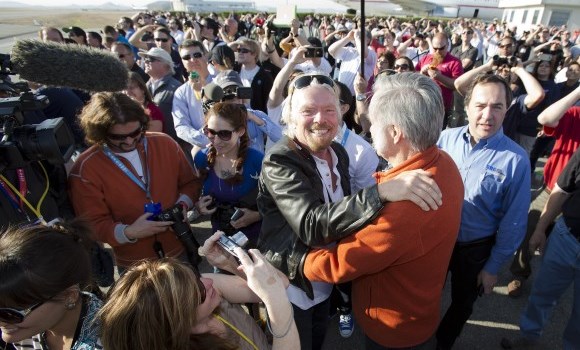
And according to Mark Burnett, it represents the culmination of a decade’s long dream:

For the past 10 years I have relentlessly pursued my dream of using a TV show to give an everyday person the chance to experience the black sky of space and look down upon mother Earth. Last year, I spent time in New Mexico at the state-of-the-art facility and last week [I] spent time in the Mojave desert with Sir Richard and his impressive team. We got to see the spaceship up close and hear of Sir Richard’s incredible vision of how Virgin Galactic is the future of private space travel. I am thrilled to be part of a series that will give the everyday person a chance to see space, and that NBC has come on board too so that viewers at home will have a first-class seat.

virgin_galactic_bransonNo telling on when this show might premiere, but it is the latest in a long series of attempts by Burnett to put a person into space. Back in 2000, he announced a deal with NBC to host a space reality show (Destination Mir) where the winner would visit the Russian space station. Burnett subsequently proposed another show that would have brought ‘N Sync guitarist Lance Bass to the International Space Station.

Due to various factors, such as lack of funding and the Russian Federal Space Agency choosing to deorbit their aging space station in 2001. But with Branson ready to send people into space, and with a transport mechanism that is far more affordable and accessible than space rockets, this latest reality space venture might just come to fruition.

The age of private space travel is dawning, friends. I sincerely hope I can afford a trip into space before I’m too old to go. It’s too soon for me to make a bucket list, but I know for a fact that I would like to know the feeling of weightlessness at least once before I die!

Source: universetoday.com, (2)

The Walking Dead – Season Four, Episode Five

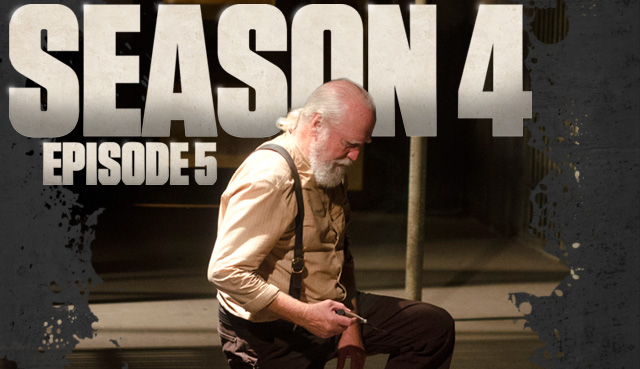
WD_season4-5This past week, the fifth episode in The Walking Dead aired, and we got treated to some interesting developments. Not only did the plot advance as far as the epidemic was concerned, a rather important tidbit involving the larger story (which, for the sake of those who haven’t watched this episode yet, I shall save to the end) was finally revealed.

But what I found interesting about this episode was the structure. After four episodes where the story was split between the prison (with one or two things going on there) and the crew that was out looking for supplies, this episode was entirely focused on the prison itself. Here, we had two threads – one involving Hershel and the infected, and the other involving the situation in the yard.

Put together, these two threads were both extremely chaotic and mirrored each other in every respect. In truth, this episode should have been called “Pandemonium” rather than “Internment”. Given all the action and the palatable sense of panic, that name would have made a hell of a lot more sense!

Internment:
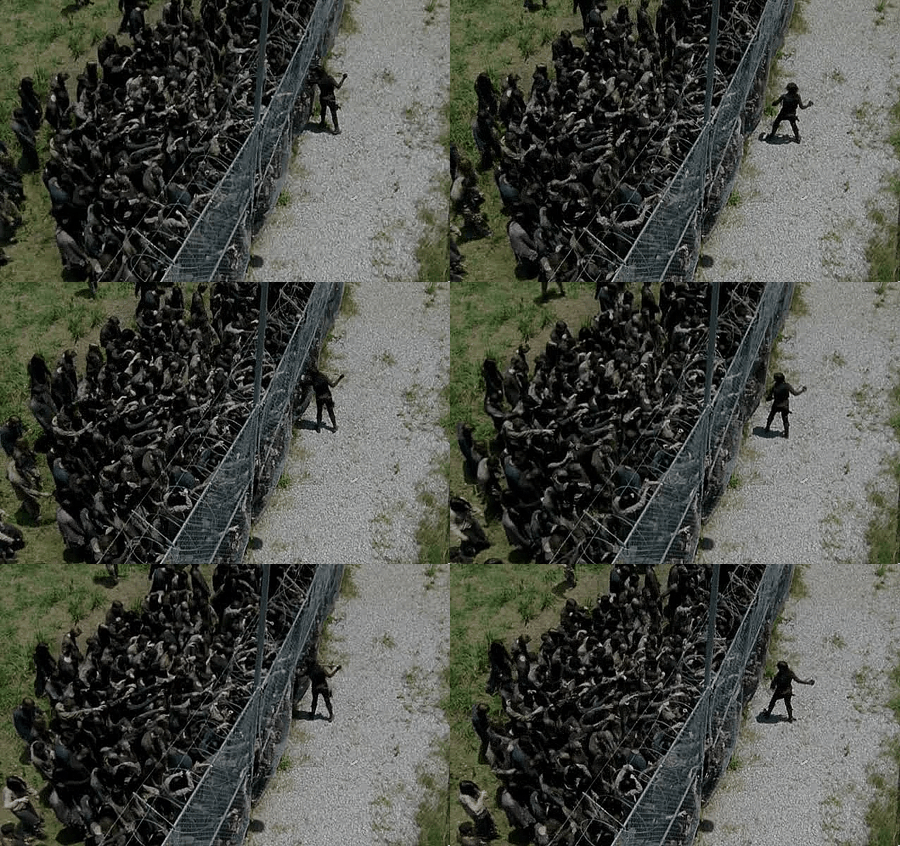
WD4_internmentThe prison people continue to die from the flu and Hershel, Glenn and Sasha struggle to deal with it. Outside the quarantine zone, Maggie works alone to deal with the Walkers that are still converging on the fence and is there when Rick returns, alone. He explains that he had to let her go because of what she did to Karen and David, and asks her to keep it a secret for now.

Rick meets with Carl, who asks to help him outside but is again refused. He tells Rick that he cannot shield him from the death and insanity of the world forever, but Rick is determined to try. Hershel meets with Doctor Kaleb Subramanian, who is also sick now and near death. Rick comes to see him and is told that they are losing more, and are trying to dispose of them quietly to safeguard morale.

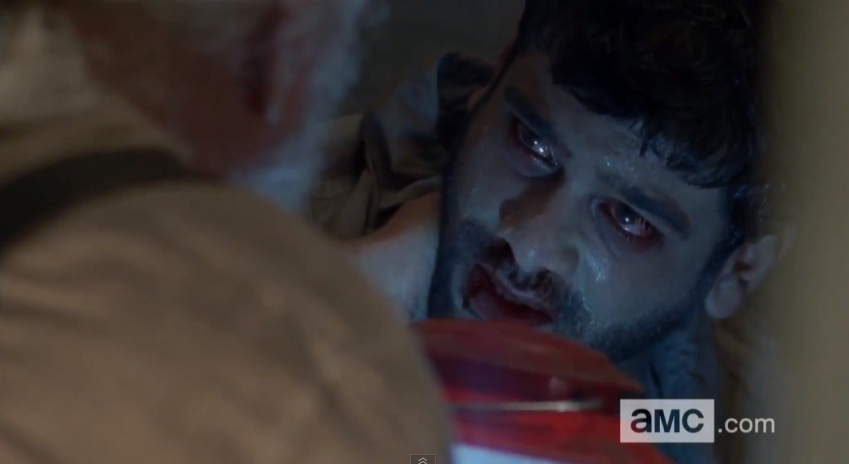
wd4_internment2Sasha and Glenn get worse, the one collapsing from dehydration while Glenn begins coughing up blood. More people die and go unnoticed, which allows them to turn. Hershel is attacked by one of them and chaos ensues as others emerge and an uninfected woman is shot and killed by accident. Lizzie foolishly tries to talk a Walker down from attacking them. It tries to bite her and Hershel narrowly saves her.

Maggie runs into help while Rick grabs Carl and asks him to assist him in reinforcing the fence. Their supports begin to break, however, and another section completely caves in. Rick and Carl narrowly escape to a nearby guard tower and make to the second line of fences. Desperate, Rick and Carl load up with assault rifles and begin mowing them down!wd4_internment1Back inside, Hershel is forced to arm himself as well almost everyone in the block appears to have turned. Grabbing a shotgun, he begins shooting Walkers as Maggie shoots her way into the quarantine zone. Hershel finds Glenn choking on his own blood and is forced to retrieve a tracheal tube and air pump from the last patient to have it, who is now a Walker.

Maggie comes to his aid and takes out the Walker with a well placed head shot. Hershel removed the device from his throat and comes to Glenn, fixing the bag to a fresh pipe and putting it down his throat. Glenn begins to breathe again and is saved. Outside, Carl and Rick go through the killing field they’ve made and dispatch the last of the Walkers.

wd4_internment3Daryl and the search party return at last and Rick lets them in. Tyreese runs in to find Sasha alive and they begin administering the antibiotics to all those who are still alive. Hershel is told by Maggie to go rest now that the others are back and he’s no longer solely responsible for the sick and dying. He checks on Dr. Subramanian, who he was forced to stab after he turned, and cries as he holds his Bible.

The next day, the entire crew collects the bodies for disposal and puts the fence back up. Rick and Carl check on the gardens and see that the first of their vegetables are starting to come in. Hershel tells Daryl to talk to Rick about Carol, and then goes off on patrol with Michonne. Outside the gate, the Governor is seen watching…

Summary:
Much like last week, I have to say that I was generally impressed with this episode. While it did advance a few things that I suspected were coming and wasn’t really looking forward to, it was still cool to see how they played out. And I could really appreciate the action that was involved and the way the episode was very tightly written.

wd4_internment5As I said already, panic and chaos run through this episode like a coiled snake. For some time now, they have been building up in this show how the prison is threatened from both inside and out. Outside their gates, there is a growing horde of Walkers who are being lured by someone, and the walls are beginning to buckle. Inside, they have an infection which has been spreading like wildfire, and the dead quickly turn into more Walkers.

In this episode, all of that hit the fan as the infection became out of control and a section of wall finally came down. And it was only by the desperate actions of those who were still inside the prison that they came through. Especially Carl and Rick, who chose to say “Screw all this keeping them out crap. Let’s just shoot the bastards!” Tell me that scene wasn’t totally boss! I dare ya!

wd4_internment4However, the episode also played to a few things I was expecting without much enthusiasm. At this point, it looks like everyone who came from Woodbury, save for Lizzie and a handful of others are now dead. What’s more, its now been shown that the mysterious person luring the Walkers to the wall is indeed the Governor. Who saw that one coming? Everyone?

And according to next week’s preview, episode six – titled “Live Bait” – is going to be all about him. While I’m sure some fans are stoked about this, I can’t help but think the same thing I do every time I see him: “He’s supposed to be dead! Why are you dragging this out?” But of course, that goes for a lot of things this season. And clinging to the comic book isn’t really helping things much.

wd4_livebait_govAnd so I’ve decided to put all that aside and start enjoying these episodes on their own merits. After all, they’ve done a good job so far this season, and them writers really know how to structure a good show! I can’t keep faulting them for the fact that they’ve chosen to deviate from the original plot, or trying to inflate the plot a little.

It’s television after all, and studios will do more of the same until audiences stop caring! So I plan to keep tuning in, and am interested to see what they do with the Governor at this point. I wonder if they’ll kill him off quickly, or keep him around to season’s end and make him part of it’s culmination. Only time will tell…

“Zombie Story”

Zombie_StoryCame across this video crossover not too long ago, and I have to say I was impressed. Drawing parallels between AMC’s The Walking Dead and the Toy Story franchise, creator John Wray uses video clips to illustrate how these two franchises – which could not be more different in terms of target audiences – really aren’t that different.

Rzombie_story1anging from the main characters (Sheriff Woody vs. Sheriff Rick), to the boy’s they love (Andy vs. Carl), to the conflict over who’s their primary caregiver (Woody or Buzz vs. Rick or Shane), to the dangerous hordes they routinely face (little kids vs. Walkers), the benevolent leader who turns out to be a psycho (Lotso vs. The Governor), there really are a lot of similarities to be found.

Granted, none of this is to be taken seriously, but it is very well made, right down to similar events in the story and bits of footage. Who knew Disney and Robert Kirkman could be of similar minds? Then again, ol’ Walt is rumored to be frozen somewhere, a living dead entity awaiting the day when he can be thawed and begin walking the Earth again.

Enjoy the clip!

When Trolls Get Really Nasty

trollIn my life, I’ve gotten into many heated debates. The majority were intelligent, but some were painfully stupid. In the former case, many were face to face, civil, and almost always resulted in some kind of resolution. In the latter, they all took place over the internet, were quite pointless, and generally resulted in me losing that much more faith in the human race.

Might sound harsh, but consider this most recent example. Over at Goodreads, I joined with a number of people in debating the merits of the Ender’s Game boycott. Without getting into the details too much, let me just say that these people and I were of the same mind and we successfully and intelligently debated against numerous people who’s point of view ran contrary to our own.

troll3Then came along a man named… let’s call him Igor! Igor began by debating with us and telling us we didn’t know what we were talking about, even though we routinely backed up what we said with direct quotations and citations. After awhile, i chose to call him on his unwillingness or inability to acknowledge what we were saying, and that’s when things got personal.

This coincided with him engaging in name-calling to a number of people in the thread. His words of choice were stupid, dishonest, trolls, and the like. For this, we called him petty, childish, and hypocritical, since he routinely would make insults in one breath and then claim we were the bad guys in the next. In no time at all, he chose to get really personal, and started attacking me on my author’s page.

troll6Yes, as if insulting my colleagues and I in an open forum was not enough, he chose to begin rating every book I’ve listed on Goodreads with one star. He even started a shelf especially for them, entitled “Sci-fi authors who hate science.” Naturally, we all wondered just how stupid he was, seeing as how any review can be flagged for abuse, much like posts.

At this point, I cut the lines of communication, but he continued to rail on in the forum against everyone. And when my colleagues all came to my defense, good people that they are, he claimed he was merely criticizing my books because of scientific inaccuracies he saw in them. Naturally, everyone called BS on that and told him he was just doing it out of spite.

troll2Not only was it abundantly clear he hadn’t read a single book in my list, the reviews were all made within a day of his opening salvo of insults. Nevertheless, he kept coming back to the forum claiming that he was a scientist and that he’s taking a stand on ethics, and even claimed my attempts to have his reviews flagged was some kind of censorship.

At this point, I just have to wonder, who does this? What kind of person decides to get back at a person who’s debating them by giving their work terrible ratings? What kind of person then has the nads to show their face again and make incredibly transparent excuses for doing it? What kind of person persists in claiming they are somehow the victim when they are the one constantly on the offensive?

troll4But of course, Goodread’s moderators have been slow to respond. Apparently, this individual has flagged every member of our group as well for abuse, and seems to think he’s in the right and will be vindicated. Worse yet, we know for a fact he trolled by the profiles of the other members in the group. But since they do not have original material posted there, he had nothing to work with.

An upside to this spiteful episode is that it made my colleagues in the group realize I was a writer. Somehow, it just never came up, and my friends were not one to troll my profile looking for something to use against me. Now, however, they’ve all taken an interest, and one was even sure to start reading my books and gave them all very high ratings (5 stars each!)

Facebook Reece ElliottBreaking my communications embargo just long enough to thank him, I let Igor know that his little explosion of pettiness actually did me good. I was also sure to let him know that as soon as his trollish one-star reviews were removed, I shall have several five star reviews to take it place. I hoped he could appreciate the irony, or at least incredibly foolish. That will be our last communication, as I have no interest in indulging this individual further.

One thing is for sure, though – Goodreads needs to seriously consider its terms of use! It’s getting like YouTube over there, with the people at the shallowest end of the gene pool setting the tone and ruining it for the rest of us. Wasn’t it supposed to be a site dedicated to literature and intellectual pursuits? Yeah, and they said that the internet would bring the world together and create a “Global Village”. Look how that turned out!

In the meantime, if you’ve got any interesting troll stories you want to share, please feel free to share them. Nothing beats the misanthropic blues like knowing that there are other people out there who can’t stand pettiness, stupidity, and general jackassery, the very stuff that trolls are made of. And in the meantime, remember…

troll1

Space Tourism: The World View Balloon

near-space_balloonWhen the Space Age began, some five decades ago, there were many who predicted that commercial space flight would follow shortly thereafter. This included everything from passenger flights into space, orbital space stations, and even space tourism. Naturally, these hopes seem quite naive in hindsight, but recent events are making them seem feasible once more.

Consider Virgin Galactic, a commercial aerospace carrier that will begin taking passengers into Low-Earth Orbit (LEO) beginning next year. And there’s Inspiration Mars, a private company that wants to send a couple on a round trip to visit the Red Planet. And now, there’s World View Enterprises, a company that plans to send to start sending passengers on a near-space balloon ride beginning in 2016.

near-space_balloon1Based in Tucson, Arizona, World View is a start-up that is looking to entice people into the budding field of space tourism by offering people a chance to get a taste of space without actually going there. Going into space is defined as traveling 100 km (62 miles) from the Earth’s surface, whereas their balloon ride will take passengers to a height of 30 km (18.6 miles), where they will be treated to a spectacular view of the Earth

World View Enterprises recently obtained approval from the US Federal Aviation Administration for its proposed balloon experiences, which will cost US $75,000 a ride, and are projected to begin in 2016. Each flight will consist of two balloon pilots and up to six passengers, which will be contained within a cylindrical capsule that comes equipped with heating and its own air-supply.

near-space_balloon2According to the company’s plan, the capsule – which measures 6 meters in length and 3 in width (approx. 20 x 10 feet) – will be deployed below a parasail (used for recovery) and tethered to a 400,000 cubic meter (14 million cubic ft) helium balloon, which will provide the lift needed to bring the capsule and its occupants to 30 km in altitude or Low-Earth Orbit.

Might sound a little dangerous to some, but the FAA has determined that World View’s design meets the engineering and environmental challenges posed by Low-Earth Orbit. They stressed that the capsule be designed and tested as if it were going to have long-term exposure in space, even though it will not exceed altitudes much above 30 km, and assigned it a safety factor of 1.4 – the same as that required of manned space systems.

near-space_balloon5The flight itself is projected to last about four hours, with the ascent taking 1.5-2 hours. The capsule will then remain at an altitude of 30 km for about two hours, during which time the semi-space tourists will be free to move about the cabin and take in the view. Unfortunately, they will not experience weightlessness during this period.

That’s comes after, when the capsule is cut off from the balloon and begins to fall towards Earth. Once it gains enough speed, the parafoil will provide sufficient lift to slow the descent and bring the passengers in for a safe, controlled landing. Before touching down, the capsule will deploy a set of skids and lands much the same way a paraglider does.

near-space_balloon4All in all, the balloon ride being suggested by World View does appear to hit many of the key points on the space tourism agenda. These include seeing black sky and the curvature of the Earth, and having a view of the planet that only astronauts are ever treated to. That may very well add up to an experience that is as good as being in space without technically getting there.

The only question is, will enough passengers line up for an amazing day’s flight that costs a startling $75K? Only time will tell. One thing is fore sure though. The dream of space tourism appears to finally be upon us, though it is a few decades late in coming. Today’s dreams do tend to become tomorrow’s reality, though they sometimes take longer than expected.

And be sure to enjoy this promotional video from World View Enterprises showing their concept in action:


Sources: gizmag.com, fastcodesign.com,

Remembrance Day 2013

lest-we-forgetIt goes by many names the world over. In Canada, Britain and Australia, we call it Remembrance Day. In the United States, it’s called by Veteran’s Day. In New Zealand, France, Belgium and Serbia, it’s known as Armistice Day. And to the Polish, it’s Independence Day since the end of World War I was also the occasion when their country achieved statehood.

Interestingly enough, the war that it originally commemorates also goes by many names. To those who fought in it, it was the Great War, but also the “War to end all wars”, as no one who lived through it could fathom that any nation would ever go to war again. And to those who have went to war again just 27 years later, it would come to be known as World War I or the First World War.

remembrance-day-poemRegardless of the name, November 11 is a day when people the world over come together to mark one of the worst periods in our history, celebrate those who made the ultimate sacrifice, and reflect upon the terrible lessons that were learned. And while it is easy to look upon the world and imagine that we’ve learned nothing, I choose to believe otherwise.

When the world went to war in August of 1914, the news was greeted with general elation for those involved. In Berlin, Paris and London, crowds emerged to celebrate the fact that their nations were mobilizing against their enemies. In Canada, people readily volunteered to serve overseas and “fight the Hun”. The propaganda mills of every nation were running overtime, stoking the fervor of war, claiming rightness, and that God was on their side.

Royal_Irish_Rifles_ration_party_Somme_July_1916Four years later, few retained these romantic notions of war. Those who survived the carnage were known as “The Lost Generation”, and those born after the war entered into a world struggling to leave the memory behind and get back to normal. When war was once again declared in 1939, few were enthused, and the general attitude was one o fear.

In fact, part of the reason “Appeasement” – the strategy of giving in to Hitler’s demands, or accommodating Japanese and Italian expansion in Africa and East Asia – was permitted was because no one wanted a repeat of the last war. Even in the Axis nations of Germany, Japan, and Italy, the general public entered the war only reluctantly, convinced they had no choice and fearful for how it might turn out.

Berlin-1945_croppedSix years, 70 million lives, 1600 cities, and several attempted genocides later, the victorious nations of the world once again came together with the common goal of lasting world peace, human rights and economic development. This was embodied in the Universal Declaration of Human Rights, the International Court of Justice, the International Monetary Fund and World Bank Group.

Despite the prevailing mood that a new “Cold War” was already brewing between east and west, the word’s “Never Again” were spoken by people on all sides. After two World Wars and the near total-destruction of many nations, it was understood that the world would not be able to endure a third. Somehow, and despite the arms race of the latter of the half of the 20th century, peace would endure.

Cuban-missile-crisis-photo-from-Oct-29-1962Lucky for all of us, the Cold War ended some two decades ago and the specter of World War III with it. While many wars took place during the intervening period and there were a few close calls (The Cuban Missile Crisis being foremost), a nuclear crisis was continually avoided because all sides understood that no one would emerge the victor.

Today, wars still rage in the underdeveloped regions of the world and even amongst the so-called “developed” nations – the rational ranging from fighting extremism to trying to foster nation building. Nevertheless, I can’t help but look back today and think that those who died and sacrificed so much taught us something invaluable and enduring.

nuclear1Sure, the Great War did not end all wars, nor did those that followed it. But with every mistake, with every new sacrifice, with every new conflict, surely we have learned something. Were it not for the UN and the spirit multilateralism the prevailed after the Second World War, World War III may have been unavoidable, and might still be a possibility.

And while there were still wars between proxy nations during the Cold War, Korea and Vietnam taught us the futility of political conflicts, a lesson which helped end the Iraq War sooner and with less loss of life than would have otherwise been possible. These sentiments have since been applied to the war in Afghanistan and the drone wars, two more unpopular campaigns that are sure to end in the near future as well.

holocaustWhat’s more, the genocide of the Jewish, Roma and Slavic peoples all across Europe taught us the evils of ethnic cleansing and man’s capacity for hate, lessons which have helped us confront and combat genocide in former Yugoslavia, Rwanda, Darfur, East Timor and elsewhere. They have also forced us to contemplate genocides which have taken place on our soil, in Australia, Canada, the US and Latin America.

To look at the state of the world today, it is easy to grow cynical and say that we’ve learned nothing. But when you consider that fact that we no longer live in a world where total war is seen as glorious, where two superpowers are aiming nuclear-tipped missiles at each other, and where aggression and genocide are actively ignored or accommodated, you begin to appreciate what we have and who made it possible.

Vimy RidgeBut most importantly of all, to say we’ve learned nothing is to disrespect those who made the ultimate sacrifice, not to mention those who came home forever changed and scarred. For these veterans, servicemen and women, and people who risked life and limb to ensure that war would bring peace, that people would remain free, and that greater evils would not be allowed to prevail, saying “it was all in vain” renders what they did for the rest of us meaningless.

With that in mind, I’m very happy to announce that next year, in April of 2014, my family and I will be visiting Europe to witness the Centennial of World War I. While we’re there, we will be visiting the grave sites of those who died overseas, several battlefield from the First and Second World War, and will bear witness to one of the greatest historic events in our lifetimes.

My father made the trip once before and remarked with awe how to people over there, the wars are not something that are commemorated once a year, but on a regular basis. But next year, it is expected to be especially poignant as people from all over the globe converge on Flanders to pay their respects. I expect it to be very eye-opening, and you can expect to be hearing about it the moment I get back!

A sober and reflective Remembrance Day to you all. Peace.

remembrance_day___poppy_day_by_daliscar

News From Space: Olympic Torch gets a Spacewalk

sochi_torch_ISS1Yesterday, for the first time ever, the Olympic torch was taken into space as two Russian cosmonauts took it on a spacewalk outside of  the International Space Station. NASA streamed video of the event as two cosmonauts, Oleg Kotov and Sergei Ryazanskiy, conducted their walk while the torch bobbed weightlessly from the end of a tether.

The two cosmonauts took several photos with the torch hovering with planet Earth in the background, the orb’s edge capturing the sunrise and emitting a bright glow. After two hours, they returned it to the space station and got to other tasks on their itinerary, which included attaching a footrest and a camera platform to the exterior of the orbiting laboratory.

The Soyuz TMA-11M spacecraft rests on its launch pad at the Baikonur cosmodromeThe walk was just latest leg in the torch’s journey, which began on October 7th when the torch was delivered from Greece to Moscow. After touring the country, a journey which took it from Moscow, to St. Petersburg, and even to the North Pole (another first) aboard an atomic-powered icebreaker, the torch was launched last Thursday aboard a Soyuz rocket from the Baikonur Cosmodrome.

Inspired by the Firebird of Russian folklore, a magical glowing birdt hat can be both a blessing and a curse to its owner, the metre-long torch – which weighs roughly 2 kg (4.4 lbs) on Earth – accompanied a three-man crew into space. This consisted of a Russian cosmonaut and an American and Japanese astronaut, bringing the total number of crew aboard the station to nine.

Space-Shuttle-Atlantis-STS-101-031.previewGranted, this is not the first time an Olympic torch has been taken into space. In 1996 and again in 2000, the Atlanta and Sydney Olympic torches were flown into space aboard the U.S. Space Shuttle Atlantis, in preparation for the Atlanta Summer Olympics. However, in that case, the torch was not taken outside of the spacecraft, which makes this a true first.

Much like on that occasion, the torch remained unlit while it was in space, as lighting it would have consumed precious oxygen. Still, the ISS crew managed to carry the unlit torch with them on a tour through several of the station’s modules and snapped pictures of it all. This took place over the course of several days before it stepped into space on Saturday.

sochi_torch_ISS4The torch is set to return to Earth tomorrow along with Russian cosmonaut Fyodor Yurchikhin, U.S. astronaut Karen Nyberg and Italian Luca Parmitano of the European Space Agency. Once home, it will be handed off to Sochi 2014 officials and continue on its 65,000 kilometer (44,000 mile) journey, which just happens to be the longest Olympic torch relay in history.

The torch is also planned to reach such destinations as Mount Elbrus (Europe’s highest peak) in the Caucasus mountain range before arriving in Sochi on February 7th, where it will kick of the 22nd Winter Games. In another interesting first, this will be the first time that an Olympic Games has been held by the Russian Federation, whereas the 1980 Summer Olympics that were held in Moscow took place during the era of the Soviet Union.

Olympic torch launched into spaceAccording to Deputy Prime Minister Dmitry Kozak, who has been in charge of planning the Olympics, transporting the Olympic torch to the ISS and bringing it into space is seen as “[A] way to show the world what Russia is made of.” He said it would display Russia’s “might” and its economic achievements, not unlike China did with the Tiangong space station.

Though the upcoming games are still a source of controversy to many – due to the recent passage of several laws that criminalize what officials call “gay propaganda” – this latest part of the Sochi Olympic torch relay showcases what is truly great about the Olympics. Not only was it an historic first, it also reminds us what the Olympics are all about.

sochi_torch_ISS5Originally conceived as a way of fostering goodwill between Greece’s city-states, and resurrected in 1894 to foster goodwill between nation-states, bringing the torch on board the ISS amidst a crew of international scientists helps to celebrate the spirit of diversity and tolerance which can and must define our modern world.

One can only hope that the symbolic value of this has not been lost on Russian lawmakers. Take it from us, Putin and the State Duma of Russia. It’s not too late to rethink your country’s political stances. If you really want to show how far your country has come, why not do some incredibly rational, like back away from an incredibly antiquated legal stance? I know for a fact it would make the Olympics go more smoothly this coming February…

And of course, be sure enjoy this video that NASA captured during the spacewalk:


Sources:
cbc.ca, (2), ctvnews.ca, abcnews.go.com, in.reuters.com