November is finally coming to an end and December is now upon us, which means the following things. It’s time to get the snow gear out, people who have grown mustaches for Movember can finally shave, and NaNoWriMo is officially over. For those who took part in it this year, my congratulations. For those who finished on time, my profound congratulations and respect. As for me, I started, stopped, and then started again. It seems this November I had a bout of temperamental inspiration which led to a weird outcome.
Originally, I wasn’t going to participate, seeing as how I had just finished work on my zombie apocalypse story known as Whiskey Delta. That took me at least a week into the month of November and I kind of felt burnt. Yet at the same time, I was rearing to go on production of the sequel and even got some encouragement to do so. Didn’t seem like a good time to take on another writing assignment. But then I was struck by an idea about the lives of future people who lived in an Arcology, a concept I’d been wanting to tackle for some time.
After coming up with a name – Etemenanki, the name of the Ziggarut that is believed to have inspired the Babel myth – I set to work. However, my passion soon faltered as I realized the idea was not well thought out, and the burden of having to write 2000 words a day sapped my inspiration further. I realized what I wanted to be writing was the sequel to Whiskey Delta – aka. Pappa Zulu – so I shut down Etemenanki and got to work on that instead.
But then I noticed that at NaNo website, you can easily change which story you’re working on by simply changing the title on your entry and resubmitting its basic data. Nowhere, except on the word count feature, does it keep track of the story itself. So I figured, what the hey? I changed the entry name to Pappa Zulu, and began submitting my chapter for it instead of chapters for Etemenanki, and the month of November proceeded. Granted, I lost a lot of time thanks to my starting and stopping, but at least I enjoyed it this way.
As of today, my final word count on Pappa Zulu is 27265 words in length, roughly half of what it needed to be to complete the challenge in time. Ah well, so sad. Better luck next year. By that time, I hope to have my act together on what I plan to write, to start on time, and not change my mind partway through. This is why they say not to change paddles in midstream, you know 😉
Yeah, it seems I’ve decided to actually take part this year. It was a bit of a dilemma as to whether or not I would be participating, what with my heavy editing schedule and all the promises I’ve made to follow up Whiskey Delta with its sequel. But wouldn’t you know it, while in the midst of a rather hectic day – the kids were absolute nightmares and it was pool day to boot! – I actually came up with an idea. In addition, I somehow found the time to belt out an outline and the first 500 words for it. I’m nuts, I know!
And truth be told, it kind of solves a few writing goals I’ve had for myself of late. First off, I’ve been dying to write about an Arcology ever since I did a post dedicated to the concept. And ever since I finished with Whiskey Delta, I’ve been looking for the next serial novel project. Originally, I had hoped to move right into the second installment in that series, but I think it would be best to let that percolate for awhile (my apologies to the fans who were expecting it sooner). And finally, I really wanted to contribute something.
As I’ve planned it, this new story ought to cover all three of those bases. The story I plan to write will take place within an Arcology, specifically an Ultima-tower type structure located in the Great Lakes Megapolis region of the future. As a massive structure that dominates the landscape, it is an entirely self-sufficient and ecologically sustainable environment surrounded by sprawling slums. The name of the place, and hence the story, is Etemenanki, the ancient ziggurat that may have inspired the Tower of Babel myth.
Over the course of November, I’ll be publishing chapters on a regular basis, much as I did with Whiskey Delta. Hopefully, I can keep up with the daily writing demand, especially since I’m getting a bit of a late start! Stay tuned for more on this front. Go NaNoWriMos!
The other day, I finally got around to dedicating a post to Paolo Soleri and the concept of Arcology, something which has fascinated me for some time. But of course, I couldn’t do justice to it all in just one post, so rather than mention every example for arcologies that I could find, I chose a select few and planned to talk about the others later. You wouldn’t believe the amount of information that I’ve found since!
Initially, I thought only a few architecture firms and city planners were considering 3-D cities; but as it turns out, there are a dozen plans under consideration and more coming every day! From New Orleans to Haiti, from Shanghai to Dubai, the world abounds with plans for possible future cities that will take advantage of 3-D planning, sustainable resource management and green technology. This last aspect is key, seeing as how the vast majority of these plans are all inspired by one thing: Climate Change!
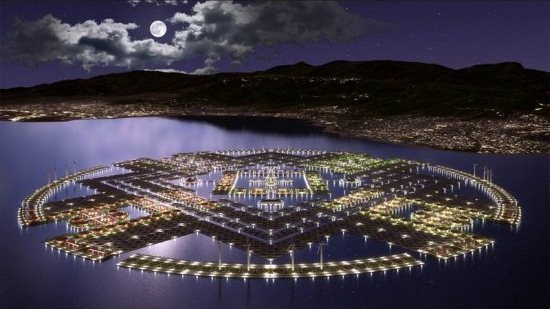
Take this concept for example: the Lillypad City. A revolutionary idea designed for dealing with the worst ravages of climate change in the coming decades, the LC is basically a floating city that is immune to things like coastal flooding and rising sea levels. According to many worst-case scenarios, these are expected to rise in excess of a meter by 2030. Coastal areas will be flooded and entire islands will disappear beneath the waves, leaving millions homeless and displaced. The Lillypad City is a possible solution: a self-contained environment built along coastal shelves and harbors, capable of supporting 50,000 people in an environment that’s ecologically friendly.
A similar concept is NOAH – or New Orleans Arcology Habitation, designed by Kevin Schopfer . An aptly named structure, NOAH is a proposed solution of what to do about coastal flooding and the ongoing problem of rebuilding New Orleans. At over 90oo square kilometers and designed to hold 40,000 residents, the pyramid shaped arcology will also boast shopping centers, 3 hotels, 1,500 timeshare units, parking for 8,000 cars, cultural spaces, public works, schools, an administrative office, and a health care facility.
All of this built upon a floating base with an open-wall structure, which will make it resistant to all forms of weather and immune to rising tides. In addition, the city will boast the latest in green technology, thus eliminate the carbon footprint of its residents. These will include internal electric transport links, secured wind turbines, solar panels and river based water turbines for electricity generation, fresh water reclamation and storage systems, grey water treatment, sky garden heating/cooling vents.
If NOAH catches on, there are even plans to build one on the banks of the Mississippi, where flooding is expected to occur, displacing people up and down the interior US.
And speaking of rebuilding, Haiti continues to suffer from the damage suffered from the 2010 Earthquake. Luckily, there are no shortages of creative ideas of what to deal with this and the likelihood of future earthquakes and flooding. Harvest City is one such idea, a city built on a series of islands capable of supporting 30,000 residents.
Based on the principles of arcology, this city is designed to be sustainable, ensuring adequate food production for all its residents while also providing employment and industry. If feasible, such a city could be indispensable to Haiti’s recovery and ensuring the survival of its people in the long run.
And then there’s the BoA, which is short for Boston Arcology. Much like many of it’s predecessors, the purpose here is to address the problem of urban sprawl in a way that does not impact the existing city, either by expanding into surrounding green space or renovating it’s aging, historic core. Built into Boston Harbor, this uniquely shaped structure will house 15,000 people and will also hold hotels, offices, retail spaces, museums, condominiums, and even a new city hall.
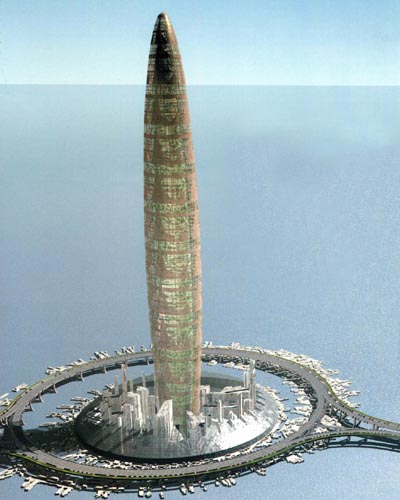
And speaking of 3-Dimensional, check out this baby: the proposed Bionic Tower! A vertical city measuring some 1,228 meters high and being able to house approximately 100,000 people, the Bionic Tower is yet another proposed solution of what to do about the twin problems of overpopulation and pollution.
And at the heart of it all lies the concept of merging bioscience with existing high-tech, meaning that the building will house extensive green-spaces, nature preserves, and its own water reclamation and bio-fuel systems.
Originally proposed at a lecture entitled “Conquest of Vertical Space in the 21st Century – International Conference on Multipurpose High-Rise Towers and Tall Buildings” in London, October, 1997, the project has since begun formal development, and garnered the interest of city planners and developers in both Shanghai and Hong Kong.
Japan is following suit. As already mentioned, the Shimizu Mega-City Pyramid is being slated for development in Tokyo Bay. However, within Tokyo’s urban center, there are also plans for the creation of a vertical city, known as Sky City 1000. Measuring 1000m high, hence the name, the supertall skyscraper would house 35,000 residents and 100,000 workers. The design consists of 14 concave dish-shaped “Space Plateaus” that are stacked one upon the other and held together by a series of vertical struts. Each plateau is designed to contain greenspaces, offices, commercial facilities, schools, theaters, residential spaces, and other modern amenities.
Back to Dubai, where arcology is just one of many inspirations for new construction projects, we have the “Dubai Ziggarut”. A proposed Carbon-Neutral habitat proposed by design firm Timelinks, this eco-pyramid is expected to house 1 million people once completed. Power is to be provided by steam, wind, solar panels and other natural resources, ensuring complete electronic self-sufficiency. The tightly knit city will also feature a super efficient public transportation system that runs both horizontally and vertically, and plans are being drawn up to utilize both public and private green spaces for agricultural opportunities.
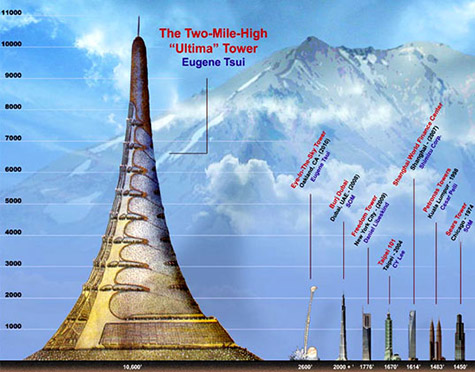
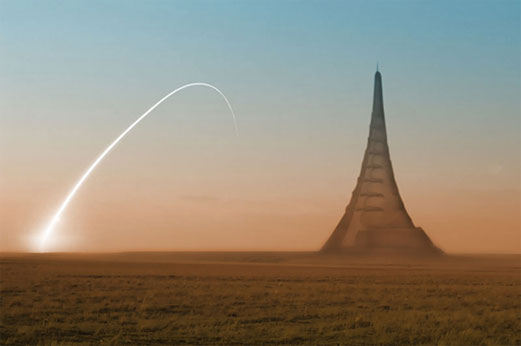
And last, but certainly not least, there is the proposed design for the “Ultima Tower”. A massive edifice, measuring some 3200 meters in height, this supertall skyscraper was first proposed in 1991 by Eugene Hui as a way of tackling the planet’s sustainability problems. At this height, it would be the tallest building ever created by human beings, should it ever be built.
The interior of the structure would measure some 140,000,000 m2 and would be capable of supporting 1 million people. Relying on atmospheric pressure difference between the bottom and the top of the tower to create electricity and vast interior green space, the building would contain several “mini-ecosystems”.
Combined with water treatment and reclamation facilities, it would be capable of sustaining its inhabitants, perhaps without any outside help. Given the sheer cost of the structure (150 billion US dollars), it remains strictly theoretical. However, as time moves on and the problems of overpopulation and climate change continue, this tower may very well be making an appearance on the landscape!
That about does it for now. As I said before, its a rich and fertile concept! And given the pace of technological change and climate change, its becoming more likely with every passing day. Will it make a difference? Will it help us whether the storm, or help reverse the process? Hard to say. All we know is, living in sustainable communities that are self-sufficient and protected from external threats is far better than the alternative.
Arcology: noun (plural arcologies) an ideal integrated city contained within a massive vertical structure, allowing maximum conservation of the surrounding environment. Origin: 1969: blend of architecture and ecology.
The question of what to do about Earth’s growing population – 7 billion and counting – and the environmental impact it is having has been on the minds of city planners, environmentalists, and global leaders for qu9ite some time. Far from it being a simple matter of determining how we are going to feed new every mouth we create, there’s also the question of how to provide for their other basic needs.
In the 20th century alone, humanity grew by multiplication factor of six. Cities expanded, suburban developments went up, and inner cities were “rezoned” and redeveloped in order to make room for them. When horizontal space became an issue, vertical structure were adapted, incorporating sky scrapers and massive high-rises. In addition, cities, counties and entire nations needed to find more sources of fresh water to address their health and sanitation needs, more landfills to accommodate waste, and more green spaces to grow food. In time, it soon became clear that this increased output of human beings and their various wastes was causing irreparable harm to the planet.
By the turn of the century, the projections only became worse, thanks in large part to the ongoing industrialization of developing nations. In these parts of the world, where a full third of the human race resides, the impact of so many new power plants, urban developments, superhighways, and fossil-fuel burning cars could not be underestimated. The problem of providing space for our people and seeing to their needs in a way that is sustainable in the long term has only become more pressing as a result.
As it turns out, the answer may lie in a concept developed in the 1960’s by a man named Paolo Soleri. An architect of Italian descent who studied at the feet of architect Frank Lloyd Wright, he is credited with coining the term “arcology”, a new form of architecture that plotted the creation of three-dimensional hyperstructures that would be self-sufficient, and in some cases, self-contained. Primarily proposed as a means to combat two-dimensional urban sprawl, arcologies were also meant to economize on transportation, energy use, commerce and agriculture. All needs, which included the need to reduce waste and impact on the environment, were incorporated in his new designs. And on top of that, they would be beautiful as well as very, very big.
One of his first designs was for a city-structure named Babel(or IID as it’s officially designated). This design called for a flared cylinder of apartments sitting in a saucer-shaped base, complete with commercial, civil spaces, and public areas. The estimated population for this monster design was 550,000 people – the population of a major city – but placed in an edifice 1900 meters high and 3000 meters at its widest point.
Close-ups of the design show the immense attention to detail that Soleri’s featured in his drawings. From housing, to production centers to water treatment and waste disposal, nothing was overlooked. And just in case you’re having problems imagining the scale, he features a picture of the Empire State building for a size comparison.
And then there was Hexadredon, an incredible geometric mountain resting on three immense supports. Accommodating over 170,000 people, it measured a mere 800 meters by 800 meters (640 square km). On top of all that, it looks immensely artistic, incorporating such design features as massive pyramids, support columns, and rotundas. In reality, it looks more like an ancient temple than a three-dimensional city.
His many other concepts involved cities adrift on water, built into canyons, or on the side of cliffs. As far as Soleri was concerned, nothing was off limits. Any and all geographic features and landscapes, including the ocean itself, could be built into human habitats. Though it remained somewhat speculative for its time, Soleri’s ideas formed the basis for a great deal of speculative writing and urban planning.
For instance, in Japan, urban planners have proposed a future city development to deal with urban sprawl in Tokyo – known as the Shimizu Mega-City Pyramid. As it stands, much of Tokyo Harbor is artificial, composed of fill in order to accommodate Japan’s growing population and industrial centers. This further expansion calls for the creation of a massive pyramid measuring 730 meters high, 8 square kilometers at the base, and capable of housing 750,000 people. All told, it would be roughly 14 times the size of the pyramid of Giza.
In addition, there is the proposed building project in Moscow known as “Crystal Island”. Measuring in at a whopping 2500 square kilometers at its base and 450 meters high, it will be the single largest structure on Earth, if and when it is completed. Shaped like a massive tent, the superstructure of the proposed design acts as a sort of second skin to the main building, creating a thermal buffer and shielding the interior from Moscow’s harsh weather.
In addition, this second skin will adjust with the seasons and sealed in winter to minimise heat loss, while opened again in summer to naturally cool the interior. Power would also be provided by built-in wind turbines and solar panel, as well as a series of renewable energy solutions. On top of all that, the design incorporates an existing park, which provides a range of activities, including cross-country skiing and skating. Construction was officially postponed in 2009 due to the economic crisis, but is expected to resume in the coming years.
Last, but not least, there is the planned community of Masdar City, which I wrote about in a previous article. Though not technically an arcology in the sense of a three-dimensional colossal environment, the design nevertheless incorporates all other aspects of Soleri’s concept. These include renewable energy sources, sustainable resource management, mass-transit, recycled water, and a range of other green technologies.
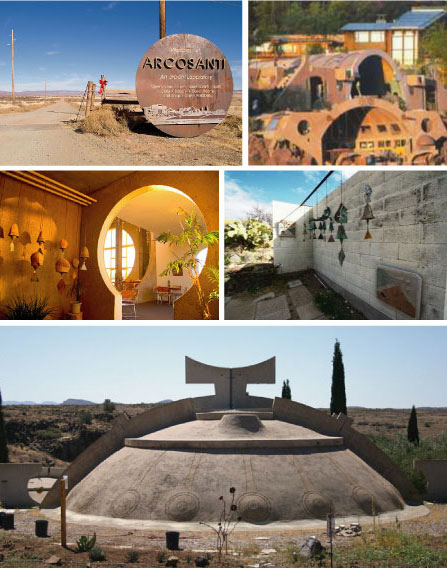
Today, the planned city of Arcosanti, which Soleri himself began construction on in 1970, remains an unfinished testament to his work and his genius. Located in central Arizona, just 110 km north of Phoenix, this work-in-progress incorporates Soleri’s unusual design features and, though uncompleted, remains a testament to his vision.
Check out this video from Arcosanti website, which featured Solari’s design for the mega-city Nudging Space:

 November is finally coming to an end and December is now upon us, which means the following things. It’s time to get the snow gear out, people who have grown mustaches for Movember can finally shave, and NaNoWriMo is officially over. For those who took part in it this year, my congratulations. For those who finished on time, my profound congratulations and respect. As for me, I started, stopped, and then started again. It seems this November I had a bout of temperamental inspiration which led to a weird outcome.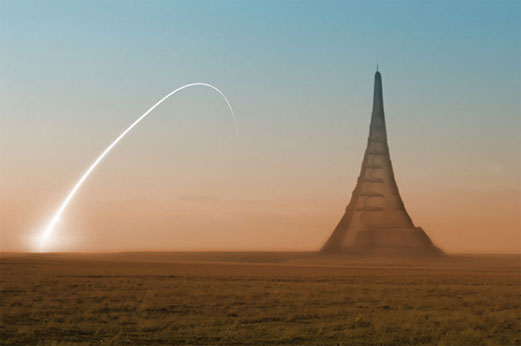






 Stories by Williams