The Future of the Classroom

virtual_learning2As an educator, technological innovation is a subject that comes up quite often. Not only are teachers expected to keep up with trends so they can adapt them into their teaching strategies, classrooms,and prepare children in how to use them, they are also forced to contend with how these trends are changing the very nature of education itself. If there was one thing we were told repeatedly in Teacher’s College, it was that times are changing, and we must change along with them.

And as history has repeatedly taught us, technological integration not only changes the way we do things, but the way we perceive things. As we come to be more and more dependent on digital devices, electronics and wireless communications to give us instant access to a staggering amount of technology, we have to be concerned with how this will effect and even erode traditional means of information transmission. After all, how can reading and lecture series’ be expected to keep kid’s attention when they are accustomed to lighting fast videos, flash media, and games?

envisioning-the-future-of-education

And let’s not forget this seminal infographic, “Envisioning the future of educational technology” by Envisioning Technology. As one of many think tanks dedicated to predicting tech-trends, they are just one of many voices that is predicting that in time, education will no longer require the classroom and perhaps even teachers, because modern communications have made the locale and the leader virtually obsolete.

Pointing to such trends as Massive Open Online Courses, several forecasters foresee a grand transformation in the not too distant future where all learning happens online and in virtual environments. These would be based around “microlearning”, moments where people access the desired information through any number of means (i.e. a google search) and educate themselves without the need for instruction or direction.

virtual_learning3The technical term for this future trend is Socialstructured Learning = an aggregation of microlearning experiences drawn from a rich ecology of content and driven not by grades but by social and intrinsic rewards. This trend may very well be the future, but the foundations of this kind of education lie far in the past. Leading philosophers of education–from Socrates to Plutarch, Rousseau to Dewey–talked about many of these ideals centuries ago. The only difference is that today, we have a host of tools to make their vision reality.

One such tool comes in the form of augmented reality displays, which are becoming more and more common thanks to devices like Google Glass, the EyeTap or the Yelp Monocle. Simply point at a location, and you are able to obtain information you want about various “points of interest”. Imagine then if you could do the same thing, but instead receive historic, artistic, demographic, environmental, architectural, and other kinds of information embedded in the real world?

virtual_learningThis is the reasoning behind projects like HyperCities, a project from USC and UCLA that layers historical information on actual city terrain. As you walk around with your cell phone, you can point to a site and see what it looked like a century ago, who lived there, what the environment was like. The Smithsonian also has a free app called Leafsnap, which allows people to identify specific strains of trees and botany by simply snapping photos of its leaves.

In many respects, it reminds me of the impact these sorts of developments are having on politics and industry as well. Consider how quickly blogging and open source information has been supplanting traditional media – like print news, tv and news radio. Not only are these traditional sources unable to supply up-to-the-minute information compared to Twitter, Facebook, and live video streams, they are subject to censorship and regulations the others are not.

Attractive blonde navigating futuristic interfaceIn terms of industry, programs like Kickstarter and Indiegogo – crowdsources, crowdfunding, and internet-based marketing – are making it possible to sponsor and fund research and development initiatives that would not have been possible a few years ago. Because of this, the traditional gatekeepers, aka. corporate sponsors, are no longer required to dictate the pace and advancement of commercial development.

In short, we are entering into a world that is becoming far more open, democratic, and chaotic. Many people fear that into this environment, someone new will step in to act as “Big Brother”, or the pace of change and the nature of the developments will somehow give certain monolithic entities complete control over our lives. Personally, I think this is an outmoded fear, and that the real threat comes from the chaos that such open control and sourcing could lead to.

Is humanity ready for democratic anarchy – aka. Demarchy (a subject I am semi-obsessed with)? Do we even have the means to behave ourselves in such a free social arrangement? Opinion varies, and history is not the best indication. Not only is it loaded with examples of bad behavior, previous generations didn’t exactly have the same means we currently do. So basically, we’re flying blind… Spooky!

Sources: fastcoexist.com, envisioningtech.com

Hacker Wars: Westboro Baptists Church Gets Jestered!

jester_westboroBy now, I imagine everyone is familiar with the Westboro Baptist Church, the notorious ultra-militant Christian cult best known for its slogan “God Hates Fags”. Well, it seems that the group has expanded its message of hate, no longer content to celebrate the deaths of gays or of US servicemen and women –  with such slogans as “Thank God for dead soldiers” or “Thank God for IEDs”. Yes, it now seems they have widened their focus and chosen to embrace new tragedies in their quest to spread their message of hate.

These include such tragedies as the Newton, Connecticut shooting and the Oklahoma tornadoes. And while their efforts to protest the funeral of Principal Dawn Hochsprung – one of the many victims of the tragic school shooting – were thwarted by a group of good Samaritans, the group still managed to make some headlines for themselves with the creation of the website GodHatesOklahoma.com, claiming once again that the tragedy in Oklahoma was God’s judgement, and praising Him for taking the lives of the 24 people who were killed.

Hackers-With-An-AgendaLuckily, the hacker community stepped in to teach these hate-mongers a lesson. Shortly after the website went up, all the original content was deleted and replaced with a picture of Jesus giving the Westboro Church the middle finger. The words ” “Westboro Faptist Church — Even Jesus Hates You” were added to let them know exactly who the Savior was cursing and why. (FYI: Faptist is a reference to the word “fap,” Internet slang for “masturbate”).

Clearly, the Westboro techs took the website down, because none of the content is avaiable for veiwing anymore. But according to some additional rumors, the person responsible was Jester, a relatively well-known hacker. This was indicated by the added message: “On the 8th day, God created hackers, and he saw that it was good. From the Gospel according to @th3j35t3r Redirecting in 5 seconds…….” After waiting, visitors were taken to a Red Cross donation site for victims of the storm.hackers_security@th3j35t3r refers to Jester’s Twitter account, which contained the message: “Westboro Faptist ‘Church’ – My God loves everyone, especially you. You need it the most”, followed by a link to an article at The Daily Dot which acknowledged his efforts. It is unclear at this time if Westboro will attempt to put their site up again, but given their inferior programming skills, I would imagine they’d not want to tempt fate, or the hacking community, a second time.

And might I take this opportunity to commend Jester and those like him. This incident, much like Anonymous’ exposure of the internet predator who ruined Amanda Todd’s life, shows how hackers can be a truly positive influence on society. Much those people who originally came together at MIT to found the “Hacker Ethic”, these individuals are proof that some people are still capable using technology for good and not abusing their freedom.

Sources: mashable.com, huffingtonpost.com

The Boston Manhunt: A Victory for Technology?

boston-marathon-bombing-suspects-2013It was announced yesterday that after an intense manhunt, a prolonged shootout, and the death of an MIT police officer, that the second and final suspect in the Boston bombing was finally captured. Identified as Tamerlan and Dzhokhar A. Tsarnaev, the eldest brother was killed during the shoot out in Watertown and the latter who was captured while in hiding under an overtunred boat in a nearby residence.

Naturally, there are still many questions about the two brothers when it comes to their motives and whether or not they had any help in the commission of this crime. But in the meantime, one can’t help but acknowledge the swiftness with which the suspects were identified and the case resolved. Considering the fact that the police had no leads and no one had come forward to take credit, the fact that the men responsible were captured and killed within four days is nothing short of astounding.

boston-marathon-bombing2So compared to past instances of terrorist acts – where the incident took place in a mass gathering and the perpetrators were mixed in with the crowd – what was different here? For one, the sheer amount of information that was provided by people who were on the scene. From torrents of photography to cell-tower information to locals’ memories, the police, FBI, and other investigators opened their investigation to spectator surveillance in a way like never before.

And in return, they received a mountain of data, which surprisingly proved quite helpful. Between the images submitted to the police from those who took pictures and video with their smartphones, PDAs and video cameras, and tips provided via Twitter and other social media, the police were quickly able to determine who the likely suspects were and how the bombing took place. After making their findings public, the suspects then fled, and committed the monumentally stupid mistake of drawing attention to themselves.

boston_bombing_manhuntAll this represented a modern twist on the age-old policy where law enforcement agencies consider the public’s eyes and ears as the crucial investigative asset. Just like with all cases, authorities opened their inquiry to account for what people saw and heard. The only real difference was that this time around, the Internet rapidly compressed the time it took for tips to arrive and get analyzed.

Mike Rolince, a retired FBI special agent who set up Boston’s first Joint Terrorism Task Force, recalls a time in the 90’s when the FBI was much more reticent about accepting information from the public and local police:

If law enforcement didn’t share any information — [as with bombers] Terry Nichols, Ted Kaczynski — if your intel is shared with no one, that is the consummate investigative challenge.

However, he acknowledges that things have since changed:

The great advantage here is the number of cameras out there. Without the cameras, I don’t know where we are.

boston-marathon-bombing-watertownBut of course, those cameras went way beyond the surveillance cameras that were in place downtown. They included every mobile camera in the hands of every person who happened to bring one. All of the information thus provided allowed the FBI and local police to turn a crime scene trampled by thousands and no leads into a solid case against two suspects and an active manhunt that led to their death and capture in four days time.

This was a victory for not only modern technology but the very democratic powers it is making possible. Much like crowdsourcing, crowdfunding, DIY research and biohacking, public surveillance is something which could very well turn the tables on terrorism. It could also go a long way to undermining fears about a surveillance-based Big Brother state, ushering in instead an era of public-government cooperation that provides for the common good.

Might sound a bit utopian, but it is a first and represents a big victory for all those who were fighting on the side of good in the midst of a heinous act of evil.

Source: Wired.com

Cyberwars: Cutting Off An Entire Continent

undersea_internet1Many people thought the Cyberbunker attack was impressive, a massive spam attack that clogged up the internet with a mind-boggling 300 gigabits per second. But at the same time, another cyberattack took place in a different part of the world, one which threatened to cut off an entire continent from the internet –  a connection equaling 1.28 terabits of information. But what’s especially impressive about it is that the men who attempted this relied on nothing more than an axe.

Yes, according to the Egyptian coastguard, three men were intercepted off the coast of Alexandria a few weeks ago who were attempting to sever the SEA-ME-WE 4 undersea cable with an axe. This cable is one of the main connections between Asia and Europe, running from France to Malaysia and linking Italy, north Africa, the middle east and south Asia. Though the identities and motives of the men have not yet been released, Egyptian authorities were clear that they were getting to the bottom of it.

undersea_internetThough unsuccessful, this recent attempt at info-terrorism is a startling reminder that the internet is not the ethereal thing, and still depends upon real, physical connections. With the expansion in recent years of wireless networks and cloud computing, people seem to have forgotten this very thing. For the most part, nations and continents are connected thanks to thousands of underground and undersea cables which are quite vulnerable to sabotage and natural hazards.

And while most big countries have several redundant cables running to their shores, the loss of even a single one means that all the traffic must be jammed through remaining connections, causing congestion. And there is nothing to stop determined attackers from targeting several cables at once. Indeed, since many cables go through geographic chokepoints like the Suez, it wouldn’t be difficult to disrupt a whole bunch of connections in a brief period of time.

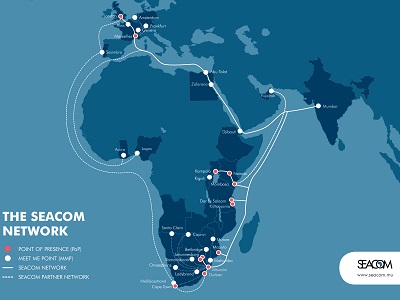
undersea_internetcableWorse yet, this last attack seems to be one of many such attacks targeting cables running to the coast of Egypt last month. Several cables were reported severed during the last week of March, and authorities initially suspected it was the result of shipping. The cables were part of the Seacom, a network of cables that serve much of Africa, the Persian Gulf and India.

SEACOM-map-largeThis latest attack seems to establish that this is a part of a pattern designed to cut Egypt off from the internet, which in many ways mirrors a series of incidents that took place back in 2008. The damage has since been repaired, but given recent events in the country, one has to wonder what agenda could be behind it all.

The most obvious possibilities include radical elements that want to cut off Egypt from foreign influence, or pro-government, pro-conservative elements that want to sever support for pro-democratic and opposition groups abroad. The success of the Arab Spring in Egypt was due in no small part to a number of social media campaigns that channeled support to the Eyptian people. Perhaps someone wants to avoid a similar situation in the future…

undersea_cable_mapDifficult to say. What seems most important though is the example this could set for extremists in other parts of the world. As the map above demonstrates, there are many fiber optics networks worldwide, and many of them pass through territory which could be easily accessed by terrorists or those looking to shut down the world wide web. Considering the effect this could have on the global economy, not to mention on geopolitical relations, it’s something to be on the lookout for!

Sources: qz.com, itnewsafrica.com

Cyberwars: The Biggest Cyber Attack in History?

cyber_virusIt’s been declared: the largest cyber attack in the history of the internet is happening right now. But you can forget about the US and China, this one is going on between private organizations, both of whom . In short, the fight comes down to Cyberbunker – a decommissioned NATO bunker located just outside of Kloetinge in the Netherlands – and a non-profit anti-spam organization named Spamhaus.

But first, a little background information is required for those of us not well-versed in the comings and goings of cyberwarfare (I include myself in this mix). Cyberbunker, as its name suggests, is an internet service provider and data haven that hosts websites and data stores for various companies. Founded in 1998, it began with the mission of hosting companies and protecting their data-assets from intrusion and attack.

cyberbunkerSpamhaus, on the other hand, is a non-profit that tracks internet addresses that are sources of email spam, and adds their addresses to a blacklist. Companies that use this blacklist—which include pretty much every email provider and most internet service providers on the planet—automatically block those addresses. Hence, to be blacklisted by this organization is to have your bottom line seriously effected.

The conflict between these two belligerents began in 2011, when Spamhaus began targeting Cyberbunker through one of its clients – and internet service provider named A2B. At the time, Spamhaus was trying to convince said provider that Cyberbunker was a haven for spam email, which led A2B to drop them as a client. Shortly thereafter, Cyberbunker moved onto a new internet service provider, leaving Spamhaus free to blacklist them directly.

Spamhaus attack … did it affect you?When they did, Cyberbunker responded in a way that seemed to suggest they wanted to live up to the reputation Spamhaus was bestowing on them. This involved massive retaliation by launching a cyberattack of some 300 billion bits of data per second, designed to clog Spamhaus’s connection to the internet and shut down their infrastructure.

Might sound like a tiff between two internet companies and nothing more. But in truth, this attack was so big that it began affecting service for regular people like you and me who happen to rely on some of the internet connections the attack is commandeering. In short, millions were effected by this “largest attack in internet history”, as their internet slowed down and even shorted out. Some even went as far as to say that it “almost broke the internet”.

internetBut for many others, this attack went unnoticed. In fact, according to an article by Gizmodo, most people were relatively unaffected. While some companies, like Netlix, reported sluggish streaming, they did not go down, mega net-enterprises such as Amazon reported nothing unusual, and organizations that monitor the health of the web “showed zero evidence of this Dutch conflict spilling over into our online backyards”.

In short, the attack was a major one and it had a profound impact on those sites it was directed at, and the collateral damage was noticeable. But aside from that, nothing major happened and this tiff remains a war between an organization known for spamming and one known for targeting them. And it shows no signs of slowing down or stopping anytime soon.

computer-virus.istockAccording to Patrick Gilmore, chief architect at the internet hosting service Akamai who was interviewed by the New York Times, the bottom line for CyberBunker is that “they think they should be allowed to spam.” CyberBunker is explicit on its homepage that it will host anything but child pornography and “anything related to terrorism.”

So while this latest incident did not cause “Infopocalype”, it does raise some interest questions. For one, how hard is it to wage a full-scale cyberwarfare in this day and age? Apparently, it is rather easy to create massive networks of “zombie PCs and use them to carry out related attacks, not to mention cheap since the hardware and software is hardly sophisticated.

cyber-war-1024x843And as it stands, numerous groups, including military hackers, are engaged in a back and forth with government and industrial giants that involves stealing information and spying on their activities. If things were to escalate, would it not be very easy for hackers or national cyberwarfare rings – especially ones operating out of China, Israel, Iran, Russia or the US – to try and shut down their enemies infrastructure by launching terabytes of useless data at them?

Oh, I shudder to think! An entire nation brought to its heels by adds for Russian brides, discount watches and cheap Viagra! But for the moment, it seems this latest apocalyptic prediction has proven to be just as flaccid as the others. Oh well, another day, another dollar…

Sources: qz.com, gaurdian.co.uk, gizmodo.com

Dealing with Spam

No-SpamI’ll say it right off the bat, I hate spam. No, let me express that properly: I HATE SPAM! And not the cheap, spiced ham that comes in a can. No, that at least has some comedic value, and the Monty Python troop made such good fun of it that the name has a permanent place in my heart. No, I refer of course to the useless adverts and unwanted solicitations that appear in your comments section whenever you log on to your website to see who’s stopping by.

Seeing as how feedback, especially the kind that lets you know you are reaching people, is so encouraging, is it not the most annoying thing in the world to find yourself beset by these uncaring, fishing, and indifferent messages? Sure, we all have been forced to accept that such garbage is simply the price we pay for using an unregulated internet, where its an open sea and you can expect to find your share of trolls, scammers, pirates and thieves. But lately, it’s becoming a total nuisance for me!

In fact, it’s gotten so bad that I’ve actually had to delete a post just so I would stop getting the free flow of useless comments that its come to attract. It was named “Anatomy of the Xenomorph”, and it contained a simple video clip that explains how the Alien costume designers have tinkered with the concept over the years. Don’t ask me why, but something in this article sends up the green flag for people looking to sell me Gucci, Cartier, glasses, handbags, running shoes, sexcam membership, free credit checks, and no credit check loans.

Because of this, it no longer appears on this site, mainly because I sank it in the hopes that it would take the rats down with it. Weeks of this stuff and I still wonder why these buggers were targeting it specifically. I’m sure many of you have seen the stuff I am referring to,  either on your own site or one you cruise by regularly, so tell me is these ring any bells…

One of the most recurring are ones that come with the name “lista de emails”, and they usually contain some nonsense message that lauds your post in such generalized terms so as not to give away the fact that they don’t have the slightest idea what you wrote in it. Others are less subtle, advertising their product directly in the message, cramming a whole of lot poorly formatted verbiage about deals and discounts and even services you can use to improve your website.

Seriously, do these sound familiar? Is it not just me getting hit up by these desperate bungholes? If so, what are you doing to dissuade these people? More than once, I’ve actually approved a comment from a repeat offender just so I could write back and tell them to F off! And now, I’ve deleted a post so they wouldn’t find that open door when next they come around. Do I need to modify my spam filter settings? Because seriously, far too much garbage is getting through here.

Oh, and if any spammers happen to be reading this, do NOT take this opportunity to solicit me, post how much you love my site with an advert link, or tell me I need to upgrade to some service of yours. Seriously deadbeats, back yer sh*t up! Not interested, don’t care, and trying to run a serious, refuse-free site here. So look for a sucker somewhere else!

Of Cybernetic Hate Crimes

Google Glass_CalaLast week, a bar in Seattle banned the use of Google Glass. The pub declared on their Facebook page that if anyone wanted to order a pint, they had better remove their $1500 pair of augmented reality display glasses beforehand. Citing the glasses potential to film or take pictures and post them on the internet, the bar owner unflinchingly declared that “ass-kickings will be encouraged for violators.”

This is the second case of what some are dubbing a new wave of “Cybernetic hate crimes”. The first took place back in July 2012 when Steve Mann, a Canadian university professor known as the “father of wearable computing”, was physically assaulted at a McDonalds in Paris, France. In this case, three employees took exception with his wearable computer and tried to physically remove it, an impossibility since it is permanent screwed into his head, and then three him out of the restaurant.

steve-mann1Taken together, these two incidents highlight a possible trend which could become commonplace as the technology grows in use. In some ways, this is a reflection of the fears critics have raised about the ways in which these new technologies could be abused. However, there are those who worry that these kinds of fears are likely to lead to people banning these devices and becoming intolerant to those who use them.

By targeting people who employ augmented reality, bionic eyes, or wearable computers, we are effectively stigmatizing a practice which may become the norm in the not too distant future. But Google responded to the incident with optimism and released a statement that cited shifting attitudes over time:

It is still very early days for Glass, and we expect that as with other new technologies, such as cell phones, behaviors and social norms will develop over time.

smartphonesYes, one can remember without much effort how similar worries were raised about smartphones and camera phones not that long ago, and their use has become so widespread that virtually all doubts about how they might be abused and what effect they would have on social norms have gone quiet. Still, doubts remain that with the availability of technologies that make it easier to monitor people, society is becoming more and more invasive.

But to this, Mann, responds by raising what he had always hoped portable computing would result in. Back in the 1970’s when he first began working on the concept for his EyeTap, he believed that camera-embedded wearables could be both liberating and empowering. In a world permeated by security cameras and a sensory-sphere dominated by corporate memes, he foresaw these devices a means for individuals to re-take control of their environment and protect themselves.

EyeTapThis was all in keeping with Mann’s vision of a future where wearable cameras and portable computers could allow for what he calls sousveillance — a way for people to watch the watchers and be at the ready to chronicle any physical assaults or threats. How ironic that his own invention allowed him to do just that when he himself was assaulted!

And in the current day and age, this vision may be even more important and relevant, given the rise in surveillance and repressive measures brought on in the wake of the “War on Terror”. As Mann himself has written:

Rather than tolerating terrorism as a feedback means to restore the balance, an alternative framework would be to build a stable system to begin with, e.g. a system that is self-balancing. Such a society may be built with sousveillance (inverse surveillance) as a way to balance the increasing (and increasingly one-sided) surveillance.

Raises a whole bunch of questions, doesn’t it? As the issue of dwindling privacy becomes more and more of an issue, and where most people respond to such concerns by dredging up dystopian scenarios, it might be helpful to remind ourselves that this is a form of technology that rests firmly in our hands, the consumers, not those of an overbearing government.

google_glass_banBut then again, that doesn’t exactly ease the fears of a privacy invasion much, does it? Whether it is a few functionaries and bureaucrats monitoring us for the sake of detecting criminal behavior or acts of “sedition”, or a legion of cyberbullies and gawking masses scrutinizing our every move, being filmed and photographed against our will and having it posted is still pretty creepy.

But does that necessitate banning the use of this technology outright? Are we within our rights, as a society, to deny service to people sporting AR glasses, or to physically threaten them if they are unable or unwilling to remove them? And is this something that will only get better, or worse, with time?

Sources: IO9, (2), news.cnet.com, eecg.toronto.edu

2013, As Imagined By 1988

bladerunnerTwenty-five years ago, Los Angeles magazine envisioned what the world would look like in the current decade. And unlike Blade Runner, they avoided the cool but standard science fiction allegories – like massive billboards, flying cars and sentient robots – and went straight for the things that seemed entirely possible by contemporary standards.

The cover story of the magazine’s April 3, 1988 edition showed a futuristic downtown L.A. crisscrossed with electrically charged, multi-tiered freeways permeated by self-driving cars. The article itself then imagined a day in the life of the fictional Morrow family of the L.A. suburb Granada Hills, as “profiled” by the magazine in 2013 by science fiction writer Nicole Yorkin.

LAtimes_2013aIronically, the magazine did not envision that it would one day go out of business, or that print media would one day be lurching towards extinction. Nevertheless, the fictional article and the world it detailed were interesting reading. Little wonder then why, earlier this month, the LA Times along with an engineering class at USC, revisited the archives to assess what it predicted correctly versus incorrectly.

Together, pro­fess­or Jerry Lock­en­our and his class made a list of the hits and misses, and what they found paints a very interesting picture of how we predict the future and how its realization so often differs from what we expect. Of the major predictions to be found in LA of the 2013, as well as in the lives of the Morrow family (get it?), here is what they got right:

Smart-Houses:
smart-house_vCe6I_25016In the article, the Morrows are said to begin every morning when their “Smart House” automatically turns on. This consists of all the appliances activating and preparing them breakfast, and no doubt turning on all the environmental controls and opening the shades to get the temperature and ambient lighting just right.

While this isn’t the norm for the American family yet, the past few years have proved a turning point for home devices hooking up with the Internet, to become more programmable and serve our daily needs. And plans are well under way to find a means of networking them all together so they function as one “smart” unit.

Self-Driving Cars:
chevy_env_croppedThe writers of the article predicted that by 2013, cars would come standard with computers that control most of the settings, along with GPS systems for navigation. They also predict self-driving cars, which Google and Chevy are busy working on. In addition to using clean, alternative energy sources, these cars are expected to be able t0 self-drive, much in the same way a pilot puts their plane on auto-pilot. Drivers will also be able to summon the cars to their location, connect wirelessly to the internet, and download apps and updates to keep their software current.

But of course, they got a few things wrong as well. Here they are, the blots on their predictive record:

Homeprinted newspapers:
news_appThe article also predicts that each morning the Morrows would begin their day with a freshly printed newspaper, as rendered by their laser-jet printer. These would be tailor-made, automatically selecting the latest news feeds that would be of most interest to them. What this failed to anticipate was the rise in e-media and the decline of printed media, though hardly anyone would fault them for this. While news has certainly gotten more personal, the use of tablets, ereaders and smartphones is the way the majority of people now read their selected news.

Robot servants and pets:
kenshiro_smallIn what must have seemed like a realistic prediction, but which now comes across as a sci-fi cliche, the Morrows’ home was also supposed to come equipped with a robotic servant that had a southern accent. The family’s son was also greeted every morning by a robot dog that would come to play with him. While we are certainly not there yet, the concept of anthropomorphic robot assistants is becoming more real every day. Consider, for example, the Kenshiro robot (pictured at right), the 3D printed android, or the proposed Roboy, the Swiss-made robotic child. With all of these in the works, a robotic servant or pet doesn’t seem so far-fetched does it?

Summary:
Between these four major predictions and which came to be true, we can see that the future is not such an easy thing to predict. In addition to always being in motion, and subject to acceleration, slowing and sudden changes, the size and shape of it can be very difficult to pin down. No one can say for sure what will be realized and when, or if any of the things we currently take for granted will even be here tomorrow.

Alpha Moon Base at http://www.smallartworks.ca

For instance, during the 1960’s and 70’s, it was common practice for futurists and scientists to anticipate that the space race, which had culminated with humans setting foot on the moon in 1969, would continue into the future, and that humanity would be seeing manned outposts on the moon by and commercial space flight by 1999. No one at the time could foresee that a more restrictive budget environment, plus numerous disasters and a thawing of the Cold War, would slow things down in that respect.

In addition, most predictions that took place before the 1980’s completely failed to predict the massive revolution caused by miniaturization and the explosion in digital technology. Many futurist outlooks at the time predicted the rise in AI, but took it for granted that computers would still be the size of a desk and require entire rooms dedicated to their processors. The idea of a computer that could fit on top of a desk, let alone on your lap or in the palm of your hand, must have seemed farfetched.

CyberspaceWhat’s more, few could predict the rise of the internet before the late 1980’s, or what the realization of “cyberspace” would even look like. Whereas writer’s like William Gibson not only predicted but coined the term, he and others seemed to think that interfacing with it would be a matter of cool neon-graphics and avatars, not the clean, page and site sort of interface which it came to be.

And even he failed to predict the rise of such things as email, online shopping, social media and the million other ways the internet is tailored to suit the average person and their daily needs. When it comes right down to it, it is not a dangerous domain permeated by freelance hacker “jockeys” and mega-corporations with their hostile counter-intrusion viruses (aka. Black ICE). Nor is it the social utopia promoting open dialogue and learning that men like Bill Gates and Al Gore predicted it would be in the 1990’s. If anything, it is an libertarian economic and social forum that is more democratic and anarchistic than anyone could have ever predicted.

But of course, that’s just one of many predictions that came about that altered how we see things to come. As a whole, the entire thing has come to be known for being full of shocks and surprises, as well as some familiar faces. In short, the future is an open sea, and there’s no telling which way the winds will blow, or what ships will make it to port ahead of others. All we can do is wait and see, and hopefully trust in our abilities to make good decisions along the way. And of course, the occasional retrospective and issue congratulations for the things we managed to get right doesn’t hurt either!

Sources: factcoexist.com, LATimes.com

Hacker Wars: The Invasion Continues!

cyber-war-1024x843State-sponsored hacking has been a major concern lately. From Russia’s “Red October” virus, which spied on embassies and diplomats in multiple countries, to China’s ongoing intrusion into government and corporate databases in the US, it seems as though private hackers are no longer the only ones we need to worry about.

The latest incident in this invasion of privacy and airing of personal information comes again from Russia, where a mysterious website has been posting personal information about some rather high-profile American figures. These include First Lady Michelle Obama, Vice-President Joe Biden, Jay-Z, Britney Spears, U.S. Attorney General Eric Holder, Sarah Palin, Arnold Schwarzenegger, and the head of the FBI.

michelle-obama_fullIn addition to taunting messages and unflattering pictures, the site includes Social Security numbers, credit reports, addresses and phone numbers. No reasons are listed on the site as to why these particular people were selected, but it seems clear at this point that they were chosen due to their high-profile nature and/or positions of importance within the US government. As of last Tuesday, both the FBI and Secret Service announced that they were investigating the website.

Though it is not definitively clear where the hackers are operating from, all indications point to Russia. The first clue came when it was revealed that site bore the internet suffix originally assigned to the Soviet Union (.su), a practice which is not uncommon with Russian hackers these days. In addition, it is also connected to a Twitter account, which carried an an anti-police message posted in Russian.

hackers_securityAt the moment, neither the White House or the Secret Service is offering assessments or comments on the matter. But some thoughts have been offered by Los Angeles Police Commander Andrew Smith, who spoke on behalf of Chief Charlie Beck, who’s information was also posted. According to Beck, this is not the first time that top police officials have had their private information posted online:

“People get mad at us, go on the Internet and try to find information about us, and post it all on one site. The best word I can use to describe it is creepy. It’s a creepy thing to do.”

Frank Preciado, assistant officer in charge of the LAPDs online division, added that the information on the police chief was likely taken from what is supposed to be a secure database of city employees. And it might just offer some insight into this latest, sweeping act of inforpiracy. When all is said and done, it appears that this may simply be a case of a small but qualified group of misfits engaging in public mischief.

internetHowever, of greater concern is the fact that with this latest act of high-profile hacking, a trend that citizens were forewarned might be coming true. In December of 2012, internet security company McAfee warned of an impending attack by Russian hackers against American banks. Dubbed “Project Blitzkrieg”, the threat of the attack surfaced on a Russian hacking forum in the previous September, and McAfee was quick to advised that it was a credible one.

As of December 2012, Russian hackers had effectively infected 500 databases in the US with the promise of more to come. The cybercriminal known as vorVzakone – whose name means ‘thief in law’ – was identified as the head of the operation, whose plans called for the release of a Trojan horse virus that would allow him and his accomplices to seize control of banks’ computers to steal information and money.

cold_war

Clearly, all of these incidents amount to a major public concern. But of greater concern to me is the fact the lines being drawn in this new era of cyber-warfare are eerily familiar. Not long ago, China and Russia were locked in an ongoing feud with the US and its allies, a war fueled by ideology but based on the cultivation of technology and espionage networks.

Granted, only China’s case of cyberwarfare against the US appears to be government-backed. But between the “Red October” virus,  “Project Blitzkrieg”, and the fact that Russian hackers are in the habit of using a Soviet-era suffix to designate their activities, it seems that Russia is fertile ground for a renewed standoff with the West as well. And given that the targets have been western governments and financial institutions, would it be so farfetched to assume the government might be marginally involved?

The means may have changed, but the overall purpose remains the same. Infiltrate, destabilize, and steal information from the enemy. Are we looking at a renewed Cold War, or just the last gasps of an ideological confrontation that was supposed to have died years ago? Only time will tell…

Sources: cbc.ca, dailymail.co.uk

Origins of Russian Meteor Found!

meteorJust over a week after a meteor exploded across the sky above the Chelyabinsk region of Russia, a group of astronomers published a paper that reconstructs where the rock came from. The men in question were Jorge Zuluaga and Ignacio Ferrin at the University of Antioquia in Medellin, Colombia. And the method they used was quite unconventional, and is perhaps a testament to the age we live in.

Basically, Zuluaga and Ferrin used the many sources of dashboard and security cameras that captured the event on film. Using the trajectories shown in the videos posted on YouTube, the researchers were able to calculate the trajectory of the meteorite as it fell to Earth and use it to reconstruct the orbit of the meteoroid before its fell to Earth and cause the shockwave that damaged buildings and shattered windows.

From their calculations, they were able to determine the height, speed and position of the meteorite as it fell to Earth. According to the team’s paper:

“…the Chelyabinski meteor started to brighten up when it was between 32 and 47 km up in the atmosphere. The velocity of the body predicted by our analysis was between 13 and 19 km/s (relative to the Earth) which encloses the preferred figure of 18 km/s assumed by other researchers.”

They then used software developed by the US Naval Observatory (called NOVAS) and the Naval Observatory Vector Astrometry to calculate the likely orbit. From all this, they came to the preliminary conclusion that the meteorite came from the Apollo class of asteroids, a well-known class of rocks that cross Earth’s orbit.

This conclusion has some worried, since the Apollo group, which orbits the Sun in the vicinity of Venus and Earth, contains over 2000 asteroids that are larger than 1 km in diameter. And considering that this one meteor, which measured between 17 and 20 meters, caused 1491 injuries and damage to over 4000 buildings in the area.

Lucky for us, NASA and every other space agency on the planet has some defensive strategies in mind. And of course, early warning is always the most important aspect of disaster preparedness. In the near future, we can expect some of the proposed observation satellites that will be going up to ensure there will be a better degree of early warning.

Source: universetoday.com