Powered by the Sun: The Artificial Leaf

solar_power1Despite progress made in recent decades, solar power still has some obstacles to overcome before it can be completely adopted. Thanks to several innovations, the price of manufacturing and installing solar panels has dropped substantially, intermittency remains a problem. So long as solar power remains limited by both geography and weather, we can expect to remain limited in terms of use.

And short of building Space-Based Solar Power (SBSP) arrays, or producing super-capacitor batteries with graphene – both of which are being explored – the only other option is to find ways to turn solar power into other forms of usable fuel. When the sun isn’t shining, people will need something else to power their homes, appliances, heating and AC. And given that the point is to reduce pollution, it will also have to be clean.

??????And that’s precisely what Daniel Nocera and his team are doing over at the University of Harvard. Their “artificial leaf” – a piece of silicon (solar cell) coated with two catalysts – is a means of turning sunshine into hydrogen fuel. Basically, when sunlight shines in, the leaf splits the water into bubbles of hydrogen and oxygen on each side, which can then be used in a fuel cell.

Efforts in the past to build similar solar cells have faltered, due largely to the costs involved. However, with the price of solar-related materials dropping in recent years, this latest device may prove commercially viable. And built to a larger scale, the device could provide a super-cheap and storable energy source from which could then be piped off and used in a fuel cell to make electricity. And combined with arrays of solar panels, we could have the energy crisis licked!

artificial-leafNocera and his team first announced the technology back in 2011, back when he was still a chemist at MIT. Since that time, they have published a follow-up paper showing how the team has improved the leaf’s efficiency, laying out future challenges, and how these might be overcome. Foremost amongst these are a field trial, with the eventual aim of building a commercial device for the developing world.

Beyond that, Nocera hopes to commercialize the technology through his company, the Massachusetts-based Sun Catalytix. Once realized, he plans to to put his dream of giving the poor “their first 100 watts of energy” into action. Here’s hoping he succeeds. The poor need power, and the environment needs a break from all our polluting!

Thank you all for reading the latest installment of PBTS! And be sure to check out this video of the artificial leaf in action:
Powered by the Sun: Nanotech Solar Cells

???????????????????????????????????????????????????????????????????????????????????????????????????????????????????????????????????????????????????????????????????????????????????????????????????????????????????????????????????????????????????????????????????????????????????????????????????????????????????????????????????????????????????????????????????????????????????????????????????????????????????????????????????????????With every passing year, interest in solar power has been growing by leaps and bounds. Given the impacts of Climate Change, widespread droughts, tropical storms, wildfires and increasing global temperatures, this should not come as a surprise. But an equally important factor in the adoption of clean energy alternatives has to do with improvements that are being made which will make it more efficient, accessible, and appealing to power companies and consumers.

Three such recent developments come to us from Standford, MIT, and the Neils Bohr Institute, respectively; where researchers have announced new ways using nanoprocesses to boost the yield of individual solar cells. In addition to cutting costs associated with production, installation, and storage, increasing the overall electrical yield of solar cells is a major step towards their full-scale implementation.

solar_nanoFirst, there’s MIT’s new concept for a solar cell, which uses nanowires to massively boost the efficiency of quantum dot photovoltaic cells. Quantum dots – which are basically nano-sized crystals of a semiconducting material – are already being considered as an alternative to conventional silicon cells, since they are cheaper and easier to produce.

However, until recently they have been a letdown in the efficiency department, lagging significantly behind their silicon counterparts. By merging zinc oxide nanowires into the design of their quantum dot photovoltaic cells, the MIT researchers were able to boost the current produced by 50%, and overall efficiency by 5%.  Ultimately, their goal is to get that up to 10%, since that is considered to be the threshold for commercial adoption.

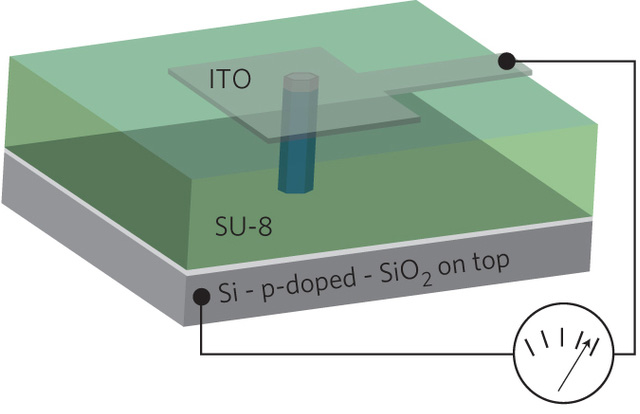
gallium-arsenide-nanowire-solar-cellMeanwhile, researchers at the Niels Bohr Institute in Denmark and EPFL in Switzerland announced that they have built solar cells out of single nanowires. In this case, the process involved growing gallium-arsenide (GaAs) wires on a silicon substrate, and then completing the circuit with a transparent indium tin oxide electrode, which are currently employed in the creation of photovoltaic cells and LEDs on the market today.

Prior to these development, nanowires were being researched mainly in conjunction with computer chips as a possible replacement for silicon. But thanks to the combined work of these researchers, we may very well be looking at solar cells which are not only hair-thin (as with the kind being developed by Penn State University) but microscopically thin. And much like the research at the University of Oslo involving the use of microbeads, this too will mean the creation of ultra-thin solar cells that have a massive energy density – 180 mA/cm2, versus ~40 mA/cm2 for crystalline silicon PVs.

solar_boosterAnd last, but not least, there was the announcement from Stanford University of a revolutionary new type of solar cell that has doubled the efficiency of traditional photovoltaic cells. This new device uses a process called photon-enhanced thermionic emission (PETE) that allows for the absorption of not only light, but heat. This combination makes this new type of cell the equivalent of a turbocharged solar panel!

pete-photovoltaic-thermionic-diagram-stanfordIn conventional cells, photons strike a semiconductor (usually silicon), creating electricity by knocking electrons loose from their parent atoms. The PETE process, on the other hand, uses the gallium arsenide wafer on top gather as much sunlight as possible, creating a lot of excited electrons using the photovoltaic effect. The underside, which is composed of nanoantennae, emits these photoexcited electrons across a vacuum to the anode with gathers them and turns them into an electrical current.

Beneath the anode is a of heat pipe that collects any leftover heat which could be used elsewhere. One of the easiest applications of PETE would be in concentrating solar power plants, where thousands of mirrors concentrate light on a central vat of boiling water, which drives a steam turbine. By concentrating the light on PETE devices instead, Stanford estimates that their power output could increase by 50%, bringing the cost of solar power generation down into the range of fossil fuels.

Though there are still kinks in their design – the cell has a very low 2% rate of energy efficient thus far – the researchers at Stanford are making improvements which are increasing its efficiency exponentially. And although their planned upgrades should lead to a solar cell capable of operating in extremely hot environments, they stress that the goal here is to build one that is capable of gathering power in non-desert environments, such as Spaced-Based solar arrays.

Combined with improved production methods, storage capacities, and plans to mount solar arrays in a variety of new places (such as on artificial islands), we could be looking at the wholesale adoption of solar power within a few years time. Every day, it seems, new methods are being unveiled that will allow Solar to supplant fossil fuels as the best, cheapest and most efficient means of energy production. If all goes as planned, all this could be coming just in time to save the planet, fingers crossed!

Sources: Extremetech.com, (2)

The Future is Here: Peel and Stick Solar Panels!

solar_arrayEver since Albert Einstein first proposed the concept in 1921, photovoltaic cells – solar cells – have been at the forefront of alternative fuel and energy research. And while progress has been made, two key factors have remained as stumbling blocks to their widespread adoption: One, the cost of making solar cells; and two, the cost of installing them.

In order for this to change, analysts have predicted for some time that solar panels would need to be printed on cheap, durable materials that could be installed anywhere. Until such time, they would continue to lose out against the gas and coal equivalents, which would continue to generate as much energy as a single solar cell while remaining comparatively cheaper.

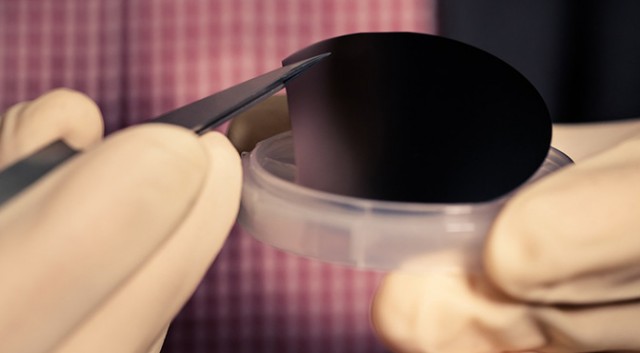
solar_powerAnd as it turns out, the wait may be coming to an end. According to Silvija Gradecak, a materials science and engineering professor at MIT, new research from around the world is driving us ever closer to that goal. And it is her lab, among others, that is making a major contribution, through the release of a new breed of bendy, peel-and-stick solar panels.

The focus of Gradecak’s team has been on the production of a organic, thin-film cells that are made from abundant materials which could be manufactured on the cheap. And in December of last year, they made a breakthrough with the production of a transparent photovoltaic cell by using flexible graphene and a nanowire coating. This thin, flexible and transparent photo cell, they claimed, could be mounted anywhere and is comparatively cheaper than current silicon based varieties.

solar_cellNaturally, Gradecak was sure to point out that this development did not take place in a vacuum. Nor was it the only one of its kind:

“”There was a significant effort to develop these type of devices and the slope of this improvement is very high… I personally believe this is not just theoretical. In a couple of years you will see these types of devices commercially.”

And in that respect, she is right. At Stanford, researchers presented their own concept for a next generation solar cell this past December: a flexible, peel-off panel that can stick to almost any surface. Composed of nickel, silicon and silicon dioxide and a protective polymer layer, the cell consists of multiple layers that can be peeled away and applied as needed.

Exciting times, these are, especially when long-awaited environmental solutions are finally becoming feasible. It also inspires hope that we might be able to tackle a little problem known as emissions before it is too late. Of course, that would require making this technology available worldwide, especially in developing economies where coal and gas power are especially lucrative. But anything is doable, especially if the price is right!

Source: Co.Exist.com

NASA Sends Mona Lisa to the Moon!

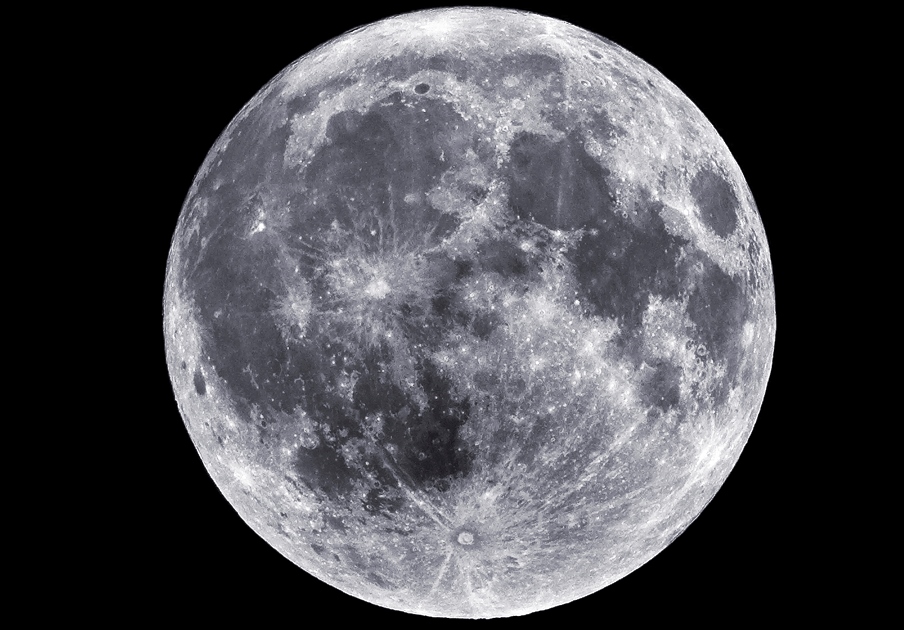
moonIn an effort to demonstrate how laser communications work, and perhaps just to show off a little, a team of NASA engineers shot an image of the Mona Lisa to the moon by piggybacking it on laser pulses. The transmission occurred back in mid-January, and took place between NASA’s Goddard Space Flight Center here on Earth and the Lunar Reconnaissance Orbiter (LRO) some 386,000 km (240,000 miles) away. In addition to showcases how NASA regularly communicated with the orbiter, it also presented a possible means of communicating with a future moon colony.

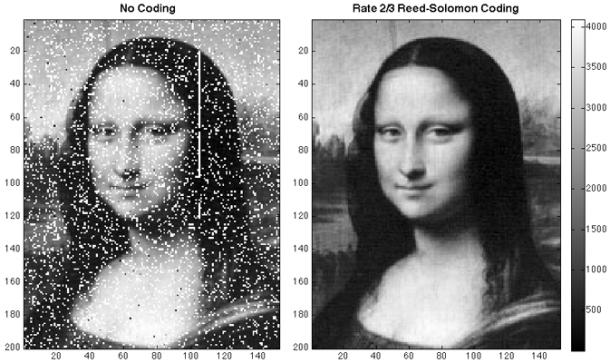
On any given day, scientists at the Goddard Space Flight Center use what is known as the Next Generation Satellite Laser Ranging Station to track the LRO’s position. Expanding on this, the staff reprogrammed the laser to send the massive work of art in the form of as massive JPEG file. This involved chopping the picture into a 152×200 pixel array, with each pixel assigned a gray-scale value and beamed up one at a time. All told, the process took some time, with image transmission speed clocked at about 300 bits per second.

mona_lisa_laserIt then fell to LOLO, the LRO’s Lunar Orbiter Laser Altimeter, to put the Mona Lisa back together based on the arrival times of the pixel data. All the while, LOLA continued to pursue its primary mission of mapping out the lunar terrain. The image was then beamed back to Earth via the LRO’s radio telemetry system, with only minor errors caused by turbulence in the atmosphere.

MIT’s David Smith, head of LOLA, had this to say about the event in a release:

“This is the first time anyone has achieved one-way laser communication at planetary distances. In the near future, this type of simple laser communication might serve as a backup for the radio communication that satellites use. In the more distant future, it may allow communication at higher data rates than present radio links can provide.”

According to NASA, the success of the demonstration could pave the way for lasers to be used for satellite communication, particularly with its Lunar Atmosphere and Dust Environment Explorer (LADEE) mission, which is set to launch this year.

No telling how DaVinci might react to the news of his classic portrait breaching the heavens and being beamed into space. However, given the man’s obvious love of his work and fascination with all things metaphysical and scientific, I think he would have been very happy. Perhaps if his enigmatic masterpiece were to be send into the cosmos as part of the search for extra-terrestrial life too. But that’s another day and another mission!

And be sure to check out the video below from the Goddard SFC explaining the process, courtesy of NASA:

Source: news.cnet.com

News From The Center of the Galaxy!

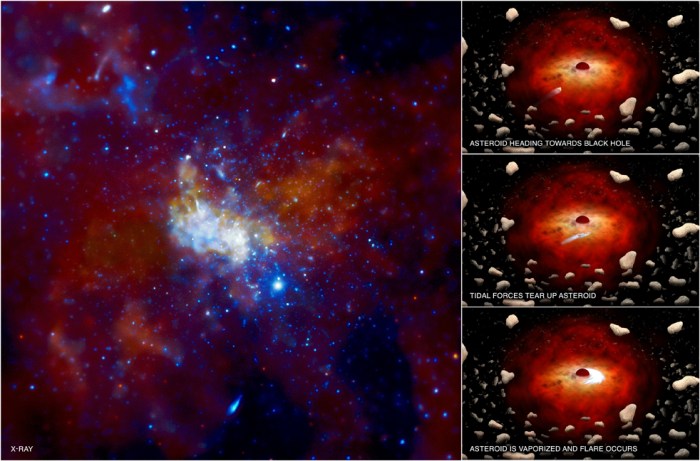
sagittarius A_flareAt least once a day, the black hole that resides at the center of the Milky Way Galaxy – aka. Sagittarius A* – shoots out an x-ray flare. These flares range in luminosity and intensity, but are usually only on the magnitude of a few dozens times its normal output. However, back in February of 2012, astronomers using the Chandra X-Ray Observatory detected the brightest flare ever observed from the central black hole, measured at 150 times its normal output.

Located some 26,000 light years from Earth, Sagittarius A* emits X-rays on a regular basis, and no one is sure why. However, a group of researchers postulated that it may be the results of asteroids or planets that wander too close to the hole and are consumed. Essentially, they believe Sagittarius A* is taking in rocky objects, eating them up, and then shooting out x-rays as exhaust.

The supermassive black hole at the center of the Milky Way galaxy.According to Michael Nowak, a research scientist at MIT Kavli and co-author of a new paper in the Astrophysical Journal, a sudden increase in consumption might explain the flare. “Suddenly, for whatever reason, Sagittarius A* is eating a lot more,” he said. “One theory is that every so often, an asteroid gets close to the black hole, the black hole stretches and rips it to pieces, and eats the material and turns it into radiation, so you see these big flares.”

This is the standard procedure that astronomers use to detect black holes – i.e. by the light energy given off as they swallow nearby matter – since they are invisible to the naked eye. Not only are black holes notorious for consuming matter, even light and gravity, the very fabric of time and space, are consumed in their maws. However, through an x-ray telescope, the centers of galaxies can appear extremely bright, giving off massive amounts of energy as they devour their surroundings. As they age, they tend to slow down, consuming less and appearing fainter.

Another MIT alumnist, Frederick K. Baganoff, has been conducting observations on Sagittarius A* with the Chandra X-ray Observatory since 2003, and in that time he has noted some interesting things. For example, he calculated that, given the amount of gas in its surroundings, Sagittarius A* should be about a million times brighter than it is — a finding that suggested the black hole throws away most of the matter they would otherwise consume.

Or as he puts it: “Everyone has this picture of black holes as vacuum sweepers, that they suck up absolutely everything. But in this really low-accretion-rate state, they’re really finicky eaters, and for some reason they actually blow away most of the energy… We’re really studying the great escape, because most of the gas escapes, and that’s not what we expect.”

The physics that underlie this process are still a mystery, but researchers like Baganoff hope to learn more through more observation. In the end, the real pay off is that it will help us to understand the history of activity at the center of our Galaxy, a history which goes back billions of years and can tell us volumes about the formation of our Milky Way and even the universe itself.

“Hurricane Hackers” Helping in Hurricane Sandy Recovery

It seems hackers are making the news once again as a force for good. In the wake of Hurricane Sandy, which has caused untold devastation along the Eastern Seaboard, hackers across the world are taking part in a series of events that are designed to help local communities prepare and cope with the devastation of this crisis. In what promises to be an ongoing series of information and development camps, the first “Sandy CrisisCamp” took place in Boston, the West Coast, and even as far away as New Zealand.

The goal here is simple: to design internet tools and applications that will assist in disaster preparedness and recovery, both now and in the future. The first step in that, which was covered this past weekend, was the work on various “crowdsourcing” tools that will allow people to categorize images for building damage and a simple Google doc that attempts to keep track of all the sources of Sandy recovery data in a single place. These will not only give people the ability to access vital information and updates on the path of hurricanes quickly, but will also help organizations such as FEMA prioritize their efforts based on up-to-the-minute damage assessments.

These efforts are all related to the work of a group known as the Hurricane Hackers, students at MIT’s Media Lab who have been helping coordinate relief efforts via Twitter. The fruits of their initial labor was the site known as Sandyslist, a simple hub for linking people with the resources they need to stay safe and ride the storm out. And in truth, they are but one group of people who have been using social utilities and the internet in order to provide info for those in need and to help others coordinate their efforts. There are even online sites where people are able to pledge donations, a process known as crowdfunding, and which are currently waiving their fees in order to ensure that more money is raised.

In addition to being reassuring and heartwarming, all of these coordinated efforts are also a good demonstration of what is possible in the information age. After all, in times of crisis, the most important tool in prevention and response is information. By ensuring that it is coordinated, easily accessible, and available all in one place, the hackers responsible for this are also helping to ensure that lives are saved and the crisis passes with far less in the way of human devastation.

Source: news.cnet.com

Worlds First Medimachine!

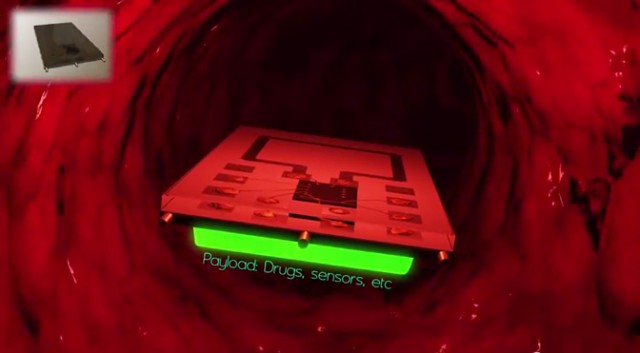
Medimachine: noun, a nanotechnological device used for medical applications. Granted, that’s not a working definition, but it does encompass what the technology is all about. And, as it happens, researchers at Standford created the world’s first device which is capable of traveling through the human bloodstream and which is controlled and powered wirelessly just this past year.

This development came in the midst of a similar significant development over at MIT. In January of this year, they announced that they had developed the world’s first implantable microchip that could deliver drugs directly into the bloodstream. This chip is also controlled wirelessly, and is the first step towards remote implants that could contain an entire pharmacy.

According to Ada Poon, the lead developer of the Standford team, the next step in the development of this device will be creating models that incorporate sensors and drug delivery systems for the ultimate in pin-point accurate medicine. If successful, Poon and her team could very well be responsible for creating the prototype device that will inspire entire generations of medical machines that are conducting exploratory exams, cleaning our arteries, removing tumors, destroying pathogens and viruses, and even repairing internal injuries.

And just think, if this development triggers further research and development, it could very well lead to nanomachines which are capable of making even tinier nanomachines. These devices could in turn manipulate matter on the mitochondrial level, correcting faults in our DNA and turning harmful or unwanted cells into something more useful for our bodies.

Just another step on the road to transhumanism and post-mortality!

Source: Extremtech.com