The Future of Cities and Urban Planning

future-city-1With the development of vertical farms, carbon capture technology, clean energy and arcologies, the future of city life and urban planning is likely to be much different than it does today. Using current trends, there are a number of people who are determined to gain some understanding of what that might look like. One such group is Arup, a design and engineering firm that produced a mockup that visualizes what urban environments will look like in 2050.

Based on the world as it is today, certain facts about the future seem relatively certain. For starters, three-quarters of the population will live in cities, or 6.75 billion of the projected 9 billion global total. In addition, everyone will have grown up with the Internet, and its successors, and city residents will have access to less natural resources than they do today, making regeneration and efficiency more of a priority.

Add to this several emerging technologies, and our urban environments are likely to look something like the building mockup below. As you can see, it has its own energy systems (“micro-wind,” “solar PV paint,” and “algae facade” for producing biofuels). There is an integrated layer for meat, poultry, fish, and vegetable farming, a “building membrane” that converts CO2 to oxygen, heat recovery surfaces, materials that phase change and repair themselves, integration with the rest of the city, and much more.

future_urban_planning

Most futuristic of all is the fact that the structure is completely modular and designed to be shifted about (by robots, of course). The building has three layer types, with different life-spans. At the bottom is a permanent layer – with a 10 to 20-year lifespan – which includes the “facade and primary fit-out walls, finishes, or on-floor mechanical plant” – and a third layer that can incorporate rapid changes, such as new IT equipment.

As Arup’s Josef Hargrave described the building when unveiling the design:

[A]ble to make informed and calculated decisions based on their surrounding environment… [a] living and breathing [structure] able to support the cities and people of tomorrow.

In short, the building is designed with personal needs in mind, based on information gleamed from a person’s behaviors, stated preferences, and even genetic information.

aircleaning_skyscraper3But what is even more interesting is how these buildings will be constructed. As countless developments are made in the field of robotics, biotechnology and nanotechnology, both the materials used and the processes involved are likely to be radically different. The rigid construction that we are used to is likely to give way to buildings which are far more flexible, adaptive, and – best of all – built by robots, drones, tiny machines and bacteria cultures.

Once again, this change is due mainly to the pressures that are being placed on urban environments, and not just technological advances. As our world becomes even more densely populated, greater proportions of people live in urban environments, and resources become more constrained, the way we build our cities must offer optimum efficiency with minimal impact.

nanomachineryTowards this end, innovations in additive manufacturing, synthetic biology, swarm robotics, and architecture suggest a future scenario when buildings may be designed using libraries of biological templates and constructed with biosynthetic materials able to sense and adapt to their conditions.

What this means is that cities could be grown, or assembled at the atomic level, forming buildings that are either living creatures themselves, or composed of self-replicated machines that can adapt and change as needed. Might sound like science fiction, but countless firms and labs are working towards this very thing every day.

It has already been demonstrated that single cells are capable of being programmed to carry out computational operations, and that DNA strains are capable of being arranged to carry out specialized functions. Given the rapid progress in the field of biotech and biomimetics (technology that imitates biology), a future where the built environment imitates organic life seems just around the corner.

biofabrication For example, at Harvard there is a biotech research outfit known as Robobees that is working on a concept known as “programming group dynamics”. Like corals, beehives, and termite colonies, there’s a scalar effect gained from coordinating large numbers of simple agents to perform complex goals. Towards this end, Robobees has been working towards the creation of robotic insects that exhibit the swarming behaviors of bees.

Mike Rubenstein leads another Harvard lab, known as Kilobot, which is dedicated to creating a “low cost scalable robot system for demonstrating collective behaviors.” His lab, along with the work of researcher’s like Nancy Lynch at MIT, are laying the frameworks for asynchronous distributed networks and multi-agent coordination, aka swarm robotics, that would also be capable of erecting large structures thanks to centralized, hive-mind programming.

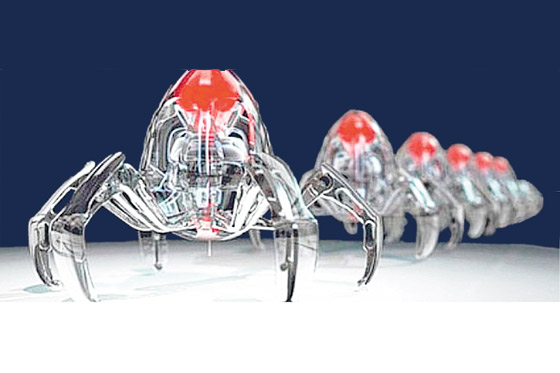
nanorobot1

In addition to MIT, Caltech, and various academic research departments, there are also scores of private firms and DIY labs looking to make things happen. For example, the companies Autodesk Research and Organovo recently announced a partnership where they will be combining their resources – modelling the microscopic organic world and building bioprinters – to begin biofabricating everything from drugs to nanomachines.

And then there are outfits like the Columbia Living Architecture Lab, a group that explores ways to integrate biology into architecture. Their recent work investigates bacterial manufacturing, the genetic modification of bacteria to create durable materials. Envisioning a future where bacterial colonies are designed to print novel materials at scale, they see buildings wrapped in seamless, responsive, bio-electronic envelopes.

ESA_moonbaseAnd let’s not forget 3D printing, a possibility which is being explored by NASA and the European Space Agency as the means to create a settlement on the Moon. In the case of the ESA, they have partnered with roboticist Enrico Dini, who created a 3-D printer large enough to print houses from sand. Using his concept, the ESA hopes to do the same thing using regolith – aka. moon dust – to build structures on Earth’s only satellite.

All of these projects are brewing in university and corporate labs, but it’s likely that there are far more of them sprouting in DIY labs and skunkworks all across the globe. And in the end, each of them is dedicated to the efficiency of natural systems, and their realization through biomimetic technology. And given that the future is likely to be characterized by resources shortages, environmental degradation and the need for security, it is likely to assume that all of these areas of study are likely to produce some very interesting scenarios.

As I’ve said many times before, the future is likely to be a very interesting place, thanks to the convergence of both Climate Change and technological change. With so many advances promising a future of post-scarcity, post-mortality, a means of production and a level of control over our environment which is nothing short of mind-boggling – and a history of environmental degradation and resource depletion that promises shortages, scarcity, and some frightening prospects – our living spaces are likely to change drastically.

The 21st century is going to be a very interesting time, people. Let’s just hope we make it out alive!

Sources: fastcoexist.com, (2)

The Future is Here: The Anti-Gravity 3D Printer

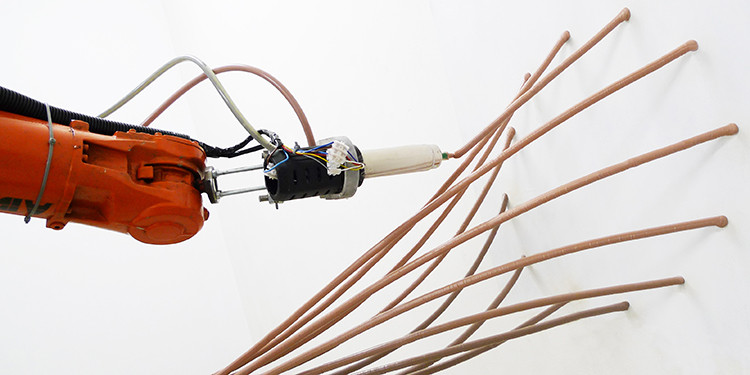
anti-grav3d2Three-dimensional printing is without a doubt one of the greatest growth industries of the 21st century. And yet, surprisingly enough, there are those who seem to think that there is room for improvement when it comes to current concepts and designs. Two such individuals are Petr Novikov and Saša Jokic, a group of architecture students who recently began interning at the Joris Laarman Lab in Amsterdam. While there, they came up with a revolutionary method for 3D printing that reboots the concept!

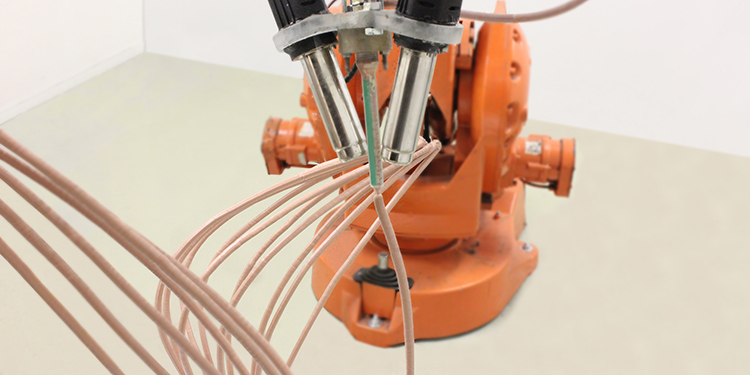
It’s called Mataerial, a new and patented process where polymers are squeezed from a nozzle similar to how bakers squeeze icing from a tube to frost a cake, except there’s a robot involved. Ultimately, their concept was based on the fact that all conventional printing works with layers, which they considered grossly inefficient. Not only do such methods require the presence of a support structure, they also take additional time, materials, and increase the risk of damage if the object is removed from its support structure.

anti-grav3d1As Novikov explains:

The material that comes out of the nozzle is still kind of viscous–It’s not a liquid already but its not a solid material, so what we wanted to do is make it solid the same exact moment it comes out of the nozzle. And that’s the hardest part. Because if it solidifies before it comes out of the nozzle, then its going to make a clog… but if it solidifies after it leaves the nozzle, than its going to be weak and fall down.

The key was to find two liquid polymers that, when mixed, quickly harden, which allows for mid-air solidification. They’re calling the resulting method “Anti-Gravity Object Modeling,” since the material’s just-in-time solidification eschews the need for any sort of support structure. The new method is exciting for a number of reasons. The first is scale, in that this method could be adapted for manufacturing large and well as small scale objects easily.

anti-grav3dDepending on the size of nozzle used, the technology could be used to print materials and objects that are on the scale of millimeters (like components for consumer electronics), 3D models (the kinds that are printed by standard professional printers), or larger objects such as furniture or even parts used in large-scale architectural construction. Basically, anything from the tiniest object to the largest structure could be created by robots equipped with specialized nozzles and Mataerial printers.

But perhaps most exciting is the possibility that this new method would be able to print objects in low or even zero gravity. Given NASA’s recent interest in building a Moon base using 3D printing, such a process could come in mighty useful. Already, the technology known as “sintering” has been considered for the purposes of building a Lunar settlement, but given its “anti-gravity” application, the Mataerial process just might have a shot at winning some lucrative contracts.

In fact, Navikov indicates that they considered the possibility and put it to the test. As he indicated: “We did an investigation and we are pretty sure that this could be used as 3-D printer in zero gravity.” Did you get that NASA? Anyway to make this technology work with regolith? Regardless, it sure could be useful here on planet Earth!

Source: fastcoexist.com

Alien Matter Found on the Moon!

blue moonYes, it may sound like the setup for a really bad movie. And in truth, it’s more than just a little misleading. But in this case, “alien matter” refers to minerals deposits that were recently discovered on the surface of the Moon which may not belong there. These deposits include Magnesium-rich spinel and olivine found in the central peaks of lunar craters, which scientists previously believed to be indigenous to the surface.

Spinel forms, it should be noted, can be found here on Earth and are the product of high-pressure and temperatures, conditions which do not exist on the Moon’s surface. Hence, scientists were forced to conclude that the presence of such minerals on the surface had to have come from somewhere else. Most likely a meteoric impact, which the Moon – as its pockmarked surface can attest to – get’s no shortage of.

moon-asteroid-impact-1600However, in the past, it was generally accepted that any collision that big would melt or vaporize the impacting material, leaving behind only geochemical traces and tiny fragments. The quantities that were noticed more recently defied this interpretation, consisting or relatively large deposits and not mere fragments.

However, Jay Melosh and his colleagues from Indiana’s Purdue University were able to show through a series of computer simulations that asteroids are capable of still producing these craters at lower impact speeds, giving them greater chance of survival. What’s more, this would leave their mineral compositions unvaporized, allowing for more generous deposits of material.

In a paper recently published in Nature Geoscience, the team explains their process and what they were able to determine:

We find that for … impact velocities below about 12 kilometres per second, the projectile may both survive the impact, and be swept back into the central peak of the final crater as it collapses… We focused on a simulation of the 93-kilometre diameter Copernicus crater because of the reports of olivine and magnesium-spinel in its central peak… The olivine observed in the central peaks of Copernicus and other lunar craters may be a remnant of the projectile and thus does not indicate deep excavation of the lunar mantle or lower crust.

Overall, their simulations revealed that roughly a quarter of lunar impacts occur at speeds below 12 kilometres per second, which is slow enough for a significant fraction of the impacting object to remain largely intact. According to astronomer Michael Brown of Melbourne’s Monash University, their conclusions about low-velocity asteroid impacts are entirely plausible.

NASA_moonWhat’s more, Brown indicated that previously-held notions about meteors and asteroids impacting the Moon may be biased by our experience here on Earth, where impacts occur at much higher velocities.

When a large asteroid hits Earth, because of the Earth’s gravity and because of the velocity of the asteroid, you’re looking at impact speeds of 20-30 kilometres per second.

But of course, he also added that there are concentrations of spinel on the Moon’s surface which cannot be explained by impact events. How and why these were brought to the surface is something that future generations of astronauts will have to study, no doubt with the help of interior examinations of the planet and surface digs.

ESA_moonbaseWhich brings up another important aspect of this information. Given that the Moon is prone to meteors and asteroids, something we don’t have to worry nearly as much about on Earth due to our protective atmosphere, any plans to colonize it will have to take surface impacts into account. How exactly are people going to be able to live, work, and enjoy themselves on the surface if they have to contend with periodic massive impacts?

And in the meantime, check out this video from CBC about the March 17th impact, the largest impact in recent history which was visible from Earth:

http://www.cbc.ca/player/News/TV%2BShows/The%2BNational/Technology%2B&%2BScience/ID/2387906092/

Sources: cbc.ca, (2)


NASA’s Eyes the Bennu Asteroid

Osiris_spacecraftNot long ago, NASA announced its plan to to visit an asteroid in our Solar System and towing it closer to Earth. And with their funding secure, NASA announced earlier this month that they had taken some key steps towards making this happen.  The first came on Wednesday, May 15th, when the spacecraft that will be performing the mission – the Origins-Spectral Interpretation Resource Identification Security Regolith Explorer, or Osiris-Rex – got the green light for development.

The second came shortly thereafter, when NASA announced where the robot craft would be headed – the asteroid now known as Bennu. Originally known as 1999 RQ36, the rock was renamed as part of a contest involving suggestions from thousands of schoolchildren. It was a nine-year-old named Michael Puzio who suggested the name, claiming that the the Touch-and-Go Sample Mechanism (Tagsam) arm and solar panels on Osiris-Rex resembled the neck and wings of Bennu, better known as the Phoenix.

Asteroid-ToutatisNASA claims that Bennu could hold clues to the origin of the solar system, hence why samples will be brought back to determine their composition. The new spacecraft will rendezvous with Bennu in 2018 and begin collecting measurements and samples of surface material, and then return to Earth by 2023. Ultimately, the mission is part of NASA’s larger aim at capturing an asteroid and towing it back it to Earth so that the entire body can be studied.

Of course, there are larger plans at work here too. NASA’s truly long-term aims also involve improving asteroid defense, which includes capturing asteroids that are on a potential collision course with Earth and towing them off course. And then there’s the plan to put astronauts on an asteroid by the 2020’s, establishing a Moon outpost in the same decade, and on Mars by 2030. In the end, all roads converge on putting boots on soil that is not of Earth!

And be sure to check out the video simulation of the Osiris-Rex in action, courtesy of NASA:


Source: cnet.news.ca

The Future is Here: The Real-Life Tricorder

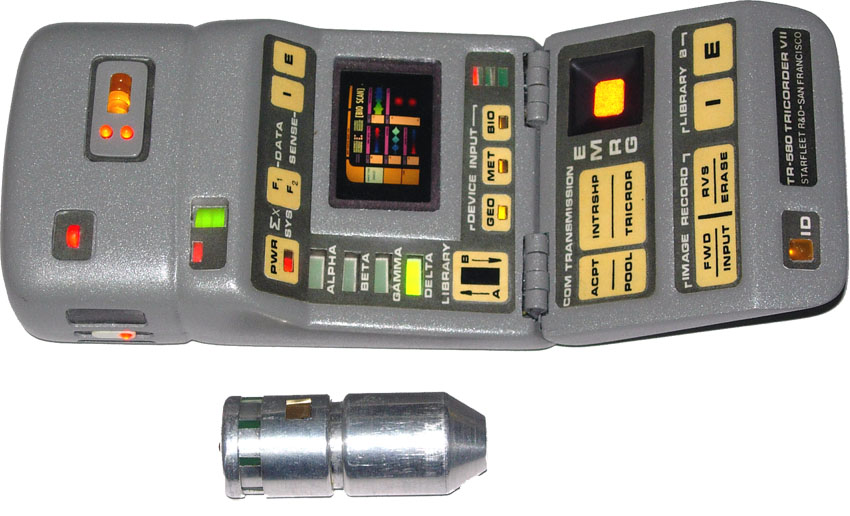
medical_tricorderIt was only a matter of time, I guess. But we really should have known that with all the improvements being made in biometrics and biotechnology – giving patients and doctors the means to monitor their vitals, blood pressure, glucose levels and the like with tiny devices – and all the talk of how it looked like something out of science fiction that it wouldn’t be long before someone took it upon themselves to build a device right out of Star Trek.

It’s known as a the Scanadu Scout, a non-invasive medical device that is capable of measuring your vitals simply by being held up to your temple for a mere 10 seconds. The people responsible for its creation are a startup named Scanadu, a group of research and medtech enthusiasts who are based at the NASA Ames Research Center. For the past two years, they have been seeking to create the world’s first handheld medical scanner, and with the production of the Scout, they have their prototype!

scanaduAll told, the device is able to track pulse transit time (to measure blood pressure), temperature, ECG, oximetry, heart rate, and the breathing rate of a patient or subject. A 10 second scan of a person’s temple yields data that has a 99% accuracy rate, which can then be transmitted automatically via Bluetooth to the user’s smartphone, tablet or mobile device.

The device has since been upgraded from its original version and runs at a rate of 32 bits (up from the original 8). And interestingly enough, the Scouts now runs on Micrium, the operation system that NASA uses for Mars sample analysis on the Curiosity rover. The upgrade became necessary when Scanadu co-founder Walter De Brouwer, decided to add an extra feature: the ability to remotely trigger new algorithms and plug in new sensors (like a spectrometer).

medtechOne would think that working with NASA is effecting his thinking. But as Brouwer points out, the more information the machine is capable of collecting, the better is will be at monitoring your health:

If we find new algorithms to find relationships between several readings, we can use more of the sensors than we would first activate. If you know a couple of the variables, you could statistically predict that something is going to happen. The more data we have, the more we can also predict, because we’re using data mining at the same time as statistics.

One of the Scout’s cornerstone algorithms, for example, allows it to read blood pressure without the inflating cuff that we’ve all come to know and find so uncomfortable. In the future, Scanadu could discover an algorithm that connects, age, weight, blood pressure, and heart rate with some other variable, and then be able to make recommendations.

2009_world_subdivisions_flu_pandemicEveryone who pre-orders a Scout has their data sent to a cloud service, where Scanadu will collect it in a big file for the FDA. Anyone who opts-in will also gain access to the data of other users who have also elected to share their vitals. Brouwer explains that this is part of the products early mission to test the parameters of information sharing and cloud-medical computing:

It’s going to be a consumer product in the future, but right now we are positioning it as a research tool so that it can be used to finalize the design and collect data to eventually gain regulatory approval. In the end, you have to prove how people are going to use the device, how many times a day, and how they are going to react to the information.

In the future, De Brouwer imagines this kind of shared information could be used for population scanning, kind of like Google Flu Trends does, except with data being provided directly from individuals. The focus will also be much more local, with people using the Scout’s stats to able to see if their child, who suddenly has flu symptoms, is alone of ir other kids at their school are also sick. Pandemics and the outbreaks of fatal diseases could also be tracked in the same way and people forewarned.

medical-technologyNaturally, this raises some additional questions. With it now possible to share and communicate medical information so easily between devices, from people to their doctors, and stored within databases of varying accessibility, there is the ongoing issue of privacy. If in fact medical information can be actively shared in real-time or with the touch of a button, how hard will it be for third parties to gain access to them?

The upsides are clear: a society where health information is easily accessible is likely to avoid outbreaks of infectious disease and be able to contain pandemics with greater ease. But on the flip side, hackers are likely to find ways to access and abuse this information, since it will be in a public place where people can get at it. And naturally, there are plenty of people who will feel squeamish or downright terrified about the FDA having access to up-to-the-moment medical info on them.

It’s the age of cloud computing, wireless communications, and information sharing my friends. And much as people feel guarded about their personal information now, this is likely to take on extra dimensions when their personal medical info is added to the mix. Not a simple or comfortable subject.

But while I’ve still got you’re here, no doubt contemplating the future of medicine, take a look at this video of the Scanadu Scout in action:


Source:
fastcoexist.com, google.org/flutrends/

Going to Mars: Now Taking Volunteers, Names and Poems

mars_lifeLooking at my site, I’ve come to notice that news concerning the Red Planet has been a bit sparse of late. Lucky for me, I had several interesting stories sitting in my inbox which were just waiting to be read, and more than a few had to do with Earth’s closest neighbor. And as we are all no doubt aware, there are quite a few of us here on Earth that believe that she is the future of planetary exploration and colonization.

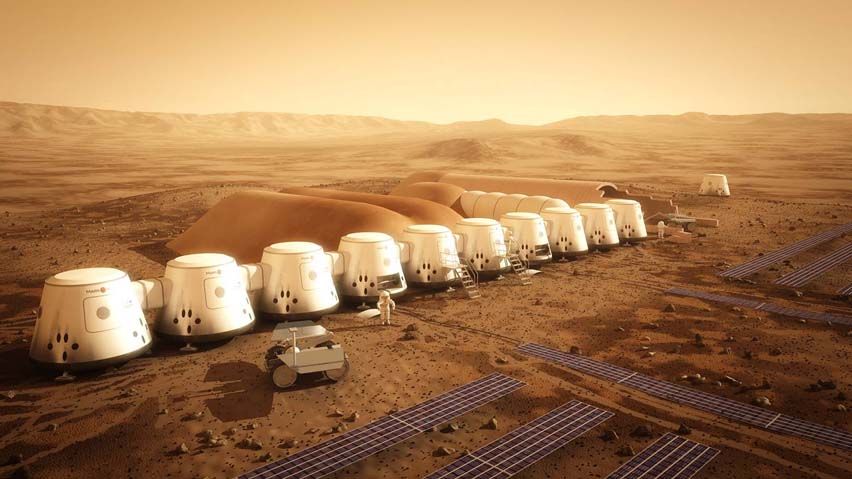
But would it surprise you to know that there are plans to visit Mars that go beyond NASA’s projected mission of 2030, which will involve sending live astronauts for the first time? Take the Mars One Project as an example. Conceived by Dutch entrepreneur Bas Landorp, this project involves using existing technology and private sponsorship to fund a one-way trip to Mars and establish the first permanent settlement there by 2023, thus putting them ahead of NASA’s plans to send explorers there by almost a decade.

mars-one-brian-versteegAnnounced back in January, the project put out an open call for volunteers, and some 80,000 people have applied thus far. Thirty-five of those applicants hail from my own country (Canada), with the vast majority of them being men who are still in their 20’s. Those who apply are apparently asked some rather grueling and personal questions designed to test their aptitude and beliefs, which includes the meaning of life itself. I’m guessing more than one person answered “space exploration”!

The first things to be sent will be the modules themselves, followed shortly thereafter by the first of six teams, with each team of four arriving every two years. In time, the home base would consist of habitation modules with oxygen, water and provisions, but would expand to include solar panels. Landorp has also indicated that primary funding will come from an as-yet-unspecified “global media event” that will feature the astronauts and their preparation.

In short, it’s like a reality TV event featuring the first people who will make the seven month trip.

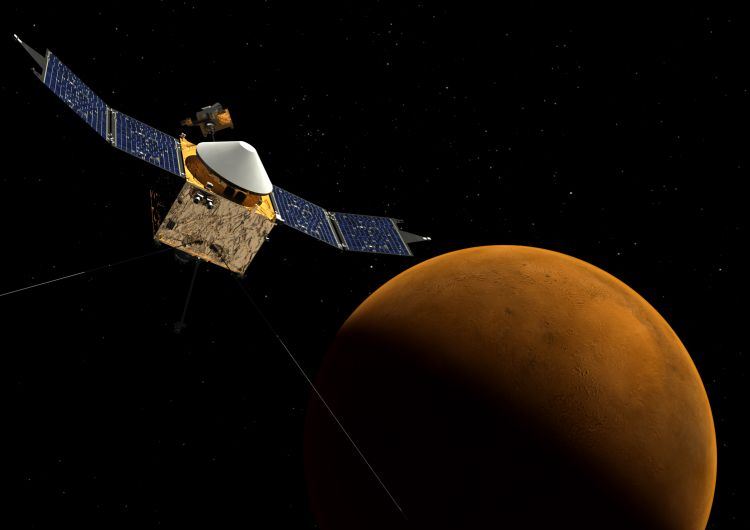
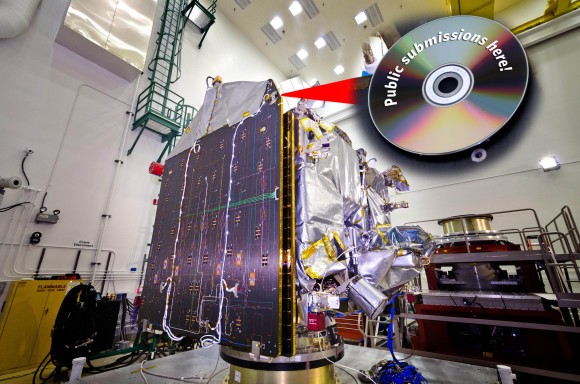
??????????????????????????????But for those who don’t feel like making the trip, or who would like to send something to Mars other than themselves, there’s also NASA’s MAVEN mission. As part of the “Going to Mars” campaign that is being managed by the University of Colorado at Boulder’s Laboratory for Atmospheric and Space Physics (CU/LASP), the MAVEN mission is a chance for the general public to send their name and a short poem to the Red Planet via NASA’s latest Mars satellite.

MAVEN – which stands for Mars Atmosphere and Volatile EvolutioN – is due to be launched in November from the Florida Space Coast. Attached to the front of the orbiter will be a DVD featuring the names of everyone who applies to take part in the campaign. In addition, of those poems submitted (which is to be written in the form of a haiku), three will be selected for the mission as well.

MAVEN_DVD-580x384

Voting will be done by the public online, and over 1 million people have already submitted their names. The rules for the contest can be found on the mission website here. Children are allowed to participate, but must do so through a participant of 18 years of age or older, preferably a parent or guardian. Activity opened at the beginning of the month and ends July 1st, so get your names of poems in soon!

Since the campaign and contest are open to people of all ages, walks of life, and is indiscriminate of education or qualification, it’s a pretty good way for the public to participate in the ongoing exploration of space and our Red planetary neighbor. And when considered alongside the many and increasing private efforts to send people to Mars, it says about the increasingly democratic nature of space exploration.

Sources: cbc.ca, universetoday.com, lasp.colorado.edu

Bad News From Space!

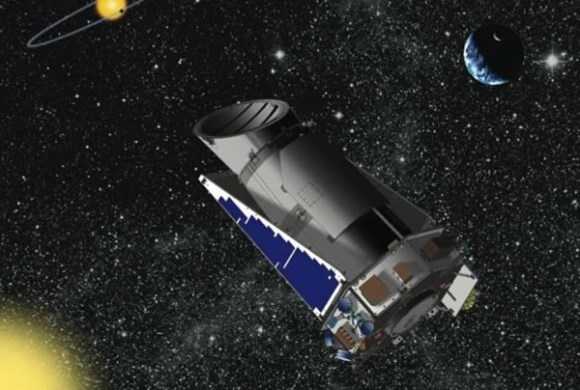
Kepler-telescope-580x448Between the Mars rovers, deep space probes, and long-term plans to mine asteroids and colonize Earth’s neighbors, there’s just no shortage of news from space these days. Unfortunately, not all of it is good. For instance, NASA recently announced that the Kepler space telescope, which was launched back in 2009 for the purpose of identifying Earth-like exoplanets, is suffering from malfunctions and may be broken down.

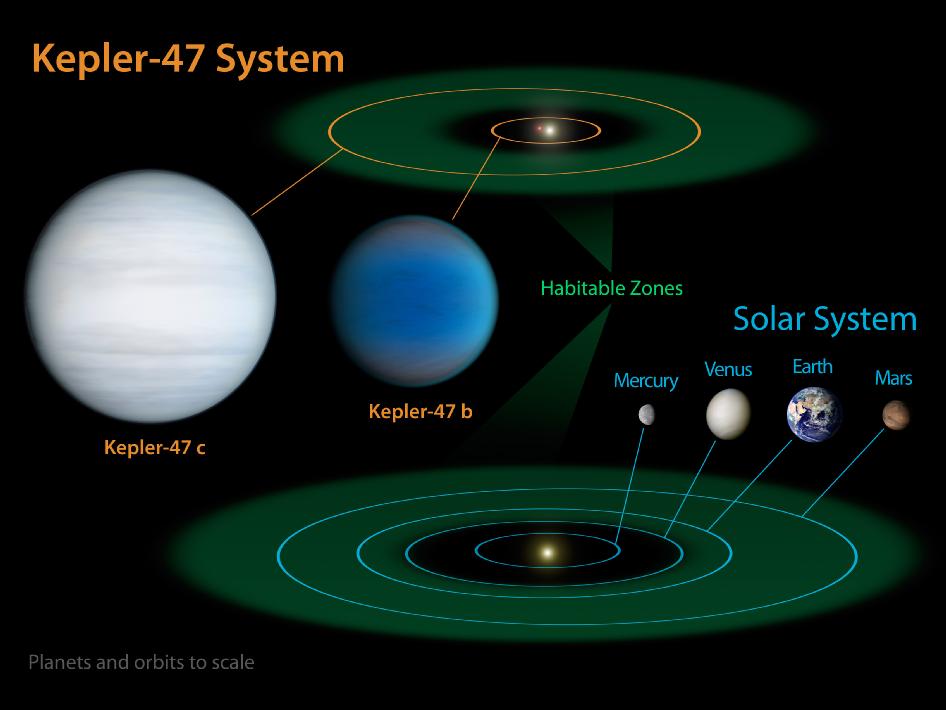
And in the course of its operational history, it did manage to identify a number of exoplanets that existed within the habitable zones of their parent stars. In fact, it had found a total of 2,740 candidate exoplanets spread across 2,046 stars systems, and a confirmed total of 132 that have the potential to support life. Unfortunately, during the early month of April during its weekly communication, NASA  found that the space observatory was in safe mode, a sign that something was amiss.

keplerAfter looking into the problem, they realized that it had lost its ability to precisely point toward stars because one of the reaction wheels – devices which enable the spacecraft to aim in different directions without firing thrusters – had failed. This was especially bad since last year an different wheel failed, meaning it only had two wheels remaining. The probe needs at least three working in order to properly aim itself, but now that seems impossible.

But the Kepler team said there are still possibilities of keeping the spacecraft in working order, or perhaps even finding other opportunities for different scientific pursuits. Either way, the team is not ready to throw in the towel on the telescope. And since NASA already approved to keep the mission going through 2016, a lot is still riding on it remaining functional.

Charles Sobeck, the Kepler deputy project manager, addressed the team’s efforts to get the telescope working again during their daily briefing earlier in May:

Initially, they did see some movement on the wheel but it quickly went back to zero speed, indicative of internal failure on the wheel. Our next step is to see what we can do to reduce the fuel consumption, as we would like to extend the fuel reserve as long as we can.

In terms of the malfunctioning wheel, he indicated that there are a few things they can still do to get it working again. One possibility is “jigging it” or running it in reverse.

We can try jiggling it, like you’d do with any wheel here on Earth, commanding it to move back and forth, so we can try to bring the wheel back in service. Or perhaps since wheel #2 hasn’t been turned on for eight months, it may come back if we turn it on. It will take us awhile to come up with a plan.

Sobeck also explained they are currently using thrusters to stabilize the spacecraft, and in its current mode, the onboard fuel will last for several months. But they hope to soon put the spacecraft into what is called a “Point Rest State” – a loosely-pointed, thruster-controlled state that minimizes fuels usage while providing a continuous X-band communication downlink. This ought to keep the fuel consumption down to the point where the telescope could keep going for several more years.

kepler47.jpgWhat’s more, the team also indicated that there is still terabytes of information gathered by the probe that has yet to be sifted through. They estimate that it will take at least two years for them to process it all and determine what other exoplanets exist nearby in our galaxy. And as Paul Hertz – NASA’s astrophysics director – put it, with the work it has already performed, Kepler has essentially carried out its task:

We’ll continue to analyze the data to get the science that Kepler was designed to do. Even though Kepler is in trouble, it has collected all the data necessary to answer its scientific objectives. Kepler is not the last exoplanet mission, but the first. It has been a great start to our path of exoplanet exploration.

In the end, its too soon to say if Kepler is deep in space (literally), or just experiencing a lull while her technicians get her back on track. And even if this does prove to be the end of her, the many thousands of planet she managed to identify during her years of service will certainly prove useful to humanity as we begin to set our sights on interstellar exploration and, God willing, colonization. And I imagine more than a few will bare the proud name of Kepler, in honor of her namesake and the telescope itself!

Sources: universetoday.com, Wired.com

News From Space: Opportunity Hits New Record!

opportunityWith the Curiosity Rover blazing a trail across Mars to find evidence of what the planet once looked like, people often forget about it’s venerable predecessor – the Opportunity Rover. Luckily, Opportunity recently broke a record that put it back in the public eye and into the history books. After nine years into what was initially meant to be a 90 day mission, Opportunity smashed yet another space milestone this week by establishing a new distance driving record.

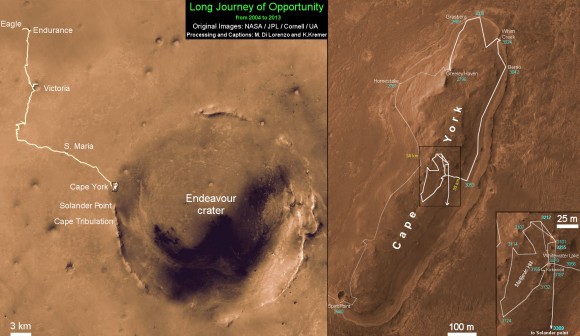
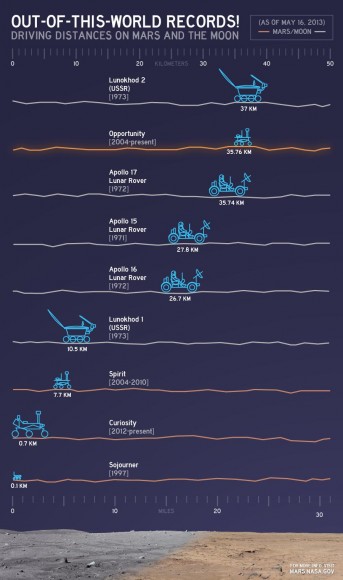
On Thursday, May 16, the Opportunity rover drove another 80 meters (263 feet) on the Martian surface, bringing her total odometry since landing on the 24th of January, 2004 to 35.760 kilometers (22.220 miles). This effectively put her ahead of the 40 year old driving record set by the Apollo 17 astronauts Eugene Cernan and Harrison Schmitt back in December of 1972.

Apollo_17_lunar-rover-577x580On that mission, Cernan and Schmitt performed America’s final lunar landing mission and drove their Lunar Roving Vehicle (LRV-3) a total of 35.744 kilometers (22.210 miles) over the course of three days on the moon’s surface at the Taurus-Littrow lunar valley. And interestingly enough, Cernan was a very good sport about his record being broken. In a statement made at NASA’s Goddard Space Flight Center in Greenbelt, Md, he said:

The record we established with a roving vehicle was made to be broken, and I’m excited and proud to be able to pass the torch to Opportunity.

And since Opportunity still has plenty of juice left, it is now eying the ‘Solar System World Record’ for driving distance on another world, a record that is currently held by the Soviet Union’s remote-controlled Lunokhod 2 rover. In 1973, Lunokhod 2 traveled 37 kilometers (23 miles) on the surface of Earth’s nearest neighbor. With Opportunity setting course for her next crater rim destination, named “Solander Point”, she is likely to overtake Lunokhod 2’s record in short order!

Opportunity-Route-Map_Sol-3309_Ken-Kremer-580x336Thereafter, Opportunity will rack up ever more distance as the rover continues driving further south to a spot called “Cape Tribulation”. This point is believed to hold caches of clay minerals that formed eons ego when liquid water flowed across this region of the Red Planet. In so doing, Opportunity will not only establish a new record that will last for years to come, it will also be obtaining data that will assist in Curiosity’s own efforts to determine what life was like on Mars in the past.

Far greater than this record-breaking news is the fact that Opportunity has lasted so far beyond her design lifetime, 37 times longer in fact than her initial 3 month “warranty”.

And be sure to check out the full list of record holders for “out-of-this-world” driving, below:

out-of-this-world_recordsSources: universetoday.com, news.cnet.com

Preventing the Apocalypse: NASA’s Asteroid Lasso Mission

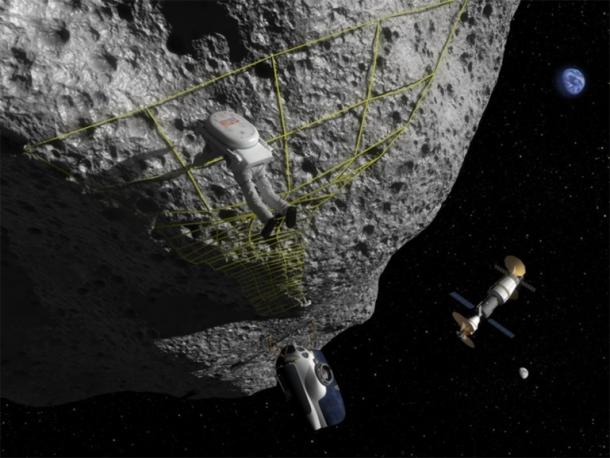
asteroid_lasso

Shortly after that large meteor hit Russia, President Obama and NASA administrator Charles Bolden both announced that work would begin on a series of asteroid tracking technologies that would ensure that more severe Earth collisions would be prevented. Earlier this month, Bolden spoke at the Mars Summit in Washington, D.C. and said that a robotic spacecraft mission is currently being planned with this goal in mind.

The plan calls to mind such films as Armageddon and Deep Impact, but differs in that it involves lassoing an asteroid instead of detonating a small nuke inside it. The ultimate goal here is to tow an asteroid out of the path of Earth, but then to deposit it in orbit so that it can be visited by astronauts. These astronauts will then collect samples and conduct research that could one day assist in a mission to Mars or save Earth from a catastrophic collision.

Asteroid-Toutatis

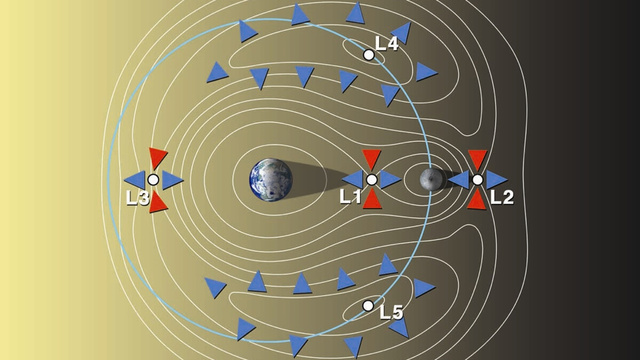
This is in keeping with the Obama administrations’ pledge of putting a man on a near-Earth asteroid by 2025 and a manned mission to Mars by 2030. It’s also in the same vein as NASA’s plan to catch and deposit an asteroid around the Moon, an idea that was proposed back in January of this year as part of the agencies plan to establish an outpost at Lagrange Point 2 early in the next decade.

And even though NASA has expressed that the massive 22 million ton asteroid Apophis will not impact planet Earth in 2036, it didn’t rule out that other, smaller rocks could possibly reach us in that time. Capturing them and towing them to where they could be safely deposited in orbit would present many opportunities, not the least of which could be commercial.

asteroid_foundry

For example, asteroid prospecting is slated to begin in 2015, with companies like SpaceX and Deep Space Industries leading the charge. Once property rights are assigned to various celestial bodies, these and other companies hope to send missions out to mine them and establish automated 3D manufacturing facilities, places that use “sintering” to process ore into metal and other materials that can then be shipped back.

NASA’s science mission directorate associate administrator John Grunsfeld also spoke about the importance of the lasso mission at the Human to Mars Summit on Monday. Above all else, he emphasized the importance of using the knowledge and skills gained from the research to achieve the long-term goal of survival:

We have a pretty good theory that single-planet species don’t survive. We don’t want to test it, but we have some evidence of that happening 65 million years ago [when an asteroid killed much of Earth’s life]. That will happen again someday … we want to have the capability [to leave the planet] in case of the threat of large scale destruction on Earth.

Yeah, its a rocky universe. And if we intend to survive in it, we had best learn how to deflect, capture and destroy any that come our way and get too close. And of course, we need to learn how to harness their endless supply of minerals and trace elements.

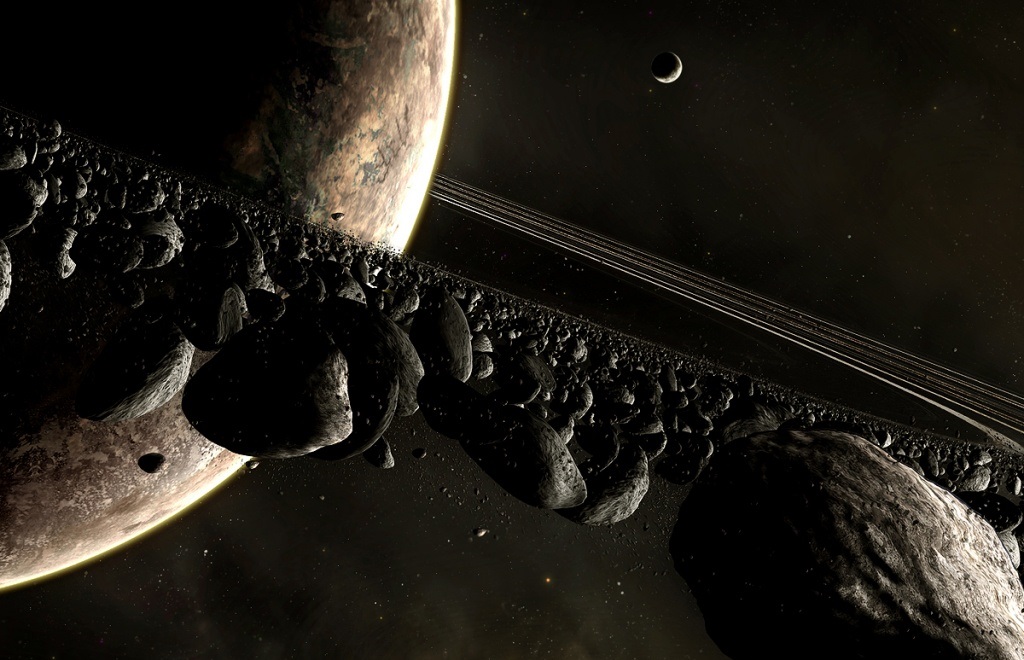
asteroid_belt1Source: news.cnet.com

News from Space: Chris Hadfield Says Goodbye to the ISS with a Music Video

chris_hadfield

How do you say goodbye to the International Space Station after five months in orbit? Well, if you’re Chris Hadfield, the commander of the latest mission to the ISS, you do so with a musical rendition! Yes, the Commander who back in February via telepresence with the Barenaked Ladies and Wexford Gleeks, is at it again. Back then, it was the original song “I.S.S. (Is Somebody Singing)” that captured the hearts and minds of Canadians and people around the world.

This time around, it was his rendition of David Bowie’s “Space Oddity” that blew people away. Changing the lyrics just a little to make for a more positive tone, the version Hadfield sings here is essentially a farewell to the ISS and an expression of anticipation about his impending trip home. And as usual, he played his own guitar, sang all of his own the lyrics, and managed to capture the perfect combination of happiness and poignancy.

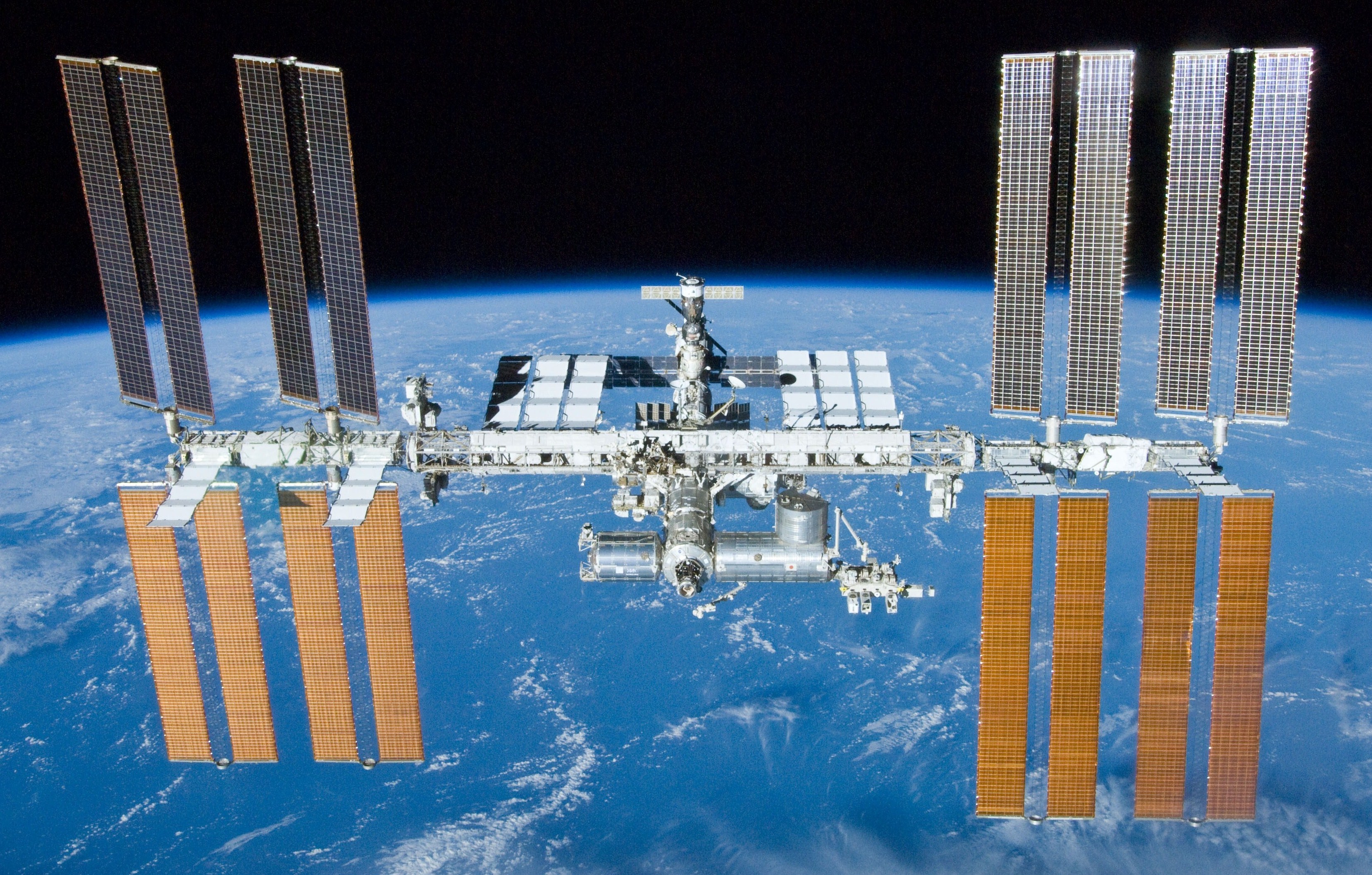
ISS

And it was a bittersweet event, when you get right down to it. Though Hadfield acknowledges that he will be coming home after many months of being away, he also repeatedly acknowledges in his musical rendition that this is the last time he will be seeing the ISS or looking down at Earth from orbit. One cannot help but feel that, under those circumstances, that Hadfield was expressing some mixed emotions, and this song is quite sad as well as upbeat as a result.

But of course, he had some help from people back home. On the YouTube post where the video was uploaded, Hadfield thanked Canadian musician Emm Gryner, his son Evan Hadfield, music producer Joe Corcoran, and TV producer Andrew Tidby “for all their hard work.” A link to the music video was also Tweeted out from his Twitter account about one hour after he formally turned over command of the ISS to Russian cosmonaut Pavel Vinogradov with the message:

With deference to the genius of David Bowie, here’s Space Oddity, recorded on Station. A last glimpse of the World.

Soyuz_capsule

Some of Hadfield’s own lyrics refer to his impending return, such as “Lock your Soyuz hatch and put your helmet on” or “Detach from station and may God’s love be with you.”  Along with the two other members of his mission crew, the departure took place shortly after 7 p.m. ET, yesterday. The trio then landed under a large parachute in the flat steppes of Kazakhstan at 10:31 p.m. ET where they were picked up by helicopter and flown to Karaganda, Kazakhstan for medical checkups.

What’s next for Hadfield and his crew? Late tomorrow, Hadfield and Marshburn will be arriving via a NASA flight back in Houston while Romanenko will board a Russian aircraft for a flight to Star City (aka. Zvyozdny gorodok), just outside of Moscow. And when Hadfield finishes the last leg of his trip home, I am sure he can look forward to a hero’s welcome, not to mention a lifetime of endorsements an fond memories.

After all, if he’s demonstrated anything in the past five months, its that he’s quite the performer in addition to being an astronaut and commander. And given the impact he has had, I’d be very surprised if Canadians or the world at large stopped thinking about him anytime soon. In the meantime, check out the video of his cover of “Space Oddity” below. The production values and Hadfield’s singing are pretty damn awesome, if I do say so myself!


Source:
ctvnews.ca
, cbc.ca