Hey folks! With every passing week, I am making (meager) progress towards the conclusion of The Cronian Incident. And in addition to designing a cover, formatting the interior, I’ve decided to create a trailer for its upcoming release. Here is the rough-cut, which features images of the planets involved, and a basic description.
I’m thinking of sexing it up with some colored script, some additional images or animations, and any other features I can think of before the book’s release. Let me know what you think in the comments.
Good day, all! I have some more good news on the whole “novel development” front. First, I must acknowledge that I started this book many many moons ago, and it has been of a slow and tedious process lately. In the past few months, I’ve experienced several mental and inspirational log jams and been hounded by the tyranny of the uncompleted manuscript. But I’ve managed to persevere and keep going.
And a few days ago, I decided to tackle a task which I’ve been putting off until now – which is designing the cover. This is unusual for me, since cover-creation is one of my favorite aspects of story-writing. In fact, sometimes I’ve been known to create a cover even before I’ve written any of the story itself! It’s kind of an inspirational tool, being able to see what the book would look like completed. It doesn’t always pan out, but I do enjoy it!
Anyway, here is the image I thought would adorn the cover. This false-color mosaic was created by NASA using images from the Cassini space probe. It’s colorful, relevant to the story, and should fit onto a dust jacket nicely. And best of all, it’s public domain!
Saturn’s moon Titan, which figures prominently in the story. Credit: NASA/JPL – Caltech/University of Arizona/University of Idaho
Next, there’s the matter of the blurb for the back of the dust-jacket. These are where I usually have trouble. It is pretty demanding, trying to create a clear, concise and gripping description for your story. Getting just the right combination of words without being too wordy – it’s hard! But I eventually came up with the following description, which I think does a pretty good of painting a picture:
Jeremiah Ward was just another convict. A disgraced investigator who once worked the Martian beat, but is now serving out his sentence in a mining colony on Mercury. But when a member of a powerful faction goes missing on Saturn’s moon Titan, Ward is given an opportunity he cannot pass up. In exchange for investigating the disappearance of this man, he will be given a shot at a new life. But the deeper Ward digs, the more he sees that this is not just a missing person’s case. What he finds is a conspiracy that was centuries in the making, and a shot a redemption that could end up costing him his life.
And of course, there’s the bio information that will need accompany the blurb at the bottom of the rear of the dust jacket. That is something that I’ve had at the ready for awhile now, and this is how it will read:
Matt Williams is a professional writer and the curator of the Guide to Space at Universe Today. He is also a regular contributor to HeroX, a science fiction author, and a Taekwon-Do instructor. He lives with his wife on Vancouver Island in British Columbia.
I’ve only tested it a bit so far, but from what I’ve been told, the description made the book seem interesting. One person told me that he’d buy the book based on the blurb alone. However, he’s a friend so his opinion is a bit suspect :). Any thoughts or criticisms are welcome, since this is going to be the first thing people see once it is available.
In my last post, I explained how I was struggling with my latest story. Particularly, it has been the task of setting the scene over and over again that’s been tiring me out. Luckily, I’m beginning to get to work again, thanks to getting a second (or third) wind. But the challenge is still a big one, so I thought I might share some of what I’ve working on and see if it helps break the logjam.
As I also mentioned last time, there are four major settings in The Cronian Incident. These consist of the planet’s Mercury, a space elevator above Mars, Jupiter’s moon of Callisto, and Saturn’s moon of Titan. Establishing these places as backdrops for the story presented many opportunities. You have to think about how people would go about colonizing and living on these worlds.
But there’s also the fun that comes from figuring out what a culture that evolved to live on these planets and moons would look like. What languages do they speak? What religions do they practice? What does their clothing look like, what kind of music do they listen to? And what kinds of technology do they rely on?
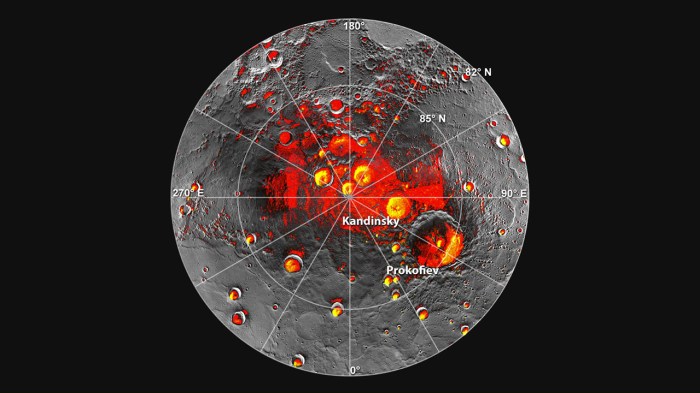
Mercury: The story opens on the planet Mercury, where mining crews diligently travel out onto the dark side of the planet, extract ore, and then return to the northern polar region. This area, which is permanently shaded, is the only part of the planet which is inhabited – after a fashion. In truth, no one really calls the planet home. But there are facilities located in the large craters, where convicts and temporary laborers harvest minerals, energy, and ice.
For the miners, their facility is located in the Prokofiev crater, which one of the larger craters in the northern polar region. It is here where miners return with their hauls of ore, which is then processed and fired into space by the Sling – a magnetic accelerator that shoots it into orbit. Some food is grown on site, most of it is shipped in, and water is sourced locally from the ice deposits. And all waste products are recycled to provide the bare necessities of life.
It is a dark place, where convicts and laborers are housed four to a room and are administered regular doses of antidepressants (to address their natural feelings of isolation and lack of natural sunlight). Convicts also have the added bonus of being equipped with “Spikes”, a neural implant that monitors their aggression levels and incapacitates them if they ever attempt to do anything violent.
And just in case they attempt anything illegal, the convict population can be confined to solitary cells, where the room’s are entirely nondescript, tiny, especially dark, and they have no company at all except for their demons.
Mars: Along with Earth, the Moon, and Venus, Mars is part of the Triumvirate – a loose alliance that embraces the most advanced worlds in the Solar System. Over 50 million people live on its surface, whereas a few million more live in orbital habitats and the Ares Installation, which sits atop The Drift (the planet’s space elevator). This installation is essentially an O’Neil Cylinder (though its more like an O’Neil can) that consists of two “hemispheres” that rotate in opposite directions- simulating gravity up to the standard Martian 0.376 g.
This self-contained world is divided into Sadak, the Hindi word for road (which is one of the official languages on Mars). Each Sadak has its share of domiciles, parks, recreation facilities, and aerodromes, where people go to test out their personal fliers. At the “southern” end of the facility is Sadak Lovelock, which is the home of the Chandrasekhar clan. Within the Formist faction, the people dedicated to terraforming Venus and Mars, they are kind of a big deal. In tall towers that face towards the planet below (which is visible through massive panels) they plot the transformation of the Red Planet into a green planet.
Lovelock is named in honor of James Lovelock, the British scientist who co-authored The Greening of Mars (one of the seminal works about terraforming). It is here that the elder Chandrasekhar (Piter Chandrasekhar) lives in what is known as a Heilig Room. Also known as a Lattice Quantum Chromodynamics environment, this room allows Piter – who is basically an upload at this point in time – to assume physical form and interact with simulated environments.
Terrafomed Mars. Credit: ittiz/deviantart.com
When Ward (the MC) meets him in this environment, he gets treated to familiar places from Piter’s life. This includes Mombasa, where Piter lived and worked during the mid-21st century, helping to create the coastal Lillypad city of Kimbilio. He then gives him a vision of Mars, of how it will look once the Formists are finished transforming it into a world with oceans, vegetation, and a breathable atmosphere.
Callisto: In part III, Ward reaches the Jovian system – aka. the system of Moons that orbit Jupiter. His first stop is the moon of Callisto, which is the outermost of the Jovians. It is a cold, frozen world with virtually no atmosphere. All major settlements consist of sealed domes that were built into the moon’s massive craters. The largest of these is the moon’s capitol of Valhalla, which was built Callisto’s massive multi-ring impact crater of the same name.
The city consists of several rings, each of which is named after a different world of the Norse mythology. Working from the outermost ring, there is Vanaheim (where the spaceport is located), Alfheim, Midgard, Jotunheim, Svartalfheim, Nidavellir, Niflheim and Muspelheim. When travelling through the city to find an old friend, Ward stops in Niflheim. It just so happens to be one of the city’s poorer districts, where the moon’s radical elements (known as the Aquiline Front) live.
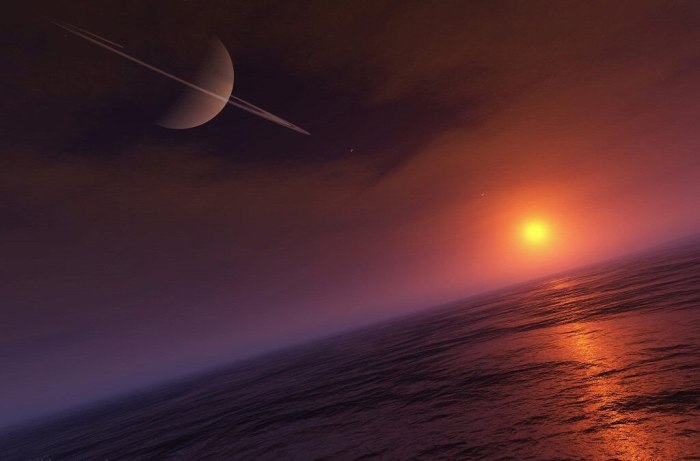
View above a methane lake on Titan. Credit: Kees Veenenbox/space4case.com
Titan: Last, there is the Cronian moon (Saturn’s moon) of Titan, where Ward inevitably goes to determine what happened to the man he’s trying to find. Much like the other moons of the outer Solar System, Titan is a world who’s surface consists mainly of ice. But unlike the other moon’s, Titan has a dense atmosphere of nitrogen, methane and other hydrocarbons. It’s surface is also covered in lakes of liquid methane, which is one of the planet’s chief exports.
The capitol of this world Huygens, a domed city named in honor of the moon’s discoverer (Christiaan Huygens). Located near the moon’s equator, this city is home to the moon\s main spaceport and is also the economic and administrative center of the entire Cronian system. As such, both the offices of the Cronian Union and the system’s more radical element – the Centimanes – are located here.
The city is also home to the infamous “Yellow Light District”, a pleasure dome that caters to every appetite imaginable. Naturally, I make sure that Ward visits here at some point, hoping to learn what he can from the moon’s many “pleasure technicians”. And of course, what he learns will both shock and intrigue him.
That’s what I got so far. And as I said, it’s been quite exhausting creating it all. I can only hope that the interest people derive from reading it will be proportional to the amount of energy it takes to write it all down!
Hey folks! In recent months, I’ve hit two milestones in the writing of my novel. The first occurred weeks ago, when I chose to change the title. The second, and more important, is that book is now half done. Yes, with part II of the story complete, and approximately 40,000 words down on paper, the novel is now halfway towards completion. That means this book is not only out of the crib and walking, its off and running. Now it just needs to avoid any nasty spills and it will be in business!
But first, let me explain why I renamed it. Basically, this book is about an “incident” that takes place on one of Saturn’s moons (Titan). Here, a high-profile figure connected to terraforming interests on Mars goes missing. The investigation into this mysterious disappearance takes the investigator (Jeremiah Ward) from Mercury, to Mars, and then to Jupiter’s moon of Callisto before moving on to Titan. Since the focus of the investigation is on the these two moons, I decided to use the name “Jovian”, since this term applies to any moon that orbits a gas giant.
Jupiter’s larger (Galilean) moons, from left to right – Callisto, Europa, Io and Ganymede. Credit: NASA
But eventually, I found this name to be problematic. For one, the larger moons that orbit Jupiter – Io, Europa, Ganymede and Callisto – are often referred to as “The Jovian Moons” (derived from Jove, the archaic name for Jupiter). While they are more properly known as “The Galilean Moons” (after their discoverer, Galileo), the name is applicable here more than with any other moon in the Solar System. Specifically, Saturn’s moons are properly called Saturnian or Cronian.
Another reason I wanted to call it the Jovian Incident was because I wanted it to be a compact volume consisting of three parts. Part I (Hermians) takes place on Mercury and shows the life of convict laborers; Part II (Martians) shows what life is like on a planet in the inner Solar System; and Part III (Jovians) covers all the action taking place in the outer Solar System and shows how people in this part of the universe live.
However, I finally realized this structure wouldn’t fly. For one, it would cause confusion to say the incident was “Jovian” when the moon where it happened on is called Cronian in the book. Second, I knew the three part structure wouldn’t fly, since it would mean Part III would likely be longer than Parts I and II combined. So I decided to add a Part IV (“Cronians”), and rename the book “The Cronian Incident”.
Saturn’s moon Titan, which figures prominently in the story. Credit: NASA
And with Part II complete and Part III underway, I have covered all the necessary exposition and background, and am now moving onto the action part of the story. I would say this is where the fun part begins. But as I am sure many would agree, once you are half done a project, completing it somehow feels more difficult. For me, starting something is the easy part. Building on that foundation is also fun. But getting it from a work-in-progress to a finished work, that’s the hard part!
So feel free to wish me luck. Also, thanks for staying abreast of my progress. For those who had a helping hand, I intend to make this book available, free of charge, once its ready. And unlike some of the thing I wrote, it should work out to a (relatively) compact 80,000 words. No tomes here!
Hey folks! Back with some good news on the creative writing front. A few weeks ago, I was given a bit of a reprieve when I took a step back from my responsibilities as Communications Manager with my friend’s startup company (Green Water Solution). As you may recall, they are the makers of the the ReFlow grey-water recycling toilette, a device that turns your bath water into toilet water to save about 40% of fresh water consumption.
And after two successful media blitz’s, I told the boss man I would like to step back and relegate myself to helping instead of being in charge. This I did largely because it was cutting into my article writing and teaching, which he totally understood. And with some of the time it freed up, I managed to get a little work done on my two biggest writing projects – Reciprocity and Oscar Mike.
In the case of the former, this involved ironing out the plot, selecting an antagonist, and finishing off the first five chapters. In the case of the latter, it meant polishing off a few chapters, and doing some research into where the third and fourth book in the series will go. The credit for this plot-related research goes to a newfound friend, Laurie Snyder.
After joining a Facebook discussion group called “Faith or Fact”, we got into a discussion and I noticed she was with the USAF and served in Colorado Springs. This is a location I was considering for the plot of the third book, so naturally I started asking questions about the armed forces and what life is like where she serves. What she revealed to me was most interesting!
Not only is Colorado Springs home to several major airbases, it is also not far from the Cheyenne Mountain Complex. For those of you who didn’t grow up during the Cold War, see Terminator 3, or watch Star Gate, perhaps some explanations are necessary. Cheyenne Mountain is the site the military installation and nuclear bunker that served as the nerve center for NORAD (the North American Aerospace Defense Command) during the Cold War, as well as numerous other defense and emergency services today.
The reason I thought this location might be useful to the plot of Oscar Mike is because of it’s proximity to New Mexico, where the series has been taking place so far. I knew that there were military bases in this city, but when she told me about Cheyenne Mountain, I seriously needed to slap myself upside the head! ***Spoilers ahead, so if you’re planning on reading Oscar Mike, you might want to tune out now…***
Basically, I decided that for a third story-twist, the Rattlesnakes (i.e. the main characters of the story) would come into some frightening information about how the zombies migrate and the likelihood that they’d be moving north – through New Mexico and the American Southwest – in the near future. However, this information also came with an upside, in that the people who knew of this had also found a potential weakness to the zombies.
For years, military scientists had been working to discern a means of taking out zombie hordes that would not pose a significant risk to civilians. Being such a terrible pandemic, which turned every populated area into a battleground between infected and uninfected, they knew that any weapon of mass destruction – i.e. chemical, biological, nuclear, or incendiary – would cause massive collateral damage and civilian casualties.
However, one weapon proved to be most effective against zombies while sparing humans, provided they had basic protection – nerve gas! Reasoning that the zombie virus infected the nerve stem and turned its victims into atavistic, blood-thirsty cannibals, it seems logical that an agent that attacked the nervous system directly and disrupted nerve signals would neutralize them.
Their hypothesis proved correct, and once the Rattlesnakes (aka. the main characters) learned of this, the task of finding an adequate store of nerve agents became paramount. As a result, the Rattlesnakes set out to establish contact with other military elements that are still active, and not hostile. To the north, Peterson Air Force Base is still believed to be intact, though direct communications had not taken place for some time.
A mission is therefore planned which will send a team of grunts there to re-establish contact, or take possession of the base should it prove to have fallen. Once that is done, they will need to get their assess to Cheyenne Mountain and retrieve the stores of chemical weapons that are believed to still be cached inside. Ultimately, what they find there will tell them much about the war, the pandemic, and the politics that have set in amidst all the chaos.
After the events in Papa Zulu, where military elements out of the east attacked the Rattlesnakes (hoping to steal their research on a vaccine) the Rattlesnakes were left with a whole lot of unanswered questions. And while it was clear that Major General Thur (“The Mage”) knew something about it, he is unable to provide them since he was severely wounded in the attack and remains in a coma. So book three, I am hoping, will fill in all the blanks I’ve deliberately left so far.
And I had to admit, the idea that nerve gas could be a potential instrument for winning the war seemed like an interesting twist too. One of the most heinous and terrible weapons ever created, now offering humanity with a chance for salvation. And naturally, there are those who are thinking of misusing it, allowing their own bitterness and hatred towards the zombies to consume them and commit great evil. What do you think?
At the moment, book three – aka. Oscar Mike – is about half done. I am hoping to get it all done before the summertime and finally put it on the shelves. For those who’ve been following the series regularly (though they are few in number, but strong in their commitment) I feel I’ve kept them waiting unfairly. A writer should never keep his audience in suspense for years on end, even if he is rich enough to get away with it (finish them books, George RR Martin!)
Hey all. Just wanted to let people know that I’m still around. And as luck would have it, I’ve found myself with some free time; free time that I’ve put towards creative writing again! In the past two weeks in fact, I have come up with a lot of new ideas for both Oscar Mike and (more importantly) Reciprocity. On this latter project, I’ve spent the past few days working through the half-written spots, and now I have a full five chapters done.
More importantly, I have revised the overall plot yet again. The last time I did this (not that long ago), I chose to change the nature of the antagonist to that of a Chinese ex-pat who was a former member of Unit 61398 – the People’s Liberation Army’s cyber warfare division. His name was Shen, and his plot involved a string of kidnapping, double-dealing, and cyber-terrorism that threatened to change the global geopolitical balance.
I liked this idea because I felt that after a good deal of research, the focus of the story should be on post-communist China, where a great deal of social confusion and economic turmoil was leading to the emergence of a semi-fascist state. In a pattern that is reminiscent to modern-day Russia, Shen sought to take advantage of these changes in order to unleash a massive cyber attack.
The downtown business district of Shanghai. One of many locations in the story.
This would have the effect of completely preoccupying the west, disabling the US Pacific Fleet, and allowing China’s new government to occupy Taiwan and the South China Sea, thus asserting their territorial sovereignty over the region. While this was interesting (at least to me), it still fell short. What I really wanted was an antagonist in the story that would make the focus be all about the two greatest issues we will be facing in the not-too-distant future.
These issues are none other than climate change, which will result in more in the way of droughts, wildfires, flooding, coastal storms, tornadoes, and diminishing resources; and technological progress, which will result in the pace of change and getting faster and faster to the point of total unpredictability.
For awhile, I’ve been writing about these subjects, and they were supposed to be the centerpiece of the story. So here’s the new plot, in a nutshell: The year, same as always, is 2030. A technological magnate’s child disappears while slumming in the Pacific Northwest in what appears to be an act of kidnapping. However, his disappearance is in fact orchestrated as part of a complex cyber intrusion designed to steal company data.
The man leading this theft – who is known only as Zeke – intends to leverage this data in mainland China, where a former member of Unit 61398, now himself a technological magnate, is in possession of a quantum-based cyber virus of last resort, a weapon that was created for a war that never happened. This virus is known as “Baoying”, which in Chinese, loosely translates to Reciprocity.
Zeke knows about this weapon because he spent years developing contacts around the world, bringing together gun runners, terrorists, socialist and anarchist militias, and Chinese ex-pats that reaches from Central Asia and the Middle East all the way to South America and the South Pacific. Though separated by ideological differences, these organizations are united in wanting to see an end to the status quo.
Zeke, however, has his own agenda. A one-time member of the technological magnates he is now using as pawns, he saw so much of the world and witnessed atrocities firsthand. He also witnessed how the privilege of developed countries is paid for in the blood of others. After a scandal in which he publicly aired all of his companies many shady dealings, his partners crucified him and cast him to the fringes of society.
In an age where the richer nations are facing the prospect of limitless energy, quantum computing, abundant resources and post-mortality while other states are failing due to displacement and mass starvation, Zeke is hoping to level the playing field once and for all. He is a genius and a man moved by a personal sense of justice. But most of all, he is a man dealing with terrible demons and some deep trauma that he can’t begin to suppress.
This kind of plot, I think, works so much better. The antagonist seems much more socially relevant, the story more focused on the big issues I like to explore, and it all seems a little less hawkish than a story where the Chinese are essentially the bad guys. But most of all, I envisioned a climactic scene where the antagonist – while explaining his motivations – says something like this:
I want a future I can control. I want a future where I have a choice. I am sick of unpredictability, or chaos and confusion. I’m sick of people being left behind, and our world being torn apart. Tomorrow, everyone will find themselves on common footing. Tomorrow, we will begin thinking towards our common future.
Try getting something like that out of a former communist who just wants to see his country win a war! Well, that’s the idea as I see it right now. What do you think? Sound good?
Happy Holidays everyone! Hope this post finds everyone safe, snug and warm in their homes, preferably surrounded by loved ones and lots of new swag! While I’m on break from my writing jobs, I thought I’d switch gears and get back to my personal writing for a bit.
And as luck would have it, I made some headway with my latest story idea – the near-future thriller Reciprocity – and I thought I’d share some of it. So far, I’ve got a few introductory chapters, and a prologue that introduces the antagonist. So, over the next few days, I thought I might share some of this work and see how it stacks up.
Here is the first snippet, which takes place in the Philippines in the year 2029. Enjoy!
He was bathing in a sea of connectivity, looking out onto the second skin that blanketed the Earth. There was virtually no corner of it now that wasn’t covered, but finding oneself in a major city was like standing directly in a pivot. After spending many weeks off the grid, it was like stepping back into the light of day after days in a dark cave. His entire body awash with high-fidelity photonic light and a microwave glow.
He felt like his skin should be burning, and yet it wasn’t…
Setting his glasses to normal view, the microwave landscape disappeared and was replaced by the stark, colorful reality of the favela. At once, his sense adjusted the combination of movement and sound that was so common to such places. A world of congestion, decay, and waste, yet teeming with so much life. Shen remembered coming to the region before, back in the day before reality could be mediated and augmented.
Now, the unseen energy and information that coursed through the landscape was illustrated in any number of ways.
At the moment, it took the form of a dozen colorful overlays that played across his contacts. He looked left and right along the thoroughfare and was awarded with helpful icons and some less-than-helpful adverts. Compared to the Metro area, the visual landscape here was not nearly as cluttered. But there were still tourist markers and small tags that he could access if he so chose. Slum tourism had become its own business of sorts, a form of adventure tourism that appealed to the reckless and irresponsible.
And for their convenience, Tondo’s checkered past and the locales that had played a role were mapped out and catalogued. They walked a few more blocks, sticking to the overhang that shaded them from the beating sun. Bagyó season was fast approaching, and the air had taken on a sticky, wet quality. For those unaccustomed, it could be the most stifling thing in the world. But for expats accustomed to venturing across the Pacific, it was within the realm of the ordinary.
They passed several rows of vendors; men, women and children who had brought their stands directly out into the street, offering large piles of oranges, bananas, watermelon, dragonfruit, mangosteens, and lychees. Farther on, they were hit with the scent of fresh and rotted produce, and the stands changed their offering to provisions of cassava, okra, pak choi, and bitter melon.
Much like the clothiers, toy sellers and peddlers or wearables that resided not far away, they would be sitting on the very edge of the streets until the weather turned. Until the rain began to pelt down with incredible fury and the flooding began. A tenacious folk, and one that seemed to respond to escalating catastrophes like the coming and going of the tide.
“Is that it?” asked Ping, pointing to a hazy standing structure at the end of the block.
Shen squinted to allow his contacts to zoom in on the building, shrouded by dew and smog. An icon appeared over top that read Cathay Towers, and a small stub explaining the nature of the housing project and how its status was currently listed as Postponed Indefinitely.
“Yes, it is,” Shen replied, tapping on his glasses again to adjust the display. He cycled to IR and noted the sheer number of heat signatures located on the first three floors. “Looks like Wáng has found himself a colorful place to live.”
“Is it safe to just walk in?”
Shen looked to the fourth floor, noted the few bodies that were standing about. Another tap and the display adjusted again, aided by the small sensor suite attached to the outer frame. He zoomed and adjusted until the scanner had just the right resolution, producing signature of a different kind and in different color. Opal and green came together to indicate the outline of weapons, all small arms from the look of it.
“There’s not many protecting him. And their weapons are antiquated. We’ll have no trouble.”
They pressed on, moving through the sea of humanity and commerce. Upon reaching the thoroughfare that ran perpendicular to them, they passed into a different crush. Countless vehicles, smart and dumb, forced them to pick up their feet and weave through the tangled mass of metal and plastic. The shouts of vendors were replaced by cab drivers and commuters exchanging expletives in Tagalog, Spanish and English – often in the same sentence.
At the front entrance, a large set of double doors that were permanently open, they paused. Shen touched the small protrusion in his jacket pocket to make sure it was still there. An odd thing to do, but if things went awry in there, it was his assurance that they might make it through.
He looked to Ping, who appeared to be doing the same. Except in his case, his fingers tapped against the PDW stashed under his coat and next to his hip. In a pinch, he knew the boy could be counted on to retrieve it and squeeze off a maelstrom before anyone else got a shot. Hopefully, his old friend would be in a talking mood and it wouldn’t come to that.
“You ready?” he asked. Ping nodded, a look of hard resolve on his face. “Good. Stay close and try not to be appalled by what you see inside.”
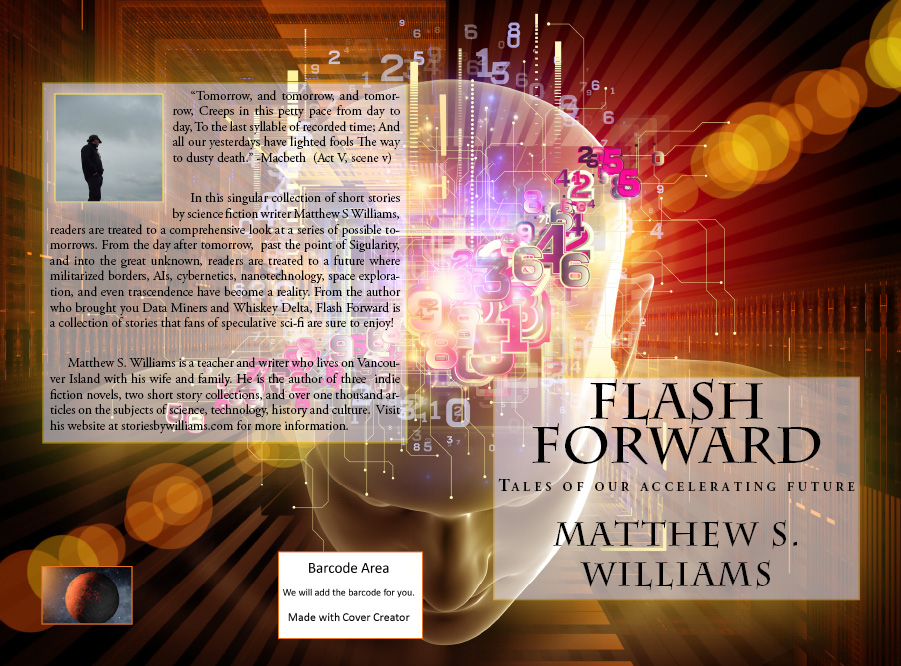
After many months on the back burner, I finally took a big step while house-sitting for my family this weekend and completed Flash Forward. For those who don’t know, this book is an anthology of short sci-fi stories I did back in April of 2013, with a few additions from both before and after. All told, it works out to 19 short stories, 140 pages, and just over 51,000 words.
For some time, I had been wanting to do some fiction that explored the world of emerging technologies, artificial intelligence, autonomous machines, space exploration and the coming Technological Singularity. And a project involving a short story a day for 26 days was just the excuse I needed. After collecting the resulting stories together, I grouped them into three parts based on common time period and theme.
Part I: Transitions deals with the near future, where climate change, militarized borders, and explosive growth in portables, social media, and synthetic foods will have a major effect on life. Part II: Convergence deals with the ensuing decades, where space exploration, artificial intelligence, digital sentience, and extropianism will become the norm and fundamentally alter what it is to live, work, and be human.
And Part III: Infinitum finishes things off, looking to the distant future where the seed of humanity is planted amongst the distant stars and our species passes the existential singularity. It was fun to write, but what I’ve been looking forward to for quite some time is the chance to hold a physical copy. Somehow, that’s always the best moment of the whole creative process for me. Seeing the book in print, as a real, physical thing you can touch and leaf through.
And now if you’ll excuse me, I have a book to edit, a million and one ideas for critical revision to consider, and a whole heap of what Aldous Huxley referred to as “Chronic Remorse” to deal with. Writing, huh? There’s a reason not everybody does it!
More good zombie-related news everybody! With 22 chapters, 116 pages, and over 40,000 words (the length of a conventional novel), Oscar Mike is now one-third complete and on its way towards being finished! Granted, this is just an estimate based on the rough outline I have for the novel, but it’s a pretty good estimate.
And let’s be honest. Given the choice, I would rather not write a book that exceeds 66 chapters, 348 pages, or 120,000 words. I’m not Tolstoy, dammit. I don’t DO epics with more than 500 characters! Anyway, at the risk of previewing things a little, I decided I wanted to offer a brief synopsis of what can be expected in book III:
Zombie Attack: For starters, it picks up shortly after where Papa Zulu left off. During the final chapters of that book, the Rattlesnakes had managed to drive the Eastern Faction (which is what the military units from the east are known as in book III), out of their hometown. However, the violent noise of this attack awoke countless zombies that had been living and hiding in the nearby hills. Now, the Rattlesnakes must deal with the aftermath of this latest assault by the zombie hordes.
Change in Leadership: Major-General Michael Thur (aka. The Mage), was severely injured in Papa Zulu and fell into a coma. In Oscar Mike, his immediate subordinate, Colonel Haynes, has risen to take command of the Rattlesnakes. He is known for being a hard liner and a ruthless man, and his assumption of command will have dire consequences for some.
Braun is MIA: After the events in Papa Zulu, Lieutenant Braun was stripped of his rank and command and sent to Santa Fe to live out his life as a civilian. Naturally, the people of 1st Platoon, Bravo Company are not too pleased with this. But for Braun, it means adapting to a new life, one where he is being compelled to make a difference in the lives of ordinary citizens.
Danger Approaching: In the aftermath of the assault by the Eastern Faction, a small band of survivors is found. They carry with them a message, and some dangerous knowledge which could alter the course of the war. (Hint: Second Wave!)
Zombie Revelations: For some time, it has been apparent to the people fighting the war against the Whiskey Delta that they are not all that they appear to be. For one, they continue to demonstrate that are capable of more than mere instinctive behavior, even a modicum of intelligence. And soon, a new weakness will be revealed. In addition to learning of a new threat, the Rattlesnakes will realize that they just might possess a weapon that could bring the Whiskeys down!
And that is what’s coming in the third installment of the Whiskey Delta series. Some time ago, I hoped to make it the final installment, but found that I had way too much to say to fit it all in one volume. But I am committed to ending it in five. I’m not George RR Martin either, dammit! Someone tell that guy to get back to work and finish the series!
More to follow on this and other writing ventures. In the meantime, always remember…
My thanks to Rami for tagging me in the latest round of WordPress Tag! This means I have to answer the following questions and then send some tags out of my own. So lets get this party started…
What are you currently working on? Having finished with my second zombie book (Papa Zulu), I’m now working full-tilt to finish my anthology of science fiction short stories. It’s called Flash Forward, and contains short pieces of fiction that deal with subjects ranging from climate change, militarized borders, drone warfare, neural downloads, cybernetic augmentation, space travel, and cosmic evolution.
How does your work differ from other authors in the genre? These days, most authors I know are writing in the dystopian sci-fi genre. Somehow, with the growth of the YA market and the popularity of books like The Hunger Games and Divergent, the whole dark future theme seems to be making a big comeback. But I want to deal with future scenarios that are in keeping with current trends, addressing the impending Technological Singularity, Climate Change, and how the interaction of these two forces will shape the coming decades and centuries.
Why do you write what you do? Because I have this obsession with recreating the kind of things that inspire me. The books that have done the best job of that in the past were always works that captured the zeitgeist of the age, making predictions about the future in order to tell a story about the here and now. It’s been my hope for almost two decades now that I could create something that would do the same thing for others.
How does your writing process work? My mind is constantly dreaming of things that inspire me and looking for new ideas. I try to feed it as best I can with research and the latest in science, tech, history and geopolitics, until such time as a breakthrough comes and I begin to plot it all out. Then, once I have a framework in place, I start field testing it out by writing the first few chapters and seeing if it has traction. Once that’s done, the story begins to evolve and take on a life of its own. Some don’t make it to fruition, but others do.
And now I tag three writers: I nominate the following three people for the next round:

















 Stories by Williams