Dealing With Rejection

As all successful writers will tell you, rejection is part of the process. From Ray Bradbury, to Frank Herbert, to George Orwell and James Joyce, every great has always admitted that before they were well known, they were a nobody. Publishing houses wouldn’t take risks on their manuscripts, editors told them it simply wasn’t what they were looking for, and friends and family told them to simply persevere. Sooner or later, their genius would be recognized for what it was.

That’s what I tell myself whenever I get the form rejection letter that I found in my Inbox this morning. For some months, I have been trying to get my short story “Domicile 4.5” published with a magazine. It’s a story of the not-too-distant future, of nanotechnology, avarice, and the dangers of constantly trying to “keep up”. And this is the third magazine to tell me, in essence, “thanks, but not what we’re looking for.”

Of course, I will try again. There are other magazines who have specified that they interested in speculative fiction and technologically based stories, so all hope is not lost yet. But it does get me down, right? One can’t help but feel personally rejected when a  form letter like this arrives. Whenever you express yourself creatively and someone says “no, thanks”, you can’t help but go through gambit of emotions. Self-doubt, sadness, and maybe even a little anger. What am I doing wrong? What was wrong with it? Surely, there must be a reason right?

Of course, I know that everyone out there knows precisely what I’m talking about. Whether it was a job application, a relationship, a petition to join a group – we’ve all been there. So I thought I might open the floor and ask my friends and colleagues out there, what kind’s of rejection stories do you have? More importantly, what did you do to soldier on when it happened? Is there a magical elixir to let yourself know that you are the problem, that this is just part of the process, or that you’re efforts are worth and just haven’t been recognized yet? Feel free to share because I’m interested to know 🙂

In the meantime, I thought I might post it here, just to see if people might actually find it worth reading. Stay tuned!

The Inspiring Blog Award!

My thanks to Renee, that lovely, sassy, irrepressible lady, for nominating me for another award. I thought I was done with these, but then the other day I began wanting to put them up on my page. I’ve already made room for the new one, and am already thinking of whom I’m going to nominate in turn. So many people to thank, so many new things to share about myself. Where to begin…

As stipulated by the rules of the IBA, I must now share seven interesting facts about me. Forgive me if I cover old ground, but that’s the way of these things. There’s only so much we can say before we either start sounding familiar or get venturing into TMI territory 😉 Okay, here we go!

  1. I prefer homemade food that’s bad for ya! My wife and I routinely set aside one day a week for pizza, perogies, or other such luxuries would put us in an early grave, assuming we ate them every night! One time, I even pounded some pork loins, breaded them, and made homemade schnitzel. We also make room for desserts, such as apple cake, apple crisp, or upside down cake.
  2. I’m bad with money. I always figured I would have to end up rich, since I could never stand living on a budget. As a young adult, I loved having steady employment and money, mainly so I could be generous with friends and ensure food, drink and good times were not in short supply. I called myself “Rich Uncle Matt” for fun. They always got a kick out of it!
  3. I like fighting! Not in the sense of brawling or fisticuffs, mind you. But I love the combative arts, love doing demos (board breaking, brick breaking and self defense skits) and would think it totally badass if I could do some fight choreography in front of a camera! I would also like to fight competitively at least once before I’m too old to do so anymore. I figure I got a good decade or so left in me. Let’s see what I can do!
  4. My sister in and wife both lost their doggies recently. It’s the saddest thing in the world when a beloved dog who’ve you;ve known for so many years reaches the end of their life span. I know exactly how they feel. They grew up on a farm and are more acquainted with the death of pets than I am, but I still know how much it sucks. What’s more, I see that a number of people I follow have experienced the same of late or are wrestling with their own personal tragedies, sickness and injury and the like. I wish you all the best in this time of sad convergence! I can only hope that things will get better from here.
  5. I wish I could write more sex and romance in my work. One of the things I like best in a book is realism, and part of that is conveying love, sex and tenderness in real terms. One of the things I like best about George RR Martin, Tom Robbins and Pat Barker as writers is their unabashed and unashamed depictions of sexuality. I wish I could write more into my own work, but what I write rarely calls for it.
  6. My dreams are almost always the same. I don’t know for what psychological reason, but my dreams usually involve me being back in school, often at my current age. In some respects, this mirrors real life since I did a year as a mature student and didn’t like it that much. Sure, its fun being in school when you actually want to be, but being around so many younger people kind of sucks! It’s humbling, really.
  7. My cat is nuts! I know I’m to blame for this, but I raised an animal that is a total… well, animal! When he was a kitten, we knew him to be the cutest damn animal in the world. So tiny, yet so brave and irrepressible. He climbed everything, the walls, the curtains, pant legs. Then, when he was old enough to go outside, he began to hunt. For months, we’d find dead birds by our doorstep.He also began to play with me, way too hard! He’d bite, kick, and just generally be a total monster! Then he began getting territorial. To this day, he won’t allow another cat to venture into our area without whooping his ass! All throughout this, I refused to repress him, mainly because I didn’t want to punish the boy for having spirit. I love his nutsy personality, but my accumulated scar tissue makes we wonder if it’s really worth it…

And now for MY nominees. For those who inspire me and encourage me to do better…

  1. Dangerously Daydreaming – Audrey’s journeys, recipes, photo journalism, and semi-daily elocutions are always a source of inspiration, be it culinary, personal, or creative! Being of the west coast, we have a lot in common when it comes to the kinds of travel and journeying we like to partake. However, she’s dangerously close to outpacing me in terms of world travels. What’s more, her constant encouragement keeps me writing!
  2. Ramiungarthewriter – Rami Ungar, a fellow writer who’s posts and plans inspire me, perhaps selfishly because he reminds me of myself. He’s also my most dedicated follower and keeps me on my toes with his observations and opinions, and is sure to be invaluable as I continue on my own writing career. I wish him the best as he embarks on the road to self-publishing! You’re on the right track, now get out there and shake your money-maker (aka. your manuscripts)!
  3. Sotetangyal – Home of the lady Nina D’Arcangela, writer, visionary and specialist in all things dark, Gothic, and pleasing to those of us who have sick senses of humor. I refer to myself of course. Somehow, her writing always brings a twisted smile to my face. So good at capturing the depths of darkness that live at the core of us all! Also, the way she retweets my stuff is always a source of encouragement. I’ve told her she can do better than my stuff, but does she listen? Nope! And I hope she never does 😉
  4. Urbannight – A fine lady who pretty much sees the world in the same light I do. Spends too much time on her computer, feels the need tog get out and see more of the world, and writes some pretty damn insightful things! Yeah, we get along fine. This, among her rather fun and quirky observations about life, inspire me because they teach me there are more people like me out there!
  5. Bucket List Publications – Here is another fellow-traveler on the world of life who’s got it figured out. As the name would suggest, it’s all about getting it all in before the clock runs out. Her travels, photo logs and accounts of the world are always inspiring and make me want to do more, see more, and experience more of this world before I am forced to leave it.
  6. bodhisattvasiddhartha – aka. Jay, former officer in the Indian Armed Forces, turned writer, muser, part-time poet, and world cyber traveller. There’s a little bit of everything here, and all of it is likely to inspire the fertile mind looking for new perspectives and friends in distant places who have something to say. I am honored that I find myself amongst the people he chooses to read and reblog from time to time and hope that whatever I’m doing to inspire him, I continue to do 😉
  7. Dr. Sci-Fi – And I thought I knew a thing or two about sci-fi, but it’s safe to say that the good doctor here puts me to shame! Not only is he a committed fanboy of numerous classic franchises, he knows the ins and outs of the sci-fi world intimately. I can always count on him to inform me on my subject matter, and offer insight into whatever world I am currently romping through.

Source, Now Available for Free until Nov.1st!

Good news everybody! At least, that’s how Professor Farnsworth would put it. My first novel, entitled Source, is now available for free through Smashwords until November 1st. As my first work of fictioni, it deals with a concept very near and dear to my heart: apocalyptic sci-fi!

In fact, the entire novel was inspired by a short story project I did with my old writer’s group – The Herscher Project – back in 2005. The theme was dark futures, and I used the opportunity to experiment with an idea that was kind of big news for the time.

If interested, go by Smashwords.com and download Source for your Kindle or ereader. Be sure to enter the coupon code: KY62K in the appropriate box, and get your copy for free! Note the old school cover, I’ve since updated that of course.

Anthology Sample: The Torch (part II)

Hello again from the world of writing! As some people may recall, I published a section of my other contribution to my group’s anthology a few days back. Entitled “The Torch”, it introduces a near-future scenario where an ecological engineer named Magid Muktari proposes launching an exoplanet colonization program. As the prologue to the anthology, it’s kind of important, in that it sets up the entire story and gets the ball rolling on the whole plot.

Hence why I wanted to do it myself. As the editor, you kind of have to put your money where your mouth is, otherwise you’re just a big fat delegator! And what good are those? In any case, the first section presented the introduction of the idea. In this second part, I wanted to get into the early like of Muktari, presenting his estranged wife from later in the book, but at a time when they were still partners and lovers.

Since she too was the creation of fellow anthologist Khaalidah, I thought she deserved a mention and a thorough treatment of all she accomplished in her lifetime. I hope I did her justice, and in the meantime captures some shred of what it will be like for a couple in the mid 21st century who are trying to make ends meet, and save the world at the same time! Hope y’all enjoy and remember that feedback is most welcome

*                    *                    *

The lights were already on when he came home. The nighttime creatures were about, singing their evening songs and tending to their nocturnal rituals. He felt the reassuring calm spread over him as soon as the wheels stopped in his driveway, the engine quieting down from its long run. The door raised itself for him and he put his tired feet to the ground, letting out a deep sigh.

“Home again, home again…” It took some effort to get him the rest of the way out. The steps were even harder to manage. It confounded him, how travelling could still be such a draining experience when machines generated all the motion. Perhaps their minds had not kept pace, still interpreting distance in terms of physical expenditure.

He paused on the front stoop and waited for Empathy to scan him. A quick flash hit his eye, discerning his retinal pattern, then projecting a kind greeting in his visual field.

Hujambo, Magid! it said. He laughed. Firdaws had toyed with the settings again. Of all the languages he had picked up in the course of his training, Swahili was the one that still alluded him. It was the one thing he she maintained over him for all these years; he suspected she relished it too.

“Hujambo, my dear!” he said as soon as he stepped into through the front door. No footsteps came to greet him. On a hunch, he wandered through the living annex and found her in her office. He paused at the entrance and sighed at her.

“Dining on ashes, dearest?”

She raised her finger to him. He spotted the jewel in her ear and the distant look in her eyes. Apparently, she had brought her work home with her again. Always the solemn and grave sort, her. Never shying and never blinking in the face of interminable change. He waited as patiently as he could while she finished her discussion with the person on the other end, and tried not to pass out against the wall.

“That’s not an offer, Tikhon, it’s an insult… No, don’t recommend this as a compromise, if we do, we’ll be doing nothing but until the project is realized. If they want the rights to drill, they need to meet the local’s demands and the EA’s demands… Alright, thank you. I’ll talk to you in the morning.”

She leaned back and sighed. She looked at him for the first time since his appearance on her step. She also removed the jewel and the contacts from her eyes, signaling the end of her day.

“How was your trip, dear?”

“Long and exhausting,” he replied. “And how goes the good fight?”

“The same,” she said, rising from her seat and proceeding to give him a kiss. “I trust your stopover was worth the extra travel time?”

“Ah, not exactly, no.”

She took his face in her hands. They felt lovely and cool against his skin. “Well, you can only do so much. I did say that it was an unlikely possibility as it was.”

He grumbled. She had indeed, and meant it as an indictment on the wisdom of his superiors rather than his plan. But it did him little good right now. In his current state, any tough love only seemed to drive the failure home.

“Shall I make us some dinner?”

He frowned and checked it his chrono. “You haven’t eaten yet?”

She shook her head and looked at the pile of display sheets that lay on her desk. No explanations were necessary. There was no time or schedules amongst workaholics.

“Sure, why not? Anything will do.”

“Good, because we’re having kofte. I was kind enough to pick some up on the way back from work, even though I knew there was a good chance you might not make it in before I went to sleep.”

“How considerate,” he said, bowing his head to offer thanks.

Punching him in the shoulder, she took off past him and headed for the kitchen. Taking a seat at the island stove, he watched while she prepared pieces of spiced meat and yoghurt from the cooler, intermixed with select greens from their crisper. She grabbed a tub of prepared rice from the bottom shelf and began spooning some into two bowls.

“Nothing like fresh,” he said, taking in the aroma. Firdaws insisted on doing things Halal, he knew. And the local authorities were yet to sign of on the compiled version. Luckily, their professions afforded them such luxuries, religious exception being a somewhat expensive pleasure these days.

“Are you going to ask about my day?” she asked finally.

“I thought I did.”

She laughed. “There are details, if you care to hear.”

“Of course,” he said with a sigh. Though he knew he wouldn’t be able to follow, and would incur her wrath if she turned around too soon.

“Well, it was hard enough getting the firm and the Emir to sit down together. He was unwilling to negotiate any lease on the land unless they agreed to a long-term commitment. The company asked what he meant by this, and he replies that fifty years would suffice. That nearly torpedoed everything. But once we got past that issue, the company started making its own demands. After surveying the land in the region, they announced they wanted to expand their lease to include an entire hillside range. They want resource exploitation rights, the whole lot…”

Muktari hummed thoughtfully, even though he wasn’t entirely sure the path she was taking with this. He heard a loud clink inside the cooler.

“So the Emir starts accusing them of sending in covert surveyors, which he claimed was in bad faith. That nearly caused the company to walk out again. However, they did say that they will resume negotiations if and when the Emir agrees to sign over the resource rights in the area to them.”

“I see…” though he didn’t.

“Now we’ve got to make a recommendation. Our boss wants to dangle the offer in front of the Emirs nose in the hopes that it might move things along, but as usual, he’s being an idiot.”

“Won’t be long before you are running things, dear.”

She chuckled. “In any case, I told him we should recommend a joint survey, find out exactly what the company found in those hills, and then conduct a separate negotiation. No sense in letting them exploit something until the locals have been notified of their rights and the government knows exactly what they are giving up.”

“Hmmm, and all this for a few hundred kilometers of sand.”

She turned suddenly. “That sand will hold one of the largest solar arrays to date. Every country in the region is already looking to buy up rights to the power it generates.”

“You’d think the Emir would want to conclude things.

Firdaws stroked a lock of black hair from her face. “His mistrust is… less than rational, but its working in his favor. Astral will make a meal out of his country if he lets them. The energy business is still the same, no matter what technology they employ.”

“And so the dance continues,” Muktari said with a chuckle. He was surprised that he had managed to get through it. His semi-delirious mind had somehow managed to take it all in and still managed to stay interested. Not all of it registered, but at least he grasped the salient points.

A loud clink signaled the presence of his bowl in front of him. He breathed in the warm steam of a lovely meal, felt his stomach ache with sudden anticipation. As usual, he hadn’t realized the extent of his own hunger until the food was in front of him.

“So…” she said. “What now?”

He looked up at her with a frown.

“You’re plan? Are you going to drop it, or take it to a more receptive audience?”

Muktari chewed slowly and considered the question. He had pondered that very question himself during the trip home, but to no avail. Short of going behind Zimmerman’s back and risking his entire career, he wasn’t sure how he could possibly move ahead with it anymore.

“Unclear,” he replied. “I might need to keep it close to my chest for now.”

“And let it die a natural death?”

Muktari cleared his throat. How like her to challenge him so. “I won’t let that happen. Sooner or later, I’ll find a receptive audience.”

Firdaws nodded and turned to close cooler unit. “It’s up to you, koca. But after the time and energy you’ve dedicated to this, I’d hate to see you lose faith just because your current boss said no.”

Current boss, he thought. Was she anticipating something, or making a possible suggestion? It was always so hard to tell with her!

New Anthology Sample: The Torch!

Hello all and welcome back for another Anthology Update. As I said a few days ago, there is still plenty of news to be had vis a vis my groups ongoing efforts to create our our Magnum Opus about colonization and space travel, aka. Yuva. And the latest is that I’ve finally begun writing the prologue for the entire series.

Entitled “The Torch”, this first installment in the anthology shows the origins of the story’s central character (Magid Muktari) and his lifelong mission to see humanity colonize a distant world. Thanks to Khaalidah Muhammed-Ali who coauthored this with me and once again provided the characters and impetus for it’s creation! Hope you all enjoy!

“A man of cold, hard science, most assume that Magid Muktari was not a man of faith. At the press conference following the acceptance of his final proposal for the creation and international funding of the Yuva Colonization Project, Muktari was questioned thus by one young reporter: “Sir, can you please explain to us why this project is so important?” Muktari said in cryptic form, “Our Earth is alive.” When asked to elaborate Muktari said: “Has not Allah promised us in that every soul shall taste of death?”

-Magid Muktari, 2108

Masdar City, UAE, 2048

Magid Muktari took a deep breath and tried to remain calm. Oh how he hated waiting! Even after all the years he had spent on the front lines of his industry, waiting for meetings, trips to end, and plans to reach fruition, he still couldn’t stand the time it took to wait for a presentation. But that was the way of it, he knew. Anticipation was the thousand little deaths that preceded the actual execution. One could only surmise from this that humans weren’t designed to wait on others. Either that or the Universe had a very poor sense of humor.

To pass the time, Muktari began to punch up his presentation info. Adjusting his compad to a convex shape and resting it on his knees, he placed his contacts to display mode and waited for the computer to warm up. A command prompt appeared in his field of vision and asked for his password. He typed it in promptly.

Meşale

His eyes filled with a cerulean blue sky, small clouds and a series of desktop icons dotted the projected heavens. Accessing the proper folder, he accessed the presentation and waited a moment. The opening display image, five planets arranged from left to right, appeared in his visual field shortly thereafter.

The Future of Off-World Settlement, ran the title. A title bar appeared beneath the five planets, their names scrolling out as the marble-sized pictures became animated.

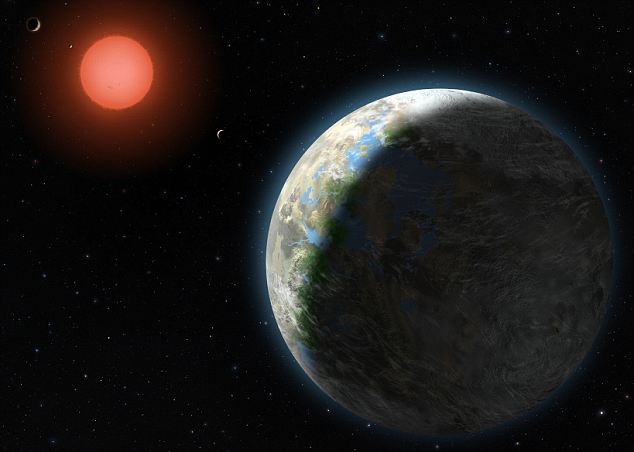
Gliese 581 g, Gliese 667C c, Kepler 22 b, HD 85512 b, Gliese 581 d

Placing his hands above the compad again, Muktari brought up the first of the five. The brown marble moved to the center of his visual field, displacing the rest and growing exponentially in size. A soft contralto began to speak in the background.

“Planet Gliese 581 g, fourth planet of the Gliese 581 star system. Discovered in 2000 by Lick-Carnegie Exoplanet Survey, led by principal investigator Steven S. Vogt, who named the planet Zarmina after his wife – ”

Muktari terminated the audio and began interfacing with the image. Zooming in on the planetary mass, he began to assess the features that had been observed from the most recent astronomical surveys. Being a tidally-locked body, only so much was visible, and most of that was only clear when the space telescope and the exoplanet’s rotations were in perfect sync. He moved back and forth, noting the outlines of a large continent facing towards the sun.

No, not a lot happening there, he thought gravely.

Putting it back in its place, he called forth the second in the list. Here too, the disc look particularly brown and mottled. However, its size and relevant characteristics set it apart from the previous entry, and here too Muktari began to worry. Super-Earth’s were not exactly a popular destination for colonists, not when they could expect a serious and potentially punitive adjustment period.

Muktari shut the display down and took a deep breath. Moments away from the greatest presentation he would ever make, that perhaps anyone would ever make, and he was already beginning to write himself off. Not a good sign, not if he wanted to have any chance at convincing Zimmerman of his sincerity.

There were those who said that the great Magid Muktari could sell ice to the Eskimos. Other’s said he could sell sand to the Arabs. He never cared for either assessment; both seemed to be both inaccurate and quite bigoted in his estimation. But the sentiment he understood.

But then again, the sheer scope of what he was proposing might have had something to do with that. Were this just another pitch, a proposal for more allocations, more surveys or more satellite deployments, he probably wouldn’t be giving it a second thought. And after years of bending the ears of government and industry officials who did business with them, he had earned himself enough capital to make a few pitches of his own.

If he screwed this up, all that capital would burn up and be gone. What’s more, he would be humiliated in front of the man he had come to respect more than any other…

Across from him, seated at her desk, the assistant seemed to stir. In her eye piece, the image of a face appeared and she began conversing with it. Muktari was only privy to one half of the conversation, which was mainly her agreeing.

 “Yes… yes… yes, sir. I will pass that along.”

The image faded and she looked over to Muktari.

“Mr. Zimmerman’s plane has just landed. He will be here in five minutes.”

Muktari nodded. Another thing that hadn’t changed over the years. Regardless of how much time transit really took, it was an administrative habit to say that it would take five. And he knew from experience that a pod ride from the aerospace port to the office building would take at least ten. And then he would no doubt be mobbed by half a dozen assistants and corporate middle-men who needed to advise him and brief him on his way in. In truth, he would be lucky if he spoke to him before the hour was out.

He checked his chrono just to get a sense of the time. His watch was still set to orbital time. He shook his head when he realized that that was the last time he had slept, in a room near the tip of the axis looking out at the southern tip of Chile. Ever since, he had been running on a non-stop diet of aerospace lag, adrenaline and EBME.

At last, the woman at her desk looked up again and got that distant look in her eyes. She repeated the familiar string of secretary talk.

“Yes… Hello. Yes, sir, he is. Right away, sir.” Her call ended and her eyes focused on him. “Mr. Zimmerman will see you now.”

Muktari smiled and placed his compad back in the satchel. Getting to his feet, he ran a hand through his hair and straightened his blazer. His clothes were fresh, but his skin still felt like it was carrying a few days’ worth of residue. He discreetly checked for any telltale signs of body odor as well, and was reasonably confident the natural musk he was carrying wouldn’t kill his boss. After many minutes in the same room as him, the secretary seemed undisturbed.

Here we go, he thought, and set off for the door.

The door slid open, revealing Zimmerman in the middle of freshening up. This consisted of him shedding his blazer and replacing it with one of the many he kept hanging in his side closet. He looked up with mild amusement at Muktari’s entrance.

“Magid,” he said, throwing on a fresh top. “You’ve travelled some distant to and come see me.”

“Yes I have, but only a fraction of your own, from what I hear.”

“Yes,” he said with a sigh. “The Jovian tour was quite extensive. One has to wonder why we can’t just teleconference the entire process.”

 Muktari smiled. Though he tended to complain upon his returns, everyone knew that Zimmerman remained an engineer at heart. Whenever new facilities went in and processing began, he insisted on conducting spot checks in person. Somehow, the virtual variety did not inspire much in the way of confidence from people like him, men who openly bragged about being educated in a simpler time.

“So…” he said, taking his seat. “What’s so important you had to see me as soon as I got back?”

“Well sir, I wanted to see you while the trip was still fresh in your mind.”

“Oh?” Zimmerman said with a nod. “Then this ought to be good.”

Muktari chuckled and placed his satchel down beside the seat in front of him. He removed his compad again and placed it directly on top of Zimmerman’s desk. He keyed up the 3D display and sat back.

“As it stands, this company is responsible for almost half of the development taking place in the outer Solar System. Unlike many other firms that see little promise in anything beyond the Belt, we’re renowned for taking the long view. That’s what I’m hoping to tap into.”

Zimmerman grumbled. “Why do I have the sinking feeling you’re winding up for a very slow pitch?”

Muktari chuckled. “Shall I cut to the chase?”

“Please do. Formal presentations are for board rooms and junior execs.”

Muktari terminated the display on his compad and stood. He walked to the room’s window and looked outside. The glittering spires of Abu Dhabi shined in the distance, visible just beyond the cities limits. He took a deep breath and started from the beginning.

“How long have I been in your employ, sir?  Ten years, the last six of which I’ve spent as the head of our eco-engineering division. Much of the technology that was borne here and is now being adapted by other cities worldwide originated in our labs. And yet, everywhere I go, I hear the same basic reports, the same alarming assessments.”

Zimmerman looked on and pursed his lips. He was still waiting for the point to emerge. His recent travel had clearly taxed his patience to its very limit. He decided to expedite things.

“As it stands, eco-engineering accounts for over twenty percent of our government’s annual global spending.  Investment and development have been moving more and more to off world locations. And it’s estimated that by the end of this century, the majority of our planet’s heavy industry will be relocated to Luna, Mars, and the Asteroid Belt. All this points towards a singular trend.”

“Extra-terrestrial development,” Zimmerman said obviously. “What of it?”

“But what drives it?” Muktari asked, turning to look him in the eye. “What knowledge prompted us to create orbital facilities, off-world mining and agricultural settlements, and to spend so much, year after year, trying to keep global mean temperatures down?”

Zimmerman nodded. The inclusion of that last detail was indication enough of what he was getting at. Naturally, he let him continue.

“The Earth is still cycling towards death, its oceans are still rising, its coastal areas are still plagued by floods and storms, drought and famine are still causing untold damage and death in the most densely populated regions, and humanitarian crises abound. What’s more, off-world settlement was hoped to be a means of relieving population pressures here at home; but you are certainly aware, the Solar Colonies maintain some of the highest birth rates, compared to Earth. Soon enough, there won’t be enough room and expansion will just shift the burden, but not by enough to make a difference here at home. When it comes right down to it, the scientific consensus on Earth’s longevity is clear.”

Zimmerman nodded, quoting from the latest findings. “Barring some major technological developments, such as the development of full-spectrum nanotechnology and/or a full-spectrum development of the Earth’s equatorial regions, and we can expect that most of the planet will be only partially habitable by 2100.”

Muktari extended his hand, palm facing up. The point was laid bare. He went back to his seat and lowered himself into it, careful not to strain any of his tired muscles.

“We proceed on track as if our current measurements will be enough to stay the torrent, but the problem continues to grow unabated. And just about everywhere I go, I am asked how we will save the planet.”

Zimmerman allowed for a brief pause and then raised his hands. “I’m on the edge of my seat, Muktari. What are you proposing?”

Muktari sighed and held his hands in front of him. This was where things would truly be tested. It was do or die time, he could hesitate no longer.

“Not too long ago, a colleague of mine, Adamcik, you’ve met him.” Zimmerman hummed affirmatively. “He hit me with a rejoinder not too long ago which truly vexed me. I asked him how we would go about addressing this planet’s needs. He retorted by asking me, ‘what if this planet is the problem?’”

Zimmerman frowned. Muktari had done much the same when he first Serge say it.

“When it comes right down to it, our homeworld is plagued by three separate problems – overpopulation, environmental degradation, and economic underdevelopment.” He raised his fingers, counting them off. “All of these are interrelated and compounded by one another. What’s more, attempts to remedy any one of them inevitably meets with failure due to the presence of the other two. We address the planet at the expense of the economy, we promote economic development at the expense of the environment, and all attempts at addressing the population fails as long as the economic divide remains. And our Extra-Terrestrial colonies aren’t going to solve this problem any time soon, and simply are not big enough to host our civilization should Earth fall.” He paused for the last time and took a deep breath. “So what if we looked farther abroad?”

Zimmerman raised an eyebrow. He was intrigued, Muktari was thankful for that much.

“Within this arm of the Galaxy, we’ve already confirmed the existence of several dozen Earth-like planets. Of the top five contenders, four are within 35 light-years from us; which, given the current state of technology and a hefty investment, can be traversed in just over a century.”

“Wait a minute!” Zimmerman raised his hand. “You’re talking about actual exoplanet colonization?” Muktari nodded. Zimmer waited for a moment, seemingly waiting for the punch line, and then scoffed. “Magid, you know as well as I do that research and development for deep space travel is a mere fraction of what we dedicate to aerospace development. For anyone to even begin contemplating an interstellar expedition, billions in investment capital would have to be poured into research and development.”

“I know,” replied Muktari. “Which is precisely what I suggest we do. If we create an exoplanet division, right away, we could produce a worthy vessel within a quarter of a century. Of all the viable candidates, two exist within the same star system and happen to be closest. Give them one-hundred years to reach –”

“How much?” Zimmerman said intrusively.

“All told, roughly fifteen percent of our annual gross. However, we’d need to outsource some of concerns, which would mean partnering with other corporations worldwide. We might also be able to convince a number of NGO’s and government bodies to –”

“Magid!” Zimmerman raised his hand again and kept it raised. When a few seconds of silence passed, he lowered it and sighed before talking again. Not that he needed to, Muktari had known for some time that he had lost him. He sighed and resigned himself for what was coming.

“You’ve compiled all this into a presentation, yes?”

“Yes,” Muktari said with a  resigned nod.

“Good. Let me look over it and present it at the next board meeting. I’m sure they will find it all… very illuminating.”

Muktari fetched his compad and keyed up the transfer sequence. Within seconds, a copy of his full presentation was transferred to Zimmerman’s personal files and the system acknowledged the receipt. Standing, he extended his hand and shook Zimmerman’s. He didn’t bother to get up.

He turned to leave, knowing there was little more that could be said. Unfortunately, something was holding him back once he reached the door. Some small shred still needed to be shared, a final push before he abandoned the office and trusted in his boss’ judgment to make the right decision. He knew that if he left without saying it, his idea would fall on deaf ears. With that degree of certainty, what else did he have to lose?

“Sir, if I may say one final thing…?” He turned to face his boss again, received a nod of approval. “Since time immemorial, civilizations have used the symbol of the torch to symbolize the life of their civilizations. I think the reason for this is obvious. Flames banish the darkness of confusion, death and despair. They light the way to the future. But most importantly, they are temporal. A flame, like a culture, or any other living thing, is impermanent. It requires care and commitment to keep it alight. When the flame begins to falter, or the bearer of it loses their footing, they must pass it onward. They throw the torch, as it were, to keep it aflame. If we are facing the death of our civilization here at home, then we must contemplate passing it onward, and to a suitable place. Before it’s too late.”

Zimmerman took a few slow, heavy breaths. When he was finished, all he could do was shook his head and offer the same tired reassurances.

“I admire your passion, Magid. However, I think your sights are focused just a little too far. In time, what you’re proposing might be feasible, but as it stands, no one is going to jump on this, not when the payoff is so immensely distant and the risks so high. I’d set your sights closer, focus on the work and development which needs to be done here. Then we’ll talk about looking to the stars.”

He smiled, a warm little gesture to let Muktari know he still held him in esteem. Muktari smiled back, thankful for that much, and showed himself out.

Cloud Atlas Trailer

Last night, I uncovered this trailer for the upcoming movie Cloud Atlas. An adaptation of the 2004 novel by David Mitchell, the novel tells the story of six characters who’s lives are interwoven across time. Beginning in the South Pacific in 1850, the novel moves through time periods, with each story being read or observed by the main character in the next. Eventually, things ends up in a distant, dystopian world before finally circling back to the 19th century where it all started.

In the end, all characters are apparently linked through reincarnation, the underlying theme being that human nature is universal. That much is made clear from this trailer, where the main characters appear to know each other in spite of never meeting in their current lives. Directed by Lana and Andy Wachowski and Tom Tykwer, the movie also stars such international heavyweights as Tom Hanks, Halle Berry, Susan Sarandon, Hugo Weaving, Keith David, Zhou Xun, Jim Broadbent, Donna Bae, and Hugh Grant.

Check out the trailer!

The Hunger Games You Didn’t See

You know how Hollywood will announce an upcoming movie, and will usually precede any trailers by releasing special info like who’s attached to direct and who will be starring in it? Believe it or not, there’s actually an interesting selection process that leads up to this. Yeah, I was surprised too. Given what I’ve learned from Entourage and Hollywood’s many movies about itself, I would have thought that the whole process was done behind closed doors, and involved a bunch of sleazy executives, some martinis and many, many lines of coke!

But according to a recent article from Blastr, the process is a bit more complicated. It seems that prospective directors are also expected to make pitches to the producers, and often do so in the form of videos. When The Hunger Games was first being conceived, that’s precisely what prospective director Kevin Tancharoen did. Tancharoen is relatively new to Hollywood, the man behind the 2009 remake of Fame and the guy who has been on the radar of the sci-fi fan universe ever since he released a test film for the proposed Mortal Kombat: Rebirth film.

The trailer featured below is the mashup he created to show to the producers. It features footage from numerous movies, including Harry Potter, Serenity, Gladiator, Ultra Violet, X-Men, 300, Lord of the Rings, and a slew of other science fiction and action films. In the background you hear key lines of dialogue featured from the original novel, giving a sense of context and direction to the montage. Having watched it, I can tell you that it’s not bad, provided you don’t mind that not a single scene is original! Of course, Tanchareon didn’t get the job. But there’s still the sequel to think of…

Which reminds me, I’m due to review the movie they did make. I finally got around to watching it, and I think it would be nice to do a blow by blow comparison between it and the original novel. Expect it soon!


The First Science Fiction Novel Ever?

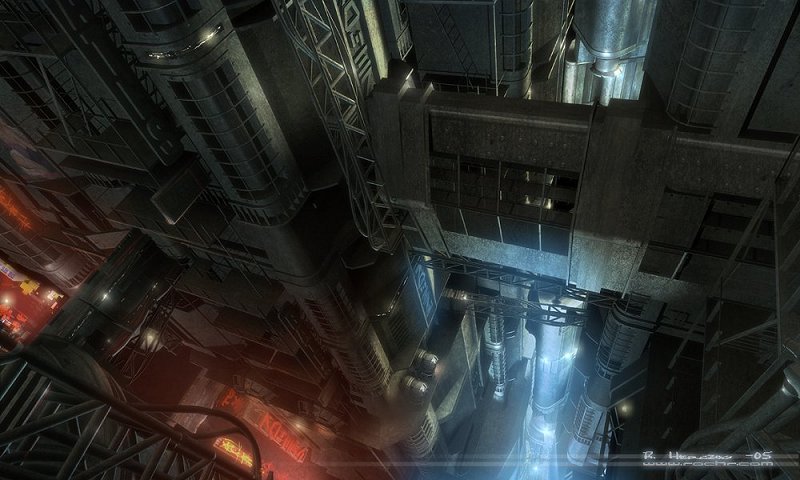
What do you think of when you hear the words Sci-Fi? Chances are, the words inspire images such as the one above, of nightmarish landscapes featuring clogged streets, flying cars, neon lights and massive skyscrapers. Or possibly you’re partial to the more utopian visions, with space travel, beautiful arcologies and happy shiny people who want for nothing and treat each other with peace and civility.

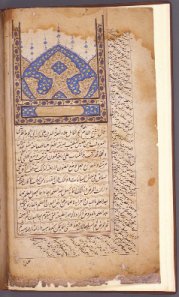
All good, but chances are, no one thinks of medieval literature from the Islamic world when they hear that term. Chances are no one thinks of anything other than the industrial age, of men like H.G Wells and Jules Verne. For most of us, these are the people who pioneered the field of science fiction, no doubt about it. But amongst scholarswho specialize in tracing literary genres to their roots, one book stands out as the possible progenitor of them all; a little known novel by the name of Theologus Autodidactus.

Outside of antiquarians and theologists, not many people have heard of this story, and up until a few weeks ago, I hadn’t either. So you can imagine my surprise when I learned about it. To me, science fiction was not something that could have predated the scientific revolution, or the age of industry when steam locomotives, steam ships, and a revolutionary understanding of the world and man’s place in it inspired flights of fancy which went well beyond our world. And yet, as it turns out, a manuscript which was written sometime in the 13th century by an Islamic scholar living in Egypt.

His pen name was Ibn al-Nafis (nee Ala-al-din abu Al-Hassan Ali ibn Abi-Hazm al-Qarshi al-Dimashqi), and he was what westerners would later refer to as a “Renaissance Man”. Not only was he an expert physician he also studied jurisprudence, literature and theology and became an expert on the Shafi’i school of jurisprudence before he died. In addition to writing many treatises on medicine, one of which was made famous for being the first in which pulmonary circulation of the blood was mentioned, he also wrote extensively on law and the world’s first coming of age tale/science fiction novel Al-Risalah al-Kamiliyyah fil Siera al-Nabawiyyah, which translated into Latin is known as Theologus Autodidactus.

Plot Summary:
Broken down succinctly, the story revolves around a protagonist named Kamil, an adolescent feral child who at the beginning of the story finds himself spontaneously transported to a cave on a deserted island. Almost immediately, it is clear that the boy is an autodidactic, a self-directed learner who has mastered several fields through independent learning.

Over time, he is met by several castaway who get shipwrecked on the island, learning and sharing from them. In time, the castaways band together to make a ship and agree to take Kamil with them back to civilization. As they return to the world of man, Kamil begins to see all the works of man, learns of philosophy, law and medicine remaining a self-directed learner all the while) and comes to several conclusions.

As he grows, he is taught the value of jurisprudence, religion, the necessity of the existence of God, and the value of the sciences, arts, and all other things that make man civilized. His own coming of age is reflected in explorations of the origin of man, the current state of the world, and predictions of the future. Towards the end, the plot develops from this coming-of-age scenario and begins to incorporate several new elements, such as the the end of the world, doomsday, resurrection and afterlife are predicted and scientifically explained using his own empirical knowledge of biology, astronomy, cosmology and geology.

Summary:
Ultimately, Ibn al-Nafis described his own work as a defense of “the system of Islam and the Muslims’ doctrines on the missions of Prophets, the religious laws, the resurrection of the body, and the transitoriness of the world”. Essentially, this meant presenting rational arguments for religious ideas, such as bodily resurrection and the immortality of the human soul, using both demonstrative reasoning and literary examples to prove his case. In this respect, he was not unlike Thomas Aquinas and a host of other western scholars from the High Middle Ages, men who would similarly try to defend reason based on faith and use empirical knowledge to defend the existence of a spiritual, universal order.

However, what set Ibn al-Nafis’ work apart was the way in which he expressed his religious, scientific and philosophical views through a fictitious narrator who went on to experience what the world had to offer. Rather than writing things in treatise form, which was the style for most philosophers of the day, he chose to do what only a select few of his contemporaries did and tell the story through a narrator who’s own journey illustrated one’s own journey of discovery. In that respect, he was like Voltaire, who’s fictional Candide had to venture out into the world in order to realize the truth about life and the order of things, though their conclusions were vastly different.

And finally, fact that he chose to speculate about what the future held, up to and including the apocalypse itself, is what makes this work classifiable as science fiction. Here, he was most comparable to men like H.G. Wells and Verne, men who looked to the future in the hopes of illustrating the current state of humanity and where it was likely to take them. And though these, and later generations of individuals, often had a negative appraisal of such things, Iban al-Nafis’ was arguably positive. His exploration was designed to affirm belief in the existence of something greater than material nature, but provable using the same basic laws.

I can’t imagine being able to find a copy of this book any time soon. It’s not like Amazon has copies on hold for anyone looking to a little cross-cultural antiquities reading. I checked, they really don’t! Still, I’d consider it a boon to find a translation and read the whole story for myself. What I little I learned can’t possibly capture the historic and cultural importance of the novel. Something to add to the reading list, right next to The Peach Blossom Spring and Beowulf!

Crashland – Chapter 16, Now Available At Story Time!

Alright! It’s been many weeks, but I finally got back to Crashland! I had been hoping to tackle it while on vacay up in Comox, but like many of my projects, it just didn’t happen. But back in my home, where I get most of my writing done, I back on that horse and updated it at last! Good thing too because I was worried people were starting to lose interest. So, here’s where things left off…

Last time around, Holden woke up to find that the subway tube had collapsed, that Jacobs was seriously injured and the medic named Jorka was dead. All of this was being laid at his feet by the new commander, a man named Kurzweil. After talking it over with Molya, the squad’s chief enforcer, Kurzweil ordered him to administer a drug that would put Holden in a coma so they could do their operation without him.

Molya, however, had other plans. Bringing the syringe to Holden, he told him to sneak into Kurzweil’s quarters and administer the drug to him in his sleep. Though he does not fully understand why Jacobs insists on making Holden a part of their operation, he is willing to give them the benefit of the doubt. What’s more, he is not willing to contravene Jacobs orders when he’s not even awake and able to defend them. Holden agreed to the plan and set off to find Kurzweil in his quarters, where he is about to find the man asleep and defenseless, or so he thinks…

Come on by and see what happens. Then stick around to vote on the next outcome. It’s all happening over at Story Time.me!

Mona Lisa Overdrive

Welcome back to the BAMA*! At long last, I’ve come to the end of William Gibson’s Sprawl Trilogy. For those who don’t remember, this began with Neuromancer and Count Zero many months ago. I had hoped to include this third and final review in short order, unfortunately other books got in the way. And by other books, I mean a tall stack that I’ve been reading, reviewing, and putting down to make room for even more! I tell ya, being a sci-fi reader/writer/reviewer can really burn your brain somedays!

Luckily, I concluded the book just yesterday and am ready to comment on it at last. And let me begin by saying that it’s very interesting, having read every novel that Gibson has written up until this point, to look back and see how his writing began and evolved over the years. It is also interesting to see how certain thematic elements which would appear in later trilogies – i.e. The Bridge and Bigend trilogies- made their first appearances.

Elements common to cyberpunk, such as high-tech and low liing, were common to all three books in this series, but were also an intrinsic part of Virtual Light, Idoru and All Tomorrow’s Parties. The stark divide between rich and the poor and the transformative power of wealth, so important to the Bigend Trilogy, was also to be found in these earliest works. And of course, stories focusing on freelancers who find themselves in the employ of enigmatic figures, and the power plays that go on behind the scenes between various brokers, were present in all of his novels to date.

However, after completing this novel, I can honestly say that I felt let down. Prior to reading it, I was told that it was the greatest of the Sprawl Trilogy, and the reviews claimed that it was Gibson’s “most engrossing story to date”. I came away feeling that it was less than engrossing and definitely not the best of the three. For one, it seemed lacking in much of the cool elements that made Neuromancer and Count Zero so very fun and intriguing.

However, before I get into all that, I should summarize what this book is about. Here goes…

Plot Synopsis:
The story, much like all of Gibson’s works, contains multiple threads that are interrelated and come together in the end. In the first, we see a Japanese girl named Kumiko, the daughter of a Yakuza boss who has decided to send her to London in the midst of a war between the various crime families.Her only companion is a construct named Colin, a personality that inhabits a portable Maas-Neotek biochip.

Once there, she makes the acquaintance of a freelancer named Sally Shears (aka. Molly Millions) who has been hired out by her father’s people to keep her safe. In addition, Sally is being blackmailed by Swain, the head of the London mob, who has ordered her to kidnap the famous simstim star Angie Mitchell and replace her with the a body double.

In thread two, we meet the intended double, a 16-year old prostitute named Mona from Florida who travels to New York with  Eddie (her pimp) after he closes some lucrative deal. However, when they arrive, Eddie is killed and Mona is forced to undergo the surgery that will make her look exactly like Angie, whom she knows from all her simstim movies and admires greatly. Angie’s back story, about how she was the daughter of the man who invented biochips and placed bioenhancements in her brain (all of which takes place in Count Zero) is all recounted, as is her failed relationship to Bobby (aka. “The Count”).

In thread three, we learn that Angie has returned from rehab after developing an addiction to a designer drug her company was supplying. After a brief stay in Malibu, she learns that it was someone in her inner circle who was giving her the drug in the hopes that it would alter her brain chemistry, thereby disrupting her ability to access cyberspace and communicate with the AI’s now living there (the lao, or Voodoo god personas the AI’s had taken on).

In the fourth and final thread, we are introduced to three residents who live together in an abandoned factory located in “The Solitude”, an uninhabited area in the Sprawl. Gentry is the defacto owner of the place, a cyberspace jockey preoccupied with the way it has changed since events in Neuromancer where AI’s began to permeate it. Slick is his roommate, a robotics enthusiast who builds giant battledroids with the help of his friend redneck friend Bird.

Things for them become interesting when Slick’s associate, Kid Afrika, drops off a man who’s permanently jacked into cyberspace and asks them to take care of him. He leaves the man (Bobby Newmark) and a registered nurse (Cherry) with instructions to keep them safe. After examining the aleph (a biochip with immense capacity) that he’s plugged into, Gentry learns that it is an approximation of the whole data of the matrix.This is where he has been living for the past few years after breaking up with simstim star Angie Mitchell.

In the course of the story, we also learn that Lady 3Jane has died and now inhabits the aleph as a construct. At some point, Bobby stole the aleph and now inhabits it with her. After checking in with her jockey friend, Tick, in London, Molly learns that 3Jane is behind the plot to kidnap Angie Mitchell and replace her, and begins to work to unravel these plans. She travels to New York to meet with the Finn, himself a construct now, and learns that since her operation to Straylight, things have been changing drastically in cyberspace.

Now, 3Jane is looking for revenge, and Angie is intrinsic to that plot. After recruiting Swain and key members of Angie’s entourage to help her, she attempts to conduct the kidnapping while Angie is in New York. However, Molly intervenes and grabs Angie and Mona, who is being set up to replace her, and begins to travel to the Solitude. Angie, under the influence of the lao, is directed to Factory to reunite Angie with Bobby.

Meanwhile, Kumiko, who is alone in London, goes to find Tick and find out what’s going on. Ever since Molly left, she is advised by her Maas-Neotek construct Colin to seek refuge from Swain. When she finds him, she too learns about how cyberpsace is changing and how a massive data profile has entered into the matrix (which turns out to be the aleph). When they jack in, they are pulled into the aleph with 3Jane who attempts to hold them prisoner.

Things come together when Molly arrives in the Factory and Sense/Net mercenaries begin to show up to take Angie back. Meanwhile, in the aleph, Colin comes to their rescue by neutralizing 3Jane’s control over the construct. He also reveals 3Jane[‘s motivations. In the wake of her death, after a life of pettiness, greed and obsessive control, she has become jealous of Angie Mitchell and her abilities. Molly, since they know each other from the Straylight run, is pretty much on her shit list as well!

In the end, Angie Mitchell and Bobby die together, but not before their personalities come together in the aleph, to be forever joined by 3Jane and the Finn. Mona is picked up Kid Afrika who assumes that she’s Angie Mitchell, and is taken off to take over her starlet life. Molly takes the aleph and travels off into the distance while Slick and Cherry get together and head off to start a new life together. And finally, Gentry, who refused to leave Factory, stays behind to contemplate the matrix’s growing complexity.

Meanwhile, a final mystery is resolved. Inside the aleph, Angie, Colin and Bobby are picked up by the Finn who explains how and why the Matrix changed. After Neuromancer and Wintermute at the end of the first novel, the combined AI indicated that there was another like him, a construct similar to the Matrix in Alpha Centauri. Apparently, after he went there, he came back changed and divided into the lao, and the Matrix itself changed. Now, the Finn is taking them there, to meet the alien cyberspace and all the mysteries it holds…

Summary:
As I may have said already, this book was my least favorite of the Sprawl Trilogy. That is not to say that I didn’t enjoy it, mind you. But it was diminished in that Gibson’s usual dark, gritty, and decidedly cyberpunk style – which ranges from opulent to gothic in its appraisal of technology and its impact on society – seemed to be watered down by a much cleaner narrative. In the end, it felt more like reading from the Bigend Trilogy, in that the settings and feel were quite similar.

Aside from taking place largely in London and New York, there was also a lot of buildup and not much in the way of action. And of course, the diversions into the fields of fashion, mass media and the cult of personality; these too felt like they would have been much more at home in the Bigend Trilogy. That was the trilogy that dealt with all these elements, whereas the Sprawl was all about the nitty-gritty, about cool gadgets, mercenaries, cyber-ninjas, deck jockeys, corporate bad guys, high-tech and low-life.

To top it all off, the ending felt quite abortive. Gibson is somewhat notorious for this, but whereas Neuromancer and Count Zero contained plenty of gun-toting and cyberspace runs, this book kept all the action til the very end. And at that point, it was complicated by a rather odd narrative structure and some pretty weak explanations. After learning that 3Jane was pulling all the strings and determined to wreak revenge, it seemed weak that it was all for the sake of punishing Angie out of jealousy.

If anything, I thought her motivations had to do with the Straylight run. That after fifteen years of waiting and plotting, she finally found Molly and decided to kill her and anyone else involved in changing the Matrix. To know that it was motivated by her jealousy of Angie’s abilities just rang hollow. In addition, I thought the usual motivations, like how the wealthy are constantly trying to cheat death, might have been a fitting motivation. I seriously thought at one point that her true intentions were to find herself a vessel, and Angie Mitchell proved to be the perfect choice due to the veves in her hand. Through these, 3Jane could simply download herself, provided she had her in custody and hooked up to the aleph… or something.

However, there was plenty of interest in between all that. While many chapters kind of dragged for me, I did enjoy the scenes where the history of the Tessier-Ashpool clan were reconstructed. The revelation about the Alpha Centauri matrix, which was only hinted at at the very end of the Neuromancer was also very cool. And the detailing of the lao and the evolution of the Matrix since Wintermute and Neuromancer came together, that too was interesting. In the end, I just wished there had been more of this.

And given that this novel did wrap up the previous two novels and brought closure to the whole Sprawl trilogy, I would highly recommend it. Regardless of whether or not it was the best or weakest of the three books, it is the final chapter and contains many important explanations and resolutions, without which the series would never be complete. On top of all that, it is hardly a weak read, and I know for a fact that many people consider it to be better than the others. So who am I to stand in anyone’s way of reading it?

Kudos to you William Gibson. I have now read every novel you wrote. I now move on to Burning Chrome and Johnny Mnemonic, plus any other bits of short fiction and thoughtful essays I can get my hands on. Despite all the little things I have come to criticize about your work, you remain one of the best and most important writers in this reader’s bookshelf! And if I really didn’t like you, why the hell do I model so much of my work on your prose? Like Aeschylus said of Homer, any work of mine dealing in cyberpunk and high-tech is pretty much the crumbs from your table!

Good day and happy reading folks!