The Future of Space Travel: Stamp-Sized Thrusters

MIT_microthrustersReducing the cost of space missions is one of the greatest challenges facing engineers and technicians today. With a myriad of planned missions, ranging from everything to a settlement on the Moon, sending satellites to Near-Earth asteroids, and manned missions to Mars, the goal of making space travel more affordable is a persistent and important one.

As it stands, most efforts are directed towards created craft that are either reusable, repurposed, or simply don’t rely on big, expensive and disposable rockets to get them into orbit. But another angle at bringing the cost of missions down is focusing on the size of the space craft themselves. If they could be shrunk down to the point where they are no larger than a paperweight, sending them into space could be done on the cheap.

cubesatAlready we are seeing this idea at work with CubeSats, a new breed of satellites that are roughly the size of a Rubik’s cube. Over the past decade, dozens of these satellites have been sent into space, often as part of University projects. Since most sensor and survey equipment is now small enough that it can fit into a shoebox, the CubeSat design is ideal for departments that cannot afford to mount multimillion dollar space missions.

Expanding on this concept, MIT’s Poalo Lozano, a professor and the director of the Institute’s Space Propulsion Laboratory, has unveiled a new type of “microthruster” which, when added to the scaled-down satellites, could radically reduce the cost of space missions even further.  Roughly the size of a stamp, these tiny ion-engines would prolong the use of satellites by ensuring they could maneuver in space.

CubeSatsUp until now, CubeSat’s have had a limited life expectancy as their orbits inevitably decay and they burn up in the Earth’s atmosphere. But by equipping them with an Electrospray Propulsion System (iEPS), these pint-sized satellites would be able to conduct life-saving maneuvers that would extend their period of service and give them new functionality.

The thrusters are basically a liquid-fuel system that, when a voltage is applied, emit a stream of ions through tiny nozzles that propel the satellite forward. According to Lozano, four of these thrusters could provide attitude control and main propulsion for standard solar-powered “1U” CubeSat, which measures about 10 centimeters (4 inches) on a side and weighs 1 kilogram (2.2 pounds).

europa-lander-2But more exciting are the long-term prospects created by the addition of these tiny thrusters. For the price of sending a large spacecraft, a fleet of CubeSats could be dispatched to explore the moons of Jupiter. Other possible missions include clearing the massive pile of orbital debris floating around the Earth, de-orbiting satellites at the end of their service lives, and correcting atmospheric drag in low Earth orbit.

Part of what makes plans like these so feasible is the fuel-to-weight ratio it allows for spacecraft, something which astronauts and space agencies always have to take into account. As the Space Propulsion Laboratory claims on their website:

Less than 150 g of propellant would be required by a 1U CubeSat to reach Earth’s escape velocity from [low Earth orbit] and explore interplanetary space.

cubesats2Other possibilities arise from the fact that iEPS units require very little in the way of fuel, so even scaled-up versions can be fitted to small satellites to provide cost-effective and fuel-efficient thrust. Scientists in Switzerland, for instance, say they can send a shoebox-size satellite to the moon in six months with only a few drops of fuel.

As Professor Lozano said, in regards to the long term plans for the iEPS concept:

The goal is to make [CubeSats] do most of the things we already do with big satellites, except in a less expensive way. People have very big plans for these very small spacecraft.

cubesats1But in reality, even the outer Solar System is not limit when it comes to this scaled-down satellite technology. Looking even further abroad, tiny satellites could be sent into deep space to map out what lies between our Solar System and other stars, or investigate the mysteries of the Milky Way. Asteroid prospecting could also benefit from small, cost-effective probes that are capable of navigating between rocks.

And when the technology is scaled down even further, perhaps even to the nano level, millions of tiny probes could be sent out into space to study dark matter, high-energy particles, and seek out new life. Combined with new technologies like space penetrators, entire solar systems and even galaxies could be seeded with tiny space sats. Exciting possibilities indeed!

And in the meantime, be sure to check out this video on CubeSat’s, courtesy of Singularity HUB:


Sources:
news.cnet.com, web.mit.edu, singularityhub.com

Typhoon Haiyan From Space

typhoon_haiyanEarlier this month, the Super Typhoon Haiyan smashed into the island nation of the Philippines, leaving an enormous amount of death and destruction in its wake. According to NASA, the typhoon struck with winds that exceeded 379 kilometers per hour (235 mph), while the U.S. Navy Joint Typhoon Warning Center indicates that it has since sustained wind speeds of over 315 kilometers per hour (95 MPH).

Classified as a Category 5 monster storm on the U.S. Saffir-Simpson scale, Haiyan is reported to be the largest and most powerful storm ever to make landfall in recorded human history. The current estimates claim that some 5000 people have died so far, with the final toll expected to be far higher.

haiyan_8_november_2013_0019_utc_0-566x580Given the enormous scale of this typhoon, many of the clearest pictures of it have come from space. Since it first made landfall on Friday, November 8th, many detailed images have been captured by NASA, the Russian Space Agency, the India’s newly-launched Mars Orbiter Mission (MOM), and even from the ISS – courtesy of astronaut Karen Nyberg.

According to NASA, the most detailed data on the storm came from the Tropical Rainfall Measuring Mission (TRMM) satellite, which captured visible, microwave and infrared data on the storm just as it was crossing the island of Leyte in the central Philippines. In addition to gauging wind speed, the satellite was also able to measure precipitation rates and temperature fluctuations.

typhoon_haiyan1Far from simply documenting this tragedy, the high resolution imagery and precise measurements provided by these and other satellites have been absolutely essential to tracking this storm and providing advance warning. Whereas thousands have died in the effected areas, some 800,000 more have been evacuated from the central region of the country.

Coincidentally, NASA’s Goddard Flight Center has just finished assembling the next generation weather satellite known as the Global Precipitation Measurement (GPM), an observatory that is scheduled to replace the Tropical Rainfall Measuring Mission. GPM is equipped with advanced, higher resolution radar instruments and is vital to the continued effort of providing forecasts and advance warning of extreme super storms.

typhoon_haiyan2In the midst of tragedies like Hurricane Sandy and Haiyan, not to mention the escalating risk of super-storms associated with Climate Change, it is good to know that there are silver linings, such as advanced warning and sophisticated instruments that can keep us apprised of the threats we face. For more information on Super Typhoon Haiyan and how you can aid in the recovery, check out the Internationa Red Cross’ website.

And be sure to check out this video of Haiyan as it made landfall, as captured by the Russian weather satellite Electro-L:


Source: universetoday.com, bbc.co.uk , icrc.org

The Future of Transport: High-Speed MagLev’s

hyperloopThis past summer, Elon Musk once again impressed the world with his futuristic design for a high-speed transit tube that could take passengers from Los Angeles and San Francisco in just 30 minutes. It’s known as the Hyperloop, a “fifth form” of transportation that would utilize linear electric motors, solar panels, and air cushions to achieve speeds of up to 1290 kilometers per hour (800 mph).

Unfortunately, Musk also indicated that with his current, busy schedule, it would be many years before a working demonstration could be produced. What’s more, he was unclear on what role, if any, he would play in its creation. The project was unveiled as an open-source venture, and he called upon business investors to take up the role of making it happen.

hyperloop1However, some investors have come forward to do just that. Gathering around the entrepreneurial collaboration platform known as JumpStartFund, these enthusiasts have come together to create a corporation that will see Musk’s concept through to development. This is no small task, seeing as how the price-tag (according to Musk) would be between 6 and 10 billion dollars.

JumpStartFund launched on August 22, and aims to give entrepreneurs a network through which to both seek funding and support as well as crowdsource the idea and collaborate with others to refine it. The Hyperloop concept, put up on the site by the JumpStart team, became the platform’s flagship project within its first week of launch.

hyperloop2Dirk Ahlborn, CEO and co-founder of JumpStartFund, said in an interview back in September:

We want to be the ones that actually make things happen. So of course we need to create a corporation. Whoever decides to dedicate more time to this than just logging onto the platform deserves to be part of this company.

Because Ahlborn and his co-founders have connections with SpaceX, they were able to talk over the idea with the company’s president, Gwynne Shotwell, and get the green light to feature it on the platform. Joining them are engineers Marco Villa and Patricia Galloway, who worked for SpaceX and the US National Science Board respectively and even held directorial and vice chair positions.

hyperloop3JumpStartFund is also accepting applications from members of the site to work full-time on the Hyperloop project in exchange for equity in the company. Ahlborn has also indicated that even naming the company will be a crowdsourced effort:

We want to find a way to give everyone the ability to be a part of this project. The whole concept is always going to be on the platform. Everything is going to be very transparent, and we intend to reserve a percent of future revenues for people that work with us on the platform.

And the Hyperloop is hardly alone when it comes to the future of mass transit. On the opposite side of the US, along the Northeast Corridor, The Northeast Maglev (TNEM) company is looking to create a superconducting magnetic railway that could take passengers from New York to Washington D.C. in 60 minutes, and from Baltimore to D.C. is just 15.

scmaglev-rendering-marylandAt present, this American company – which is backed by a Japanese government bank – is testing a maglev route in Japan that runs from Nagoya to Tokyo in Japan and is planned to be completed by 2027. In the US, their efforts are aimed at replacing the nation’s aging transit infrastructure, which is unable to cope with modern demand.

As Northeast Maglev CEO and chairman Wayne Rogers said in a recent interview with Co.Exist:

What’s happening is we’re operating on 1940s and 1950s infrastructure and drowning in congestion. This isn’t pie-in-the-sky technology. This is something that you could fly to Tokyo, sit on a train, and actually ride a train that goes 311 miles per hour.

Much like the Hyperloop, the train would run on a bed of air, levitated by a series of electromagnetic coils located on the track. While similar magnetic levitation projects along the corridor have been considered in the past, they repeatedly failed due to curves that would slow down the transit process, and passengers projections were consistently too low.

scmaglev-rendering-new-jersey-high-trafficThe current maglev project plans on using tunnels to bypass the curves, and train ridership is at an all-time high. However, the realization of the project will still require significant funds. As Rogers himself projects, the first leg of the route – from D.C. to Baltimore – will cost some $10 billion. As such, the company imagines it will require some additional federal support.

The company does have some high-profile support working in its favor, though. Its advisory board includes two former transportation secretaries, former majority leader Tom Daschle, Under Armour CEO Kevin Plank, former Northwest Airlines CEO Doug Steenland, and George Pataki, Christine Todd Whitman, and Ed Rendell – the former governors of New York, New Jersey, and Pennsylvania.

scmaglev-rendering-washington-stationAnd ultimately, Rogers and his company are hopeful, citing recent changes and the enthusiasm garnered by the Hyperloop project:

[T]he concept is different, the sponsorship is different, the routing is different, and the technology is different. I think one of the things [the Hyperloop] has done – without commenting on the feasibility of the Hyperloop or not – is it’s brought people’s attention to the problem and brings America back to the things it’s good at, which is thinking big things and implementing cutting-edge technologies on terrific projects.

Who knows? In a few decades times, we could be looking at a world where high-speed maglev trains crisscross every continent, carrying people between all major cities faster than jet planes, and at a fraction of the cost. Meanwhile, intercontinental transit could be taking the form of aerospace travel, jets that fly into the lower atmosphere at hypersonic speeds. It’s important to dream big!

And in the meantime, enjoy this promotional video from The Northeast Maglev company:


Sources: news.cnet.com, fastcoexist.com

World’s First 3-D Printed Metal Gun

3dmetalgun-640x353Earlier this year, Distributed Defense became the source of much controversy after they unveiled the world’s first 3-D printed gun. Known as the Liberator, this single-shot weapon was entirely composed of ABS plastic, and was the first weapon that could be created using open-source software and a 3-D printer, giving anyone with access the means to build their own firearms.

Predictably, the website was shut down and the design specs were removed, thanks to an injunction filed by the U.S. Department of Defense Trade Control just a few days after the unveiling. However, the issue was far from closed, as the case of Distributed Defense and the Liberator were clearly just a drop in the bucket of a much larger trend.liberatorAnd now, just six months later, the issue is once again rearing its head as the world’s first 3-D printed metal gun was unveiled. Created by the rapid prototyping and 3-D printing company known as Solid Concepts, this 1911 Colt .45 is a major step forward in the realm of weapons that can be built by just about anyone and counted on to remain functional after firing.

The gun was built using the relatively new process known as Selective Laser Sintering (SLS), a process that combines lasers and powdered metals to create finished products. Basically, a high-powered laser is used to fuse small particles of powder together, layer by layer, until the desired shape is created. In addition to being able to create highly intricate objects, sintering is far more efficient than the machining process.

3D-Printed-Metal-Gun-Components-Disassembled-Low-Res-640x480This latest weapon was also an improvement over the Liberator in that it was able to fire over 50 rounds with considerable accuracy, whereas the Liberator broke down after just a few shots. Made of of over 30 separate 3D printed parts, the gun is composed of stainless steel and Inconel 625 (a nickel-chromium superalloy), consistent with the original Colt design.

But before people begin to worry that this is bad news, Solid Concepts was quick to point out that the gun was printed using an industrial printer, the price of which is out of range of your average citizen. In addition, the software is not open-source, meaning people can’t simply download it from any 3-D printing website and begin producing their own private arsenal.

sinteringSolid Concepts also claims that they produced this weapon to demonstrate how 3-D printing is not just for hobbyists anymore, and how sintering is a viable way to produce delicate, precise, specific consumer and professional grade products. The company said that it is currently the only 3D printing service provider with a federal firearms license, and will be looking to provide printed gun parts for legal gun owners.

Regardless, this story serves as an example of how far the technology of 3-D printing has come in just a short amount of time. From printing models with plastic, the technology is now pushing the boundaries of industrial manufacturing and bioprinting, using everything from steel and titanium to liver and kidney cells.

Give more time and refinement, we could be entering into an age where all consumer products and necessities are created from powder and individual cells, possibly even at the atomic level. For those wondering what the next industrial revolution will look like, I suggest you look no further!

And of course, Solid Concepts captured the test firing of their 1911 Colt on video. Check it out:


Source: extremetech.com

Honest Trailers – The Walking Dead

honest-trailers-the-walking-dead-2528176Here is another internet video series that I’ve come to know and love: Honest Trailers! As one of several hilarious series’ by ScreenJunkies and Break Media, it is all about doing mock trailers that are unabashedly honest about the movie or show in question. I’m sure most people are familiar with them by now and have seen at least one of their spoofs.

In this recent trailer, they tackle AMC’s The Walking Dead. As usual, they manage to weave what fans already know and complain about into the 5 minute segment, touching on everything from problems with the adaptation, inconsistencies in the plot, the way extras routinely die, how boring Season 2 was, how the Governor was the most evil/benevolent dictator since Toy Story 3’s Lotso (echoes of Zombie Story), and just how awful the character of Lori is.

They even tackle such repetitive things as Rick losing his hat, Dale making his stunned face, Shane rubbing his head, characters pulling that crying-frowny face, and that obscure scene where a zombie extra was drinking a bottle of water during a shot. Check it out:

Alien Spotting by 2020?

alien-worldWith recent observations made possible by the Kepler space telescope, numerous planets have been discovered orbiting distant stars. Whereas previous observations and techniques could detect exoplanets, scientists are now able to observe and classify them, with the ultimate aim of determining how Earth-like they are and whether or not they can support life.
Combined with advanced astronomical techniques, the latest estimates claim that there may be are up to 50 sextillion potentially habitable planets in the universe. With their eyes on the next step, the scientific community is now preparing to launch a bevy of new space telescopes that can peer across the universe and tell us how many of those planets actually harbor life.

TESSOne such telescope is NASA’s Transiting Exoplanet Survey Satellite (TESS), which will launch in 2017. While Kepler was focused on a single patch of sky with around 145,000 stars, TESS will be equipped with four telescopes that keep track of around 500,000 stars, including the 1,000 nearest red dwarfs. TESS is expected to find thousands of orbiting, Earth-sized-or-larger planets around these stars.

But to find out whether or not any of those planets actually house life, another sophisticated telescope needs to be employed – the James Webb Space Telescope.Whereas TESS is Kepler’s successor, the James Webb Space Telescope – a joint NASA/ESA/CSA venture – is the planned successor for the Hubble Telescope and is due to launch in 2018.

TESS_Space_Telescope_Mirror37-640x425The JWST has a primary mirror that’s about five times larger than Hubble’s (pictured above), which means it can resolve much fainter signals, locating stars and other objects that have never been seen before. Because it primarily operates in the infrared band (whereas Hubble was tuned towards visible light), the JWST will also be able to see through dust clouds into hidden areas of space.

The JWST’s scientific payload includes a spectrometer that’s sensitive enough to analyze the atmosphere of distant planets. By measuring light from the parent stars, and how its reflected in the planets atmospheres, it will be able to determine if there are life-supporting elements and evidence of biological life – such as oxygen and methane.

TESS_comparisonBecause these planets are light years away, and because the reflected light is incredibly dim, the James Webb Space Telescope will only be able to do this for large planets that orbit red and white dwarfs. Still, that leaves thousands or even millions of candidates that it will be able to observe, and determine whether or not they are already inhabited by extra-terrestrial life.

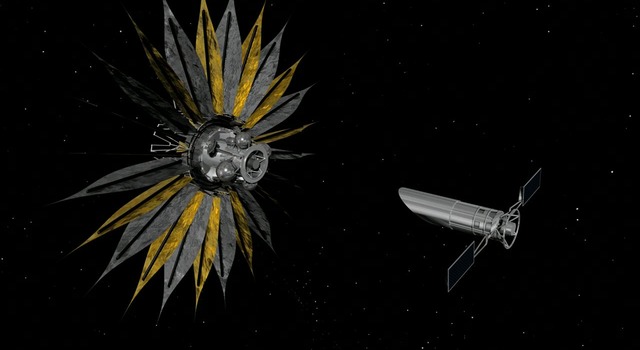
And last, but not least, there’s the New Worlds Mission, which aims to put a Starshade – which is essentially a big flying space umbrella – into space. This disc would then fly between the James Webb Space Telescope and the star its observing, blocking out large amounts of light and the result “noise pollution” from nearby bright stars that the JWST isn’t observing.

Starshade_1280x720_H264With the Starshade in place, the JWST would be able to probe thousands of nearby planets for signs of life and return data to Earth that is of far greater accuracy. The New Worlds Mission is currently in the prototyping stage, but NASA hopes to procure the necessary funding by 2015 and and launch it within the JWST’s own lifetime.

Because of all this, it is now believed that by 2020 (give or take a few years) we will have the ability to directly image a distant planet and analyze its atmosphere. And if we find methane or another biological marker on just one planet, it will completely redefine our understanding of the universe and the lifeforms that inhabit it.

The answer to the question – “are we alone in the universe?” – may finally be answered, and within our own lifetime. And in the meantime, be sure to enjoy this video of the Starshade space umbrella, courtesy of New Scientist.


Sources: extremetech.com, wired.co.uk, newscientist.com

The Walking Dead – Season Four, Episode Six

wd_season4And we’re back with more of AMC’s The Walking Dead. This week, the sixth episode aired, with just more to go before the show takes another mid-season break. And it’s clear that they are working up to something climactic, given that the story involving the flu that’s sweeping the prison has finally come to an end. And it’s pretty clear at this point who’s going to be involved.

As expected, this week’s episode was all about the Governor, addressing what happened to him after the events of the last season. This would be everything that followed from the abortive attack on the prison, his subsequent breakdown and summary execution of his people, and his fleeing into the wilderness. And in all honesty, it was kind of interesting…

Live Bait:
wd4_livebait_govThe episode begins with a recap of what happened since the Season Three finale. After shooting his own people, the Governor and what was left of his henchmen drove to a spot in the wilderness where they set up camp. In the morning when the Governor awoke, he realized he had been abandoned by the last of them and drove to Woodbury. Finding it abandoned, he set the town ablaze and began walking the road.

After wandering for quite some time, he comes upon a community where a family is held up in an apartment complex. This consists of Lily (a former nurse), her daughter Megan, sister Tara (a police academy student), and father David (a former truck driver). After meeting with them and telling them his name is Brian, he takes the apartment across the hall and begins helping them.

wd4_livebaitEventually, Lily asks for his help in obtaining more oxygen tanks from the nearby senior care center. Her father, who is dying of lung cancer, is running out, and she fears what will happen to her daughter if he dies. Brian goes to the center and finds a large stash, but is quickly set upon by a dozen or so Walkers and has to retreat with what he can carry.

Afterward, Lily begins to attend to his injuries and tells him that Megan initially thought that Brian was her father, who disappeared three years back. Megan is left to watch over him and asks what happens to his eye, and the two quickly begin to bond. He teaches her to play chess, and she draws an eye patch on the king to make it look like him.

wd4_livebait2Afterwards, he and Megan learn that David has died, and may have been dead for some time. He tells them to leave, but David comes back before they can, and Brian crushes his head with an oxygen tank. After burying him outside, Tara tells him that they understand what that their father had turned, and forgive him for what he did.

That night in his room, Brian burns a picture he has been keeping of himself with his wife and daughter and tells Lily that he’s leaving. Lily tells him they are coming too to find something better, and that he’s stuck with them. Grabbing the truck David commandeered, they begin to drive off. While on the road, Brian and Lily make love while the others sleep.

wd4_livebait3The next day, the truck won’t start and they begin walking. On the road, they are spotted by a herd of Walkers and are forced to ditch their gear and run. After clearing the forest by the side of the road, Brian and Megan fall into a trench and are set upon by several more and Brian manages to kill them with his bare hands. After reassuring Megan, he looks up and sees Martinez looking down at them.

Summary:
Well, that’s part I of what happened to the Governor down. And judging from the sneak peak, part II is all about him and his new family being introduced to a new community, one which is run by Martinez himself. And of course, things go awry, and I’m guessing the Governor deciding to oust Martinez as leader has something to do with that.

wd4_livebait5But getting back to what happened this week, I would reiterate that it seemed interesting. After all he’s done and been through, it was kind of neat to see what the Governor got up to after his sudden disappearance. It’s always good in a series when a character who is considered evil and irredeemable is given a second chance at life and finds a way to carry on.

However, I would have to say that things began to fall apart for me when it became obvious that Lily, Tara and Megan are becoming his new family. The indications were many and obvious, and it seemed like the moment David died, it would prove to be the case. And if all those hints weren’t enough, he even burns the picture of his old family just to make it abundantly clear.

wd4_livebait4I did suspect that there might be some tension after Lily and he hooked up, but they pretty much nullified that with the 11th hour revelation that Tara is a lesbian. Kind of seemed a bit awkward and forced, but whatever. I guess they had their hands full with finding a way to both fill in the missing pieces of the story and bring it back to the point where he begins messing with the prison crew again.

Some things I did like is where the Governor takes out several Walkers with his bare bands. Not since Michonne had her hands bound and her sword confiscated have we seen such creativity at work. And I was also surprised to see Martinez at the end, and was intrigued by the idea of the Governor being forced to endure his leadership for a change. I imagine some interesting scenarios occurring in the episodes to come.

wd4_livebait6On the other hand, I do kind of worry that the Governor’s role in this season is going to last to the end. With just two more episodes before the season halfway mark, I’m thinking that the next two episodes will both involve the Governor, in full or in part. That way, he can remain in the background for the rest of the season as the prison crew’s antagonist, thus ending the season with a final battle.

Which means it won’t be until season five that they’ll be getting back to anything resembling the original plot. Still, should be interesting, and the prospect of a little action where the Governor is no longer in charge and fighting for some other than brutal, backstabbing revenge will certainly be worth watching! Until next week…

News From Space: MAVEN Launched

maven_launchYesterday, NASA’s Mars Atmosphere and Volatile Evolution (MAVEN) space probe was finally launched into space. The flawless launch took place from Cape Canaveral Air Force Station’s Space Launch Complex 41 at 1:28 p.m. EST atop a powerful Atlas V rocket. This historic event, which was the culmination of years worth of research, was made all the more significant due to the fact that it was nearly scrapped.

Back in late September, during the government shutdown, NASA saw its funding curtailed and put on hold. As a result, there were fears that MAVEN would miss its crucial launch window this November. Luckily, after two days of complete work stoppage, technicians working on the orbiter were granted an exemption and went back to prepping the probe for launch.

NASA_mavenThanks to their efforts, the launch went off without a hitch. 52 minutes later, the $671 Million MAVEN probe separated from the Atlas Centaur upper stage module, unfurled its wing-like solar panels, and began making its 10 month interplanetary voyage that will take it to Mars. Once it arrives, it will begin conducting atmospheric tests that will answer key questions about the evolution of Mars and its potential for supporting life.

Originally described as a “time-machine for Mars”, MAVEN was designed to orbit Mars and examine whether the atmosphere could also have provided life support, what the atmosphere was like, and what led to its destruction. This mission was largely inspired by recent discoveries made by the Opportunity and Curiosity rovers, whose surface studies revealed that Mars boasted an atmosphere some billions of years ago.

maven_atmo1During a post launch briefing for reporters, Bruce Jakosky – MAVEN’s Principal Investigator – described MAVEN’s mission as follows:

We want to determine what were the drivers of that change? What is the history of Martian habitability, climate change and the potential for life?

Once the probe arrives in orbit around Mars, scheduled for September 22nd, 2014, MAVEN will study Mars’ upper atmosphere to explore how the Red Planet may have lost its atmosphere over the course of billions of years. This will be done by measuring the current rates of atmospheric loss to determine how and when Mars lost its atmosphere and water.

maven_atmosphereFor the sake of this research, MAVEN was equipped with nine sensors the come in three instrument suites. The first is the Particles and Fields Package – which contains six instruments to characterize the solar wind and the ionosphere of Mars – that was provided by the University of California at Berkeley with support from CU/LASP and NASA’s Goddard Space Flight Center.

The second suite is the Remote Sensing Package, which ill determine global characteristics of the upper atmosphere and ionosphere and was built by CU/LASP. And last, but not least, is the Neutral Gas and Ion Mass Spectrometer, built by Goddard, which will measure the composition of Mars’ upper atmosphere.

As for the long term benefits of the mission and what it could mean for humanity, I’d say that Dr. Jim Green – NASA’s Director of Planetary Science at NASA HQ in Washington, DC – said it best:

We need to know everything we can before we can send people to Mars. MAVEN is a key step along the way. And the team did it under budget! It is so exciting!

Source: universetoday.com

South Park: Winter is Coming!

south_park_60532South Park once again spoofed Game of Thrones this past week. Using Black Friday as a plot line, the episode had the children dressing up as characters from the GOT universe and plotting to get their hands on the new Xbox One’s and PS4’s. In true GOT fashion, this involved plotting, making and breaking alliances, and the use of the slogan “Winter is Coming” to portend the need for swift action.

And of course, the show itself was reference, much in the same way that Lord of the Rings or World of Warcraft was worked into the plot in previous episodes. As usual, Butters is the only one who doesn’t know about it yet and is promptly told to get on it by Cartman. Plotting ensues, and a war of GOT proportions is declared.


And just like with the Lord of the Rings and World of Warcraft episode, Butters is confused by (and has some hilarious observations about) the pop culture phenomena once he actually starts experiencing it. I’m sure fans of the GOT series know exactly what he’s talking about.


And there’s even a thread where Randy Marsh (Stan’s dad) joins the mall cops, ostensibly to earn more money for the holidays, but really so he can get a better shot at scoring some Black Friday deals. After the head cop, an old man with a scarred face, is stabbed and passes leadership onto Randy it’s clear they are alluding to John Snow and Jeor Mormont of the Night’s Watch. While I could not find a clip of that part, trust me when I tell you its quite accurate.

This is the second time that South Park has referenced this show, and about the millionth time that GOT was spoofed, referenced, or satirized in some way. Man, that show has made some serious inroads into popular culture, and dammit if they aren’t taking their precious time getting Season 4 out!

Judgement Day Update: Bionic Computing!

big_blue1IBM has always been at the forefront of cutting-edge technology. Whether it was with the development computers that could guide ICBMs and rockets into space during the Cold War, or the creation of the Internet during the early 90’s, they have managed to stay on the vanguard by constantly looking ahead. So it comes as no surprise that they had plenty to say last month on the subject of the next of the next big leap.

During a media tour of their Zurich lab in late October, IBM presented some of the company’s latest concepts. According to the company, the key to creating supermachines that 10,000 faster and more efficient is to build bionic computers cooled and powered by electronic blood. The end result of this plan is what is known as “Big Blue”, a proposed biocomputer that they anticipate will take 10 years to make.

Human-Brain-project-Alp-ICTIntrinsic to the design is the merger of computing and biological forms, specifically the human brain. In terms of computing, IBM is relying the human brain as their template. Through this, they hope to be able to enable processing power that’s densely packed into 3D volumes rather than spread out across flat 2D circuit boards with slow communication links.

On the biological side of things, IBM is supplying computing equipment to the Human Brain Project (HBP) – a $1.3 billion European effort that uses computers to simulate the actual workings of an entire brain. Beginning with mice, but then working their way up to human beings, their simulations examine the inner workings of the mind all the way down to the biochemical level of the neuron.

brain_chip2It’s all part of what IBM calls “the cognitive systems era”, a future where computers aren’t just programmed, but also perceive what’s going on, make judgments, communicate with natural language, and learn from experience. As the description would suggest, it is closely related to artificial intelligence, and may very well prove to be the curtain raiser of the AI era.

One of the key challenge behind this work is matching the brain’s power consumption. The ability to process the subtleties of human language helped IBM’s Watson supercomputer win at “Jeopardy.” That was a high-profile step on the road to cognitive computing, but from a practical perspective, it also showed how much farther computing has to go. Whereas Watson uses 85 kilowatts of power, the human brain uses only 20 watts.

aquasar2Already, a shift has been occurring in computing, which is evident in the way engineers and technicians are now measuring computer progress. For the past few decades, the method of choice for gauging performance was operations per second, or the rate at which a machine could perform mathematical calculations.

But as a computers began to require prohibitive amounts of power to perform various functions and generated far too much waste heat, a new measurement was called for. The new measurement that emerged as a result was expressed in operations per joule of energy consumed. In short, progress has come to be measured in term’s of a computer’s energy efficiency.

IBM_Research_ZurichBut now, IBM is contemplating another method for measuring progress that is known as “operations per liter”. In accordance with this new paradigm, the success of a computer will be judged by how much data-processing can be squeezed into a given volume of space. This is where the brain really serves as a source of inspiration, being the most efficient computer in terms of performance per cubic centimeter.

As it stands, today’s computers consist of transistors and circuits laid out on flat boards that ensure plenty of contact with air that cools the chips. But as Bruno Michel – a biophysics professor and researcher in advanced thermal packaging for IBM Research – explains, this is a terribly inefficient use of space:

In a computer, processors occupy one-millionth of the volume. In a brain, it’s 40 percent. Our brain is a volumetric, dense, object.

IBM_stacked3dchipsIn short, communication links between processing elements can’t keep up with data-transfer demands, and they consume too much power as well. The proposed solution is to stack and link chips into dense 3D configurations, a process which is impossible today because stacking even two chips means crippling overheating problems. That’s where the “liquid blood” comes in, at least as far as cooling is concerned.

This process is demonstrated with the company’s prototype system called Aquasar. By branching chips into a network of liquid cooling channels that funnel fluid into ever-smaller tubes, the chips can be stacked together in large configurations without overheating. The liquid passes not next to the chip, but through it, drawing away heat in the thousandth of a second it takes to make the trip.

aquasarIn addition, IBM also is developing a system called a redox flow battery that uses liquid to distribute power instead of using wires. Two types of electrolyte fluid, each with oppositely charged electrical ions, circulate through the system to distribute power, much in the same way that the human body provides oxygen, nutrients and cooling to brain through the blood.

The electrolytes travel through ever-smaller tubes that are about 100 microns wide at their smallest – the width of a human hair – before handing off their power to conventional electrical wires. Flow batteries can produce between 0.5 and 3 volts, and that in turn means IBM can use the technology today to supply 1 watt of power for every square centimeter of a computer’s circuit board.

IBM_Blue_Gene_P_supercomputerAlready, the IBM Blue Gene supercomputer has been used for brain research by the Blue Brain Project at the Ecole Polytechnique Federale de Lausanne (EPFL) in Lausanne, Switzerland. Working with the HBP, their next step ill be to augment a Blue Gene/Q with additional flash memory at the Swiss National Supercomputing Center.

After that, they will begin simulating the inner workings of the mouse brain, which consists of 70 million neurons. By the time they will be conducting human brain simulations, they plan to be using an “exascale” machine – one that performs 1 exaflops, or quintillion floating-point operations per second. This will take place at the Juelich Supercomputing Center in northern Germany.

brain-activityThis is no easy challenge, mainly because the brain is so complex. In addition to 100 billion neurons and 100 trillionsynapses,  there are 55 different varieties of neuron, and 3,000 ways they can interconnect. That complexity is multiplied by differences that appear with 600 different diseases, genetic variation from one person to the next, and changes that go along with the age and sex of humans.

As Henry Markram, the co-director of EPFL who has worked on the Blue Brain project for years:

If you can’t experimentally map the brain, you have to predict it — the numbers of neurons, the types, where the proteins are located, how they’ll interact. We have to develop an entirely new science where we predict most of the stuff that cannot be measured.

child-ai-brainWith the Human Brain Project, researchers will use supercomputers to reproduce how brains form in an virtual vat. Then, they will see how they respond to input signals from simulated senses and nervous system. If it works, actual brain behavior should emerge from the fundamental framework inside the computer, and where it doesn’t work, scientists will know where their knowledge falls short.

The end result of all this will also be computers that are “neuromorphic” – capable of imitating human brains, thereby ushering in an age when machines will be able to truly think, reason, and make autonomous decisions. No more supercomputers that are tall on knowledge but short on understanding. The age of artificial intelligence will be upon us. And I think we all know what will follow, don’t we?

Evolution-of-the-Cylon_1024Yep, that’s what! And may God help us all!

Sources: news.cnet.com, extremetech.com