Hello, everyone. As usual, I feel obliged to share some good news of the milestone-hitting variety. As the title makes abundantly clear, I’ve completed the third part in my upcoming novel, The Cronian Incident. Yes, thanks to my somewhat less than tireless efforts over the course of the past few months,this story is now three-fourths complete, and officially stands at thirty chapters and 60,000 words in length. And it’s been quite the ride so far.
Since I stopped daydreaming about (and bothering people with) this idea and began putting words to paper, I have managed to bang out the better part of a story that involves our Solar System in the late 23rd century, colonization, terraforming, and the future of humanity. And in the course of this, I’ve had to create and detail settings for Mercury, Mars, and the Jovian moon Callisto, and fill in bits of pieces on culture, history and other assorted aspects of background to boot.
Much of this has to do with setting the tone of the late 23rd century. The way I see it, humanity has passed through two major cataclysms at this point, both of which took place in the 21st century. The first was the Climate Crisis, where all over the world, economies began to collapse as drought, crop failure, and warfare led to the displacement of millions of people.
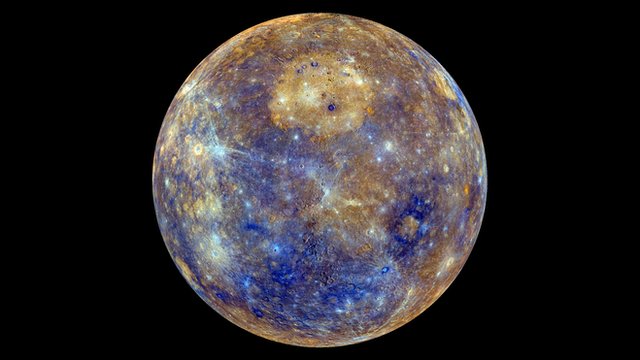
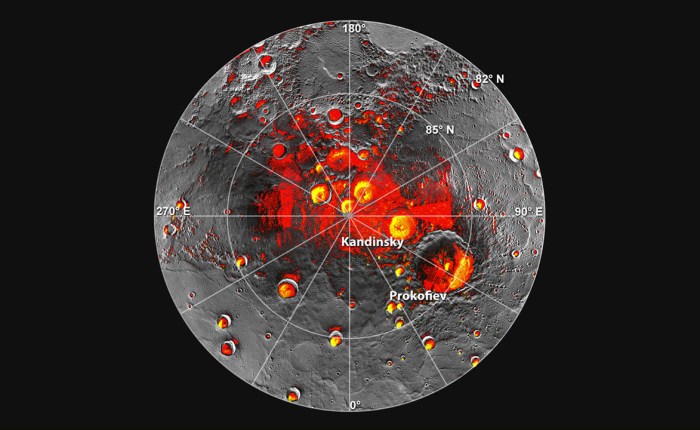
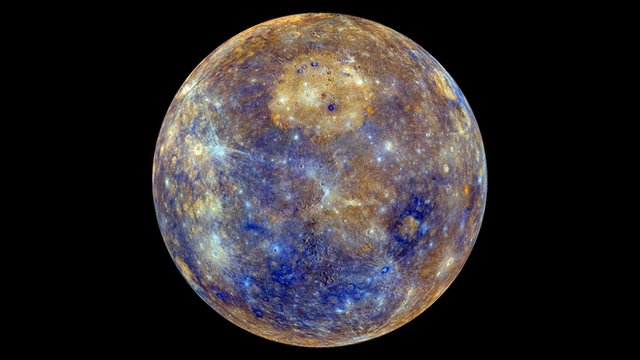
Color-enhanced map of Mercury. Credit: NASA/JPL
The second occurred shortly thereafter, when all around the world, the technological progress that has been building up since the Paleolithic exploded in a quantum leap of learning and accelerated change. Within decades, the Climate Crises began to abate, and a new world characterized by runaway change began to take over. And at about the same time, a renewed Space Age set in as humans began to migrate to the Moon, to Mars, and beyond.
And after about a century and a half of all that, the human race has now colonized the majority of the Solar System. Between Mercury, Venus, the Moon, Mars, the Asteroid Belt, Jupiter’s moons, Saturn’s moons, and of course, Earth and its millions of orbital habitats, the human race now stands at a hefty 15 billion. And across this vast interplanetary dominion, a massive economy has taken root that is beyond scarcity and want.
But there are no shortages of intrigue thanks to the forces that have shaped this new age. While the inner Solar System is populated by people who have embraced the Singularity, transhumanism, posthumanism, and runaway progress, the outer Solar System has become a new home for people looking to escape this pace of life and maintain a simpler existence. And in time, the disappearance of one person will force everyone – be they in the inner or outer worlds – to sit up and take notice.
Jupiter’s larger (Galilean) moons, Callisot, Europa, Io and Ganymede. Credit: NASA
I tell you, it’s been tiring process, getting this far. And at one point, I did declare that I had OD’d on writing about setting and world building. I mean, how can you dedicate 20,000 words to detailing a place, making it as vivid as possible for the reader, and then just switch to another? Screw plot necessity, it’s like abandoning an idea half-way! And I still have the all important one – the Cronian moon Titan – to cover.
But I’d be lying if I said that it hasn’t also been fun and that it wouldn’t be so tiring if I weren’t’ completely emotionally invested in it. And (spoiler alert!) that is where things should be the most interesting. As is usually the case, Part I through III of this four-part story have been all about establishing character, background, a sense of space and place, and introducing the various elements that drive the plot.
But in Part IV, I will not only get to write about a particularly intriguing place – Titan; capital city Huygens; dense nitrogen-methane atmosphere; principle industries, methane and ammonia harvesting; principle activities, sailing on methane lakes and gliding in low-g, cruising for action in its Yellow Light District and political dissent – but I’ll also be getting into the real heart of the plot, the mystery of the disappearing Dr. Lee!
A possible base on the surface of Callisto. Credit: NASA
In the coming months, I hope to have part IV, fully edited, and in a position to be published. While it remains unclear just what form that will take – the old submission to a publishing house route, or via an independent publisher – I know that some really amazing friends and colleagues will be there to cheer it on. Hell, some of them actually read this blog, for some reason. So if you’re reading this now, then I thank you for sticking with me thus far! 🙂
You know how this is going to start, don’t you? Yes, with one of these:
In any case, here is an article that I wrote for UT recently. However, due to a surprising lack of response to the subject on social media, it never got published. So I have decided to publish it in full here. Enjoy!
Since it was deployed in March of 2009, the Kepler space telescope has been responsible for the discovery of thousands of potential extrasolar planets (aka. exoplanets). In fact, as of January 2015, Kepler confirmed the existence of 1,013 exoplanets in about 440 stellar systems, along with a further 3,199 unconfirmed planet candidates. This is certainly an impressive feat, especially when you consider the fact that it accounts for almost half of all the exoplanets discovered so far.
But earlier today, NASA hosted a news conference in which they declared that Kepler has effectively doubled the number of exoplanets it has discovered. In what is the largest single batch of discoveries to be announced at one time, NASA claimed that the Kepler mission has validated the existence of 1284 new planets with 99% percent certainty (along with 428 likely false positives).
Not only is this the largest group of discoveries made by NASA (or any space agency) to date, it doubles the number of planets in the Kepler catalog. As of May 9th, 2016, some 1,041 confirmations had been made. But with this latest addition, that number now stands at a robust 2,325. Quite the accomplishment for a mission that was nearly abandoned due to mechanical failure.
Since its deployment in 2009, Kepler has confirmed the existence of over 2000 extra-solar planets. Credit: NASA
Back in 2012, the Kepler mission suffered a setback when one of the spacecraft four reaction wheels – which are used to point the spacecraft – stopped working. This was followed by a second failure in May of 2013, which disabled the collection of science data and threatened to end the mission three years ahead of schedule.
After much consideration, NASA declared on August 15th, 2013 that they had given up on attempting to repair the reaction wheels and had instead chosen to modify the mission. By November, NASA reported that Kepler would henceforth be dedicated to searching for habitable planets around smaller red dwarf stars – a mission which they named K2 “Second Light”. This mission extension was approved shortly thereafter, and Kepler has been carrying on with this mission ever since.
And with this latest batch of discoveries, Kepler is showing that it is still pulling its weight, and then some! Of those planets confirmed in this latest batch, most fell into the class of “mini-Neptunes” – planets that are the lower limits of a gas giant’s size. The next greatest sample consisted of “super-Earths” – terrestrial planets that are larger than Earth, but significantly less than that of a gas giant.
The remainder of those discovered fell between those that were Earth-sized or Neptune-sized gas giants. And as was made clear at the NASA-hosted conference, the discovery of over 2000 more confirmed exoplanets will also be of major importance for the next-generation of space telescopes, all of which will picking up where Kepler leaves off.
The number of newly discovered exoplanets, by year. Credit: NASA
These include missions like the James Webb Telescope, the Transiting Exoplanet Space Survey (TESS), the Wide Field Infrared Survey Telescope (WFIRST), and the ESA’s Plato mission. Much like Kepler, they will be searching for more than just extra-solar planets. Using similar detection methods as Kepler, as well as coronagraphic measurements, these missions will be hunting for more worlds, and assessing their properties to see if they are capable of supporting life.
And in the meantime, there is still plenty for Kepler to do before its mission is set to expire (in October of 2016). For example, there are more than 3,000 candidate planets in the Kepler database that need to be confirmed or ruled out. And then there are the “Kepler Objects of Interest”, a list of detections that need to assessed to see if they can even be considered as true candidates.
It certainly goes without saying that this latest announcement is also a major step along the road to finding extra-terrestrial life in the Universe. The more planets we find, the greater the odds of finding ET! While it may be naive to assume that they would live under conditions similar to our own, we are looking for the low-hanging fruit first. And finding and studying more exoplanets could also help us to understand what other conditions life might flourish under.
Hello folks! As you may know, I don’t get around to posting much in the way on this blog lately. These days, my time has been pretty much stretched thin with writing for Universe Today and HeroX, and what time I have left over I generally dedicate towards my personal writing. But I felt the need to hop on here today and share something which it pains me to admit.
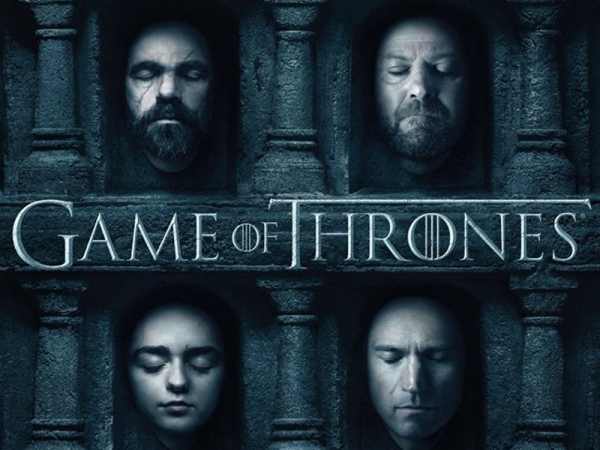
I do not care for Game of Thrones anymore! And since I have friends who were so excited about Season 6 and raved about how Season 5 ended, I know this will lead to some arguments down the road. But I must be honest here…
When the show began, I was a non-initiate, someone who had never read the books or ever heard of George R.R. Martin. Once the first season was complete, I took it upon myself to read all five books and found myself quickly turned into a ASOIAF geek. Naturally, this lessened the experience of the show as for Season 2, 3, 4, and 5, I knew how the story would go and reacted predictably whenever they changed any details. But that was only because I liked the story so much.
But last season, the writers of GOT went so far off book and left so much stuff out that I became genuinely disinterested with the show. Still, I felt I had to see what they were going to do with Season 6, so when “The Red Woman” premiered, I was sure to tune in. And then I watched the follow-up in “Home” to see where things went from there. Needless to say, the way they handled things reminded me of why I lost interest.
Let me explain why…
When the show writer’s tackled season 5, they had material from two books to work with – A Feast for Crows and A Dance with Dragons. And whereas they divided the third book (A Storm of Swords) into two seasons and ended up padding the second half with lots of things they made up, for Season 5 they skimmed over much of it, left a whole bunch of things out, and then reached the point where they had nothing more of Martin’s material to work with.
And it seems obvious to me why they did that now. In the course of making Season 5, they knew they would be flying without Martin’s net by Season 6. And so they began moving to eliminate all the material they didn’t want to work with and began simplifying the plot. Too bad, because so much of what they eliminated was intriguing and made the story interesting.
Also, it seems obvious that the promos they made for Season 6 – “Anybody can be killed” – have been less than honest. In reality, they’ve been killing off only certain kinds of characters, and it seems clear why. Now covering all of what they changed would take some time, so here’s the Cole Notes version of it. This is where the story left off in the books, and where they diverged from it…
Tyrion In Essos: Having killed his father, Tyrion fled King’s Landing with Jaime and Varys help, and travels to the free city of Pentos, where he is in the care of lllyrio Mopatis (the same man who had played host to Daenerys and her brother Varys for years). Tyrion is then sent to Volantis in order to meet with a party led by a man named Griff and his son, young Griff, which will be traveling east to find Daenerys. After spending time with them, Tyrion learns the startling truth.
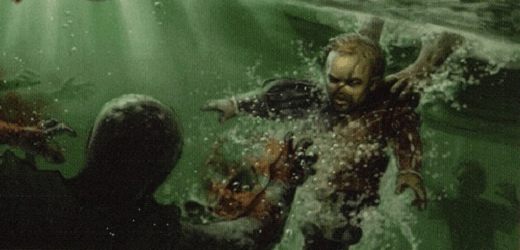
Tyrion pulled from the river, by Dimitri Bielak
Young Griff is in fact Aegon Targaryen, the son of Rhaegar Targaryen (and cousin to Daenerys) who was thought to have died in Robert’ Rebellion. Griff, meanwhile, is Jon Connington, the Hand of “The Mad King” Aerys II. For years, Aegon has been raised in secret, for the day that he could return to Westeros and reclaim the throne. With Daenerys having risen to become queen of Mereen and the “Mother of Dragons”, they now intend to find Daenerys’ and convince her to marry Aegon, at which time they will return to Westeros in force and claim the thrones.
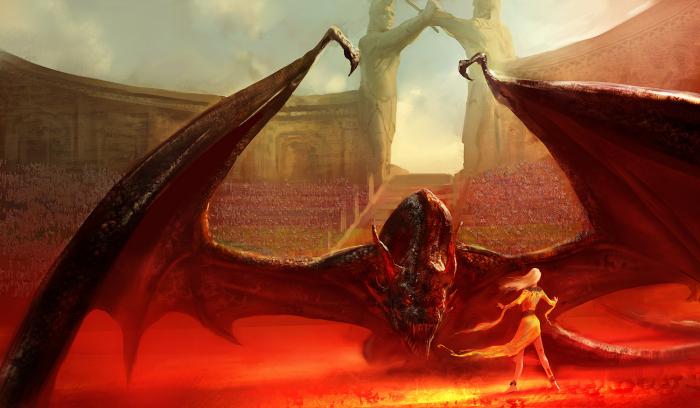
Unfortunately, Tyrion is kidnapped by Ser Jorah Mormont, who intends to take him to Daenerys as a gift. But they are taken by slavers who intend to force them to fight in Mereen’s recently reopened fighting pits. During the opening fight, when Daenerys is attacked and flees on the back of Drogon, Tyrion, Mormont, and Penny (another dwarf taken as a slave) flee outside the city.
Beyond the walls of Mereen, the armies of Slaver’s Bay are gathered.Having retaken Yunkai and Astapor from the freed slavers, they are now gathered to lay siege to Mereen. Daenerys managed to broker a truce by reopening the fighting pits and marrying Hizdahr zo Loraq. However, with her gone from the city, the truce is broken. Tyrion and the others manage to join with a sellsword company Second Sons, and hope to switch sides while the camp suffers from a plague that has broken out (the Bloody Flux).
Daenerys and Drogon in Daznak’s Pit, by Marc Simonetti
While in the wilderness, Daenerys is found by an old foe – Khal Jhaqo, the man who took command of the khalasar after Khal Drogo died.
Iron Islands: The Ironborne choose a new king after Balon Greyjoy dies in a fatal fall at Pyke. Euron, Balon’s brother, becomes the new king by promising his people victory thanks to a “dragonhorn”, an instrument which can control dragons that he managed to procure. He orders his younger brother Victarion to sail to Essos to bring Daenerys and her dragons back.
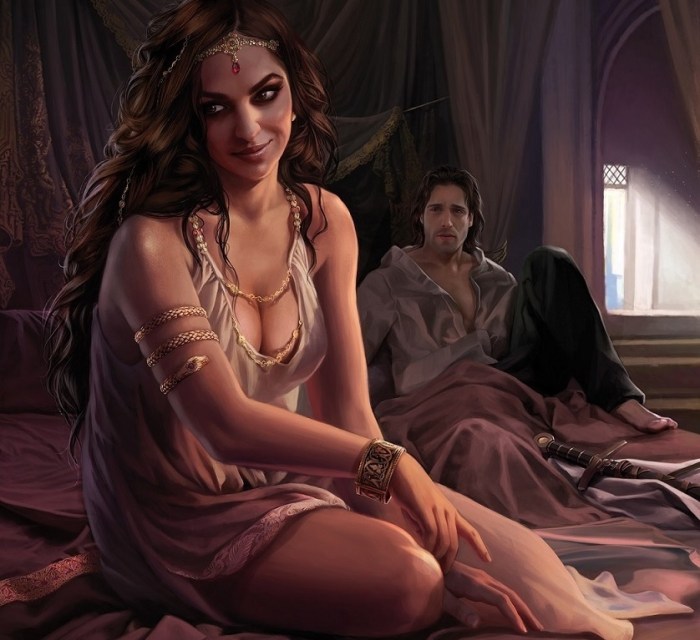
Dorne: The Sand Snakes plot to kidnap Princess Myrcella has failed thanks to the intervention of Prince Doran Martell. After freeing the ringleader – his daughter, Arianna Martell – he explains to her that he has a plot to get revenge on the Lannisters, Baratheons and Tyrells and is not the weak man they think he is. This plan involves sending his son Quentyn Martell to Mereen to marry Daenerys and bring her home to Dorne, where their kingdom will pledge support for her and take the Iron Throne for House Martell.
Arianna Martell and Ser Arys Oakheart, by Magali Villeneuve
However, this plan went a bit awry when Daenerys fled Mereen, and Quentyn is burned alive when he and his men try to take matters into their own hands and free her dragons. At the same time, the Ironborn are traveling to Mereen in the hopes of striking an alliance with Daenerys and bringing her and her dragons back to Westeros, also with the hope of conquering the Iron Throne for themselves.
In the Riverlands: Brienne of Tarth still searches for Sansa and Arya with the help of Podrick Payne. Along the way, she runs into the Brothers Without Banners, who arrest her and take her before their master – Lady Stoneheart. Brienne learns, to her surprise and horror, that Stoneheart is actually Lady Caitelyn Stark.
After being murdered at the Red Wedding, her body was thrown into the river and washed up on shore. The Brothers found her, and Lord Berric Dondarion (having been resurrected many times by Thoros of Myr) breathes his last life to her. A cold, viscous shadow of her former self, she orders Brienne killed on suspicion that is she working for the Lannisters, but Brienne is released after agreeing to kill Ser Jaime.
Lady Stoneheart, by Azad Injejikian
She finds Ser Jaime in the Riverlands, where is he busy negotiating an end to the sieges that are still taking place there. When they meet, she tells him that she has found Sansa Stark, but only Jaime can accompany her. The reason, she claims, is that Sandor Clegane (The Hound) is alive and with her, and that he will attack if he Brienne comes alone. In short, we are led to believe she is leading him into a trap.
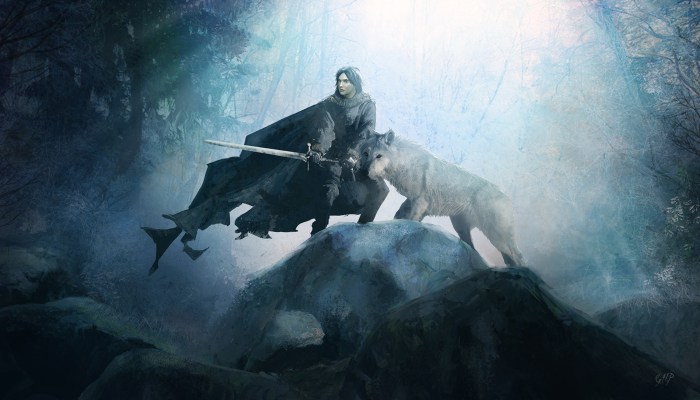
In The North: Jon Snow allows the Wildlings to pass through the Wall after their defeat at the hands of Stannis. While it is believed that Mance Rayder was burned alive, along with the other Wildlings that would not bend the knee to Stannis’, Jon learns that he’s actually alive. With Melisandre’s help, who cast a spell of illusion on him, he switched places with Rattleshirt and has been carrying on in disguise. Jon asks him to travel south and rescue his sister Arya, who he was told was married to Ramsay Bolton (not knowing that he married Jeyne Poole, who is being forced to impersonate Arya).
Melisandre also warns Jon that she has seen him in her visions, where he is surrounded by daggers in the dark. As he prepares to ride south to fight the Boltons, the vision comes true when Jon is attacked and stabbed severely by Bowen Marsh and other members of the Night’s Watch. The book ends with us not knowing if he survives or not.
Jon Snow and Ghost, by guillemhp
Just south of them, Stannis has taken Deepwood Motte and captured Asha Greyjoy (Theon’s sister). However, he is unable to march on Winterfell since the winter snows have made movement impossible and hunger begins to set in. However, the Boltons are doing just as bad at Winterfell, where the Boltons and their allies begin turning on each other. In the confusion, Theon rescues Jeyne Pool (who was posing as Arya) and they escape the castle together. They flee into the wilderness, eventually being picked up by Stannis men and brought back to camp. Theon reunites with his sister for the first time since his capture.
Oldtown: Samwell Tarley, Gilly, and Maester Aemon travel from Castle Black to Oldtown via Bravos. It is there that Sam is to become a Maester, seek out the old prophecies, and learn all he can about the coming of the White Walkers and the prophecy of Azor Ahai reborn. Aemon reveals to him that he once thought that this might be Varys, but now believes it to be Daenerys. Aemon dies before they can reach Oldtown, but when Samwell arrives, he speaks to the masters at the Citadel of what Aemon told him. When they hear this, Archmaester Marwyn leaves to go to Mereen with the intention of becoming Daenerys’ maester.
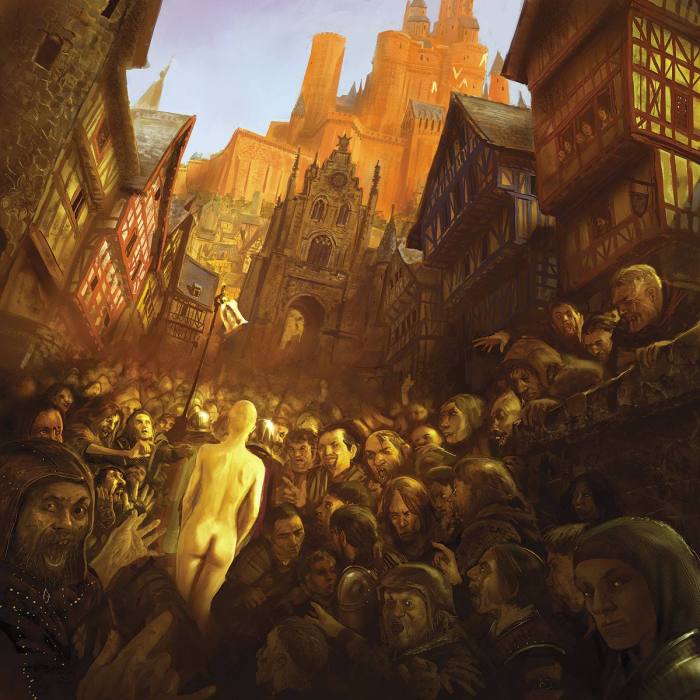
At King’s Landing: Cersei confesses to having sex with her cousin, Lancel Lannister, and performs the penace walk back to the Red Keep. There, she meets Ser Robert Strong (a resurrected Gregor Clegane) who will she is relieved to know will be fighting for her if she asks for a trial by combat. With Ser Jaime out of the city and her father dead, the task of running things has fallen to her uncle, Kevan Lannister.In addition to trying to clean up the messes Cersei and Joffrey has made, he must also deal with the fact that Aegon Targaryen’s forces appear to be landing in the east and raising a banner of war.
Walk of shame, by Marc Simonetti
Shortly after Cersei arrives home and they dine together, Ser Kevan is murdered in his quarters by Varys (who has also killed Grand Maester Pycelle). Varys explains to Kevan before he dies that he is part of the conspiracy to bring Aegon Targaryen home and to see him made king.
So that’s the story up until Season 6 (or the end of A Dance of Dragons) in a nutshell. As you can plainly see, so much of the plot had to do with Daenerys at this point, who has been revealed to be intrinsic to the whole prophecy of the coming of winter, the coming of the Others, and the war that will decide the fate of Westeros and the world. Basically, the War of Five Kings is over, and all roads lead back to Westeros by way of Mereen.
Where They’ve Change Things:
In the series, things changed drastically by Season 5. Basically, they were using material at that point from both A Feast for Crows and A Dance with Dragons, but seemed to be skimming through much of it, leaving a lot of other stuff out, and taking various story threads and tying them together.
For example, rather than showing the full intrigue that was happening in Dorne – which included Arianna Martell’s daughter and the Sand Snakes kidnapping Myrcella and positioning her to become Queen on the Iron Throne, thus making her betrothed (Trystane Martell) king – they instead made a story about Oberyn’s paramour (Ellaria Sand) and the Sand Snakes trying to kill her. Instead of Prince Doran thwarting this and telling Arianna of his plans, we get a big mash-up with Jaime and Bronn trying to save her and the whole thing ending in failure.
Ellaria and the Sand Snakes respond by killing Doran, Myrcella and Trystane all in one shot. Not only did none of this happened in the story, but killing off ALL these people means that their attempts to get Daenerys on their side and come back to Westeros are not going to happen. It eliminates the Dorne thread from the story altogether, and also means Cersei is mourning two dead kids instead of one as she prepares for her trial.
Speaking of murdering people off, they also killed off Stannis in a way that was very sudden. Not only did he not burn his daughter at the stake in the story, his daughter and his wife weren’t even with him as he marched to lay siege to Winterfell, which only made sense. You don’t bring family with you on a war march! Another person he left behind was Melisandre, so none of these people abandoned him or committed suicide on him. He also didn’t then march on Winterfell only to get his butt handed to him by Ramsay and then killed by Brienne. The way this all happened in one episode showed that they were eager to kill off his thread.
Speaking of Brienne, she was supposed to be in the Riverlands. But since they decided, for whatever reason, not to touch the Lady Stoneheart part of the story, this meant the writers had to give her something to do. In the same vein, Sansa had little to do, so they changed it up and made it her who was married to Ramsay Bolton and who got rescued by Theon.
At the same time, Ramsay Bolton spent the second episode of this season hatching a plot to kill his father, his stepmother, and his new brother is some big power play. With Roose gone, this means that Ramsay will now likely try to kill Jon Snow again (something they never bothered with in the books). With no epic battle looming between Stannis and he, there’s not much left for him to except get killed off himself, thus eliminating that thread as well.
Meanwhile, Theon’s father has been killed off and the island has fallen into political divide. Sure, this is close to what happened in Crows, but they’ve done it here makes it seem like this is just another minor thread they intend to tie off.
Getting to Mereen, the show skipped over the siege on the city. While just about everything else has happened according to the books (except that Tyrion and Mormont have not found their way into her court yet), this removes a major aspect of the story which was Martin was gearing up for book 6 – The Winds of Winter. So now, all Daenerys can do now is escape the Khal, return to Mereen and resume being queen(unless they choose to throw the sage in later).
But worst of all was the way they handled Jon Snow’s death/resurrection. After showing him to be dead in “The Red Woman”, it was quite obvious what was going to happen. A disheveled and broken Melisandre would be called upon to resurrect him, she would, and he would resume command of the Night’s Watch. It just felt so… predictable!
Ah, and of course, the entire thread involving Aegon Targaryen was completely left out. That means that in Westeros, there isn’t currently a war looming as Jon Connington lands forces loyal to Aegon, Kevan Lannister isn’t murdered, and we are not treated to the knowledge that Varys was conspiring with them all along. Instead, Varys is in Mereen conspiring to bring Daenerys home, but can’t do that until she comes back.
Why This Is Wrong (IMHO):
Basically, I didn’t like any of this because it eliminated so much of the plot. Sure, Martin can be (and is) criticized for writing stories that are too convoluted and too detailed. And in all fairness, I really began to feel by book four that things were going nowhere and I was determined to quit. But then, the ending of A Feast for Crows brought everything together quite succinctly and let us know exactly why what seemed like diversions and a drawn out tale was important.
And after the fifth book, A Dance of Dragons, things were really coming together and there was a sense of synthesis to the long tale that had been delivered thus far. By eliminating four separate threads from the story, the series writers are depriving the universe of a lot of its best material and altering the story inexorably.
For instance, the Iron Islanders are all but gone from the plot. The Dornish plans for revenge are all but gone too. Stannis’ plot to secure the crown for himself is gone, and in all likelihood, so will the war to secure the North. Aegon Targaryen and his hopes to secure the throne were never included. And Lady Stoneheart and House Stark’s hopes for revenge have also been excluded.
And in this, it seems pretty clear what the writers are doing. By closing down these other threads, they are now left with the Big Three – King’s Landing, The North, and the East. In all fairness, this was how the show started and it seemed like a classic narrative structure. And since then, Martin expanded the story greatly and took things in many different directions, to the point that a lot of people felt exhausted by books 4 and 5. And with him out of the picture, it looks like the show writers want to bring things back to a good old fashioned three-pointed story.
But doing so means that the ending will be a simplified, watered-down, and less detailed. It also means that – unless Martin gave them some indication of how the story is to end – it won’t be in keeping with the creator’s vision. Sure, at this point, they’re writing it out how they see fit and its not like they have much of a choice. But from now on, the story will be so different that it really doesn’t even make sense to call it Game of Thrones.
But of course, I just know I’m going to tune in next and watch episode three. I mean, who knows? Maybe they do have the deets on how things are supposed to proceed from here and are just giving us the scaled-down version. Only one way to find out! 🙂
As I’ve been talking about non-stop for the past few months, I got a novel in the works. As of the writing of this post, I’ve written 25 chapters and almost 50,000 words (that terrible middle part!) But what I haven’t shared yet is that some lovely websites have promised to promote it as soon as its done. This is a first for me, and something that I’m really looking forward to!
Truth is, this wouldn’t be possible were it not for the professional writing I’ve been doing for the past year and a half. And it all started a few months ago when I was busy updating an article (How Long Does It Take To Get To The Nearest Star). The article was a few years out of date at this point, and my boss wanted it expanded to include all the cool theoretical methods that have been proposed over the past few decades.
Artist’s concept of the Project Daedalus spacecraft, with a Saturn V rocket standing next to it for scale. Credit: Adrian Mann
While researching the topic to find out how long it would take a nuclear-powered spaceship to make the journey, I stumbled across Futurism.com and saw that they had reposted the old version of the article. I also noticed that they had reposted a few articles done by little ol’ me, which include the very first article I wrote back in Oct of 2014 (about hibernation technologies for a trip to Mars).
While telling them that a newer version would be coming out, the manager and I got to talking. I asked them if they would appreciate some articles on terraforming, and happened to mentioned that I was writing a book where that was a major theme. To my surprise, they expressed interest in both things, and asked if they could interview me when the book was done.
Naturally, I was worried they thought I was someone who was… you know, a big deal! I was sure to point out that this book was fiction and not some professional treatise. I’m not exactly Mike Brown or Neil DeGrasse Tyson here. But they said it was cool! Then I pointed out that I didn’t have a publisher lined up, and it might very well be indie published in the end. They said that this was cool too!
Color-enhanced map of Mercury. Credit: NASA/JPL
Suffice it to say, I was surprised and flattered. And after talking this over with my boss (I wanted his permission to write content that would be put on another site, he said that was cool!), he told me that Universe Today would be promoting the hell out of it too. I was honored. At no point did I ask or expect that the people I work for would be promoting something I wrote on my own time. But of course, I was sure to let them know that the work I was doing for them is what inspired it.
Were it not for all the research I had been doing about the Solar System and articles I was writing about its various planets, the story would not exist. It actually all started with the article I wrote on Mercury, in fact. Learning about its extremes in temperature, its richness in minerals, its very slow rotation, and its icy poles all made me think that a mining colony would be possible there someday. Especially if it were a penal colony!
Bottom line, when the book is finished, two prominent websites are going to be making a big deal out of it. How cool is that?
And just in case anyone is interested, those terraforming article are now finished and up at Universe Today. There are three in the series now, starting with a rundown of the topic, and ones on how it could be done on Venus and Mars. Next up, the Moon, followed by Mercury and the Outer Solar System. Feel free to leave comments too, especially constructive ones. 🙂
In my last post, I explained how I was struggling with my latest story. Particularly, it has been the task of setting the scene over and over again that’s been tiring me out. Luckily, I’m beginning to get to work again, thanks to getting a second (or third) wind. But the challenge is still a big one, so I thought I might share some of what I’ve working on and see if it helps break the logjam.
As I also mentioned last time, there are four major settings in The Cronian Incident. These consist of the planet’s Mercury, a space elevator above Mars, Jupiter’s moon of Callisto, and Saturn’s moon of Titan. Establishing these places as backdrops for the story presented many opportunities. You have to think about how people would go about colonizing and living on these worlds.
But there’s also the fun that comes from figuring out what a culture that evolved to live on these planets and moons would look like. What languages do they speak? What religions do they practice? What does their clothing look like, what kind of music do they listen to? And what kinds of technology do they rely on?
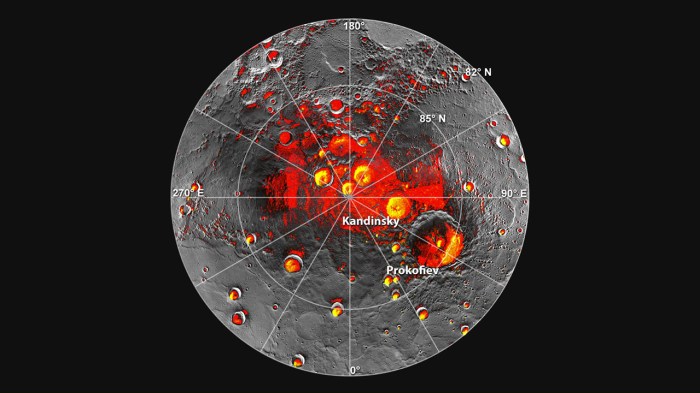
Mercury: The story opens on the planet Mercury, where mining crews diligently travel out onto the dark side of the planet, extract ore, and then return to the northern polar region. This area, which is permanently shaded, is the only part of the planet which is inhabited – after a fashion. In truth, no one really calls the planet home. But there are facilities located in the large craters, where convicts and temporary laborers harvest minerals, energy, and ice.
For the miners, their facility is located in the Prokofiev crater, which one of the larger craters in the northern polar region. It is here where miners return with their hauls of ore, which is then processed and fired into space by the Sling – a magnetic accelerator that shoots it into orbit. Some food is grown on site, most of it is shipped in, and water is sourced locally from the ice deposits. And all waste products are recycled to provide the bare necessities of life.
It is a dark place, where convicts and laborers are housed four to a room and are administered regular doses of antidepressants (to address their natural feelings of isolation and lack of natural sunlight). Convicts also have the added bonus of being equipped with “Spikes”, a neural implant that monitors their aggression levels and incapacitates them if they ever attempt to do anything violent.
And just in case they attempt anything illegal, the convict population can be confined to solitary cells, where the room’s are entirely nondescript, tiny, especially dark, and they have no company at all except for their demons.
Mars: Along with Earth, the Moon, and Venus, Mars is part of the Triumvirate – a loose alliance that embraces the most advanced worlds in the Solar System. Over 50 million people live on its surface, whereas a few million more live in orbital habitats and the Ares Installation, which sits atop The Drift (the planet’s space elevator). This installation is essentially an O’Neil Cylinder (though its more like an O’Neil can) that consists of two “hemispheres” that rotate in opposite directions- simulating gravity up to the standard Martian 0.376 g.
This self-contained world is divided into Sadak, the Hindi word for road (which is one of the official languages on Mars). Each Sadak has its share of domiciles, parks, recreation facilities, and aerodromes, where people go to test out their personal fliers. At the “southern” end of the facility is Sadak Lovelock, which is the home of the Chandrasekhar clan. Within the Formist faction, the people dedicated to terraforming Venus and Mars, they are kind of a big deal. In tall towers that face towards the planet below (which is visible through massive panels) they plot the transformation of the Red Planet into a green planet.
Lovelock is named in honor of James Lovelock, the British scientist who co-authored The Greening of Mars (one of the seminal works about terraforming). It is here that the elder Chandrasekhar (Piter Chandrasekhar) lives in what is known as a Heilig Room. Also known as a Lattice Quantum Chromodynamics environment, this room allows Piter – who is basically an upload at this point in time – to assume physical form and interact with simulated environments.
Terrafomed Mars. Credit: ittiz/deviantart.com
When Ward (the MC) meets him in this environment, he gets treated to familiar places from Piter’s life. This includes Mombasa, where Piter lived and worked during the mid-21st century, helping to create the coastal Lillypad city of Kimbilio. He then gives him a vision of Mars, of how it will look once the Formists are finished transforming it into a world with oceans, vegetation, and a breathable atmosphere.
Callisto: In part III, Ward reaches the Jovian system – aka. the system of Moons that orbit Jupiter. His first stop is the moon of Callisto, which is the outermost of the Jovians. It is a cold, frozen world with virtually no atmosphere. All major settlements consist of sealed domes that were built into the moon’s massive craters. The largest of these is the moon’s capitol of Valhalla, which was built Callisto’s massive multi-ring impact crater of the same name.
The city consists of several rings, each of which is named after a different world of the Norse mythology. Working from the outermost ring, there is Vanaheim (where the spaceport is located), Alfheim, Midgard, Jotunheim, Svartalfheim, Nidavellir, Niflheim and Muspelheim. When travelling through the city to find an old friend, Ward stops in Niflheim. It just so happens to be one of the city’s poorer districts, where the moon’s radical elements (known as the Aquiline Front) live.
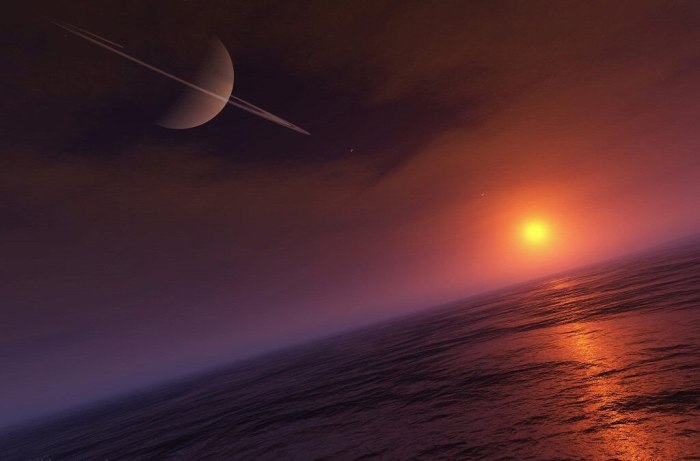
View above a methane lake on Titan. Credit: Kees Veenenbox/space4case.com
Titan: Last, there is the Cronian moon (Saturn’s moon) of Titan, where Ward inevitably goes to determine what happened to the man he’s trying to find. Much like the other moons of the outer Solar System, Titan is a world who’s surface consists mainly of ice. But unlike the other moon’s, Titan has a dense atmosphere of nitrogen, methane and other hydrocarbons. It’s surface is also covered in lakes of liquid methane, which is one of the planet’s chief exports.
The capitol of this world Huygens, a domed city named in honor of the moon’s discoverer (Christiaan Huygens). Located near the moon’s equator, this city is home to the moon\s main spaceport and is also the economic and administrative center of the entire Cronian system. As such, both the offices of the Cronian Union and the system’s more radical element – the Centimanes – are located here.
The city is also home to the infamous “Yellow Light District”, a pleasure dome that caters to every appetite imaginable. Naturally, I make sure that Ward visits here at some point, hoping to learn what he can from the moon’s many “pleasure technicians”. And of course, what he learns will both shock and intrigue him.
That’s what I got so far. And as I said, it’s been quite exhausting creating it all. I can only hope that the interest people derive from reading it will be proportional to the amount of energy it takes to write it all down!
According to the Science Fiction and Fantasy Writers of America, a work needs to be over 40,000 words long to be classified as a “novel”. This is just one standard, but right now, it’s an important one as far as I am concerned. Why? Two reasons: one, its what the SFSWA uses to classify books when considering them for a Nebula Award. Since science fiction is my chosen genre, I got to think these people know what they are talking about.
Second, and perhaps more importantly, it is because my WIP, The Cronian Incident, just passed this milestone. At present, the novel is 22 chapters and just over 43,000 words in length. And I’m only about halfway done! Problem is, this is where I begin to feel the crunch with most novels. Halfway is a bad point to be in when you’re me, because you’re feeling the weight of all that you’ve created so far, and are really aching to get to the finish line!
In the meantime, I am busy exploring the various aspects of Part III of the book, otherwise known as “Jovians”. In this part, the story’s MC, Jeremiah Ward, has traveled to the Jovian moon of Callisto (the fourth large moon of Jupiter) to meet his associate in the investigation. It is also here that he meets an old contact of his from his police-work days, and tries to learn more about the people he is working for.
One of the things that makes this challenging is that I spent the past few months developing characters and the settings of two different worlds. The story began on Mercury, moved to Mars, and now, its in orbit around Jupiter. From the surface of a cratered, hostile world, to a space elevator in orbit of Mars, and now to a frozen moon around a gas giant. Gah! I think I’ve officially OD’d on setting!
Artist’s impression of a possible base on the surface of Callisto. Credit: NASA
But I shall persevere. I’ve put too much into this idea to abandon it halfway, and this is one novel that I am determined to see through to completion! So – and I apologize in advance for this – expect to hear me blab a lot about it in the weeks and months to come. And you can bet I will be blabbing non-stop about it once its finished. Thanks to all those who are still paying attention 🙂
Welcome back Maria Ramos! Today, she would like to talk to you all about another aspect of the science fiction landscape – a lesser-known subgenre known as “cli-fi”. Embracing dystopian narratives and speculative fiction that looks at the future through the lens of environmentalism and climate change, cli-fi is very similar to other sub-genres of science fiction. In the end, its all about cautionary tales and agitating for change. But I’ll let her explain it, as she’s better at this sort of thing!
Dystopian fiction has always provided a means of commenting on and critiquing the political and social statuses of the eras they were created in. From George Orwell’s 1984 and Animal Farm to the more recent P.D. James’ The Children of Men and Kazuo Ishiguro’s Never Let Me Go, the fiction changed with the prevalent issues of the times, from the cold war and communism to concerns over reproductive rights. Throughout the genre the fear of too much government control over some or all aspects of our lives has remained a central theme. More recently, focuses have turned to nature and the negative effect that humanity has on the environment.
While existing for decades, the recent upsurge in dystopian fiction has taken a turn into the newly coined sub genre of “cli-fi” or climate change fiction, which depicts current and very valid concerns over environmental, overpopulation, and global warming issues. Much of this fiction also targets a young adult audience. Perhaps this is to encourage the next generation of scientists and technology experts to work with the current generation in seeking solutions for our environmental issues. Such problems include a steady increase of the amount of carbon dioxide in our atmosphere since 2007, creating what the National Oceanic and Atmospheric Administration (NOAA) has reported are the highest levels in 650,000 years. Some cli-fi books even tackle this very issue head on.
Two of the best-known examples of young adult cli-fi are The Hunger Games trilogy and The Maze Runner trilogy, both with blockbuster movie counterparts. In each of these, the characters live in a world depleted of natural resources because of some sort of man-made, or at least man-assisted, environmental disaster. While The Hunger Games doesn’t provide the specifics of what caused the world to become Panem, it’s clear that a central government controls the limited resources that are left while the general population struggles. While criticized for ignoring such issues as racial tensions, it nonetheless ticks the boxes of government excess leading to suffering for the general populace.
In The Maze Runner, the cause for the world’s destruction is more specifically attributed to solar flares, which devastated the majority of the planet and left the few survivors destitute. Further government meddling then caused many of those survivors to degenerate into a crazed and animalistic existence in which they tear each other apart. While neither of these trilogies, nor many of the other works of cli-fi, provide solid solutions for fixing the world once it’s gotten to the post-apocalyptic point of the stories, they remind us that consequences will remain devastating if we do nothing now.
The term “cli-fi” is popularly attributed to Dan Bloom in 2008, but nonetheless can define works of fiction created as early as the mid-20th century. Before there was such a term, authors such as J.G. Ballard were producing works of fiction describing a post-apocalyptic world caused by the effects of global warming, works such The Wind from Nowhere in 1961, The Drowning World in 1962, and The Burning World in 1964. Describing different worlds ravaged by hurricane-force winds, melting polar ice caps, and worldwide drought, respectively, such works provide early warning of the ravaging effects of global warming if left unchecked.
More recent examples that existed before 2008 include the first novel of Margaret Atwood’s MaddAddam trilogy, Oryx and Crake, written in 2003. Set closer to the present, this trilogy delves into the possible detrimental effects of biotechnology on both the environment and on the human inhabitants of the planet. It also takes aim at multinational corporations that ignore and/or deny their role in global warming and environmental disasters, alluding to real issues faced by today’s environmentalists worldwide. Other examples of more adult-oriented dystopian novels that address the possibility of environmental catastrophes include The Road, the excellent post-oil-crisis novel The Windup Girl, and The Children of Men.
Whether the rise in recent works of cli-fi is having any effect on our actions toward being more environmentally responsible or not, artists and writers have always found ways to provide commentary through entertainment. In the case of saving our planet, any means of getting the message across is welcome and necessary.
Hey folks! In recent months, I’ve hit two milestones in the writing of my novel. The first occurred weeks ago, when I chose to change the title. The second, and more important, is that book is now half done. Yes, with part II of the story complete, and approximately 40,000 words down on paper, the novel is now halfway towards completion. That means this book is not only out of the crib and walking, its off and running. Now it just needs to avoid any nasty spills and it will be in business!
But first, let me explain why I renamed it. Basically, this book is about an “incident” that takes place on one of Saturn’s moons (Titan). Here, a high-profile figure connected to terraforming interests on Mars goes missing. The investigation into this mysterious disappearance takes the investigator (Jeremiah Ward) from Mercury, to Mars, and then to Jupiter’s moon of Callisto before moving on to Titan. Since the focus of the investigation is on the these two moons, I decided to use the name “Jovian”, since this term applies to any moon that orbits a gas giant.
Jupiter’s larger (Galilean) moons, from left to right – Callisto, Europa, Io and Ganymede. Credit: NASA
But eventually, I found this name to be problematic. For one, the larger moons that orbit Jupiter – Io, Europa, Ganymede and Callisto – are often referred to as “The Jovian Moons” (derived from Jove, the archaic name for Jupiter). While they are more properly known as “The Galilean Moons” (after their discoverer, Galileo), the name is applicable here more than with any other moon in the Solar System. Specifically, Saturn’s moons are properly called Saturnian or Cronian.
Another reason I wanted to call it the Jovian Incident was because I wanted it to be a compact volume consisting of three parts. Part I (Hermians) takes place on Mercury and shows the life of convict laborers; Part II (Martians) shows what life is like on a planet in the inner Solar System; and Part III (Jovians) covers all the action taking place in the outer Solar System and shows how people in this part of the universe live.
However, I finally realized this structure wouldn’t fly. For one, it would cause confusion to say the incident was “Jovian” when the moon where it happened on is called Cronian in the book. Second, I knew the three part structure wouldn’t fly, since it would mean Part III would likely be longer than Parts I and II combined. So I decided to add a Part IV (“Cronians”), and rename the book “The Cronian Incident”.
Saturn’s moon Titan, which figures prominently in the story. Credit: NASA
And with Part II complete and Part III underway, I have covered all the necessary exposition and background, and am now moving onto the action part of the story. I would say this is where the fun part begins. But as I am sure many would agree, once you are half done a project, completing it somehow feels more difficult. For me, starting something is the easy part. Building on that foundation is also fun. But getting it from a work-in-progress to a finished work, that’s the hard part!
So feel free to wish me luck. Also, thanks for staying abreast of my progress. For those who had a helping hand, I intend to make this book available, free of charge, once its ready. And unlike some of the thing I wrote, it should work out to a (relatively) compact 80,000 words. No tomes here!
Future City [3] by josueperez79 at deviantart.comHi again folks! I’m back with some thoughts from my most recent story project – The Jovian Incident. I know, what else is new, right? Writing can be a self-indulgent process. But if there’s one thing I’ve learned, its that sharing helps when it comes to developing a story. It helps you articulate your thinking and ideas, especially if respected peers tell you what they think (hint, hint!)
As I also learned a long time ago, any science fiction piece that deals with the distant future has to take into account how human beings in the future go about organizing themselves. In this future world, what are the political blocs, the alliances, the rivalries – the ways in which people are united and divided? Well, I gave that a lot of thought before sitting down to pen the book (which is into chapter 11 now). And this is the basic breakdown I came up with.
Extro Factions: For starters, people in the future I am envisioning are tentatively divided into those that live in the inner and outer Solar Systems. But that geographic divide is merely representative of a much bigger issue that divides humanity. Whereas the people living on Earth, Mars and Venus largely fall into the category of “Extro” (i.e. Extropian, people who embrace the transhuman ethic) people in the outer Solar System live simpler, less augmented and enhanced lives (“Retro”).
But within this crude division between people who believe in going beyond their biological limitations and those who believe in respecting them, there are plenty of different social, political and ideological groups to be found. Here’s a rundown on them, starting with the Extro factions…
The Formists: Founded by Piter Chandrasekhar, one of the first colonists of Mars, the Formists are a faction dedicated to the full-scale terraforming of the Red Planet. The purpose of this, obviously, is to allow for full-scale colonization, which is something that remains impossible at this point in the story. All inhabitants on Mars lived in sealed domes, all transit takes place in pressurized tubes or on flyers, and anyone venturing out onto the surface is forced to wear a pressure suit with life-support systems.
Mars Terraformed by Daein Ballard
Currently, the Formist faction is run by Emile Chandrasekhar, Piter’s grandson. And for the past few decades, they have been busy procuring resources from the outer Solar System to aid in the terraforming process. This includes supplies of methane, ammonia, ices, and lots and lots of comets.
However, they are also busy trying to ensure that the process will have a minimal impact on the settlements and those living within them. Altering the planet’s atmosphere will definitely have a significant impact on the landscape in the short-term, such as sublimating all the water ice in the Martian soil and in the polar caps. Once that water begins to flow, much of the surface will find itself being swallowed up by newly-created oceans. So naturally, the Formists must proceed slowly, and make sure all settlements on Mars agree to their plans.
While the Formist faction is largely centered on Mars, they have counterparts on Venus as well – known as The Graces (after the children of Aphrodite). Here, the process is significantly different, and involves converting the existing atmosphere rather than increasing its density. But the goal is the same: to one day make Venus a living, breathing world human beings can set foot on.
The Dysonists: Among the Extros, there are also those who believe humanity’s future lies not in the stars or in the terraforming the Solar System’s planets, but in the space that surrounds our Sun. They are known as the Dysonists, a faction that is intent on building a massive swarm of structures in the inner Solar System. For some, this calls for a series of rings which house the inhabitants on their inner surface and provide gravity through endless rotation.
This artist’s concept of a Dyson sphere is via SentientDevelopments.com
For other, more ambitious Dysonists, the plan involves massive swarms of computronium that will contain a sea of uploaded personalities living in simulated environments. Both the swarms and the powerful bandwidth that connects them will draw energy from the Sun’s rays. These individuals consider themselves to be the more puritan of Dysonists, and believe those who advocate buildings rings structures are more properly known as Nivenists.
The process of converting all the “dumb matter” in the Solar System into smart matter has already begun, but in limited form. Within a few generations, it is believed that the Sun will be surrounded by a “Torus” of uploaded minds that will live on while countless generations come and go. Dysonists and their enclaves can be found on Near-Earth Asteroids, in the Main Asteroid Belt, and with committed supporters living on Venus, Mars, Earth, the Moon, and Ceres.
The Habitationists: Inspired by Gerard K. O’Neill, the inventor of the O’Neill Cylinder, the Habitationists began as an architects dream that quickly expanded to fill all of known space. In the 21st century, Earthers looking to escape the growing population crisis began migrating to space. But rather than looking to live on distant worlds or the Moon, where the environment was harsh and the gravity limited, they decided to set up shop in orbit. Here, supplies could be shipped regularly, thanks to the advent of commercial aerospace, and gravity could be simulated at a full g thanks to rotating toruses.
By the mid 22nd century, Low Earth Orbit (LEO) Habs had become all the rage and the skies became somewhat saturated. The existence of Earth’s space elevator (The Spindle) only made deploying and supplying these Habs easier, and a steady drop in the costs of manufacturing and deploying them only made them more popular. As such, Terran architect Hassan Sarawak, who had designed many of the original habitats in space, began to busy himself designing a new series of Habs that would allow human beings to live in space anywhere in the Solar System.
Artistic impression of the inside of an O’Neil Cylinder. Lightfarm Studios
By the end of the 22nd century, when the story takes place, large cylinders exist in several key places in the Solar System. Most are named in honor of either their founders, those who articulated the concept of space habitats, or those who believed in the dream of colonizing space itself (and not just other planets and moons). These places are thusly named O’Neil’s Reach, Clarkestown, Sawarakand, and New Standford.
The Seedlings: As the name would suggest, the Seedlings are those intrepid Extropians who believe humanity should “seed” the galaxy with humanity, spreading to all solar systems that have confirmed exoplanets and building settlements there. But in a slight twist, they believe that this process should be done using the latest in nanotechnology and space penetrators, not slow interstellar ships ferrying human colonist and terraformers.
To the Seedlings, who can be found throughout the inner Solar System, and on some of its most distant moons, the idea is simple. Load up a tiny projectile-ship with billions of nanobots designed to slowly convert a planet’s climate, then fire it on a trajectory that will take it to an exoplanet many generations from now. Then, prepare a ship with colonists, send it on its merry way into space, and by the time they reach the distant world, it will be fully prepared for their arrival.
At this point in the story, the Seedlings first few missions are still in the planning stages. They’ve got the technology, they’ve got the know-how, and they know where the right candidate planets are located. All they need to do know is test out their machines and make sure the process works, so that they won’t be sending their colonists into a deathtrap.
Sidenote: this idea is actually one I explored in a short story I am trying to get published. If all goes well, I am the short story and this full-length idea can be connected as part of a singular narrative.
Retro Factions: And now we come to the people who live predominantly in the outer Solar System, the folks who found life on Earth and the inner worlds unlivable thanks to its breakneck pace and the fact that life was becoming far too complicated. These are the people whom – for religious, personal, or moral reasons – chose to live on the frontier worlds in order to ensure something other than humanity’s survival as a species. For these people, it was about preserving humanity’s soul.
Organics: In the mid to late 21st century, as biotech and cybernetics became an increasingly prevalent part of society, a divide began to emerge between people who enhanced their biology and neurology and those who did not. While the former were in the minority for the first few decades, by the latter half of the 21st century, more and more people began to become, in essence, “transhuman” – (i.e. more than human).
Cyber Girl by Fausto De Martini
At the same time, fears and concerns began to emerge that humanity was forsaking the very things that made it human. With lives becoming artificially prolonged, human parts being swapped for bionic or biomimetic implants, and brains becoming enhanced with neural implants and “looms”, humanity seemed on course to becoming post-human (i.e. not human at all).
And while the concerns were justified, few who could afford such enhancements seemed to be willing to forsake the convenience and necessity they represented. In a world where they conferred advantage over the unenhanced, choosing not to augment one’s body and mind seemed foolish. But between those who could not afford to, those who were forbidden to, and those who chose not to, eventually a new underclass emerged – known as “Organics”.
Today’s organics, who live predominantly in the outer Solar System or isolated pockets in the inner worlds, are the descendants of these people. They live a simpler life, eschewing most of the current technology in favor for a more holistic existence, depending on various levels of technology to maintain a certain balance.
Fundies: Naturally, human beings in the late 22nd century still have their faiths and creeds. Despite what some said in previous centuries, mankind did not outgrow the need for religion as it began to explore space and colonizing new worlds. And when the Singularity took place in the mid 21st century, and life became increasingly complex, enhanced, and technologically-dominated, the world’s religiously-devout began to feel paradoxical. On the one hand, religion seemed to be getting more unpopular and obsolete; but at the same time, more rare and precious.
To be fair, there was a time when it seemed as though the prediction of a religion-less humanity might come true. In the early to mid 21st century, organized religion was in a noticeable state of decline. Religious institutions found it harder and harder to adapt to the times, and the world’s devout appeared to be getting increasingly radicalized. However, in and around all of these observable trends, there were countless people who clung to their faith and their humanity because they feared where the future was taking them.
In the current era, the outer Solar System has become a haven for many sects and religious organizations that felt the Inner Worlds were too intolerant of their beliefs. While there will always be people who embrace one sort of faith or another on all worlds – for instance, billions of Extros identify as Gnosi or Monist – the majority of devout Kristos, Sindhus, Mahavadans, Mahomets, and Judahs now call the worlds of Ganymede, Callisto, Europa, Titan, Rhea, Iapetus, Dione, Tethys, Titania, Oberon, Ariel and Umbriel home.
The vast majority of these people want to live in peace. But for some, the encroachment of the Inner Worlds into the life and economies of their moons is something that must be stopped. They believe, as many do, that sooner or later, the Extro factions will try to overtake these worlds as well, and that they will either be forced to move farther out, colonizing the moons of Neptune and the Kuiper Belt, or find homes in new star systems entirely. As such, some are joining causes that are dedicated to pushing back against this intrusion…
Chauvians (Independents): Many in the past also thought that nationalism, that sense of pride that is as divisive as it is unifying, would also have disappeared by this point in time. And while humanity did begin to celebrate a newfound sense of unity by the late 21st century, the colonizing of new worlds had the effect of creating new identities that were bound to a specific space and place. And given the divisive political climate that exists in the late 22nd century, it was only natural that many people in the Outer Worlds began preaching a form of independent nationalism in the hopes of rallying their people.
Collectively, such people are known as “Chauvians“, a slight bastardization of the word “Jovian” (which applies to inhabitants of any of the outer Solar System’s moons). But to others, they are known simply as Independents, people striving to ensure their worlds remain free of external control. And to those belonging to these factions, their worlds and their people are endangered and something must be done to stop the intrusion of Extros into the outer Solar System. For the most part, their methods are passive, informative, and strictly political. But for others, extra-legal means, even violent means, are seen as necessary.
Examples include the Children of Jove and the Aquilan Front, which are native to the Galilean moons of Jupiter. On the Cronian moons, the Centimanes are the main front agitating for action against the Extros. And on the Uranian moons, the organizations known as The Furies and the Sky Children are the forces to be reckoned with. Whereas the more-moderate of these factions are suspected of being behind numerous protests, riots, and organized strikes, the radicals are believed to be behind the disappearance of several Extro citizens who went missing in the Outer Worlds. In time, it is believed that a confrontation will occur between these groups and the local authorities, with everyone else being caught in the middle.
And those are the relevant players in this story I’m working out. Hope you like them, because a few come into play in the first story and the rest I think could become central to the plots of any future works in the same universe. Let me know what you think! 🙂
Hey there, folks! As the title of this entry would suggest, I’ve made some serious progress on my latest book, The Jovian Incident. After a few months of writing, I’ve finished all nine chapters of the first installment – aka. Part I: “Hermians”. These chapters cover the part of the story that takes place on Mercury, where the main character is introduced, some details of his background are revealed, and he is eventually recruited to go do a job.
This part was also a chance to preview the universe I went about building for the story. This included not only using Mercury as the setting for a prison planet, but descriptions about what Earth, Mars, Venus looked like in this day and age. And there was the matter of how people lived in a post-Singularity universe, when a whole range of amazing technologies were at their disposal. Today, I thought I’d focus on one in particular. The subject of…
Clinical Immortality!
To be clear, clinical immortality in this context does not refer to cryogenics or frozen heads waiting to be stitched onto bodies once they find a cure for… whatever. In this context, clinical immortality refers to what is possible through advances in biotechnology, robotics and cybernetics, to the point where human beings can artificially prolong their lives for centuries. At the same time, it refers to knowledge of the brain and computing advancing to the point where people can back up their neurology, living on indefinitely as a digital “ghost in the machine”.
In short, those who have access to this kind of technology in my story have a lot of options for staying alive. One of the more popular (but more complicated) ways is to create clones of oneself, which are then be equipped with the host’s memories backed up to the point of their death. These “facsimiles” are able to carry on in the place of the original, creating an unbroken chain of lineage. The reason why this means is complicated is because if two versions of the same person are alive at the same time, it creates some sticky legal issues.
To put it in perspective, here’s a fragment from the story, where the MC (Jeremiah Ward) is reminiscing about a case he once had to deal with aboard an LEO Hab called Ri-La. Basically, LEO Habs are habitats that exist in Low-Earth Orbit. The owner in question was a former magnate named Xian, a man who lived in the early 21st century before “dying”:
“I went there as part of a case back in 23’. The whole place had been built by some old Terran magnate named Xian. Some Jom-gua gentleman, born in the previous century who made his fortune running bio, shipping and software. Before he died, he had a Hab commissioned in orbit for his wife and family, and then invited his extended family to move there so they could have their own orbital estate all to themselves.”
“Died?” said Guernsey, noting the one word that seemed out of place in the story. “This guy, he was an Extro. And he died? Like… for real?”
“No, no…” Ward replied, waving his hand dismissively. “Though he did forego the whole facsimile thing, the old man uploaded himself like anybody else before he got too old, suffered brain death. That way, his children, nieces and nephews had the run of the place and could summon him whenever they wanted.”
“Descendants calling up their great ancestor,” said Burton. “Fucking vain, if you ask me. But makes sense if you’re one of them Core types, all rich and shit.”
“Well and he was the traditional sort, that guy. Not a lot of people back home who were like him anymore. Most people take the idea of post-mortality too literally.”
As he goes on with the story, he explains how he was on the habitat to investigate a murder case. At the heart of the case was an inhabitant who got into a struggle with their facsimile:
“Turns out some of the Xian clan were not as traditional as their forebear. Some of them went about creating facsimiles of themselves, even woke them up before they died. I don’t know, all that time in orbit, they must have feared they’d die out unless they started cloning themselves.”
“It didn’t occur to them to get some new blood in the place? Or even someone’s DNA?”
Ward shrugged. “Who knows? Maybe they couldn’t find anyone they thought worthy. Point is, having more than one version of yourself around can get ugly, especially when there’s inheritance on the line. And in this case, one kid was killed by another version of himself.”
“Wow…” Jordon whispered. “Was it hard to figure out who did it?”
“Not even a little bit,” said Ward, shaking his head. “Forensics took all of five minutes. The trickier part was trying to deduce if the victim was an original or not. As you know, the penalty for a facsimile killing their original is way higher than the reverse.”
A little later, Ward is confronted with the man who comes to Mercury to offer him a job. His task, he learns, is to venture to the Outer Solar System and find a colleague who has gone missing. Given that the man he is tasked with finding is clearly of the Extro (Extropian) faction, he naturally feels the need to ask the obvious:
“This man, there’s a record of his DNA, yes?”
“Of course,” Chandrasekhar replied simply.
“And his neurology is on file as well, I take it?”
“Backed up directly before his departure, yes.”
“So why not just reproduce him and cut your losses?”
“Well, three reasons.” Chandrasekhar raised three fingers and began listing them off. “For one, the man in question was a conservative soul. He would not approve of being resurrected unless it was absolutely necessary. Second, if he were still alive and turned up after we produced his facsimile, there would be some sticky issues of legality to contend with.Lastly, there is the matter of what he learned while conducting our business in the Outer Worlds. We need to make every effort to retrieve the version of him that knows all of these things, if at all possible.”
I wanted to include all this stuff in the story for two reasons. On the one hand, as a way of commenting on some of the issues that are likely to come up if and when such things are possible. And two, to address the fundamental question: if people are capable of uploading themselves, and creating facsimiles of themselves, what will it mean for issues of identity, legality, and even mortality?
If death is no longer an inevitable fact of life, will death cease to have meaning? And by extension, will life cease to be valued? If someone can just recreate themselves, then what harm is there in murdering them? And if the only real loss is memory that hasn’t been backed up, will the information they carry in their minds be more valuable than the person themselves?
But this of course is all background stuff, something that is meant to frame the main story, which I am still working on. But I feel at this point that it’s off and running. So as I get into Part II: “Martians”, I hope to be getting away from some of that stuff, and more into the issues of timelines, plot, and more character development. Stay tuned!


















 Stories by Williams