Powered by the Sun: The “Energy Duck”

Magnificent CME Erupts on the Sun - August 31Part of the challenge of paving the way towards a future where solar power is able to meet our energy needs is finding ways to integrate it into our daily lives. Basically, until such time as efficiency limits, storage and intermittency problems are truly overcome, one of the best ways to do this is to place photovoltaic arrays where the demand is highest and to get creative with how they collect it.

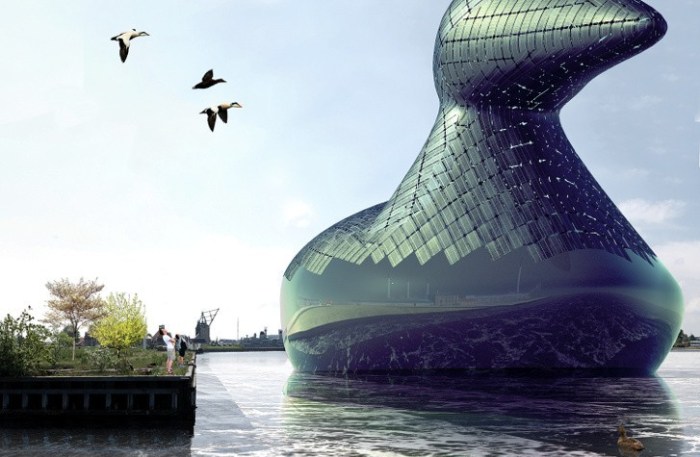
For example, a group of British artists have conceptualized a giant solar harvesting floating duck as part of the 2014 Land Art Generator Initiative Copenhagen design competition. Dubbed “Energy Duck”, the giant structure has been designed not only to generate clean electricity for the local residents of Copenhagen, but to also provide a unique visitor center. In short, it comes renewable energy with a cautionary message about the effects of Climate Change.

energyduckInspired by the arctic eider duck, Energy Duck not only hopes to offer a unique renewable energy source, but also highlight the impact that climate change has had on the local population and breeding habitats of the eider duck in recent years. As its creators – Hareth Pochee, Adam Khan, Louis Leger and Patrick Fryer – explained:

Energy Duck is an entertaining iconic sculpture, a renewable energy generator, a habitable tourist destination and a celebration of local wildlife.

Covered in photovoltaic panels, the Energy Duck is designed to harvest solar energy from every inch of its exterior shell. Solar cells mounted around the base are also positioned to take advantage of the sun’s rays being reflected off the water’s surface. Additionally, the facility features hydro turbines which use water pressure to provide stored energy to the grid after sunset and during the evening.

https://i0.wp.com/images.gizmag.com/gallery_lrg/energyduck-2.jpgAll of this helps the Energy Duck overcome the all-important issue of intermittency. By being able to generate energy around the clock, the Duck is not dependent on the sun shining in order to continue operating and providing power. As the team explained:

When stored energy needs to be delivered, the duck is flooded through one or more hydro turbines to generate electricity, which is transmitted to the national grid by the same route as the PV panel-generated electricity. Solar energy is later used to pump the water back out of the duck, and buoyancy brings it to the surface. The floating height of the duck indicates the relative cost of electricity as a function of city-wide use: as demand peaks the duck sinks.

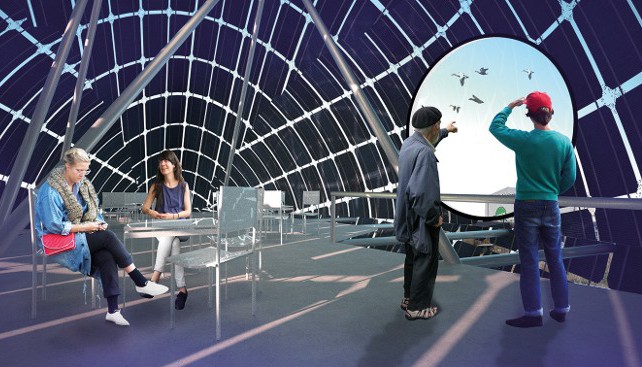
Inside the giant Energy Duck, visitors can get a unique look into the working mechanics of the hydro turbines, watching as the water levels rise and fall. Sunlight also filters through small spaces between the exterior solar panels, providing a kaleidoscope-like view of Copenhagen. However, another interesting feature about the Energy Duck is its environmental message.

energyduck-5So while people are visiting the interior and taking note of the impressive technology, they will also be getting a lesson in why it is important. And really, the inherent message of the concept is really very appropriate. A clean, renewable, alternative energy source designed to look like, and inspired by, one of the many creatures that is endangered because of humanity’s dependence on unclean fuels.

Now if we could just design a land-roving solar farm in the shape of a polar bear!

Sources: gizmag.com, inhabitat.com

The Future of Urban Planning: The Urban Skyfarm

urban-skyfarm-9The world’s population is projected to grow to between 9 and 10 billion people by the middle of the century. What’s more, roughly two-thirds of those people are expected to live in major cities. Coupled with the expected changes caused by Climate Change (i.e. increased drought and less in the way of arable land), and its understandable why urban farms are seen as a means of picking up the slack.

That’s the concept behind the Urban Skyfarm, a concept for a skyscraper that is shaped like a tree and comes with leaf-like decks to provide space for real trees to grow. Currently, most vertical farming operations – like warehouses in Chicago, Kyoto, Singapore and a recent skyscraper built in Sweden by Plantagon – grow plants with ultra-high-efficiency systems under artificial light.

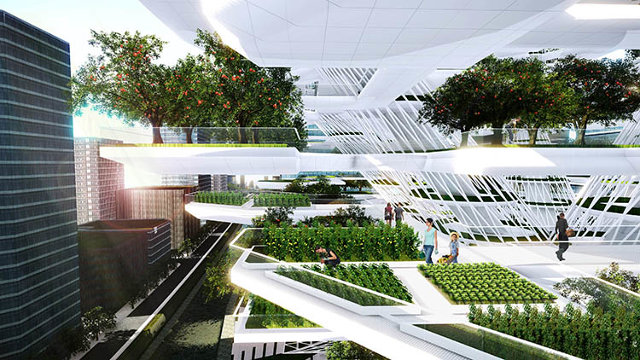
urban-skyfarm-2However, this new design concept from Aprilli Design Studio takes a different approach, using lightweight decks to provide growing space outdoors on the sides of a giant skyscraper. The architects aren’t the first to embrace the trend of sticking greenery on towers, but they may be one of the first to look at how to use the technique to maximize food production. As architects Steve Lee and See Yoon Park explained:

Our version of the vertical farm was intended to become an independent, open-to-air structure which would be purely focusing on farming activities and sustainable functions such as generating renewable energy and performing air, and water filtration.

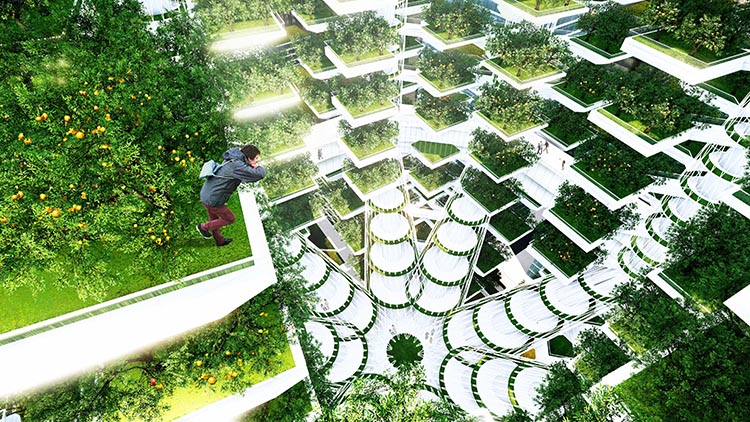
Designed to mimic the shape of an enormous tree, the Urban Skyfarm uses leaf-like decks to provide 24 acres of space for growing fruit trees and plants. The “trunk” houses an indoor hydroponic farm for greens, and solar panels and wind turbines at the top of the tower provide enough energy to power the whole operation. The design would also capture rainwater and filter it through a constructed wetland before returning it to a nearby stream.

urban-skyfarm-5So in addition to growing food and using rainwater to provide irrigation, the building also was also designed with an eye towards energy independence. The architects envision the project in the middle of downtown Seoul, South Korea:

It seemed to be an ideal place to test out our prototype since the specific area is very dense and highly active and has been suffering for a long time by all sorts of environmental problems resulting from rapid urbanization…With the support of hydroponic farming technology, the space could efficiently host more than 5,000 fruit trees. Vertical farming is more than an issue of economical feasibility, since it can provide more trees than average urban parks, helping resolve urban environmental issues such as air pollution, water run-off and heat island effects, and bringing back balance to the urban ecology.

The design would also provide community gardens, park space, and a farmers market to cater to a demand for fresh, local food in a city where apples can cost more than $20 at local markets.

urban-skyfarm-7Vertical farming has already started in South Korea. Another project, based in Suwon, is growing food in a three-story building and may eventually expand into a skyscraper. But the outdoor vertical farm is just a concept for now. Lee and Park are confident this is the way of the future, and that demand for clean, sustainable buildings that grow fresh food is only going to increase:

We believe there will be more attention and discussions of vertical farms as the 2015 Milan Expo approaches, and we hope the Urban Skyfarm can become part of the discussion as a prototype proposal. Vertical farming really is not only a great solution to future food shortage problems but a great strategy to address many environmental problems resulting from urbanization.

And with the problems of urban growth and diminished farmland occurring all over the developed world – but especially in nations like China, Indonesia, the Philippines, and India (which are likely to be the hardest hit by Climate Change) – innovative designs that combine sustainability and urban farming are likely to become all the rage all over the world.

Source: fastcoexist.com

Stephen Hawking: AI Could Be a “Real Danger”

http://flavorwire.files.wordpress.com/2014/06/safe_image.jpgIn a hilarious appearance on “Last Week Tonight” – John Oliver’s HBO show – guest Stephen Hawking spoke about some rather interesting concepts. Among these were the concepts of “imaginary time” and, more interestingly, artificial intelligence. And much to the surprise of Oliver, and perhaps more than a few viewers, Hawking’s was not too keen on the idea of the latter. In fact, his predictions were just a tad bit dire.

Of course, this is not the first time Oliver had a scientific authority on his show, as demonstrated by his recent episode which dealt with Climate Change and featured guest speaker Bill Nye “The Science Guy”. When asked about the concept of imaginary time, Hawking explained it as follows:

Imaginary time is like another direction in space. It’s the one bit of my work science fiction writers haven’t used.

singularity.specrepIn sum, imaginary time has something to do with time that runs in a different direction to the time that guides the universe and ravages us on a daily basis. And according to Hawking, the reason why sci-fi writers haven’t built stories around imaginary time is apparently due to the fact that  “They don’t understand it”. As for artificial intelligence, Hawking replied without any sugar-coating:

Artificial intelligence could be a real danger in the not too distant future. [For your average robot could simply] design improvements to itself and outsmart us all.

Oliver, channeling his inner 9-year-old, asked: “But why should I not be excited about fighting a robot?” Hawking offered a very scientific response: “You would lose.” And in that respect, he was absolutely right. One of the greatest concerns with AI, for better or for worse, is the fact that a superior intelligence, left alone to its own devices, would find ways to produce better and better machines without human oversight or intervention.

terminator2_JDAt worst, this could lead to the machines concluding that humanity is no longer necessary. At best, it would lead to an earthly utopia where machines address all our worries. But in all likelihood, it will lead to a future where the pace of technological change will impossible to predict. As history has repeatedly shown, technological change brings with it all kinds of social and political upheaval. If it becomes a runaway effect, humanity will find it impossible to keep up.

Keeping things light, Oliver began to worry that Hawking wasn’t talking to him at all. Instead, this could be a computer spouting wisdoms. To which, Hawking replied: “You’re an idiot.” Oliver also wondered whether, given that there may be many parallel universes, there might be one where he is smarter than Hawking. “Yes,” replied the physicist. “And also a universe where you’re funny.”

Well at least robots won’t have the jump on us when it comes to being irreverent. At least… not right away! Check out the video of the interview below:


Source: cnet.com

Build Your Own Electric Car

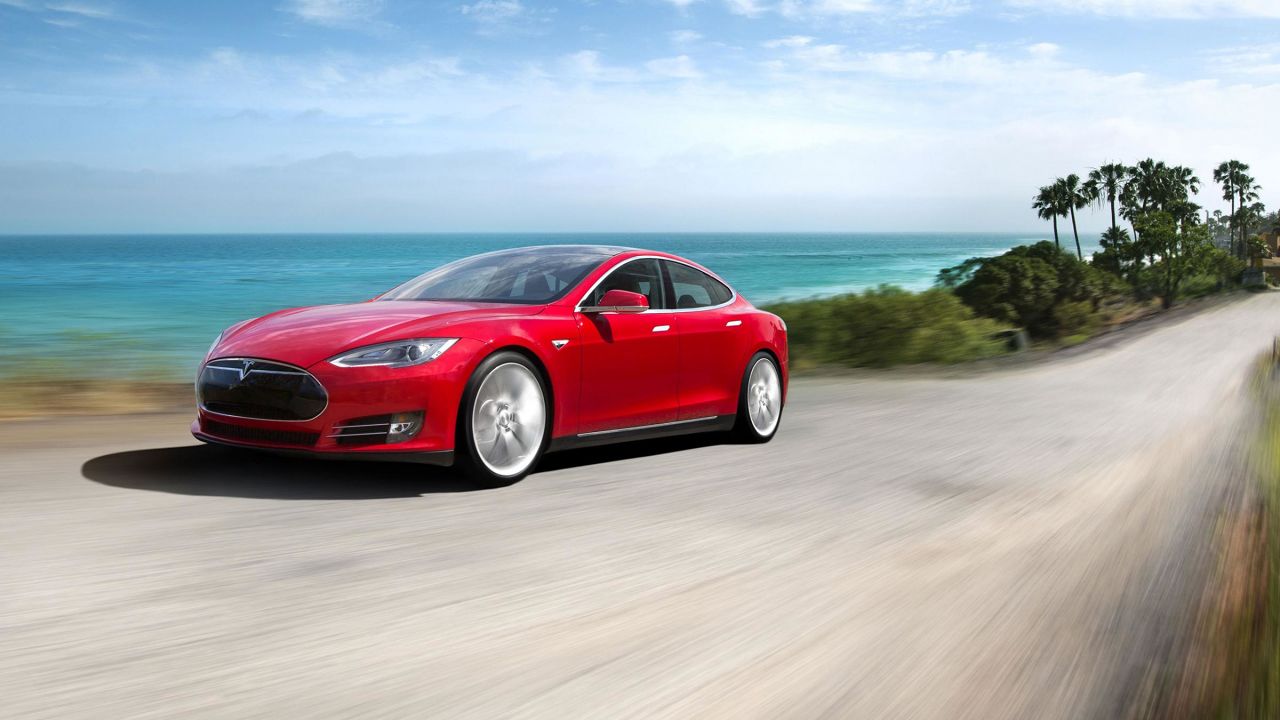
https://i0.wp.com/f.fastcompany.net/multisite_files/fastcompany/imagecache/1280/poster/2014/06/3031851-poster-model-s-photo-gallery-01.jpgIt’s official: all of Tesla’s electric car technology is now available for anyone to use. Yes, after hinting that he might be willing to do so last weekend, Musk announced this week that his companies patents are now open source. In a blog post on the Tesla website, Musk explained his reasoning. Initially, Musk wrote, Tesla created patents because of a concern that large car companies would copy the company’s electric vehicle technology and squash the smaller start-up.

This was certainly reasonable, as auto giants like General Motors, Toyota, and Volkswagon have far more capital and a much larger share of the market than his start-up did. But in time, Musk demonstrated that there was a viable market for affortable, clean-running vehicles. This arsenal of patents appeared to many to be the only barrier between the larger companies crushing his start-up before it became a viable competitor.

electric_carBut that turned out to be an unnecessary worry, as carmakers have by and large decided to downplay the viability and relevance of EV technology while continuing to focus on gasoline-powered vehicles. At this point, he thinks that opening things up to other developers will speed up electric car development. And after all, there’s something to be said about competition driving innovation.

As Musk stated on his blog:

Given that annual new vehicle production is approaching 100 million per year and the global fleet is approximately 2 billion cars, it is impossible for Tesla to build electric cars fast enough to address the carbon crisis. By the same token, it means the market is enormous. Our true competition is not the small trickle of non-Tesla electric cars being produced, but rather the enormous flood of gasoline cars pouring out of the world’s factories every day…

We believe that Tesla, other companies making electric cars, and the world would all benefit from a common, rapidly-evolving technology platform.

https://i0.wp.com/media.treehugger.com/assets/images/2011/10/tesla-roadster-ev-rendering01.jpgAnd the move should come as no surprise. As the Hyperloop demonstrated, Musk is not above making grandiose gestures and allowing others to run with ideas he knows will be profitable. And as Musk himself pointed in a webcast made after the announcement, his sister-company SpaceX – which deals with the development of reusable space transports – has virtually no patents.

In addition, Musk stated that he thinks patents are a “weak thing” for companies. He also suggested that opening up patents for Tesla’s supercharging technology (which essentially allows for super-fast EV charging) could help create a common industry platform. But regardless of Musk’s own take on things, one thing remains clear: Tesla Motors needs competitors, and it needs them now.

https://i0.wp.com/www.greenoptimistic.com/wp-content/uploads/2012/11/Siemens-electric-car-charging-stations.jpgAs it stands, auto emissions account for a large and growing share of greenhouse gas emissions. For decades now, the technology has been in development and the principles have all been known. However, whether it has been due to denial, intransigence, complacency, or all of the above, no major moves have been made to effect a transition in the auto industry towards non-fossil fuel-using cars.

Many would cite the lack of infrastructure that is in place to support the wide scale use of electronic cars. But major cities and even entire nations are making changes in that direction with the adoption of electric vehicle networks. These include regular stations along the Trans Canada Highway, the Chargepoint grid in Melbourne to Brisbane, Germany’s many major city networks, and the US’s city and statewide EV charging stations.

Also, as the technology is adopted and developed further, the incentive to expand electric vehicle networks farther will be a no brainer. And given the fact that we no longer live in a peak oil economy, any moves towards fossil fuel-free transportation should be seen as an absolutely necessary one.

Sourees: fastcoexist.com, fool.com

Frontiers in 3-D Printing: Frankenfruit and Blood Vessels

bioprinting3-D printing is pushing the boundaries of manufacturing all the time, expanding its repertoire to include more and more in the way of manufactured products and even organic materials. Amongst the many possibilities this offers, arguably the most impressive are those that fall into the categories of synthetic food and replacement organs. In this vein, two major breakthroughs took place last month, with the first-time unveiling of both 3-D printed hybrid fruit and blood vessels.

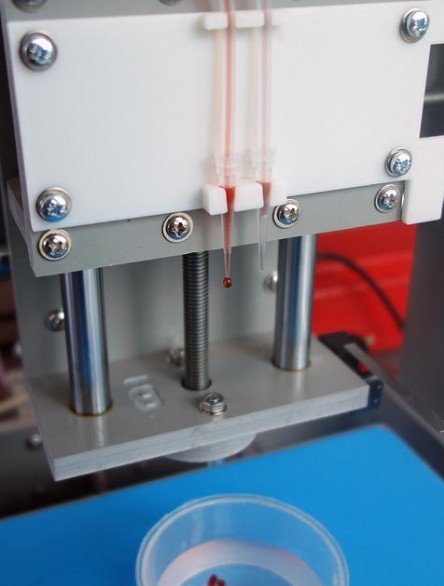
The first comes from a Dovetailed, UK-based design company which presented its 3-D food printer on Saturday, May 24th, at the Tech Food Hack event in Cambridge. Although details on how it works are still a bit sparse, it is said to utilize a technique known as “spherification” – a molecular gastronomy technique in which liquids are shaped into tiny spheres – and then combined with spheres of different flavors into a fruit shape.

frankenfruit1According to a report on 3DPrint, the process likely involves combining fruit puree or juice with sodium alginate and then dripping the mixture into a bowl of cold calcium chloride. This causes the droplets to form into tiny caviar-like spheres, which could subsequently be mixed with spheres derived from other fruits. The blended spheres could then be pressed, extruded or otherwise formed into fruit-like shapes for consumption.

The designers claim that the machine is capable of 3D-printing existing types of fruit such as apples or pears, or user-invented combined fruits, within seconds. They add that the taste, texture, size and shape of those fruits can all be customized. As Vaiva Kalnikaitė, creative director and founder of Dovetailed, explained:

Our 3D fruit printer will open up new possibilities not only to professional chefs but also to our home kitchens – allowing us to enhance and expand our dining experiences… We have been thinking of making this for a while. It’s such an exciting time for us as an innovation lab. Our 3D fruit printer will open up new possibilities not only to professional chefs but also to our home kitchens, allowing us to enhance and expand our dining experiences. We have re-invented the concept of fresh fruit on demand.

frankenfruit2And though the idea of 3-D printed fruit might seem unnerving to some (the name “Frankenfruit” is certainly predicative of that), it is an elegant solution of what to do in an age where fresh fruit and produce are likely to become increasingly rare for many. With the effects of Climate Change (which included increased rates of drought and crop failure) expected to intensify in the coming decades, millions of people around the world will have to look elsewhere to satisfy their nutritional needs.

As we rethink the very nature of food, solutions that can provide us sustenance and make it look the real thing are likely to be the ones that get adopted. A video of the printing in action is show below:


Meanwhile, in the field of bioprinting, researchers have experienced another breakthrough that may revolution the field of medicine. When it comes to replacing vital parts of a person’s anatomy, finding replacement blood vessels and arteries can be just as daunting as finding sources of replacement organs,  limbs, skin, or any other biological material. And thanks to the recent efforts of a team from Brigham and Women’s Hospital (BWH) in Boston, MA, it may now be possible to fabricate these using a bioprinting technique.

3d_bloodvesselsThe study was published online late last month in Lab on a Chip. The study’s senior author,  Ali Khademhosseini – PhD, biomedical engineer, and director of the BWH Biomaterials Innovation Research Center – explained the challenge and their goal as follows:

Engineers have made incredible strides in making complex artificial tissues such as those of the heart, liver and lungs. However, creating artificial blood vessels remains a critical challenge in tissue engineering. We’ve attempted to address this challenge by offering a unique strategy for vascularization of hydrogel constructs that combine advances in 3D bioprinting technology and biomaterials.

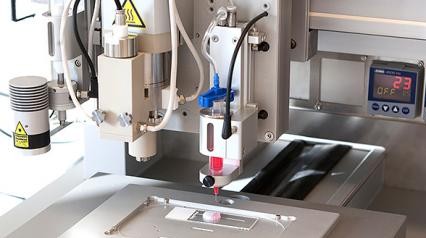
The researchers first used a 3D bioprinter to make an agarose (naturally derived sugar-based molecule) fiber template to serve as the mold for the blood vessels. They then covered the mold with a gelatin-like substance called hydrogel, forming a cast over the mold which was then  reinforced via photocrosslinks. Khademhosseini and his team were able to construct microchannel networks exhibiting various architectural features – in other words, complex channels with interior layouts similar to organic blood vessels.

bioprinting1They were also able to successfully embed these functional and perfusable microchannels inside a wide range of commonly used hydrogels, such as methacrylated gelatin or polyethylene glycol-based hydrogels. In the former case, the cell-laden gelatin was used to show how their fabricated vascular networks functioned to improve mass transport, cellular viability and cellular differentiation. Moreover, successful formation of endothelial monolayers within the fabricated channels was achieved.

According to Khademhosseini, this development is right up there with the possibility of individually-tailored replacement organs or skin:

In the future, 3D printing technology may be used to develop transplantable tissues customized to each patient’s needs or be used outside the body to develop drugs that are safe and effective.

Taken as a whole, the strides being made in all fields of additive manufacturing – from printed metal products, robotic parts, and housing, to synthetic foods and biomaterials – all add up to a future where just about anything can be manufactured, and in a way that is remarkably more efficient and advanced than current methods allow.

 Sources: gizmag.com, 3dprint.com, phys.org

Climate Crisis: Bigger Storm Waves and Glacier Collapse

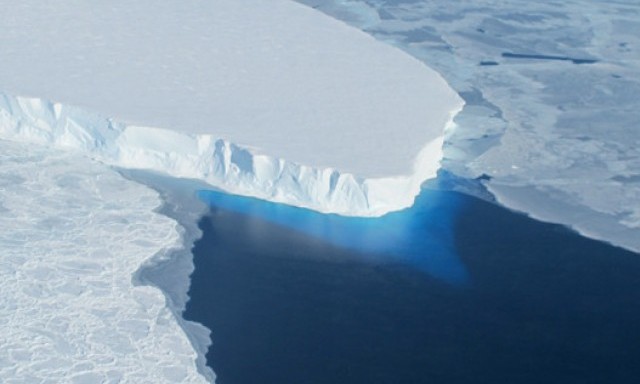
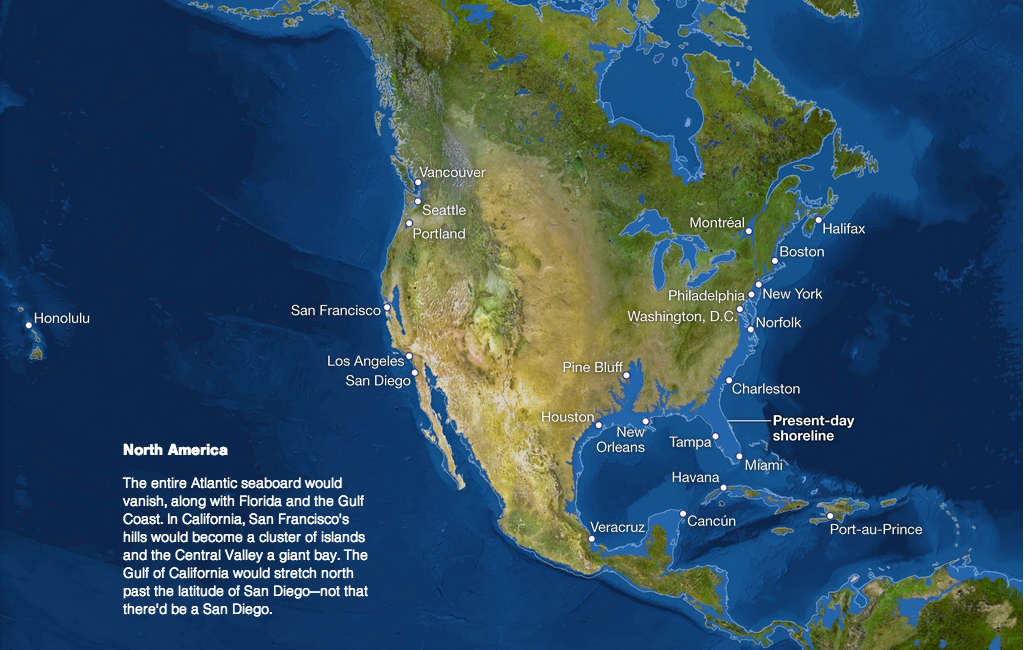
glacier collapseClimate Change is a multifaceted issue, which is due to the fact that there is no single consequence that takes precedence over the others. However, one undeniable consequence is the effect rising sea levels will have, thanks to rising temperatures and melting polar ice caps. Unfortunately, a new paper from Eric Rignot at NASA’s Jet Propulsion Laboratory  claims that some glaciers in West Antarctica “have passed the point of no return”.

A section of glaciers along West Antarctica’s coastline on the Amundsen Sea was previously predicted to be solid enough to last thousands of years. However, the JPL report finds that the ice will continue to slip into the water and melt much faster than expected. These massive glaciers are releasing tremendous amounts of water each year, nearly the equivalent of the entire Greenland Ice Sheet. When they are gone, they will have increased sea-level by about 1.2 meters (4 feet).

NOAA_sea_level_trend_1993_2010Rignot and his team came to this conclusion after analyzing three critical factors of glacier stability: slope of the terrain, flow rate, and the amount of the glacier floating in the water. Flow rate was the topic of a paper Rignot’s team published previously in Geophysical Research Letters where they determined the flow rate of these Antarctic glaciers has increased over the last few decades. The current paper discusses the slope and how much of the glacier is actually floating on seawater.

The conclusion he and his team came to were quite dire. As he summarized it in a recent press conference:

The collapse of this sector of West Antarctica appears to be unstoppable. The fact that the retreat is happening simultaneously over a large sector suggests it was triggered by a common cause, such as an increase in the amount of ocean heat beneath the floating sections of the glaciers. At this point, the end of this sector appears to be inevitable.

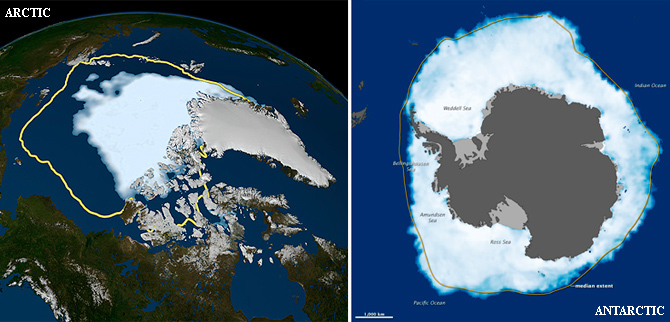
rising_sea_levelsAnother recent study, which appeared last month in the journal Nature, addressed another major problem threatening the polar ice caps. This study, which was compiled by researchers from the National Institute of Water and Atmospheric Research and The University of Newcastle, found that ocean waves that are whipped up by storms hundreds or even thousands of miles away from Earth’s poles, could play a bigger role in breaking up polar sea ice and thus contributing to its melt more than had been thought.

According to the study, these waves penetrate further into the fields of sea ice around Antarctica than current models suggest, and that bigger waves might be more common near the ice edges at both poles as climate change alters wind patterns. Incorporating this information into models could help scientists better predict the patterns of retreat and expansion seen in the sea ice in both Antarctica and the Arctic — patterns that are at least partly related to the effects of climate change — the researchers say.

glacier_collapseSea ice, as its name would suggest, frozen ocean water is, and therefore differs from icebergs, glaciers and their floating tongues called ice shelves – all of which originate on land. Sea ice grows in the winter months, and wanes as summer’s warmth causes it to melt. The amount of ice present can influence the movement of ocean currents — on average, about 9.7 million square miles of the ocean is covered with sea ice, according to the U.S. National Snow and Ice Data Center (NSIDC).

Researchers in Australia and New Zealand wanted to see how the action of big waves — defined as those with a height of at least 3 meters (about 10 feet) — might play a role in influencing the patterns of retreat and expansion, and if they could help improve the reliability of sea ice models. Prior to this study, no one had measured the propagation of large waves through sea ice before because the sea ice is in some of the most remote regions on the planet, and icebreaker ships must be used to plow through the thick ice.

Live blog on Artic sea ice : Sea Ice MinimumTo conduct their research, Alison Kohout – of New Zealand’s National Institute of Water and Atmospheric Research and the lead author on the study – went on a two-month ocean voyage with her colleagues to drop five buoys onto the sea ice that could measure the waves as they passed. It is thought that the ice behaves elastically as the waves pass through, bending with the wave peaks and troughs, weakening, and eventually breaking.

What the team found was that the big waves weren’t losing energy as quickly as smaller waves, allowing them to penetrate much deeper into the ice field and break up the ice there. That exposes more of the ice to the ocean, potentially causing more rapid melting and pushing back the edge of the sea ice. The researchers also compared observed positions of the sea ice edge with modeled wave heights in the Southern Ocean from 1997 to 2009 and found a good match between the waves and the patterns of retreat and expansions.

NASA_arctic-antarctic-2012Essentially, more big waves matched increased rates of sea ice retreat and vice versa. And while they believe that this might be able to help researchers understand this regional variability around Antarctica, Kohout and other researchers agree that more work needs to be done to fully understand how waves might be influencing sea ice. Kohout and her colleagues are planning another expedition in a couple of years. and it is hoped that subsequent studies will help identify the relationship with larger ice floes as well as the Arctic.

One thing remains clear though: as we move into the second and third decade of the 21st century, a much clearer picture of how anthropogenic climate change is effecting our environment and creating feedback mechanisms is likely to resolve itself. One can only hope that this is the result of in-depth research and not from the worst coming to pass! It is also clear that it is at the poles of the planet, where virtually no human beings exist, that the clearest signs of human agency are at work.

And be sure to check out this video from NASA’s Jet Propulsion Laboratory that illustrates the decline of glaciers in Western Antarctica:


Sources:
iflscience.com, scientificamerican.com


The Future is Here: Vertical Algae Farms

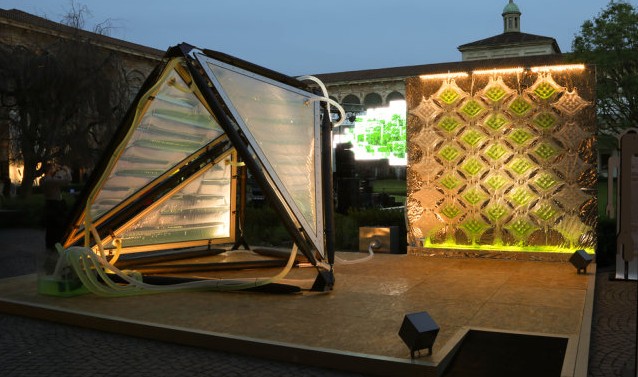
waterlilly1Walls may be the next frontier in in urban farming, allowing residents of large buildings to cultivate food for local consumption. Already, rooftop gardens are already fairly common, the use of exterior walls for growing spaces is still considered problematic. While certain strains of edible greens might grow in a “vertical farm”, root vegetables, tubers and fruits aren’t exactly practical options. However, a vertical algae farm just might work, and provide urban residents with a source of nutrition while it cleans the air.

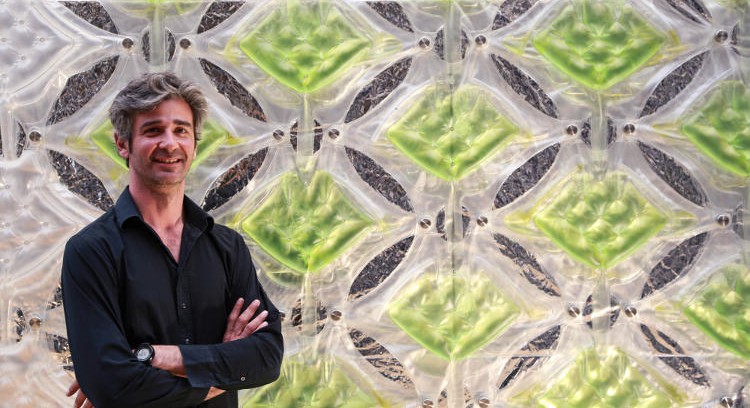
That’s the idea behind Italian architect Cesare Griffa’s new concept, which is known as the WaterLilly system. Basically, this algae-filled structure, which can be attached to the façade of a building, is made up of a series of individual chambers that contain algae and water. After a few days or weeks, the algae can be harvested and used for energy, food, cosmetics, or pharmaceuticals, with a small amount left behind to start the next growing cycle.

waterlilly2In addition to being completely non-reliant on fossil fuels, these algae also take in carbon dioxide and produce oxygen while growing. Compared to a tree, micro-algae are about 150 to 200 times more efficient at sucking carbon out of the air, making them far more useful in urban settings than either parks or green spaces. Unfortunately, public perception is a bit of a stumbling block when it comes to using microorganisms in the pursuit of combating Climate Change and pollution.

As Griffa himself remarked:

Micro-organisms like algae are like bacteria–it’s one of those things that in our culture people try to get rid of. But algae offer incredible potential because of their very intense photosynthetic activity.

waterlilly3Each system is custom designed for a specific wall, since it’s important to have the right conditions for the algae to thrive. Too little sun isn’t good for growth, but too much sun will cook the organisms. Griffa is working on his first large-scale application now, which will be installed in the Future Food District curated by Carlo Ratti Associates at Expo 2015 in Milan. And it won’t be the first project to incorporate algae-filled walls. A new building in Germany is entirely powered by algae growing outside.

But as Griffa indicates, there’s no lack of wall space to cover, and plenty of room for different approaches:

Urban facades and roofs represent billions of square meters that instead of being made of an inanimate material such as concrete, could become clever photosynthetic surfaces that respond to the current state of climate warming.

And in that, he’s correct. In today’s world, where urban sprawl, pollution, and the onset of Climate Change are all mounting, there’s simply no shortage of ideas, nor the space to test them. As such, it is not far-fetched at all to suspect that in the coming years, algae farms, artificial trees, coral webbing, and many other proposed solutions will be appearing in major cities all over the world.

Source: fastcoexist.com

New Theatrical Trailer: Interstellar

interstellar_2014This weekend, when the Godzilla remake will be screening, audiences will be treated to another first. After wrapping up with the Dark Knight series, Christopher Nolan has taken a different route with this next project, title Interstellar. And with this latest theatrical trailer, moviegoers will finally see exactly what his new film is about. Basically, in the not-to-distant future, a global food crisis hits Earth, and to find solutions, humanity must look to the stars.

That’s the bare bones of it at any rate.  To be more specific, the plot revolves around Cooper (Matthew McConaughey) and his family. A former pilot and engineer who has had to turn to farming to feed his family, Conner finds himself being called upon to take part in an expedition in order to find a new place for humanity to live. As Michael Caine’s character is quoted as saying: “We’re not meant to save the world, we’re meant to leave it.”

Embracing such things as Climate Change and the public’s growing fascination with space exploration and the next great leaps humanity is likely to take, Nolan has announced his return to the world of epic space-exploration. And between the scenes of gritty desolation seen on planet Earth, to the majestic grandeur of the scenes set in space, it’s clear that Nolan is well suited to the medium, being a director who’s well known for his stunning visuals and ability to create atmosphere.

Climate Crisis: Present Changes and Coming Impacts

climate-changeThis Tuesday, the Whitehouse received the latest draft of the Climate Assessment Report, a scientific study produced by the National Climate Assessment to determine the impacts of Climate Change. In addition to outlining the risks it poses to various regions in the US, the report also addresses the apparent increase in the number of severe weather events that have taken place in the past few years, and how these events affect local economies and communities.

According to the 840-page report, America is fast becoming a stormy and dangerous place, with rising seas and disasters effecting regions from flood-stricken Florida to the wildfire-ravaged West. The report concluded that Climate change’s assorted harms “are expected to become increasingly disruptive across the nation throughout this century and beyond.” It also emphasized how warming and its all-too-wild weather are changing daily lives, even using the phrase “climate disruption” as another way of saying global warming.
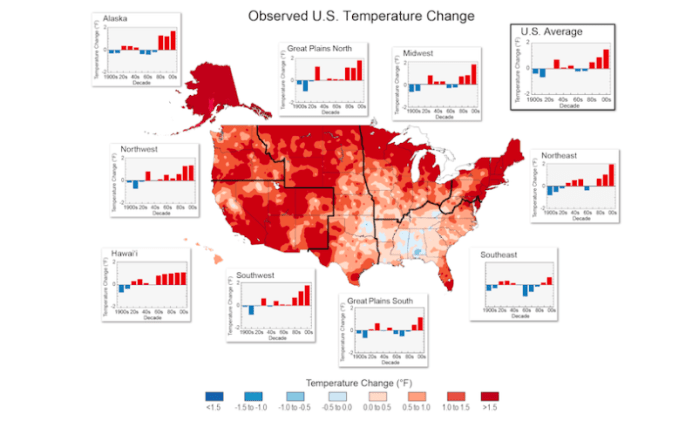
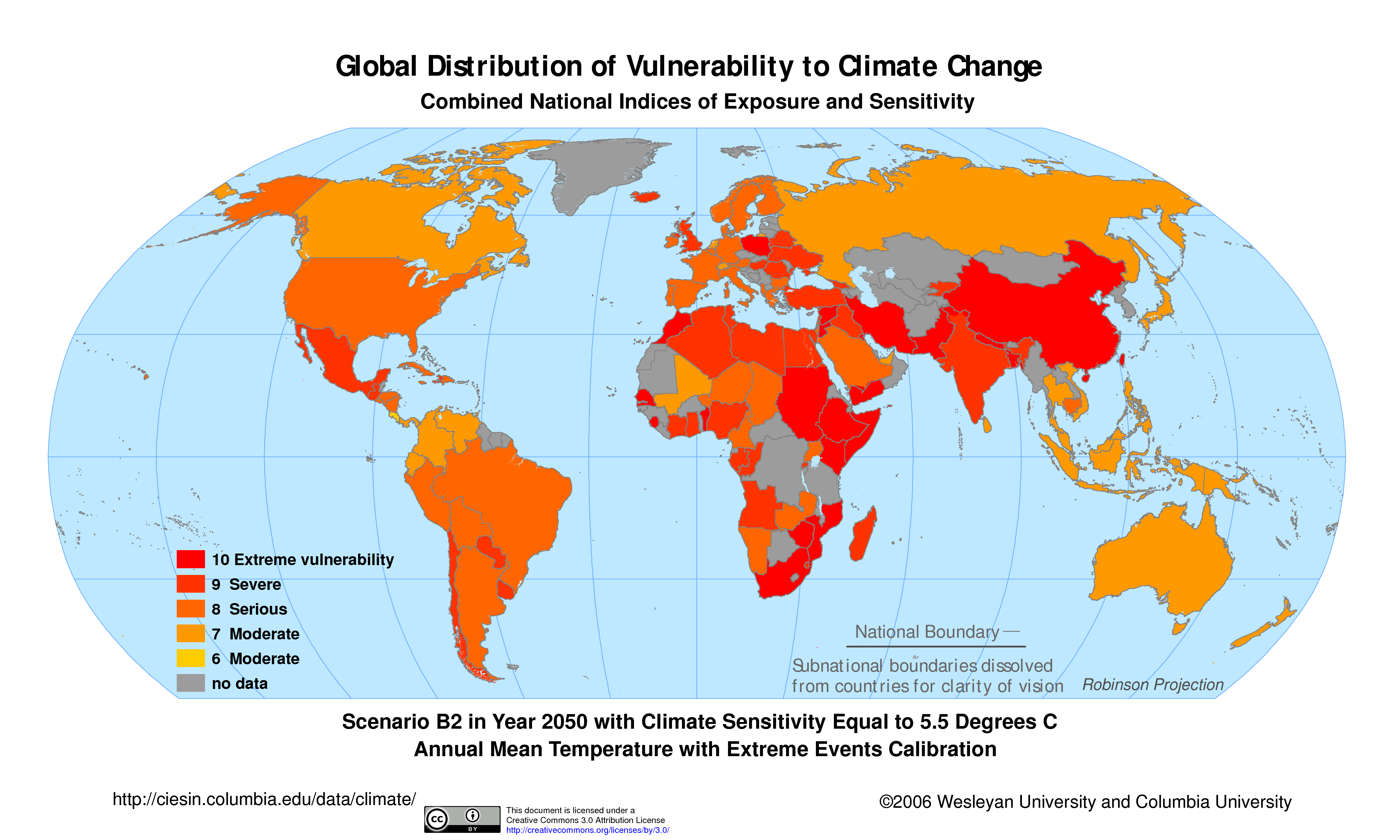
Climate_Change_vulnerability_USHenry Jacoby, co-director of the Joint Program on the Science and Policy of Global Change at the MIT, was joined by other scientists and White House officials when he claimed that this is the most detailed and U.S.-focused scientific report on global warming. Above all, the most chilling claim contained within is the fact that “Climate change, once considered an issue for a distant future, has moved firmly into the present.”

The report also examined the effects at the regional and state-level, compared with recent reports from the UN that examined North America as a single case study. In a recent interview with CBC’s The Lang & O’Leary Exchange, Jacoby pointed to a range of impacts of global warming that people see everyday, from the change in the growing season, to extreme heat, severe Atlantic storms and drought in some areas.
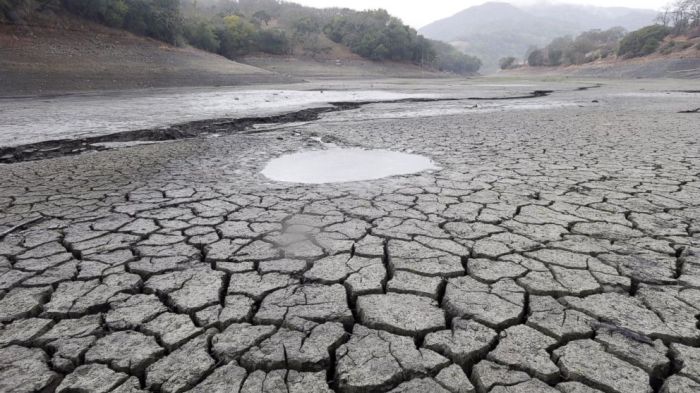
climate_change_variableweatherAs he explained, these changes are far more than just variable weather:

If you look at what’s happening to the Arctic ice at your northern border, you are seeing changes to the ice like you haven’t seen in hundreds of years. We’re seeing change on a scale that’s going beyond variability.

A draft of the report was released in January 2013, but this version has been reviewed by more scientists, the National Academy of Science, 13 other government agencies, and was subject to public comment. It is written in a bit more simple language so people could realize “that there’s a new source of risk in their lives,” said study lead author Gary Yohe of Wesleyan University in Connecticut.

Even though the nation’s average temperature has risen by as much as 1.9 degrees since record keeping began in 1895, it’s in the big, wild weather where the average person feels climate change the most. As the report’s co-author Katharine Hayhoe – a Texas Tech University climate scientist – put it, extreme weather like droughts, storms and heat waves hit us in the pocketbooks and can be seen by our own eyes. And it’s happening a lot more often lately.

climate_change_precipThe report says the intensity, frequency and duration of the strongest Atlantic hurricanes have increased since the early 1980s. Winter storms have increased in frequency and intensity and shifted northward since the 1950s, with heavy downpours increasing by 71 per cent in the northeast alone. Heat waves are projected to intensify nationwide, with droughts in the southwest expected to get stronger. Sea levels have risen 20 centimetres since 1880 and are projected to rise between 0.3 meters and 1.2 metres by 2100.

The report was also clear that the 2010’s have been a record-setting decade. For example, since January 2010, 43 of the lower 48 states have set at least one monthly record for heat, such as California having its warmest January on record this year. In the past 51 months, states have set 80 monthly records for heat, 33 records for being too wet, 12 for lack of rain and just three for cold, according to an Associated Press analysis of federal weather records.

climate_change_tempsAs she described it, America is basically in a boxing match, and is currently on the ropes:

We’re being hit hard. We’re holding steady, and we’re getting hit in the jaw. We’re starting to recover from one punch, and another punch comes.

John Podesta, an adviser to President Barack Obama, said on Monday that the report includes “a huge amount of practical, usable knowledge that state and local decision-makers can take advantage of.” The report also stressed that climate change threatens human health and well-being in a number of ways. Those include smoke-filled air from more wildfires, smoggy air from pollution, more diseases from tainted food, water, mosquitoes and ticks.

climate_change_lossAnd then there’s more pollen because of warming weather and the effects of carbon dioxide on plants. Ragweed pollen season has lengthened by 24 days in the Minnesota-North Dakota region between 1995 and 2011, the report says. In other parts of the Midwest, the pollen season has gotten longer by anywhere from 11 days to 20 days. And all of this has associated costs, not the least of which is in damages, insurance costs, and health care expenses.

Flooding alone may cost $325 billion by the year 2100 in one of the worst-case scenarios, with $130 billion of that in Florida, the report says. Already the droughts and heat waves of 2011 and 2012 added about $10 billion to farm costs, the report says. Billion-dollar weather disasters have hit everywhere across the nation, but have hit Texas, Oklahoma and the southeast most often, the report says. And there is the impact on agricultural producers, which is also stressed:

Corn producers in Iowa, oyster growers in Washington state and maple syrup producers in Vermont are all observing climate-related changes that are outside of recent experience.

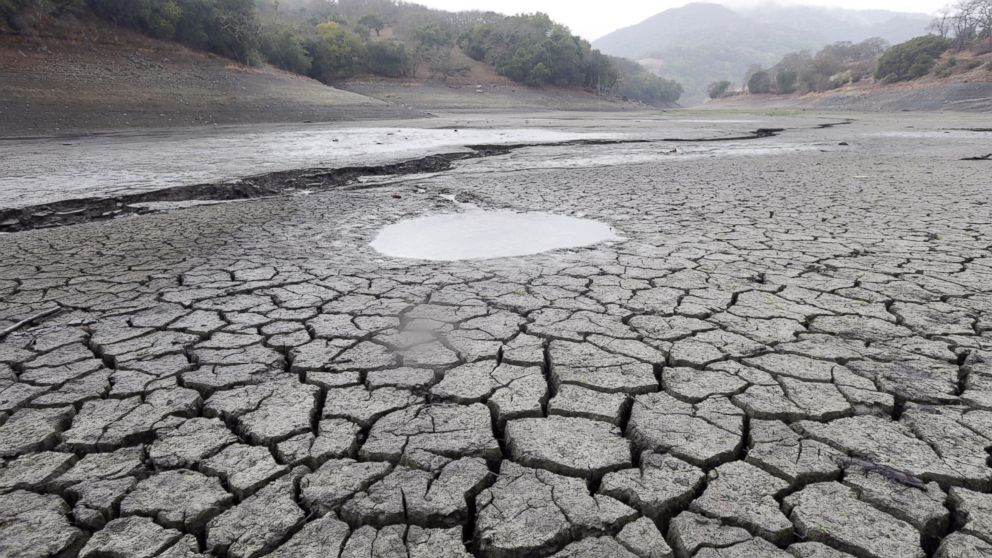
Climate_Change_vulnerability1Still, it’s not too late to prevent the worst of climate change, says the 840-page report, which the White House is highlighting as it tries to jump-start often stalled efforts to curb heat-trapping gases. However, if the U.S. and the world don’t change the way they use energy, the current effects will continue to intensify to the point where property damage, wildfires, storms, flooding and agricultural collapse will become untenable.

Already, the report has its detractors, many of whom appeared together for a Special Report segment on Fox News. In addition to commentator George Will questioning the scientific consensus – which accounts for 97% of the scientific community – Charles Krauthammer compared to the findings to a bargaining process, and ultimately condemned it as “superstition”. As he put it:

What we’re ultimately talking about here is human sin, through the production of carbon. It’s the oldest superstition around. It was in the Old Testament. It’s in the rain dance of the Native Americans. If you sin, the skies will not cooperate. This is quite superstitious and I’m waiting for science that doesn’t declare itself definitive but is otherwise convincing.

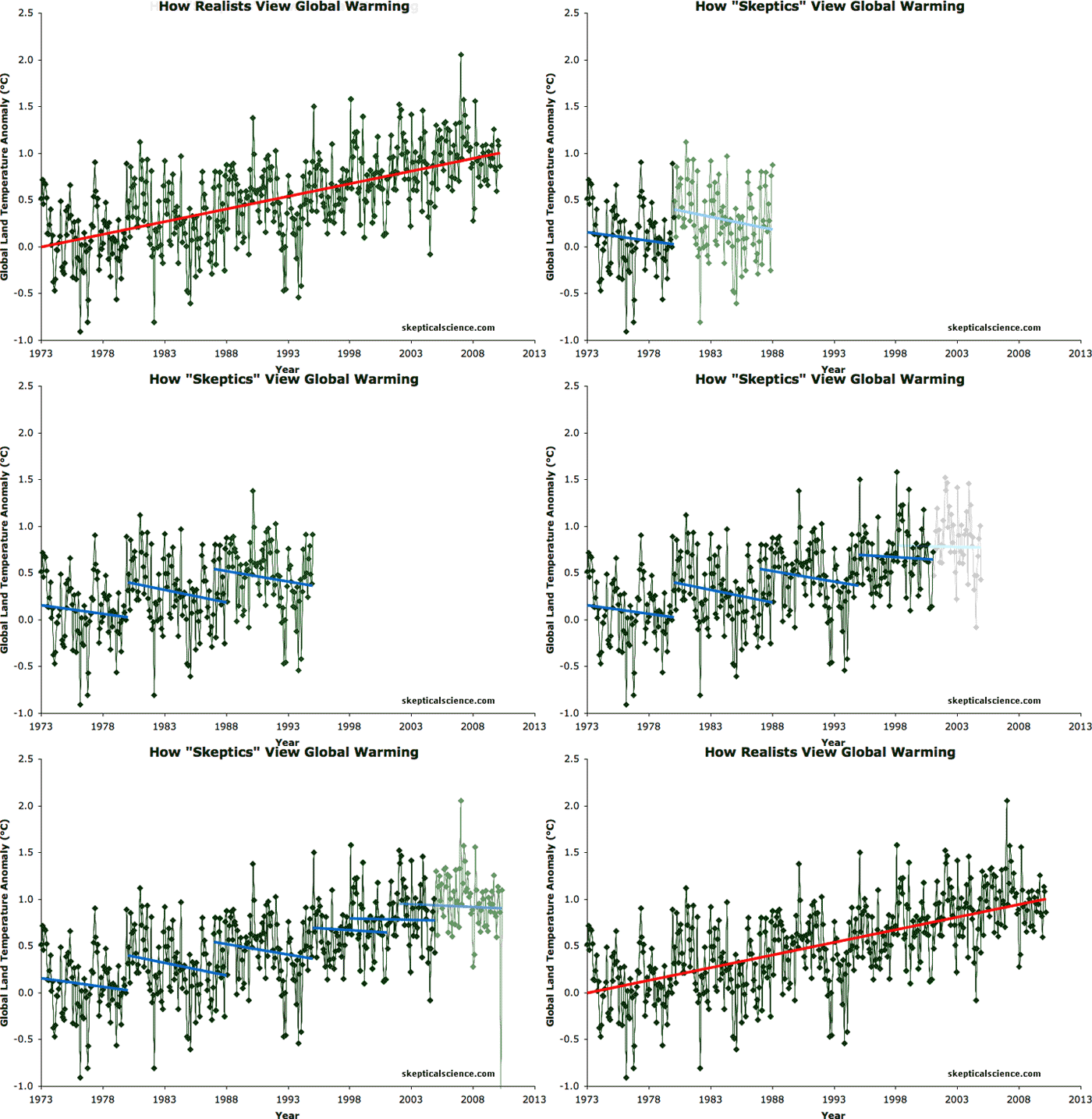
climate_change_denialNot to belabor the point, but superstition is what happens when people trust in rituals and practices that have no discernible effect whatsoever on a problem to protect themselves from said problem. Conducting research, performing field studies, and compiling statistics that cover hundreds, thousands, and even millions of years – this is called the scientific method. And Krauthammer would do well to realize that it is this same method that has done away with countless superstitious rituals throughout history.

He and other so-called skeptics (though a more accurate term is deniers) would also do well to understand the difference between superstition and a little thing known as cause and effect. For example, avoiding black cats, not walking under ladders, or sacrificing human beings to make the sun rise or the crops grow is superstition. Pumping thousands of tons of carbon dioxide into the air, which is known to have the effect of absorbing the sun’s thermal energy (aka. radiant forcing), is cause and effect.

See? Easily distinguished. But if there’s one thing that the “denial machine” has shown an affinity for, its remaining divorced from the scientific consensus. Luckily, they have been in full-retreat for some time, leaving only the most die hard behind to fight their battles. One can only hope their influence continues to diminish as time goes on and the problems associated with Climate Change get worse.

You can read the  full Climate Assessment Report here.

Sources: cbc.ca, abcnews.go.com, IO9.com, (2), nca2014.globalchange.gov

Climate Crisis: Terraforming the Desert

green_machineNow that I’m back from my European adventure, I finally have the time to catch up on some news stories that were breaking earlier in the month. And between posting about said adventure, I thought I might read up and post up on them, since they are all quite interesting to behold. Take, for example, this revolutionary idea that calls for the creation of a rolling city that has one purpose in mind: to replant the deserts of the world.

Desertification is currently one of the greatest threats facing humanity. Every year, more than 75,000 square kilometers (46,000 square miles) of arable land turns to desert. As deserts spread – a process that is accelerating thanks to climate change and practices like clear-cutting – the UN estimates that more than 1 billion people will be directly affected. Many of them, living in places like Northern Africa and rural China, are already struggling with poverty, so the loss of farmland would be especially hard to handle.

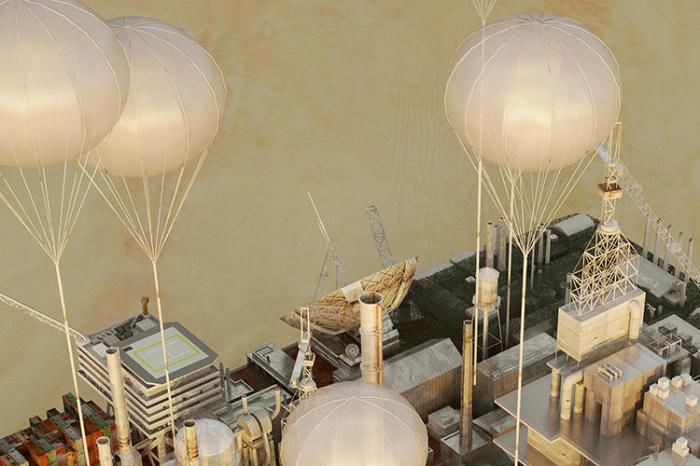
green_machine_balloonsAs a result, scientists are looking to come up with creative solutions to the problem. One such concept is the Green Machine – a floating, self-powered platform that would act as a mobile oasis. Rolling on treads originally designed to move NASA rockets. Designed by Malka Architecture and Yachar Bouhaya Architecture for the Venice Biennial, this mobile city would roam the drylands and plant seeds in an effort to hold back the desert.

The huge platform would be mounted on sixteen caterpillar treads originally made to move NASA rockets, while giant floating balloons that hover from it capture water condensation. As the first treads roll over the soil, the machine uses a little water from the balloons to soften the ground while the last set of treads injects seeds, some fertilizer, and more water. The entire platform would run on renewable power, using a combination of solar towers, wind turbines, and a generator that uses temperature differences in the desert to creates electricity.

green_machine_cityThe machine could theoretically capture enough energy that it can self-support an entire small city onboard, complete with housing, schools, businesses, parks, and more farmland to grow produce for the local area. This city would house and support the many researchers, agronomers, workers and their families that would be needed to oversee the efforts. Similar to what takes place in oil drilling, these individuals could be flown in for periods of work that could last up to sixth weeks at a time before rotating out.

The designers were inspired by Allan Savory, who has proposed a much lower-tech version of the same process that relied on cattle to naturally till and fertilize the soil. For the architects, building on this idea seemed like a natural extension of their work. If the machine went into action at desert borders, the designers say it could help formerly barren soil produce 20 million tons of crops each year, and could even help slow climate change by capturing carbon in soil.

green_machine_terraOver time, biodiversity could also gradually return to the area. The architects are currently working on developing the project on the Moroccan side of the Sahara Desert. As Stephane Malka, founder of Malka Architecture, put it, it’s all about using the neglected parts of the world to plan for humanity’s future:

For a long time, my studio has developed work around neglected spaces of the city. Deserts are the biggest neglected space on Earth, as they represent more than 40% of the terrestrial surface. Building the Green Machine units would be able to re-green half of the desert borders and the meadows of the world, while feeding all of humanity

As to the sheer size of their massive, treaded city, the designers stressed that it was merely an extension of the challenge it is seeking to address. Apparently, if you want to halt a worldwide problem, you need a big-ass, honking machine!

Sources: fastcoexist.com, dvice.comdesignboom.com