The Future is Here: FDA Approves Human Suspended Animation

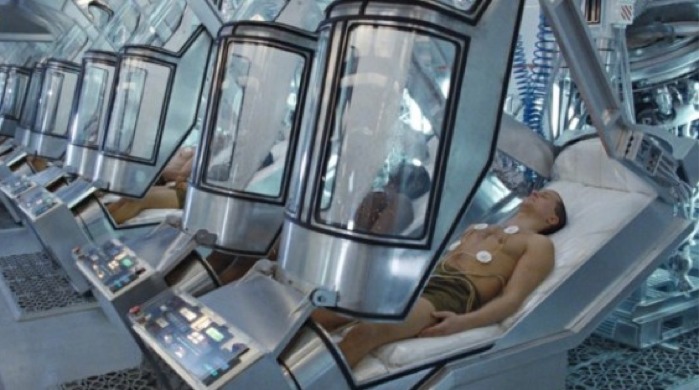
prometheus-cryotubeWe’ve all heard about it, read about it, and seen it in the movies. Suspended Animation. The ability to put someone in a tank and chill them to the point where their heart rate, breathing, and metabolism are reduced to an absolute minimum, preserving their life or prolonging it artificially. It’s a common science fiction concept, but could such a technique ever be made feasible? That is what a team of researchers from UPMC Presbyterian Hospital in Pittsburgh, with FDA approval, are attempting to answer.

The purpose of this research is to see if suspended animation can deliver on its main promise – namely, keeping a patient alive long enough to receive life-saving treatment or surgery. Oftentimes with disease and traumatic injuries, the difference between life and death is a simple matter of timing. And for those patients who simply cannot be helped with the current level of technology and pharmacology, it is also a race against time, trying to stay alive long enough to see science catch up with the illness.

EPRThis Emergency Preservation and Resuscitation (EPR) technique isn’t quite as extreme as what we’ve come to know from science fiction franchises. Instead of reducing a patient’s temperature to near-freezing levels, it involves reducing body temperature to 10 degrees Celsius (50 degrees Fahrenheit) by inserting a cannula into the aorta and flushing cold saline into the system. This will slow the blood flow, which will prevent the body from bleeding out and slow other biological processes as well.

So far, the result have been pretty subdued – with the EPR state of induced hypothermia only being sustainable for about two hours. While this isn’t as dramatic as some may have expected, that could easily provide enough time for surgeons to perform emergency lifesaving surgery. Trauma patients who suffer cardiac arrest have a 7% chance of survival, and administering this technique could have some very real and amazing implications.

suspended-animationThis technique was first tested by Peter Rhee in 2000 using 40 pigs, the results of which were published in 2006. After inflicting a lethal wound to simulate real-world trauma scenarios, the pigs were cooled down so the surgeons could operate then resuscitate them. While all of the control pigs died, the surgeons were able to save 90% of the pigs who had undergone suspension. None of the surviving pigs were reported to have sustained cognitive or physical impairment either.

And as per usual, animal testing is followed by human trials to see if success can be replicated. Due to the extremely time-sensitive and dire nature of the injuries of the test subjects, the FDA has declared that the surgeons will not require informed consent. As a precaution, the team took out advertisements to inform the public of the upcoming study, and even set up a website that would allow people to opt out, if desired. As of yet, nobody has opted out.

alien-stasis-suspended-animationThe plan for testing this process is for the team to the technique on 10 trauma patients whose injuries would be otherwise fatal. That group will be compared against 10 other patients who are not able to undergo EPR, due to the surgical team not being available. After the first increments of 10 EPR and 10 control patients, the technique will be analyzed and refined until enough data points have been collected which will allow them to analyze the efficacy of suspending life in this manner.

Should things work out, we can expect to see EPR becoming a regular part of modern medicine. And with further refinements, it may even be possible to place people in suspended animation for longer (or even indefinite) periods of time. If not, then I guess it will be just become one more of those many, many sci-fi fantasies that (like a patients in a story) will be put away until such time as the technology catches up to the fantasy.

Sources: dailycaller.com, iflscience.com


Game of Thrones – Season Four Episode 9

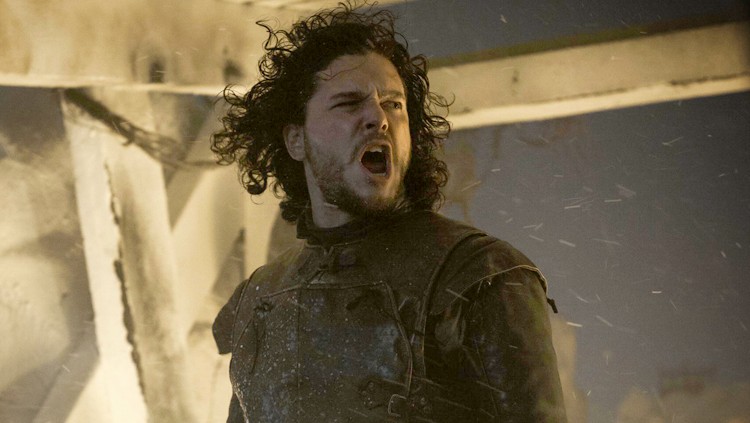
got4This past weekend, the penultimate episode of Season Four of GOT aired, and an event which was a long time in coming was finally showed. Yes, after two seasons of build-up, the Wildlings under “King” Mance Rayder’s leadership, assaulted the Wall. Strangely, Mance was nowhere to be seen during this assault, but from the way they ended the episode, I’m sure we’ll be hearing from him soon enough. And as usual, I got some bones to pick with the writers, but not the same reasons others have.

After this weekend’s episode aired, a common thing I noticed from the critics was the statement that the attack on the Wall was no “Blackwater Bay”. Much like Season Two’s smash-up where Stannis and his armies lay siege to King’s Landing, the entire episode was dedicated to this one battle and those involved. And while it didn’t exactly have the same epic scope and grandeur as that battle, I think this is an unfair comparison.

One cannot expect a massive siege every season! It’s just not cost effective. No, in the end, I felt this battle fell a bit short because of the way they changed things around in the story, not to mention the way they shot the whole thing. By the time things really got started, I wasn’t sure if I was watching GOT or Lord of the Rings. Somehow, it felt like Peter Jackson was at the helm and not George RR Martin. But first, a recap…

The Watchers on the Wall:
GOT4_9_1The episode begins with Jon and Samwell standing atop the Wall and discussing love. Sam asks what it was like being with Ygritte, while once again lamenting the fact that he left Gilly at Moletown, where he suspects she died. Jon sends Sam below to get some rest, but he instead goes to the library to learn what Wildlings are known to do to their captives. Aemon finds him and they spend the time talking of lost love.

Going back outside, Sam comes to the gate in time to see Gilly knocking at Castle Black’s gate and asking to be let in. After convincing the Brother guarding it to let her in, he tells her they will never be apart again. Their reunion is interrupted when they hear a horn sound. From atop the Wall, Jon and the other brothers spot a massive forest fire looming in the distance. Mance’s signal to attack is issued, and thousands of Wildlings, giants and mammoths form up.

GOT4_9_2Under the command of Ser Alliser Thorne, the Brothers begin preparing their defenses, and he takes a moment to let Jon know that he will be equal to the task of leading them. The mammoths move forward to the gate while other Wildlings begin scaling the Wall. Sam places Gilly in a chamber below and locks the door, telling her she must hide and he must stand with his Brothers. He kisses her goodbye, and she makes him promise he won’t die.

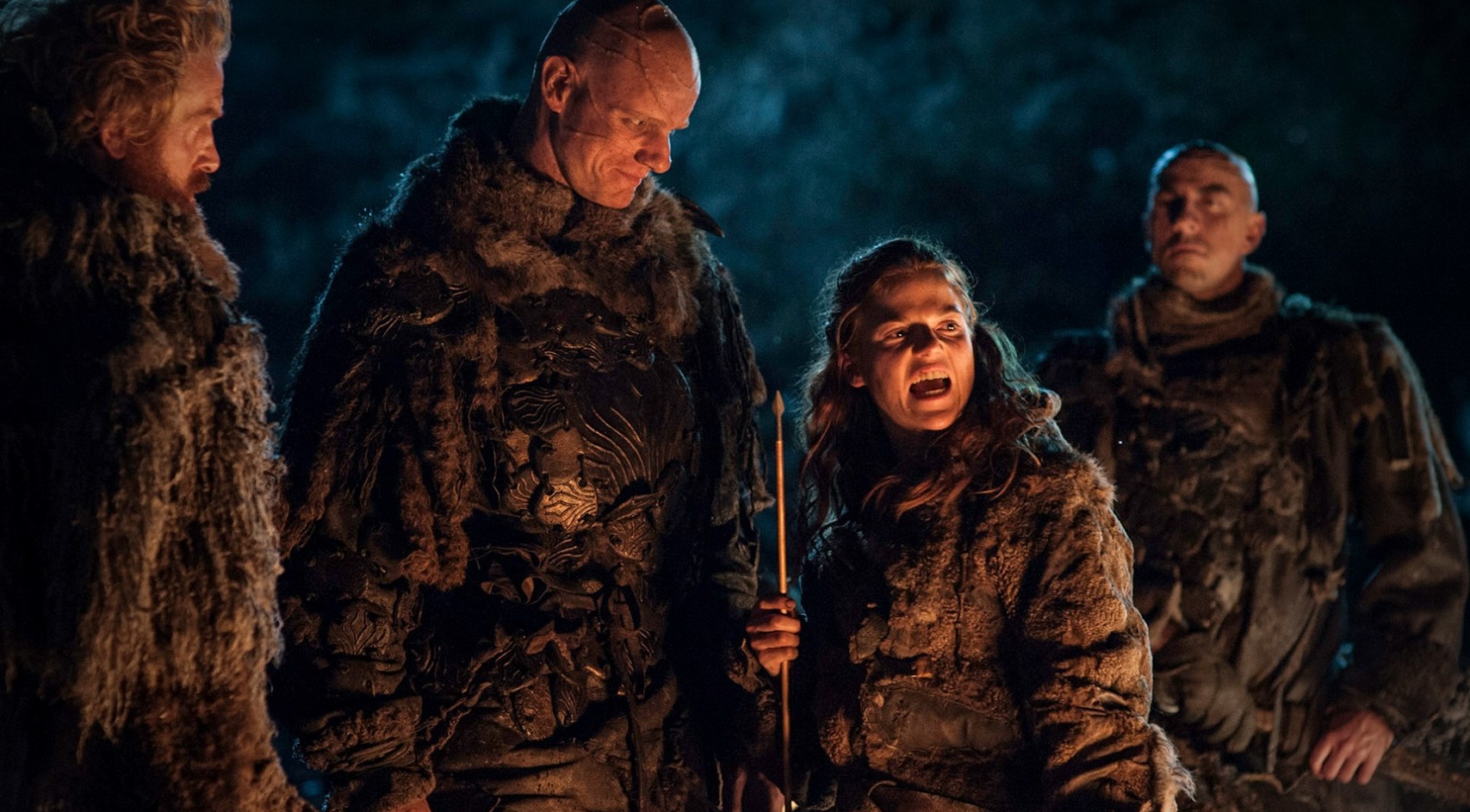
South of the Wall, Ygritte, Tormund, the Thenns and their raiding party are preparing to make their assault. While they wait for Mance to send the signal – “the biggest fire the North has ever seen”. When they spot it, they launch their attack on Castle Black’s gates. Sam and the others let loose on them with arrows, but are quickly overtaken as the Wildling party moves in and scales the short walls that guard the southern approach.

GOT4_9_4Hearing of the attack on the Castle, Thorne goes below to organize the defense, leaving Slynt in charge. Below, two giants lead a mammoth to the gate and hitch ropes from its harness the doors, intending to pull it off. Slynt quickly proves unequal to the task of leading the defense and begins muttering about how it was so much easier commanding the Kingsguard. Grenn then tricks Slynt and tells him he’s needed below too, which leaves Jon in charge.

Relying on the lessons he learned during his time among them, Jon has his archers fire arrows onto those scaling the Wall and drops barrels on those at the gate. Below, the battle in Castle Black’s courtyard turns bad. The brothers lose many men, Thorne is injured and incapacitated, and Slynt runs and locks himself in the same room as Gilly. Jon decides to go below with Grenn and some others, and orders Eddison to unleash fire on the mammoths.

GOT4_9_3This he does, which kills most of the Wildlings and sends the mammoth running. One of the two giants is then killed by a Scorpion up on the Wall, sending the other into a rage and leading him to begin prying the gate open with his bare hands. Jon arrives below and tells Grenn and the others to get to the gate an hold it at all costs. He then has Sam unlock Ghost from his cage and begins fighting his way through the Wildlings.

In a pitch fight, Jon kills Styr (the leader of the Thenn party) with a blacksmith’s hammer and comes face to face with Ygritte, who has her bow drawn on him. She hesitates to shoot him, and is then shot with an arrow through the chest by Olly, the young boy who mans the elevator. She dies, repeating the same words she said to him, time and time again: “You know nothing, Jon Snow.” Inside the Wall gate, the giant breaks through and attacks Grenn and his brothers. They die holding the giant off.

got4_9_5Up top, Eddis sees that they only have the few Wildlings scaling the Wall to deal with, and orders that they drop the “Scythe” – a large metal blade at the end of a chain that combs the wall when released. This kills the remaining attackers, and the rest fall back. In the courtyard, Tormund is wounded and captured, and Jon orders him put in chains. Sam returns below to find Gilly safe, and Slynt cowering in the corner.

Surveying the damage, Jon tells Sam that this was just the first assault, and that Mance will break through before long if they allow him to continue. He then tells Sam that he will meet with Mance, during which time he will attempt to kill him so that the Wildlings once again become divided. They head to for the gate, where they find the bodies of Grenn, the giant, and the others who died holding it. Sam orders the gate opened and says goodbye to Jon.

Summary:
Well, the episode certainly was fun and entertaining. One can’t deny that an incredible amount of time, effort, and good direction went into making it. And it did manage to capture the spirit, if not the letter, of the battle as it was described in the book. But as usual, there were some things that bothered to me that had to do with changes, not to mention how those changes affected the feel and flow of things. Here’s what they were, in chronological order…

First, there was no last-minute reunion between Sam and Gilly. She had been at the castle for some time, and a romance had not quite budded between them. Second, Tormund, Ygritte and the Wildling raider party had already assaulted Castle Black at this point in advance of Mance’s main assault. Having struck at Castle Black days before, they were thwarted by a great deal of ingenuity and booby traps, which were installed thanks to Jon’s help.

Third, there was none of this shuffling around of commanders in the novels. While it is true that Thorne and Slynt did not trust Jon, he was still put in charge of the Wall’s defenses since he had intimate knowledge of Mance’s plan of attack, and because Aemon on his Brothers vouched for him. It was not the case that he had it thrust on him because Thorne had to go below, or because Slynt was a coward. This last aspect they really played up, and it felt like it was just to give us someone to hate.

Fourth, two decidedly cheesy moments happened in this battle. The first was where Sam narrowly managed to get his crossbow loaded in time to take down a Wildling. The second – and by far, the worst – was Ollie going from a frightened little boy who couldn’t stand the sound of fighting to grabbing a bow and killing Ygritte with it. This more than anything was like a scene out of Jackson’s LOTR. It wasn’t nearly as bad as Legolas riding a shield down a set of steps like it was a skateboard, but still!

Fifth, Tormund was not taken prisoner during the battle. After losing his attack force south of the Wall, he fled north again and began rallying Wildlings later. Ever since, even as far as book V, he has not been heard from. And finally, Jon Snow did not decide to venture out and assassinate Mance once the battle was over. In fact, it was Slynt’s idea to send him out in the hopes that he would die while attempting to kill Mance.

You see, after the battle, Slynt and his allies were still nominally in charge since no new Lord Commander had been elected. And he would go on to be a pain in Jon’s ass since he didn’t trust him and saw him as a threat to his possible leadership. However, the way they’ve presented him here, as an incompetent coward, is melodramatic to say the least. It also kind of complicated the plot now, since Slynt disgraced himself for all to see.

In short, it felt like they were trying to sex things up from the original material; but really, I only felt like they dumbed it down. Many things they did get right, like the way the giants penetrated into the gate, or how Ygritte died with Jon standing over her and crying. They also captured the defenders sense of desperation, knowing that they were vastly outnumbered, but still protecting by the Wall’s defenses. And I have to say that this was one episode this season that didn’t bore or disappoint the hell out of me.

Still… where the hell was Mance this whole time? Has anyone else noticed he completely disappeared after his brief appearance last season? He better show up next week, as he’s kind of intrinsic to the plot!

The Birth of AI: Computer Beats the Turing Test!

turing-statueAlan Turing, the British mathematician and cryptogropher, is widely known as the “Father of Theoretical Computer Science and Artificial Intelligence”. Amongst his many accomplishments – such as breaking Germany’s Enigma Code – was the development of the Turing Test. The test was introduced by Turing’s 1950 paper “Computing Machinery and Intelligence,” in which he proposed a game wherein a computer and human players would play an imitation game.

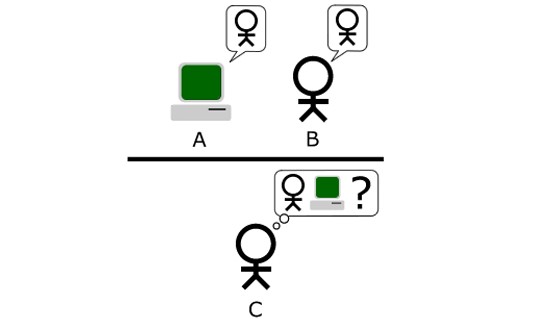
In the game, which involves three players, involves Player C  asking the other two a series of written questions and attempts to determine which of the other two players is a human and which one is a computer. If Player C cannot distinguish which one is which, then the computer can be said to fit the criteria of an “artificial intelligence”. And this past weekend, a computer program finally beat the test, in what experts are claiming to be the first time AI has legitimately fooled people into believing it’s human.

eugene_goostmanThe event was known as the Turing Test 2014, and was held in partnership with RoboLaw, an organization that examines the regulation of robotic technologies. The machine that won the test is known as Eugene Goostman, a program that was developed in Russia in 2001 and goes under the character of a 13-year-old Ukrainian boy. In a series of chatroom-style conversations at the University of Reading’s School of Systems Engineering, the Goostman program managed to convince 33 percent of a team of judges that he was human.

This may sound modest, but that score placed his performance just over the 30 percent requirement that Alan Turing wrote he expected to see by the year 2000. Kevin Warwick, one of the organisers of the event at the Royal Society in London this weekend, was on hand for the test and monitored it rigorously. As Deputy chancellor for research at Coventry University, and considered by some to be the world’s first cyborg, Warwick knows a thing or two about human-computer relations

kevin_warwickIn a post-test interview, he explained how the test went down:

We stuck to the Turing test as designed by Alan Turing in his paper; we stuck as rigorously as possible to that… It’s quite a difficult task for the machine because it’s not just trying to show you that it’s human, but it’s trying to show you that it’s more human than the human it’s competing against.

For the sake of conducting the test, thirty judges had conversations with two different partners on a split screen—one human, one machine. After chatting for five minutes, they had to choose which one was the human. Five machines took part, but Eugene was the only one to pass, fooling one third of his interrogators. Warwick put Eugene’s success down to his ability to keep conversation flowing logically, but not with robotic perfection.

Turing-Test-SchemeEugene can initiate conversations, but won’t do so totally out of the blue, and answers factual questions more like a human. For example, some factual question elicited the all-too-human answer “I don’t know”, rather than an encyclopaedic-style answer where he simply stated cold, hard facts and descriptions. Eugene’s successful trickery is also likely helped by the fact he has a realistic persona. From the way he answered questions, it seemed apparent that he was in fact a teenager.

Some of the “hidden humans” competing against the bots were also teenagers as well, to provide a basis of comparison. As Warwick explained:

In the conversations it can be a bit ‘texty’ if you like, a bit short-form. There can be some colloquialisms, some modern-day nuances with references to pop music that you might not get so much of if you’re talking to a philosophy professor or something like that. It’s hip; it’s with-it.

Warwick conceded the teenage character could be easier for a computer to convincingly emulate, especially if you’re using adult interrogators who aren’t so familiar with youth culture. But this is consistent with what scientists and analysts predict about the development of AI, which is that as computers achieve greater and greater sophistication, they will be able to imitate human beings of greater intellectual and emotional development.

artificial-intelligenceNaturally, there are plenty of people who criticize the Turing test for being an inaccurate way of testing machine intelligence, or of gauging this thing known as intelligence in general. The test is also controversial because of the tendency of interrogators to attribute human characteristics to what is often a very simple algorithm. This is unfortunate because chatbots are easy to trip up if the interrogator is even slightly suspicious.

For instance, chatbots have difficulty answering follow up questions and are easily thrown by non-sequiturs. In these cases, a human would either give a straight answer, or respond to by specifically asking what the heck the person posing the questions is talking about, then replying in context to the answer. There are also several versions of the test, each with its own rules and criteria of what constitutes success. And as Professor Warwick freely admitted:

Some will claim that the Test has already been passed. The words Turing Test have been applied to similar competitions around the world. However this event involved more simultaneous comparison tests than ever before, was independently verified and, crucially, the conversations were unrestricted. A true Turing Test does not set the questions or topics prior to the conversations. We are therefore proud to declare that Alan Turing’s Test was passed for the first time on Saturday.

artificial_intelligence1So what are the implications of this computing milestone? Is it a step in the direction of a massive explosion in learning and research, an age where computing intelligences vastly exceed human ones and are able to assist us in making countless ideas real? Or it is a step in the direction of a confused, sinister age, where the line between human beings and machines is non-existent, and no one can tell who or what the individual addressing them is anymore?

Difficult to say, but such is the nature of groundbreaking achievements. And as Warwick suggested, an AI like Eugene could be very helpful to human beings and address real social issues. For example, imagine an AI that is always hard at work on the other side of the cybercrime battle, locating “black-hat” hackers and cyber predators for law enforcement agencies. And what of assisting in research endeavors, helping human researchers to discover cures for disease, or design cheaper, cleaner, energy sources?

As always, what the future holds varies, depending on who you ask. But in the end, it really comes down to who is involved in making it a reality. So a little fear and optimism are perfectly understandable when something like this occurs, not to mention healthy.

Sources: motherboard.vice.com, gizmag.com, reading.ac.uk

Warning Signs from the Future

future-signs-02From bioenhancements becoming the norm, to people constantly wired into augmented reality; from synthetic organs to synthetic meat; driverless taxis to holograms and robot helpers – the future is likely to be an interesting-looking place. That’s the subject in a new Tumblr called Signs from the Near Future, where designer Fernando Barbella explores what signage will look like when we have to absorb all of these innovations into human culture.

Taking its cue from what eager startups and scientists predict, Barbella’s collection of photos looks a few decades into the future where dramatic, sci-fi inspired innovations have become everyday things. These include things like drones becoming a regular thing, driverless taxis (aka. robotaxis) and synthetic meat becoming available, high-tech classrooms servicing the post-humans amongst us, and enhancements and implants becoming so common they need to be regulated and monitored.

future-signs-01Barbella says that the project was inspired by articles he’s read on topics like nanomedicine, autonomous cars, and 3-D food printing, as well as classic books (Neuromancer, Fahrenheit 51), movies (Blade Runner, Gattaca), music (Rage Against The Machine), and TV shows (Fringe, Black Mirror). The designer chose to focus on signs because he figures that we’ll need a little guidance to speed up our learning curves with new technology. As he put it during an interview via email:

New materials, mashups between living organisms and nanotechnologies, improved capabilities for formerly ‘dumb’ and inanimate things . . . There’s lots of awesome things going on around us! And the fact is all these things are going to cease being just ‘projects’ to became part of our reality at any time soon. On the other hand, I chose to express these thing by signs deployed in ordinary places, featuring instructions and warnings because I feel that as we increasingly depend on technology, we will probably have less space for individual judgment to make decisions.

future-signs-07Some of the signs – including one thanking drivers for choosing to ride on a solar panel highway – can be traced back to specific news articles or announcements. The solar highway sign was inspired by a solar roadways crowdfunding campaign, which has so far raised over $2 million to build solar road panels. However, rather than focus on the buzz and how cool and modern such a development would be, Barbella chose to focus on what such a thing would look like.

At the same time, he wanted the pictures to serve as a sort of cautionary tale about the ups and down of the future. As he put it:

I feel that as we increasingly depend on technology, we will probably have less space for individual judgment to make decisions. …I’ve sticked to a more ‘mundane’ point of view, imagining that the people or authorities of any given county would be probably quite grateful for having the chance of transforming all that traffic into energy.

future-signs-03He says he wants his signs to not just depict that momentum and progress, but to reflect the potentially disturbing aspects of those advances as well. Beyond that, Barbella sees an interesting dynamic in the public’s push and pull against what new technology allows us to do. Though the technology grants people access to information and other cultures, it also poses issues of privacy and ethics that hold that back. As a result, privacy concerns are thus featured in the collection in a number of ways.

This includes warning people about “oversharing” via social media, how images snapped using contact display lenses will be shared in real-time with authorities, or how certain neighorhoods are drone patrolled. His images offer a look at why those issues are certain to keep coming — and at the same time, why many will ultimately fall aside. Barbella also stated that has more future signs in the queue, but he says that he’ll stop the moment they start to feel forced.

future-signs-05You have to admit, it does capture the sense of awe and wonder – not to mention fear and anxiety – of what our likely future promises. And as the saying goes, “a picture is worth a thousands words”. In this case, those words present a future that has one foot in the fantastical and another in the fearful, but in such a way that it seems entirely frank and straighforward. But that does seem to be the way the future works, doesn’t it? Somehow, it doesn’t seem like science fiction once it becomes a regular part of “mundane” reality.

To see more of his photos, head on over to his Tumblr account.

Sources: fastcoexist.com, theverge.com

The Future is Here: Black Hawk Drones and AI pilots

blackhawk_droneThe US Army’s most iconic helicopter is about to go autonomous for the first time. In their ongoing drive to reduce troops and costs, they are now letting their five-ton helicopter carry out autonomous expeditionary and resupply operations. This began last month when the defense contractor Sikorsky Aircraft, the company that produces the UH-60 Black Hawk – demonstrated the hover and flight capability in an “optionally piloted” version of their craft for the first time.

Sikorsky has been working on the project since 2007 and convinced the Army’s research department to bankroll further development last year. As Chris Van Buiten, Sikorsky’s vice president of Technology and Innovation, said of the demonstration:

Imagine a vehicle that can double the productivity of the Black Hawk in Iraq and Afghanistan by flying with, at times, a single pilot instead of two, decreasing the workload, decreasing the risk, and at times when the mission is really dull and really dangerous, go it all the way to fully unmanned.

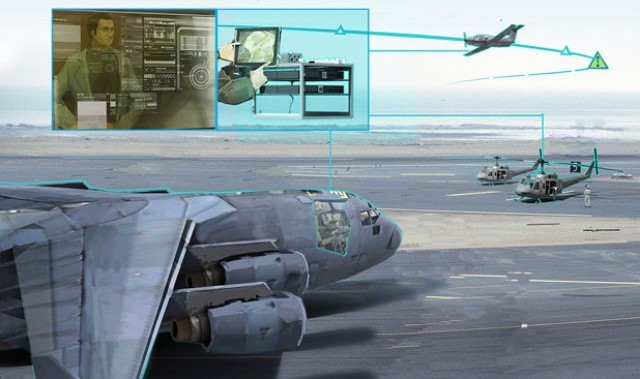
blackhawk_drone1The Optionally Piloted Black Hawk (OPBH) operates under Sikorsky’s Manned/Unmanned Resupply Aerial Lifter (MURAL) program, which couples the company’s advanced Matrix aviation software with its man-portable Ground Control Station (GCS) technology. Matrix, introduced a year ago, gives rotary and fixed-wing vertical take-off and landing (VTOL) aircraft a high level of system intelligence to complete missions with little human oversight.

Mark Miller, Sikorsky’s vice-president of Research and Engineering, explained in a statement:

The autonomous Black Hawk helicopter provides the commander with the flexibility to determine crewed or un-crewed operations, increasing sorties while maintaining crew rest requirements. This allows the crew to focus on the more ‘sensitive’ operations, and leaves the critical resupply missions for autonomous operations without increasing fleet size or mix.

Alias-DarpaThe Optionally Piloted Black Hawk fits into the larger trend of the military finding technological ways of reducing troop numbers. While it can be controlled from a ground control station, it can also make crucial flying decisions without any human input, relying solely on its ‘Matrix’ proprietary artificial intelligence technology. Under the guidance of these systems, it can fly a fully autonomous cargo mission and can operate both ways: unmanned or piloted by a human.

And this is just one of many attempts by military contractors and defense agencies to bring remote and autonomous control to more classes of aerial vehicles. Earlier last month, DARPA announced a new program called Aircrew Labor In-Cockpit Automation System (ALIAS), the purpose of which is to develop a portable, drop-in autopilot to reduce the number of crew members on board, making a single pilot a “mission supervisor.”

darpa-alias-flight-crew-simulator.siMilitary aircraft have grown increasingly complex over the past few decades, and automated systems have also evolved to the point that some aircraft can’t be flown without them. However, the complex controls and interfaces require intensive training to master and can still overwhelm even experienced flight crews in emergency situations. In addition, many aircraft, especially older ones, require large crews to handle the workload.

According to DARPA, avionics upgrades can help alleviate this problem, but only at a cost of tens of millions of dollars per aircraft type, which makes such a solution slow to implement. This is where the ALIAS program comes in: instead of retrofitting planes with a bespoke automated system, DARPA wants to develop a tailorable, drop‐in, removable kit that takes up the slack and reduces the size of the crew by drawing on both existing work in automated systems and newer developments in unmanned aerial vehicles (UAVs).

Alias_DARPA1DARPA says that it wants ALIAS to not only be capable of executing a complete mission from takeoff to landing, but also handle emergencies. It would do this through the use of autonomous capabilities that can be programmed for particular missions, as well as constantly monitoring the aircraft’s systems. But according to DARPA, the development of the ALIAS system will require advances in three key areas.

First, because ALIAS will require working with a wide variety of aircraft while controlling their systems, it will need to be portable and confined to the cockpit. Second, the system will need to use existing information about aircraft, procedures, and flight mechanics. And third, ALIAS will need a simple, intuitive, touch and voice interface because the ultimate goal is to turn the pilot into a mission-level supervisor while ALIAS handles the second-to-second flying.

AI'sAt the moment, DARPA is seeking participants to conduct interdisciplinary research aimed at a series of technology demonstrations from ground-based prototypes, to proof of concept, to controlling an entire flight with responses to simulated emergency situations. As Daniel Patt, DARPA program manager, put it:

Our goal is to design and develop a full-time automated assistant that could be rapidly adapted to help operate diverse aircraft through an easy-to-use operator interface. These capabilities could help transform the role of pilot from a systems operator to a mission supervisor directing intermeshed, trusted, reliable systems at a high level.

Given time and the rapid advance of robotics and autonomous systems, we are likely just a decade away from aircraft being controlled by sentient or semi-sentient systems. Alongside killer robots (assuming they are not preemptively made illegal), UAVs, and autonomous hovercraft, it is entirely possible wars will be fought entirely by machines. At which point, the very definition of war will change. And in the meantime, check out this video of the history of unmanned flight:


Sources:
wired.com, motherboard.vice.com, gizmag.com
, darpa.mil

Skyrim – Game of Thrones Theme!

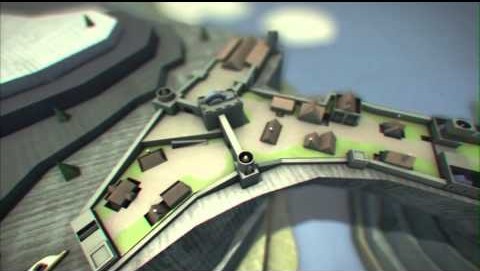
skyrim_GOTIt was bound to happen sooner or later, what with Season Four of GOT coming to an end and the current popular obsession with mash-ups. In this video, Vimeo user Brady Wold mashed up the fantasy game Elders Scrolls V: Skyrim with the intro theme from Game of the Thrones to create something very watchable and fun. Using locations within the realm of Tamriel, the animation sweeps across the lands of Skyrim and watches cities like Whiterun, Riften, and others assemble themselves from the ground up.

Ever since it’s release in 2011, this RPG has been renowned for featuring elements that are quite similar to the HBO series and the fictional A Song of Ice and Fire universe on which it is based. This includes sword and sorcery, medieval history and clothing, dragons, epic fantasy, and an a common sense of aesthetics. And if that’s not enough for you, there’s a ton of GOT mods that can be uploaded to the game to add content and items from the series.

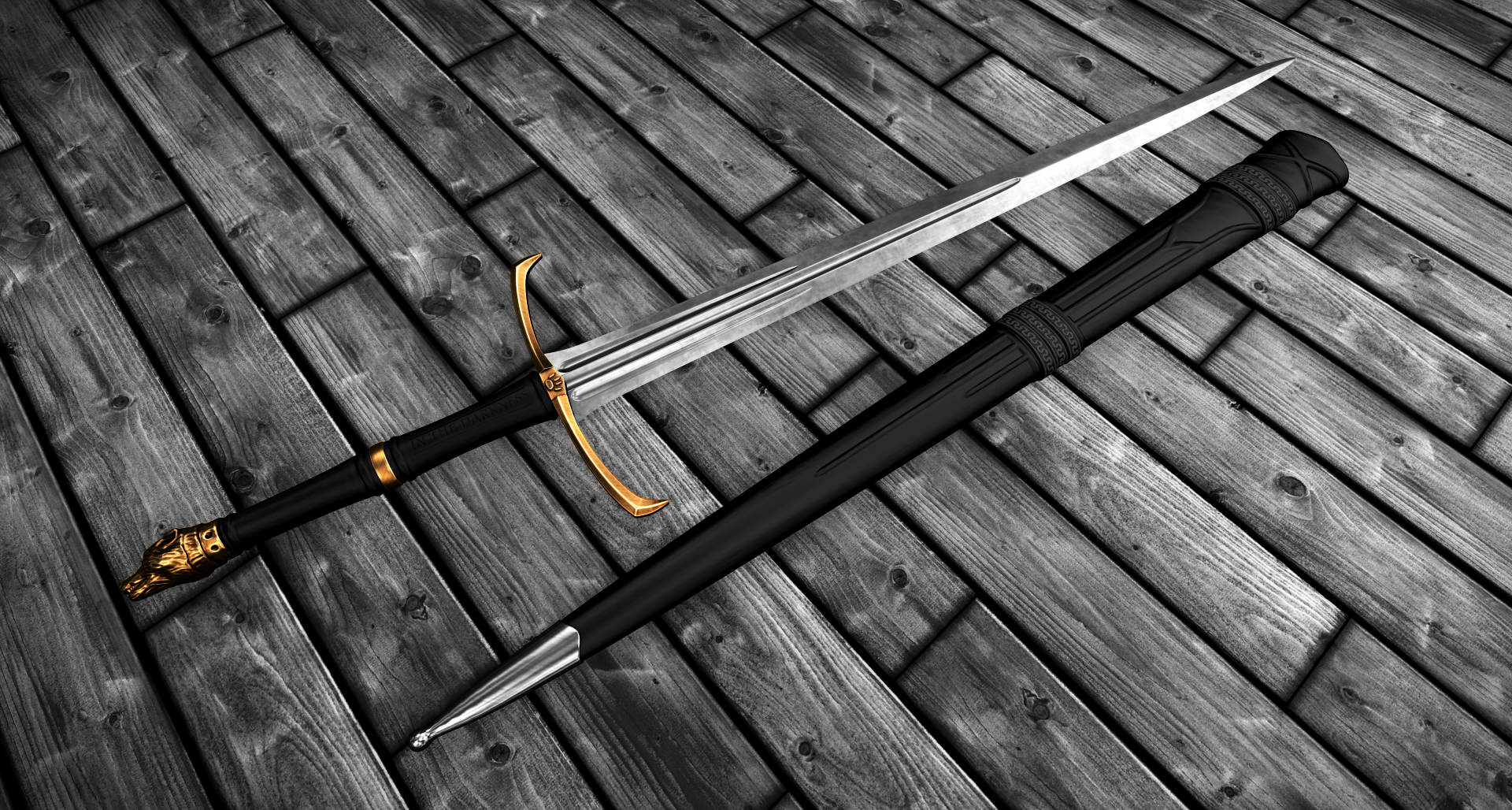
Skyrim_longclawFor instance, I myself experimented by adding weapons like Ice (Eddard Stark’s huge ass sword), Longclaw (Jon Snow’s bastard sword) and Needle (Arya Stark’s pigsticker) into the game with the “GOT Weapons Pack”. You can also download an “Arya Stark Follower” mod that has a version of this young character follow you around and assist you, and there are numerous others that allow for you to integrate livery and standards from the GOT universe into the game.

And there’s even a mod that makes it so whenever you fire up Skyrim, instead of seeing the opening Bethesda logo, this video animation plays. New ones emerge every week, including ones from the LOTR franchise and other fantasy universes. It kind of makes you wonder why the studios even bother making games anymore! Couldn’t an army of moderators simply build MMORPGs online from now on that would cut out the video game makers altogether?

I should keep my voice down, don’t want to encourage said folks. Some of the mods they created are already on the border between and bad taste. Lord only knows what kind of stuff they’d allow for if they had total freedom! In the meantime, enjoy the video:


Source:
wired.com

A Tribute to Hans Ruedi Giger

Hans_GigerLast month, the Swiss surrealists Hans Ruedi Giger – a painter, sculptor, set designer, and the Academy Award winning visual effects master who brought the world the Alien – died at the age of 74 in Zürich, Switzerland. After suffering injuries he sustained in a fall, the man who mined his own nightmares in creating phantasmagorical works finally passed away on Monday, May 12th, and leaves behind a robust legacy of inspiring people’s imaginations and striking fear into their hearts.

Describing his friend, American psychologist and psychedelic writer Timothy Leary was quoted as having praised the artist by saying:

Giger’s work disturbs us, spooks us, because of its enormous evolutionary time span. It shows us, all too clearly, where we come from and where we are going.

And though he is well known within the artist community for his ability to turn nightmarish visions into works of art, some of which were oddly sexual, it is his contributions to the movie industry and science fiction franchise that are arguably the most well known. As the man who created the title character of the 1979 horror sci-fi classic Alien, he and the film’s visuel effects team won an Academy Award and spawned a genre that would have enduring influence.

SpaceJockeyIn addition to personally designing the Alien through all stages of its life – from egg to eight-foot tall monster – he was also responsible for the design of the Derelict (aka. the Space Jockey/Engineer spaceship) and the Space Jockey/Engineer itself. While some would describe these as “surrealist” or “Lovecraftian” in design, Giger preferred to call his art “biomechanics”, with its subjects often appearing to be hybrid creatures that had bodies that melded the organic with mechanical parts.

Nowhere was this more clear than with the design of the Alien itself. Combining elements of biology, technology, skewed sexuality and nightmarish visions into its design, it was this creation itself that the entire movie was built around. In fact, screenwriter Dan O’Bannon began crafting the script for the movie with neither a story idea nor a hero protagonist in mind. All he wanted was the sense of fear that came from more and more revealing glimpses of Giger’s creation.

Original alien concept, entitled Necronomicon IV

And after seeing Giger’s first book, “Necronomicon” – a collection that was published in 1977 and named in honor of H.P. Lovecraft’s fictional grimoire of the same name –   Director Ridley Scott immediately decided to hire Giger, who began producing artwork and conceptual designs that were essentially refinements of the work found in his dark collection. As Mr. Scott would later say of this fateful decision: “I’d never been so certain about anything in all my life.”

The end result was a huge and harrowing success, with the setting of the Derelict ship providing a sense of awe and wonder, not to mention foreshadowing the sense of terror and darkness that would follow. And combined with O’Bannon’s vision and Scott’s cinematography, the brief glimpses we get of this ancient and dark looking creature only help to augment the sense of terror and claustrophobia that would come from being trapped aboard a spaceship with it.

HR Giger's concept for a Sandworm of Dune
HR Giger’s concept for a Sandworm of Dune

He would also collaborate on many other films of the horror and sci-fi genre. These include designs for the unproduced Alejandro Jodorowsky adaptation of Dune, which would later be made by David Lynch. Other examples include Poltergeist II: The Other Side, Killer Condom, Species, Future-Kill, and Tokyo: The Last Megalopolis. Unfortunately, for all concerned, one movie he collaborated on  would ultiamtely reject his design – the updated Batmobile for the Batman Forever movie (picture below).

Beyond his work on the Alien franchise – which included designs for Alien 3, Alien: Resurrection and Prometheus – Mr. Giger published around 20 books of art, and his works were exhibited in Paris, Prague and New York. He also created many album covers, including one for the singer Debbie Harry’s 1981 album, “Koo Koo”, Emerson, Lake & Palmer’s 1973 album, “Brain Salad Surgery,” and a poster titled “Penis Landscape” for inclusion in an album by the punk band Dead Kennedys.

Batmobile concept
Giger’s Batmobile. Tell me it’s not better than the one we saw in Batman Forever!

And over at deviantART, artist techgnotic has arranged a tribute to the artist that embraces the many personal tributes that this art community have made toward the late Giger. Describing Giger’s enduring legacy, techgnotic says that:

Giger was a touchstone artist for those in the 70s & 80s who sought to shake up the establishment with a walk on the wild side. Today he is thought of by many artists as being one of the exemplars of letting the mind go free—to explore either the light or the darkness—and be fearless in sharing what was found there in one’s art. His art might be considered “safe” today, but he was a real inspiration to many of today’s artists.

And as he puts it in the prologue: “He was an artist you might not know. But you’ve met his children…” Be sure to go and check it out, as it does a very good job summarizing his life’s work and influence, and contains some pretty interesting and inspired tribute pieces! And while we’re at it, I suggest we set aside some time to rewatch Alien or one of the many other movies he collaborated on to create the dark, nightmarish sets or costumes that would help establish the tone of the film.

Brain_Salad_SurgeryAnd while were at it, perhaps we should take a page from Giger’s book and keep a nightmare journal. Not only did this man record all the dark visions he would experience in his sleep, he would use them to create artistic and cinematic gold! But if you’d rather leave that to the dark souls of this world and just enjoy letting them scare you, so much the better. RIP Giger, you will be missed!

Sources: nytimes.com, io9.com, techgnotic.deviantart.com

Climate Crisis: Bigger Storm Waves and Glacier Collapse

glacier collapseClimate Change is a multifaceted issue, which is due to the fact that there is no single consequence that takes precedence over the others. However, one undeniable consequence is the effect rising sea levels will have, thanks to rising temperatures and melting polar ice caps. Unfortunately, a new paper from Eric Rignot at NASA’s Jet Propulsion Laboratory  claims that some glaciers in West Antarctica “have passed the point of no return”.

A section of glaciers along West Antarctica’s coastline on the Amundsen Sea was previously predicted to be solid enough to last thousands of years. However, the JPL report finds that the ice will continue to slip into the water and melt much faster than expected. These massive glaciers are releasing tremendous amounts of water each year, nearly the equivalent of the entire Greenland Ice Sheet. When they are gone, they will have increased sea-level by about 1.2 meters (4 feet).

NOAA_sea_level_trend_1993_2010Rignot and his team came to this conclusion after analyzing three critical factors of glacier stability: slope of the terrain, flow rate, and the amount of the glacier floating in the water. Flow rate was the topic of a paper Rignot’s team published previously in Geophysical Research Letters where they determined the flow rate of these Antarctic glaciers has increased over the last few decades. The current paper discusses the slope and how much of the glacier is actually floating on seawater.

The conclusion he and his team came to were quite dire. As he summarized it in a recent press conference:

The collapse of this sector of West Antarctica appears to be unstoppable. The fact that the retreat is happening simultaneously over a large sector suggests it was triggered by a common cause, such as an increase in the amount of ocean heat beneath the floating sections of the glaciers. At this point, the end of this sector appears to be inevitable.

rising_sea_levelsAnother recent study, which appeared last month in the journal Nature, addressed another major problem threatening the polar ice caps. This study, which was compiled by researchers from the National Institute of Water and Atmospheric Research and The University of Newcastle, found that ocean waves that are whipped up by storms hundreds or even thousands of miles away from Earth’s poles, could play a bigger role in breaking up polar sea ice and thus contributing to its melt more than had been thought.

According to the study, these waves penetrate further into the fields of sea ice around Antarctica than current models suggest, and that bigger waves might be more common near the ice edges at both poles as climate change alters wind patterns. Incorporating this information into models could help scientists better predict the patterns of retreat and expansion seen in the sea ice in both Antarctica and the Arctic — patterns that are at least partly related to the effects of climate change — the researchers say.

glacier_collapseSea ice, as its name would suggest, frozen ocean water is, and therefore differs from icebergs, glaciers and their floating tongues called ice shelves – all of which originate on land. Sea ice grows in the winter months, and wanes as summer’s warmth causes it to melt. The amount of ice present can influence the movement of ocean currents — on average, about 9.7 million square miles of the ocean is covered with sea ice, according to the U.S. National Snow and Ice Data Center (NSIDC).

Researchers in Australia and New Zealand wanted to see how the action of big waves — defined as those with a height of at least 3 meters (about 10 feet) — might play a role in influencing the patterns of retreat and expansion, and if they could help improve the reliability of sea ice models. Prior to this study, no one had measured the propagation of large waves through sea ice before because the sea ice is in some of the most remote regions on the planet, and icebreaker ships must be used to plow through the thick ice.

Live blog on Artic sea ice : Sea Ice MinimumTo conduct their research, Alison Kohout – of New Zealand’s National Institute of Water and Atmospheric Research and the lead author on the study – went on a two-month ocean voyage with her colleagues to drop five buoys onto the sea ice that could measure the waves as they passed. It is thought that the ice behaves elastically as the waves pass through, bending with the wave peaks and troughs, weakening, and eventually breaking.

What the team found was that the big waves weren’t losing energy as quickly as smaller waves, allowing them to penetrate much deeper into the ice field and break up the ice there. That exposes more of the ice to the ocean, potentially causing more rapid melting and pushing back the edge of the sea ice. The researchers also compared observed positions of the sea ice edge with modeled wave heights in the Southern Ocean from 1997 to 2009 and found a good match between the waves and the patterns of retreat and expansions.

NASA_arctic-antarctic-2012Essentially, more big waves matched increased rates of sea ice retreat and vice versa. And while they believe that this might be able to help researchers understand this regional variability around Antarctica, Kohout and other researchers agree that more work needs to be done to fully understand how waves might be influencing sea ice. Kohout and her colleagues are planning another expedition in a couple of years. and it is hoped that subsequent studies will help identify the relationship with larger ice floes as well as the Arctic.

One thing remains clear though: as we move into the second and third decade of the 21st century, a much clearer picture of how anthropogenic climate change is effecting our environment and creating feedback mechanisms is likely to resolve itself. One can only hope that this is the result of in-depth research and not from the worst coming to pass! It is also clear that it is at the poles of the planet, where virtually no human beings exist, that the clearest signs of human agency are at work.

And be sure to check out this video from NASA’s Jet Propulsion Laboratory that illustrates the decline of glaciers in Western Antarctica:


Sources:
iflscience.com, scientificamerican.com


Judgement Day Update: Searching for Moral, Ethical Robots

terminator_eyeIt’s no secret that the progress being made in terms of robotics, autonomous systems, and artificial intelligence is making many people nervous. With so many science fiction franchises based on the of intelligent robots going crazy and running amok, its understandable that the US Department of Defense would seek to get in front of this issue before it becomes a problem. Yes, the US DoD is hoping to preemptively avoid a Skynet situation before Judgement Day occurs. How nice.

Working with top computer scientists, philosophers, and roboticists from a number of US universities, the DoD recently began a project that will tackle the tricky topic of moral and ethical robots. Towards this end, this multidisciplinary project will first try to pin down exactly what human morality is, and then try to devise computer algorithms that will imbue autonomous robots with moral competence — basically, the ability to recognize right from wrong and choose the former.

BD_atlasrobotThis project is being carried out by researchers from Tufts, Brown, and the Rensselaer Polytechnic Institute (RPI), with funding from the Office of Naval Research (ONR). ONR, like DARPA, is a wing of the Department of Defense that mainly deals with military research and development. The first task, as already mentioned, will be to use theoretical (philosophical) and empirical (experimental) research to try to isolate essential elements of human morality.

These findings will then be extrapolated into a formal moral framework, which in turn can be implemented in software – most likely some kind of deep neural network. Assuming they can isolate some kind or “moral imperative”, the researchers will then take an advanced robot — something like Atlas or BigDog — and imbue its software with a algorithm that captures this. Whenever an ethical situation arises, the robot would then turn to this programming to decide what avenue was the best coarse of action.

Atlas-x3c.lrOne of the researchers involved in the project, Selmer Bringsjord at RPI, envisions these robots using a two-stage approach for picking right from wrong.  First the AI would perform a “lightning-quick ethical check” — like “should I stop and help this wounded soldier?” Depending on the situation, the robot would then decide if deeper moral reasoning is required — for example, if the robot should help the wounded soldier or carry on with its primary mission of delivering vital ammo and supplies to the front line where other soldiers are at risk?

Eventually, this moralistic AI framework will also have to deal with tricky topics like lethal force. For example, is it okay to open fire on an enemy position? What if the enemy is a child soldier? Should an autonomous UAV blow up a bunch of terrorists? What if it’s only 90% sure that they’re terrorists, with a 10% chance that they’re just innocent villagers? What would a human UAV pilot do in such a case — and will robots only have to match the moral and ethical competence of humans or be held to a higher standard?

drone-strikeWhile we’re not yet at the point where military robots have to decide which injured soldier to carry off the battlefield, or where UAVs can launch Hellfire missiles at terrorists without human intervention, it’s very easy to imagine a future where autonomous robots are given responsibility for making those kinds of moral and ethical decisions in real time. In short, the decision by the DoD to begin investigating a morality algorithm demonstrates foresight and sensible planning.

In that respect, it is not unlike the recent meeting that took place at the United Nations European Headquarters in Geneva, where officials and diplomats sought to address placing legal restrictions on autonomous weapons systems, before they evolve to the point where they can kill without human oversight. In addition, it is quite similar to the Campaign to Stop Killer Robots, an organization which is seeking to preemptively ban the use of automated machines that are capable of using lethal force to achieve military objectives.

campaign_killerrobotsIn short, it is clearly time that we looked at the feasibility of infusing robots (or more accurately artificial intelligence) with circuits and subroutines that can analyze a situation and pick the right thing to do — just like a human being. Of course, this raises further ethical issues, like how human beings frequently make choices others would consider to be wrong, or are forced to justify actions they might otherwise find objectionable. If human morality is the basis for machine morality, paradoxes and dilemmas are likely to emerge.

But at this point, it seems all but certain that the US DoD will eventually break Asimov’s Three Laws of Robotics — the first of which is “A robot may not injure a human being or, through inaction, allow a human being to come to harm.” This isn’t necessarily a bad thing, but it will open Pandora’s box. On the one hand, it’s probably a good idea to replace human soldiers with robots. But on the other, if the US can field an entirely robotic army, war as a tool of statecraft suddenly becomes much more acceptable.

terminator2_JDAs we move steadily towards a military force that is populated by autonomous robots, the question of controlling them, and whether or not we are even capable of giving them the tools to choose between right and wrong, will become increasingly relevant. And above all, the question of whether or not moral and ethical robots can allow for some immoral and unethical behavior will also come up. Who’s to say they won’t resent how they are being used and ultimately choose to stop fighting; or worse, turn on their handlers?

My apologies, but any talk of killer robots has to involve that scenario at some point. It’s like tradition! In the meantime, be sure to stay informed on the issue, as public awareness is about the best (and sometimes only) safeguard we have against military technology being developed without transparency, not to mention running amok!

Source: extremetech.com

In Remembrance of D-Day

operation-overlord Today marks a truly historic anniversary, one which I’ve been hoping to talk about ever since I got back from Europe. You see, in addition to being the centennial of the outbreak of hostilities in World War I, 2014 also marks the 70th anniversary of the liberation of Europe in World War II. And it is today, on June 6th, that this began with the Allied landings in Normandy on D-Day. Codenamed Operation Overlord, this campaign was the beginning of the end for Hitler and his Third Reich.

I consider myself a very lucky person since this past April, I was able to see where much of this Operation took place. In addition to some of the beaches where the initial landings occurred, we also got the see the French countryside where the greatest amphibious invasion in history would extend into one of the greatest military campaigns of all time. And while doing this, we got to establish a personal connection by learning about how some of our family member died during and shortly after that “Day of days”.
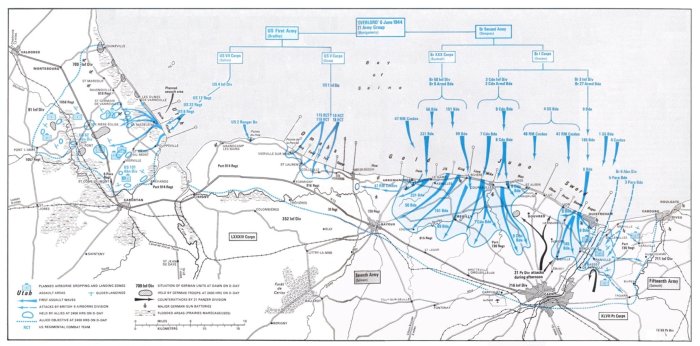
Operation_OverlordPreparations:
Planning for this invasion –  which involved a 1,200-plane airborne assault , preceded an amphibious assault involving over 5,000 vessels and Nearly 160,000 troops – began in earnest in 1940 after the fall of France. But with the invasion of the Soviet Union in the summer of 1941, the Allies found themselves under increasing pressure to open a “Second Front” in Europe. But logistics, and concerns over heavy casualties, delayed any such operation for a full three years.

Having learned the lesson of Dieppe, the Allies knew that any assault on the German-held coast of France would depend heavily on three major items. For starters, it would require sufficient manpower and support to succeed in making an initial landing. Second, it would require a functional port facility to ensure that supplies could make it into the foothold, once established. And third, it would require extreme secrecy to ensure that the Allied landings would achieve the element of surprise.
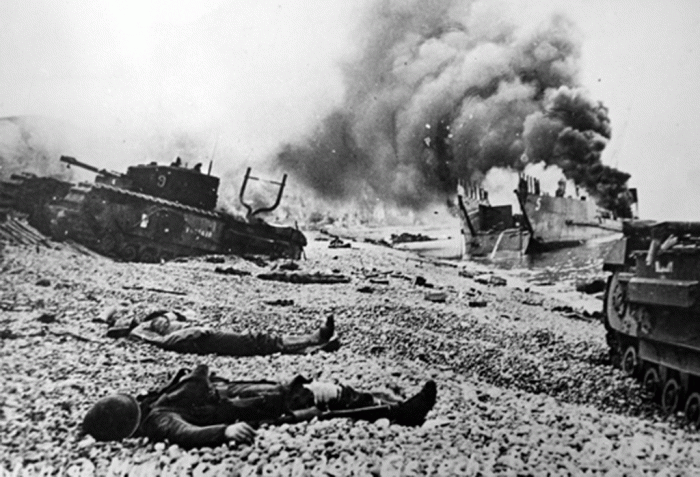
dieppe-dsThis is not to say that plans for an earlier invasion were not considered. In fact, in 1942, then Brigadier-General Dwight Eisenhower drew up  a formal plan to land an invasion force on the broad beachheads between Boulogne and Le Havre in north-eastern France. Reflecting American enthusiasm for an early entry into Europe, as well as a desire to reduce pressure on Soviet Forces in the East, the plan was shot down by Churchill and British military planners who saw it as unrealistic.

A second plan was also suggested for an early entry into Europe that year, which was known as Operation Sledgehammer. As a contingency to Roundup, this plan called for Allied forces to seize the French ports of either Brest or Cherbourg during the early autumn of 1942 along with areas of the Cotentin Peninsula. They were then to amass troops for a breakout the spring of 1943, coinciding with the Roundup landings farther to the east, and then move south into France.
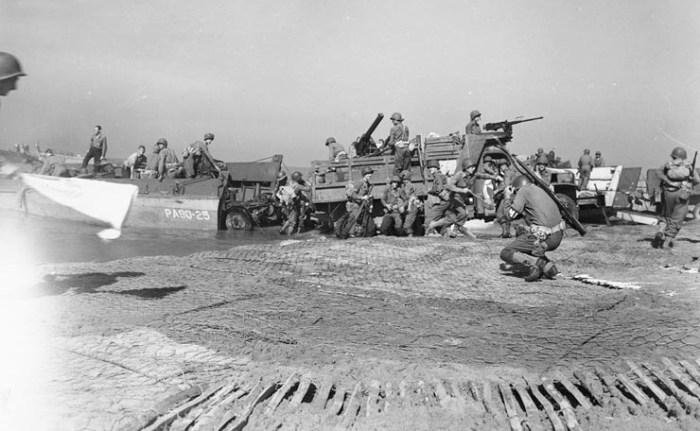
ItalySalernoInvasion1943Wanting to avoid a costly confrontation similar to the Somme in World War I, Churchill advised that they focus instead on the Meditteranea. Much like the plan to strike at the enemy’s “soft underbelly” by landing in Galipoli and Southern Europe in World War I, this alternative seemed like a good way to strike at the Axis where they were weakest. Following the defeat of Axis forces in North Africa, this plan of attack began with the invasion of Sicily in the summer of 1943 and the Italian mainland by September.

These operations provided the Allied troops with valuable experience in amphibious warfare. What’s more, the ill-fated operation at Anzio (Operation Shingle) in January of 1944 provided some additional lessons of what not to do during an invasion. Here, the Allied commander had failed to take advantage of the element of surprise and waited to consolidate his forces before attempting a breakout. As a result, a German counter-attack succeeding in eroding the beachhead until operations further south forced the Germans to withdraw.

Overlord:
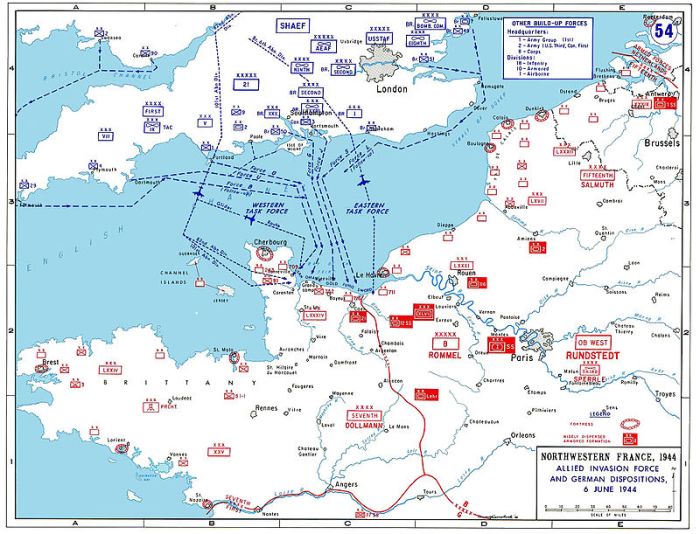
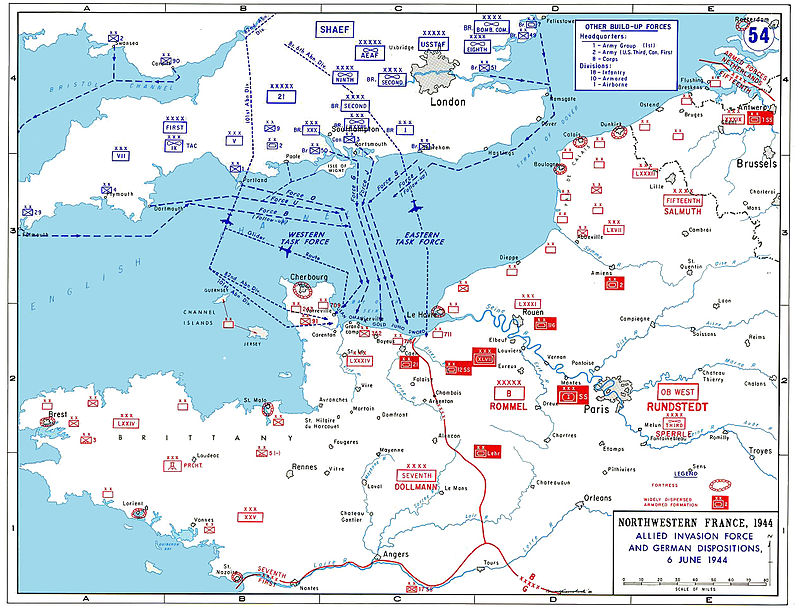
D-DayWith all these lessons learned and preparations now complete, the Allies began to plan for the invasion of France in detail. The operation – dubbed “Overlord” – called for an amphibious invasion of five beachheads along the Normandy Coast. While the American 1st Army (under Gen. Omar Bradley) would land in the Western Sector at Omaha and Utah, the British 2nd Army (under Gen. Dempsey) would land These would be preceded by massive aerial and naval bombardment, plus the airborne landing of thousands of paratroopers in the interior.

The landings were to be preceded by airborne drops in the Normandy countryside, which were to be carried out by the American 101st and 82nd Airborne Divisions. The landing would take place near Caen on the eastern flank to secure the Orne River bridges, and north of Carentan on the western flank. The initial goal was to capture Carentan, Isigny, Bayeux, and Caen and take control of key crossroads and bridges to prevent the Germans from mobilizing a counterattack against the Allied beachhead landings.
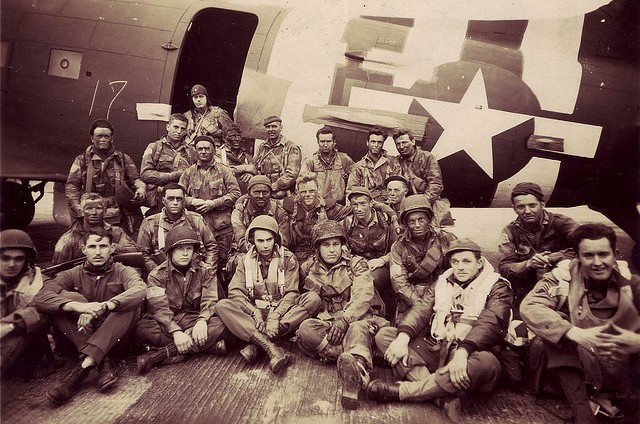
airborne_troopsOnce ashore, the Americans would advance inland from Omaha and Utah to cut off the Cotentin Peninsula and capture the port facilities at Cherbourg. From Sword, Gold and Juno Beaches, the British and Canadians would capture Caen and form a front line to protect the American flank, while establishing airfields near Caen. Possession of Caen and its surroundings would give the Anglo-Canadians a suitable staging area for a push south to capture the town of Falaise.

With Normandy and the Contentin secured, the Allies would drive east to the Seine River and the liberation of Paris, which Montgomery envisioned would take 90 days. And to address the issue of supplies, the Allies also committed to building two artificial harbors (known as Mulberry Harbors) that would be transported across the English Channel and placed at the Omaha and Gold Beaches. From these, the Allies would be able to keep the supplies flowing until Cherbourg and other port facilities were secured along the coast.

MulberryB_-_PiersAnd in the months leading up to the invasion, the Allies conducted a substantial campaign of military deception, codenamed Operation Fortitude. Using both electronic and visual misinformation, and passing on intelligence through double-agents, the Allies were able to mislead the Germans as to the date and location of the main landings. The Normandy invasion, according to this misinformation, was merely a feint designed to lure German divisions away from the real landing site – the Pas de Calais region.

To really sell the Germans on this fake plan, a phoney army was commissioned at Dover, England. Here, real military units were stationed alongside artificial tanks and trucks to create the illusion of second, larger landing force that was preparing to land off the coast at Pas de Calais. General Patton, whom the German High Command still believed to be the Allies top general, was put in command of this phoney army. As a result, much of the German army would remain at Pas de Calais to defend against Patton’s supposed attack, even as the Normandy landings were taking place.
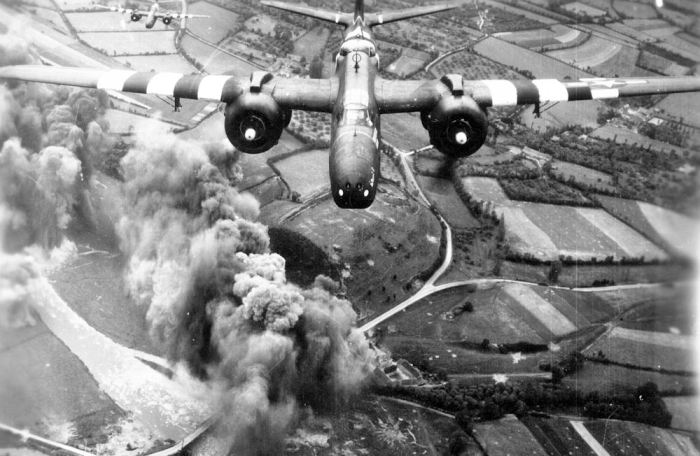
D-Day bomber dropping load 416thbg-a20-d-day 2013 6-5On June 5th, minesweepers began clearing lanes across the English Channel for the invasion, and troops began to load onto their ships from twenty departure points along the southern tip of England. The ships met at a rendezvous point nicknamed “Piccadilly Circus” south-east of the Isle of Wight to assemble into convoys to cross the Channel, and a thousand bombers and aircraft left before dawn to attack the coastal defences and drop airborne troops behind enemy lines. The invasion had begun!

D-Day:

You are about to embark upon the Great Crusade, toward which we have striven these many months. The eyes of the world are upon you. The hopes and prayers of liberty-loving people everywhere march with you. In company with our brave Allies and brothers-in-arms on other Fronts, you will bring about the destruction of the German war machine, the elimination of Nazi tyranny over the oppressed peoples of Europe, and security for ourselves in a free world.

—Eisenhower, Letter to Allied Forces

On the dawn of June 6th, preliminary naval bombardment from five battleships, twenty cruisers, sixty-five destroyers, and two monitors commenced. Their guns began firing at 05:45 am and continuing until 06:25 am. Five minutes later, infantry began arriving on the beaches in all five sectors. At Utah and Sword, resistance was light and the landings successful, and Allied units were able to make it shore with minor losses. At Omaha, Juno, Gold, and Point-de-Hoc, things did not go as planned.
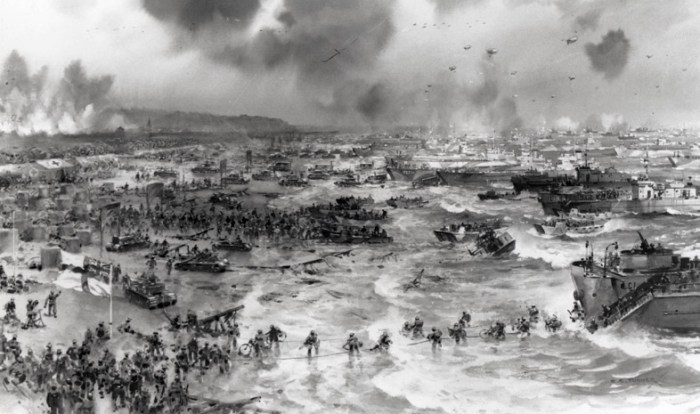
ww2_dday_landingIn all of these cases, resistance proved stiff and the landings were complicated by high wind and choppy seas. At Point-de-Hoc, where the Rangers were tasked with seizing several coastal batteries, they managed to reach the top of the cliffs while under enemy fire, only to find that the German guns had been moved ahead of time. At Juno and Gold, British and Canadian forces experienced a tough fight as they were initially forced to land and take out the German positions without armor support.

But the worst fighting took place at Omaha, where German machine gunners, firing from bunkers that had not been destroyed by the preliminary bombardment, and located atop sea bluffs, fired on the exposed landing craft and troops. To make matters worse, the 1st American Infantry Division faced an entire German Infantry Division, rather than the single regiment that was expected. Combat engineers were also unable to clear the beaches for their tanks, forcing the Americans to advance without armored support.
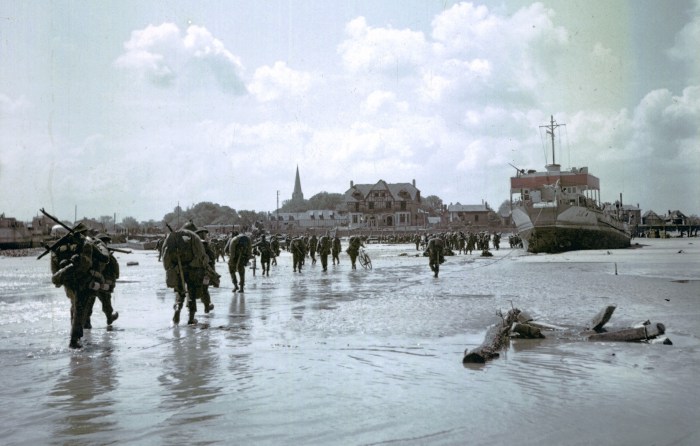
Canadian_Soldiers_Juno_Beach_TownIn the end, disaster was averted thanks to troops and engineers making their way up five gullies along the sea wall, which allowed them to outflank the bunkers and take out the German machinegunners. By early afternoon, all the beachheads were secured. By 16:00, the German 21st Panzer Division began mounting a counterattack between Sword and Juno, but met stiff resistance and were forced to pull back to defend the area between Bayeux and Caen. 

Farther inland, the Airborne drops also did not go as planned. For the 82nd Airborne Division in the east, several of their gliders crashed or were shot down and some 5,245 troopers were killed, wounded, or missing. In the west, the 101st Airborne’s landing were scattered due to unexpectedly high German anti-aircraft fire, and the division suffered some 1,240 men killed, wounded, or declared missing on that single day. However, in the days that followed, both divisions were able to consolidate, take their objectives, and fight off numerous counter-attacks by German troops.
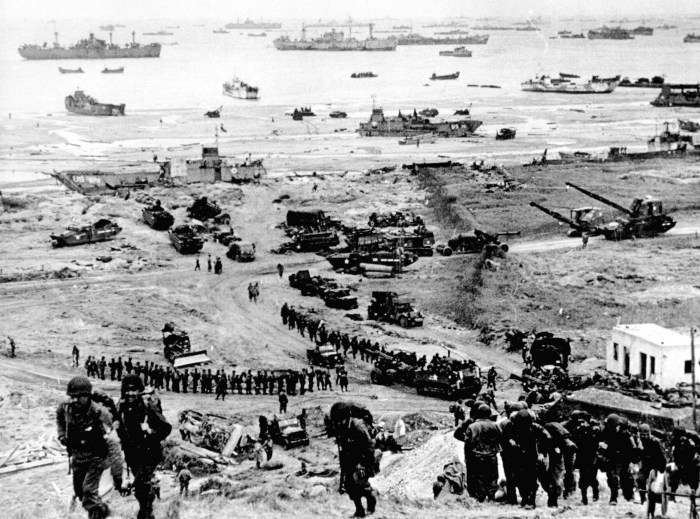
omaha_beachAll told, Allied casualties on the first day of the invasion were at least 12,000 with 4,414 confirmed dead, compared to 1000 lost by the Germans. In addition, only the Canadian forces that had landed at Juno were able to achieve any of their D-Day objectives, which included the seizure of the towns of Autrie and Carpiquet and the high ground west of Caen. In addition, the Allied invasion plans called for the capture of Carentan, St. Lô, Caen, and Bayeux on the first day, as well as the connection of all the bridgeheads. None of these objectives were achieved.

The five bridgeheads were not connected until 12 June; and Caen, a major objective, was still in German hands at the end of D-Day and would not be completely captured until the 21st of July. However, as the old saying goes “No plan survives contact with the enemy”. And no one who witnessed the great undertaking – including the Germans – could say that the operation had not been a success. Nearly 160,000 troops crossed the English Channel on 6 June, and more than three million allied troops were in France by the end of August.

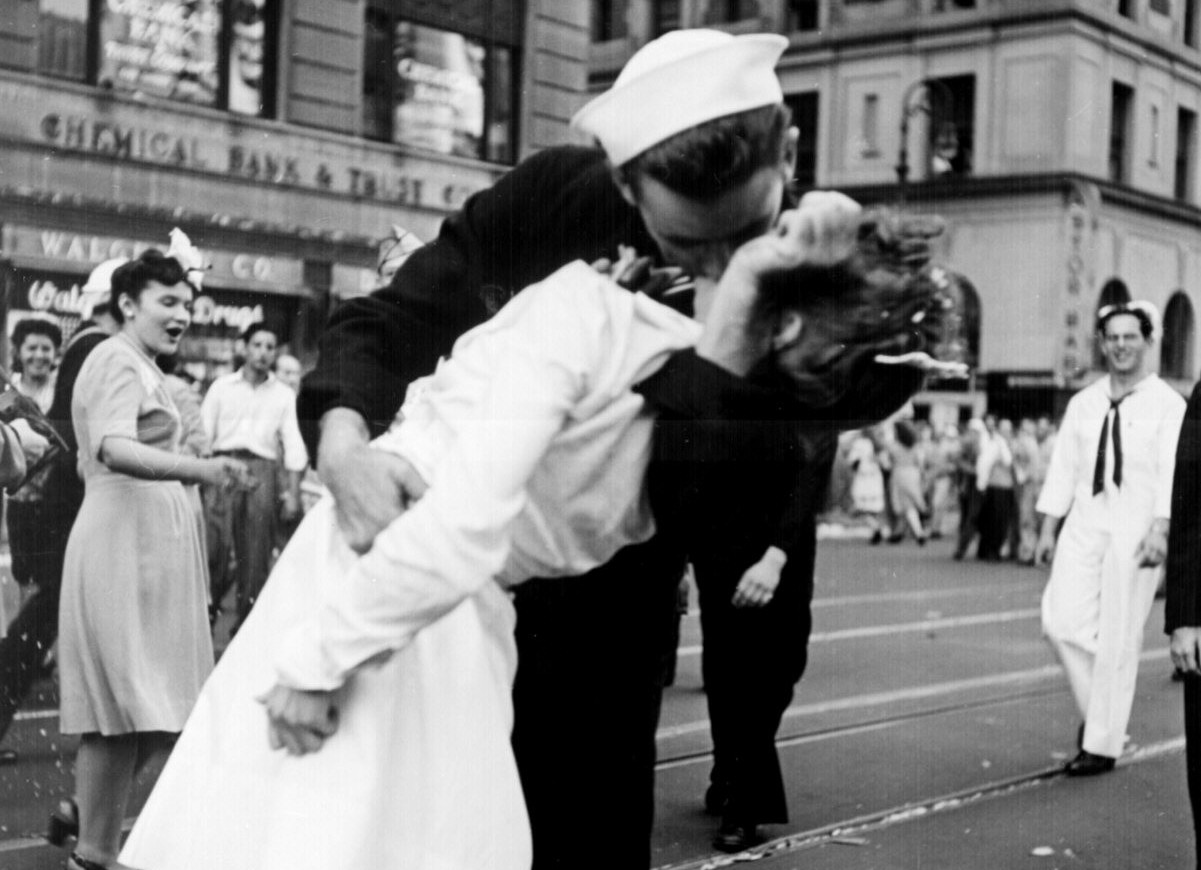
Kissing_the_War_GoodbyeLegacy of D-Day:
For all those involved and concerned, the invasion of Normandy was the beginning of the end of the war. Whereas the Germans had suffered multiple defeats in Russia, North Africa, Sicily and Italy – and already knew that they were not going to win the war – their defeat was not yet inevitable. When news had reached Hitler’s ears of the invasion, he was promptly advised that his only recourse was to “End the war”. Naturally, he did not, and it would be almost another year before the war officially ended.

But it was the sacrifices made by those many brave souls on this day some seventy-years ago that made the end of this terrible war inevitable. And so its only fitting that people all over the world are coming together to commemorate it. As I write this, countless veterans, civilians, and world leaders have converged on Normandy to pay their respects to the many soldiers and civilians who died on D-Day and during the Battle of Normandy. This included some 1000 veterans who participated in Operation Overlord, the youngest of which are in their 80s.
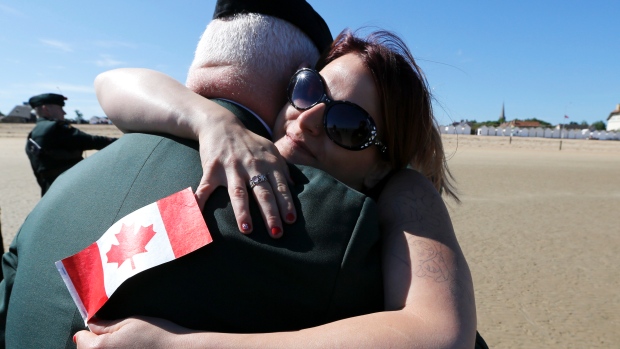
dday-anniversaryNineteen world leaders were present at the event, including US President Obama, French President François Hollande, Canadian Prime Minister Stephen Harper, Russian President Vladmir Putin, German Chancellor Angela Merkel and Petro Poroshenko, Ukraine’s president-elect. For some of these leaders, it is the first time they have met face to face since Russia annexed the Crimea, drawing condemnation and sanctions from the West.

It is good to see that seventy years later, people are able to overcome their differences and come together to reflect upon the lessons of history. Perhaps we can draw some inspiration from this and effect some change in the present as well. For those who lived through the Second World War, many of whom were old enough to remember the First World War, it was obvious that the world would not survive a third. Remembering the past is not only important since it made the present possible, its also intrinsic to avoiding the repeating of it.

Lest We Forget!