Two days ago, another major milestone passed for one of NASA’s famed rovers. But this time around, it wasn’t the spotlight-hogging Curiosity or the die-hard Opportunity rover that was the subject of interest. It was the Spirit rover, the other half of NASA’s now legendary Mars Exploration Rovers (MER) that landed on the Red Planet over a decade ago.
Yes, January 3rd of this year marks the 10th anniversary since the safe landing of NASA’s renowned Spirit rover on the plains of Mars, making her the oldest rover in operation on the planet’s service. Opportunity, her twin sister, landed on the opposite side of the Mars three weeks later – on Jan. 24, 2004. The goal was to “follow the water” as a potential enabler for past Martian microbes if they ever existed.
Together, the long-lived, golf cart sized robots proved that early Mars was warm and wet, billions of years ago – a key finding in the search for habitats conducive to life beyond Earth. It was these findings that have since been followed up on by Curiosity rover in its ongoing search for water and organic particles in the soil, and MAVEN’s planned surveys of the Martian atmosphere.
And it was a decade ago that the famous robot survived the 6 minute plunge through the thin Martian atmosphere, which involved scorching atmospheric heating, and then bounced some two dozen times inside cushioning airbags before coming to a stop. It then gradually rolled to a stop inside 161 km (100 mile) wide Gusev Crater. This landing was known as the “6 minutes of Terror”.
The three petaled landing pad then opened and Spirit was deployed in what was a milestone event. This deployment will be forever remembered in the annuls of history, mainly because of the groundbreaking scientific discoveries that ensued, not to mention the unbelievable longevity of the twins. And while Spirit did not make it past 2010 – effectively remaining in service for six years – she accomplished quite a bit in that time.
Before they were launched atop a series of Delta II rockets in the summer of 2003 from Cape Canaveral, the dynamic, solar powered robo duo were expected to last for only 90 Martian days (Sols). NASA engineers firmly believed that dust accumulation on the life-giving solar panels, an engineering issue or the extremely harsh Martian environment would terminate them before long.
But in reality, both robots enormously exceeded expectations and accumulated a vast bonus time of exploration and discovery in numerous extended mission phases. In part, the harsh Martian winds occasionally cleaned their solar panels to give them both a new lease on life. And more importantly, the rovers’ components just kept working miraculously.
And she kept working faithfully for six years until communications officially ceased in 2010. Altogether, Spirit drove 7.73 kilometers (4.8 miles) across the Martian surface – about 12 times more than the original goal set for the mission – and transmitted over 128,000 images. And shortly after landing, Spirit scaled Husband Hill and found evidence for the flow of liquid water at the Hillary outcrop.
This was especially impressive, seeing as how the rovers were not designed to climb hills. But eventually, she managed to scale the 30 degree inclines and collect a series of rock samples using her Rock Abrasion Tool (RAT). The samples were then inspected using her on-board spectrometers and a microscopic imager. Eventually she drove back down the hill and made even greater scientific discoveries.
These occurred in 2007 in an area known as “Home Plate”, where she unexpectedly got mired thanks to an ancient volcanic feature named ‘Home Plate’ that prevented the solar arrays from generating. In the process, her right front wheel churned up a trench of bright Martian soil that exposed a patch of nearly pure silica, which was formed in a watery hot spring or volcanic environment.
Three years later, in February of 2010, Spirit once again got mired and took her last panorama (pictured above), which was stitched together from raw images by Marco Di Lorenzo and Ken Kremer. After several attempts to save her, NASA eventually declared Spirit dead in the water, her last resting place being the same as where she made her landing – the Gustev Crater in the Aeolis quadrangle.
At one time, many billions of years ago, the Ma’adim Vallis channel – a natural river-like depression running from the crater – probably carried liquid water and/or ice into Gutev. NASA scientists believe this has left sediments in the crater that could be up to 915 meters (3000 feet) thick. Spirit all but confirmed this when her tire turned up a patch of silica in 07, thus providing the first conclusive evidence of this theory.
Mosaic image taken on Jan. 4, 2004 after deployment
The rovers’ principal investigator, Steve Squyres of Cornell University, Ithaca, N.Y., described some of the key findings in a NASA statement, starting with what Spirit found after driving from the crater floor where it landed into the Columbia hills to the east:
In the Columbia Hills, we discovered compelling evidence of an ancient Mars that was a hot, wet, violent place, with volcanic explosions, hydrothermal activity, steam vents — nothing like Mars today.
At Opportunity’s landing site, we found evidence of an early Mars that had acidic groundwater that sometimes reached the surface and evaporated away, leaving salts behind. It was an environment with liquid water, but very different from the environment that Spirit told us about.
When Opportunity got to the rim of Endeavour Crater, we began a whole new mission. We found gypsum veins and a rich concentration of clay minerals. The clay minerals tell us about water chemistry that was neutral, instead of acidic — more favorable for microbial life, if any ever began on Mars.
Because of the rovers’ longevity, we essentially got four different landing sites for the price of two.
Meanwhile, NASA’s new Curiosity rover just celebrated 500 Sols on Mars and is speeding towards Mount Sharp from inside Gale Crater – which is about the same size as Gusev crater. And a pair of newly launched orbiters are streaking towards the Red Planet as we speak – NASA’s Mars Atmosphere and Volatile EvolutioN (MAVEN) and India’s Mars Orbiter Mission (MOM).
In short, we are not finished with Mars yet. And the past, ongoing and future efforts of our many rovers, orbiters and (someday) astronauts are likely to keep providing us with a slew of new discoveries and revelations about our celestial neighbor.
Amongst the sci-fi greats of old, there were few authors, scientists and futurists more influential than Isaac Asimov and Arthur C. Clarke. And as individuals who constantly had one eye to the world of their day, and one eye to the future, they had plenty to say about what the world would look like by the 21st century. And interestingly enough, 2014 just happens to be the year where much of what they predicted was meant to come true.
For example, 50 years ago, Asimov wrote an article for the New York Times that listed his predictions for what the world would be like in 2014. The article was titled “Visit to the World’s Fair of 2014”, and contained many accurate, and some not-so-accurate, guesses as to how people would be living today and what kinds of technology would be available to us.
Here are some of the accurate predictions:
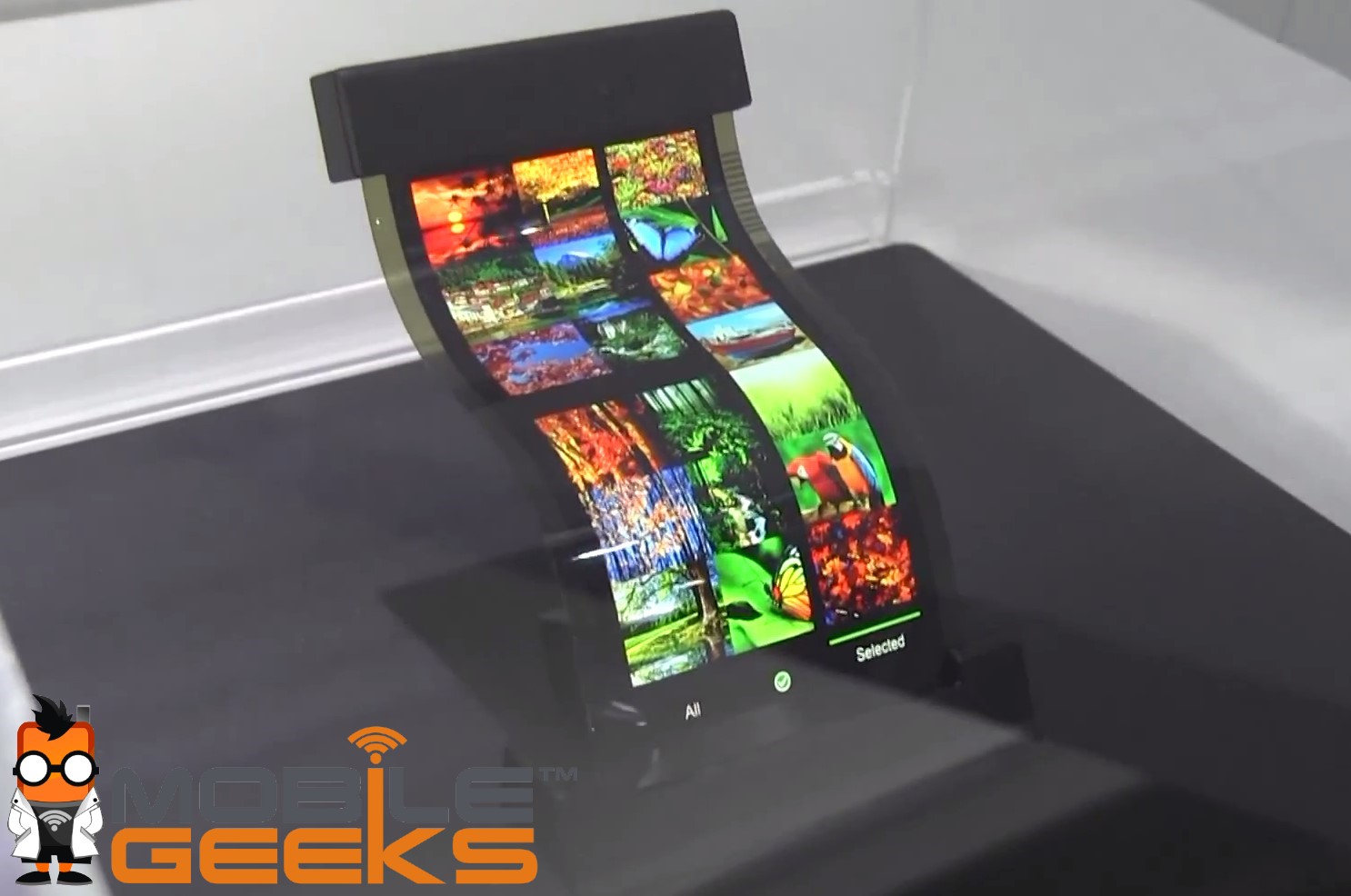
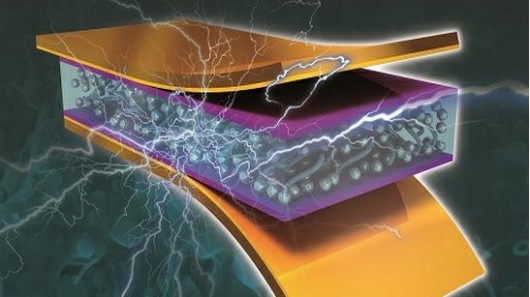
1. “By 2014, electroluminescent panels will be in common use.” In short, electroluminescent displays are thin, bright panels that are used in retail displays, signs, lighting and flat panel TVs. What’s more, personal devices are incorporating this technology, in the form of OLED and AMOLED displays, which are both paper-thin and flexible, giving rise to handheld devices you can bend and flex without fear of damaging them.
2. “Gadgetry will continue to relieve mankind of tedious jobs.” Oh yes indeed! In the last thirty years, we’ve seen voicemail replace personal assistants, secretaries and message boards. We’ve seen fax machines replace couriers. We’ve seen personal devices and PDAs that are able to handle more and more in the way of tasks, making it unnecessary for people to consult a written sources of perform their own shorthand calculations. It’s a hallmark of our age that personal technology is doing more and more of the legwork, supposedly freeing us to do more with our time.
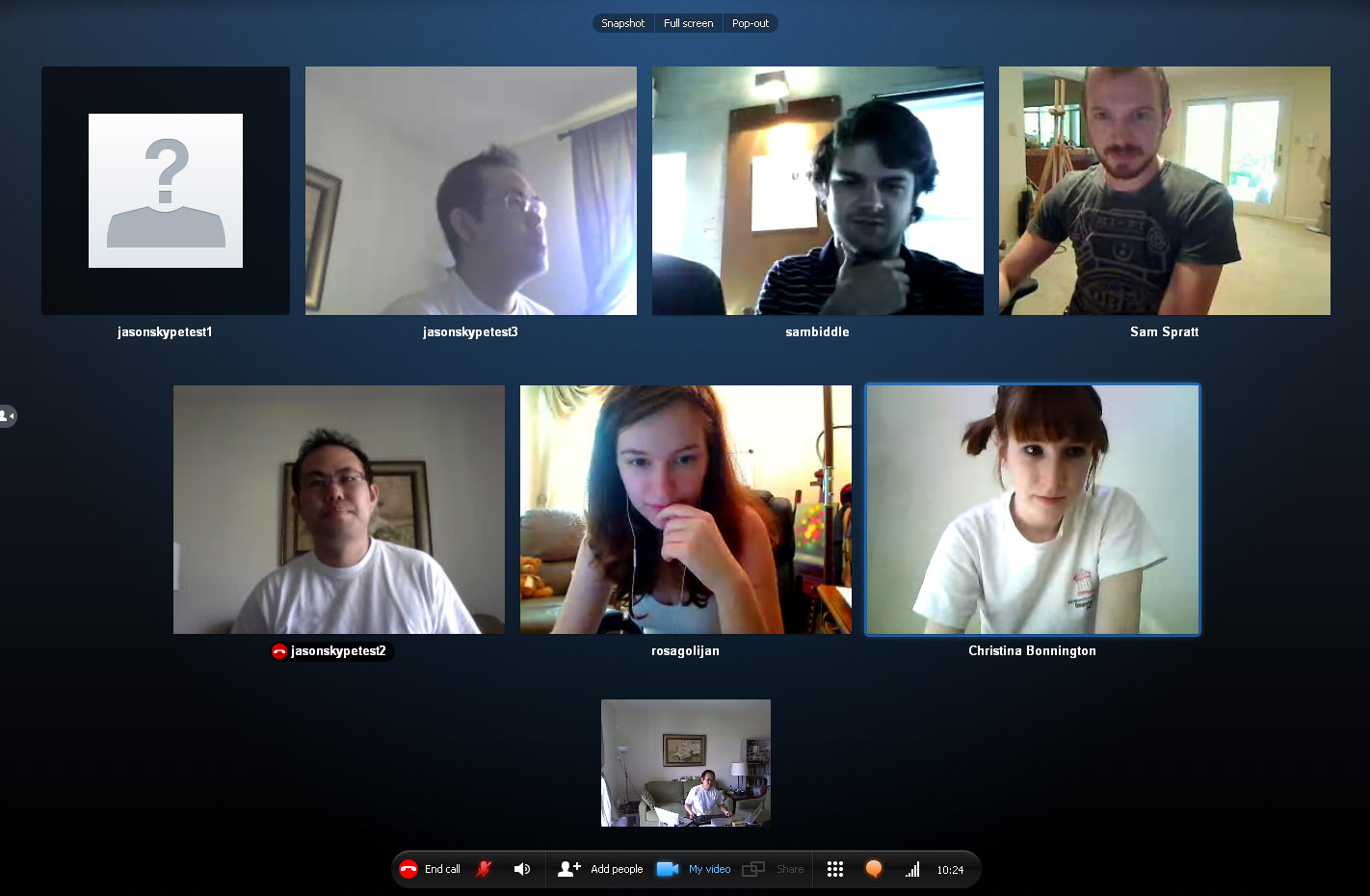
3. “Communications will become sight-sound and you will see as well as hear the person you telephone.” This was a popular prediction in Asimov’s time, usually taking the form of a videophone or conversations that happened through display panels. And the rise of the social media and telepresence has certainly delivered on that. Services like Skype, Google Hangout, FaceTime and more have made video chatting very common, and a viable alternative to a phone line you need to pay for.
4. “The screen can be used not only to see the people you call but also for studying documents and photographs and reading passages from books.” Multitasking is one of the hallmarks of modern computers, handheld devices, and tablets, and has been the norm for operating systems for some time. By simply calling up new windows, new tabs, or opening up multiple apps simultaneously and simply switching between them, users are able to start multiple projects, or conduct work and view video, take pictures, play games, and generally behave like a kid with ADHD on crack if they so choose.
5. “Robots will neither be common nor very good in 2014, but they will be in existence.” If you define “robot” as a computer that looks and acts like a human, then this guess is definitely true. While we do not have robot servants or robot friends per se, we do have Roomba’s, robots capable of performing menial tasks, and even ones capable of imitating animal and even human movements and participating in hazardous duty exercises (Google the DARPA Robot Challenge to see what I mean).
Alas, he was off on several other fronts. For example, kitchens do not yet prepare “automeals” – meaning they prepare entire meals for us at the click of a button. What’s more, the vast majority of our education systems is not geared towards the creation and maintenance of robotics. All surfaces have not yet been converted into display screens, though we could if we wanted to. And the world population is actually higher than he predicted (6,500,000,000 was his estimate).
As for what he got wrong, well… our appliances are not powered by radioactive isotopes, and thereby able to be entirely wireless (though wireless recharging is becoming a reality). Only a fraction of students are currently proficient in computer language, contrary to his expectation that all would be. And last, society is not a place of “enforced leisure”, where work is considered a privilege and not a burden. Too bad too!
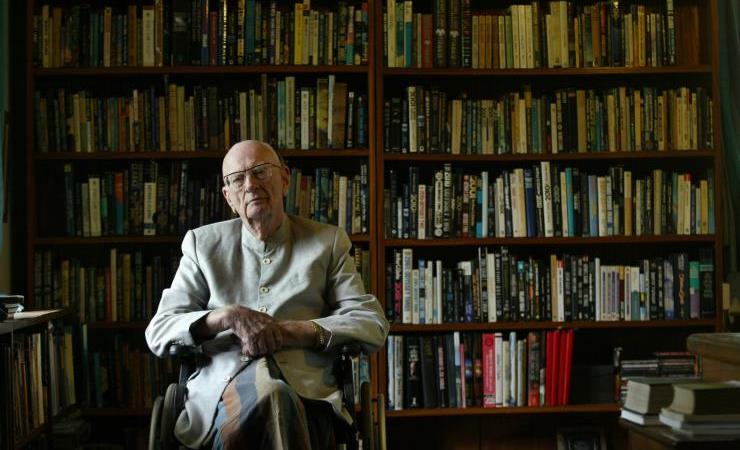
And when it comes to the future, there are few authors whose predictions are more trusted than Arthur C. Clarke. In addition to being a prolific science fiction writer, he wrote nearly three dozen nonfiction books and countless articles about the future of space travel, undersea exploration and daily life in the 21st century.
And in a recently released clip from a 1974 ABC News program filmed in Australia, Clarke is shown talking to a reporter next to a massive bank of computers. With his son in tow, the reporter asks Clarke to talk about what computers will be like when his son is an adult. In response, Clarke offers some eerily prophetic, if not quite spot-on, predictions:
The big difference when he grows up, in fact it won’t even wait until the year 2001, is that he will have, in his own house, not a computer as big as this, but at least a console through which he can talk to his friendly local computer and get all the information he needs for his everyday life, like his bank statements, his theater reservations, all the information you need in the course of living in a complex modern society. This will be in a compact form in his own house.
In short, Clarke predicted not only the rise of the personal computer, but also online banking, shopping and a slew of internet services. Clarke was then asked about the possible danger of becoming a “computer-dependent” society, and while he acknowledged that in the future humanity would rely on computers “in some ways,” computers would also open up the world:
It’ll make it possible for us to live really anywhere we like. Any businessman, any executive, could live almost anywhere on Earth and still do his business through his device like this. And this is a wonderful thing.
Clarke certainly had a point about computers giving us the ability to communicate from almost anywhere on the globe, also known as telecommunication, telecommuting and telepresence. But as to whether or not our dependence on this level of technology is a good or bad thing, the jury is still out on that one. The point is, his predictions proved to be highly accurate, forty years in advance.
Granted, Clarke’s predictions were not summoned out of thin air. Ever since their use in World War II as a means of cracking Germany’s cyphers, miniaturization has been the trend in computing. By the 1970’s, they were still immense and clunky, but punch cards and vacuum tubes had already given way to transistors, ones which were getting smaller all the time.
And in 1969, the first operational packet network to implement a Transmission Control Protocol and Internet Protocol (TCP/IP) was established. Known as a Advanced Research Projects Agency Network (or ARPANET), this U.S. Department of Defense network was set up to connect the DOD’s various research projects at universities and laboratories all across the US, and was the precursor to the modern internet.
In being a man who was so on top of things technologically, Clarke accurately predicted that these two trends would continue into the foreseeable future, giving rise to computers small enough to fit on our desks (rather than taking up an entire room) and networked with other computers all around the world via a TCP/IP network that enabled real-time data sharing and communications.
And in the meantime, be sure to check out the Clarke interview below:
With all of the world’s current problems, poverty, underdevelopment, terrorism, civil war, and environmental degradation, it’s easy to overlook how things are getting better around the world. Not only do we no longer live in a world where superpowers are no longer aiming nuclear missiles at each other and two-thirds of the human race live beneath totalitarian regimes; in terms of health, mortality, and income, life is getting better too.
So, in honor of the New Year and all our hopes for a better world, here’s a gander at how life is improving and is likely to continue…
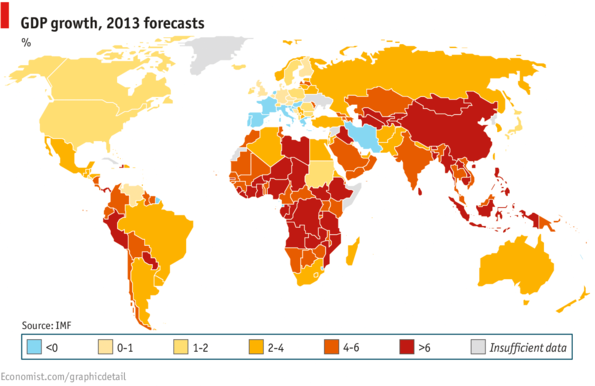
1. Poverty is decreasing: The population currently whose income or consumption is below the poverty line – subsisting on less than $1.25 a day – is steadily dropping. In fact, the overall economic growth of the past 50 years has been proportionately greater than that experienced in the previous 500. Much of this is due not only to the growth taking place in China and India, but also Brazil, Russia, and Sub-Saharan Africa. In fact, while developing nations complain about debt crises and ongoing recession, the world’s poorest areas continue to grow.
2. Health is improving:
The overall caloric consumption of people around the world is increasing, meaning that world hunger is on the wane. Infant mortality, a major issue arising from poverty, and underdevelopment, and closely related to overpopulation, is also dropping. And while rates of cancer continue to rise, the rate of cancer mortality continue to decrease. And perhaps biggest of all, the world will be entering into 2014 with several working vaccines and even cures for HIV (of which I’ve made many posts).
3. Education is on the rise:
More children worldwide (especially girls) have educational opportunities, with enrollment increasing in both primary and secondary schools. Literacy is also on the rise, with the global rate reaching as high as 84% by 2012. At its current rate of growth, global rates of literacy have more than doubled since 1970, and the connections between literacy, economic development, and life expectancy are all well established.
4. The Internet and computing are getting faster:
Ever since the internet revolution began, connection speeds and bandwidth have been increasing significantly year after year. In fact, the global average connection speed for the first quarter of 2012 hit 2.6 Mbps, which is a 25 percent year-over-year gain, and a 14 percent gain over the fourth quarter of 2011. And by the second quarter of 2013, the overall global average peak connection speed reached 18.9 Mbps, which represented a 17 percent gan over 2012.
And while computing appears to be reaching a bottleneck, the overall increase in speed has increased by a factor of 260,000 in the past forty years, and storage capacity by a factor of 10,000 in the last twenty. And in terms of breaking the current limitations imposed by chip size and materials, developments in graphene, carbon nanotubes, and biochips are promising solutions.
5. Unintended pregnancies are down:
While it still remains high in the developing regions of the world, the global rate of unintended pregnancies has fallen dramatically in recent years. In fact, between 1995 and 2008, of 208 billion pregnancies surveyed in a total of 80 nations, 41 percent of the pregnancies were unintended. However, this represents a drop of 29 percent in the developed regions surveyed and a 20 percent drop in developing regions.
The consequences of unintended pregnancies for women and their families is well established, and any drop presents opportunities for greater health, safety, and freedom for women. What’s more, a drop in the rate of unwanted pregnancies is surefire sign of socioeconomic development and increasing opportunities for women and girls worldwide.
6. Population growth is slowing: On this blog of mine, I’m always ranting about how overpopulation is bad and going to get to get worse in the near future. But in truth, that is only part of the story. The upside is while the numbers keep going up, the rate of increase is going down. While global population is expected to rise to 9.3 billion by 2050 and 10.1 billion by 2100, this represents a serious slowing of growth.
If one were to compare these growth projections to what happened in the 20th century, where population rose from 1 billion to just over 6, they would see that the rate of growth has halved. What’s more, rates of population growth are expecting to begin falling in Asia by 2060 (one of the biggest contributors to world population in the 20th century), in Europe by 2055, and the Caribbean by 2065.
In fact, the only region where exponential population growth is expected to happen is Africa, where the population of over 1 billion is expected to reach 4 billion by the end of the 21st century. And given the current rate of economic growth, this could represent a positive development for the continent, which could see itself becoming the next powerhouse economy by the 2050s.
7. Clean energy is getting cheaper:
While the price of fossil fuels are going up around the world, forcing companies to turn to dirty means of oil and natural gas extraction, the price of solar energy has been dropping exponentially. In fact, the per capita cost of this renewable source of energy ($ per watt) has dropped from a high of $80 in 1977 to 0.74 this past year. This represents a 108 fold decrease in the space of 36 years.
And while solar currently comprises only a quarter of a percent of the planet’s electricity supply, its total share grew by 86% last year. In addition, wind farms already provide 2% of the world’s electricity, and their capacity is doubling every three years. At this rate of increase, solar, wind and other renewables are likely to completely offset coal, oil and gas in the near future.
Summary:
In short, things are looking up, even if they do have a long way to go. And a lot of what is expected to make the world a better place is likely to happen this year. Who knows which diseases we will find cures for? Who knows what inspirational leaders will come forward? And who knows what new and exciting inventions will be created, ones which offer creative and innovative solutions to our current problems?
Who knows? All I can say is that I am eager to find out!
The new year is literally right around the corner, folks. And I thought what better way to celebrate 2013 than by acknowledging its many scientific breakthroughs. And there were so many to be had – ranging in fields from bioresearch and medicine, space and extra-terrestrial exploration, computing and robotics, and biology and anthropology – that I couldn’t possibly do them all justice.
Luckily, I have found a lovely, condensed list which managed to capture what are arguably the biggest hits of the year. Many of these were ones I managed to write about as they were happening, and many were not. But that’s what’s good about retrospectives, they make us take account of things we missed and what we might like to catch up on. And of course, I threw in a few stories that weren’t included, but which I felt belonged.
So without further ado, here are the top 12 biggest breakthroughs of 2013:
1. Voyager 1 Leaves the Solar System:
For 36 years, NASA’s Voyager 1 spacecraft has travelling father and farther away from Earth, often at speeds approaching 18 km (11 miles) per second. At a pace like that, scientists knew Voyager would sooner or later breach the fringe of the heliosphere that surrounds and defines our solar neighborhood and enter the bosom of our Milky Way Galaxy. But when it would finally break that threshold was a question no one could answer. And after months of uncertainty, NASA finally announced in September that the space probe had done it. As Don Gurnett, lead author of the paper announcing Voyager’s departure put it: “Voyager 1 is the first human-made object to make it into interstellar space… we’re actually out there.”
2. The Milky Way is Filled with Habitable Exoplanets:
After years of planet hunting, scientists were able to determine from all the data gathered by the Kepler space probe that there could be as many as 2 billion potentially habitable exoplanets in our galaxy. This is the equivalent of roughly 22% of the Milky Way Galaxy, with the nearest being just 12 light years away (Tau Ceti). The astronomers’ results, which were published in October of 2013, showed that roughly one in five sunlike stars harbor Earth-size planets orbiting in their habitable zones, much higher than previously thought.
3. First Brain to Brain Interface:
In February of 2013, scientists announced that they had successfully established an electronic link between the brains of two rats. Even when the animals were separated by thousands of kms distance, signals from the mind of one could help the second solve basic puzzles in real time. By July, a connection was made between the minds of a human and a rat. And by August, two researchers at the Washington University in St. Louis were able to demonstrate that signals could be transmitted between two human brains, effectively making brain-to-brain interfacing (BBI), and not just brain computer interfacing (BCI) truly possible.
4.Long-Lost Continent Discovered:
In February of this year, geologists from the University of Oslo reported that a small precambrian continent known as Mauritia had been found. At one time, this continent resided between Madagascar and India, but was then pushed beneath the ocean by a multi-million-year breakup spurred by tectonic rifts and a yawning sea-floor. But now, volcanic activity has driven the remnants of the long-lost continent right through to the Earth’s surface.
Not only is this an incredibly rare find, the arrival of this continent to the surface has given geologists a chance to study lava sands and minerals which are millions and even billions of years old. In addition to the volcanic lava sands, the majority of which are around 9 million years old, the Oslo team also found deposits of zircon xenocryst that were anywhere from 660 million to 1.97 billion years old. Studies of these and the land mass will help us learn more about Earth’s deep past.
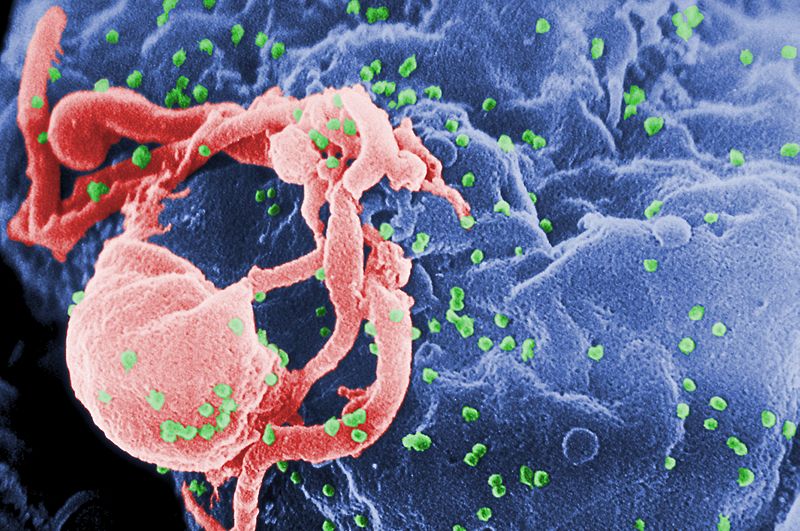
5. Cure for HIV Found!:
For decades, medical researchers and scientists have been looking to create a vaccine that could prevent one from being infected with HIV. But in 2013, they not developed several vaccines that demonstrated this ability, but went a step further and found several potential cures. The first bit of news came in March, when researchers at Caltech demonstrated using HIV antibodies and an approach known as Vectored ImmunoProphylaxis (VIP) that it was possible to block the virus.
Then came the SAV001 vaccine from the Schulich School of Medicine & Dentistry at Western University in London, Ontario, which aced clinical trials. This was punctuated by researchers at the University of Illinois’, who in May used the “Blue Waters” supercomputer to developed a new series of computer models to get at the heart of the virus.
But even more impressive was the range of potential cures that were developed. The first came in March, where researchers at the Washington University School of Medicine in St. Louis that a solution of bee venom and nanoparticles was capable of killing off the virus, but leaving surrounding tissue unharmed. The second came in the same month, when doctors from Johns Hopkins University Medical School were able to cure a child of HIV thanks to the very early use of antiretroviral therapy (ART).
And in September, two major developments occurred. The first came from Rutgers New Jersey Medical School, where researchers showed that an antiviral foot cream called Ciclopirox was capable of eradicating infectious HIV when applied to cell cultures of the virus. The second came from the Vaccine and Gene Therapy Institute at the Oregon Health and Science University (OHSU), where researchers developed a vaccine that was also able to cure HIV in about 50% of test subjects. Taken together, these developments may signal the beginning of the end of the HIV pandemic.
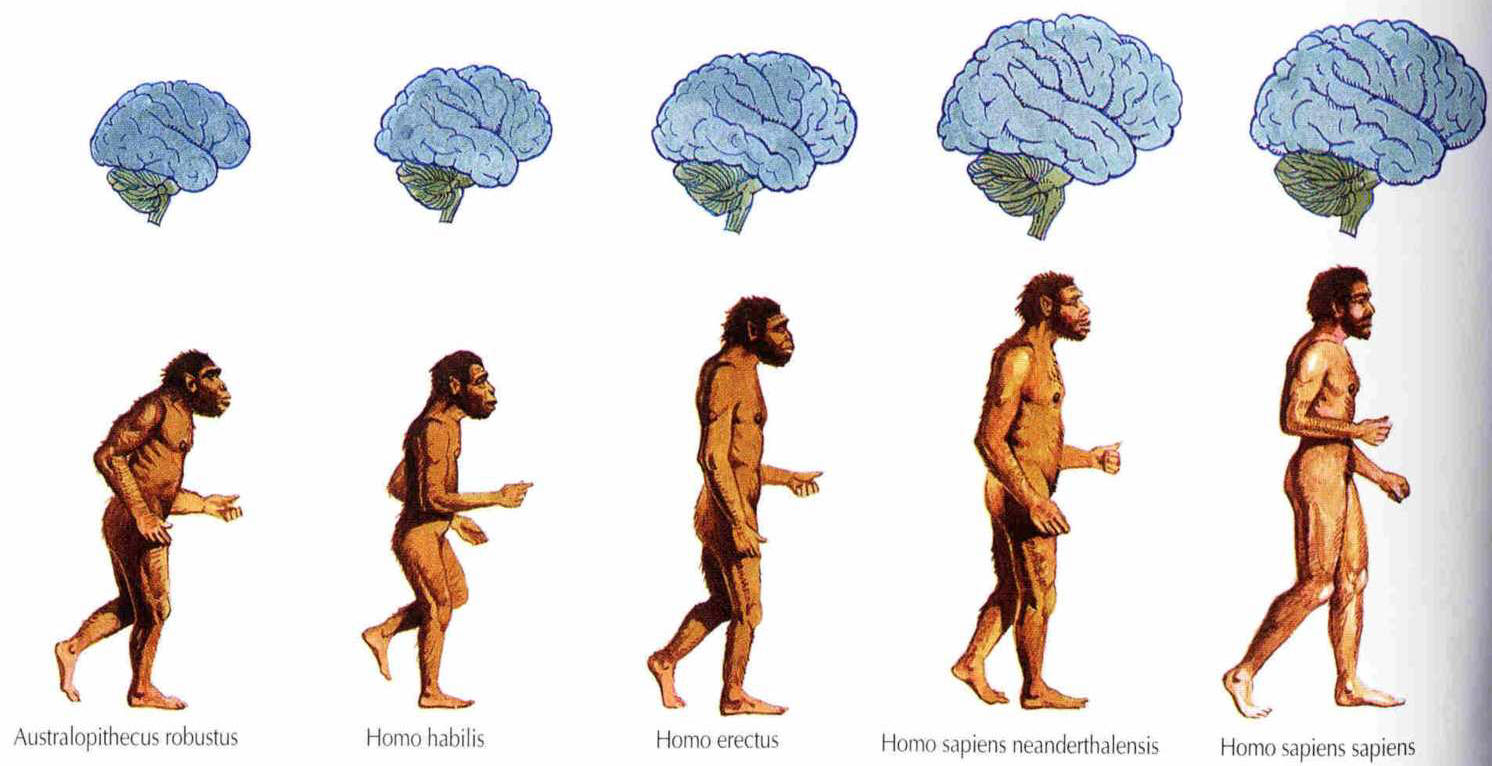
6. Newly Discovered Skulls Alter Thoughts on Human Evolution:
The discovery of an incredibly well-preserved skull from Dmanisi, Georgia has made anthropologists rethink human evolution. This 1.8 million-year old skull has basically suggested that our evolutionary tree may have fewer branches than previously thought. Compared with other skulls discovered nearby, it suggests that the earliest known members of the Homo genus (H. habilis, H.rudolfensis and H. erectus) may not have been distinct, coexisting species, but instead were part of a single, evolving lineage that eventually gave rise to modern humans.
7. Curiosity Confirms Signs of Life on Mars:
Over the past two years, the Curiosity and Opportunity rovers have provided a seemingly endless stream of scientific revelations. But in March of 2013, NASA scientists released perhaps the most compelling evidence to date that the Red Planet was once capable of harboring life. This consisted of drilling samples out of the sedimentary rock in a river bed in the area known as Yellowknife Bay.
Using its battery of onboard instruments, NASA scientists were able to detect some of the critical elements required for life – including sulfur, nitrogen, hydrogen, oxygen, phosphorus, and carbon. The rover is currently on a trek to its primary scientific target – a three-mile-high peak at the center of Gale Crater named Mount Sharp – where it will attempt to further reinforce its findings.
8. Scientists Turn Brain Matter Invisible:
Since its inception as a science, neuroanatomy – the study of the brain’s functions and makeup – has been hampered by the fact that the brain is composed of “grey matter”. For one, microscopes cannot look beyond a millimeter into biological matter before images in the viewfinder get blurry. And the common technique of “sectioning” – where a brain is frozen in liquid nitrogen and then sliced into thin sheets for analysis – results in tissue being deformed, connections being severed, and information being lost.
But a new technique, known as CLARITY, works by stripping away all of a tissue’s light-scattering lipids, while leaving all of its significant structures – i.e. neurons, synapses, proteins and DNA – intact and in place. Given that this solution will allow researchers to study samples of the brains without having to cut them up, it is already being hailed as one of the most important advances for neuroanatomy in decades.
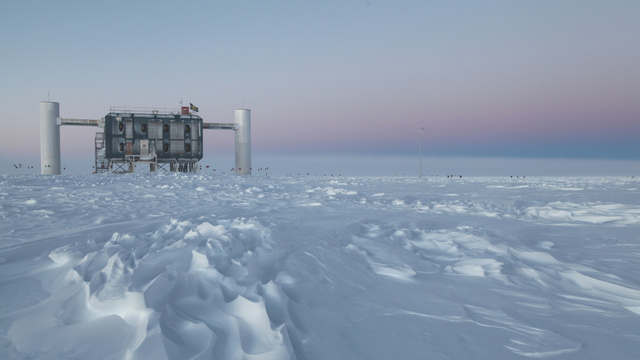
9. Scientists Detect Neutrinos from Another Galaxy:
In April of this year, physicists working at the IceCube South Pole Observatory took part in an expedition which drilled a hole some 2.4 km (1.5 mile) hole deep into an Antarctic glacier. At the bottom of this hole, they managed to capture 28 neutrinos, a mysterious and extremely powerful subatomic particle that can pass straight through solid matter. But the real kicker was the fact that these particles likely originated from beyond our solar system – and possibly even our galaxy.
That was impressive in and off itself, but was made even more so when it was learned that these particular neutrinos are over a billion times more powerful than the ones originating from our sun. So whatever created them would have had to have been cataclysmicly powerful – such as a supernova explosion. This find, combined with the detection technique used to find them, has ushered in a new age of astronomy.
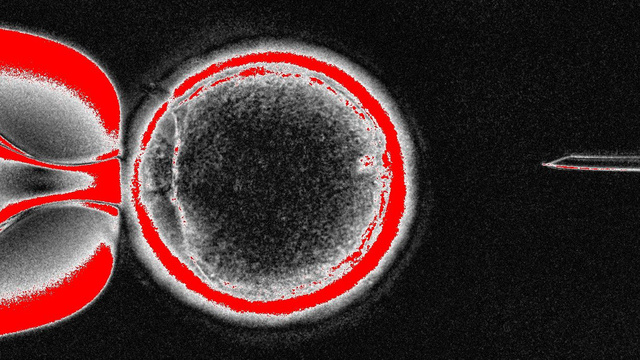
10. Human Cloning Becomes a Reality:
Ever since Dolly the sheep was cloned via somatic cell nuclear transfer, scientists have wondered if a similar technique could be used to produce human embryonic stem cells. And as of May, researchers at Oregon Health and Science University managed to do just that. This development is not only a step toward developing replacement tissue to treat diseases, but one that might also hasten the day when it will be possible to create cloned, human babies.
11. World’s First Lab Grown Meat:
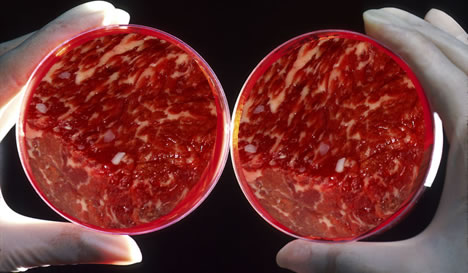
In May of this year, after years of research and hundred of thousands of dollars invested, researchers at the University of Maastricht in the Netherlands created the world’s first in vitro burgers. The burgers were fashioned from stem cells taken from a cow’s neck which were placed in growth medium, grown into strips of muscle tissue, and then assembled into a burger. This development may prove to be a viable solution to world hunger, especially in the coming decades as the world’s population increases by several billion.
12. The Amplituhedron Discovered:
If 2012 will be remembered as the year that the Higgs Boson was finally discovered, 2013 will forever be remembered as the year of the Amplituhedron. After many decades of trying to reformulate quantum field theory to account for gravity, scientists at Harvard University discovered of a jewel-like geometric object that they believe will not only simplify quantum science, but forever alters our understanding of the universe.
This geometric shape, which is a representation of the coherent mathematical structure behind quantum field theory, has simplified scientists’ notions of the universe by postulating that space and time are not fundamental components of reality, but merely consequences of the”jewel’s” geometry. By removing locality and unitarity, this discovery may finally lead to an explanation as to how all the fundamental forces of the universe coexist.
These forces are weak nuclear forces, strong nuclear forces, electromagnetism and gravity. For decades, scientists have been forced to treat them according to separate principles – using Quantum Field Theory to explain the first three, and General Relativity to explain gravity. But now, a Grand Unifying Theory or Theory of Everything may actually be possible.
13. Bioprinting Explodes:
The year of 2013 was also a boon year for bioprinting – namely, using the technology of additive manufacturing to create samples of living tissue. This began in earnest in February, where a team of researchers at Heriot-Watt University in Scotland used a new printing technique to deposit live embryonic stem cells onto a surface in a specific pattern. Using this process, they were able to create entire cultures of tissue which could be morphed into specific types of tissue.
Later that month, researchers at Cornell University used a technique known as “high-fidelity tissue engineering” – which involved using artificial living cells deposited by a 3-D printer over shaped cow cartilage – to create a replacement human ear. This was followed some months later in April when a San Diego-based firm named Organova announced that they were able to create samples of liver cells using 3D printing technology.
And then in August, researchers at Huazhong University of Science and Technology were able to use the same technique create the world first, living kidneys. All of this is pointing the way towards a future where human body parts can be created simply by culturing cells from a donor’s DNA, and replacement organs can be synthetically created, revolutionizing medicine forever.
14. Bionic Machinery Expands:
If you’re a science buff, or someone who has had to go through life with a physical disability, 2013 was also a very big year for the field of bionic machinery. This consisted not only of machinery that could meld with the human body in order to perform fully-human tasks – thus restoring ambulatory ability to people dealing with disabling injuries or diseases – but also biomimetic machinery.
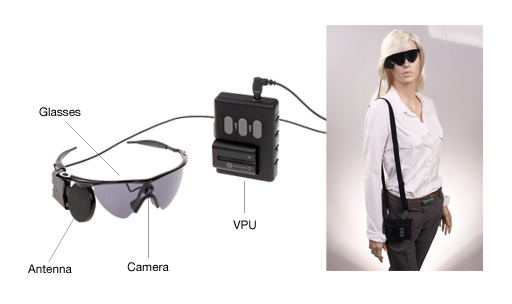
The first took place in February, where researchers from the University of of Tübingen unveiled the world’s first high-resolution, user-configurable bionic eye. Known officially as the “Alpha IMS retinal prosthesis”, the device helps to restore vision by converted light into electrical signals your retina and then transmitted to the brain via the optic nerve. This was followed in August by the Argus II “retinal prosthetic system” being approved by the FDA, after 20 years of research, for distribution in the US.
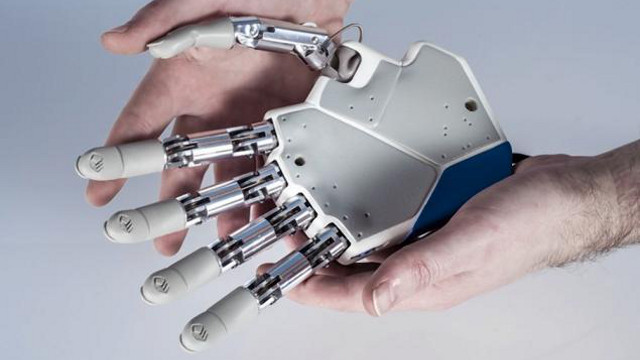
Later that same month, the Ecole Polytechnique Federale de Lausanne in Switzerland unveiled the world’s first sensory prosthetic hand. Whereas existing mind-controlled prosthetic devices used nerve signals from the user to control the movements of the limb, this new device sends electrostimulus to the user’s nerves to simulate the sensation of touch.
Then in April, the University of Georgia announced that it had created a brand of “smart skin” – a transparent, flexible film that uses 8000 touch-sensitive transistors – that is just as sensitive as the real thing. In July, researchers in Israel took this a step further, showing how a gold-polyester nanomaterial would be ideal as a material for artificial skin, since it experiences changes in conductivity as it is bent.
15. 400,000 Year-Old DNA Confuses Humanity’s Origin Story:
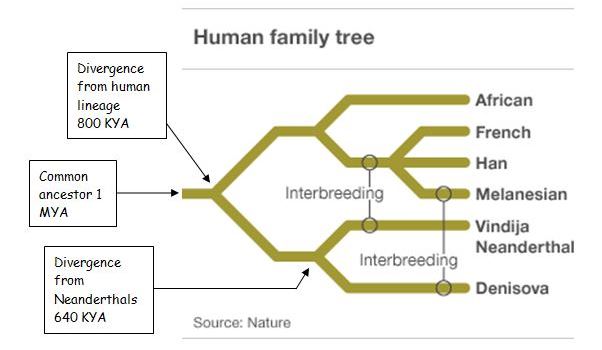
Another discovery made this year has forced anthropologist to rethink human evolution. This occurred in Spain early in December, where a team from the Max Planck Institute for Evolutionary Anthropology in Leipzig, Germany recovered a 400,000 year-old thigh bone. Initially thought to be a forerunner of the Neanderthal branch of hominids, it was later learned that it belonged to the little-understood branch of hominins known as Denisovans.
The discordant findings are leading anthropologists to reconsider the last several hundred thousand years of human evolution. In short, it indicates that there may yet be many extinct human populations that scientists have yet to discover. What’s more, there DNA may prove to be part of modern humans genetic makeup, as interbreeding is a possibility.
When it comes to the future of transportation and urban planning, some rather interesting proposals have been tabled in the past few years. In all cases, the challenge for researchers and scientists is to find ways to address future population and urban growth – ensuring that people can get about quickly and efficiently – while also finding cleaner and more efficient ways to power it all.
As it stands, the developed and developing world’s system of highways, mass transit, and emission-producing vehicles is unsustainable. And the global population projected to reach 9 billion by 2050, with just over 6 billion living in major cities, more of the same is just not feasible. As a result, any ideas for future transit and urban living need to find that crucial balance between meeting our basic needs and doing so in a way that will diminish our carbon footprint.
One such idea comes to us from New York City, where a small company known as HEVO Power has gotten the greenlight to study the possibility of charging parked electric vehicles through the street. Based on the vision of Jeremy McCool, a veteran who pledged to reduce the US’s reliance on foreign fuel while fighting in Iraq, the long-term aim of his plan calls for roadways that charge electric cars as they drive.
Development began after McCool received a $25,000 grant from the Department of Veterans Affairs and put it towards the creation of an EV charging prototype that could be embedded in city streets. Designed to looked like a manhole cover, this charging device runs a type of electromagnetic wireless charging technology proposed by researchers Marian Kazimierczuk of Wright State University and professor Dariusz Czarkowski of NYU’s Polytechnic Institute.
The charge consists of two coils – one connected to the grid in the manhole cover, and the other on the electric vehicle. When the car runs over the manhole, the coils conduct a “handshake,” and the manhole delivers a charge on that frequency to the car. Though HEVO has yet to test the device in the real world, they are teamed up with NYU-Poly to develop the technology, and have already proven that it is safe for living things with the help of NYU’s medical labs.
So far, McCool says his company has commitments from seven different companies to develop a series of delivery fleets that run on this technology. These include PepsiCo, Walgreens, and City Harvest, who have signed on to develop a pilot program in New York. By creating regular pick-up and drop-off points (“green loading zones”) in front of stores, these fleets would be able to travel greater distances without having to go out of their way to reach a charging station.
In order to test the chargers in New York City in early 2014, HEVO has applied for a $250,000 grant from the New York State Energy Research and Development Authority. The organization has already granted a feasibility study for the green loading zones. According to McCool, Glasgow’s Economic Development Corps is also exploring the idea of the technology in Scotland.
But looking ahead, McCool and his company have more ambitious plans than just a series of green loading zones. Already, HEVO is developing a proof of concept to place these kinds of chargers along major highways:
The concept is simple. There is a way to provide wireless charging in an HOV lane. That’s a small strip at every yard or so that has another wireless charging plate, so as you go down the street you’re collecting a charge. One wireless charging highway.
However, this is just a first step, and a major infrastructure project will still be needed to demonstrate that the technology truly does have what it takes to offset fossil fuel burning cars and hybrids. However, the technology has proven promising and with further development and investment, a larger-scale of adoption and testing is likely to take place.
Another interesting idea comes to us from Mexico, where a developer has come up with a rather ingenious idea that could turn mass transit into a source of electricity. The developer’s name is Héctor Ricardo Macías Hernández, and his proposal for a piezoelectric highway could be just the thing to compliment and augment an electric highway that keeps cars charged as they drive.
For years, researchers and developers have been looking for ways to turn kinetic energy – such as foot traffic or car traffic – into electricity. However, these efforts have been marred by the costs associated with the technology, which are simply too high for many developing nations to implement. That is what makes Hernández concept so ingenious, in that it is both affordable and effective.
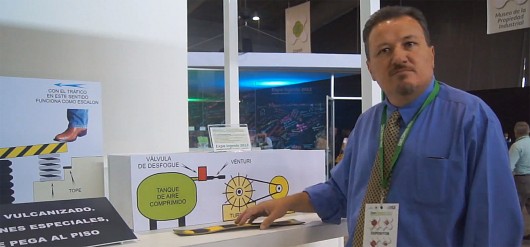
In Macías Hernández’ system, small ramps made from a tough, tire-like polymer are embedded in the road, protruding 5 cm (2 inches) above the surface. When cars drive over them, the ramps are temporarily pushed down. When this happens, air is forced through a bellows that’s attached to the underside of the ramp, travels through a hose, and then is compressed in a storage tank. The stored compressed air is ultimately fed into a turbine, generating electricity.
In this respect, Hernández’s concept does not rely on piezoelectric materials that are expensive to manufacture and hence, not cost effective when dealing with long stretches of road. By relying on simple materials and good old fashioned ingenuity, his design could provide cheap electricity for the developing world by simply turning automobile traffic – something very plentiful in places like Mexico City – into cheap power.
Macías Hernández points out, however, that in lower-traffic areas, multiple ramps placed along the length of the road could be used to generate more electricity from each individual vehicle. He adds that the technology could also be used with pedestrian foot-traffic. The system is currently still in development, with the support of the Mexican Institute of Industrial Property, and will likely take several years before becoming a reality.
Exciting times these are, when the possibility of running an advanced, industrial economy cleanly may actually be feasible, and affordable. But such is the promise of the 21st century, a time when the dreams of the past several decades may finally be coming to fruition. And just in time to avert some of our more dystopian, apocalyptic scenarios!
When it comes to observational astronomy, scientists and cosmologists have been facing a sort of crisis of late. With so many instruments aimed at the heavens, recording what little information makes it all the way to Earth, simply observing distant stars has been providing diminishing returns. In order to keep moving forward, we must observe the most unusual and, in many cases, violent cosmic events so we can see some truly novel data.
This presents a bit of a challenge, since the the space industry can’t possibly set up enough telescopes to look at every part of the night sky all at once. With so much depth through which to zoom, it would seem a lost cause to try to capture unexpected, short-lived events. And yet, one such event, one that is truly cosmic in nature (no pun!), was captured just recently.
It took place back in late November, when an “armada of instruments” from all over the world saw a massive gamma-ray burst originating from a point in space known as GRB 130427A. This burst was more powerful than what many researchers believed was theoretically possible, and is now thought to be the collapse of a giant star and the birth of a black hole.
The event has been described as a “Rosetta stone moment” by astronomers for a number of reasons. In addition to being a truly rare and awesome sight, this burst has also sent out information that astronomers will be studying for many years to come. And while it’s too soon to draw any real conclusions, there is already widespread excitement about the sheer newness of it.
And yet, GRB 130427A only lasted about 80 seconds at observable intensities, so the fact that it was observed, letalone documented so thoroughly was truly surprising! This was all thanks to the Los Alamos National Laboratories in New Mexico, where six robotic cameras – collectively referred to as RAPTOR, or RAPid Telescopes for Optical Response – were able to respond in time to catch the event unfold.
The RAPTOR telescopes are networked together and all obey a central computer “brain”. Between their dedicated computing hardware and robotic swivel-mounts, they can turn to view any point in the sky in less than three seconds. As the world’s fastest “optical response” devices, RAPTOR’s telescopes are designed to make sure we don’t miss astronomical events when they happens, because in astronomy there are no second chances.
The RAPTOR telescopes to ensure things aren’t missed by performing extremely diffuse, wide-angle sweeps of the sky to pick up hints at about where and when a major event is taking place. When one of the telescopes sees a hint of something good, it and the others quickly reorient and zoom to capture it in full detail. And with all six telescopes capturing the same event, the wealth of information gleamed is quite impressive.
The telescopes have different specializations as well. For example, the RAPTOR-T views all events through four aligned lenses with four different color filters. By looking at the differences in color distribution in the sample, RAPTOR-T can provide info about the distance to an event (by measuring Red Shift and Blue Shift) or about some elements of its environment.
This gamma ray burst is thought to be the brightest in decades, perhaps in a century. And if astronomers had missed it, it’s likely that nobody would have gotten the chance to capture one again. Luckily, the event was also seen by a number of other gamma ray detectors and x-ray telescopes. These included NASA’s Fermi, NuSTAR, and Swift satellites, all of which managed to see some portion of the event as it unfolded.
However, most telescopes joined in to view the event’s so-called afterglow, an incredibly violent occurrence where the newly-born black hole threw out debris and damage over a wide radius. For several hours, this radius glowed and astronomers watched as it faded. The intensity of high-energy gamma rays in that afterglow faded in tandem with its conventional light emissions.
This is one of the first useful bits of information provided by this event – the link between gamma rays and optical phenomena. But this is just one way that it could be astronomy’s latest Rosetta Stone observation. In the next few months, we can all look forward to a slew of exciting updates as astronomers sort through the implications of having witnessed the birth of an unprecedented singularity.
And in the meantime, check out this video of the gamma-ray burst, as observed by the RAPTOR All-Sky Monitor:
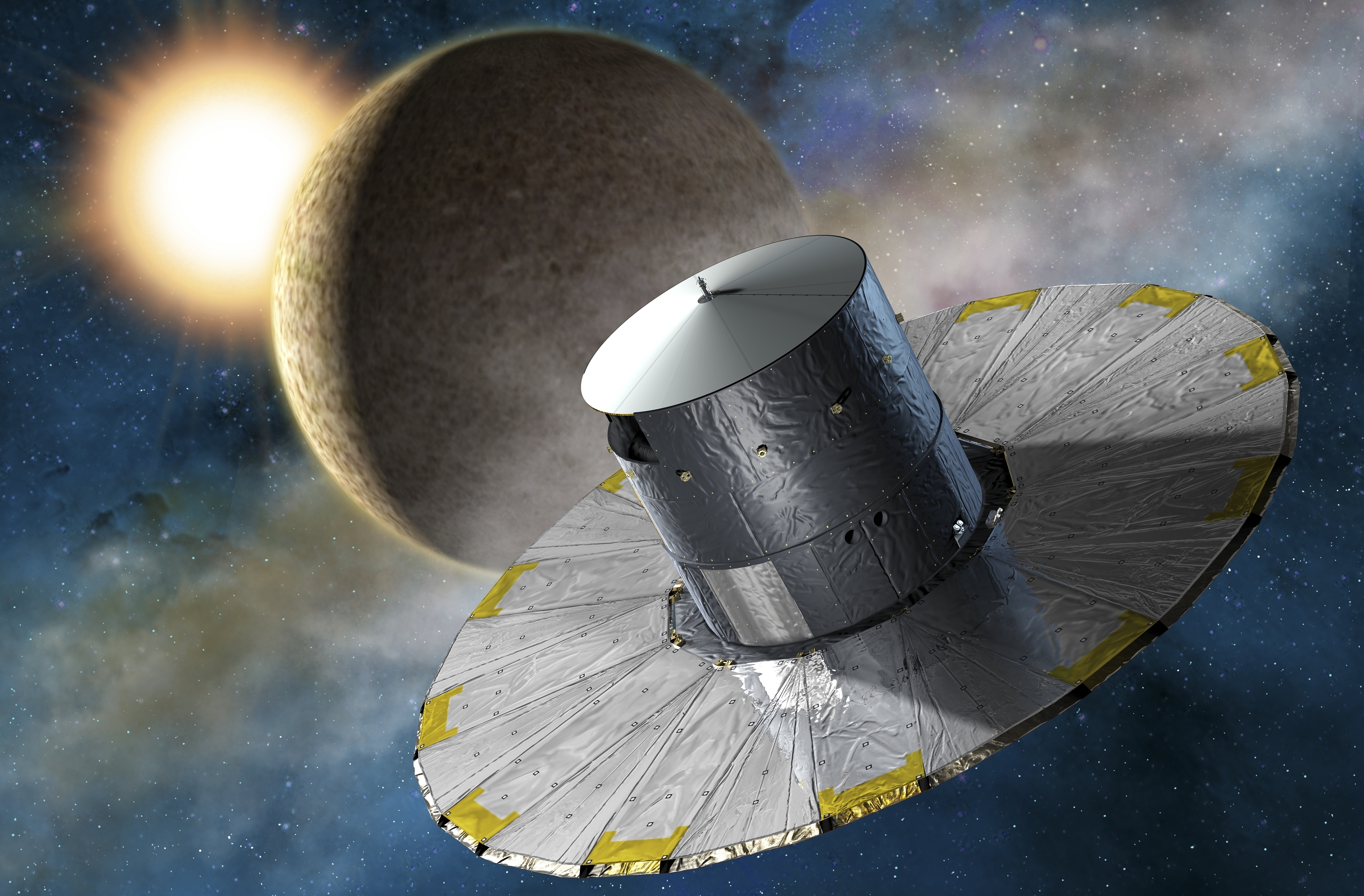
This morning, the European Space Agency’s Gaia mission blasted off from Europe’s Spaceport in Kourou, French Guiana, on the head of a Soyuz rocket. This space observatory aims to study approximately 1 billion stars, roughly 1% of the Milky Way Galaxy, and create the most accurate map yet of the Milky Way. In so doing, it will also answer questions about the origin and evolution of our home Galaxy.
As the successor to the Hipparcos mission – an ESA astrometry satellite that was launched in 1989 and operated until 1993 – it is part of ESA’s Horizon 2000 Plus long-term scientific program. Repeatedly scanning the sky, Gaia will observe each of the billion stars an average of 70 times each over the five years and measure the position and key physical properties of each star, including its brightness, temperature and chemical composition.
The Soyuz VS06 launcher, operated by Arianespace, lifted off at 09:12 GMT (10:12 CET). About ten minutes later, after separation of the first three stages, the Fregat upper stage ignited, delivering Gaia into a temporary parking orbit at an altitude of 175 km. A second firing of the Fregat 11 minutes later took Gaia into its transfer orbit, followed by separation from the upper stage 42 minutes after liftoff.
Gaia is now en route towards an orbit around a gravitationally-stable virtual point in space called L2 Lagrange Point, some 1.5 million kilometres beyond Earth. Tomorrow, engineers will command Gaia to perform the first of two critical thruster firings to ensure it is on the right trajectory towards its L2 home orbit. About 20 days after launch, the second critical burn will take place, inserting it into its operational orbit around L2.
Jean-Jacques Dordain, ESA’s Director General, had this to say about the launch:
Gaia promises to build on the legacy of ESA’s first star-mapping mission, Hipparcos, launched in 1989, to reveal the history of the galaxy in which we live.
ESA’s Gaia project scientist Timo Prusti expressed similar sentiments, highlighting how the Gaia mission’s ultimate purpose is to advance our understanding of the cosmos:
Along with tens of thousands of other celestial and planetary objects, this vast treasure trove will give us a new view of our cosmic neighbourhood and its history, allowing us to explore the fundamental properties of our Solar System and the Milky Way, and our place in the wider Universe.
By taking advantage of the slight change in perspective that occurs as Gaia orbits the Sun during a year, it will measure the stars’ distances and their motions across the sky. This motions will later be put into “rewind” to learn more about where they came from and how the Milky Way was assembled over billions of years from the merging of smaller galaxies, and into “fast forward” to learn more about its ultimate fate.
This is an especially ambitious mission when you consider that of the one billion stars Gaia will observe, 99% have never had their distances measured accurately. The mission will also study 500,000 distant quasars and will conduct tests of Einstein’s General Theory of Relativity. So as the mission continues and more data comes in, scientists and astronomers will be able to construct more detailed models of how the universe was created, and perhaps how it will end…
The current consensus is that the universe began with a creation event known as The Big Bang. However, the question of how it will end, either through a “Big Crunch” event – where the expansion of the universe will eventually cease and all matter will collapse back in on itself – or simply continue to expand until all stars and galaxies consume their fuel and burn out, remains something of a mystery.
Personally, I call Big Crunch, mainly because I like to the think that our universe is one of many. Not just in the parallel dimension sense, but in the temporal sense as well. Like the city of Ilium (aka. Troy), existence as we know it is built upon the foundations of countless others, stretching backwards and forwards into infinity…
Deep stuff, man! In the meantime, enjoy this video of the Gaia’s mission’s liftoff, courtesy of the ESA:
Since the first discovery of their remains was made, modern humans have struggled to reconstruct how dinosaurs lived, behaved, and even appeared. As simple as it may seem to the rest of us, paleontologists understand that bones alone do not an accurate representation make. And over the years, many theories have been advanced as to what the full, fleshy forms of dinosaurs truly looked like.
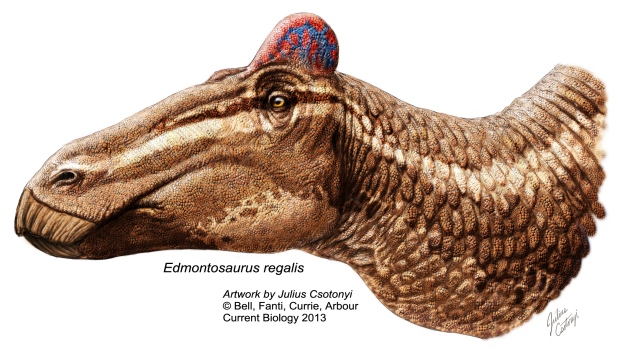
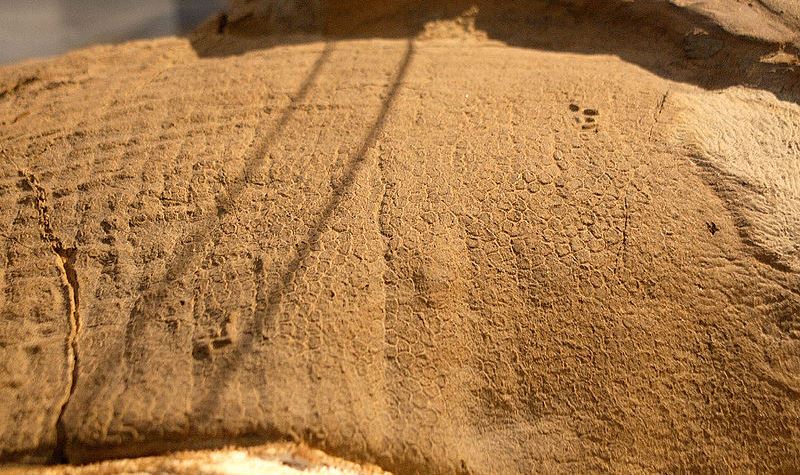
And thanks to a find made in Grand Prairie, Alberta last year, one of the richest source of dinosaur bones in the world, scientists are that much closer to getting an accurate picture as to what one candidate – Edmontosaurus regalis – looked like. In short, the find revealed a body part never seen before on any dinosaur – a soft, fleshy comb on its head, similar to those found on roosters.
According to Victoria Arbour, a University of Alberta paleontologist who co-authored the scientific paper published Thursday in the journal Current Biology, the comb constituted a “structure that was completely unexpected.” And that it “kind of makes us wonder what other dinosaurs might have had.” The find is also interesting because of the connection it draws to the biology of today’s animals, something which is still considered distinct from prehistoric creatures.
Edmontosaurus are a duck-billed, plant-eating dinosaur that grew to be 12 metres long and was thought to have roamed North America in herds during the late Cretaceous, about 75 and 65 million years ago. It also belonged to a group of dinosaurs known as hadrosaurs, a family of duck-billed herbivores which were the most common dinosaurs on the continent at the time.
Phil Bell, a paleontologist at the University of New England in Armidale, Australia, was with the Philip J. Currie Dinosaur Museum currently under construction in Grand Prairie, Alta., when he uncovered the fossil last summer with geologist Federico Fanti of the University of Bologna. As the lead author of the paper, Bell claims that the new findings are a major breakthrough in determining the dinosaur’s behavior.
In particular, the existence of the comb adds to evidence that Edmontosaurus was a social animal, as ornaments like combs and crests are typically used for communication among animals such as roosters, especially in relation to competition for females:
[E]quivalent to discovering for the first time that elephants had trunks. These findings dramatically alter our perception of the appearance and behaviour of this well-known dinosaur. We might imagine a pair of male Edmontosaurus sizing each other up, bellowing, and showing off their head gear to see who was the dominant male and who is in charge of the herd.
And of course, this find demonstrates many of the limitations imposed on paleontologist, as fossils typically only preserve the bones of an animal and not fleshy structures. But in rare cases, fossils are found that are described as “mummified”, where bones are in the same positions relative to each other that they would have been in life, with impressions of the skin preserved on top.
According to Arbour, it’s not clear what conditions lead the preservation of skin impressions, but it likely involves the animals dying in a flood and being quickly buried by sand or mud. She added that even when skin impressions are preserved, they are often only visible in certain lighting or when the rock breaks a certain way, which may be why combs hadn’t been noticed on earlier “mummified” Edmontosaurus fossils.
While earlier hadrosaurs had bony crests, researchers thought the crest had been completely lost in Edmontosaurus. The new discovery suggests that, in fact, the dinosaurs’ crests had changed, but remained an important feature. Bell said it also suggests that similar structures may have been missed in other dinosaurs:
There’s no reason that other strange fleshy structures couldn’t have been present on a whole range of other dinosaurs, including T. rex or Triceratops.
So really, this single find could have far-reaching implications for the field of paleontology. And with time, more discoveries, and additional refinements to the excavation process, we might just get a full and complete picture of what life really and truly looked like on Earth millions of years ago.
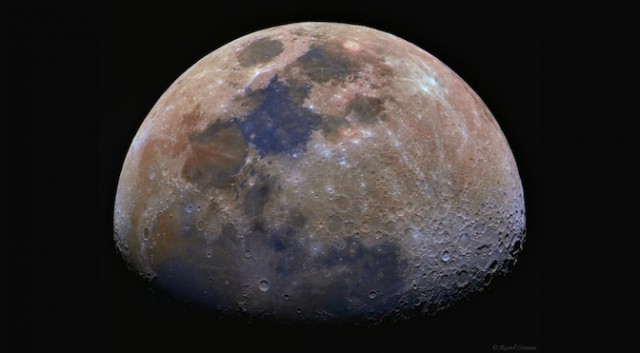
The moon remains the focal point of much of our space-related goals for the near future. In addition to China recently landing its Jade Rabbit probe, the more ambitious plans of NASA and the ESA involve building a settlement there in the near future. But of course, these and other plans to turn the moon into a new frontier from humanity are marred by the fact the environment is not habitable.
Luckily, NASA plans to change that, starting with growing plants on the lunar surface. And while this might seem like a long way away from building sealed domes and mounting full-scale terraforming, it is a big step in that direction. Aside from the obvious life support that vegetation would provide – air, food, and water – it would also provide another integral aspect to a habitable lunar environment.
Plants react to aspects of a harsh environment similarly to humans, as their genetic material can be damaged by radiation. A relatively safe way to test long-term lunar exposure is to send plants there and monitor their health. Rather than making the trip and dropping the plants off itself, NASA plans to use commercial spaceflight as the vehicle by which the plants will be sent up to the moon.
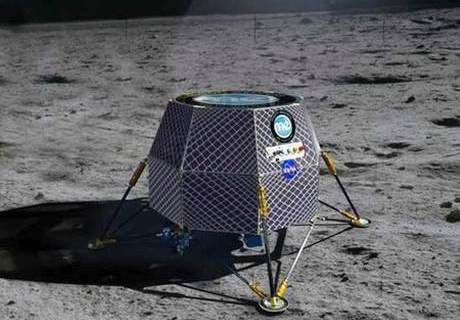
And that’s where Google comes in, NASA’s proposed partner for this venture. Using the Moon Express, a small, lightweight craft (about 1 kilogram or 2 pounds) that will act as a self-sustaining habitat for the vegetation, NASA will deliver these plants to the moon by 2015. This lunar lander is part of the Google Lunar X Prize, a competition to create a robotic spacecraft that can fly to and land on the moon.
Once the lander arrives on the moon, water will be added to the basil, turnip, and Arabidopsis (a small flowering plant) seeds kept in the habitat, then monitored for five to ten days and compared to control groups germinating back on Earth. NASA will also monitor the actual habitat itself, looking toward its scalability since the small habitat isn’t large enough to support human life.
Currently, the chamber can support 10 basil seeds, 10 turnip seeds, and around 100 Arabidopsis seeds. It also holds the bit of water that initiates the germination process, and uses the natural sunlight that reaches the moon to support the plant life. In order to study the quality of the plant growth and movement, the habitat will take images and beam them back home.
If NASA doesn’t run into any unexpected bumps, its long-term plans include attempting to grow a more diverse array of plants, longer growth periods, and reproduction experiments. The longer the experiments, the more we’ll learn about the long-term effects of a lunar environment on Earth plants, which will tell us much of what we need to know if we ever plan on building true settlements there in the future.
Earlier this month, Industry Minister James Moore announced that Canada’s new space plan will be made public in early in the new year. The announcement came on Monday Dec. 2nd at an aerospace forum in Montreal which also brought together leaders of Canada’s space industry. Emphasizing the achievements of Canada’s space industry, he also went on to claim that next year’s goals would reach beyond these traditional areas:
Our companies are leaders in optics, in robotics, radar imagery and satellite communications, but we will not stop at this success… The industry has spoken up, has worked collaboratively, has given the government advice on how to proceed (and) we’ve taken the advice and we’re putting it into action.
A background paper provided by Moore outlined the government’s strategic goals for its space activities, which include jobs and growth, sovereignty, security and the advancement of knowledge. Moore also told the space industry executives assembled that the government will examine all opportunities to work with the private sector and Canada’s international partners to encourage innovation in the country’s space activities.
Following up on the Emerson report’s recommendations, Moore announced various actions, including the establishment of a space advisory board composed of industry leaders and chaired by Walt Natynczyk, head of the Canadian Space Agency.
This framework will provide the foundation for the next phase of our government’s space program. It will be based on the principles of partnership with other countries and the private sector, catering to our strengths and inspiring Canadians.
The industry minister also said the government will double current support for its space technologies development program to $20 million annually by 2015-2016:
This will bring the kind of predictability and stability of funding that you asked for. And (it) will help develop more groundbreaking space technologies that Canadian space companies are so recognized for.
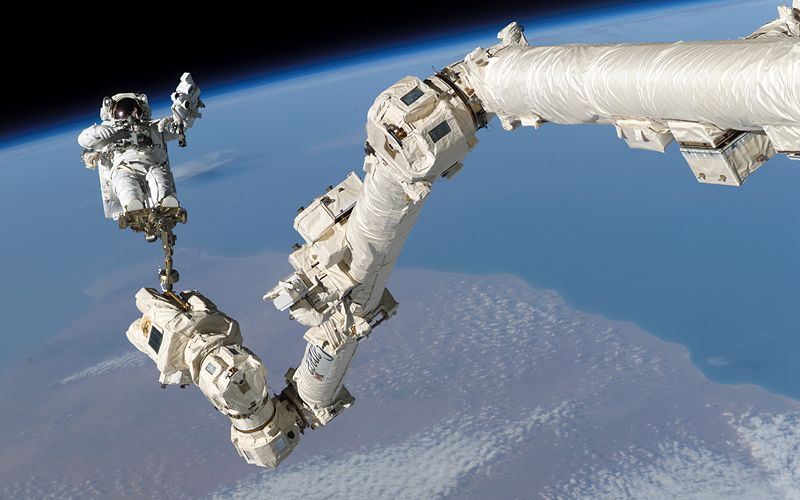
Beyond these stated objectives, its not quite clear what in store’s for the Canadian Space Agency (CSA). After Hadfield’s high-profile tour as the mission commander aboard the ISS, it is safe to say that interest in this field is growing. And with our nation’s ongoing commitment to providing new robotic arms (aka. Canadarm’s) for the ISS, parts and technical workers and astronauts for manned missions, any increase in public interest is likely to have positive results.
What’s more, with the Obama government dedicated to pursuing some extremely ambitious objectives – towing an asteroid to Near-Earth Orbit, a manned mission to Mars, establishing an outpost on the Moon – it would seem obvious that one of their greatest colleagues in space exploration and research would want to get on board.

 Two days ago, another major milestone passed for one of NASA’s famed rovers. But this time around, it wasn’t the spotlight-hogging Curiosity or the die-hard Opportunity rover that was the subject of interest. It was the Spirit rover, the other half of NASA’s now legendary Mars Exploration Rovers (MER) that landed on the Red Planet over a decade ago.
 Together, the long-lived, golf cart sized robots proved that early Mars was warm and wet, billions of years ago – a key finding in the search for habitats conducive to life beyond Earth. It was these findings that have since been followed up on by Curiosity rover in its ongoing search for water and organic particles in the soil, and MAVEN’s planned surveys of the Martian atmosphere.
 The three petaled landing pad then opened and Spirit was deployed in what was a milestone event. This deployment will be forever remembered in the annuls of history, mainly because of the groundbreaking scientific discoveries that ensued, not to mention the unbelievable longevity of the twins. And while Spirit did not make it past 2010 – effectively remaining in service for six years – she accomplished quite a bit in that time.
 But in reality, both robots enormously exceeded expectations and accumulated a vast bonus time of exploration and discovery in numerous extended mission phases. In part, the harsh Martian winds occasionally cleaned their solar panels to give them both a new lease on life. And more importantly, the rovers’ components just kept working miraculously.
 This was especially impressive, seeing as how the rovers were not designed to climb hills. But eventually, she managed to scale the 30 degree inclines and collect a series of rock samples using her Rock Abrasion Tool (RAT). The samples were then inspected using her on-board spectrometers and a microscopic imager. Eventually she drove back down the hill and made even greater scientific discoveries.
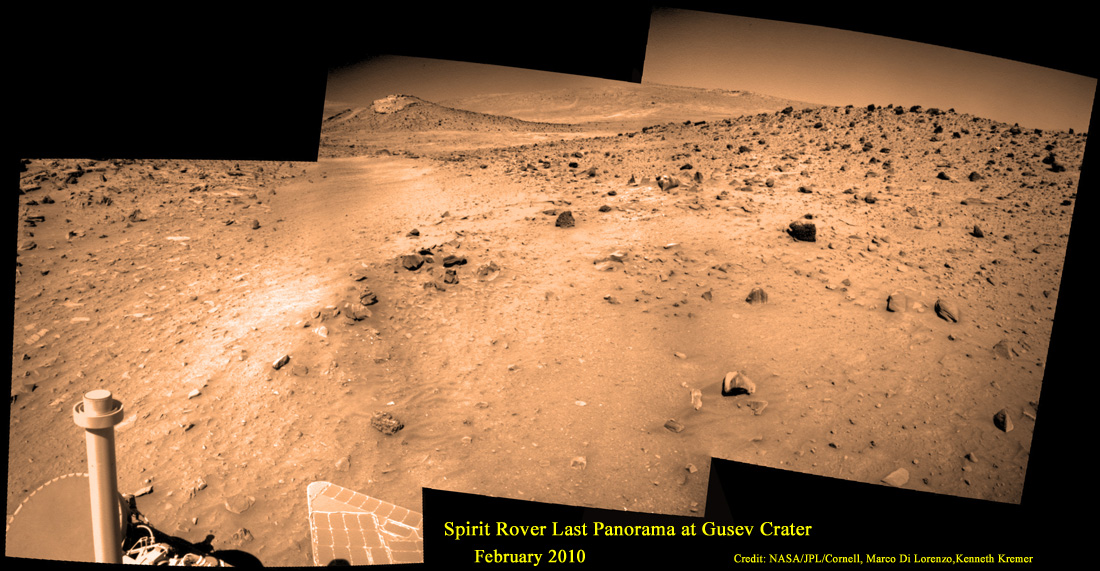 Three years later, in February of 2010, Spirit once again got mired and took her last panorama (pictured above), which was stitched together from raw images by Marco Di Lorenzo and Ken Kremer. After several attempts to save her, NASA eventually declared Spirit dead in the water, her last resting place being the same as where she made her landing – the Gustev Crater in the Aeolis quadrangle.
 Meanwhile, NASA’s new Curiosity rover just celebrated 500 Sols on Mars and is speeding towards Mount Sharp from inside Gale Crater – which is about the same size as Gusev crater. And a pair of newly launched orbiters are streaking towards the Red Planet as we speak – NASA’s Mars Atmosphere and Volatile EvolutioN (MAVEN) and India’s Mars Orbiter Mission (MOM).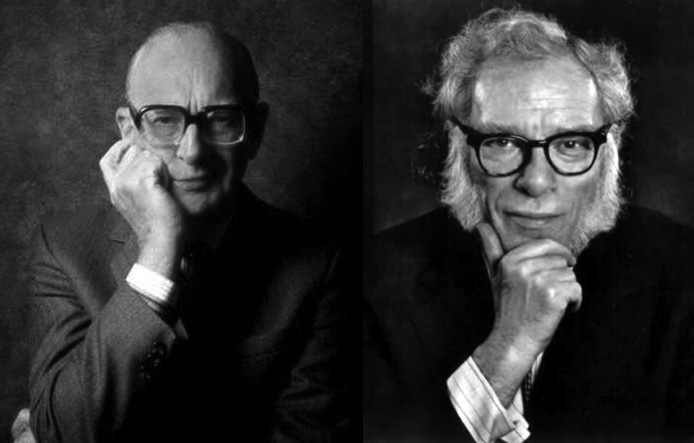






























 Stories by Williams