Some of you may recall how a few months back, I posted a video from Mr. Jack Collins that provided a breakdown of Ray Bradbury’s Fahrenheit 451. As it turns out, that video was just the tip of the iceberg for what he and others are doing over at Academic Earth, a website dedicated to media literacy and education in an age of evolving technology.
So far, I’ve found several items of interest, but this other video breakdown of another dystopian classic – Ayn Rand’s Atlas Shrugged – was especially eye-catching. Here, Collins breaks down the books plot, themes, characters and message with the same thoroughness and incisive commentary that he brought to Bradbury’s classic tale of a society base on censorship and mindless leisure.
Of note is how Rand’s philosophy of Objectivism – which combines individualism, freedom and self-interest – is unapologetically portrayed in this book. Having witnessed the horrors of Soviet Communism firsthand, she had a good deal to say about a society that promoted social equality at the expense of creativity, enterprise and personal merit. Rand’s book has often been criticized as “hateful” and the perfect example of class-antagonism, but to conservative thinkers and fans of dystopia alike, it remains a classic.
Years later, Atlas Shrugged remains a controversial story, due to its stern and at times vitriolic attack on what Rand saw as systems that promoted mediocrity in the name of “social justice”. In contrast to the idea that the wealthy have a social obligation to those less fortunate than themselves, Rand retorts by stating that those with wealth exist by their own merits and are essentially holding up the needy, poor, and working classes of society – a la Atlas.
By urging these people to “shrug” off this burden, Rand was rejecting the idea that the social classes owe each other anything and claimed that society would be made better by enshrining the ideal of self-interest and unfettered rewards for individual effort. And as Mr. Collins notes, by story’s end, it was… for some people.
In short, there’s a reason people like Glenn Beck, Michelle Malkin, Sean Hannity and Rupert Murdoch love this book and its author. Nothing says “go capitalism” or promotes Cold War-era ideology like a Russian emigre who thinks that the free market is the pinnacle of civilization and things like charity, welfare, and social assistance are crutches that need to be kicked out. I’m biased, I know. But then again, so was Rand…
And as usual, I’m looking forward to using this somewhere down the line, should this book ever appear on my student’s reading list. Check out the full video at the link below:
When it comes to building the homes, apartment blocks and businesses headquarters of the future, designers and urban planners are forced to contend with a few undeniable realities. No only are these buildings going to be need to be greener and more sustainable, they will need to be built in such a way that doesn’t unnecessarily burden the environment.
Currently, the methods for erecting a large city building are criminally inefficient. Between producing the building materials – concrete, steel, wood, granite – and putting it all together, a considerable amount of energy is expended in the form of emissions and electricity, and several tons of waste are produced.
Luckily, there are many concepts currently on the table that will alter this trend. Between using smarter materials, more energy-efficient design concepts, and environmentally-friendly processes, the future of construction and urban planning may someday become sustainable and clean.
At the moment, many such concepts involve advances made in 3-D printing, a technology that has been growing by leaps and bounds in recent years. Between anti-gravity printers and sintering, there seems to be incredible potential for building everything from settlements on the moon to bridges and even buildings here on Earth.
One case in particular comes to us from Spain, where four students from the Institute for Advanced Architecture of Catalonia have created a revolutionary 3-D printing robot. It’s known as Stone Spray, a machine that can turn dirt and sand into finished objects such as chairs, walls, and even full-blown bridges.
The brainchild of Anna Kulik, Inder Prakash, Singh Shergill, and Petr Novikov, the robot takes sand or soil, adds a special binding agent, then spews out a fully formed architectural object of the designers’ choosing. As Novikov said in an interview with Co.Design:
The shape of the resulting object is created in 3-D CAD software and then transferred to the robot, defining its movements. So the designer has the full control of the shape.
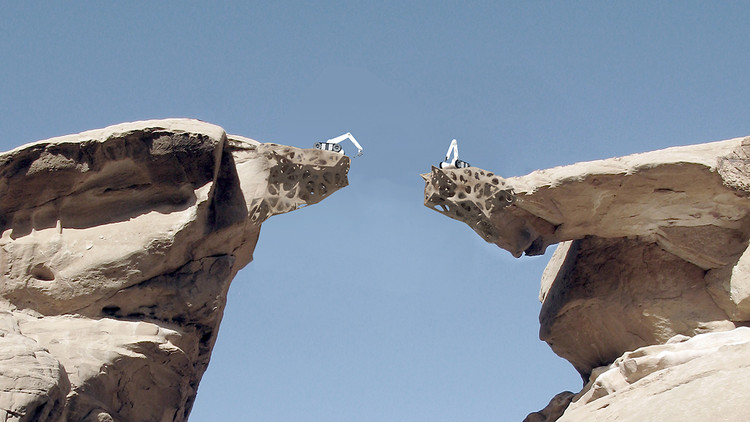
So far, all the prototypes – which include miniature stools and sculptures – are just 20 inches long, about the size of a newborn. But the team is actively planning on increasing the sizes of the objects this robot can produce to architectural size. And they are currently working on their first full-scale engineering model: a bridge (pictured above).
If successful, the robot could represent a big leap forward in the field of sustainable design. Growing a structure from the earth at your feet circumvents one of the most resource-intensive aspects of architecture, which is the construction process.
And speaking of process, check out this video of the Stone Spray in action:
At the same time, however, there are plans to use biohacking to engineer tiny life forms and even bacteria that would be capable of assembling complex structures. In a field that closely resembles “swarm robotics” – where thousands of tiny drones are programmed to build thing – “swarm biologics” seeks to use thousands of little creatures for the same purpose.
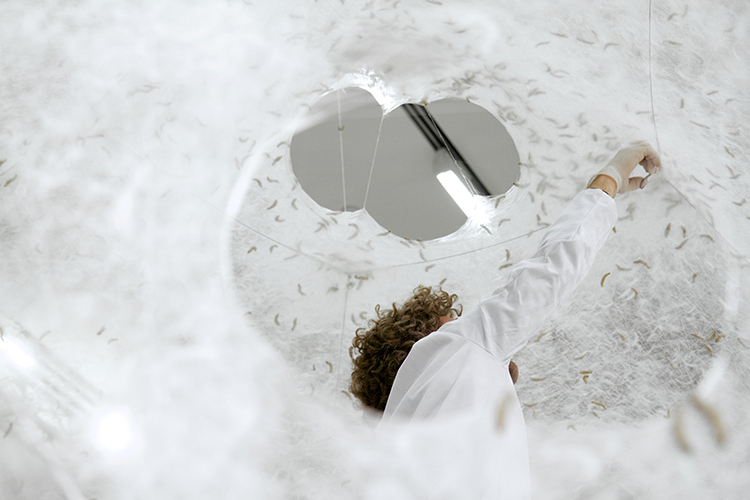
MIT has taken a bold step in this arena, thanks to their creation by the Mediated Matter Group that has rebooted the entire concept of “printed structures”. It’s called the Silk Pavilion, a beautiful structures whose hexagonal framework was laid by a robot, but whose walls were shell was created by a swarm of 6,500 live silkworms.
It’s what researchers call a “biological swarm approach to 3-D printing”, but could also be the most innovate example of biohacking to date. While silkworms have been used for millennia to give us silk, that process has always required a level of harvesting. MIT has discovered how to manipulate the worms to shape silk for us natively.
The most immediate implications may be in the potential for a “templated swarm” approach, which could involve a factory making clothes just by releasing silkworms across a series of worm-hacking mannequins. But the silkworms’ greater potential may be in sheer scale.
As Mediated Matter’s director Neri Oxman told Co.Design, the real bonus to their silkworm swarm its that it embodies everything an additive fabrication system currently lacks.
It’s small in size and mobile in movement, it produces natural material of variable mechanical properties, and it spins a non-homogeneous, non-woven textile-like structure.
What’s more, the sheer scale is something that could come in very handy down the road. By bringing 3-D printing together with artificial intelligence to generate printing swarms operating in architectural scales, we could break beyond the bounds of any 3-D printing device or robot, and build structures in their actual environments.
In addition, consider the fact that the 6,500 silkworms were still viable after they built the pavilion. Eventually, the silkworms could all pupate into moths on the structure, and those moths can produce 1.5 million eggs. That’s enough to theoretically supply what the worms need to create another 250 pavilions.
So on top of everything else, this silkworm fabrication process is self-propagating, but unlike plans that would involve nanorobots, no new resources need to be consumed to make this happen. Once again, it seems that when it comes to the future of technology, the line between organic and synthetic is once more blurred!
And of course, MIT Media Lab was sure to produce a video of their silkworms creating the Silk Pavilion. Check it out:
The Systems & Materials Research Corporation, a 3D printing development firm, received a lot of attention after it became revealed that NASA had hired him (to the tune of $125,000) to develop a printer that could create pizza. Looking ahead to the era of deep-space exploration, NASA wanted something that could provide its astronauts with food that was tasty, nutritious, and not subject to a shelf life.
But to Anjan Contractor, the head of SMRC, 3D printing also presents a solution to a much more terrestrial problem: world hunger. He sees a day when every kitchen has a 3D printer, and the earth’s 12 billion people feed themselves customized, nutritionally-appropriate meals synthesized one layer at a time, from cartridges of powder and oils they buy at the corner grocery store.
Contractor’s vision would mean the end of food waste, because the powder his system will use is shelf-stable for up to 30 years. Each cartridge, whether it contains sugars, complex carbohydrates, protein or some other basic building block, would therefore be fully exhausted before ever needing to be returned to the store. So in addition to providing for our daily needs, this process would also eliminate a massive proportion of the waste we generate on a daily basis.
In addition, the proliferation of food synthesizers is also likely lead to new and diverse ways of producing the basic calories on which we rely. Since a powder is a powder, the inputs could be anything that contain the right organic molecules. And with open source software, where people can upload and download recipes all the time, people will have a chance to get creative and expand the repertoire.
And in addition to alleviating hunger, there is the added (and arguably bigger) bonus of relieving pressure on the natural environment. Already, environmentalists are gravelly concerned about the amount of land that is consumed every year by urban sprawl. But even more disconcerting is the amount of land, forests, wetlands, and natural habitats, that are consumed and destroyed by the need to farm food for these environments, and dispose of their waste.
And he is hardly alone when it comes to the concept of turning powdered ingredients and pastes into food. The Dutch holding company known as TNO Research, which owns several technology firms, has also been contemplating the possibilities of turning any food-like starting material into an edible meal. According to an outline provided by their researchers, 3D printed meals of the future could include any of the following “alternative ingredients”:
algae
duckweed
grass
lupine seeds
beet leafs
insects
As long as the biological properties of the base materials are appropriate – meaning they have the requisite carbohydrates, protein, fatty acids, etc – than it should be possible to synthesize just about anything.
In addition, companies like Philips and institutions like MIT have been working on the concept of food printers for many years. In Philip’s case, this research led to the creation of the Diagnostic Kitchen program. This led to ideas for a Food Printer, which was inspired by the concept of ‘molecular gastronomists’, chefs who deconstruct meals and then reassemble it in completely different ways.
In much the same way, a Food Printer would take various edible ingredients and then combine and ‘print’ them in the desired shape and consistency. The nutritional value and relevance of what was being ‘printed’ would also be adjusted based on input from the diagnostic kitchen’s nutrition monitor. If, for example, you were trying to carbo-load for an athletic event, wanted to build muscle, or lower your cholesterol, you could tweek the levels of carbs, protein, or fatty acids to suit your needs.
And there’s the Cornucopia, a 3D printer that was unveiled by MIT’s gastronomy geeks back in 2010. Here, a series of refrigerated food canisters provide the food ingredients, which are then deposited into a built-in mixer which delivers concoctions that can be either heated or cooled thanks to a temperature controlled print head. A touch screen allows users to dial in what they want, and adjust ingredients to get the desired end.
Granted, there are those who won’t likely see this as an appetizing prospect. But as Contractor notes, that’s probably because they haven’t tried the high-end stuff yet. As the technology improves, attitudes about printed food products are likely to change. What’s more, he also believes overpopulation might add a little incentive to the mix:
I think, and many economists think, that current food systems can’t supply 12 billion people sufficiently. So we eventually have to change our perception of what we see as food.
Quite right. When the world is bursting at the seems and so many people are forced to live together in close quarters, hardly anyone is likely to raise a fuss about assembled food. Not when the alternative is an empty belly or a planet that will collapse from the weight of so much farming and waste. So if you’re the kind of person who likes their meat, veggies and fruits to be farmed locally and organically, you may want to consider moving to the country!
And be sure to check out this concept video produced by NTO that showcases the future of 3D printing, which of course includes food production:
Came across these in a recent research stint. It’s from BBC Future’s “What if?” section and is segment that deals with the coming decades, entitled News 2050. In a series of mock newscasts, they address likely scenarios from the future, looking at everything from emerging technology to environmental, social and political issues.
Here’s a sampling of what they’ve covered so far:
The world’s first 10,000 meter tower:
Hypersonic flights take-off:
Digital Eye Unveiled:
Pretty cool huh? And fun and educational. I’ll be looking for more of these segments from now on…
In what could be called a case of serious repurposing – beating swords into plowshares and so forth – or something out of science-fiction, a crowdfunded project has sought to turn a Cold War era dish into a deep-space communications array. This array will send messages to that’s relatively near to us, and potentially inhabited. And assuming anything sufficiently advanced lives there, we could be talking to them soon enough.
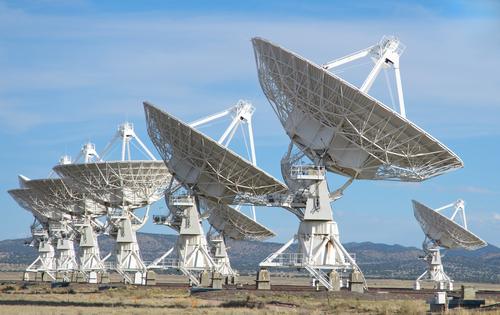
The project is known as Lone Signal, a crowdfunded effort to send a continuous stream of messages to the folks at Gliese 526, a red dwarf star 17.6 light-years away in the constellation of Bootes (aka Wolf 498). And the dish with which they intend to do this is known as the Jamesburg Earth Station, a nuke-proof satellite relay station in California that dates from the 1960s and even helped broadcast images of Neil Armstrong on the moon.
Long Signal, it should be noted, is the brainchild of The Blue Marble Space Institute of Science, non-profit virtual research institute that networks scientists from across the globe and multiple disciplines for the purpose of expanding the boundaries of knowledge, science and astronomy and promoting an open dialogue on the subject of exploration and settlement.Towards this end, they arranged for a 30-year lease on the Cold War-era dish (for a cool $3 million) and set up a project that will allow participants who contribute money to send a personalized message into space.
Ultimately, they plan to direct two beams at Gliese 526: a continuous wave with fundamental physics laws and basic information about Earth, and another consisting of crowdsourced greetings. The project is open to anyone and a series of initial short message (the equivalent of a 144-character tweet) will be available free of charge. Subsequent messages, images, and longer greetings, however, will cost money (about $1 for four texts) that will help the project fund itself.
The project’s website also lets participants track their messages and share them via social media, dedicate messages to others, and view signal stats. In an interview with Universe Today, Lone Signal co-founder Pierre Fabre, told people:
Our scientific goals are to discover sentient beings outside of our solar system. But an important part of this project is to get people to look beyond themselves and their differences by thinking about what they would say to a different civilization. Lone Signal will allow people to do that.
Indeed. Nothing like the prospect of facing another life form, a potential space invader even, to make people forget about all their petty bickering!
As our knowledge of the universe expands, we are becoming aware of the existence of more and more exoplanets. Many of these exist within the Habitable Zones of their parent star, which means two things. On the one hand, they may be candidates for potential settlement in the future. On the other, they may already be home to sentient life. If said life is sufficiently advanced, its entirely possible they could be looking back at us.
For some time, the human race has been contemplating First Contact with potential extra-terrestrial life, which was the very purpose behind the creation of NASA’s SETI (Search for Extra-Terrestrial Intelligence) program in 1961. The Pioneer space probes were another attempt at making contact, both of which carried small metal plaques identifying their time and place of origin for the benefit of any other spacefarers that might find them in the distant future.
Following in that tradition, Voyager 1 and 2 space probes contained even more ambitious messages, otherwise known as the Golden Record. These phonograph records – two 12-inch gold-plated copper disks – contained both sounds and images selected to portray the diversity of life and culture on Earth that would give any civilization that found them a good idea of what the people of Earth were capable of.
The contents of the records were selected for NASA by a committee chaired by Carl Sagan of Cornell University, and consisted of 115 images and a variety of natural sounds – surf, wind, thunder, birds, whales, and other animals. To this they added musical selections from different cultures and eras, and spoken greetings from Earth-people in fifty-five languages, and printed messages from then-President Carter and U.N. Secretary General Waldheim.
In this respect, Lone Signal represents the latest step in promoting contact and communication with other life forms. And in keeping with the trend of modern space exploration, it is being opened to the public via crowdfunding and personalized messages. But unlike SETI, which lost its government funding in 1995 and had to turn to private supporters, crowdfunded space exploration is something directly accessible by all citizens, not just corporate financiers.
Update:The Lone Signal project is now operational and on 9:00 PM EDT Monday, June 17 at a press event in New York, the team announced the transmission of the first interstellar message. The message was sent by none other than Ray Kurzweil, noted Futurist and science guru. That message was then read during his welcome talk to the Singularity University class of 2013, from the Computer History Museum in Mountain View, California:
Greetings to Gliese 526 from Singularity University. As you receive this, our computers have made us smarter, the better to understand you and the wisdom of the universe.
What he means by this is that by the time the message is recieved – roughly 18 years from now, assuming it ever is – humanity is likely to have taken the first steps towards merging our brains with computers via biotech, artificial intelligence, or other means of computer-assisted brain augmentation. At least, that’s what guys like Kurzweil hope for.
Other “alpha beamers” — including Dan Aykroyd, Alicia Keys, and Jason Silva — also sent beams Monday night. And for the time being, anyone can send a “crowdsourced” 144-character beam and pic. Better get on it before they start charging. If texting and phone rates are any indication, the price is likely to go up as the plan improves!
And be sure to enjoy this promotional video from Lone Signal:
And also check out this time-lapse video of the Jamesburg Earth Station in operation:
While I have yet to see the first installment, and generally disapproved of Peter Jackson’s decision to release this comparatively short story as a trilogy, I would be remiss if I didn’t post about the new trailer. And as you can from see from this 2 minute spot, the next installment promises plenty of action, adventure, and some serious divergences from the source material.
In the last movie, the characters had just survived their encounter with the cave Orcs, Bilbo found the One Ring and “won” it from Gollum, and the company was on its way to Mirkwood. In this installment, things appear to climax when the band of merry dwarves, a hobbit and a wizard reach Smaug’s lair. Some serious changes are showcased with the addition of Legolas (who wasn’t even in the first book), mini battles that didn’t happen, and lots more portentous talk that connects it all to the original trilogy.
And word around the campfire is this is what Jackson really has planned for the rest of the series – Game of Thrones-like diversions from Tolkien’s text that are clearly designed to sex the material up, hint at what was to come with the War of One Ring, and make the whole thing feel like a fantasy miniseries instead of a single story. While I’m sure I’m going to catch the entire trilogy at some point, I might sit the theatrical version out again…
But that’s just me! Enjoy the trailer and, if you’re so inclined, the movie on the silver screen!
Last weekend, while the wife, our friend and I were all watching the new Star Trek movie, a number of trailers came on that made us antsy for other “coming attractions”! One of them was one I instantly recognized and began saying the title of long before they flashed it across the screen. Months back, when this movie was first announced, I posted the trailer here because it looked to have all the things I love in sci-fi story. And they have since come out with a longer, more detailed trailer which I share now…
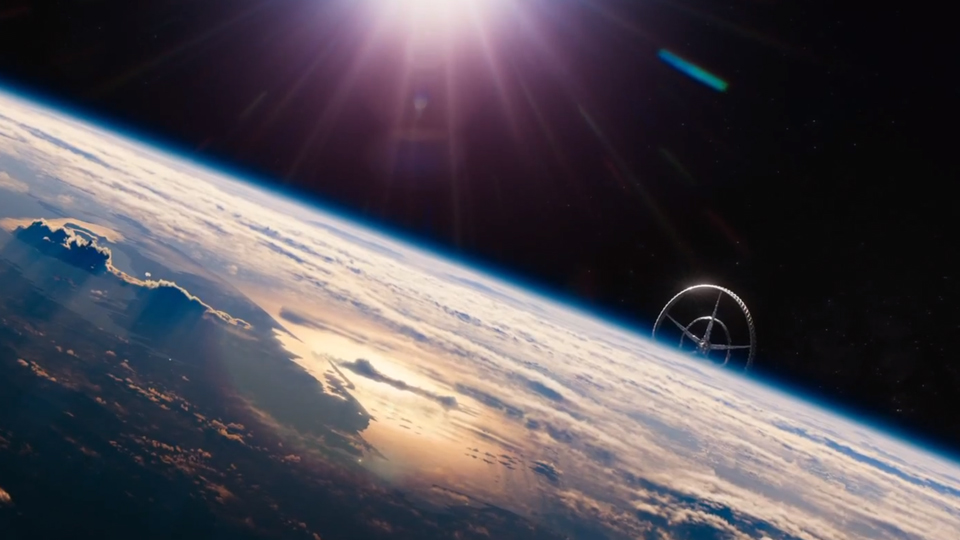
Elysium tells the story of a dystopian future, set in 2154, where the wealthy and privileged live in an orbital colony that is peaceful, serene, idyllic, and sees to all their needs (and looks a lot like the station from Space Odyssey). Meanwhile, the remaining 99% of humanity live planetside, where pollution, environmental collapse and economic ruin have made Earth into a veritable hellhole.
Enter into this Max De Costa (played by a cueballed Matt Damon), a man who is near death who comes to learn of a secret that could topple the whole system and achieve a degree of social justice. In order to do this, he has to break into Elysium, a facility that is heavily guarded and run by Secretary Rhodes (Jodie Foster), and undergoes a radical surgery to get an exoskeleton and some powerful weaponry permanently attached.
Directed by Neil Blomkamp – the South-African director who brought us District 9 and provided visual effects for such shows as Star Gate: SG-1, Smallville and Dark Angel – this movie clearly boasts the same kind of gritty, realistic texture he has come to be known for. And after the 2008 Financial Crisis and the subsequent Occupy Movement, it’s message is pretty timely and likely to be well-received.
As for me? You can keep your social commentary and comparisons to other movie franchises, I wanna see me some exoskeleton battles! Enjoy the trailer:
Hello all, and welcome to another glorious Friday! I feel fortunate today, due largely to the fact that yet another person who is dedicated to media literacy, science fiction, books and issues has chosen to get in contact with me and asked to be featured on this site. It’s always good to hear from people and know that what you are doing is garnering attention. But when they ask permission to share their message in your forum, well that’s just the bee’s knees!
Apparently. it was my tribute to Ray Bradbury which got this particular gentleman’s attention, and for good reason too. Through a site known as Academic Earth, where one can create and post educational videos on a variety of subject, Mr. Jack Collins created a video breakdown of Fahrenheit 451 that was both educational and insightful. In his brief but poignant segment, he takes a look at the major plot points, themes and motifs of Bradbury’s enduring classic.
To quote from his description of the video:
Ray Bradbury wrote his dystopian classic Fahrenheit 451 at the height of McCarthyism and Cold War paranoia. In the novel, Guy Montag is employed as a fireman who burns books. The whole of American society has descended into a zombie-like stupor of instant gratification, and books are seen as challenging and disruptive relics, which must be destroyed at any cost.
Today, with the increasing proliferation of surveillance equipment in American cities, the spread of digital books and the decline of attention spans the world over, Fahrenheit 451 remains a startlingly relevant work of fiction today. Watch this video and be instantly gratified (irony alert) with your knowledge of Bradbury’s most famous novel.
Trust me when I say it’s a fine educational short, one which I would definitely use if and when I got the chance to teach this novel. And after watching it, I couldn’t help but reflect upon a certain irony. More and more today, educators find themselves taking advantage of new media and video breakdowns in order to help students make sense of complex subject matter and lengthy texts. A few decades ago, they would simply be expected to read it, internalize it, and report on what they read.
One could easily argue that all this sort of trend really is a part of our society’s growing preoccupation with sound bites and easy accessibility. But then again, in our quest to maintain attention spans and promote thoughtfulness, we’d be fools to not take advantage of the very technology that is making it quicker and easier for people to do the opposite in the first place.
Enjoy the video! As you can tell, it got me thinking, and that’s not always the easiest thing for someone else to do 😉 Check out the video by following the link below, and be sure to comment!
We are now just one week way from Man of Steel‘s official, theatrical release. And in honor of this final lap, the studio has chosen to release one last, beautifully produced, trailer. And unlike the other trailers, which focused on Clarke’s upbringing, his quest to find his true identity, or showcased how the people of Earth would react to his presence, this one is action and nothing but!
It starts with a fair bit of footage from Krypton, where we see more of the apocalyptic event that required that Clarke be sent away, and then moves to Earth, where the same forces that took his homeworld threaten to consume his adopted world. And it’s abundantly clear from this and the last trailer that in this relaunch, unlike the originals, that Zod is at the center of it all.
Krypton’s destruction was no mere accident, and the evil Kryptonians were not mere exiles. Interesting angle…
Enjoy the show, and let’s all be ready for when it comes out. This is one relaunch I actually intend to see!
When it comes to high-tech flight, hypersonic is the undisputed way of the future. Not only is it the next logical step in the long chain from the Wright Brothers to supersonic flight (which humanity achieved in 1947), it is sort of a prerequisite in order for commercial space travel to take place. And on May 1st, the US Air Force tested its latest concept vehicle for going hypersonic, known as the X-51A Waverider.
The test took place at Edwards Air Force Base in California, when a B-52H Stratofortress carried the scramjet to a height of 15,000 meters (50,000 feet) and then released it. A solid rocket booster then kicked in and brought the X-51A to a speed of Mach 4.8 in just 26 seconds. The solid rocket booster then separated and the X-51A’s air-breathing supersonic combustion ramjet – or scramjet – engine pushed it up the rest of the way to Mach 5.1 and up to an altitude of 18,300 meters (60,000 feet).
Four minutes later, its fuel supply was spent and the scramjet nosed down, finally crashing (as planned) into the Pacific Ocean. The previous air speed record for manned flight is just under Mach 3, making this a rather large leap forward. In addition, in just over six minutes, the scramjet traveled over 425 kilometers (264 miles), making it the longest air-breathing hypersonic flight ever.
In addition to being record-breaking, it also tested out an important concept which may soon get more of us here on Earth into orbit. Considering the cost of sending a single rocket into space, concepts for a reusable space craft that could break the Earth’s gravitational pull, fly itself into high-earth orbit, and then land again have been under review for some time. All that was missing was an engine that could accomplish the kind’s of speeds needed without relying on criminally-fuel efficient rockets.
Needless to say, this is a difficult task, since maintaining airspeed above mach 2 is a serious challenge. This is due to the fact that at these speeds, its very difficult for jet engines to continue to intake air. What makes the X-51A special is the fact that it has no moving parts. Whereas scramjets of the past used hydrogen fuel which would be injected into a combustion chamber and mixed with incoming air, the X-51A differs in that it uses a hydrocarbon fuel as sort of a pilot light, effectively“lighting a match in a hurricane.”
This apparently makes more sense logistically, and therefore could allow the technology to be applied on a broader scale. As it stands, this test involved the last of four X-51As to be constructed, the previous tests having taken place between 2004 and 2012. No plans exist for the construction of future X-51A vehicles, perhaps because the program cost a staggering $300 million. Nevertheless, Air Force officials indicated that the Waverider has left a valuable legacy.
And certainly think so! Not only has the Waverider established a new air speed record, and set a hypersonic distance record, it has also taken an important step as far as the next generation of space flight is concerned. In time, and perhaps in conjunction with rocket boosters, we could be seeing commercial spacecraft capable of breaking the atmosphere very soon.
Think of it, aerospace flights making deliveries to the ISS, and perhaps even beyond… Also, check out the video of the X-51A below making it’s historic, record-breaking flight:

 Some of you may recall how a few months back, I posted a video from Mr. Jack Collins that provided a breakdown of Ray Bradbury’s Fahrenheit 451. As it turns out, that video was just the tip of the iceberg for what he and others are doing over at Academic Earth, a website dedicated to media literacy and education in an age of evolving technology.
 Of note is how Rand’s philosophy of Objectivism – which combines individualism, freedom and self-interest – is unapologetically portrayed in this book. Having witnessed the horrors of Soviet Communism firsthand, she had a good deal to say about a society that promoted social equality at the expense of creativity, enterprise and personal merit. Rand’s book has often been criticized as “hateful” and the perfect example of class-antagonism, but to conservative thinkers and fans of dystopia alike, it remains a classic.





















 Stories by Williams