Powered by the Sun: Bringing Solar to the Developing World

Magnificent CME Erupts on the Sun - August 31All over the world, the goal of bringing development to impoverished communities and nations – but in ways that won’t cause additional harm to the natural environment – remains problematic. As the cases of China and India demonstrate, the world’s fastest growing economies in the 21st century, rapid industrialization may bring economic development, but it comes with a slew of consequences.

These include urban sprawl, more emissions from cars and public transit, and the poisoning of waterways through toxic runoff, chemicals and fertilizers. With seven billion people living in the world today, the majority of which live in major cities and are dependent on fossil fuels, it is important to find ways to encourage growth that won’t make a bad situation worse.

solar_quetsolBut to paraphrase an old saying, crisis is the mother of creative solutions. And amongst forward-looking economist and developers, a possible solution is take the latest advancements in solar, wind, tidal power and biofuels, and tailor them to meet the needs of local communities. In so doing, it is hoped that the developing world could skip over the industrial phase, reaping the benefits of modernization without all the dirty, unhealthy consequences.

Two such men are Juan Rodriguez – a young man who was studying for his business administration at the Universidad Francisco Marroquin in and cut his teeth working for major multinationals like Pampers, Pepto Bismol and Pantene – and his childhood friend Manuel Aguilar, a Harvard graduate with a degree in astrophysics who had gone on to manage a global hedge fund.
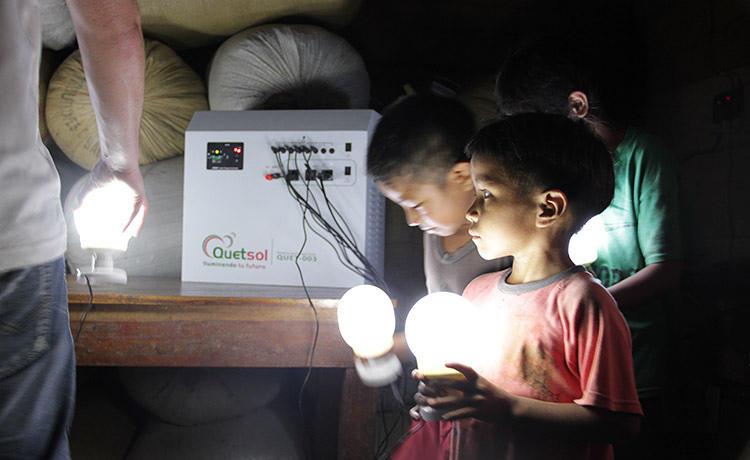
solar_quetsol1Three years ago, the two agreed that they were looking for something else and began investigating renewable energy. The result was Quetsol, a company that uses solar energy to improve the quality of life of poor communities living off the electrical grid. In Rodriguez’s and Aguilar’s native Guatemala, such poverty is widespread, with close to 20% of the population living without electricity and relying primarily on candles for light.

This picture of poverty is not exactly news. But after spending a year visiting close to 100 such communities, Rodriguez and Aguilar began to get a clear picture of why solar hadn’t yet succeeded. As Rodriguez put it:

Going to a community and talking about solar power isn’t like going into a community and talking about space travel. It is something that people have already seen, because NGOs have donated solar systems to these communities for decades. In many cases, the systems worked perfectly, but eventually the batteries died, and nobody was there to service them.

solar_quetsol2There solution was to start from the bottom up, using the free-market principle of adapting their approach to meet local needs. This would involve identifying communities before visiting them, taking into account how many people were living without electricity, and what the housing situation was like. When they then visited these communities, they sought out community leaders and held public meetings to learn about them and present their ideas.

Buildings relationships with local communities was a challenge, but so was creating a product for a market whose needs ranged from basic lighting and cell phone charging to powering a refrigerator all day. What they found was that unelectrified communities were relying on terribly inefficient means, ranging from diesel generators to walking to the nearest electrified community to plug in a phone.

solar_quetsol3What was resulted was a Solar Kit, consisting of a 10W Solar Panel, a control box with 7 Amp Battery, 2  LED Bulbs  (and a third optional bulb), and a universal cell phone charger. This kit has the ability to provide five hours of electricity to a house made up of two rooms that measure roughly 25 square meters (225 square feet) each. This is the typical design of homes in rural Guatemala, with one room serving as the bedroom and the other as the kitchen.

With that done, they began working on their sales strategy. Initially, this consisted of working with microfinance credit institutions to help families and communities purchase their solar kits. But after watching too many credit applications get rejected, they took a page from the telecom companies that have made cell phones ubiquitous in Guatemala, Basically, they switched to a pay-as-you-go plan.

solar_quetsol4Today, Quetsol employs a staff of 20 people and boasts board members like Google’s Tom Chi. There product line has also expanded, with the Q1 Solar Kit being supplemented by the Q3, a heavier model that boasts a 75W solar panel, an 85 Amp Battery, and five LED bulbs. The Q2 Kit – a middle of the road model with a 30W panel, 34 amp battery and 3 bulbs – is soon to be released.

But most importantly of all, they have electrified more than 3,500 homes in Guatemala thus far. But that is just a drop in the bucket compared to their long-term goal. Basically, the organization is viewing Guatemala as a stepping stone to all of Latin America as well as Africa by 2015. By 2016, they’d like to tackle the nearly 700 million off-the-grid homes in Asia.

Might sound ambitious, but Rodriguez and Marroquin feel they have the business acumen and social entrepreneurial savvy to pull it off. And given their background and business model, I’d say they are about right. Combined with other technologies that merge local needs with clean, efficient, and renewable means, development in the developing world might actually be an eco-friendly possibility.

Sources: fastcoexist.com, quetsol.com


News from Space: Curiosity Finds Water!

curiosity_drillsGood news (and bad) from the Red Planet! According to NASA, an examination of the fine-grained soil particles extracted by Curiosity, scientists have concluded that roughly 2 percent of Martian surface soil is made up of water. Though they did not find any traces of organic particles, this latest find confirms that water not only used to exist on the surface of the planet, but can still be found within.

These results bode well for future manned missions to Mars, wherein astronauts could mine the soil for water and study it to advance their understanding of Mars’ history. The findings, which were published today in the journal Science are part of a five-paper segment that began back in August of 2012 and is dedicated to Curiosity’s ongoing mission.

curiosity_drilling2Laurie Leshin, dean of the School Science at Rensselaer Polytechnic Institute and lead author of the paper, said in a NASA press release:

One of the most exciting results from this very first solid sample ingested by Curiosity is the high percentage of water in the soil.

These tests were conducted using the rover’s Sample Analysis at Mars (SAM), a collection of instruments that includes a gas chromatograph, a mass spectrometer, and a tunable laser spectrometer. The first soil samples were collected back in February when the rover used its drill tool for the first time and created a series of holes that were a little over 6 centimeters (2.5 inches) deep and collected the fine dust that resulted.

SAM_NASAOnce placed into the SAM assembly, the samples were heated to 835 degrees Celsius (1,535 degrees Fahrenheit). The gases that were released – which included significant portions of carbon dioxide, oxygen, and sulfur compounds – were then analyzed. The Mars Science Laboratory (MSL) also noticed that quantities of gaseous carbonite were found, which would suggests the presence of water in the Martian soil.

These positive findings were quite welcome, especially in light of the disheartening news last week that Curiosity has yet to crack the methane mystery. Back in 2003, scientists observed methane plumes coming from the planet, a strong indicator of microbial life, which sent scientific and professional interest in finding life on the red planet soaring.

Since that time, no traces of methane have been found, and it was hoped that Curiosity would finally locate it. However, the lack of methane thus far indicates that the rover has little chance of finding existing microbial life on the planet. But the existence of water in such great quantities in the surface soil brings scientists one step closer to piecing together the planet’s past potential for harboring life.

Curiosity_drillingsPaul Mahaffy, a lead investigator for SAM at NASA’s Goddard Space Flight Center, had this to say:

This work not only demonstrates that SAM is working beautifully on Mars, but also shows how SAM fits into Curiosity’s powerful and comprehensive suite of scientific instruments… By combining analyses of water and other volatiles from SAM with mineralogical, chemical, and geological data from Curiosity’s other instruments, we have the most comprehensive information ever obtained on Martian surface fines. These data greatly advance our understanding surface processes and the action of water on Mars.

Given the renewed interest of late in manned missions to Mars – from nonprofit organizations like Mars One, privatized transportation companies like SpaceX, and the unofficial plans to mount a manned mission to Mars by 2030 by NASA – these findings are reassuring. In addition to providing fuel for hydrogen fuel cells for a return craft, subsurface water will be a boon for settlers and terraformers down the road.

mars-one-brian-versteegLeshin confirmed a cubic foot of soil, as opposed to the tiny sample Curiosity analyzed, could yield nearly 2 pints of condensation when heated. So volunteers who are planning on signing up with Mars One, pack your buckets and stoves and be prepared to do a lot of condensing! And perhaps we can expect “moisture farms” to become the norm on a colonized Mars of the future.

Source: news.cnet.com

The Future is Here: The Pilotless Fighter Jet

QF-16sGoogle may be developing driverless robot cars, but Boeing already has a small fleet a fighter jets that do not require a human pilot. These retired and refurbished QF-16s were turned into special drone craft for use by the US Air Force. But before anyone gets nervous, it should be noted that these specialized drones are strictly flying targets that are meant to assist with aerial combat training.

The test flight of one of the QF-16s took place last week and included an auto-take off and landing as well as an array of aerial maneuvers. The highlights of this test flight were a barrel roll while pulling 7 G’s, climbing to an altitude of 12,000 meters (40,000 feet) and accelerating to a speed of Mach 1.47. All the while, the plane was controlled by two Air Force test pilots on the ground.

drone-strikeIncorporating the latest in unmanned controls, these fighter jets will act as more realistic targets than the older generation of QF-4 unmanned aircraft – which are refurbished F-4 Phantoms. Whereas these Vietnam-era fighter craft are incapable of keeping up with modern designs, F-16s are capable of supersonic speeds and 9-G performance, which should help hone pilots for real-world combat missions.

While this is in many ways is just an upgrade on existing methods, it also represents a big step forward in terms of automation and drone warfare. With greater refinements in the technology and a more effective range, it may be possible to remotely pilot any and all combat aircraft in the not-too-distant future. Unmanned Aerial Vehicles (UAVs) may come to mean all aircraft, and not just Reapers and Predators (pictured above).

And of course, Boeing has produced a video of the QF-16s test flight. Enjoy!


Source: news.cnet.com

News From Space: Manned Europa Mission!

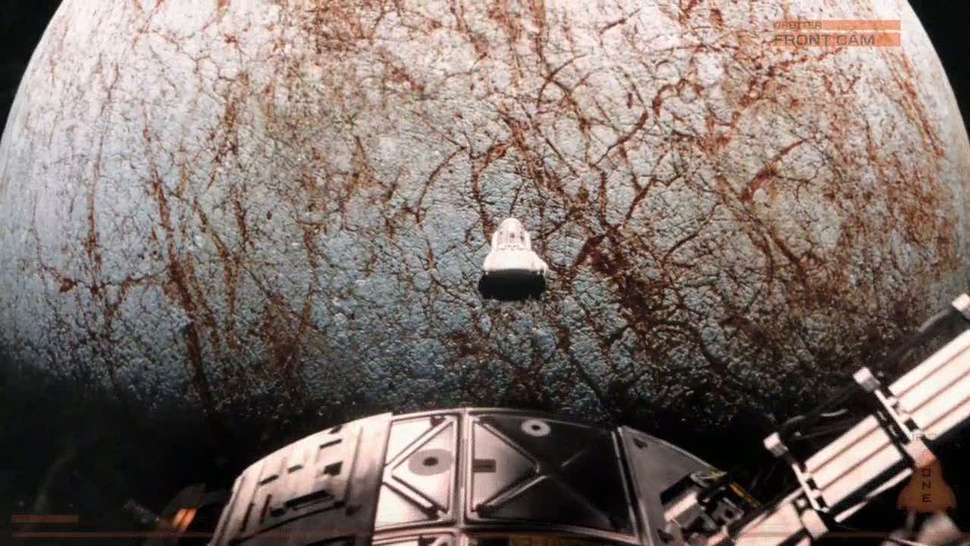
europa-landerWith so much attention focused on Mars in recent years, the other planets of the Solar System have a hard time getting noticed. But lately, Europa has found itself the subject of some interest. In addition to NASA proposing to send a lander there in the near future, a private space organization is thinking of mounting a manned mission to the Jovian moon in search of knowledge and extra-terrestrial life.

This organization is known as Objective Europa, a group made up of  volunteer scientists, conceptual artists, and social-media experts. At the moment, they exist only on the internet. But with time and financial backing, they hope to form a volunteer corps of settlers that would make a one-way trip to Europa and settle the planet while they researched it.

europa-lander-2Inspired by the recent missions to Mars, Objective Europa also believes a mission to this moon would be worthwhile since it is a far better candidate for extra-terrestrial life. Mars, though it is thought to have once hosted life, is a barren and dry world in its present state. Though many are holding out for the discovery of organic particles in the near future, the likelihood of finding any complex organisms larger than a microbe remains extremely low.

Not surprisingly, their group has attracted some big-name celebrities. This includes Kristian von Bengtson, a Danish architect and co-founder of Copenhagen Suborbitals, a nonprofit focused on launching humans into space. Then there’s Michele Faragalli, a rover mobility specialist for a NASA private contractor. Scientist and diver Pierre-Yves Cousteau, son of legendary explorer Jacques Cousteau, is also on the team as an ambassador for the group.

europa_reportCurrently, the group is in Phase 1 of their plan, which is geared towards the gathering of ideas. Towards this end, they have opened up a variety of research topics for discussion on their website. These include investigating the feasibility of a manned mission versus a robotic mission, launch vehicle studies, and cost analysis.Future phases would involve raising funds, and prototyping and testing technology.

What’s more, while they have not yet stated outright how they plan to fund the mission, it seems likely at this point that crowdfunding and sponsorship will come into play. As the goal statement reads on their site:

“Our purpose is to establish the foundation for and carry out a crewed mission to Jovian ice moon Europa through international crowd-research and participation.”

mars-one-brian-versteegIf this is beginning to sound a little bit like Mars One – a similar space organization looking to send volunteers to Mars – then chances are you’ve been paying attention! In terms of their purpose, objectives, and the fact that the trips they are planning would be a one-way, the two organizations are very similar. But even more interesting is what these and other space organizations like them represent.

In an age when private space travel and exploration are beginning in earnest, crowdfunded, volunteer groups are emerging with the common goal of making things happen ahead of anyone else’s schedule. Whereas space was once the exclusive province of government-sanctioned and funded agencies, now the public is stepping in to assume a measure of control.

And thanks to new media and communications, the money, talent, and energy needed are all available. It’s just a matter of bringing them all together!

Source: news.cnet.com

A Kinder, Gentler Internet: California’s “Erase Button”

cyber bullyingIn the early nineties, the internet was greeted with immense optimism and anticipation. Scarcely a week went by without some major personality – Al Gore and Bill Gates come to mind – championing its development, saying it would bring the world together and lead to “the information age”. After just a few years, these predictions were being mocked by just about everyone on the planet who had access.

Rehtaeh_ParsonsYes, despite all that has been made possible by the internet, the heady optimism that was present in those early days seem horribly naive by today’s standards. In addition to making virtually any database accessible to anyone, the world wide web has also enabled child pornographers, hate speech, conspiracy theorists and misinformation like never before.

What’s more, a person’s online presence opens them to new means of identity theft, cyberbullying, and all kinds of trolling and harassment. Who can forget the cases of Amanda Todd or Rethaeh (Heather) Parsons? Two young women who committed suicide due to relentless and disgusting bullying that was able to take place because there simply was no way to stop it all.

amanda_toddsuicide.jpeg.size.xxlarge.letterboxAnd with the ever expanding online presence of children and youths on the internet, and little to no controls to monitor their behavior, there are many campaigns out there that hope to reign in the offenders and protect the users. But there are those who have gone a step further, seeking to put in place comprehensive safeguards so that trollish behavior and hurtful comments can be stopped before it becomes a permanent part of the digital stream.

One such person is California Governor Jerry Brown, who recently signed a bill into law that requires all websites to provide an online “erase button” for anyone under 18 years of age. The stated purpose of the law is to help protect teens from bullying, embarrassment and harm to job and college applications from online posts they later regret. The law, which is designated SB568, was officially passed on Sept. 23rd and will go into effect Jan 1st, 2015.

kid-laptop-156577609_610x406Common Sense Media, a San Francisco based non-profit organization that advocates child safety and family issues, was a major supporter of the bill. In a recent interview, CEO James Steyer explained the logic behind it and how it will benefit youths:

Kids and teens frequently self-reveal before they self-reflect. In today’s digital age, mistakes can stay with and haunt kids for their entire life. This bill is a big step forward for privacy rights, especially since California has more tech companies than any other state.

The law is not without merit, as a 2012 Kaplan survey conducted on college admissions counselors shows. In that study, nearly a quarter of the counselors interviewed said they checked applicants’ social profiles as part of the admission process. Of those counselors, 35% said what they found – i.e. vulgarities, alcohol consumption, “illegal activities” – negatively affected their applicants’ admissions chances.

smartphoneteensBut of course, the bill has its share of opponents as well. Of those who voted against it, concerns that the law will burden websites with developing policies for different states appeared to be paramount. Naturally, those who support the bill hope it will spread, thus creating a uniform law that will remove the need to monitor the internet on a state-by-state basis.

At present, major social media sites such as Facebook, Twitter, Instagram and Vine already allow users of any age to delete their posts, photos and comments. California’s “eraser button” law requires that all websites with users in the state follow this policy from now on. And given the presence of Silicon Valley and the fact that California has one of the highest per capita usages of the internet in the country, other states are sure to follow.

facebook-privacyThe new law also prohibits youth-oriented websites or those that know they have users who are minors from advertising products that are illegal to underage kids, such as guns, alcohol and tobacco. Little wonder then why it was also supported by organizations like Children NOW, Crime Victims United, the Child Abuse Prevention Center and the California Partnership to End Domestic Violence.

In addition to being a legal precedent, this new law represents a culmination of special interests and concerns that have been growing in size and intensity since the internet was first unveiled. And given the recent rise in parental concerns over cyberbullying and teen suicides connected to online harassment, its hardly surprising that something of this nature was passed.

Sources: news.cnet.com, cbc.ca, huffingtonpost.com

Ending HIV: Foot Cream Kills HIV Cells!

HIV-budding-ColorThe fight to end HIV has been long and ongoing. But in recent years, researchers have made some incredible breakthroughs in terms of treatment and vaccines. Well as it turns out, the fight may be getting a punch in the arm from a most unlikely source – an anti-fungal foot cream! Yes, not only does this common drug kill HIV, it is even more effective than some of today’s most cutting-edge drugs.

In a study performed at Rutgers New Jersey Medical School, the drug Ciclopirox was shown to completely eradicate infectious HIV when applied to cell cultures of the virus. But what was even more impressive was the fact that the virus didn’t bounce back when the drug was withheld. This means that, unlike most anti0viral drugs, it may not require a lifetime of use to keep HIV at bay.

ciclopiroxThe same group of researchers had previously shown that Ciclopirox – which was approved by the FDA and Europe’s EMA to treat foot fungus – inhibits the expression of HIV genes. Now they have found that it also blocks the essential function of the mitochondria, which results in the reactivation of the cell’s suicide pathway, all while sparing surrounding healthy cells.

This is key since one of the worst aspects of HIV – one that makes it particularly persistent, even in the face of strong antiviral treatments – is its ability to disable a cell’s altruistic suicide pathway. This “self-destruct protocol” is typically activated when a cell is damaged or infected. With the introduction of Ciclopirox, these cells are tricked into pulling a double negative, disabling the disabling of the suicide pathway.

HIVNaturally, the cream will have to be tested on humans before its efficacy as a topical HIV treatment can be tested. However, the fact that it’s already been deemed safe for one type of human use could make the regulatory process faster than usual. In fact, the researchers have noted that another FDA-approved drug now thought to help subdue HIV (called Deferiprone) skipped animal studies and went straight to human trials in South Africa.

Naturally, the Rutgers team hopes they too can go directly from their culture studies to human trials, and that the case involving Deferiprone will pave the way for a more streamlined testing process. This is likely, seeing as how there have been many breakthroughs in recent months and everyone – from researchers to patients to medical authorities – want to make treatments available as soon as possible.

Source: news.cnet.com

News From Space: Big Bang Vs. Black Hole

big bang_blackholeFor decades, the Big Bang Theory has remained the accepted theory of how the universe came to be, beating out challengers like the Steady State Theory. However, many unresolved issues remain with this theory, the most notable of which is the question of what could have existed prior to the big bang. Because of this, scientists have been looking for way to refine the theory.

Luckily, a group of theoretical physicists from the Perimeter Institute (PI) for Theoretical Physics in Waterloo, Ontario have announced a new interpretation on how the universe came to be. Essentially, they postulate that the birth of the universe could have happened after a four-dimensional star collapsed into a black hole and began ejecting debris.

big_bangThis represents a big revision of the current theory, which is that universe grew from an infinitely dense point or singularity. But as to what was there before that remain unknown, and is one of a few limitations of the Big Bang. In addition, it’s hard to predict why it would have produced a universe that has an almost uniform temperature, because the age of our universe (about 13.8 billion years) does not give enough time to reach a temperature equilibrium.

Most cosmologists say the universe must have been expanding faster than the speed of light for this to happen. But according to Niayesh Afshordi, an astrophysicist with PI who co-authored the study, even that theory has problems:

For all physicists know, dragons could have come flying out of the singularity. The Big Bang was so chaotic, it’s not clear there would have been even a small homogenous patch for inflation to start working on.

black_holeThe model Afshordi and her colleagues are proposing is basically a three-dimensional universe floating as a membrane (or brane) in a “bulk universe” that has four dimensions. If this “bulk universe” has four-dimensional stars, these stars could go through the same life cycles as the three-dimensional ones we are familiar with. The most massive ones would explode as supernovae, shed their skin and have the innermost parts collapse as a black hole.

The 4-D black hole would then have an “event horizon”, the boundary between the inside and the outside of a black hole. In a 3-D universe, an event horizon appears as a two-dimensional surface; but in a 4-D universe, the event horizon would be a 3-D object called a hypersphere. And when this 4-D star blows apart, the leftover material would create a 3-D brane surrounding a 3-D event horizon, and then expand.

planck-attnotated-580x372To simplify it a little, they are postulating that the expansion of the universe was triggered by the motion of the universe through a higher-dimensional reality. While it may sound complicated, the theory does explain how the universe continues to expand and is indeed accelerating. Whereas previous theories have credited a mysterious invisible force known as “dark energy” with this, this new theory claims it is the result of the 3-D brane’s growth.

However, there is one limitation to this theory which has to do with the nearly uniform temperature of the universe. While the model does explain how this could be, the ESA’s Planck telesceop recently mapped out the universe and discovered small temperature variations in the cosmic microwave background (CBM). These patches were believed to be leftovers of the universe’s beginnings, which were a further indication that the Big Bang model holds true.

big_bang1The PI team’s own CBM readings differ from this highly accurate survey by about four percent, so now they too are going back to the table and looking to refine their theory. How ironic! However, the IP team still feel the model has worth. While the Planck observations show that inflation is happening, they do not show why the inflation is happening.

Needless to say, we are nowhere near to resolving how the universe came to be, at least not in a way that resolves all the theoretical issues. But that’s the things about the Big Bang – it’s the scientific equivalent of a Hydra. No matter how many times people attempt to discredit it, it always comes back to reassert its dominance!

Source: universetoday.com, perimeterinstitute.ca

More News in Quantum Computing!

quantum-computers-The-Next-GenerationRecently, a team of researchers at the University of Rochester conducted an experiment where they managed to suspend a nano-sized diamond in free space with a laser. The purpose of the experiment was to measure the amount of light emitted from the diamond, but had the added bonus of demonstrating applications that could be useful in the field of quantum computing.

For those unfamiliar with the concept, quantum computing differs from conventional computing since it does not rely on sending information via a series of particles (electrons) through one-way channels. Instead, quantum computing relies on the process of beaming the states of particles (i.e. a photons quantum properties) from one location to the next.

nanodiamondSince this process occurs faster than the speed of light (as no movement takes place) and qubits (quantum bits) have the ability to be in more than one state simultaneously, computations done using this model would be exponentially faster. But despite many advancements made in recent years, the field remains largely theoretical and elusive.

To conduct their experiment, the researchers focused a laser into a 25 cm (10 inch) chamber and then sprayed an aerosol containing dissolved nanodiamonds inside. These nanodiamonds were attracted to the laser in a technique known as “laser trapping”, until a single particle was isolated and made to levitate. Once the tiny gem was levitating in free space, the researchers used another laser to make defects within the diamond emit light at given frequencies.

nanodiamond1This process is known as photoluminescence – a form light emission that is caused by defects in the tiny diamond that allows for the absorptions of photons. When the system is excited, it changes the spin; and when the it relaxes after the change, other photons are emitted. This occurs because nitrogen atoms replace some of the carbon atoms in the diamond. Once the nitrogen is nested in the diamond’s atomic structure, it is possible to excite electrons with a laser.

According to the researchers, this photoluminescence process has the potential to excite the system and cause what is known as Bohr spin quantum jumps, which are changes in spin configuration of the internal defect. This occurs because nitrogen atoms replace some of the carbon atoms in the diamond. Once the nitrogen is nested in the diamond’s atomic structure, it is possible to excite electrons with a laser.

????????????????????In addition, the potential also exists to turn the nanodiamond into an optomechanical resonator. According to Nick Vamivakas, an assistant professor of optics at the University of Rochester, these are structures in which the vibrations of the system can be controlled by light. Optomechanical resonators have the potential to be used as incredibly precise sensors, which could lead to uses in microchips.

In addition, these resonator systems have the potential to create Schrödinger Cat states, which are typically not found in microscopic objects. As anyone who’ familiar with Futurama or Big Bang Theory may recall, this refers to the thought experiment where a cat is inside a box with poison, and until someone opens the box and determines its whereabouts, the cat could be considered simultaneously both alive and dead.

^Being able to stimulate matter so that it can exist in more than one state at any given time is not only revolutionary, it is a clear step towards the creation of machines that exploit this principle to perform computations. According to Nick Vamivakas, an assistant professor of optics at the University of Rochester, explained:

Cat or cat-like states contradict our everyday experiences since we do not see common things in quantum states. The question is: where is this boundary between microscopic and macroscopic? By generating quantum states of larger and larger objects, we can hone in on a boundary … if there is one.

Naturally, the Rochester team is still a long way from achieving their big breakthrough, and Vamivakas himself admits that he does not know how far away a quantum computing truly is. In terms of this latest experiment, the team still needs to cool the crystal better, which they are hoping can be achieved with a few technical improvements. And then they hope to find a better way of running the experiment than spraying nanodiamond dust into a tube.

In the meantime, check out this video of the experiment. It promises to be “illuminating” (sorry!):


Source:
gizmag.com

GOT Fanfilm: A Tale of Benjen Stark

A-taleofBenjenStarkThough season four may still be many months away, some in the fan community have bravely stepped up to make sure the die hards of Game Of Thrones get a dose to tide them over. In this case, the fans in question are the good folks behind The Von Wong and Five Knights Productions, who have created A Tale of Benjen Stark, a short fanfilm that addresses a hole in the series’ story.

Basically, the film explores the question of what happened to Ben Stark, Lord Ned Stark’s brother and a man of the Night’s Watch. As fans of the book and TV series may recall, Benjen set out north of the Wall in the first installment, seeking to find what was behind the reported deaths of several Wildlings and the disappearance of his brothers. After setting out, he was never heard from again, and only passing clues were given as to his fate.

A-taleofBenjenStark1In A Tale of Benjen Stark, his adventure north of the Wall is chronicled, as is the discovery he makes that is later uncovered by Jon Snow. As expected, the production values are not as good as the show itself, and it kind of borders on a zombie B movie, but it still manages to address something that was never fully resolved in the story.

And based on the success of this movie, the production team has indicated that they are open to making a second installment. If all goes well, they should be able to wrap up Benjen’s entire story arc, culminating in the little “gift” he left behind for his brother’s to find. Enjoy!


Source: theawesomer.com

Repitching an Old Idea: The Council of Muraqaba

world_religionsHey folks! A lot of things have got me thinking about another old idea that I think needs to be updated and brought forward. This one comes from many years back, roughly 2007, when I was working on the series of short stories that make up my Legacies series. As one of several ideas I was working with back then, it kind of fell by the wayside as I busied myself with writing the others – Flight of the Icarus, Eyes in the Dark, Turncoats, Vega Rising.

Eventually, as with many ideas us indie writers come up with, it lost my interest after lingering so long in my Inbox. But after a few conversations with respected colleagues, I found myself thinking about it again and looking to update it, add a new spin, and just generally give it another try. The story, in its updated version, is called The Council of Muraqaba, and it concerns humanity’s efforts to create a universal religion in the future.

world_religions_distWhen I first came up with the idea for a universal faith as part of my Legacies universe, I was still in my Frank Herbert phase and borrowed many crumbs off his table. His own notes in Dune about the Orange Catholic Bible and the Commission of Ecumenical Translators that created it really inspired me, and it put me in mind of the World Religions class I took in high school, which just happened to be one of my favorite subjects.

In 2007, the short story that was to feature the attempts to create this religion was more of an original idea, at to me. I envisioned a world where the council behind the religion’s creation established a permanent seat where matters of interfaith exchanges could take place, and where research into what made them all tick could be done and universal principles uncovered.

world_religions_popThis seemed like a timely idea to me given just how controversial, central, and daunting the issue of faith continues to be in our world today. Between people who demand that others conform to their religion to those who condemn religion of any kind, and from those who use it justify violence and persecution to those who blame it for the problems of entire regions of the world (i.e. Africa, the Middle East and Islamophobia), it’s almost inescapable.

Because of this, and because of the way humanity has a hard time outgrowing old habits, I figured a story that dealt with humanity’s continued difficulties with religion and sectarian differences should be included in my Legacies bundle. But as I said, I’ve been updating the idea a bit thanks to some conversations with friends which raised some poignant issues about the future, and thanks to some research about what the future is likely to hold…

gliese-581.jpgWhat I am envisioning now is a world where a group of mystic settlers originally established a colony on Gliese 581 d – aka. Muraqaba – in the hopes of creating a community where traditional faiths could still be practiced, free from the fear of ongoing progress and how it was leading many to conclude that religion was obsolete. Named after the Sufi practice of meditation, they sought to live in peace and practice freely, and were on guard against what they saw as “needless augmentation”.

In time, this community expanded and became dedicated to finding a way to bring all faiths together and finding common ground not just between religions but between faith and science itself, something which still eluded people in this age. Eventually, this led to the creation of the Council of Muraqaba, a permanent institution where scholars and religious authorities could meet, discuss, and network with people in the universe at large to iron out matters of spirituality.

matrix_cyberspaceIronically, the Council became a hub for some of the most advanced interstellar learning and education since people who were light years away from each other could communicate using a quantum array that allowed FTL communications to take place. The experience of this is central to the story, as it provides a sort of mystic mental sharing that is akin to a spiritual connection, emotions and thoughts shared instantaneously between people.

And of course, there will be a twist as a regular day at the Council turns into something sinister. Just because the local inhabitants have succeeded in creating a dialogue with the universe at large doesn’t mean that everyone is interesting in what they have to say. And some people are concerned that all this “common ground” stuff is eroding the things that make their faith special and want it to end.

And some… some are interested in what the Council has to say for reasons that go far beyond matters of faith! Be sure to check it out, as I think this story just might be one of my more inspired pieces of writing. And my thanks once again for Khaalidah for turning on the light in my head. There’s a reason I call you “Lady Inspiration” you know 😉