
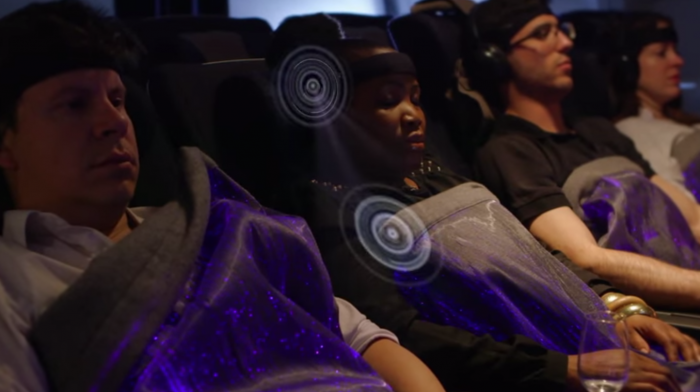
 It’s like something out of Huxley’s Brave New World: a blanket that monitors your brain activity, and takes on a corresponding color to show just how relaxed you are. Yes, it might sound like a bizarre social experiment, but in fact, it is part of a British Airways study to measure the effects of night-time travel between Heathrow and New York, a trip that takes flyers across multiple time zones.
Anyone who has ever done this knows that the jet lag can be a real pain in the ass. And for frequent flyers, jet lag has a surprisingly powerful impact on their internal clocks and circadian rhythms. Part of the problem arises from the fact that travelers are inside a metal and plastic cylinder that’s about as far from natural as possible, which poses difficulties for psychologists and others tasked with improving passenger conditions.
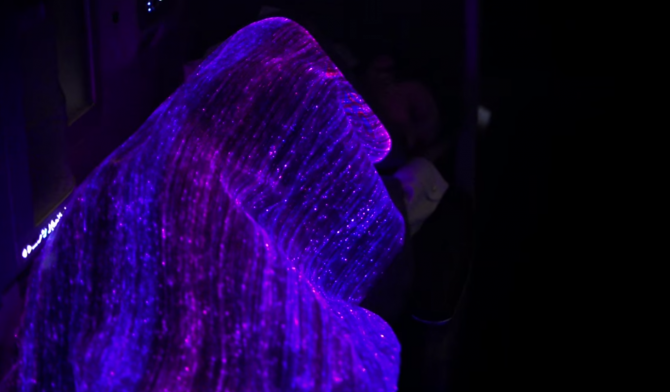 Using the happiness blanket, British Airways is trying to tweak those conditions to make air travel more relaxing and better suited to adjusting to a new time zone. The blanket works by using a neurosensor studded headband to measure brain waves and determine the user’s level of relaxation, while fiber optics woven into the material display this through color patterns. Red means the minimum of relaxation, and blue indicates the maximum relaxation.
Naturally, there’s also the marketing angle that’s at work here. In truth, there’s no need for the blankets to have a readout mechanism, but it is a nice way of illustrating to the public what’s going on. Using data gleaned from volunteer fliers, British Airways hopes to learn how to adjust the various factors in the cabin options and routines – including lighting, mealtimes, menus, seating positions, types of films shown, and general cabin routine.
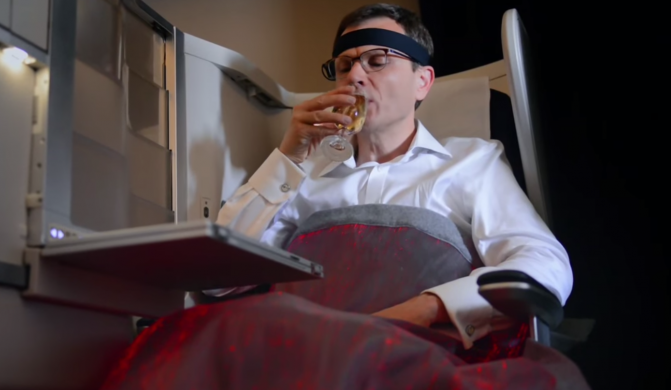 According to British Airways, the key to these adjustments is to provide passengers with the best sleep possible on long flights, which is one reason why the airline has introduced lie-flat seating for business class and above. Better relaxation provides the brain with as few distractions as possible while traveling to different time zones, so it has a chance to adjust.
As Frank van der Post, British Airways’ managing director, brands and customer experience, said about the experiment:
Using technology like the British Airways ‘happiness blanket’ is another way for us to investigate how our customers’ relaxation and sleep is affected by everything on board, from the amount of light in the cabin, when they eat, to what in-flight entertainment they watch and their position in the seat.
I can smell an industry emerging. High-tech happiness monitoring. And with the growth in neurosensors and EEG headsets, its was really just a matter of time before someone got pro-active and decided to mass produce them. I imagine other companies will begin following suit, perhaps to monitor their employees happiness, or to gauge customer response to commercials. It all sounds so deliciously quasi-fascist!
And be sure to check out the video of the company’s promotional video:
Source: gizmag.com, britishairways.com
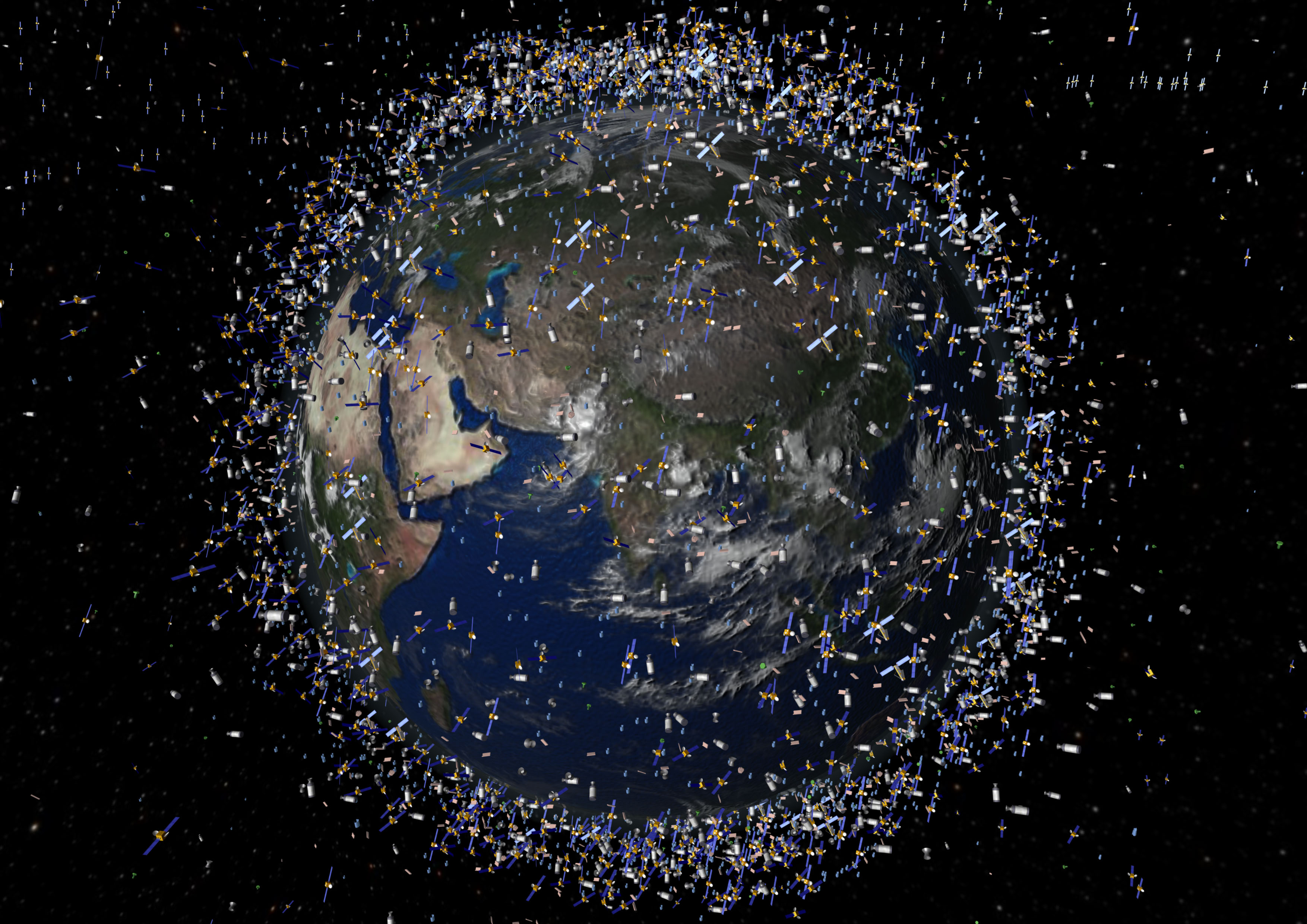
 This is just the latest in a series of possible plans to capture debris. In the past, the ESA has revealed that it was looking at capturing space debris in a net, securing it with clamping mechanisms, or grabbing hold of it using robotic arms. However, the latest possibility calls for using capturing debris with a tethered harpoon, which would pierce the debris with a high-energy impact before reeling it in.
 The ESA says the space harpoon concept has already undergone initial investigations by Airbus Defense and Space in Stevenage – two aerospace developers based in the UK. The preliminary design incorporates a penetrating tip, a crushable cartridge to help embed it in the target satellite structure, and barbs to keep it sticking in so the satellite can then be reeled in.





 This tool, which was created in 1994, instructs search engines and other automated bots to avoid crawling certain pages or directories of a website. The industry has done a remarkable job staying true to the simple text file in the two decades since; Google, Bing, and Yahoo still obey its directives. The changes they uploaded read like this, just in case you’re planning on adding your name to the “disallow” list:
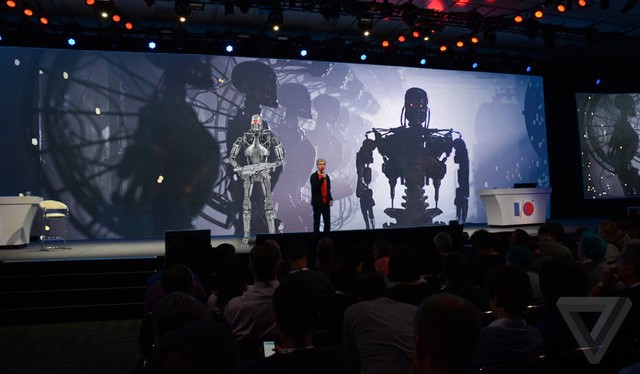
 Basically, as Google’s senior VP of technical infrastructure Urs Hölze spoke about their cloud platform, the unidentified man stood up and began screaming “You all work for a totalitarian company that builds machines that kill people!” As you can see from the video below, Hölze did his best to take the interruptions in stride and continued with the presentation. The protestor was later escorted out by security.


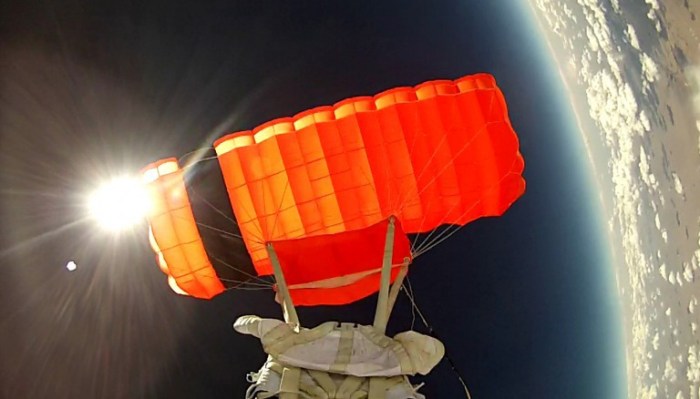 For the cost of $75,000, customers will be taken to an altitude of 32 km (20 miles). From there, they will be able to see the curvature of the Earth, and at a fraction of the price for Virgin Galactic’s $200,000 rocket-propelled trip. The ride will consist of a capsule large enough for passengers to walk around in will being lifted well above the troposphere, thanks to a giant balloon containing 400,000 cubic meters of helium.
 Battelle has been working on neurosensing technology for almost a decade. As Chad Bouton, the leader of the Neurobridge project at Battelle, explains:
 A team led by Chad Bouton at Battelle spent nearly a decade developing the algorithms, software and sleeve. Then, just two years ago, Dr Ali Rezai and Dr Jerry Mysiw were brought on board to design the clinical trials. Burkhart became involved with the study after his doctor mentioned it to him and he learned he was an ideal candidate. He had the exact level of injury the researchers were looking for, is young and otherwise healthy, and lives close to the Ohio State University Wexner Medical Center, where the research is being conducted.
 Post-surgery, Burkhart still had a lot of thinking to do, this time, in order to move his hand. As he explained:
 Burkhart is confident that he can regain even more movement back from his hand, and the researchers are approved to try the technology out on four more patients. Ultimately, the system will only be workable commercially with a wireless neural implant, or an EEG headset – like the
 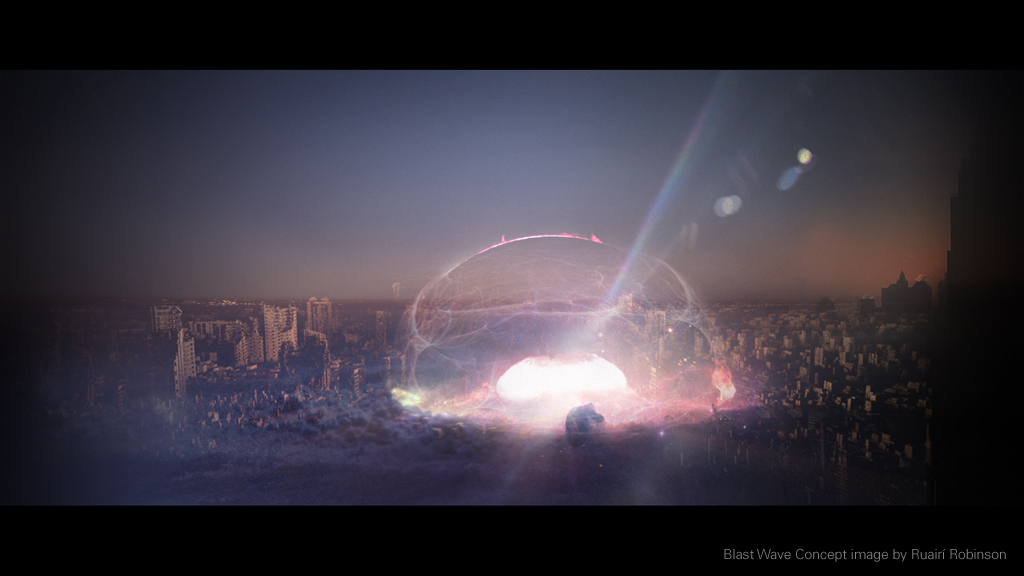 A few years ago, it was reported that director Ruairi Robinson was going to create a live-action American adaptation of the classic anime, Akira! The project has getting a lot of hype, despite what many hardcore fans have to say about an American version of the anime cult classic. And while the attempts to get the ball rolling have continually stalled, with actors and directors constantly dropping and out of the project, it does seem like this is one project that just wont’ die.
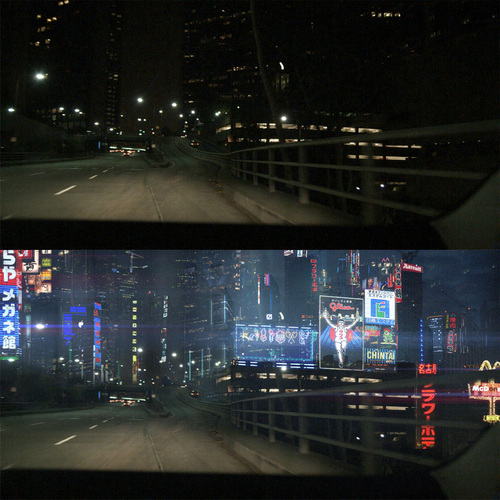
 In many of these, you can see Kaneda’s iconic red bike running through the streets. But the larger focus is on the colorful skylines, complete with skyscrapers, neon signs, multiple languages scripts, and a general gritty, cyberpunk feel. And at the bottom, there is a comparison shot showing a shooting location in New York City above a picture of what the proposed Neo-New York City would look like. That name sound at all believable to you?


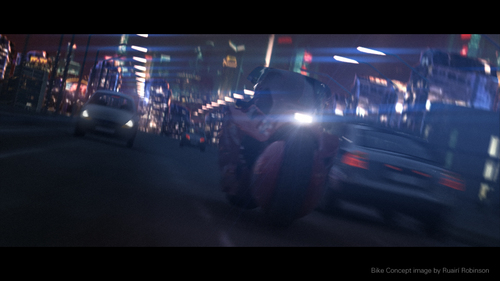

 But what montage of Akira-related images would be complete without scenes depicting the unleashed psychic Tetsuo, demonstrated his newfound powers? Below are a couple that demonstrate the anime’s antagonist in action, in the first, deflecting a missile attack from an attack chopper, and in the second breaking into the Akira vault and discovering the namesake’s remains.
 Not too bad to look at. But with the supposed director, producers, and actors changing every few years, many are wondering if this live-action remake will ever happen. And many fans can see nothing wrong with the idea, provided it is true to the source material. And dropping the whole Americanized angle and setting it back in Neo-Tokyo where it belongs wouldn’t hurt much either! But in the end, it really comes down to being true to the spirit of the Manga, if not the precise format.
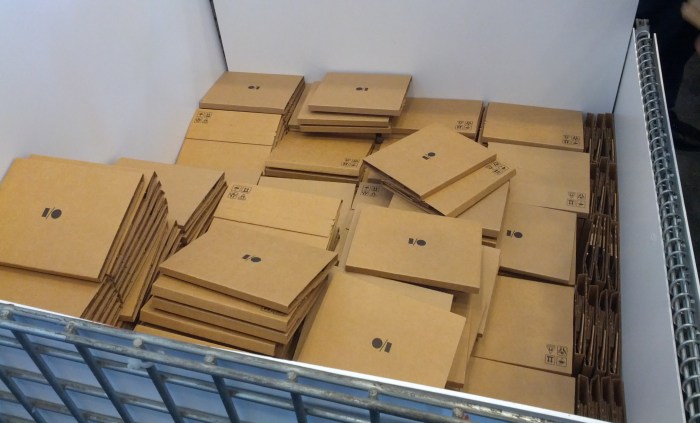 You can use household materials to build one, and a rubber band to hold your smartphone in place on the front of the device. Assembly instructions, plans and links for where to source the needed parts (like lenses) — as well as an SDK — are available on the project’s website. Google hopes that by making the tech inexpensive (unlike offerings from, say, Oculus), developers will be able to make VR apps that hit a wider audience.
 Meanwhile, Google has created some great demos within the Cardboard app, showcasing the kind of experiences people can expect moving forward. Right now, the Cardboard app features simple demonstrations: Google Earth, Street View, Windy Day, and more. But it’s just a small taste of what’s possible. And anyone willing to put some time into putting together their own cardboard headset can get involved. Never before has virtual reality been so accessible, or cheap.
 As Google said a related press release:

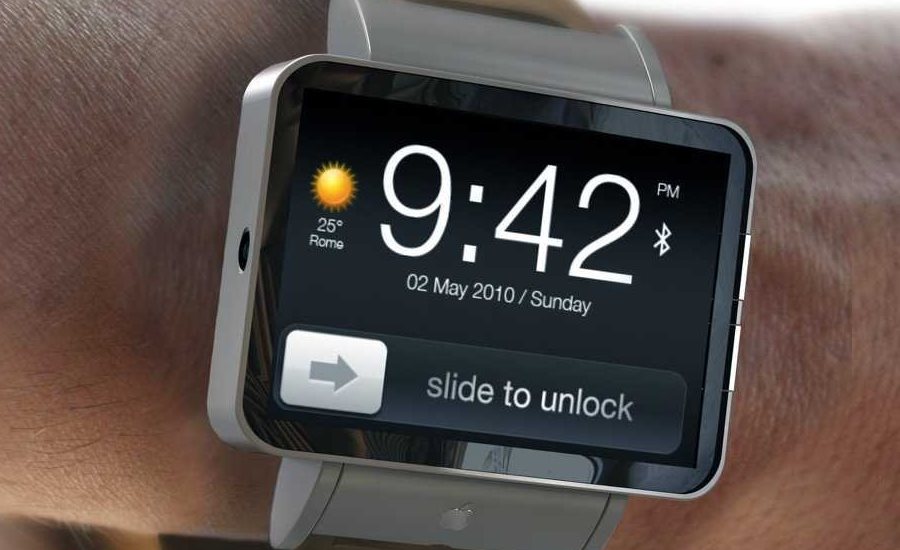

 Android Wear takes much of the functionality of Google Now – an intelligent personal assistant – and uses the smartwatch as a home for receiving notifications and context-based information. For the sake of travel, Android Wear will push relevant flight, weather and other information directly to the watch, where the user can tap and swipe their way through it and use embedded prompts and voice control to take further actions, like dictating a note with reminders to pack rain gear.
 Google officials also claimed at I/O that the same interface being Android Wear will be behind their new Android Auto and TV, two other integrated services that allow users to interface with their car and television via a mobile device. So don’t be surprised if you see someone unlocking or starting their car by talking into their watch in the near future. The first Android Wear watches – the Samsung Gear Live and the LG G Watch – are available to pre-order and the round-face Motorola Moto 360 is expected to come out later this summer.
